Parts of the Road
The law gives everyday words like “road” and “lane” exact meanings, and the exam tests those meanings. Learn the parts of the road once here, and every later lesson gets easier.
What is a road made of?
Section titled “What is a road made of?”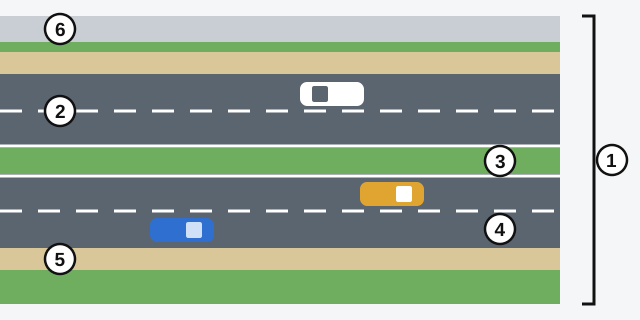
1: the road. 2: a carriageway. 3: the dividing strip. 4: a lane. 5: a shoulder. 6: a pavement.
Under Article 2 of the RA law, a road is the strip of land, or the surface of an artificial structure, that carries at least one carriageway. Tram tracks, pavements, shoulders and dividing strips are part of the road too, where they exist.
| Part | In plain words |
|---|---|
| Carriageway | The part of the road for non-rail vehicles. One road may have several. |
| Lane | A lengthwise strip of the carriageway, wide enough for one row of vehicles. Marked or unmarked. |
| Dividing strip | Separates neighbouring carriageways, by construction and (or) by marking. Not intended for vehicles or pedestrians to move or stop on. |
| Pavement | The part for pedestrians. It runs right beside the carriageway, or is separated from it in any way. |
Common trap: “Road” is the big word and “carriageway” the small one. The pavement and the shoulder are both part of the road.
How do I count carriageways and lanes?
Section titled “How do I count carriageways and lanes?”A dividing strip is what splits a road into separate carriageways.
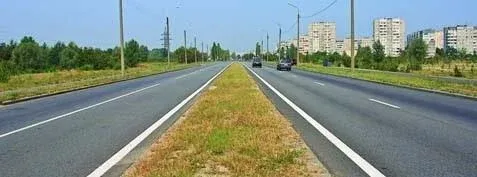
The green dividing strip gives this road two carriageways. The lanes inside each one are only lanes.
A dividing strip doesn’t have to be green. A marked strip counts just the same.
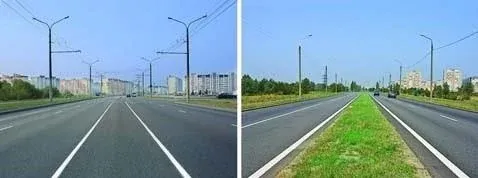
Both roads have a dividing strip: marked on the left, built on the right.
Under point 51 of the Traffic Rules, markings give the number of lanes. One line down the middle means two lanes, one each way.
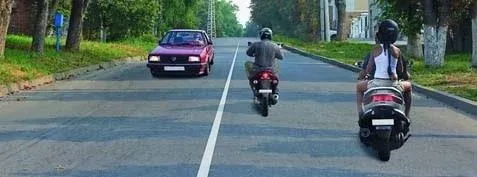
One centre line: two lanes.
Remember: Width makes a lane, not paint. A road with no markings still has lanes.
What counts as an intersection?
Section titled “What counts as an intersection?”An intersection is the area where roads cross, join or separate at the same level. Its edge is imaginary: lines that join the opposite points where the kerbs start to curve.
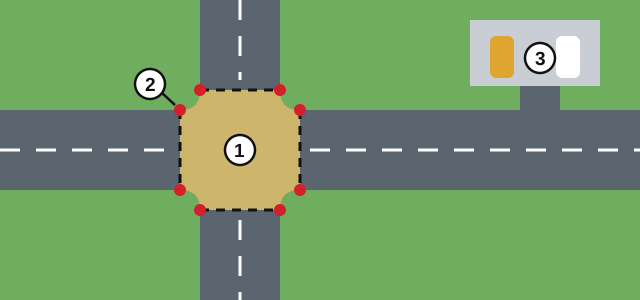
1: the intersection. 2: a point where the kerb starts to curve, with the imaginary lines running between these points. 3: a car park, whose exit is not an intersection.
An exit onto the road from an adjacent area, such as a yard, a car park or a filling station, is not an intersection. You still give way to those already on the road, but the intersection rules don’t apply.
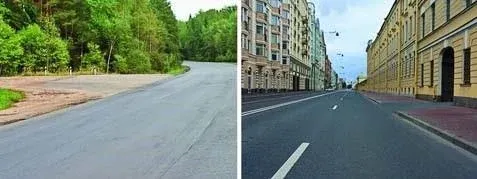
Left: an intersection. Right: only exits from adjacent areas.
An intersection is one shared area, however many arms lead into it.
What makes a stop a “stopping point”?
Section titled “What makes a stop a “stopping point”?”A stopping point of a public-use vehicle is a place on its route for boarding and alighting that is also equipped with the corresponding road signs. The signs tell other drivers where the stopping-point restrictions apply.
Which road is the main road?
Section titled “Which road is the main road?”Under point 3 of the Traffic Rules, a road is the main road in either of two cases:
- It has the sign. It is marked with sign 2.1 “Main road”, signs 2.3.1 to 2.3.7, or sign 5.1 “Motorway”, in relation to the road crossing or joining it.
- It has the better surface. It has a hard surface (asphalt concrete, cement concrete, stone materials and so on) and the other road has an earth surface.
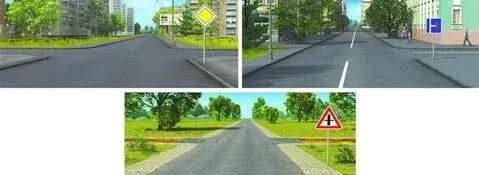
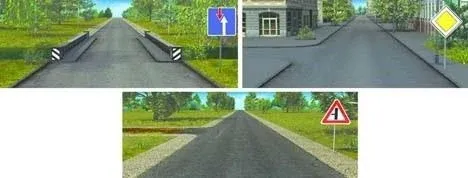
A main road is shown on the left (sign 2.1) and at the bottom (sign 2.3.1, asphalt meeting earth roads). The blue sign on the right gives no priority.
Common trap: More lanes don’t make a road main, and neither does asphalt against tiles, because both are hard surfaces. Sign 2.7 “Priority over oncoming traffic” only settles who goes first through a narrow section, and sign 5.5 “Road with one-way traffic” only describes how traffic runs.
Try it yourself
Section titled “Try it yourself”How many lanes does this road have?
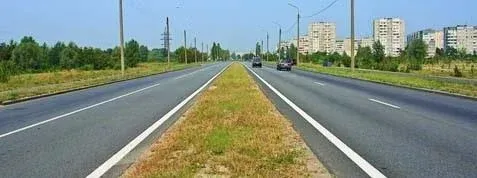
Four. The strip makes two carriageways, and each is marked into two lanes.
How many intersections, and how many crossings of carriageways?
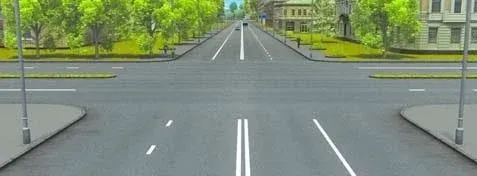
One intersection, two crossings. There is one shared area. But the road running left to right is split by a dividing strip, so the other road cuts across two carriageways.
Where is a main road shown?
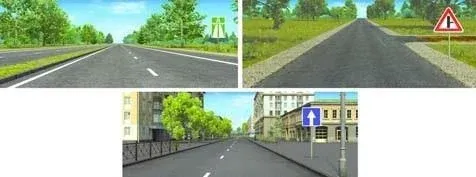
In both upper pictures. One has sign 5.1 “Motorway”. The other has an earth road joining asphalt under a “Junction with a minor road” sign. Sign 5.5 below gives no priority.
Key points
Section titled “Key points”- The road includes the carriageway, pavement, shoulder, dividing strip and tram tracks.
- A carriageway is for non-rail vehicles. A road can have several.
- A lane may be marked or unmarked. A dividing strip may be built or marked.
- An intersection is one shared area. An exit from a yard, car park or filling station isn’t one.
- A stopping point needs its road signs.
- Main road: the right sign, or a hard surface against an earth one. Lane count doesn’t matter.
Practice questions
Section titled “Practice questions”Question 142. According to the RA law “On ensuring road traffic safety”, the carriageway of a road is considered to be:
- The element of the road intended for the movement of vehicles.
- The element of the road intended for the movement of non-rail vehicles.
Show answer
Correct: 2. The element of the road intended for the movement of non-rail vehicles.
Under Article 2 of the RA law ‘On ensuring road traffic safety’, the carriageway is ‘the element of the road intended for the movement of non-rail vehicles’. The words ‘non-rail’ are an essential part of that definition, and one road may have several carriageways. So ‘The element of the road intended for the movement of vehicles.’ is wrong: it drops the ‘non-rail’ condition the law writes into the definition.
Question 147. According to the RA law “On ensuring road traffic safety”, is an exit from an adjacent area onto a road considered an intersection?
- It is not considered.
- It is considered.
Show answer
Correct: 1. It is not considered.
Under Article 2 of the RA law ‘On ensuring road traffic safety’, an intersection is the area where roads cross, join or separate at the same level. The same definition states outright that an exit onto a road from an adjacent area - a yard, a car park, a filling station and the like - is not considered an intersection. So ‘It is not considered.’ is correct: when leaving such an exit the driver must give way to those already travelling on the road, but the rules on passing through intersections do not apply there.
Question 166. According to the RA law “On ensuring road traffic safety”, a traffic lane is considered:
- A marked longitudinal strip of the carriageway whose width is sufficient for the movement of vehicles in one row.
- A marked or unmarked longitudinal strip of the carriageway whose width is sufficient for the movement of vehicles in one row.
Show answer
Correct: 2. A marked or unmarked longitudinal strip of the carriageway whose width is sufficient for the movement of vehicles in one row.
Under Article 2 of the RA law “On ensuring road traffic safety”, a traffic lane is a marked or unmarked longitudinal strip of the carriageway whose width is sufficient for the movement of vehicles in one row. What makes a strip a lane is its width, not the paint on it, so a road without markings has lanes too. The answer is therefore “A marked or unmarked longitudinal strip of the carriageway whose width is sufficient for the movement of vehicles in one row.”, while “A marked longitudinal strip of the carriageway whose width is sufficient for the movement of vehicles in one row.” covers only half the definition.
Question 186. According to the RA law “On ensuring road traffic safety”, a stopping point of a public-use vehicle is considered:
- A place on a particular section of a public-use vehicle’s route intended for boarding and alighting of passengers and equipped with the corresponding road signs.
- A place on a particular section of a public-use vehicle’s route intended for boarding and alighting of passengers.
Show answer
Correct: 1. A place on a particular section of a public-use vehicle’s route intended for boarding and alighting of passengers and equipped with the corresponding road signs.
Article 2 of the RA law “On ensuring road traffic safety” defines a stopping point of a public-use vehicle as a place on a particular section of that vehicle’s route intended for the boarding and alighting of passengers AND equipped with the corresponding road signs. Being marked with those signs is what makes the place a stopping point in law, because it is the signs that tell other drivers where the stopping-point restrictions apply. The option describing the same place without the corresponding road signs therefore does not meet the definition.
Question 190. How many traffic lanes are there on this carriageway?
- One
- Two
- Three
Show answer
Correct: 2. Two
Under point 51 of the Traffic Rules the number of traffic lanes is determined by the markings. In the picture the carriageway is divided by a single longitudinal line down the centre, separating the opposing flows - the oncoming car on one side, the mopeds on the other - so the carriageway has two lanes, one in each direction. The answer is therefore two, not one or three.
Question 193. Are the pavement or the shoulders part of the road?
- Yes
- Only the shoulder
- No
Show answer
Correct: 1. Yes
Article 2 of the RA law “On ensuring road traffic safety” defines a road as the strip of land, or the surface of an artificial structure, that carries at least one carriageway and that includes - where they are present - tram tracks, pavements, shoulders and dividing strips. Pavements and shoulders are named in that definition as parts of the road, so the answer is “Yes”. “Only the shoulder” is wrong because the definition treats the pavement in exactly the same way, and “No” contradicts the definition outright.
Question 194. How many carriageways does this road have?
- One
- Two
- Four
Show answer
Correct: 2. Two
Article 2 of the RA law “On ensuring road traffic safety” defines a carriageway as the element of the road intended for the movement of non-rail vehicles, and a dividing strip as the element separating adjacent carriageways. In the picture the central dividing strip - the green band down the middle - separates the road into two distinct carriageways, one on each side of it. This road therefore has two carriageways, not one and not four: the lanes inside each carriageway are lanes, and it is the dividing strip that makes a carriageway separate.
Question 195. How many intersections are there in this picture?
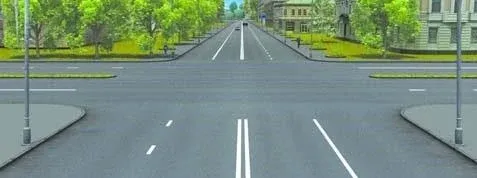
- One
- Two
- Four
Show answer
Correct: 1. One
Article 2 of the RA law “On ensuring road traffic safety” defines an intersection as the single common area where roads cross at the same level, bounded by the imaginary lines joining the opposite starting points of the kerb curves. In the picture the crossing road forms one such common area with the main road, so there is one intersection - however many approach arms lead into it. Counting the arms rather than the shared area is what produces the answers two and four.
Question 196. How many crossings of carriageways are there at this intersection?
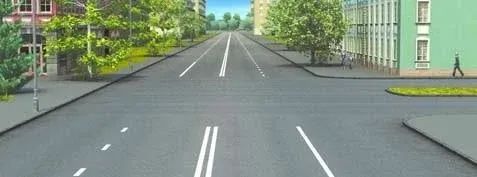
- One
- Two
Show answer
Correct: 2. Two
Article 2 of the RA law “On ensuring road traffic safety” defines the carriageway and the dividing strip - the element separating the adjacent carriageways, set apart structurally and (or) by the corresponding marking. The road running through this intersection is divided down the middle by a double solid line, so it has two carriageways, and the crossing road cuts across both of them. There are therefore two crossings of carriageways at this intersection, not one.
Question 197. How many traffic lanes does this road have?
- Two
- Four
Show answer
Correct: 2. Four
Under point 51 of the Traffic Rules the number of traffic lanes is determined by the markings, and under Article 2 of the RA law “On ensuring road traffic safety” a road divided by a central dividing strip has separate carriageways. In the picture the green strip down the middle divides the road into two carriageways, and each of them is marked into two lanes, so the road has four traffic lanes in all. The answer “Two” counts only the lanes on the near side of the dividing strip and misses the other carriageway.
Question 198. In which picture does the road have a dividing strip?
- Only the right one
- In both cases
- Only the left one
Show answer
Correct: 2. In both cases
Article 2 of the RA law “On ensuring road traffic safety” defines a dividing strip as the element separating the adjacent carriageways of a road, set apart structurally AND (OR) by the corresponding marking. In the left picture the carriageways are separated by marking - the solid centre lines - and in the right one by a structural green divider. Because the law recognises both forms equally, a dividing strip is present in both cases, and it is a mistake to think one has to be able to walk on it.
Question 200. In which picture is an intersection shown?
- Only the left one
- Only the right one
- In both cases
Show answer
Correct: 1. Only the left one
Article 2 of the RA law “On ensuring road traffic safety” defines an intersection as the area where roads cross, join or separate at the same level, and it expressly states that an exit from an adjacent area onto a road is NOT an intersection. In the left picture the roads meet at the same level, which is an intersection. In the right picture there are only exits from an adjacent area between the buildings, which the definition excludes. An intersection is therefore shown in the left picture only.
Question 201. How many crossings of carriageways are there at the intersection shown?
- One
- Two
- Four
Show answer
Correct: 2. Two
Article 2 of the RA law “On ensuring road traffic safety” defines the carriageway and the dividing strip, the element that separates adjacent carriageways. The road passing through this intersection is split by a central dividing strip into two carriageways, so the crossing road cuts across two of them: there are two crossings of carriageways at this intersection. “One” ignores the divider, and “Four” counts the arms of the junction instead of the carriageways actually crossed.
Question 428. In which picture is a major road shown?
- Only the left
- The bottom and the left
- All
Show answer
Correct: 2. The bottom and the left
Under sub-point 1 of point 3 of the Traffic Rules a road counts as the main one when it is marked with sign 2.1 “Main road”, 2.3.1 “Junction with a minor road” or a similar sign in relation to the road crossing it, OR when it has a hard surface and the crossing road has an earth one. In the left picture sign 2.1 is in place, and in the bottom picture the asphalt road crosses earth roads and carries sign 2.3.1 - so a main road is shown in exactly those two. “Only the left” is wrong because the bottom road is main as well, and “All” is wrong because the remaining picture has neither a priority sign nor a hard surface meeting an earth road.
Question 429. In which picture is a major road shown?
- Only the right
- The right and the bottom
- All
Show answer
Correct: 2. The right and the bottom
Under sub-point 1 of point 3 of the Traffic Rules a road is the main one when it is marked with sign 2.1 “Main road” or with signs 2.3.1 to 2.3.7 in relation to the road crossing or joining it, or when it has a hard surface against an earth one. Sign 2.1 stands in the right-hand picture, and in the bottom picture an earth road joins an asphalt one under a “Junction with a minor road” sign, so a main road is shown in those two. “Only the right” is wrong because the bottom road is main too, and “All” is wrong because the left picture carries sign 2.7 “Priority over oncoming traffic”, which settles who passes a narrow section first and does not make a road main.
Question 430. In which picture is a major road shown?
- Upper left
- Upper right
- In the upper pictures
- All
Show answer
Correct: 3. In the upper pictures
Under sub-point 1 of point 3 of the Traffic Rules a road is the main one when it is marked with sign 2.1, with signs 2.3.1 to 2.3.7 or with sign 5.1 “Motorway” in relation to the road crossing or joining it, or when it has a hard surface against an earth one. The upper left picture carries the green sign 5.1 “Motorway”, and in the upper right an earth road joins an asphalt one under a “Junction with a minor road” sign, so a main road is shown in both of the upper pictures. Naming only one of them is wrong because each satisfies the condition, and “All” is wrong because the bottom picture carries sign 5.5 “Road with one-way traffic”, which describes how traffic runs and confers no priority.
Question 431. Which road is considered the major one at the intersection?
- The road with a hard surface (asphalt concrete, cement concrete, stone materials, etc.) relative to one with an earth surface
- The three-lane road relative to one having one lane in each direction
- The asphalt concrete road relative to a paved (tiled) road
Show answer
Correct: 1. The road with a hard surface (asphalt concrete, cement concrete, stone materials, etc.) relative to one with an earth surface
Point 3, sub-point 1 of the Rules — the definition of «main road» — treats as the major one “The road with a hard surface (asphalt concrete, cement concrete, stone materials, etc.) relative to one with an earth surface”. What decides is the type of surface, hard against earth, and that is what makes one road the major one at the intersection. “The three-lane road relative to one having one lane in each direction” is wrong, because the number of lanes does not make a road major. “The asphalt concrete road relative to a paved (tiled) road” is wrong, because both have a hard surface, and the definition contrasts a hard surface with an earth one.
Question 1031. According to the RA law “On ensuring road traffic safety”, a dividing strip is considered to be:
- An element separating the adjacent carriageways of a road, structurally separated, which is not intended for the movement or stopping of vehicles and pedestrians.
- An element separating the adjacent carriageways of a road, separated structurally and (or) by the corresponding marking, which is not intended for the movement or stopping of vehicles and pedestrians.
Show answer
Correct: 2. An element separating the adjacent carriageways of a road, separated structurally and (or) by the corresponding marking, which is not intended for the movement or stopping of vehicles and pedestrians.
Article 2 of the RA law “On ensuring road traffic safety” defines a dividing strip as an element of the road separating the adjacent carriageways, separated structurally AND (OR) by the corresponding marking, and not intended for the movement or stopping of vehicles and pedestrians. The words “and (or) by the corresponding marking” matter: a dividing strip need not be a physical structure, and a strip marked out on the surface is a dividing strip too. The option allowing only a structurally separated element is therefore narrower than the law.
Question 1032. According to the RA law “On ensuring road traffic safety”, a pavement is considered to be:
- The element of the road adjoining the carriageway, intended for the movement of pedestrians in the manner established by law.
- The element of the road separated from the carriageway in any way, intended for the movement of pedestrians in the manner established by law.
- Both of the stated cases.
Show answer
Correct: 3. Both of the stated cases.
Article 2 of the RA law “On ensuring road traffic safety” defines a pavement as the element of the road adjoining the carriageway, or separated from it in any way, that is intended for the movement of pedestrians in the manner established by law. Both arrangements are inside the one definition: a pavement running right along the kerb and a pavement set apart by a verge or a barrier are equally pavements. Since the law covers each of the two described cases, “Both of the stated cases.” is the correct answer and neither single option is complete on its own.