Motorways and Mountain Roads
A motorway only works if everything on it moves fast. That is why the Rules keep slow vehicles and people on foot off it completely.
Who is banned from a motorway?
Section titled “Who is banned from a motorway?”- Pedestrians. Walking is prohibited in any direction, on any stretch, inside or outside built-up areas (point 116). Walking along the edge facing traffic is the habit for ordinary roads, not for a motorway.
- Vehicles whose speed, by their technical characteristics or condition, does not exceed 40 km/h (point 116). The ban covers the whole motorway, so keeping to the right-hand lane doesn’t make it legal.
Common trap: This ban comes from the Rules, not from a sign on the road. It applies even if no “Minimum speed limit” sign is in sight.
Which signs bring these rules?
Section titled “Which signs bring these rules?”Two signs do, because point 117 extends the motorway requirements to sign 5.3.
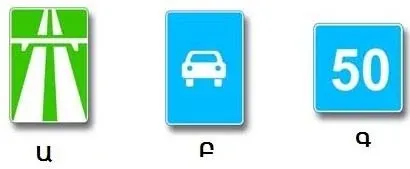
Sign A is 5.1 “Motorway”. Sign B is 5.3 “Road for automobiles”. Both keep out vehicles that can’t exceed 40 km/h. Sign C, the blue square with a number, is 6.2 “Recommended speed”, which sets no such ban.
The Speed lesson has the motorway speed limits.
Extra: Joining and leaving a fast road
Not from the question bank.
Use the whole slip road to match the speed of the traffic before you merge, and look for your gap early. When you leave, move across in good time and slow down on the exit lane, not on the main carriageway. After a long fast stretch, your speed feels lower than it is, so check your speedometer.
Extra: Long descents on mountain roads
Not from the question bank.
Choose a low gear before the descent starts and let the engine hold your speed. Long, constant braking overheats the brakes until they stop working well. Brake firmly in short bursts instead, and slow down before each bend, not in it. Watch for falling stones, and remember that a bend can hide a vehicle in the middle of the road.
Try it yourself
Section titled “Try it yourself”Your car has a fault and can’t go above 35 km/h. You come to a road with sign 5.3. May you use it? No. The same ban applies as on a motorway, because of your vehicle’s condition.
Key points
Section titled “Key points”- Pedestrians are prohibited on motorways, whatever the direction.
- Vehicles that can’t exceed 40 km/h are prohibited, by their design or by their condition.
- The ban comes from the Rules, so it needs no extra sign.
- Signs 5.1 and 5.3 both bring this ban. Sign 6.2 doesn’t.
Practice questions
Section titled “Practice questions”Question 860. Are pedestrians permitted to move along a road equipped with the “Motorway” sign?
- It is prohibited.
- It is permitted — outside populated areas — against the flow of vehicles.
- It is permitted — outside populated areas — along with the flow of vehicles.
Show answer
Correct: 1. It is prohibited.
A road equipped with the 5.1 “Motorway” sign is intended for motor traffic only. point 116 of the Rules directly prohibits the movement of pedestrians on motorways, so “It is prohibited.” is the correct answer. “It is permitted — outside populated areas — against the flow of vehicles.” and “It is permitted — outside populated areas — along with the flow of vehicles.” are wrong: walking along the shoulder facing the traffic is the rule for ordinary roads, whereas on a motorway pedestrian movement is banned whatever the direction and whether or not the road lies outside a populated area.
Question 861. Travelling on motorways with vehicles whose speed, based on technical characteristics or condition, does not exceed 40 km/h:
- Is permitted — only in the right-hand edge lane.
- Is prohibited.
- Is permitted — in the absence of the “Minimum speed limit” sign.
Show answer
Correct: 2. Is prohibited.
Point 116, sub-point 2 of the Traffic Rules prohibits on motorways the movement of vehicles whose speed, from their technical characteristics or their condition, does not exceed 40 km/h — so “Is prohibited.” is correct. The ban covers the whole motorway and not one lane of it, so “Is permitted — only in the right-hand edge lane.” is excluded as well. It does not depend on signing either: “Is permitted — in the absence of the “Minimum speed limit” sign.” is wrong because the prohibition is imposed by the Rules themselves, whether or not that sign is there.
Question 1044. Which of the signs prohibits travel at a speed less than 40 km/h
- Only Ա (A)
- Only Գ (C)
- Ա (A) and Բ (B)
Show answer
Correct: 3. Ա (A) and Բ (B)
Sign Ա (A) is 5.1 “Motorway” and sign Բ (B) is 5.3 “Road for automobiles”. Under point 116 of the Rules, on motorways the movement of vehicles whose speed, by their technical characteristics or their condition, does not exceed 40 km/h is prohibited, and under point 117 the same requirements extend to roads marked with sign 5.3. It is therefore signs Ա (A) and Բ (B) that prohibit travel at a speed less than 40 km/h. “Only Ա (A)” and “Only Գ (C)” are wrong: Գ (C), the blue 50 square, imposes no such restriction, and the prohibition applies under both Ա (A) and Բ (B).