Speed
Speed decides how much time you have when something goes wrong. The exam tests it with numbers, so this lesson gives you one small table to learn and three rules that handle the tricky questions.
How fast may a car go?
Section titled “How fast may a car go?”Three questions tell you the limit for a passenger car: are you in a built-up area, a residential zone, or on a motorway?
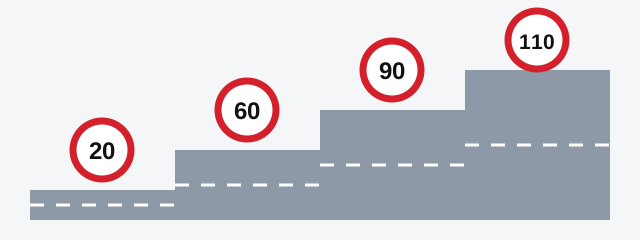
From left to right, the limits for a passenger car: 20 km/h in a residential zone or courtyard, 60 km/h in a built-up area, 90 km/h on roads outside built-up areas, 110 km/h on a motorway.
What about other vehicles?
Section titled “What about other vehicles?”| Vehicle | Built-up area | Outside built-up areas | Motorway |
|---|---|---|---|
| Passenger car, or truck up to 3.5 t | 60 | 90 | 110 |
| Suburban, inter-regional or intercity bus | 60 | 90 | 90 |
| Other bus | 60 | 70 | 90 |
| Truck over 3.5 t | 60 | 70 | See the Traffic Rules |
| Passenger car towing a trailer | 60 | 70 | 90 |
All figures are km/h, from points 68 and 69 of the Traffic Rules. In a residential zone or courtyard, the limit is 20 km/h for every vehicle.
Common trap: An intercity bus gets 90 km/h on all roads outside built-up areas, but no more on a motorway. Only passenger cars and trucks up to 3.5 t get 110 km/h. Inside a built-up area, the bus is back to 60 km/h like everyone else.
Which limits ignore the road?
Section titled “Which limits ignore the road?”Point 71 sets two limits that apply on every kind of road:
- Towing a mechanical vehicle: 50 km/h, with a rigid or flexible coupling.
- Carrying people in a truck’s equipped body, or an organized group of children: 60 km/h.
A sign can’t raise these limits. If a sign allows 80 km/h and you are towing, your limit is still 50 km/h. The stricter limit always wins.
Remember: Lifting a limit set by a sign does not lift a limit that the Rules attach to what you are doing. Sign 3.25 “End of the maximum speed limit zone” won’t free you from the towing limit.
How do I read a speed sign?
Section titled “How do I read a speed sign?”Three signs show a number. Only the shape and color tell you what it means.
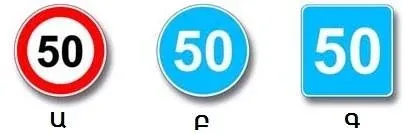
- Red ring, sign 3.24 “Maximum speed limit”: a ceiling. Don’t go faster.
- Blue disc, sign 4.6 “Minimum speed limit”: a floor. Don’t go slower.
- Blue square, sign 6.2 “Recommended speed”: advice. It sets no binding limit.
The town name sign matters too. It looks harmless, but its color changes your speed limit.
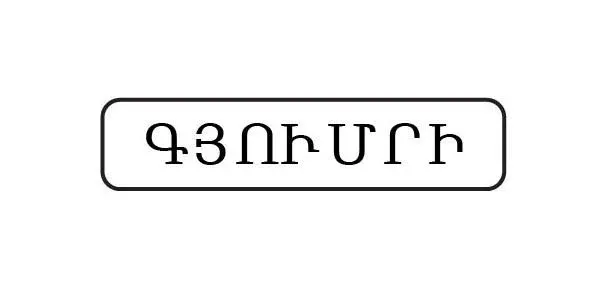
Black on white, sign 5.23.1: built-up area rules apply from here, so the limit is 60 km/h.
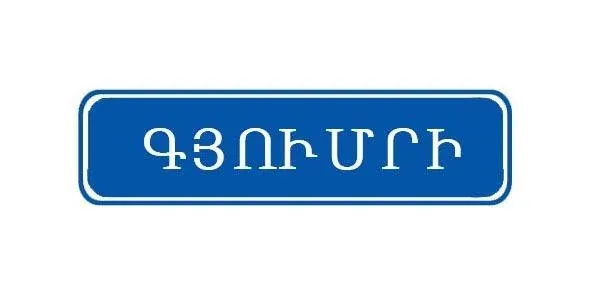
White on blue, sign 5.25: built-up area rules do not apply, so the limits for roads outside built-up areas stay in force.
Common trap: Seeing a town’s name doesn’t always mean 60 km/h. Check the color first.
Extra: Why twice the speed needs about four times the braking distance
Not from the question bank.
A moving car’s energy grows with the square of its speed, and your brakes have to remove all of it. Double your speed and there is about four times as much energy, so braking takes about four times the distance. Reaction distance comes on top of that: the car keeps moving at full speed while you notice the danger and move your foot.
Is staying under the limit enough?
Section titled “Is staying under the limit enough?”No. The limit is the most you may do, not what you should do. Point 65 tells you to take into account the condition of the road surface and the visibility ahead. Point 66 asks for a speed that keeps the vehicle fully under your control.
You also must not:
- Exceed your vehicle’s technical maximum speed.
- Exceed the speed on a “Speed limit” identification sign fitted to your vehicle.
- Drive very slowly without need, if this obstructs other vehicles.
- Brake sharply, unless it is needed to prevent an accident.
When must I slow down?
Section titled “When must I slow down?”The Rules require you to reduce speed when:
- An obstacle or danger to traffic arises (point 67).
- You are dazzled (point 129).
- You approach a vehicle with a “Transport of children” sign while children are boarding or alighting (point 156).
- You approach a vehicle with blue and red flashing beacons and a special sound signal, or a stationary vehicle with flashing beacons on (points 29 and 30).
Try it yourself
Section titled “Try it yourself”You are driving the blue van. You are towing the white car on a flexible coupling, and a sign shows 80.
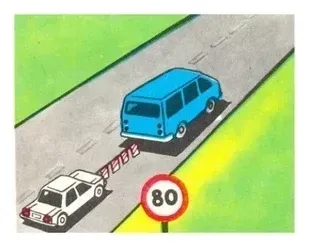
What is your limit? 50 km/h. The sign allows 80, but point 71 limits towing to 50, and the stricter limit wins.
You are towing a car, and this sign appears ahead. The main lane requires at least 60 km/h, and an extra lane begins on the right.
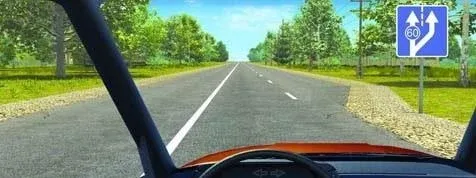
Which lane may you use? Only the right one. Towing limits you to 50 km/h, so you can’t reach the 60 km/h the main lane requires.
Key points
Section titled “Key points”- Passenger car: 20 in a residential zone, 60 in a built-up area, 90 outside, 110 on a motorway.
- Intercity bus: 90 on all roads outside built-up areas, including motorways.
- Towing: 50 km/h. People in a truck body or organized groups of children: 60 km/h. No sign raises these.
- Red ring means maximum, blue disc means minimum, blue square means advice.
- A black-on-white town sign means 60 km/h. A white-on-blue one doesn’t.
- The limit is a ceiling: match your speed to the road, visibility and your control of the vehicle.
Practice questions
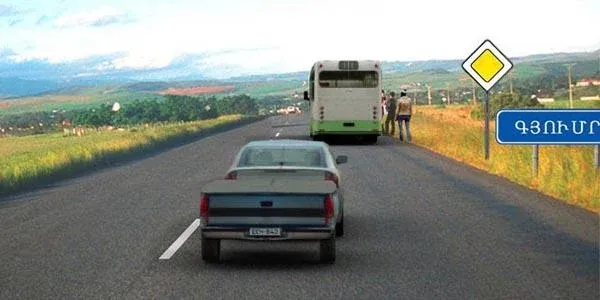
Section titled “Practice questions”Question 484. The bus driver has made a stop in order to pick up passengers. The passenger car is travelling at a speed of 70 km/h. Which vehicle’s driver is violating the requirements of the road traffic rules?
- No one.
- The bus driver.
- The driver of the passenger car.
- Both drivers.
Show answer
Correct: 1. No one.
The settlement name stands on a BLUE plate - sign 5.25 - which means the requirements laid down for movement in built-up areas do NOT apply on this road, so under point 69 of the Rules a light passenger car may travel at up to 90 km/h and 70 km/h is no offence. The bus has stopped at the right-hand side of the road to pick up passengers, which point 78 permits; sign 2.1 “Main road” outside a built-up area prohibits only PARKING on the carriageway (point 86), not a stop made to pick up passengers. Neither driver is therefore breaking the Rules.
Question 601. At what maximum speed is the movement of passenger cars allowed on roads outside built-up areas?
- 110 km/h.
- 100 km/h.
- 90 km/h.
- 80 km/h.
- 70 km/h.
Show answer
Correct: 3. 90 km/h.
Point 69, sub-point 1 of the Rules allows passenger cars no more than 90 km/h on roads outside built-up areas, so “90 km/h.” is the correct answer. “110 km/h.” applies only on motorways, not on ordinary roads outside built-up areas. “100 km/h.”, “80 km/h.” and “70 km/h.” are not speeds the Rules set for passenger cars in this situation at all.
Question 602. The movement of trucks carrying people in an equipped body is allowed at no more than:
- A speed of 60 km/h.
- A speed of 70 km/h.
- A speed of 80 km/h.
Show answer
Correct: 1. A speed of 60 km/h.
Point 71, sub-point 1 of the Rules sets a limit of no more than 60 km/h for lorries carrying people in an equipped body, so “A speed of 60 km/h.” is the correct answer. It is a special limit for the safety of the people riding in the body, and it applies whatever the type of road, overriding the general speed limits. “A speed of 70 km/h.” and “A speed of 80 km/h.” are therefore wrong — both exceed the maximum this sub-point states directly.
Question 604. The movement of vehicles carrying organized groups of children is allowed:
- At a speed of no more than 60 km/h.
- At a speed of no more than 70 km/h.
- At a speed of no more than 80 km/h.
Show answer
Correct: 1. At a speed of no more than 60 km/h.
Point 71, sub-point 1 of the Rules sets no more than 60 km/h for vehicles carrying organized groups of children, so “At a speed of no more than 60 km/h.” is the correct answer. This special limit overrides the general speed limits and applies whatever the type of road, because the passengers are children. “At a speed of no more than 70 km/h.” and “At a speed of no more than 80 km/h.” are wrong — both exceed the maximum set by that sub-point.
Question 605. The movement of vehicles in built-up areas is allowed:
- At a speed of no more than 60 km/h.
- At a speed of no more than 80 km/h.
- At a speed of no more than 90 km/h.
Show answer
Correct: 1. At a speed of no more than 60 km/h.
Under point 68 of the Traffic Rules, vehicles in built-up areas may travel “At a speed of no more than 60 km/h” (and no more than 20 km/h in residential and courtyard areas), which is why that is the correct option. “At a speed of no more than 80 km/h” is wrong: inside a built-up area 80 km/h is possible only as an exception, where sign 3.24 raises the limit under point 70. “At a speed of no more than 90 km/h” is not allowed in a built-up area at all.
Question 607. Travel of intercity buses outside built-up areas is permitted:
- At a speed of not more than 70 km/h.
- At a speed of not more than 90 km/h.
- At a speed of not more than 110 km/h.
Show answer
Correct: 2. At a speed of not more than 90 km/h.
Under point 69, sub-point 2, of the Traffic Rules, buses running suburban, inter-regional and intercity services may travel outside built-up areas on all roads “At a speed of not more than 90 km/h”, which is the correct option. “At a speed of not more than 70 km/h” is the limit sub-point 3 sets for all other buses, and it does not apply to an intercity bus. “At a speed of not more than 110 km/h” is allowed by sub-point 1 only to light passenger cars and trucks of not more than 3.5 t, and only on motorways.
Question 608. At what speed is it permitted to travel with trucks having a permissible maximum mass of not more than 3.5 t, outside built-up areas?
- Not more than 90 km/h.
- Not more than 70 km/h.
- Not more than 80 km/h.
Show answer
Correct: 1. Not more than 90 km/h.
Under point 69, sub-point 1, of the Traffic Rules, a truck with a permissible maximum mass of not more than 3.5 t may travel outside built-up areas at “Not more than 90 km/h” (and up to 110 km/h on motorways), which is the correct option. “Not more than 70 km/h” is the limit sub-point 3 sets for trucks heavier than 3.5 t, not for this one. “Not more than 80 km/h” is not a figure point 69 sets outside built-up areas at all.
Question 609. Are drivers of suburban, inter-regional and intercity buses permitted to exceed the speed of 60 km/h in built-up areas?
- Permitted — only on roads having two or more lanes in the same direction.
- Permitted.
- Prohibited.
Show answer
Correct: 3. Prohibited.
Under point 68 of the Traffic Rules, all vehicles in built-up areas are limited to 60 km/h and no exception is made for any kind of bus, so for suburban, inter-regional and intercity buses the answer is “Prohibited”. The raised 90 km/h limit comes from point 69 and applies only outside built-up areas, which rules out “Permitted”. The number of lanes makes no difference — point 68 ties the limit purely to the built-up area — so “Permitted — only on roads having two or more lanes in the same direction” is wrong as well; a higher speed can be set only by sign 3.24 under point 70.
Question 610. Is the driver of an intercity bus permitted to exceed the speed of 70 km/h outside built-up areas?
- Permitted — only when travelling on roads having two or more lanes for traffic in the given direction.
- Permitted, if it does not exceed the speed of 90 km/h.
- Prohibited.
Show answer
Correct: 2. Permitted, if it does not exceed the speed of 90 km/h.
Under point 69, sub-point 2, of the Traffic Rules, the driver of a bus on intercity services may travel outside built-up areas at up to 90 km/h on all roads, so exceeding 70 km/h is not forbidden and “Permitted, if it does not exceed the speed of 90 km/h” is correct. For the same reason “Prohibited” is wrong. The Rules attach no lane condition to this allowance — it holds whatever the number of lanes — so “Permitted — only when travelling on roads having two or more lanes for traffic in the given direction” is wrong too, and 90 km/h remains the ceiling.
Question 615. At what maximum speed is travel permitted when towing with mechanical vehicles?
- 30 km/h.
- 40 km/h.
- 50 km/h.
- 60 km/h.
- 70 km/h.
Show answer
Correct: 3. 50 km/h.
Under point 71, sub-point 2, of the Traffic Rules, travel while towing with mechanical vehicles is permitted at not more than 50 km/h, so “50 km/h” is the correct option. “60 km/h” and “70 km/h” exceed that limit and are not allowed. “30 km/h” and “40 km/h” fall below the figure the point fixes and are not the maximum it sets.
Question 617. At what maximum speed may the towing be carried out under the given conditions?
- 30 km/h.
- 50 km/h.
- 70 km/h.
- 80 km/h.
Show answer
Correct: 2. 50 km/h.
In the picture the blue van is towing the white passenger car on a flexible coupling - the tow line carries the red-and-white warning shields used with a flexible link. Although sign 3.24 raises the limit on this stretch to 80 km/h, under point 71 of the Traffic Rules movement while towing mechanical vehicles is permitted at no more than 50 km/h, and the stricter limit is the one that governs. The maximum here is therefore 50 km/h. 30 km/h understates the towing limit, while 70 km/h and 80 km/h are wrong because the sign’s 80 km/h cannot override the special 50 km/h towing maximum set by point 71.
Question 620. At what maximum speed is the towing of vehicles with a flexible coupling permitted?
- 70 km/h.
- 60 km/h.
- 50 km/h.
- 40 km/h.
- 30 km/h.
Show answer
Correct: 3. 50 km/h.
Under point 71, sub-point 2 of the Traffic Rules, when mechanical vehicles coupled to one another are towed — a flexible coupling included — travel is allowed at no more than “50 km/h”. “60 km/h” and “70 km/h” exceed that limit. “30 km/h” and “40 km/h” are not speeds the Rules set for towing at all.
Question 622. When towing mechanical vehicles outside built-up areas, the travel speed must not exceed:
- 30 km/h.
- 40 km/h.
- 50 km/h.
- 60 km/h.
- 70 km/h.
Show answer
Correct: 3. 50 km/h.
Under point 71, sub-point 2 of the Traffic Rules, the speed when towing mechanical vehicles must not exceed “50 km/h”, and that limit holds outside built-up areas too, despite the higher general speeds set by point 69. “60 km/h” and “70 km/h” exceed the limit. The Rules set no towing speed of “30 km/h” or “40 km/h”.
Question 625. At what maximum speed is the travel of light passenger cars towing a trailer permitted when travelling on motorways?
- 110 km/h.
- 100 km/h.
- 90 km/h.
- 80 km/h.
- 70 km/h.
Show answer
Correct: 3. 90 km/h.
Under point 69, sub-point 3 of the Traffic Rules, a light passenger car towing a trailer may travel at not more than 70 km/h outside built-up areas and at not more than “90 km/h” on motorways, so the motorway limit here is exactly 90 km/h. “110 km/h” is the speed sub-point 1 of the same point sets for light passenger cars without a trailer, “100 km/h” is not a limit the Rules set at all, and “80 km/h” and “70 km/h” are not the motorway limit in this case.
Question 629. At what maximum speed is travel permitted when towing with a flexible coupling?
- 70 km/h.
- 60 km/h.
- 50 km/h.
- 40 km/h.
- 30 km/h.
Show answer
Correct: 3. 50 km/h.
Under point 71, sub-point 2 of the Traffic Rules, travel at not more than 50 km/h is permitted when mechanical vehicles coupled to one another are being towed, and that applies to towing with a flexible coupling as well. “50 km/h” is therefore the maximum the Rules allow. “70 km/h” and “60 km/h” exceed that limit, while “40 km/h” and “30 km/h” fall short of the limit the Rules actually set.
Question 641. At what maximum speed are buses carrying out inter-regional and intercity passenger transport permitted to travel on all roads outside built-up areas?
- 60 km/h.
- 70 km/h.
- 90 km/h.
Show answer
Correct: 3. 90 km/h.
Under point 69(2) of the Traffic Rules, buses carrying out suburban, inter-regional and intercity passenger transport may travel on all roads outside built-up areas at not more than 90 km/h, so “90 km/h” is the answer. “60 km/h” is the limit set by point 68 inside built-up areas and does not apply outside them, and “70 km/h” is the point 69(3) limit for all remaining buses, which does not cover inter-regional and intercity transport.
Question 642. Is it allowed for buses to travel outside built-up areas at a speed of 70 km/h?
- It is allowed.
- It is prohibited.
Show answer
Correct: 1. It is allowed.
Under point 69 of the Road Traffic Rules, the maximum permitted speed for buses outside built-up areas is 90 km/h for those carrying out suburban, interregional and intercity transport (sub-point 2), and 70 km/h for all other buses (sub-point 3). A speed of 70 km/h exceeds neither of these limits, so any bus outside a built-up area may lawfully travel at that speed, and the answer “It is prohibited” contradicts point 69.
Question 643. The movement of buses carrying out intercity transport is allowed in built-up areas at no more than:
- 60 km/h.
- 70 km/h.
- 90 km/h.
Show answer
Correct: 1. 60 km/h.
Under point 68 of the Traffic Rules, vehicles may travel in built-up areas at not more than 60 km/h, and the point provides no exception for buses carrying out intercity transport, so the answer is “60 km/h”. “70 km/h” and “90 km/h” are the speeds set by point 69 for roads outside built-up areas and do not apply inside one.
Question 644. At what maximum speed is the movement of buses carrying out intercity transport allowed outside built-up areas:
- 60 km/h.
- 70 km/h.
- 90 km/h.
Show answer
Correct: 3. 90 km/h.
Under point 69(2) of the Traffic Rules, buses carrying out intercity transport may travel on all roads outside built-up areas at not more than 90 km/h, so the answer is “90 km/h”. “60 km/h” is the point 68 limit that applies inside built-up areas, and “70 km/h” is the point 69(3) limit for all remaining buses; neither applies to an intercity bus outside a built-up area.
Question 645. At what maximum speed is the movement of buses allowed in areas marked with the “Residential zone” and “End of residential zone” signs?
- 20 km/h.
- 30 km/h.
- 40 km/h.
Show answer
Correct: 1. 20 km/h.
Under point 68 of the Traffic Rules, in areas whose entrance and exit are marked with sign 5.21 “Residential zone” and sign 5.22 “End of residential zone”, and in courtyard areas, traffic is allowed at not more than 20 km/h — so the answer is “20 km/h”. The point sets that limit for all vehicles without singling buses out, so “30 km/h” and “40 km/h” both exceed the maximum permitted in such a zone.
Question 647. When transporting people in an equipped cargo bed, the driver of a truck is obliged to travel at no more than:
- 50 km/h.
- 60 km/h.
- 70 km/h.
Show answer
Correct: 2. 60 km/h.
Under point 71(1) of the Traffic Rules, a truck carrying people in an equipped cargo bed may travel at not more than 60 km/h, so the driver is obliged to keep to “60 km/h”. “50 km/h” is the speed set by point 71(2) for towing one mechanical vehicle by another — a different case altogether — and “70 km/h” is above the maximum fixed for carrying people in a bed.
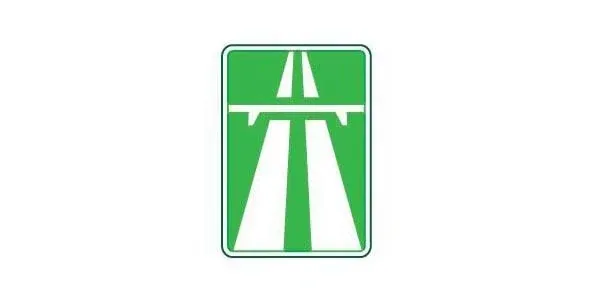
Question 649. In the presence of this sign, at what maximum speed do intercity bus drivers have the right to travel?
- 70 km/h.
- 90 km/h.
- 110 km/h.
Show answer
Correct: 2. 90 km/h.
The sign shown is 5.1 “Motorway”. Under point 69 of the Traffic Rules, outside built-up areas buses carrying out intercity transport are permitted to travel at no more than 90 km/h on ALL roads, motorways included, so the maximum here is 90 km/h. The figure of 110 km/h is allowed by the same item on motorways only to light passenger cars and to lorries with a permissible maximum mass of up to 3.5 t, and 70 km/h is the limit for other buses rather than for intercity ones.
Question 650. At what maximum speed may the driver of a towing bus travel in the given situation?
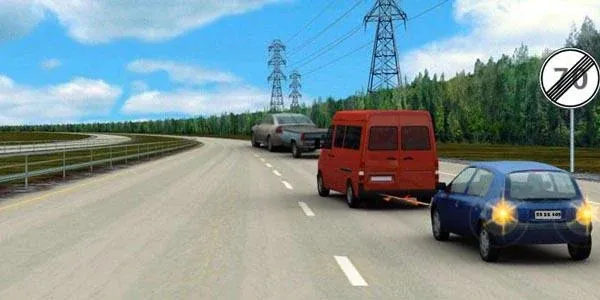
- 50 km/h.
- 60 km/h.
- 90 km/h.
Show answer
Correct: 1. 50 km/h.
The red minibus is towing the blue light passenger car on a flexible coupling, and sign 3.25 “End of the maximum speed limit zone” stands on the right, cancelling the previous 70 km/h restriction. But under point 71 of the Traffic Rules, when towing coupled mechanical vehicles, travel is permitted at no more than 50 km/h. “60 km/h.” and “90 km/h.” are therefore wrong: lifting a limit imposed by a SIGN does not lift the 50 km/h limit the Rules themselves attach to towing.
Question 651. At what maximum speed may the driver of an intercity bus travel in the given situation?
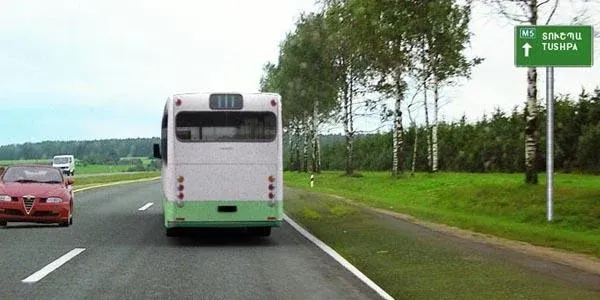
- 60 km/h.
- 70 km/h.
- 80 km/h.
- 90 km/h.
Show answer
Correct: 4. 90 km/h.
The bus is travelling outside a built-up area - open country all around - past a route direction indicator, and there is no sign restricting speed. Under point 69 of the Traffic Rules, outside built-up areas buses carrying out intercity transport may travel at no more than 90 km/h on all roads, so the maximum here is 90 km/h. “60 km/h.” is the limit that applies inside built-up areas (point 68), “70 km/h.” is the limit for buses other than intercity ones, and point 69 sets no limit of 80 km/h at all.
Question 652. At what speed may the driver of a bus continue driving in the zone marked by the given road sign?
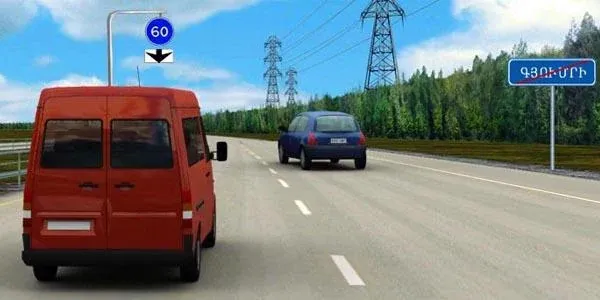
- Less than 60 km/h.
- Not less than 60 km/h, but not more than 70 km/h.
- Not less than 60 km/h, but not more than 90 km/h.
Show answer
Correct: 3. Not less than 60 km/h, but not more than 90 km/h.
The blue 60 sign hanging over the road is sign 4.6 “Minimum speed limit”, applied to the lane above which it hangs: under the Traffic Rules travel in that lane is permitted only at the speed shown or higher, so the bus may not go slower than 60 km/h. The upper bound is the bus’s own maximum outside built-up areas, which under point 69 of the Rules is 90 km/h. The driver may therefore continue at not less than 60 km/h but not more than 90 km/h. “Less than 60 km/h.” is wrong because sign 4.6 makes 60 km/h the minimum, and “Not less than 60 km/h, but not more than 70 km/h.” is wrong because 70 km/h is the ceiling for buses other than intercity ones, not the 90 km/h that applies here.
Question 656. At what maximum speed is the movement of intercity buses on motorways allowed?
- 70 km/h.
- 80 km/h.
- 90 km/h.
- 100 km/h.
- 110 km/h.
Show answer
Correct: 3. 90 km/h.
Under sub-point 2 of point 69 of the Road Traffic Rules, buses carrying out intercity transport are allowed to travel on all roads, including motorways, at a speed of no more than 90 km/h; this sub-point sets no separate, higher speed for motorways. 70 and 80 km/h are permitted but are not the maximum, while 100 and 110 km/h exceed the limit — under sub-point 1, 110 km/h applies only to passenger cars and trucks of up to 3.5 t.
Question 657. At what maximum speed is the movement of a bus allowed on the road sections covered by this road sign?
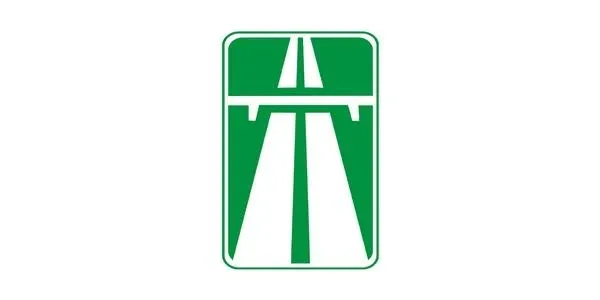
- 70 km/h.
- 80 km/h.
- 90 km/h.
- 100 km/h.
- 110 km/h.
Show answer
Correct: 3. 90 km/h.
The picture shows sign 5.1 «Motorway» — a green sign with the image of a road with a divided carriageway. Under point 69 of the Road Traffic Rules, the raised speed of 110 km/h on motorways applies only to passenger cars and to trucks with a maximum permissible mass of no more than 3.5 t, while for buses the limit on a motorway is 90 km/h (for those carrying out suburban, interregional and intercity transport — 90 km/h on all roads; for the remaining buses — 90 km/h precisely on motorways). “70 km/h” is the limit for the remaining buses on ordinary roads, and the speeds “80 km/h”, “100 km/h” and “110 km/h” are not set by point 69 for buses.
Question 659. At what speed is the movement of vehicles allowed in the areas covered by the road signs “Residential zone” and “End of residential zone”?
- No more than 5 km/h.
- No more than 10 km/h.
- No more than 20 km/h.
Show answer
Correct: 3. No more than 20 km/h.
Under point 68 of the Traffic Rules, in the areas whose entrance and exit are marked with signs 5.21 “Residential zone” and 5.22 “End of residential zone”, and in courtyard areas as well, vehicles may move at a speed of “No more than 20 km/h” — which is why that is the correct option. The Rules set no 5 km/h or 10 km/h limit for a residential zone; 20 km/h is the maximum the Rules themselves establish there.
Question 660. At what maximum speed is the movement of passenger cars allowed on the road sections covered by this road sign?
- 70 km/h.
- 80 km/h.
- 90 km/h.
- 100 km/h.
- 110 km/h.
Show answer
Correct: 5. 110 km/h.
The picture shows sign 5.1 «Motorway» — a green sign with the image of a road with a divided carriageway. Under point 69 of the Road Traffic Rules, outside built-up areas passenger cars (and trucks with a mass of no more than 3.5 t) are allowed to travel at a speed of no more than 90 km/h, and on motorways at no more than 110 km/h. Therefore, within the zone covered by this sign a passenger car may move at up to 110 km/h. “90 km/h” is the passenger car limit outside a built-up area on an ordinary road, and the speeds “70 km/h”, “80 km/h” and “100 km/h” are not set by point 69 for passenger cars.
Question 661. At what maximum speed is movement allowed for the driver of a truck with a permissible maximum mass of no more than 3.5 tonnes within the zone of effect of the indicated signs?
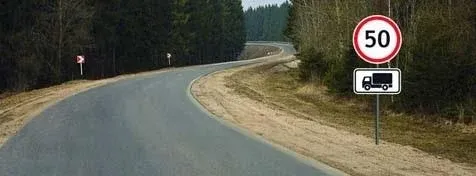
- No more than 50 km/h
- No more than 70 km/h
- No more than 90 km/h
Show answer
Correct: 3. No more than 90 km/h
Sign 3.24 “Maximum speed limit” shows 50, but beneath it is plate 8.4.1 “Type of vehicle” bearing a lorry, under which the sign’s effect extends only to lorries with a permissible maximum mass of MORE than 3.5 tonnes. A lorry of no more than 3.5 tonnes does not fall under that restriction and is governed by the general rule: under point 69 of the Traffic Rules it may travel at no more than 90 km/h outside built-up areas. “No more than 50 km/h” is wrong because the plate addresses the sign only to lorries heavier than 3.5 t, and “No more than 70 km/h” is the point 69 limit for those heavier lorries, not for a light one.
Question 662. When towing a mechanical vehicle, in which lane of this road may you continue moving?
- Only the right one
- Any one
Show answer
Correct: 1. Only the right one
The sign on the right is 5.15.3 “Beginning of a lane”, and on it the main lane carries sign 4.6 “Minimum speed limit” showing 60: drivers who cannot travel in the main lane at at least that speed must move across into the additional lane. Under point 71 of the Traffic Rules, when towing coupled mechanical vehicles travel is permitted at no more than 50 km/h, so you cannot maintain the 60 km/h the left lane requires. You may therefore continue only in the right - the additional - lane, and “Any one” is wrong.
Question 663. What conditions must the driver take into account when choosing a speed not exceeding the established speed?
- The condition of the road surface
- Visibility in the direction of travel
- Both of the indicated conditions.
Show answer
Correct: 3. Both of the indicated conditions.
Point 65 of the Traffic Rules requires the driver to drive at a speed not exceeding the established one, taking into account in particular “The condition of the road surface” and “Visibility in the direction of travel”. The point names both conditions expressly, so an option that gives only one of them is incomplete, and the correct answer is “Both of the indicated conditions.”
Question 664. What speed must the driver choose within the limits of the permissible maximum?
- One that ensures full control of the vehicle
- He is free to choose any speed that does not exceed the permissible maximum
Show answer
Correct: 1. One that ensures full control of the vehicle
Point 66 of the Traffic Rules requires the driver to choose a speed that lets him keep the vehicle fully under control as the Rules demand — that is exactly the option “One that ensures full control of the vehicle”. Staying below the permissible maximum is therefore not enough on its own, so the option saying he “is free to choose any speed that does not exceed the permissible maximum” is wrong.
Question 665. The driver is prohibited from:
- exceeding the maximum speed established by the technical specification of the given vehicle;
- exceeding the speed provided for by the “Speed limit” identification sign placed on the vehicle;
- driving at a very low speed without necessity, obstructing the movement of other vehicles;
- braking sharply, if this is not necessary in order to prevent a road traffic accident
- All the indicated actions
Show answer
Correct: 5. All the indicated actions
Point 72 of the Traffic Rules forbids the driver, in its sub-points, to exceed “the maximum speed established by the technical specification of the given vehicle”, to exceed “the speed provided for by the ‘Speed limit’ identification sign placed on the vehicle”, to drive “at a very low speed without necessity, obstructing the movement of other vehicles”, and to “brake sharply, if this is not necessary in order to prevent a road traffic accident”. All four are prohibited by that same point, so any one of them taken alone is only part of the answer and “All the indicated actions” is correct.
Question 669. The driver is obliged to reduce speed
- When approaching vehicles equipped with the “Transport of children” identification sign during the boarding and alighting of children from those vehicles.
- In case of being dazzled
- In case an obstacle or danger to traffic arises.
- When approaching a vehicle with blue and red flashing beacons and a special sound signal switched on, as well as when approaching a stationary vehicle with blue, or blue and red, flashing beacons switched on.
- In all the listed cases
Show answer
Correct: 5. In all the listed cases
The duty to reduce speed is set by several points of the Traffic Rules: point 156 when approaching vehicles carrying the “Transport of children” identification sign while children board and alight, point 129 in case of being dazzled, point 67 when an obstacle or danger to traffic arises, and points 29 and 30 when approaching a vehicle with blue and red flashing beacons and a special sound signal switched on, as well as a stationary vehicle with flashing beacons on. All four situations are expressly covered by the Rules, so only “In all the listed cases” is correct.
Question 1038. Which sign introduces a speed restriction:
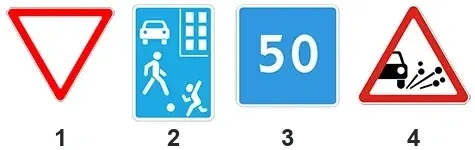
- 1 and 3
- 1 and 4
- Only 2
- 2 and 3
Show answer
Correct: 3. Only 2
Sign 2 is 5.21 ‘Residential zone’, and under point 68 of the Traffic Rules a speed of no more than 20 km/h is permitted in zones marked by signs 5.21 ‘Residential zone’ and 5.22 ‘End of residential zone’ — so that sign is the one introducing a speed restriction. Sign 1 (2.4 ‘Give way’) governs priority only, sign 3 (6.2 ‘Recommended speed’, the blue square) indicates a preferred speed and restricts nothing, and sign 4 (1.18 ‘Loose gravel’) is a warning sign. ‘Only 2’ is therefore correct.
Question 1064. In the zone of action of which sign may you travel at a speed of 60 km/h?
- Only Բ (B)
- Բ (B) and Գ (C)
- None of them
Show answer
Correct: 2. Բ (B) and Գ (C)
Sign Ա (A) is 3.24 “Maximum speed limit” - the red-bordered disc - which prohibits travel faster than the figure shown, so 50 is a ceiling and 60 km/h is not allowed there. Sign Բ (B) is 4.6 “Minimum speed limit” - the solid blue disc - which permits travel only at the speed shown or higher, so 60 km/h is allowed. Sign Գ (C) is 6.2 “Recommended speed” - the blue square - which merely suggests a preferable speed and sets no binding limit, so 60 km/h is allowed there too. The correct answer is therefore “Բ (B) and Գ (C)”; “Only Բ (B)” wrongly excludes the advisory sign 6.2, and “None of them” is wrong because both Բ (B) and Գ (C) permit 60 km/h.
Question 1095. On roads equipped with this sign, drivers of intercity buses have the right to travel at no more than:
- 60 km/h.
- 80 km/h.
- 90 km/h.
Show answer
Correct: 1. 60 km/h.
The sign shown is 5.23.1 “Beginning of built-up area” - the settlement name in black on a WHITE plate - and under the road-signs annex it means that from this point the requirements the Rules lay down for built-up areas apply on the road. point 68 of the Traffic Rules permits movement in built-up areas at no more than 60 km/h, and no higher limit is set for buses, so the driver of an intercity bus may travel at 60 km/h at most. The figures 80 km/h and 90 km/h belong to point 69, which governs speeds outside built-up areas and does not apply beyond this sign.
Question 1096. On roads equipped with this sign, drivers of intercity buses have the right to travel at no more than:
- 60 km/h.
- 80 km/h.
- 90 km/h.
Show answer
Correct: 3. 90 km/h.
The sign shown is 5.25 “Beginning of built-up area” with the name in white letters on a blue ground. Because of that colour, the requirements of the Rules laid down for built-up areas do NOT apply on this road, and the speeds permitted outside built-up areas are the ones in force. Under point 69 of the Rules, on ordinary roads outside built-up areas the drivers of intercity buses are permitted to travel at no more than 90 km/h, which is therefore the answer; the two lower figures offered are the limits that apply elsewhere and not on a road carrying this sign.