Signalling and the Horn
A signal is the only way to tell other road users what you are about to do, and it needs time to work. The exam asks when you must signal, when you stop, and what a signal doesn’t give you. The horn is simpler: the Rules allow it in just two cases.
When must I signal?
Section titled “When must I signal?”Point 36 of the Traffic Rules says: before you move off, and before every manoeuvre, signal with the direction indicator on the side you are heading. Moving off, changing lanes, turning, making a U-turn and stopping all count. If your indicators are missing or faulty, signal by hand.
The duty has no conditions, because road users you can’t see may be reading your signal. So you signal:
- By day and by night, inside and outside built-up areas.
- Whether or not anyone is behind you, oncoming or nearby.
- In a residential zone, in a parking area and at a filling station.
- When a sign forces the turn, such as sign 4.1.2 “Movement to the right”.
- When you drive a route bus. An established route is no exemption.
- When your lane ends, or when you leave your lane to pass animals on the road.
Is a signal ever not needed?
Section titled “Is a signal ever not needed?”Yes, in one case: you are following a bend and staying in your lane. You aren’t manoeuvring, because the road is doing the turning. That is why sign 1.11.1 “Dangerous turn” doesn’t call for an indicator.
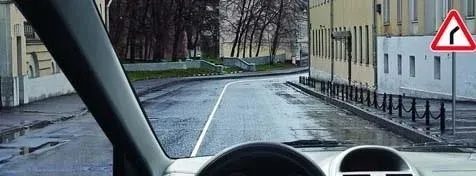
The road simply bends. Stay in your lane and no signal is required.
An intersection is different, even if the main road turns there. You are still leaving one road for another, so that is a turn.
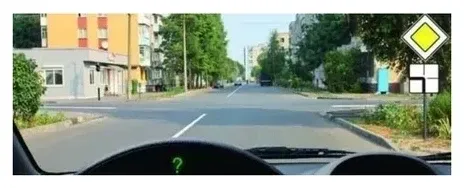
Here the main road turns left. Following it is a turn, so you must signal.
Which indicator?
Section titled “Which indicator?”Usually the direction is obvious. These cases are not:
- Stopping at the left edge of a one-way road: that edge is where you are heading, so use the left indicator.
- Two moves in a row: give a signal for each. To swing right and then make a U-turn to the left, signal first right, then left.
- Roundabouts: use the right indicator as you enter and leave, including when you go round the island to make a U-turn. A left signal would mislead other drivers.
When does the signal start and stop?
Section titled “When does the signal start and stop?”| Type of signal | Start | Stop |
|---|---|---|
| Direction indicator | In advance, before the manoeuvre | Immediately after the manoeuvre |
| Hand signal | In advance, before the manoeuvre | Immediately before the manoeuvre starts |
Others need time to notice your signal, so it must come first. You stop a hand signal early because you need both hands on the wheel for the manoeuvre.
Common trap: “Immediately before starting the manoeuvre” sounds right for an indicator, but it gives nobody time to react. The answer is “in advance”. The “immediately before” wording belongs to ending a hand signal.
When you overtake, the left indicator goes with the move into the left lane. Switch it off as soon as you are in that lane, not after you have passed the other vehicle. Leaving it on tells following drivers you are still moving left.
There is one case where signalling too early misleads. You want to stop just past an intersection, and a road joins from the right.
Switch on the right indicator only after you enter the intersection. Any earlier and it looks like you are turning into that road.
Does signalling give me priority?
Section titled “Does signalling give me priority?”No. A signal only warns others about what you intend to do. You must still let through everyone who has priority, and you must not begin while the manoeuvre is unsafe.
Remember: A signal asks. It doesn’t entitle. It gives you no advantage in any situation, whether you are starting off or changing lanes.
What do the hand signals mean?
Section titled “What do the hand signals mean?”Hand signals replace indicators that are missing or faulty, at any time of day. If your indicators work, a hand signal doesn’t replace them. Point 37 sets the meanings:
| Signal | Meaning |
|---|---|
| Left arm out to the side, or right arm bent up at the elbow | Left turn or U-turn |
| Right arm out to the side, or left arm bent up at the elbow | Right turn |
| Right or left arm raised straight up | Braking |
There is no hand signal for going straight ahead.
A memory hook: a straight arm points where you are going, a bent arm means the opposite side, and an arm straight up means braking.
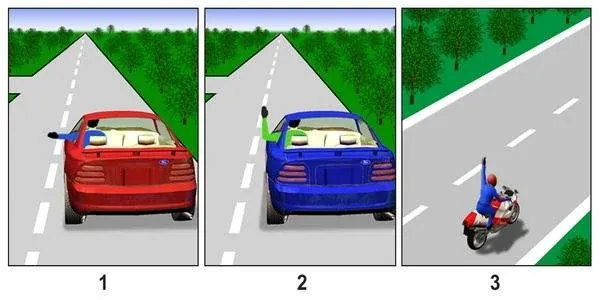
Picture 1 is a left turn, picture 2 a right turn, picture 3 braking.
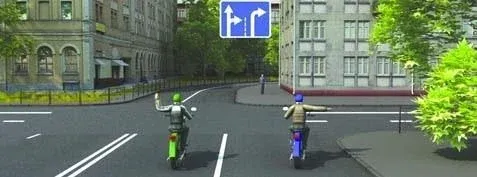
Two ways to say the same thing: both riders are signalling a right turn.
Extra: Check your indicators
Not from the question bank.
Walk round the car now and then with the indicators on, or ask someone to look for you. On many cars, an indicator that suddenly clicks much faster than usual means a bulb has failed.
When may I use the horn?
Section titled “When may I use the horn?”Point 136 allows sound signals in only two cases:
- Outside built-up areas, to warn another driver that you intend to overtake.
- When it is needed to prevent a road traffic accident, anywhere.
The list is complete. The horn can’t win you priority, and drivers of public transport vehicles get no extra cases.
Common trap: The overtaking warning is allowed outside built-up areas, not inside them. Options that say “in built-up areas” are wrong.
Try it yourself
Section titled “Try it yourself”You are driving here and want to warn the driver ahead that you are about to overtake. Sign 3.26 “Audible signal prohibited” stands on the right.
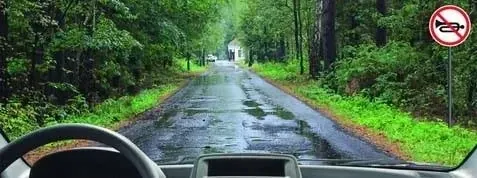
May you use the horn? No. Under this sign, the horn is allowed only to prevent an accident. The overtaking warning is not an exception.
A car stands at the edge of the road, and its driver puts an arm out.
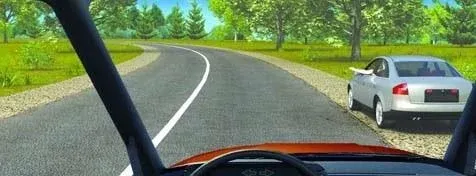
What does it mean? He is about to start moving. Before moving off, a driver with no working indicators warns others by hand.
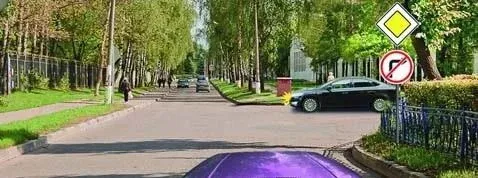
The truck turns right into a yard, under sign 4.1.1 “Straight ahead only”. It has no indicator on.
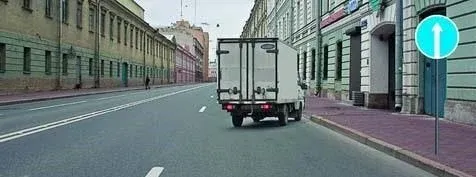
What rule is broken? Only the signalling rule. Sign 4.1.1 doesn’t prohibit turning right into yards and other areas next to the road, but the driver still had to signal.
Key points
Section titled “Key points”- Signal before moving off and before every manoeuvre, always, whoever is around.
- The one exception: following a bend without changing lanes.
- Indicator: on in advance, off immediately after the manoeuvre. Hand signal: off immediately before it.
- A signal gives no priority.
- Hand signals: straight arm points the way, bent arm means the opposite side, raised arm means braking. They are for missing or faulty indicators only.
- Horn: only outside built-up areas to warn of overtaking, or to prevent an accident. Under sign 3.26, only to prevent an accident.
Practice questions
Section titled “Practice questions”Question 121. An audible signal can be used in this situation
- Only for warning about overtaking
- Only to prevent a traffic accident
- In both cases.
Show answer
Correct: 2. Only to prevent a traffic accident
Sign 3.26 “Audible signal prohibited” is in place, and it forbids the use of an audible signal except where the signal is given to prevent a road traffic accident. In this situation an audible signal may therefore be used only to prevent an accident. Warning about overtaking does not fall within that exception, so “Only for warning about overtaking” and “In both cases.” are wrong.
Question 770. When stopping in this situation, which turn signal indicator must the driver switch on
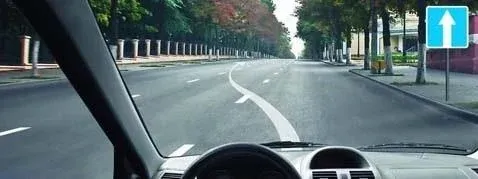
- Right
- Right, and left after changing lanes
- Left
Show answer
Correct: 3. Left
Under point 36 of the Traffic Rules the driver must switch on the indicator of the appropriate direction in advance of a manoeuvre, and stopping is a manoeuvre. In the picture the road carries one-way traffic - the blue sign 5.5 with an upward arrow stands on the right - and the marking leads across to the left; on a one-way road stopping is made at the LEFT edge, so the driver must switch on the left indicator. The right-hand answers assume the kerb you pull into is always on the right, which is exactly what a one-way road changes.
Question 776. Is the driver obliged, when making a left turn in this situation, to give a signal with the turn indicator
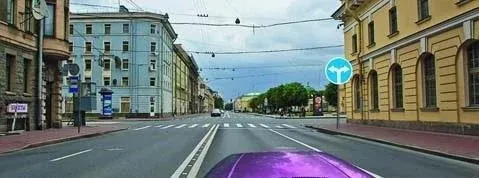
- Yes
- Yes, when there is an oncoming road user
- Not obliged
Show answer
Correct: 1. Yes
Under point 36 of the Traffic Rules, before moving off or carrying out a manoeuvre a driver must give a signal with the light indicator of the appropriate direction, in order to warn the other road users. That duty is unconditional and does not depend on whether an oncoming road user is present, so in making the left turn shown in the picture the driver is obliged to signal with the left indicator - other traffic you cannot see may still be reading your intentions. “Yes, when there is an oncoming road user” and “Not obliged” are therefore wrong: the signal is compulsory in every case, even though, under the same item, it confers no advantage.
Question 779. What rule is the driver violating by entering the yard
- Makes a right turn in the zone of effect of a straight-ahead-only sign
- Does not give a signal with the turn indicator
- Both violations at the same time
Show answer
Correct: 2. Does not give a signal with the turn indicator
Under point 36 of the Traffic Rules a driver must signal with the light indicator of the appropriate direction before a manoeuvre, and in the picture the lorry is turning right into the yard with no indicator switched on - that is the violation. The right turn into a yard is not itself an offence: under the description of sign 4.1.1 “Straight ahead only”, that sign does not prohibit turning right into courtyards and other areas adjoining the road. “Makes a right turn in the zone of effect of a straight-ahead-only sign” and “Both violations at the same time” are therefore wrong - the only violation is the failure to signal.
Question 794. Are you obliged to switch on the right turn indicator at this intersection
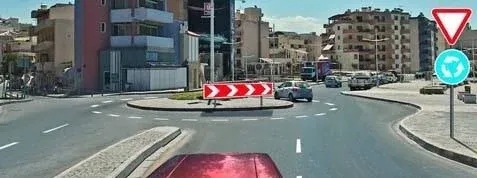
- Yes
- No
- Yes, except when making a U-turn.
Show answer
Correct: 1. Yes
The picture shows an intersection with a roundabout - sign 4.3 “Roundabout” together with sign 2.4 “Give way” - and you leave it by turning right off the ring. Under point 36 of the Traffic Rules, before moving off or carrying out a manoeuvre a driver must signal with the light indicator of the appropriate direction, so on leaving the roundabout you must switch on the right indicator. That requirement applies at every exit, including one taken after going right round the island, so the answer is yes and the exception in the third option does not exist.
Question 798. Giving a signal, an advantage over the other road users
- Gives
- Gives only when changing lanes
- Does not give
Show answer
Correct: 3. Does not give
Under point 36 of the Road Traffic Rules, a direction-indicator or hand signal only warns the other road users of an intended manoeuvre, and the point states outright that giving a signal grants no advantage over them. The driver must still let through everyone who has priority and must not begin the manoeuvre while it is not safe. The answer is therefore “Does not give”, and both “Gives” and “Gives only when changing lanes” contradict point 36.
Question 812. Audible signals may be used by drivers of public transport vehicles:
- To gain priority over the other road users.
- In built-up areas — to warn the other drivers of the intention to overtake.
- When it is necessary in order to prevent a road traffic accident.
- In all cases.
Show answer
Correct: 3. When it is necessary in order to prevent a road traffic accident.
Point 136 of the Traffic Rules allows an audible signal in only two cases: outside built-up areas, to warn other drivers of an intention to overtake, and “When it is necessary in order to prevent a road traffic accident” — the second of these is the keyed answer. That is why “In built-up areas — to warn the other drivers of the intention to overtake” is not permitted, while “In all cases” contradicts the word “only” in that point. The list is exhaustive, so using the horn “To gain priority over the other road users” is ruled out as well.
Question 815. In which case do the rules not require a warning signal to be given?
- When stopping at the edge of the carriageway.
- Before the bend of a road section within the zone of the “Dangerous turn” sign.
- Before changing lanes into an adjacent traffic lane.
Show answer
Correct: 2. Before the bend of a road section within the zone of the “Dangerous turn” sign.
Under point 36 of the Traffic Rules, the direction-indicator (or hand) signal must be given before starting movement or performing a manoeuvre, but it is not mandatory when the vehicle is merely following a curved section of the road without changing lanes. So no warning signal is required before a road curve marked with a “Dangerous Turn” sign, since that is following the road, not a manoeuvre. “Before stopping at the edge of the roadway” and “Before converting to an adjacent traffic lane” are wrong because those are manoeuvres for which point 36 requires a signal.
Question 816. Before changing lanes, the warning signal must be given:
- Immediately before starting the manoeuvre.
- Immediately after starting the manoeuvre.
- In advance — before starting the manoeuvre.
Show answer
Correct: 3. In advance — before starting the manoeuvre.
Under point 36 of the Traffic Rules the signal must be given “In advance — before starting the manoeuvre” (the point says the same about starting to move), so that the other road users have time to notice it and react. A signal given “Immediately before starting the manoeuvre” does not give them that time, and “Immediately after starting the manoeuvre” has already lost its warning purpose, so neither of those meets the requirement of the point.
Question 817. Before performing the manoeuvre, the warning signal must be given:
- Immediately before starting the manoeuvre.
- Simultaneously with starting the manoeuvre.
- In advance — before starting the manoeuvre.
Show answer
Correct: 3. In advance — before starting the manoeuvre.
Under point 36 of the Traffic Rules, before performing a manoeuvre the warning signal must be given “In advance — before starting the manoeuvre”, so that the other road users know the driver’s intention beforehand. “Immediately before starting the manoeuvre” leaves them no time to react, and “Simultaneously with starting the manoeuvre” performs no warning function at all.
Question 818. The warning signal given by the driver with the hand is stopped:
- Immediately before starting the manoeuvre.
- Immediately after completing the manoeuvre.
- During the performance of the manoeuvre.
Show answer
Correct: 1. Immediately before starting the manoeuvre.
Point 36 of the Traffic Rules has the signal of the direction indicator stopped immediately after the manoeuvre is completed, but the same point makes a special reservation for the signal given with the hand: that one is stopped “Immediately before starting the manoeuvre”. The reason is that during the manoeuvre the driver needs both hands to control the steering wheel. So “Immediately after completing the manoeuvre” and “During the performance of the manoeuvre” describe the indicator, not the hand signal.
Question 819. In which case must the driver give a warning signal before stopping?
- If another vehicle is travelling behind him.
- Only in built-up areas.
- In all cases.
Show answer
Correct: 3. In all cases.
Under point 36 of the Traffic Rules, before carrying out a manoeuvre - and stopping is a manoeuvre - the driver must give the warning signal in order to warn the other road users, and that duty is not made conditional on another vehicle following behind or on being inside a built-up area. A warning signal before stopping is therefore required in all cases. “If another vehicle is travelling behind him.” and “Only in built-up areas.” are wrong because point 36 imposes the signalling duty unconditionally, whatever the traffic behind and wherever the vehicle is.
Question 821. In the absence or malfunction of the turn light indicator, the warning signal given by hand is stopped:
- Immediately before starting the manoeuvre.
- Immediately after completing the manoeuvre.
- During the performance of the manoeuvre.
Show answer
Correct: 1. Immediately before starting the manoeuvre.
Under point 36 of the Traffic Rules, where the turn light indicator is absent or faulty the signal is given by hand, and the hand signal is discontinued immediately before the manoeuvre begins - the driver needs that hand back on the wheel to carry the manoeuvre out. “Immediately before starting the manoeuvre.” is therefore correct. “Immediately after completing the manoeuvre.” is the rule for a signal given by the direction indicator, not for the hand signal, and “During the performance of the manoeuvre.” is wrong because point 36 fixes the cut-off at the moment just before the manoeuvre starts.
Question 823. In which picture is the driver giving the left turn signal?
- 1
- 2
- 3
Show answer
Correct: 1. 1
Under point 37 of the Traffic Rules the signal for a left turn (or a U-turn) is the left arm extended to the side, or the right arm bent upwards at the elbow at a right angle. In picture 1 the driver has his left arm extended straight out to the side, which is exactly that signal, so the answer is 1. In picture 2 the left arm is bent upwards at the elbow, which under point 37 is the signal for a RIGHT turn, and in picture 3 the arm is raised straight up, which under the same item is the braking signal and not a turn signal at all.
Question 849. Sound signals may be used only:
- In built-up areas, to warn the other drivers about the intention to overtake.
- When this is necessary to prevent a road traffic accident.
- In both cases.
Show answer
Correct: 2. When this is necessary to prevent a road traffic accident.
Under point 136 of the Traffic Rules, sound signals may be used only outside built-up areas to warn other drivers of an intention to overtake, and in cases where this is necessary to prevent a road traffic accident — the second of which is exactly “When this is necessary to prevent a road traffic accident.” The option “In built-up areas, to warn the other drivers about the intention to overtake.” contradicts that point, because the overtaking signal is allowed outside built-up areas, not inside them. Since that case is not permitted, “In both cases.” is wrong as well.
Question 875. In which case do the rules not require the bus driver to give a warning signal?
- When stopping at the edge of the carriageway.
- Before the curve of a road section marked with a “Dangerous turn” sign.
- Before changing lanes into the adjacent traffic lane.
- When travelling along an established route.
Show answer
Correct: 2. Before the curve of a road section marked with a “Dangerous turn” sign.
Under point 36 of the Traffic Rules a signal is not required when a vehicle follows a section of road that is curved in plan without changing lanes. Before the curve of a road section marked with a “Dangerous turn” sign the bus is travelling through exactly such a section — it only follows the line of the road and performs no manoeuvre — so no warning signal is needed there. The actions described in “When stopping at the edge of the carriageway.” and “Before changing lanes into the adjacent traffic lane.” are manoeuvres, and the same item requires a signal before them, while “When travelling along an established route.” gives no exemption in the Rules — a route bus must also signal before a manoeuvre.
Question 876. Before changing lanes, the bus driver must give a warning signal:
- Immediately before starting the manoeuvre.
- Immediately after starting the manoeuvre.
- In advance — before starting the manoeuvre.
- He is not obliged to, if the bus is travelling on an established route.
Show answer
Correct: 3. In advance — before starting the manoeuvre.
Under point 36 of the Traffic Rules the signal must be given in advance — before moving off or before starting the manoeuvre — and stopped immediately after it is completed. The correct option is therefore “In advance — before starting the manoeuvre.”: the bus driver must switch the indicator on early enough for other road users to take his intention into account. “Immediately before starting the manoeuvre.” and “Immediately after starting the manoeuvre.” both contradict that wording, and “He is not obliged to, if the bus is travelling on an established route.” is wrong because point 36 grants no exemption for route services.
Question 879. May a warning signal be given by hand in order to travel along the indicated path?
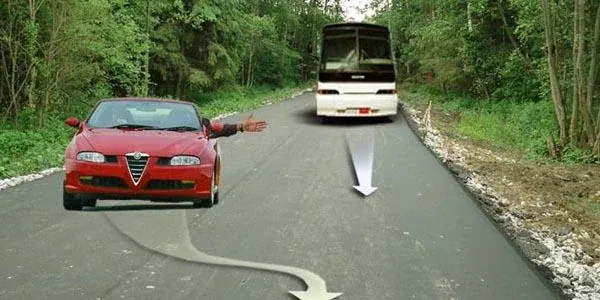
- Yes, if the turn indicator is faulty.
- Yes, if the turn indicator is faulty — during daylight hours.
- Yes, in all cases.
Show answer
Correct: 1. Yes, if the turn indicator is faulty.
Under the Rules the signal before a manoeuvre is given by the direction indicators, and by hand only where there are none or they are faulty. A warning signal may therefore be given by hand in order to travel along the indicated path if the turn indicator is faulty. “Yes, in all cases.” is wrong - with a working indicator a hand signal is no substitute - and the restriction to daylight hours does not exist in the Rules: a hand signal is allowed whenever the indicator has failed, at any time of day.
Question 880. Is the driver obliged to switch on the turn indicator before starting to move in a residential zone?
- Is not obliged.
- Is obliged.
- Is obliged, in the presence of other vehicles.
Show answer
Correct: 2. Is obliged.
Point 36 of the Traffic Rules obliges a driver to signal with the turn indicator for the appropriate direction before moving off, and makes no exception for a residential zone, so the correct answer is “Is obliged.” The only exception in that point concerns driving along a curved section of the carriageway without changing lanes — it is about the road’s shape, not about where you are. “Is not obliged.” is therefore wrong, and the condition in “Is obliged, in the presence of other vehicles.” does not exist in the Rules: the signal is given whether or not other road users are nearby.
Question 884. What does the hand signal given by the driver of the light passenger car indicate?
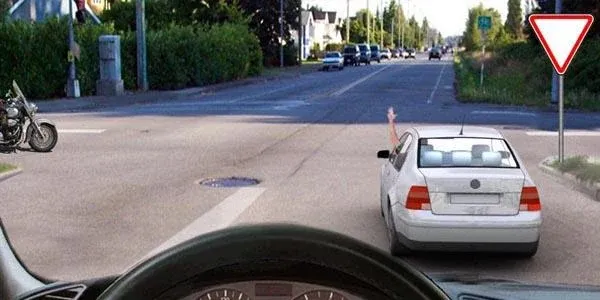
- He is turning right.
- He is continuing straight ahead.
- He is braking.
Show answer
Correct: 3. He is braking.
Under point 37 of the Traffic Rules the braking signal is the right or left arm raised upwards, and the driver of the car ahead has his left arm raised straight up, well above the roof of the car. A right turn would be shown by the right arm extended to the side, or by the left arm bent upwards at the elbow at a right angle, and neither of those positions is in the picture. The Rules provide no hand signal at all for continuing straight ahead, so that option is wrong too - he is braking.
Question 886. What does the hand signal given by the motorcycle driver indicate?
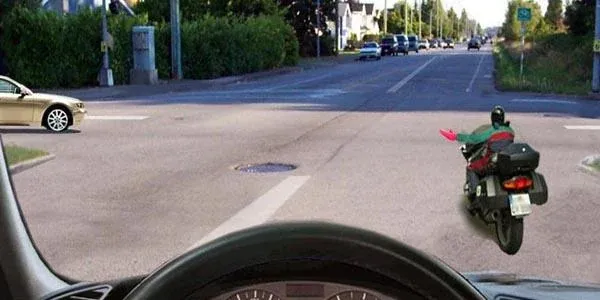
- He is continuing to travel in the left or opposite direction.
- He is continuing to travel in the straight or right direction.
Show answer
Correct: 1. He is continuing to travel in the left or opposite direction.
The motorcyclist has extended his left arm out to the side. Under point 37 of the Traffic Rules the left arm extended to the side corresponds to the signal for a left turn or a U-turn, so the rider is telling you that he is continuing to travel in the left or the opposite direction. The other option is wrong because a right turn would be shown by the RIGHT arm extended to the side, or by the left arm bent upwards at the elbow at a right angle, and no hand signal is given for travelling straight ahead.
Question 887. What does the hand signal given by the driver of the light passenger car indicate?
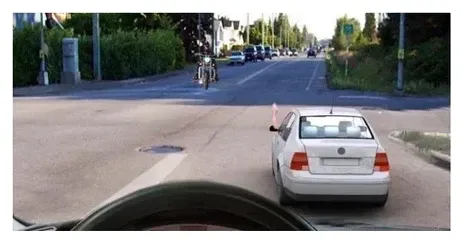
- He is turning right.
- He is continuing straight ahead.
- He is braking in order to give way to the motorcycle.
Show answer
Correct: 1. He is turning right.
The left arm of the light passenger car’s driver is out of the window and bent upwards at the elbow at a right angle. Under point 37 of the Traffic Rules that gesture corresponds to the signal for a RIGHT turn, so the driver ahead is telling you that he is turning right. Continuing straight ahead is wrong because no hand signal is given for it, and braking is wrong because under the same point 37 the braking signal is the arm raised straight UP, not bent at the elbow.
Question 888. What does the signal given by hand by the driver of the passenger car inform about?
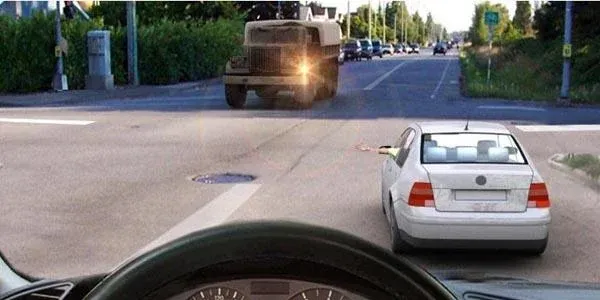
- He intends to make a left turn or a U-turn.
- He is braking — in order to give way to the truck.
Show answer
Correct: 1. He intends to make a left turn or a U-turn.
The left arm of the light passenger car’s driver is extended horizontally out of the window, straight to the side. Under point 37 of the Traffic Rules the left arm extended to the side corresponds to the signal for a left turn or a U-turn, which is what the driver is announcing. The braking option is wrong because under the same point 37 the braking signal is the right or left arm raised UPWARDS, not extended horizontally.
Question 889. Is the driver obliged to switch on the turn indicator in this case?
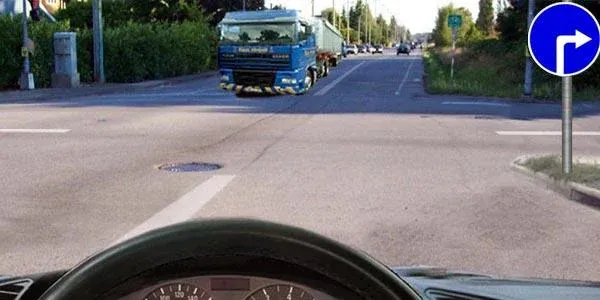
- He is obliged.
- He is not obliged.
Show answer
Correct: 1. He is obliged.
Before the intersection, on the right, stands the blue circular sign 4.1.2 “Movement to the right”, which permits travel only in the direction its arrow shows - so the driver must turn right. Under point 36 of the Rules, before carrying out a manoeuvre a driver must warn the other road users by signalling with the indicator of the appropriate direction, and a turn compelled by a sign is a manoeuvre like any other. He is therefore obliged to switch on the right indicator. “He is not obliged.” contradicts point 36, which makes no exception for a turn dictated by a mandatory sign - other drivers still need to know what you are about to do.
Question 911. To switch on the turn light indicator in this situation, the driver
- Is obliged
- Is obliged if there is a driver approaching from behind
- Is not obliged
Show answer
Correct: 3. Is not obliged
Sign 1.11.1 “Dangerous turn” on the right and the curving edge line show that the road here simply bends to the right and the driver follows it in his own lane, without changing lanes. Under point 36 of the Traffic Rules a signal is NOT required where a vehicle travels along a curved section of road in plan without changing lanes, so switching on the indicator is not obligatory here. Following the bend is not a turn into another road, so “Is obliged” is wrong, and point 36 does not make that exception depend on whether a driver is approaching from behind.
Question 912. The driver, with his arm raised upward, informs about
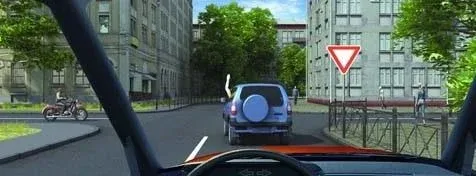
- Making a left turn
- Proceeding straight ahead
- Slowing down
Show answer
Correct: 3. Slowing down
Under point 37 of the Traffic Rules the braking signal is the right or left arm raised upwards, and in the picture the driver of the car ahead has put his arm out of the window and raised it straight up. He is therefore informing you that he is slowing down or stopping. It is not a left turn, for which point 37 prescribes the left arm extended to the side or the right arm bent upwards at the elbow at a right angle, and no hand signal at all is provided for travelling straight ahead.
Question 913. Giving a signal, with respect to the other road users, priority
- Does give
- Does not give
- Gives only when starting to move
Show answer
Correct: 2. Does not give
Point 36 of the Rules, in setting out how and when the turn signal is given, states directly that giving a signal grants no priority over the other road users. The signal only warns the others of an intended manoeuvre; it confers no right to proceed. So the correct answer is “Does not give”. “Does give” and “Gives only when starting to move” contradict point 36: a driver who has signalled is still obliged to give way wherever the Rules require it, and may not drive on merely because the indicator is on.
Question 914. What is the motorcycle driver informing about?
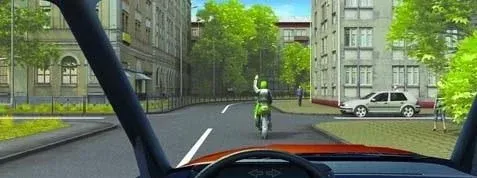
- Continuing straight ahead
- Making a left turn
- Reducing speed in order to give way to the passenger car
Show answer
Correct: 3. Reducing speed in order to give way to the passenger car
The motorcyclist ahead has raised his left arm straight up, and under point 37 of the Traffic Rules the braking signal is the right or left arm raised upwards. He is therefore informing you that he is reducing speed - here in order to give way to the light passenger car. No hand signal at all is provided for continuing straight ahead, and a left turn would be shown by the left arm extended to the side or the right arm bent upwards at the elbow, not by a vertically raised arm.
Question 915. When making a left turn in this situation, giving a signal is
- Mandatory
- Not mandatory
Show answer
Correct: 1. Mandatory
Sign 2.1 “Main road” with plate 8.13 “Direction of the main road” shows that the main road turns left at this intersection, but the driver is still leaving one road for another, which under point 3 of the Traffic Rules is a turn and therefore a manoeuvre. Under point 36 a driver must signal with the light indicator of the appropriate direction before a manoeuvre, so giving a signal here is mandatory. The exception in point 36 covers only travelling along a section of road that is curved in plan without changing lanes, and an intersection is not such a section - so “Not mandatory” is wrong.
Question 916. When overtaking, we are obliged to switch off the left turn light indicator
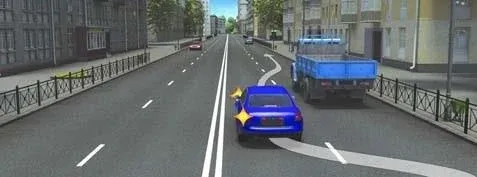
- Immediately after changing into the left lane
- Only after passing ahead of the one travelling in front
- At the driver’s discretion
Show answer
Correct: 1. Immediately after changing into the left lane
Under point 36 of the Traffic Rules the signal is discontinued immediately after the manoeuvre is completed. When overtaking, the left indicator - as on the car in the picture - accompanies the move into the left lane, and that manoeuvre is complete as soon as the change of lane is finished, so the indicator is switched off immediately after moving into the left lane. “Only after passing ahead of the one travelling in front” and “At the driver’s discretion” both contradict point 36, which ties the end of the signal to the end of the MANOEUVRE, not to the end of the whole overtake nor to the driver’s choice - leaving it on would tell following traffic you are still moving left.
Question 917. When making a U-turn at this intersection, which turn indicator must we switch on?
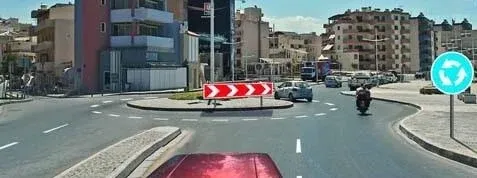
- Right
- Left
- Neither
Show answer
Correct: 1. Right
The intersection is marked with sign 4.3 “Roundabout”, so a U-turn here is made by going round the central island: you enter the ring to the RIGHT and leave it to the right as well. Under point 36 of the Traffic Rules the signal is given with the indicator of the appropriate direction, which means the right indicator both on entering and on leaving. The left indicator would be wrong - travelling round the island is movement along a section curved in plan without changing lanes, for which point 36 requires no signal, and a left signal would mislead other drivers. “Neither” is wrong because entering and leaving the ring are manoeuvres and do require a signal.
Question 918. Are you obliged to give a signal with the light indicator in the situation shown?
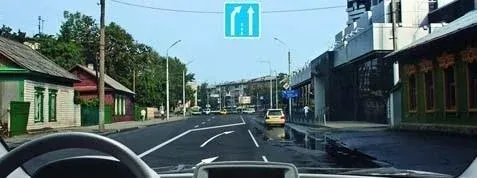
- Yes
- No
- Yes, if there is a driver travelling in the right lane.
Show answer
Correct: 1. Yes
The curving arrows painted in your lane are marking 1.19, warning that the lane is ending and that you must move across to the right, and the sign above the road says the same. Leaving the lane you occupy is a change of lane, which point 3 of the Traffic Rules classes as a manoeuvre, and point 36 obliges the driver to signal in advance with the indicator of the appropriate direction. “No” is wrong because a manoeuvre is being made here, not merely travelling along a curved section without changing lanes; and the duty does not depend on whether another driver happens to be in the right lane, so the conditional answer is wrong too.
Question 919. What is the motorcycle driver informing about?
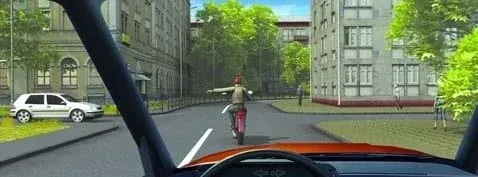
- Continuing straight ahead
- Making a right turn
- Making a left turn or a U-turn
Show answer
Correct: 3. Making a left turn or a U-turn
The motorcyclist has extended his left arm out to the side. Under point 37 of the Rules the signal for a left turn or a U-turn is the left arm extended to the side, or the right arm bent upwards at the elbow. He is therefore informing you that he is making a left turn or a U-turn. There is no hand signal at all for continuing straight ahead, and a right turn would be the RIGHT arm extended to the side or the left arm bent upwards - not the left arm held out straight.
Question 920. The signal about the manoeuvre given with the light indicator must be stopped
- Immediately before the manoeuvre
- Immediately after the manoeuvre
- During the manoeuvre
Show answer
Correct: 2. Immediately after the manoeuvre
Point 36 of the Rules provides that the signal is given in advance, before the manoeuvre, and is stopped immediately after the movement or the manoeuvre has been completed — only a signal given by hand may be ended immediately before the manoeuvre. So a signal given with the light indicator must be stopped “Immediately after the manoeuvre”, which is the marked answer. “Immediately before the manoeuvre” applies to the hand signal alone, and “During the manoeuvre” is wrong: the indicator has to keep working for as long as the manoeuvre lasts and is switched off only once it is finished.
Question 921. Giving a signal with the light indicator in the situation shown is
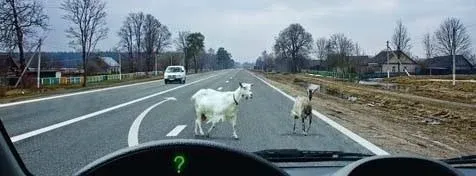
- Mandatory
- At the driver’s discretion
Show answer
Correct: 1. Mandatory
The animals are standing in the lane you occupy, and the trajectory shown takes you out of that lane in order to pass them. Under point 3 of the Traffic Rules leaving the lane or row you occupy is a change of lane and counts as a manoeuvre, and point 36 obliges the driver to signal in advance with the indicator of the appropriate direction, so as to warn the other road users - the oncoming car included. Giving the signal is therefore not left to the driver’s discretion: it is mandatory.
Question 922. Which driver is giving a right-turn signal?
- Only the one on the right
- Both drivers
- Only the one on the left
Show answer
Correct: 2. Both drivers
The rider on the left has raised his left arm bent upwards at the elbow at a right angle, and the rider on the right has extended his right arm out to the side. Under point 37 of the Traffic Rules the signal for a right turn is EITHER the right arm extended to the side OR the left arm bent upwards at the elbow at a right angle, so both drivers are giving a right-turn signal. The options naming only one of them are wrong: a LEFT turn would be the left arm extended to the side or the right arm bent upwards, and neither rider is doing that.
Question 923. When manoeuvring in parking areas or at filling stations, to give a signal with the light indicator
- You are obliged
- You are not obliged
Show answer
Correct: 1. You are obliged
Point 36 of the Rules requires a driver to warn the other road users with the turn indicators before starting to move or carrying out any manoeuvre (and by hand if the indicators are missing or faulty). This duty has no exception for parking areas or filling stations, so when manoeuvring there to signal with the light indicator “You are obliged” — that is the marked answer. “You are not obliged” contradicts point 36, which extends the duty to signal to every manoeuvre, wherever it is made.
Question 924. In this situation, what may the driver’s outstretched arm mean?
- Information regarding his starting to move
- A sign asking to stop
- A general alarm signal
Show answer
Correct: 1. Information regarding his starting to move
The driver of the car standing at the edge of the road has put his arm out. point 36 of the Rules requires a driver, before moving off, to warn the other road users with the turn indicators - and, where these are absent or faulty, by hand. The outstretched arm here therefore conveys information that he is about to start moving. It is not a sign asking you to stop or a general alarm signal: the Rules define no such arm gestures for a driver, and the general alarm signal is an audible signal used at railway crossings, not an arm out of a window.
Question 925. What signals must you give when making the U-turn along the trajectory shown?
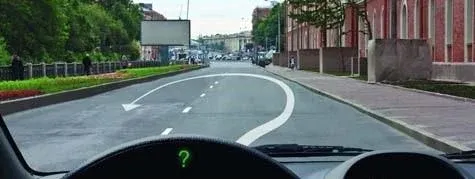
- Right
- Left
- First right, then left.
Show answer
Correct: 3. First right, then left.
The trajectory shown consists of two successive manoeuvres: first a movement to the right, towards the edge of the carriageway, and only then the U-turn itself, to the left. Under point 3 of the Traffic Rules both a change of lane and a U-turn are manoeuvres, and point 36 requires the indicator of the appropriate direction to be switched on before each of them - so first right, then left. Signalling only right would not warn anyone of the U-turn back to the left, and signalling only left would not warn of the initial move to the right.
Question 926. If you intend to stop immediately after an intersection, in order not to confuse the other road users, when must you switch on the right turn indicator
- In advance, before the intersection
- After entering the intersection
Show answer
Correct: 2. After entering the intersection
point 36 of the Traffic Rules requires the turn indicator to be switched on in advance of the manoeuvre, but the signal must also be clear and must not mislead the other road users. A road joins from the right at the intersection ahead, so a right-hand indicator switched on before the intersection would be read as an intention to turn off there or to stop before it - which is why “In advance, before the intersection” is wrong. Switched on only after you have entered the intersection, the signal is unambiguous: it can refer only to the stop you intend to make immediately beyond it.
Question 1105. When making a right turn along the major road, giving a signal is
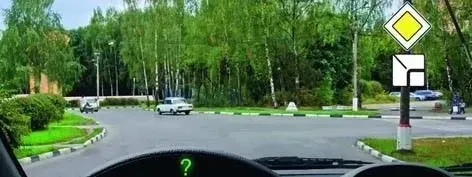
- Not mandatory
- Mandatory only during the dark time of day
- Mandatory
Show answer
Correct: 3. Mandatory
Under the Rules a driver must give a signal with the direction indicators before turning, changing lanes, turning round or stopping, and by hand where there are none or they are faulty. That requirement does not depend on which road you are travelling on or on whether another vehicle happens to be nearby: the signal warns everyone, pedestrians and the traffic behind included. Giving a signal when making a right turn along the major road is therefore mandatory - by day and by night alike, which is why “Not mandatory” and “Mandatory only during the dark time of day” are both wrong.