Wheels and Tyres
Your tyres are the only part of the vehicle that touches the road, and everything you do with the wheel and the pedals passes through them. This is stop 3 of the check: walk round and look at each wheel in turn.
How much tread is enough?
Section titled “How much tread is enough?”The tread is the pattern cut into the tyre. Its remaining height is the number the exam cares about most, and the limit depends on the vehicle (section 4 of Annex 2).
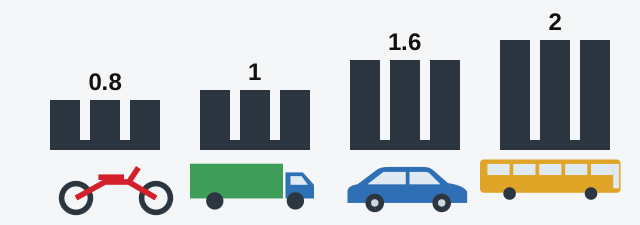
The smallest allowed tread height, in millimetres: motorcycle 0.8, truck 1.0, passenger car 1.6, bus 2.0.
| Vehicle | Minimum (mm) |
|---|---|
| Motorcycle | 0.8 |
| Truck | 1.0 |
| Passenger car | 1.6 |
| Bus | 2.0 |
A trailer follows the vehicle that tows it, so a passenger car’s trailer also needs 1.6 mm.
The figure is a minimum, so a tyre exactly on it is still allowed. Only below it does the vehicle have to stop.
| Tyre | Limit (mm) | Prohibited? |
|---|---|---|
| Car at 1.8 mm | 1.6 | No |
| Car at 1.6 mm | 1.6 | No |
| Truck at 1.6 mm | 1.0 | No |
| Truck at 1.4 mm | 1.0 | No |
| Motorcycle at 1.6 mm | 0.8 | No |
| Motorcycle at 0.6 mm | 0.8 | Yes |
| Bus at 2.5 mm or 2.2 mm | 2.0 | No |
| Bus at 1.8 mm, 1.6 mm or 0.8 mm | 2.0 | Yes |
Common trap: 1.6 mm sounds like the magic number, but it belongs to cars. On a bus, 1.6 mm is too little. On a truck or motorcycle, it’s plenty.
Is the tyre damaged or wrong?
Section titled “Is the tyre damaged or wrong?”Operation is prohibited if a tyre:
- Has local damage, such as a puncture, cut or tear, that exposes the cord or separates the carcass. Such a tyre can burst at speed.
- Doesn’t match the vehicle model in size or permissible load. It would carry a load it wasn’t built for.
Do the tyres on each axle match?
Section titled “Do the tyres on each axle match?”Two wheels on one axle must grip alike. If they don’t, the vehicle pulls to one side under braking. So a single axle must not have:
- Different sizes, constructions or models.
- Different tread patterns.
- New tyres with retreaded ones.
- Frost-resistant tyres with non-frost-resistant ones.
Remember: “Same axle” is the phrase to watch for. When it appears with a mismatch, the vehicle must not be used.
Is the wheel sound?
Section titled “Is the wheel sound?”Operation is prohibited if:
- There are cracks in the wheel rim or disc.
- Even one bolt or nut fastening the wheel is missing. The others are then overloaded, and the wheel can come off.
- The fastening holes visibly differ from their proper shape and dimensions.
Extra: Looking after your tyres
Not from the question bank.
Check the pressure when the tyres are cold, using the figures in the vehicle handbook. Low pressure wears the edges of the tread and heats the tyre up, and high pressure reduces grip. A cheap tread gauge measures depth better than your eye. Look for bulges in the sidewall, which often mean hidden damage, and don’t forget the spare.
Try it yourself
Section titled “Try it yourself”A car has one missing wheel bolt and tyres at 1.8 mm. What’s the problem? The bolt. The tread is above 1.6 mm, but one missing bolt is enough on its own.
A bus has tyres at 1.8 mm, and its hydraulic brake line has a broken seal. Which prohibits operation? Both. The bus needs 2.0 mm, and the broken seal is a fault in its own right.
The engine runs unevenly, and a tyre shows its cord. Which one prohibits operation? Only the tyre. An engine that works with interruptions isn’t on the list.
Key points
Section titled “Key points”- Minimum tread: motorcycle 0.8 mm, truck 1.0 mm, car 1.6 mm, bus 2.0 mm.
- A trailer follows the vehicle that tows it.
- A tyre exactly at the minimum is allowed.
- Exposed cord, or the wrong size or load rating, prohibits operation.
- Tyres on one axle must match in size, construction, model and tread pattern, and must not mix new with retreaded or frost-resistant with non-frost-resistant.
- One missing wheel bolt is enough. So is a cracked rim or disc, or a damaged fastening hole.
Practice questions
Section titled “Practice questions”Question 938. Operation of vehicles is prohibited if:
- The external lighting devices do not work in the established mode.
- The residual tread depth of a motorcycle’s tyres is 0.6 mm.
- In both cases.
Show answer
Correct: 3. In both cases.
Appendix N 2 to the Road Traffic Rules prohibits operation in section 3 (external lighting devices) when “the external lighting devices do not work in the established mode”, and in section 4 (wheels and tyres) when the residual tread depth is below the minimum — for motorcycles that minimum is 0.8 mm, and “the residual tread depth of a motorcycle’s tyres is 0.6 mm” falls below it. Each situation prohibits operation on its own, so the correct answer is “In both cases.”
Question 940. Operation of vehicles is prohibited if:
- The engine works with interruptions.
- The tyres have local damage exposing the tyre carcass (cord).
- The interior lighting devices of a passenger car’s cabin do not work.
- In all the listed cases.
Show answer
Correct: 2. The tyres have local damage exposing the tyre carcass (cord).
Section 4 of Annex N 2 to the Road Traffic Rules (“wheels and tyres”) prohibits operation when “The tyres have local damage exposing the tyre carcass (cord).” - punctures, cuts and tears - because such a tyre can burst at speed. “The engine works with interruptions.” is not in the list: section 5 names only a faulty exhaust gas system, a broken seal of the crankcase ventilation or fuel supply system, and external noise above the norm. “The interior lighting devices of a passenger car’s cabin do not work.” is not prohibiting either - section 6 sets that requirement only for a bus cabin. So “In all the listed cases.” is wrong.
Question 941. Operation of vehicles is prohibited if:
- The “Emergency stop” sign is missing on a motorcycle without a sidecar.
- The tyres do not correspond, by size or permissible load, to the given model of the vehicle.
- In both cases.
Show answer
Correct: 2. The tyres do not correspond, by size or permissible load, to the given model of the vehicle.
Section 4 of Annex N 2 to the Road Traffic Rules (faults of wheels and tyres) prohibits operation when “The tyres do not correspond, by size or permissible load, to the given model of the vehicle.”, because such a tyre carries a load it was never built for. The requirement to carry an “Emergency stop” sign applies to buses, passenger cars, lorries and wheeled tractors, not to a motorcycle without a sidecar, so “The “Emergency stop” sign is missing on a motorcycle without a sidecar.” is not a prohibiting condition. “In both cases.” is therefore wrong.
Question 942. Operation of vehicles is prohibited if:
- Even one of the bolts fastening the tyre’s wheel rim is missing.
- Tyres with different tread patterns are fitted on the same axle.
- In both cases.
Show answer
Correct: 3. In both cases.
Section 4 of Annex N 2 (“wheels and tyres”) prohibits operation when “Even one of the bolts fastening the tyre’s wheel rim is missing.”, because the remaining bolts are then overloaded and the wheel can come off. The same section also prohibits operation when “Tyres with different tread patterns are fitted on the same axle.”, because the two wheels of that axle grip the road unequally and the vehicle is pulled aside under braking. Each condition prohibits operation on its own, so the correct answer is “In both cases.”
Question 943. Operation of vehicles is prohibited if:
- The head restraints of the seats provided by the design are missing.
- New and retreaded tyres are fitted on the same axle.
- In both cases.
Show answer
Correct: 3. In both cases.
Section 6 of Annex N 2 (other faults) prohibits operation when “The head restraints of the seats provided by the design are missing.”, because they protect the neck in a rear-end collision. Section 4 (wheels and tyres) prohibits operation when “New and retreaded tyres are fitted on the same axle.”, because the two behave differently under braking. Each condition prohibits operation on its own, so the correct answer is “In both cases.”
Question 946. Operation of vehicles is prohibited if:
- The tightness of the engine crankcase ventilation system is broken.
- Frost-resistant and non-frost-resistant tyres are fitted on the same axle.
- In both cases.
Show answer
Correct: 3. In both cases.
Section 5 of Annex N 2 to the Traffic Rules (engine faults) prohibits operation when the tightness of the engine crankcase ventilation system is broken, and Section 4 (wheels and tyres) prohibits it when frost-resistant and non-frost-resistant tyres are fitted on the same axle. Each situation prohibits operation on its own, so the correct answer is both cases.
Question 957. Operation of vehicles is prohibited if:
- Turn indicators with yellow lights are fitted at the front.
- Even one of the bolts fastening the tyre’s wheel rim is missing.
- In both cases.
Show answer
Correct: 2. Even one of the bolts fastening the tyre’s wheel rim is missing.
The “Wheels and tyres” section of Appendix No. 2 to the Traffic Rules - the list of malfunctions and conditions prohibiting the operation of vehicles - prohibits operation where there are cracks in the wheel rim or disc, or where even one of the bolts (nuts) fastening them is missing. A single missing bolt is therefore enough on its own, which is why “Even one of the bolts fastening the tyre’s wheel rim is missing.” is correct. Turn indicators showing yellow light at the front are permitted - yellow or orange is the prescribed colour for front turn indicators - so they are not a fault, and “In both cases.” is wrong.
Question 969. Operation of vehicles is prohibited if:
- The residual height of the tread pattern of a passenger car trailer’s tyres is less than 1.6 mm.
- Turn indicators with amber lights are installed at the rear.
- In both cases.
Show answer
Correct: 1. The residual height of the tread pattern of a passenger car trailer’s tyres is less than 1.6 mm.
The correct answer is “The residual height of the tread pattern of a passenger car trailer’s tyres is less than 1.6 mm.” The “Wheels and tyres” section of Annex N 2 to the Road Traffic Rules (the list of faults and conditions prohibiting operation) sets the norms for a trailer’s tyres to match those of the towing vehicle, so a passenger car’s trailer takes the car’s minimum residual tread height of 1.6 mm, and anything below that bars it from the road. “Turn indicators with amber lights are installed at the rear” is not a fault: turn indicators are required to show amber light. So only the worn tyres prohibit operation.
Question 971. Operation of vehicles is prohibited if:
- Tyres of different constructions are fitted on the same axle.
- The tightness of the engine’s fuel supply system is broken.
- In both cases.
Show answer
Correct: 3. In both cases.
Both situations prohibit operation. The “Wheels and tyres” section of Appendix No. 2 to the Traffic Rules, the list of malfunctions and conditions prohibiting operation, forbids fitting tyres of different constructions on the same axle, because they grip and deform differently and the vehicle pulls under braking. The “Engine malfunctions” section forbids a broken seal in the engine’s fuel supply system, which leaks fuel. Each condition is prohibiting in itself, so “In both cases.” is the correct answer.
Question 975. Operation of vehicles is prohibited if:
- The residual height of the tread pattern of the bus’s tyres is 1.8 mm.
- The tightness of the hydraulic brake line is broken.
- In both cases.
Show answer
Correct: 3. In both cases.
Both situations prohibit operation. The “Wheels and tyres” section of Appendix No. 2 to the Traffic Rules sets the minimum residual tread height for a bus at 2.0 mm, so a bus tyre worn down to 1.8 mm is below the limit and prohibits operation. Separately, the “Malfunctions of braking systems” section prohibits operation when the seal of the hydraulic brake line is broken. Each condition is prohibiting in itself, so “In both cases.” is the correct answer.
Question 976. Operation of vehicles is prohibited if:
- The pressure gauge of the pneumatic brake line does not work.
- The residual height of the bus’s tyre tread is 1.6 mm.
- In both cases.
Show answer
Correct: 3. In both cases.
Both situations prohibit operation. The “Malfunctions of braking systems” section of Appendix No. 2 to the Traffic Rules prohibits operation when the pressure gauge of the pneumatic brake line does not work. The “Wheels and tyres” section sets the minimum residual tread height for a bus at 2.0 mm, so a bus tyre at 1.6 mm is below that limit. Each condition prohibits operation in itself, so “In both cases.” is the correct answer.
Question 977. Operation of vehicles is prohibited if:
- The external lighting devices do not work in the prescribed mode.
- The residual height of the tread pattern of the bus’s tyres is 0.8 mm.
- In both cases.
Show answer
Correct: 3. In both cases.
Both situations prohibit operation. The “Malfunctions of external lighting devices” section of Appendix No. 2 to the Traffic Rules prohibits operation when the external lighting devices do not work in the prescribed mode. The “Wheels and tyres” section sets the minimum residual tread height for a bus at 2.0 mm, so a bus tyre at 0.8 mm is far below the limit that applies to it. Each condition prohibits operation in itself, so “In both cases.” is the correct answer.
Question 978. Operation of buses is prohibited if:
- The engine works with interruptions.
- The tyres have local damage exposing the tyre carcass (cord).
- In both cases.
Show answer
Correct: 2. The tyres have local damage exposing the tyre carcass (cord).
point 4 of Appendix No. 2 to the Traffic Rules, “Wheels and tyres”, prohibits operation where tyres have local damage - punctures, cuts or tears - that exposes the cord or delaminates the carcass, so “The tyres have local damage exposing the tyre carcass (cord).” is correct. An engine that works with interruptions is not a prohibiting condition: point 5, which covers the engine, lists only a faulty exhaust gas system, a broken seal in the crankcase ventilation or fuel supply system, and excessive external noise. “In both cases.” is therefore wrong.
Question 987. Operation of buses is prohibited if:
- The residual height of the tyre tread pattern is 1.6 mm.
- The engine coolant temperature gauge does not work.
- In both cases.
Show answer
Correct: 1. The residual height of the tyre tread pattern is 1.6 mm.
point 4 of Appendix No. 2 to the Traffic Rules sets the minimum residual height of the tread pattern for a bus at 2.0 mm, so bus tyres worn to 1.6 mm are below the limit that applies to them and prohibit operation - 1.6 mm is the minimum for a light passenger car, not for a bus. A non-working engine coolant temperature gauge is not in the list: point 6 names only the speedometer and the tachograph among the instruments that must work. Only one of the two situations prohibits operation, so “In both cases.” is wrong.
Question 1004. Operation of vehicles is prohibited if
- There are cracks on the wheel rim or the wheel disc
- There are visible violations of the shape and dimensions of the rim’s fastening holes
- In both cases
Show answer
Correct: 3. In both cases
point 4 of Appendix No. 2 to the Traffic Rules prohibits operation where there are cracks in the wheel rim or the wheel disc, where even one of the bolts (nuts) fastening them is missing, or where there are visible violations of the shape and dimensions of the fastening holes. Cracks in the rim or disc fall under that entry directly, and visible violations of the shape and dimensions of the fastening holes are named in the same entry as a ground of their own - either can let a wheel come off. Each situation prohibits operation by itself, so “In both cases” is the correct answer.
Question 1008. Operation of vehicles is prohibited if:
- Tyres with different tread patterns are fitted on the same axle of the vehicle
- The residual depth of the tread pattern of a passenger car’s tyre is 1.6 mm.
- In both cases
Show answer
Correct: 1. Tyres with different tread patterns are fitted on the same axle of the vehicle
point 4 of Appendix N 2 prohibits operation when tyres of different sizes, different constructions, different models or different tread patterns are fitted on the same axle of a vehicle, so tyres with different tread patterns on the same axle are grounds for prohibition — the answer given. A residual tread depth of 1.6 mm on a passenger car’s tyre is not a defect: point 4 sets 1.6 mm as the minimum for a passenger car, so 1.6 mm is at the limit, not below it. “In both cases” is therefore wrong — point 4 is breached only by the tyres with different tread patterns.
Question 1012. Operation of vehicles is prohibited if:
- tyres with different tread patterns are fitted on the same axle of the vehicle
- the “Carriage of children” identification sign, with a yellow reflecting background and red reflecting borders, is fitted at the front
- In both cases
Show answer
Correct: 1. tyres with different tread patterns are fitted on the same axle of the vehicle
point 4 of Appendix No. 2 to the Traffic Rules prohibits operation when tyres with different tread patterns are fitted on the same axle, because they grip differently and the vehicle pulls to one side under braking. The “Carriage of children” identification sign with a yellow reflecting background and red reflecting borders is not a fault: that is exactly how point 175 of the Rules and the prescribed form of identification signs require the sign to look, so displaying it at the front is compliance rather than a violation. “In both cases” is therefore wrong.