Vehicle Identification Signs
Some signs are fitted to the vehicle, not to the roadside. They tell you something about that vehicle, its driver or its load, so that you can adjust how you drive around it.
What’s an identification sign?
Section titled “What’s an identification sign?”Point 175 and Form No. 3 of the Traffic Rules set these signs. The test is simple: if it’s fixed to the vehicle, it’s an identification sign. A road sign stands at the roadside.
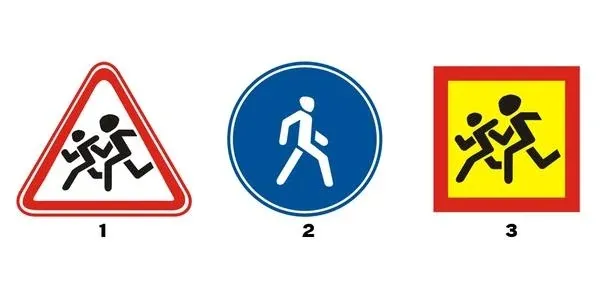
Number 1 is road sign 1.23 “Children”. Number 2 is road sign 4.5.1 “Footpath”. Only number 3, the yellow square, is fitted to a vehicle.
Common trap: The same running children appear in both. The red-bordered triangle is a road sign. The yellow square with a red border is the “Carriage of children” identification sign.
Which signs should I know?
Section titled “Which signs should I know?”| Sign | What it looks like | Where it goes | What it tells you |
|---|---|---|---|
| “Carriage of children” | Yellow square, red border, figure from sign 1.23 | Front and rear | An organized group of children is on board |
| “Deaf driver” | Yellow disc with three black circles | Front and rear | The driver is deaf or deaf-and-mute |
| “Dangerous goods” | Rectangular panel showing the load’s hazards | Front and rear | The vehicle carries dangerous goods |
| “Road train” | Three orange lamps in a row | Cab roof | This is a truck with a trailer, a wheeled tractor or an articulated bus |
| “Studs” | White triangle, red border, letter Ш | Rear | The tyres are studded |

“Deaf driver”.
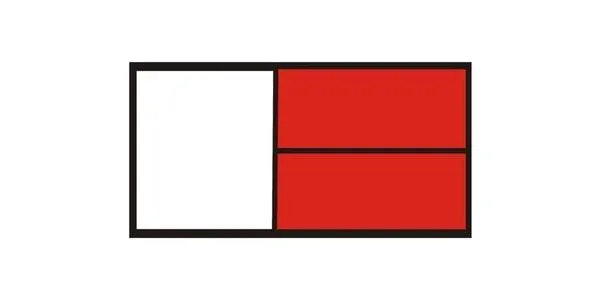
“Dangerous goods”. It isn’t a marking for heavy or large loads.
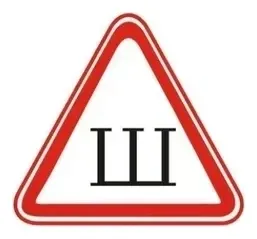
“Studs”. It looks like a warning sign, but it says nothing about the road ahead.
Which signs are compulsory?
Section titled “Which signs are compulsory?”- “Carriage of children”: compulsory when carrying organized groups of children. Displaying it at the front is correct, not a fault.
- Practical driving instruction sign: a training vehicle without it must not be used.
- “Oversized load”: needed on a load past the limits in the lesson on carrying loads.
- “Doctor” and “Disabled person”: displayed at the driver’s own wish, so leaving them off is not a fault. The “Disabled person” sign is a yellow square with the symbol from plate 8.17.
The Rules have no sign for a driver with up to 3 years of experience.
Remember: Ask where the sign is. On a vehicle, it tells you about that vehicle. At the roadside, it tells you about the road.
Extra: Driving around marked vehicles
Not from the question bank.
Give extra room to any vehicle carrying dangerous goods, and don’t park beside it. Around a children’s bus, slow down and expect children to appear from behind it. Studded tyres can throw small stones, so stay further back on loose or icy surfaces.
Try it yourself
Section titled “Try it yourself”Which sign goes on the front and rear of a vehicle carrying an organized group of children?
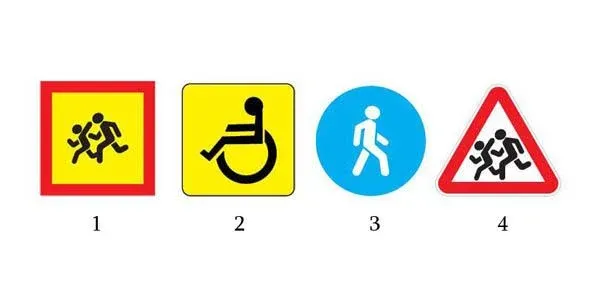
Number 1. Number 2 is the “Disabled person” sign. Numbers 3 and 4 are road signs.
Which truck shows it is a road train?
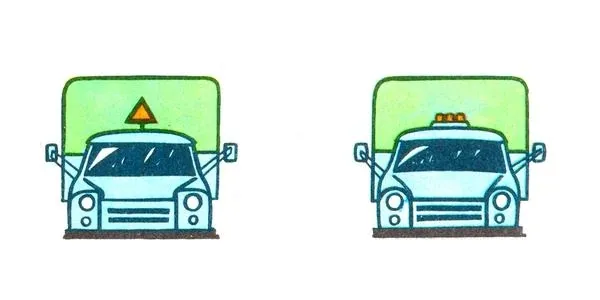
The right one, with three orange lamps in a row.
Key points
Section titled “Key points”- Identification signs are fitted to the vehicle. Road signs stand at the roadside.
- Yellow square with a red border: children. Yellow disc with three black circles: deaf driver.
- Three orange lamps: road train. White triangle with Ш: studded tyres.
- “Doctor” and “Disabled person” are optional. The driving instruction sign is compulsory.
Practice questions
Section titled “Practice questions”Question 27. Cars fitted with such an identification sign are those which
- Transport dangerous goods.
- Are driven by disabled persons.
- Are driven by deaf or deaf-and-mute drivers.
- Are driven by drivers with up to 3 years of driving experience.
Show answer
Correct: 3. Are driven by deaf or deaf-and-mute drivers.
Under the order on vehicle identification signs (point 175, Form No. 3), the “Deaf driver” identification sign - a yellow disc bearing three small black circles - is fitted to the front and rear of cars driven by deaf or deaf-and-mute drivers, which is the marked answer. It is not the “Dangerous goods” sign, which is a rectangular orange-and-white panel carried by vehicles transporting dangerous goods, and it is not the voluntary “Disabled person” sign, a yellow square bearing the 8.17 symbol used on vehicles driven by or carrying disabled persons of groups 1 and 2. The Rules provide no identification sign at all for a driver with up to 3 years of driving experience.
Question 30. Vehicles equipped with such an identification sign are those which:
- Are driven by disabled persons.
- Transport heavy-weight and large-dimension loads.
- Transport dangerous goods.
- Are driven by deaf or deaf-mute drivers.
Show answer
Correct: 3. Transport dangerous goods.
Under the order on vehicle identification signs (point 175, Form No. 3), the “Dangerous goods” identification sign - an orange-and-white rectangle of 690 x 300 mm carrying the marking of the load’s hazardous properties - is fitted to the front and rear of vehicles transporting dangerous goods, which is the marked answer. It is not the “Disabled person” sign, a yellow square bearing the 8.17 symbol, and not the “Deaf driver” sign, a yellow disc with three black dots. Nor is it a marking for heavy or large-dimension loads, which indicate entirely different circumstances. The vehicle carrying this panel is therefore one transporting dangerous goods.
Question 33. Which of those placed is used as the identification sign of a road train?
- The left sign.
- The right sign.
- Both signs.
Show answer
Correct: 2. The right sign.
Under the Rules (point 175, Form No. 3) the “Road train” identification sign is three orange lamps arranged horizontally on the roof of the cab of a lorry with a trailer, a wheeled tractor or an articulated bus. Only the right-hand sign shows that arrangement of three orange lamps, so it is the one used to identify a road train. The left-hand sign is a different identification sign - a single triangle on the cab roof - so “Both signs.” is wrong. The right sign is therefore the correct answer.
Question 44. What does this identification sign mean?
- Ahead is a road section with an uneven carriageway.
- Ahead is a road section with three lanes for travel in the given direction.
- Studded tyres are fitted on the mechanical vehicle.
Show answer
Correct: 3. Studded tyres are fitted on the mechanical vehicle.
This is the “Studs” identification sign - under the Rules (Form No. 3) a white equilateral triangle with its apex upwards, a red border and the letter Ш - which is fitted to the rear of mechanical vehicles running on studded tyres. “Studded tyres are fitted on the mechanical vehicle.” is therefore correct. “Ahead is a road section with an uneven carriageway.” describes a warning ROAD sign, not a sign carried on a vehicle, and a section with three lanes in the given direction would be shown by a lane information sign of the 5.15 group - also a road sign. This one is fixed to the vehicle itself.
Question 48. Which of these signs is considered a vehicle identification sign?
- 1
- 2
- 3
Show answer
Correct: 3. 3
Vehicle identification signs, under point 175 of the Rules and Form No. 3, are fitted to the VEHICLE itself. In the picture only number 3 is one: the “Carriage of children” identification sign, a yellow square with a red border bearing the figure from sign 1.23. Number 1 is the warning road sign 1.23 “Children” - a red-bordered triangle - and number 2 is the mandatory road sign 4.5.1 “Footpath”, a blue disc; both of those are erected at the roadside, not carried on a vehicle. Sign 3 is therefore the correct choice.
Question 51. Which of the signs is placed on the front and rear sides of vehicles when transporting organised groups of children?
- 1
- 2
- 3
- 4
Show answer
Correct: 1. 1
On the front and rear of vehicles carrying organised groups of children, Form No. 3 of the Rules requires the “Carriage of children” identification sign - a yellow SQUARE with a red border bearing the figure from sign 1.23 - and under point 155 such carriage is performed by a bus fitted with those very signs. That is number 1. Number 4 carries the same running-children figure but is the red-bordered TRIANGLE, warning sign 1.23 “Children”, which stands at the roadside and not on a vehicle. Number 2 is the “Disabled person” identification sign and number 3 is the road sign 4.5.1 “Footpath”. Sign 1 is therefore correct.