Actions on the Road
A rule about “overtaking” or “parking” only makes sense if you know exactly what that word covers. These terms are defined in Article 2 of the RA law and point 3 of the Traffic Rules, and the exam tests the exact wording.
Stopping or parking?
Section titled “Stopping or parking?”Both mean deliberately bringing the vehicle to a standstill. Time and purpose tell them apart.
- Stopping: up to 5 minutes, or the time needed for a passenger to board or alight, or to load or unload.
- Parking: more than 5 minutes, except to prevent a collision with another road user or an obstacle, for a passenger to board or alight, to load or unload, and in other cases provided by legislation.
Common trap: “Stopping because a passenger asked” is not the definition. The law looks at time and purpose, not at who asked.
What is a forced stop?
Section titled “What is a forced stop?”A forced stop is one you did not choose. The vehicle comes to a standstill because of:
- A malfunction of the vehicle.
- The physical or mental state of the driver or a passenger.
- The load being carried.
- A danger or another obstacle appearing on the road.
- A prohibiting signal of a traffic light or traffic officer, or the need to give way.
So an unexpected red light and a traffic jam are covered too. When a question lists them with a breakdown, the answer is “all the listed cases”.
What is an obstacle?
Section titled “What is an obstacle?”Under point 3 of the Traffic Rules, an obstacle is a stationary object in a lane that stops drivers continuing along that lane: a damaged or faulty vehicle, a foreign object, damage to the road surface and the like.
Common trap: A car stopped in a traffic jam is not an obstacle. It is part of the traffic stream and will move when the stream does.
What does “give way” really mean?
Section titled “What does “give way” really mean?”To give way means you must not continue, resume moving or make any manoeuvre if this may force other drivers to change direction or speed suddenly.
The word “suddenly” decides the exam question. Giving way is a duty not to obstruct, not an order to stop every time.
Which moves have their own name?
Section titled “Which moves have their own name?”| Term | Meaning |
|---|---|
| Starting to move | The moment the vehicle moves off from a stopping or parking place, whether or not it changes into the next lane. |
| Changing lanes | Leaving your lane, or your row within a marked lane, and keeping your initial direction. |
| Turn | A manoeuvre to enter another road or an area adjacent to the road. |
| U-turn | A manoeuvre to change your direction to the oncoming direction. |
Driving into a yard or a car park is still a turn. A U-turn is the manoeuvre itself, not the driving that follows it.
Manoeuvring is the name for this whole group: starting to move (moving out into the next lane), changing lanes, changing direction (a turn or U-turn), stopping (by changing lanes) and reversing.
Remember: The brackets are part of the definition. Pulling away or stopping is a manoeuvre only when you move across into another lane.
Passing, overtaking or bypassing?
Section titled “Passing, overtaking or bypassing?”All three get you ahead of something. Ask two questions: is it moving, and did you leave your lane?
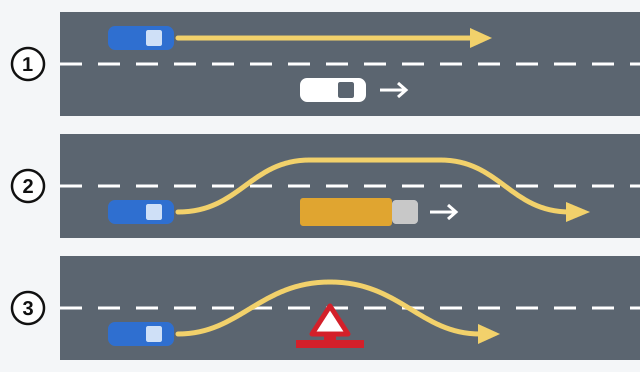
| Name | What you get ahead of | Do you leave your lane? | |
|---|---|---|---|
| 1 | Passing | One or several moving vehicles | No |
| 2 | Overtaking | One or several moving vehicles | Yes |
| 3 | Bypassing an obstacle | A stationary obstacle in your lane | Yes |
Common trap: Overtaking doesn’t require going into the oncoming lane. Leaving the lane you occupy is enough.
What do “insufficient visibility” and “dark time of day” mean?
Section titled “What do “insufficient visibility” and “dark time of day” mean?”Insufficient visibility means road visibility or a visibility distance of up to 300 metres in fog, rain, snowfall or other weather unfavourable for road safety. Weather is part of the definition, so darkness alone doesn’t make it insufficient visibility.
The dark time of day is the period between the end of evening twilight and the beginning of morning twilight. The law fixes no clock hours for it, and it doesn’t begin at sunset: during twilight there is still some light.
Try it yourself
Section titled “Try it yourself”What manoeuvre is the driver of the grey car performing?
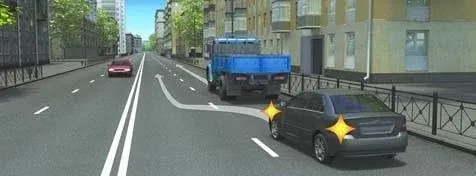
Overtaking. The truck is moving and the car has left its lane. It would be passing if the car stayed in its lane, and bypassing if the truck were a stationary obstacle.
You stop to unload boxes, and it takes 12 minutes. Are you parked? No. More than 5 minutes is fine for unloading, so this is still stopping.
Key points
Section titled “Key points”- Stopping: up to 5 minutes, or as long as boarding, alighting, loading or unloading takes. Parking: longer, for other reasons.
- A forced stop covers breakdowns, danger, the load, red lights and traffic jams.
- A car queuing in a jam is not an obstacle.
- Giving way means not forcing others to change speed or direction suddenly.
- A turn can lead into another road or an adjacent area.
- Passing stays in the lane. Overtaking leaves it. Bypassing goes round something stationary.
- Insufficient visibility: up to 300 metres in bad weather. Dark time of day: from twilight to twilight.
Practice questions
Section titled “Practice questions”Question 151. According to the RA law “On ensuring road traffic safety”, a forced stop is considered:
- An interruption of movement connected with the unexpected switching on of a prohibiting traffic-light signal.
- An interruption of movement connected with a traffic jam formed on the road.
- Bringing the vehicle to a stationary state because of a danger conditioned by a malfunction of the vehicle, by the physical and (or) mental state of the driver (passenger) and (or) by the carriage of the load, or because of another obstacle appearing on the road.
- All the listed cases.
Show answer
Correct: 4. All the listed cases.
Under Article 2 of the RA law “On ensuring road traffic safety”, a forced stop is bringing a vehicle to a stationary state both because of a malfunction, the driver’s or passenger’s physical and (or) mental state, the load being carried, a danger or another obstacle appearing on the road, and in order to obey a prohibiting signal of a traffic light or a traffic controller or to give way to other vehicles. So “An interruption of movement connected with the unexpected switching on of a prohibiting traffic-light signal.” falls under obeying a prohibiting signal, and “An interruption of movement connected with a traffic jam formed on the road.” falls under an obstacle appearing on the road. Since the definition covers all three situations listed, “All the listed cases.” is correct.
Question 152. According to the RA law “On ensuring road traffic safety”, insufficient visibility is considered:
- The visibility distance of the road during the dark time of day.
- The visibility distance of the road in built-up areas, in conditions of absence of artificial lighting of the carriageway.
- Road visibility and (or) a visibility distance of up to 300 metres in conditions of fog, rain, snowfall and (or) other weather unfavourable for ensuring road traffic safety.
Show answer
Correct: 3. Road visibility and (or) a visibility distance of up to 300 metres in conditions of fog, rain, snowfall and (or) other weather unfavourable for ensuring road traffic safety.
Under Article 2 of the RA law “On ensuring road traffic safety”, insufficient visibility means road visibility and (or) a visibility distance of up to 300 metres in fog, rain, snowfall and (or) other weather unfavourable for ensuring road traffic safety. That is exactly what the option naming fog, rain and snowfall together with the visibility distance of up to 300 metres says, so it is correct. “The visibility distance of the road during the dark time of day.” and “The visibility distance of the road in built-up areas, in conditions of absence of artificial lighting of the carriageway.” describe other concepts and are not the definition of insufficient visibility.
Question 153. According to the RA law “On ensuring road traffic safety”, stopping is considered:
- Deliberately bringing the vehicle to a stationary state for up to 5 minutes, or for the time necessary for a passenger to board or alight and (or) for loading or unloading the vehicle.
- Bringing the vehicle to a stationary state for more than 5 minutes, if it is not connected with boarding or alighting of passengers or with loading or unloading of the vehicle.
Show answer
Correct: 1. Deliberately bringing the vehicle to a stationary state for up to 5 minutes, or for the time necessary for a passenger to board or alight and (or) for loading or unloading the vehicle.
Under Article 2 of the RA law “On ensuring road traffic safety”, stopping is the deliberate bringing of a vehicle to a stationary state for up to 5 minutes, or for the time necessary for a passenger to board or alight and (or) for loading or unloading the vehicle. “Bringing the vehicle to a stationary state for more than 5 minutes, if it is not connected with boarding or alighting of passengers or with loading or unloading of the vehicle.” is the definition of PARKING rather than of stopping, which is why it is wrong.
Question 172. According to the RA law “On ensuring road traffic safety”, the dark time of day is considered:
- In autumn and winter, the period from 20:00 in the evening until 8:00 in the morning; in spring and summer, the period from 22:00 in the evening until 6:00 in the morning.
- The period between the end of evening twilight and the beginning of morning twilight.
- The period of absence of solar illumination.
Show answer
Correct: 2. The period between the end of evening twilight and the beginning of morning twilight.
According to Article 2 of the RA law “On ensuring road traffic safety”, which sets out the basic concepts, the dark time of day is “The period between the end of evening twilight and the beginning of morning twilight” - the boundary is the light itself, not the clock. That is why the law fixes no hours, and the option giving 20:00 to 8:00 in autumn and winter and 22:00 to 6:00 in spring and summer is wrong. “The period of absence of solar illumination” is wrong too: during twilight the sun has already set, yet there is still enough light, so it is not yet the dark time of day.
Question 182. According to the RA law “On ensuring road traffic safety”, stopping is considered:
- Bringing the vehicle to a stationary state, connected with a passenger’s demand.
- Deliberately bringing the vehicle to a stationary state for a time of more than 5 minutes, if it is not connected with boarding or alighting of passengers or with loading or unloading of the vehicle.
- Deliberately bringing the vehicle to a stationary state for up to 5 minutes, or for the time necessary for a passenger to board or alight and (or) for loading or unloading the vehicle.
Show answer
Correct: 3. Deliberately bringing the vehicle to a stationary state for up to 5 minutes, or for the time necessary for a passenger to board or alight and (or) for loading or unloading the vehicle.
Article 2 of the RA law “On ensuring road traffic safety”, which defines the terms it uses, treats as stopping the deliberate bringing of a vehicle to a stationary state for up to 5 minutes, or for the time needed for a passenger to board or alight and (or) for the vehicle to be loaded or unloaded. Standing still for more than 5 minutes when that is not connected with boarding, alighting, loading or unloading is parking rather than stopping, so that option describes the wrong term. Bringing the vehicle to a stationary state merely because a passenger demands it is not the test the law uses either - what matters is the time and the purpose.
Question 192. Which of the indicated stationary objects is not an obstacle?
- Damage to the surface of the carriageway
- A foreign object
- A faulty or immobile car
- A car stopped because of a traffic jam
Show answer
Correct: 4. A car stopped because of a traffic jam
Under sub-point 12 of point 3 of the Traffic Rules, an obstacle is a stationary object standing in a lane of the carriageway - a damaged or faulty vehicle, a foreign object, damage to the road surface and the like - which deprives drivers of the possibility of continuing along that lane. “Damage to the surface of the carriageway”, “A foreign object” and “A faulty or immobile car” are each named in that definition, so each of them is an obstacle. “A car stopped because of a traffic jam” is not an obstacle: it is a vehicle queuing in the traffic stream, and it will move on as soon as the stream does, so the lane is not closed to following drivers.
Question 199. To give way to other vehicles means
- The driver must not continue or resume movement or perform any manoeuvre if this may force the drivers of other vehicles to change their direction of movement or speed.
- The driver must not continue or resume movement or perform any manoeuvre if this may force the drivers of other vehicles to change their direction of movement or speed suddenly
- To stop the vehicle unconditionally.
Show answer
Correct: 2. The driver must not continue or resume movement or perform any manoeuvre if this may force the drivers of other vehicles to change their direction of movement or speed suddenly
Under Article 2 of the RA Law on Ensuring Road Traffic Safety, giving way means the driver must not continue or resume movement or perform any manoeuvre if this may force the drivers of other vehicles to change their direction of movement or speed suddenly. The word “suddenly” is what decides the question, so the correct answer is the wording that ends “…to change their direction of movement or speed suddenly”. The otherwise identical option that leaves “suddenly” out would forbid any effect at all on other drivers, which the definition does not require, and “To stop the vehicle unconditionally.” is wrong because giving way is a duty not to obstruct, not a duty to stop.
Question 202. Changing lanes is considered to be
- a vehicle leaving the traffic lane it occupies while keeping the initial direction of travel
- a vehicle leaving the row it occupies within the limits of a marked traffic lane, while keeping the initial direction of travel
- Both of the stated cases
Show answer
Correct: 3. Both of the stated cases
Point 3 of the Traffic Rules defines changing lanes as a vehicle leaving the traffic lane it occupies, or leaving the row it occupies within the limits of a marked traffic lane, while keeping the initial direction of travel. The two descriptions offered are the two halves of that one definition, which is why “Both of the stated cases” is correct. Choosing only “a vehicle leaving the traffic lane it occupies while keeping the initial direction of travel” or only “a vehicle leaving the row it occupies within the limits of a marked traffic lane, while keeping the initial direction of travel” would drop a case the Rules expressly include.
Question 203. A turn is considered to be
- a manoeuvre performed by a vehicle for the purpose of entering another road
- a manoeuvre performed by a vehicle for the purpose of entering another road or an area adjacent to the road
Show answer
Correct: 2. a manoeuvre performed by a vehicle for the purpose of entering another road or an area adjacent to the road
Point 3 of the Traffic Rules defines a turn as a manoeuvre performed by a vehicle for the purpose of entering another road or an area adjacent to the road. Driving into a yard, a car park or a filling station is therefore just as much a turn as turning into another street, which is why “a manoeuvre performed by a vehicle for the purpose of entering another road or an area adjacent to the road” is correct. The option reading “a manoeuvre performed by a vehicle for the purpose of entering another road” leaves adjacent areas out and is narrower than the Rules.
Question 204. A U-turn is considered to be
- driving a vehicle in the oncoming direction;
- a manoeuvre performed for the purpose of changing a vehicle’s direction of movement to the oncoming direction.
Show answer
Correct: 2. a manoeuvre performed for the purpose of changing a vehicle’s direction of movement to the oncoming direction.
Point 3 of the Traffic Rules defines a U-turn as a manoeuvre performed for the purpose of changing a vehicle’s direction of movement to the oncoming direction. What makes it a U-turn is the manoeuvre together with its purpose, so “a manoeuvre performed for the purpose of changing a vehicle’s direction of movement to the oncoming direction.” is correct. “Driving a vehicle in the oncoming direction” describes how the car is travelling once the manoeuvre is over — it would equally fit driving the wrong way down a one-way street — and not the manoeuvre itself.
Question 205. Passing (without leaving your lane) is considered to be
- moving ahead of one or several vehicles that are in motion, without leaving the lane occupied
- moving ahead of one or several vehicles that are in motion, involving leaving the lane occupied
Show answer
Correct: 1. moving ahead of one or several vehicles that are in motion, without leaving the lane occupied
Point 3 of the Traffic Rules defines passing as moving ahead of one or several vehicles that are in motion without leaving the lane occupied, and overtaking as the same movement ahead but involving leaving the lane occupied. So “moving ahead of one or several vehicles that are in motion, without leaving the lane occupied” is correct: staying inside your own lane is exactly what separates passing from overtaking. The option reading “moving ahead of one or several vehicles that are in motion, involving leaving the lane occupied” is the definition of overtaking, not of passing.
Question 206. Starting to move is considered to be
- The moment a vehicle starts moving from a stopping or parking place, whether or not it involves changing lanes into an adjacent traffic lane
- The moment a vehicle starts moving from a stopping or parking place, involving changing lanes into an adjacent traffic lane.
Show answer
Correct: 1. The moment a vehicle starts moving from a stopping or parking place, whether or not it involves changing lanes into an adjacent traffic lane
Point 3 of the Traffic Rules defines starting to move as the moment a vehicle starts moving from a stopping or parking place, whether or not it involves changing lanes into an adjacent traffic lane. A car that pulls away and stays in its own lane has begun moving just as much as one that pulls out into the next lane, so the answer is “The moment a vehicle starts moving from a stopping or parking place, whether or not it involves changing lanes into an adjacent traffic lane”. The option that requires the move to involve changing lanes into an adjacent traffic lane covers only half of the cases the Rules include.
Question 207. Manoeuvring is considered to be
- a vehicle starting to move (involving moving out into an adjacent traffic lane), changing lanes, changing the direction of movement, stopping (by changing lanes) and reversing
- a vehicle starting to move, changing lanes, changing the direction of movement, stopping and reversing
Show answer
Correct: 1. a vehicle starting to move (involving moving out into an adjacent traffic lane), changing lanes, changing the direction of movement, stopping (by changing lanes) and reversing
Point 3 of the Traffic Rules defines manoeuvring as a vehicle starting to move (involving moving out into an adjacent traffic lane), changing lanes, changing the direction of movement (turning or making a U-turn), stopping (by changing lanes) and reversing. The bracketed qualifiers are part of the definition: pulling away or stopping counts as a manoeuvre only when the vehicle moves across into another lane. That is why the correct answer is the wording that keeps “(involving moving out into an adjacent traffic lane)” and “stopping (by changing lanes)”, while “a vehicle starting to move, changing lanes, changing the direction of movement, stopping and reversing” drops them and would make every start and every stop a manoeuvre.
Question 845. Overtaking of vehicles means:
- Passing ahead of one or several moving vehicles, involving leaving the occupied lane into the oncoming traffic lane.
- Passing ahead of one or several moving vehicles, involving leaving the occupied lane.
Show answer
Correct: 2. Passing ahead of one or several moving vehicles, involving leaving the occupied lane.
Under point 3, sub-point 11 of the Traffic Rules, overtaking is “Passing ahead of one or several moving vehicles, involving leaving the occupied lane.” — the correct answer repeats the definition word for word. The definition does not require driving out into the lane of oncoming traffic, so the option that adds “into the oncoming traffic lane” narrows the term without any basis in the Rules. Passing ahead without leaving the occupied lane is not overtaking at all, but passing by, in the sense of sub-point 14 of the same point.
Question 900. What manoeuvre is the passenger car driver performing?
- Passing
- Overtaking
- Bypassing
Show answer
Correct: 2. Overtaking
The light passenger car is getting ahead of a lorry that is in motion, and to do it has moved out of the lane it occupied - which is overtaking, as sub-point 11 of point 3 of the Traffic Rules defines it. “Passing” is wrong because under sub-point 14 passing means getting ahead WITHOUT leaving the lane you occupy, and in the picture the car has left its lane. “Bypassing” is wrong because under sub-point 12 bypassing refers to a stationary obstacle standing in the traffic lane, whereas the lorry here is moving.
Question 1013. According to the RA law “On ensuring road traffic safety”, parking is considered:
- Deliberately bringing the vehicle to a stationary state for more than 5 minutes, if it is not connected with boarding or alighting of passengers or with loading or unloading of the vehicle.
- Deliberately bringing the vehicle to a stationary state for more than 5 minutes, except for preventing a collision with another road traffic participant or with any obstacle, for a passenger to board or alight and (or) for loading or unloading the vehicle, as well as other cases provided by legislation.
Show answer
Correct: 2. Deliberately bringing the vehicle to a stationary state for more than 5 minutes, except for preventing a collision with another road traffic participant or with any obstacle, for a passenger to board or alight and (or) for loading or unloading the vehicle, as well as other cases provided by legislation.
Article 2 of the RA law “On ensuring road traffic safety” defines parking as deliberately bringing a vehicle to a stationary state for more than 5 minutes, except to prevent a collision with another road traffic participant or with an obstacle, for a passenger to board or alight and (or) for the vehicle to be loaded or unloaded, and in other cases provided by legislation. The option carrying that full list of exceptions is the definition the law gives. The other option keeps the 5-minute rule but drops the exception for preventing a collision and the reference to other cases provided by legislation, so it is narrower than the law.