Stopping Signs and Lines
Most stopping questions come down to reading a sign or a yellow line correctly. Learn what each one bans, where its effect ends and who is exempt, and these questions become quick marks.
How do I tell the signs apart?
Section titled “How do I tell the signs apart?”Count the stripes across the disc.
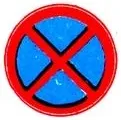
Sign 3.27 “No stopping”: two crossing stripes. It bans stopping and parking.
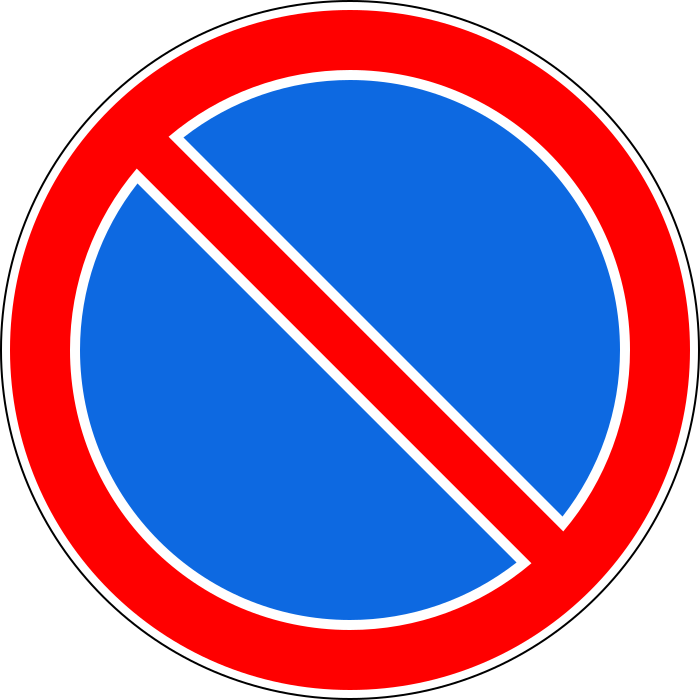
Sign 3.28 “No parking”: one stripe. It bans parking only.
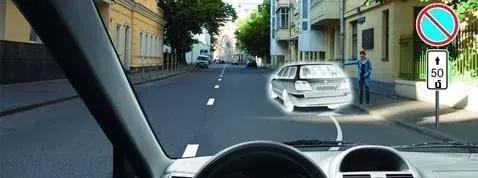
Remember: Under sign 3.28 you may still stop. Picking up a passenger is stopping. So is unloading, for as long as the work takes.
Common trap: The exam offers “permitted if it lasts up to 5 minutes” for unloading under sign 3.28. That limit is irrelevant, because a halt to unload is stopping however long it lasts.
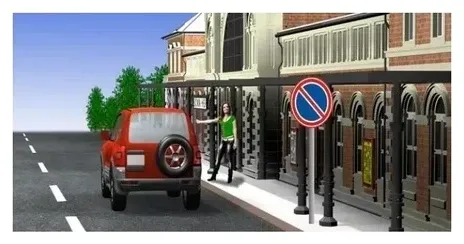
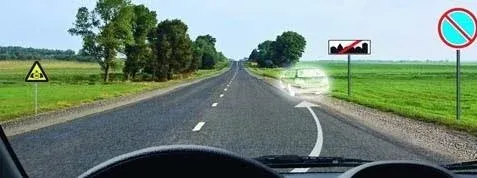
Stopping here is allowed. Sign 3.28 doesn’t ban it, the 3 m rule counts solid lines and not broken ones, and this is not an odd or even day sign.
Odd and even days
Section titled “Odd and even days”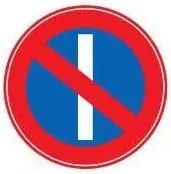
Sign 3.29 “No parking on odd days of the month”: one vertical bar.
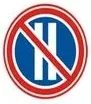
Sign 3.30 “No parking on even days of the month”: two vertical bars.
Where the two signs are used together, on opposite sides of the street, vehicles move from one side to the other between 19:00 and 21:00. So on an odd day, parking on the side with sign 3.29 is prohibited during the day and becomes possible after 19:00.
Where does a sign start and end?
Section titled “Where does a sign start and end?”Signs 3.27 to 3.30 work like this, unless a plate or a marking says otherwise:
- They start at the sign. A place before the sign is not covered.
- They cover only the side of the road where they stand.
- They end at the nearest intersection after the sign. A secondary road joining yours counts.
- In a built-up area with no intersection, they end at the end of the built-up area.
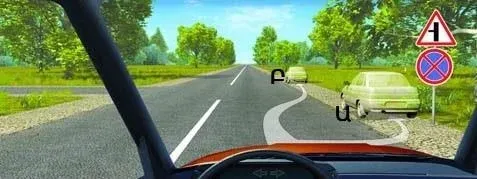
The triangular sign above announces a side road ahead. Ա (A) is inside the zone. Բ (B) is past the side road, so it may stop there.
Plates that change the zone
Section titled “Plates that change the zone”| Plate | What it tells you |
|---|---|
| 8.2.2, an up arrow and a distance | The zone runs that far ahead of the sign |
| 8.2.3, one down arrow | The zone ends here, so the ban is behind you |
| 8.2.4, two arrows | You are inside the zone, so the ban runs both before and after the sign |

Plate 8.2.3: past this sign you are free of it. Before it, you are still in the zone.

Plate 8.2.4: no stopping on either side of the sign.
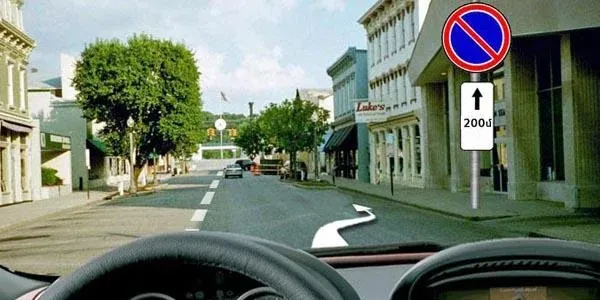
A plate 8.2.2 of 200 m under sign 3.28. You may still stop here to pick up passengers.
Common trap: Sign 3.27 with a down arrow looks like a ban starting. It is the opposite. Parking is allowed past the sign, and the ban covers the road before it.
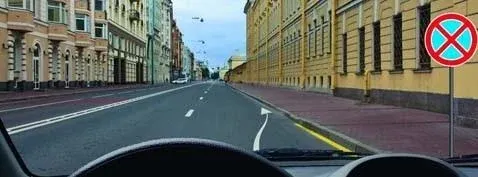
Sign 3.27 used with the solid yellow marking 1.4 has a simpler rule: the ban runs only as far as the marking does.
Parking zones
Section titled “Parking zones”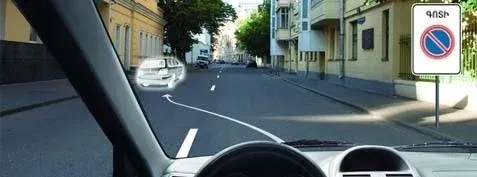
Sign 5.27 “Zone with parking restriction” starts an area of restricted parking.
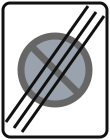
Sign 5.28 “End of the zone with parking restriction”. The next intersection doesn’t end the zone: only this sign does.
Who is exempt?
Section titled “Who is exempt?”Signs 3.28 to 3.30 don’t apply to:
- Vehicles driven by, or carrying, disabled persons of groups I and II.
- Taxis with the meter switched on.
- Postal special-communication vehicles with the prescribed colour scheme.
Public-use vehicles are not on this list.
Sign 3.27 has none of these exemptions. With no plate under it, it binds everyone. A plate can change that:
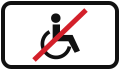
Plate 8.18 “Except for disabled persons”: the sign doesn’t apply to cars carrying the “Disabled person” identification sign. The plate looks for the sign on the car.
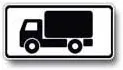
Plate 8.4.1 “Type of vehicle”: sign 3.28 with this plate applies only to trucks over 3.5 t. A car and a motorcycle may park there, but a 4 t truck may not.
What do the yellow lines mean?
Section titled “What do the yellow lines mean?”| Line | Where you see it | What it bans | Used with |
|---|---|---|---|
| Solid yellow, marking 1.4 | Along the edge of the carriageway or on the top of the kerb | Stopping and parking | On its own, or with sign 3.27 |
| Broken yellow, marking 1.10 | Along the edge of the carriageway | Parking only | On its own, or with sign 3.28 |
Think of it as a pair: a solid line matches two stripes, and a broken line matches one.
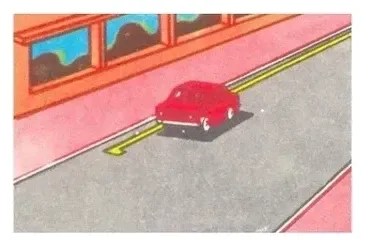
No sign is needed. The solid yellow line alone bans stopping here.
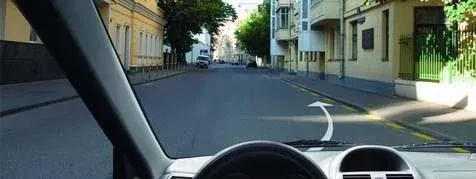
Broken yellow: stopping is allowed for every vehicle.
Common trap: You can’t escape a solid yellow line by mounting the pavement. Stopping on the pavement is prohibited too, and motorcycles get no exception.
How does a parking place sign work?
Section titled “How does a parking place sign work?”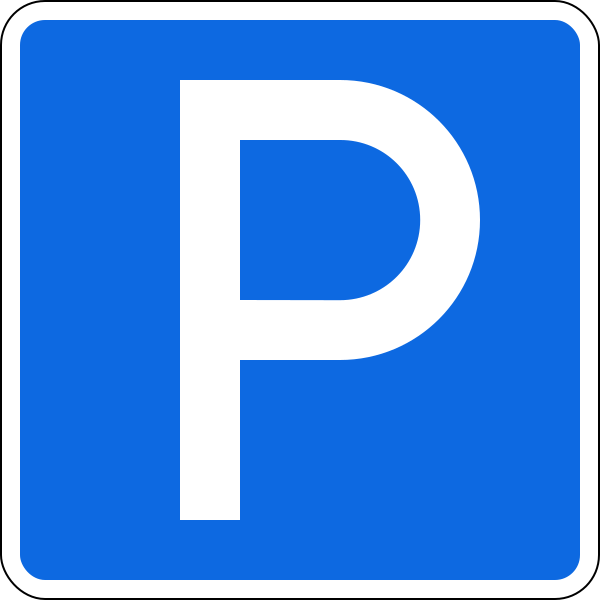
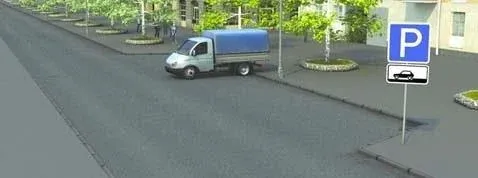
Sign 6.4 “Parking place”. A plate under it shows how to stand, and you must stand that way (point 80).
| Plate | How you stand | Who may |
|---|---|---|
| 8.6.1 | On the carriageway, along the kerb | All vehicles |
| 8.6.2 to 8.6.9 | Using the pavement edge | Light passenger cars and motorcycles |
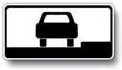
Plate 8.6.1.
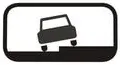
Plate 8.6.2.
Point 81 allows the pavement edge only to light passenger cars, motorcycles, mopeds and bicycles.
Common trap: The exam offers “yes, if the permissible maximum mass exceeds 3.5 tonnes”. The ban depends on the type of vehicle, not its mass. A truck under 3.5 t may not park on the pavement edge either.
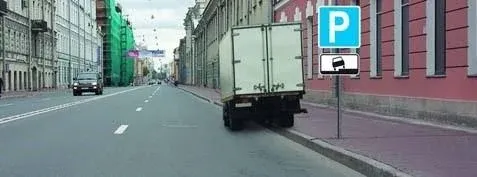
The plate allows this manner to cars and motorcycles only, so the truck driver is in breach.
Try it yourself
Section titled “Try it yourself”The same street, two different plates. First, plate 8.6.1.
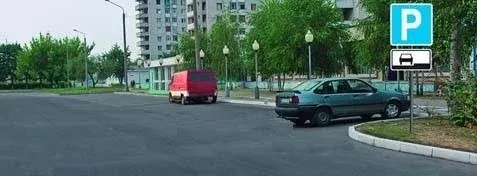
Who broke the rules? The passenger-car driver. The plate puts vehicles on the carriageway, along the edge. The van stands that way and the car doesn’t.
Now the plate shows a car on the pavement edge.
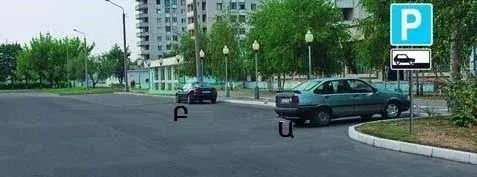
Who broke the rules? Բ (B). Ա (A) stands as the plate shows, and Բ (B) doesn’t.
You are on a one-way road, and sign 3.28 stands on the right.
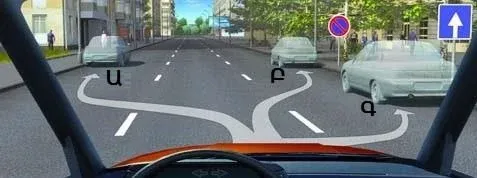
Where may you park? Ա (A) or Գ (C). Ա (A) is on the left, where the sign doesn’t reach, and one-way roads allow the left side. Գ (C) is before the sign. Բ (B) is past it, on the same side.
Key points
Section titled “Key points”- Sign 3.27 and solid yellow 1.4 ban stopping and parking. Sign 3.28 and broken yellow 1.10 ban parking only.
- Signs 3.27 to 3.30 run from the sign to the nearest intersection, on their own side of the road only.
- Down arrow: the zone ends here. Two arrows: you are inside it. Up arrow and distance: its length ahead.
- Disabled drivers and taxis with the meter on are exempt from signs 3.28 to 3.30. Nobody is exempt from 3.27 unless a plate says so.
- Sign 6.4 with plate 8.6.1 is for all vehicles. Parking on the pavement edge is never for trucks.
Practice questions
Section titled “Practice questions”Question 89. Parking at the indicated place is
- Permitted
- Permitted only during daylight hours
- Prohibited
Show answer
Correct: 1. Permitted
Sign 3.28 “No parking” stands on the right of the road, and ahead of it is sign 5.24.2 “End of built-up area”. Under the signs annex the effect of signs 3.26 to 3.30 extends as far as the nearest intersection, and in a built-up area with no intersection, as far as the end of the built-up area. The place the arrow indicates lies beyond the “End of built-up area” sign, where the effect of 3.28 has already ceased, so parking there is permitted. “Permitted only during daylight hours” is wrong because no time restriction is imposed at all, and “Prohibited” is wrong because the prohibition zone ended at the end of the built-up area.
Question 90. Has the truck driver violated the parking rules
- Yes
- Yes, if the permissible maximum mass exceeds 3.5 tonnes
- No
Show answer
Correct: 1. Yes
Sign 6.4 “Parking place” (“P”) is accompanied by plate 8.6.2 “Method of placing a vehicle in a parking place”. Under the annex on signs, plate 8.6.1 (standing on the carriageway along the sidewalk) applies to all vehicles, while the kerbside parking methods shown by plates 8.6.2-8.6.9 apply only to passenger cars and motorcycles; point 81 of the Traffic Rules likewise permits parking at the edge of the sidewalk only to passenger cars, motorcycles, mopeds and bicycles. The truck stands in exactly that kerbside manner, which is not available to it, so its driver has violated the parking rules. The answer “Yes, if the permissible maximum mass exceeds 3.5 tonnes” is wrong, because the restriction depends on the type of vehicle, not on its mass, and the answer “No” is wrong, because parking in this manner is prohibited for a truck.
Question 93. Stopping at the indicated place is
- Permitted
- Prohibited
Show answer
Correct: 1. Permitted
Sign 3.27 “No stopping” is used here together with the solid yellow marking 1.4 drawn along the kerb, and under the appendix on signs its zone of effect is in that case determined by the length of the marking rather than by the usual distance. The place the arrow points to lies past the end of the yellow marking, so the sign no longer applies there and stopping is permitted. “Prohibited” is wrong because the ban runs only alongside marking 1.4, which ends before the indicated place.
Question 99. Is stopping permitted at the indicated place for the purpose of picking up a passenger?
- Yes
- No
Show answer
Correct: 1. Yes
The sign is 3.28 “No parking”, which under the Rules prohibits only the PARKING of vehicles and not stopping. Halting briefly to pick up or set down a passenger is stopping, not parking, so it is permitted inside the zone of action of sign 3.28. Stopping at the indicated place to pick up a passenger is therefore permitted. “No” is wrong because 3.28 forbids parking alone - unlike 3.27 “No stopping”, which carries two crossing stripes and would forbid this halt as well.
Question 102. Parking at the indicated place
- Is permitted
- Is prohibited
Show answer
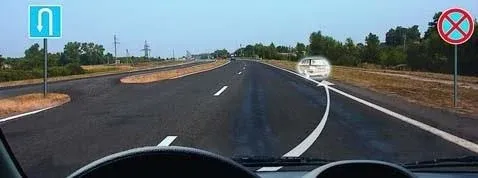
Correct: 2. Is prohibited
Sign 3.27 “Stopping prohibited” bans both stopping and parking of vehicles under the Rules. Since the sign prohibits even stopping, parking is prohibited all the more, so parking at the indicated place is prohibited. The answer “Is permitted” is wrong, because 3.27 prohibits stopping and parking throughout its zone of action.
Question 110. Unloading the vehicle in the zone of effect of this road sign
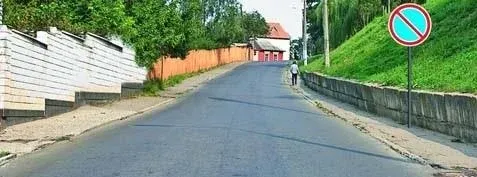
- Is permitted if it lasts up to 5 minutes
- Is permitted, regardless of the duration
- Is prohibited
Show answer
Correct: 2. Is permitted, regardless of the duration
The sign is 3.28 “No parking”, which under the Rules prohibits only the parking of vehicles and not stopping. Unloading a vehicle is stopping rather than parking - the law treats a halt made for loading or unloading as stopping however long the work takes - so it is permitted in the zone of action of sign 3.28, regardless of the duration. “Is permitted if it lasts up to 5 minutes” is wrong because the 5 minute threshold is irrelevant under 3.28, which bans parking and not stopping, and “Is prohibited” is wrong because 3.28 does not forbid a halt made to unload.
Question 112. In this situation, stopping for the purpose of picking up a passenger
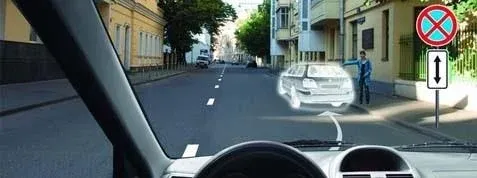
- Is permitted after the sign
- Is permitted before the sign
- Is prohibited in both cases
Show answer
Correct: 3. Is prohibited in both cases
The sign is 3.27 “No stopping”, which prohibits both stopping and parking, and the plate beneath it is 8.2.4 “Zone of action”, telling the driver that he is already INSIDE the zone of action of a sign of the 3.27 to 3.30 group. Stopping to pick up a passenger is therefore prohibited both before the sign and after it. “Is permitted after the sign” and “Is permitted before the sign” are wrong because with plate 8.2.4 the prohibited zone extends on both sides of the sign - the sign marks a point within the ban, not its beginning.
Question 119. Is parking permitted at the indicated place?
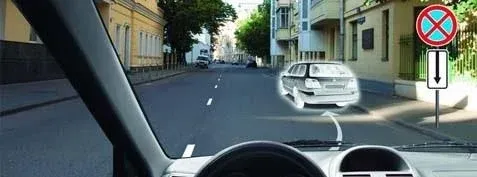
- Yes
- Permitted only for the residents of the indicated place
- No
Show answer
Correct: 1. Yes
The sign is 3.27 “No stopping”, but it is used with plate 8.2.3 “Zone of action”, whose single downward arrow marks the END of the zone of action of a sign of the 3.27 to 3.30 group. Past this point the ban on stopping and parking is over, so parking at the indicated place is permitted. “Permitted only for the residents of the indicated place” is wrong because plate 8.2.3 introduces no restriction about residents at all, and “No” is wrong because the plate stops the effect of sign 3.27 at precisely that place.
Question 123. Has the truck driver violated the parking rules?
- No
- Yes, if the permissible maximum mass is greater than 3.5 tonnes
- Yes
Show answer
Correct: 3. Yes
The “P” — sign 6.4 “Parking place” — is accompanied by one of the plates 8.6.2–8.6.9, “Method of placing a vehicle in a parking place” (the car is shown standing with use of the pavement), and under the appendix on road signs that kerbside form of parking is provided only for passenger cars and motorcycles. point 81 of the Traffic Rules likewise allows standing for parking on the edge of the pavement bordering the carriageway only to passenger cars, motorcycles, mopeds and bicycles. The truck stands in exactly that kerbside form, which is not available to it, so the driver has violated the parking rules. The answer “Yes, if the permissible maximum mass is greater than 3.5 tonnes” is wrong, because the ban depends on the type of vehicle and not on its mass — it also covers a truck of up to 3.5 t; and “No” is wrong, because that form of standing is not allowed for a truck.
Question 124. On odd days of the month, may you park in the indicated place?
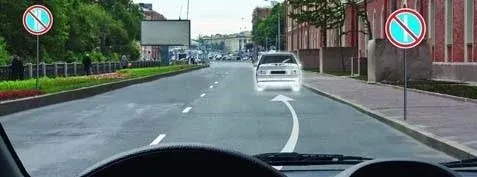
- Yes
- Yes, after 19:00
- No
Show answer
Correct: 2. Yes, after 19:00
Signs 3.29 “No parking on odd days of the month” and 3.30 “No parking on even days of the month” are in use here at the same time, on opposite sides of the street. Under the Rules, where 3.29 and 3.30 are applied together vehicles are moved from one side of the road to the other between 19:00 and 21:00. On an odd day, parking at the indicated place is therefore prohibited during the day but becomes possible after 19:00, once that changeover period begins. “Yes” without qualification is wrong because the odd-day prohibition holds until 19:00, and “No” is wrong because parking does become possible after 19:00.
Question 130. Which driver has violated the parking rules?
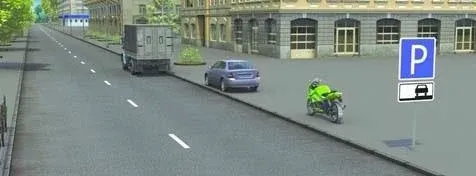
- No one
- The truck driver
- The motorcycle and light passenger car drivers
Show answer
Correct: 1. No one
Under the “P” of sign 6.4 “Parking place” is plate 8.6.1 “Manner of positioning a vehicle in parking places”, which shows the car on the carriageway alongside the kerb and which, under the road-signs annex, prescribes that manner for ALL vehicles - unlike the other plates of that group, which apply to light passenger cars and motorcycles only. The lorry, the light passenger car and the motorcycle are all standing exactly that way, on the carriageway parallel to the kerb, so no one has broken the parking rules. “The truck driver” and “The motorcycle and light passenger car drivers” are wrong because plate 8.6.1 permits every type of vehicle to park in this manner.
Question 132. Parking after the overpass
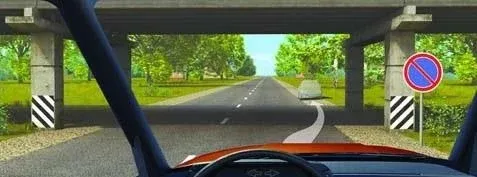
- Permitted
- Prohibited
Show answer
Correct: 2. Prohibited
Beyond the overpass, on the right, stands sign 3.28 “No parking” - a blue disc with a red border and a single red diagonal stripe - which under the road-signs section means that the parking of vehicles is prohibited. The place the arrow indicates lies inside its zone of action, and there is no supplementary plate here shortening or cancelling that zone, so parking there is prohibited and “Permitted” is wrong. Do not confuse this sign with 3.27 “No stopping”, which carries two crossing stripes and prohibits stopping as well as parking: 3.28 does not prohibit stopping, so pulling up here briefly, for instance to let a passenger in, is allowed.
Question 432. Which vehicles are allowed to park?
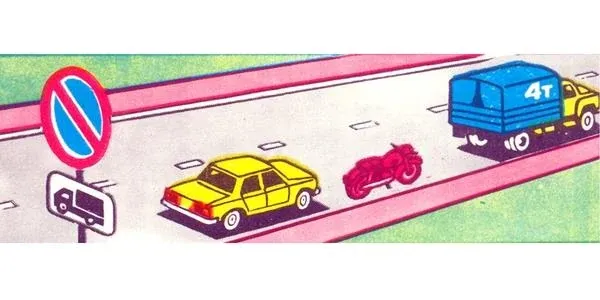
- Only the motorcycle.
- Only the truck.
- Only the light passenger car.
- The light passenger car and the motorcycle.
- All vehicles.
Show answer
Correct: 4. The light passenger car and the motorcycle.
Sign 3.28 “No parking” is in force with plate 8.4.1, and under the Rules that plate extends the sign’s effect only to lorries with a permissible maximum mass of more than 3.5 tonnes. The parking prohibition therefore reaches only the truck, which is marked 4 t, while the light passenger car and the motorcycle are not covered by the plate and may park. Parking is thus permitted to the light passenger car and the motorcycle; the single-vehicle answers and “All vehicles.” are wrong, because the truck is barred and the other two are not.
Question 434. Is it permitted to let a passenger off at that place on the road where a solid yellow line is drawn on the top surface of the curb and the “Stopping is prohibited” sign is installed?

- It is permitted.
- It is prohibited.
- It is permitted in the absence of public-use vehicles.
- It is permitted only to public-use vehicles.
Show answer
Correct: 2. It is prohibited.
The solid yellow line on the top surface of the curb is marking 1.4, which shows where stopping and parking are prohibited and is used together with sign 3.27 “Stopping is prohibited”. Under the Rules, sign 3.27 prohibits both stopping and parking. Letting a passenger off requires a stop, so it is prohibited here. The options that permit it — in general, in the absence of public-use vehicles, or only for them — are wrong, because “Stopping is prohibited” bans any stop, including a stop to let a passenger off.
Question 441. Which vehicles are permitted to park within the zone of effect of this road sign?
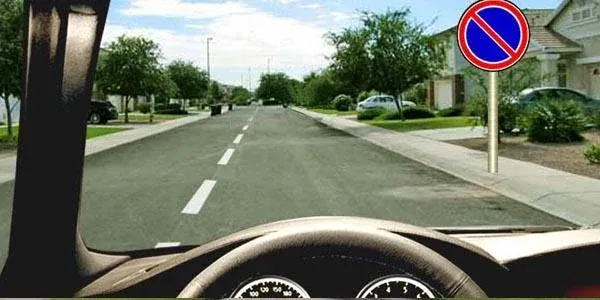
- Only public transport vehicles.
- Vehicles driven by disabled persons and taxis with the meter switched on.
Show answer
Correct: 2. Vehicles driven by disabled persons and taxis with the meter switched on.
The sign shown is 3.28 “No parking”. Under the general provisions on applying the signs, the effect of signs 3.28 to 3.30 does not extend to vehicles driven by or carrying disabled persons of groups I and II, nor to taxis with the meter switched on (nor to postal special-communication vehicles bearing the prescribed colour scheme). Parking in this sign’s zone is therefore permitted to vehicles driven by disabled persons and to taxis with the meter on. “Only public transport vehicles.” is wrong because public-use transport is exempted from signs 3.1 to 3.3, 3.18 and 3.19 - the entry and turn prohibitions - and not from the parking sign 3.28.
Question 463. Which car is allowed to stop within the zone of effect of these signs?
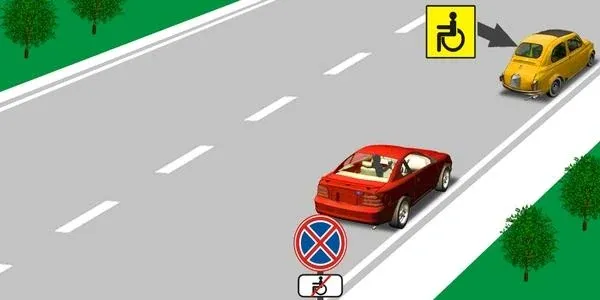
- The red one.
- Both cars.
- Neither one.
- The yellow one, fitted with the “Disabled” identification sign.
Show answer
Correct: 4. The yellow one, fitted with the “Disabled” identification sign.
The sign is 3.27 “No stopping” with plate 8.18 “Except for disabled persons”, which states that the sign’s effect does not extend to cars carrying the “Disabled person” identification sign. The yellow car carries that sign, so it is allowed to stop, while the red one has no such sign and may not. “The red one.”, “Both cars.” and “Neither one.” are wrong, because the exception under plate 8.18 works only for a vehicle actually displaying the “Disabled person” identification sign - it is the sign on the car, not the driver, that the plate looks for.
Question 468. Is stopping allowed at the indicated place?
- It is allowed.
- It is prohibited.
Show answer
Correct: 2. It is prohibited.
A solid yellow line is drawn here on the top surface of the kerb - marking 1.4 - which under the Rules indicates the places where the stopping and parking of vehicles are prohibited. Stopping at the indicated place is therefore prohibited. “It is allowed.” is wrong because marking 1.4 forbids stopping there, and it does so on its own: no sign is needed alongside it.
Question 469. Is stopping the car allowed at this place?
- It is prohibited, because the distance between the broken line of the marking and the stopped vehicle is less than 3 metres.
- It is prohibited on even days of the month.
- It is allowed.
Show answer
Correct: 3. It is allowed.
Sign 3.28 “No parking” prohibits the parking of vehicles but not stopping. The driver here has merely stopped to pick up a passenger, which is stopping and not parking, so it is allowed. The first option is wrong because the 3 metre rule of point 84 measures the distance to a SOLID line, not to a broken one, so a broken line imposes no such limit. “It is prohibited on even days of the month.” is wrong because this is the ordinary sign 3.28, not the odd- and even-day signs 3.29 and 3.30.
Question 475. In which answer are the drivers who violated the stopping rules listed correctly?
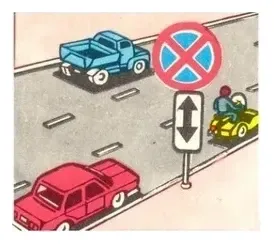
- The drivers of the red car and the motorcycle.
- The driver of the blue car.
- The driver of the motorcycle.
- The drivers of all the vehicles.
Show answer
Correct: 4. The drivers of all the vehicles.
Sign 3.27 “Stopping prohibited” is shown with plate 8.2.4 “Zone of effect”, which states that the vehicle is inside the zone of effect of sign 3.27. The blue truck, the red car and the motorcycle have all stopped inside that zone, where sign 3.27 prohibits both stopping and parking, so the drivers of all the vehicles violated the stopping rules. The options that list only some of them are wrong, because the driver of every vehicle standing in the sign’s zone is in violation.
Question 480. Is the vehicle allowed to stop at the indicated place to let passengers off?
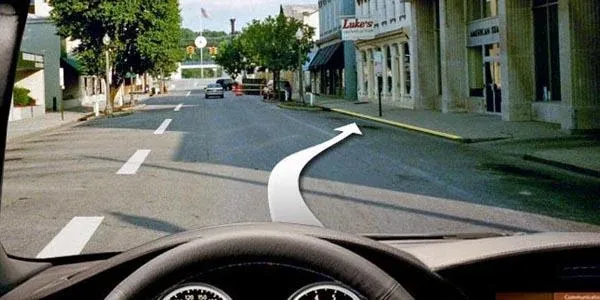
- It is allowed.
- It is prohibited.
- It is allowed, but by mounting the pavement.
Show answer
Correct: 2. It is prohibited.
A solid yellow line - marking 1.4 - is drawn along the kerb at the indicated place, and under the Rules it shows where the stopping and parking of vehicles are prohibited. Letting passengers off requires stopping, and stopping there is prohibited, so the vehicle may not stand at that place. “It is allowed.” is wrong, and “It is allowed, but by mounting the pavement.” is wrong because stopping on the pavement is itself prohibited - driving up onto it does not escape the marking.
Question 492. In the zone of effect of the given sign, which vehicles are permitted to stop?
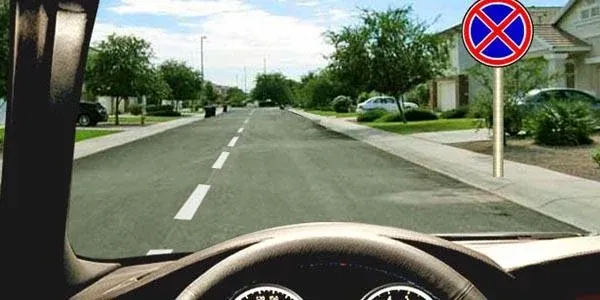
- Only public-use vehicles.
- Only vehicles driven by disabled persons.
- Only taxis with the meter switched on.
- It is prohibited to all.
Show answer
Correct: 4. It is prohibited to all.
Sign 3.27 “No stopping” prohibits both stopping and parking. The exemptions for vehicles driven by disabled persons and for taxis with the meter switched on attach to the PARKING signs 3.28 to 3.30, not to 3.27, and here there is no supplementary plate, so no class is released. Stopping in this sign’s zone is therefore prohibited to all. The options naming public-use vehicles, vehicles driven by disabled persons or taxis with the meter on are wrong because none of them is exempted from the effect of sign 3.27.
Question 493. In the zone of effect of the indicated road signs, is it permitted to stop for the purpose of picking up passengers?
- It is permitted.
- It is prohibited.
Show answer
Correct: 1. It is permitted.
Sign 3.28 “No parking”, here with a plate showing its zone of action, prohibits the parking of vehicles but not stopping. A halt made to pick up passengers is stopping and not parking, so it remains permitted in the zone of these signs. “It is prohibited.” is wrong because 3.28 bars only parking - it is sign 3.27, with two crossing stripes, that would bar a short stop as well.
Question 512. Is parking permitted in the indicated place?
- It is prohibited
- It is permitted
Show answer
Correct: 1. It is prohibited
The sign here is 5.27 “Zone with parking restriction” - the plate bearing the word ZONE together with the no-parking symbol - which marks the place where an area of restricted parking begins. Parking at the indicated place is therefore prohibited. “It is permitted” is wrong because the sign’s effect covers the whole zone, running on until sign 5.28 “End of the zone with parking restriction”: unlike an ordinary prohibitory sign, it is not cancelled by the next intersection.
Question 516. Which driver has violated the parking rules?
- The truck driver
- The passenger-car driver
- No one
- Both drivers
Show answer
Correct: 2. The passenger-car driver
Sign 6.4 “Parking place” is in place with a plate of group 8.6 beneath it, on which the car is drawn parallel to the edge of the carriageway. Under point 80 of the Rules vehicles are placed in the manner laid down by that plate. The truck is standing in exactly that manner, parallel to the edge, so it is in no breach. The passenger car has been left at right angles to the edge, outside the position the plate requires, so it is its driver who has broken the parking rules. “The truck driver”, “No one” and “Both drivers” are wrong.
Question 517. Is the driver of a truck lighter than 3.5 tonnes permitted to park in the manner shown on the sign plate?
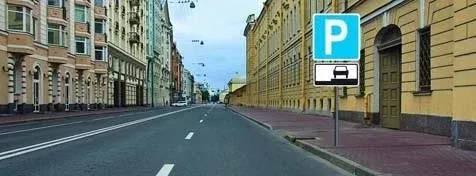
- Yes
- No
Show answer
Correct: 2. No
Sign 6.4 “Parking place” is in place with a plate showing the manner of standing at the pavement edge. Under point 81 of the Rules, standing at the pavement edge adjoining the carriageway for the purpose of parking is permitted ONLY to light passenger cars, motorcycles, mopeds and bicycles. A lorry is not in that list - the list names vehicle types and sets no weight limit - so even a light truck under 3.5 tonnes may not park in the manner shown on the plate. “Yes” is wrong because point 81 excludes lorries from pavement-edge parking however light they are.
Question 535. Is parking permitted at the indicated place
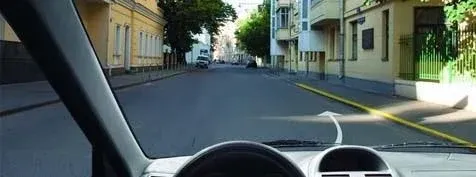
- It is permitted
- It is permitted, without mounting the sidewalk
- It is prohibited
Show answer
Correct: 3. It is prohibited
A solid yellow line is drawn over the kerb at the indicated place - marking 1.4 - which under the markings section of the Rules shows the places where stopping and parking are prohibited; it is used on its own or together with sign 3.27 “No stopping”, and it is drawn along the top of the kerb exactly as here. Parking at the indicated place is therefore prohibited. “It is permitted” is wrong because that line bars both stopping and parking, and “It is permitted, without mounting the sidewalk” is wrong because the prohibition attaches to that edge of the carriageway whether or not the wheels go up onto the pavement.
Question 540. Is stopping permitted at the indicated place
- Only for motorcycles
- No
- Yes
Show answer
Correct: 3. Yes
The broken yellow line along the edge of the carriageway is marking 1.10, which under the horizontal-markings section of the Rules shows ONLY the places where parking is prohibited; it is used on its own or with sign 3.28 “No parking”. Stopping, unlike parking, is not prohibited by that marking, so stopping at the indicated place is permitted. “No” would be right for the solid yellow line 1.4, which bars both stopping and parking, and “Only for motorcycles” is wrong because marking 1.10 draws no distinction by type of vehicle.
Question 546. Is parking permitted at the indicated place
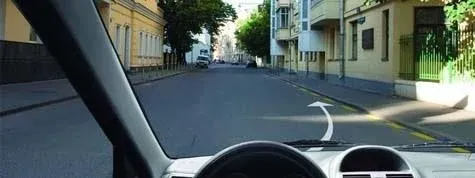
- It is prohibited
- Only on the sidewalk
- Only for motorcycles
- It is permitted
Show answer
Correct: 1. It is prohibited
A solid yellow line is drawn on the top surface of the kerb at the indicated place - marking 1.4 - which shows the places where both stopping and parking are prohibited, so parking there is prohibited to every vehicle. “Only on the sidewalk” is wrong because point 84 of the Rules prohibits stopping on pavements, and parking at the pavement edge is permitted only where sign 6.4 stands together with one of the plates such as 8.6.2 showing the manner of standing (point 81) - and neither is here. “Only for motorcycles” is wrong because the Rules provide no motorcycle exception to marking 1.4, and “It is permitted” contradicts it outright.
Question 1071. In which of the indicated places may you stop?
- Only Ա (A)
- Only Բ (B)
- None
Show answer
Correct: 2. Only Բ (B)
Under the appendix on road signs, the zone of action of sign 3.27 “Stopping prohibited” extends from the place where the sign stands as far as the nearest intersection beyond it - and the triangular priority sign above it, 2.3.3 “Adjoining of a secondary road”, is there precisely to announce that such an intersection lies ahead. Car Ա (A) is standing after the sign but before that intersection, that is inside the prohibited zone, so stopping there is not allowed. Car Բ (B) is beyond the intersection, where the sign’s effect has already ended, so stopping there is permitted and the correct answer is “Only Բ (B)”. “None” is wrong because the intersection interrupts the effect of sign 3.27, and at the place where Բ (B) stands there is no longer any prohibition.
Question 1080. In which place is it permitted to stop?
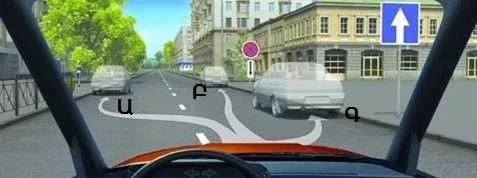
- Only Բ (B)
- Only Ա (A) and Բ (B)
- Only Ա (A) and Գ (C)
- In no place
Show answer
Correct: 2. Only Ա (A) and Բ (B)
The sign 3.27 “Stopping prohibited” on the right carries plate 8.2.3, whose downward arrow marks the END of the sign’s zone of action, and signs 3.27-3.30 act only on the side of the road on which they stand. Place Գ (C) is on the right BEFORE the sign, that is still inside the zone, so stopping there is prohibited, while place Բ (B) is past the sign where the zone has already ended, so stopping is permitted. Place Ա (A) is at the left-hand edge, which the sign on the right does not reach, and the road is one-way (sign 5.5), so under point 79 of the Rules stopping on the left-hand side is allowed. Stopping may therefore be made at Ա (A) and Բ (B), which is why “Only Բ (B)”, “Only Ա (A) and Գ (C)” and “In no place” are wrong.
Question 1084. In which of the indicated places may parking be done?
- Only Ա (A)
- Only Գ (C)
- Ա (A) or Գ (C)
Show answer
Correct: 3. Ա (A) or Գ (C)
Sign 3.28, “No parking”, stands at the right edge, and under the annex on road signs it applies only on the side of the road where it is installed, and only from the point of installation up to the nearest intersection after it. Place Բ (B) lies past that sign, on the right side, so parking there is prohibited, while place Գ (C) is before the sign and does not fall within its zone of effect. Place Ա (A) is on the left side, where sign 3.28 does not extend, and since sign 5.5 shows one-way traffic in a built-up area, point 79 of the Rules permits parking on the left side; parking may therefore be done at both Ա (A) and Գ (C), and the options “Only Ա (A)” and “Only Գ (C)” are incomplete.
Question 1089. Which driver has violated the parking rules?
- Only Ա (A)
- Only Բ (B)
- No one
Show answer
Correct: 2. Only Բ (B)
Sign 6.4 “Parking place” is in place here together with a plate of group 8.6, on which the car is drawn in side view, parallel to the edge and standing on the pavement. Under point 80 of the Rules vehicles are placed in the manner laid down by that plate. Driver Ա (A) has parked in exactly that manner - beyond the kerb, at the edge of the pavement - and has committed no breach. Driver Բ (B) has left the car out on the carriageway instead, that is otherwise than the plate requires, so it is Բ (B) who has broken the parking rules. “Only Ա (A)” and “No one” are therefore wrong.