Special Regulation Signs
These signs change the rules of the road you are on: which way traffic runs, who may use a lane, and which speed limit applies. They look harmless, because most are plain blue rectangles, yet several change what you may do.
What do they look like?
Section titled “What do they look like?”Most are blue squares or rectangles with a white picture. Three variations matter:
- Green means sign 5.1, the motorway.
- White is used for the town signs that bring in built-up area rules.
- A red diagonal means the end of what the sign started: 5.6 ends 5.5, 5.9 ends 5.8, 5.22 ends 5.21.
Some members, such as the exit signs 5.7.1 and 5.7.2, only report how the road ahead is arranged. They forbid no manoeuvre by themselves.
Road types
Section titled “Road types”| Sign | No. | Name | Meaning |
|---|---|---|---|
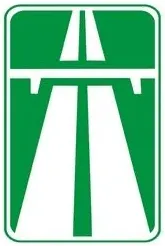 |
5.1 | Motorway | A motorway begins |
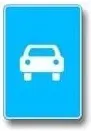 |
5.3 | Road for automobiles | Only automobiles, including buses, and motorcycles |
Mopeds, bicycles, horse-drawn carts, tractors and self-propelled machines may not use a road with sign 5.3. On both roads, vehicles whose speed can’t exceed 40 km/h are banned (points 116 and 117). Type comes first under 5.3, though: even a fast tractor stays out.
One-way and reversible roads
Section titled “One-way and reversible roads”| Sign | No. | Name | Meaning |
|---|---|---|---|
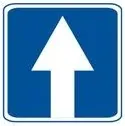 |
5.5 | Road with one-way traffic | Traffic runs one way across the full width |
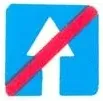 |
5.6 | End of one-way road | Oncoming traffic begins further ahead |
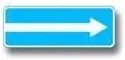 |
5.7.1 | Exit to a road with one-way traffic | The crossing road is one-way in the arrow’s direction |
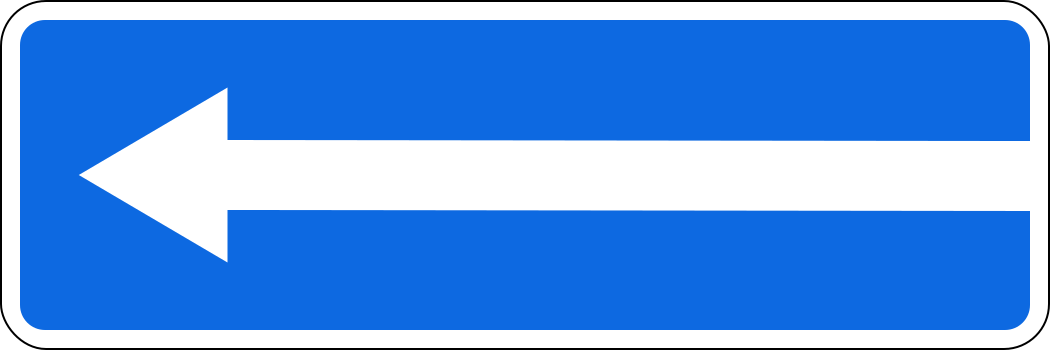 |
5.7.2 | Exit to a road with one-way traffic | The same, running left |
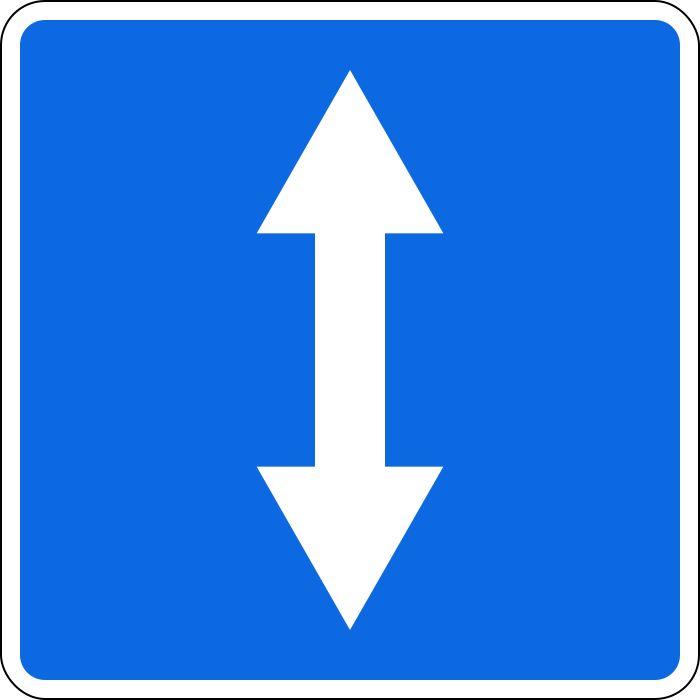 |
5.8 | Reversible traffic | The direction of one or more lanes can be reversed |
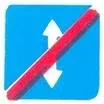 |
5.9 | End of reversible traffic | Reversible traffic ends |
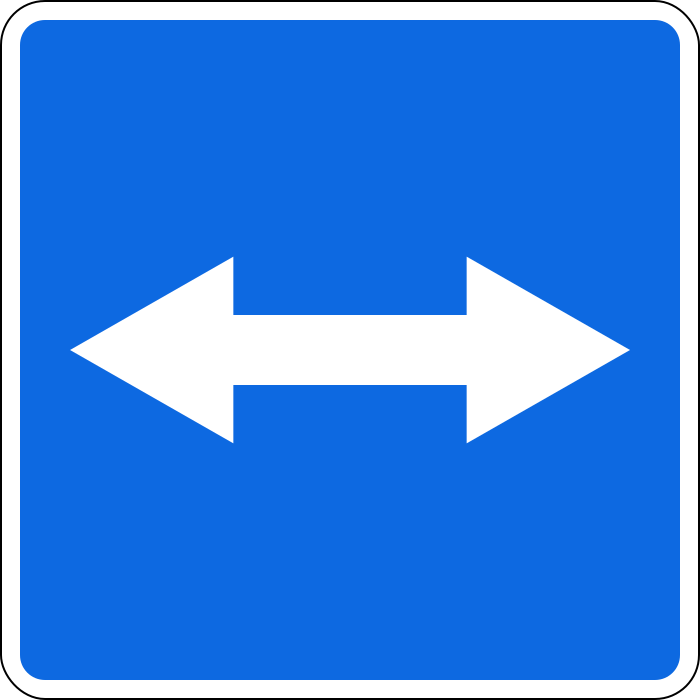 |
5.10 | Exit to a road with reversible traffic | The crossing road carries reversible traffic |
Common trap: A U-turn is prohibited on a one-way road (point 50), so under 5.5 you may go straight, right or left, but not back. Until you pass sign 5.6, the road is still one-way.
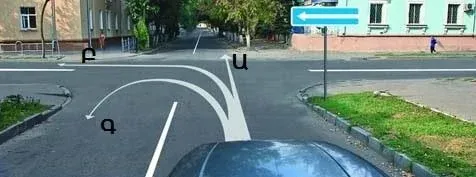
Signs 5.7.1 and 5.7.2 prohibit nothing by themselves. They don’t ban a U-turn. They just tell you that turning against the arrow means driving against the flow.
| Sign | No. | Name | Meaning |
|---|---|---|---|
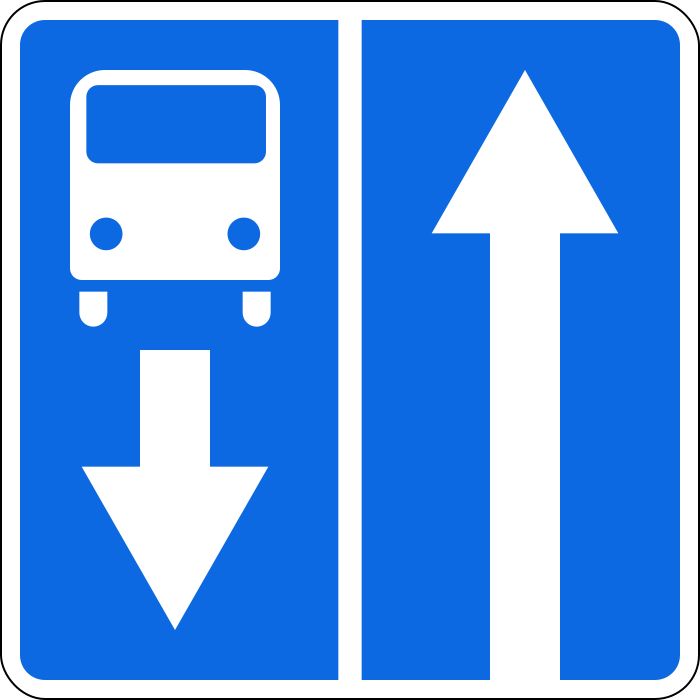 |
5.11.1 | Road with a lane for public-use transport vehicles | A lane for route vehicles runs against the general flow |
 |
5.12.1 | End of the road with a lane for public-use transport vehicles | That road ends |
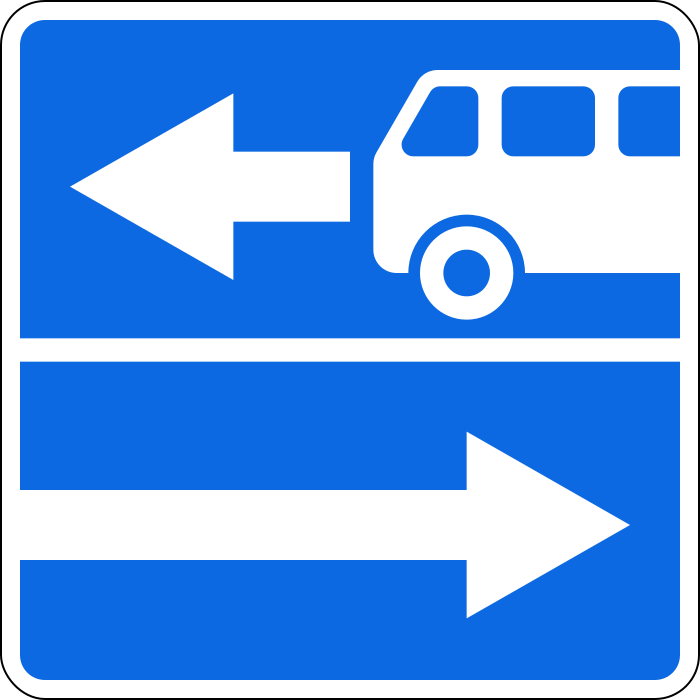 |
5.13.1 | Exit to a road with a lane for public-use transport vehicles | The crossing road has such a lane |
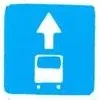 |
5.14 | Lane for public-use transport vehicles | The lane is reserved for route vehicles |
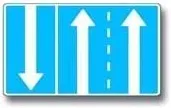 |
5.15.1 | Directions of travel by lanes | Which way each lane may go |
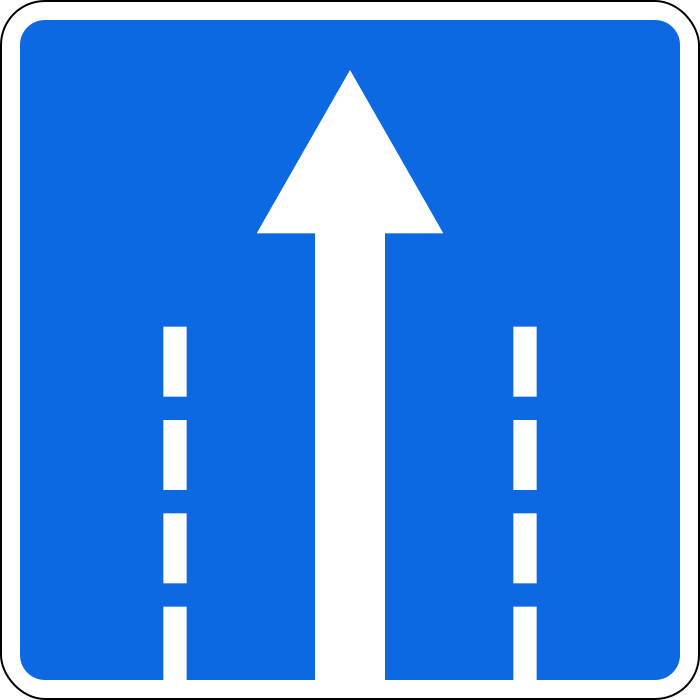 |
5.15.2 | Directions of travel by lane | The same, shown lane by lane |
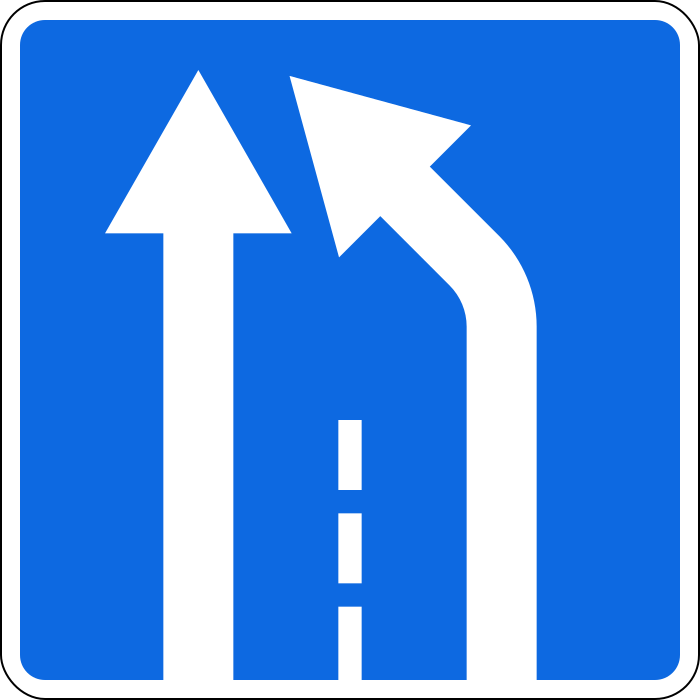 |
5.15.5 | End of lane | The lane ends, so move across |
Sign 5.15.3 “Beginning of a lane” announces an extra lane:
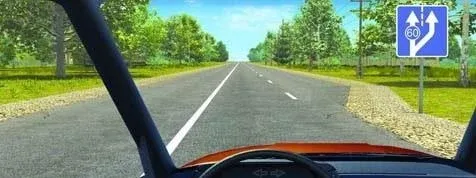
How do I read the exit signs with a bus? Sign 5.13.2 is the mirror image of 5.13.1. The plain arrow shows the general traffic, and the arrow with the bus shows the reserved lane. Follow the plain arrow.
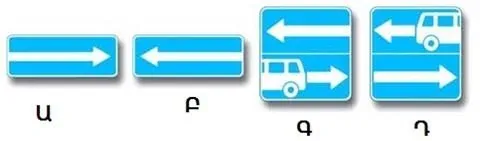
None of these prohibits a U-turn. Only sign 3.19 does that.
Other vehicles may not drive or stop in the lane (point 124). If a broken line separates it, you may enter it to turn off the road, or to pick up and set down passengers, without obstructing route vehicles.
Remember: Under signs 5.15.1 and 5.15.2, drive only where your lane’s arrows point. No green light can add a direction. A sign permitting a left turn from the left edge lane permits a U-turn from it too, but a left turn from any other lane doesn’t.
Stops, crossings and bumps
Section titled “Stops, crossings and bumps”| Sign | No. | Name | Meaning |
|---|---|---|---|
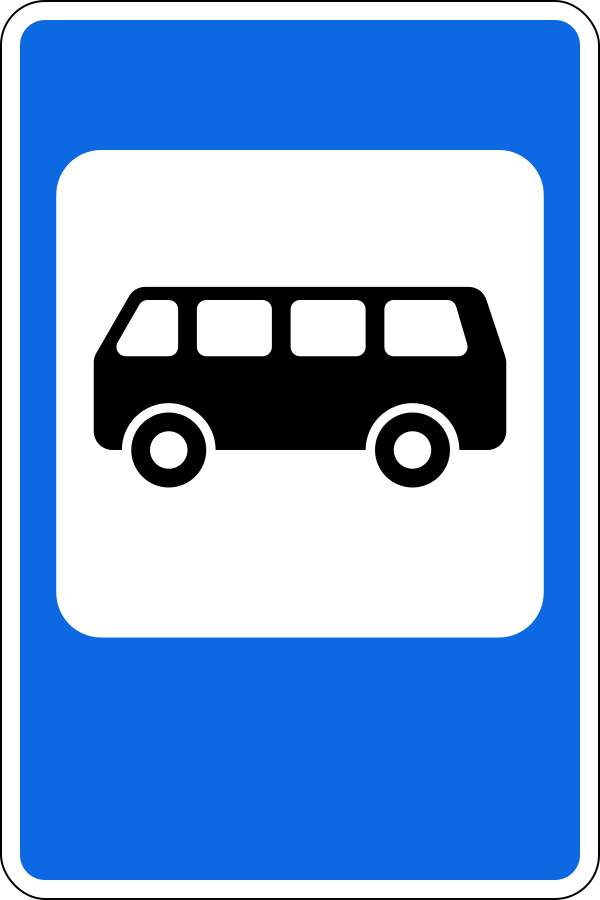 |
5.16 | Bus and (or) trolleybus stop | A stopping point for public transport |
 |
5.18 | Parking place for light passenger taxis | A place where taxis park |
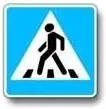 |
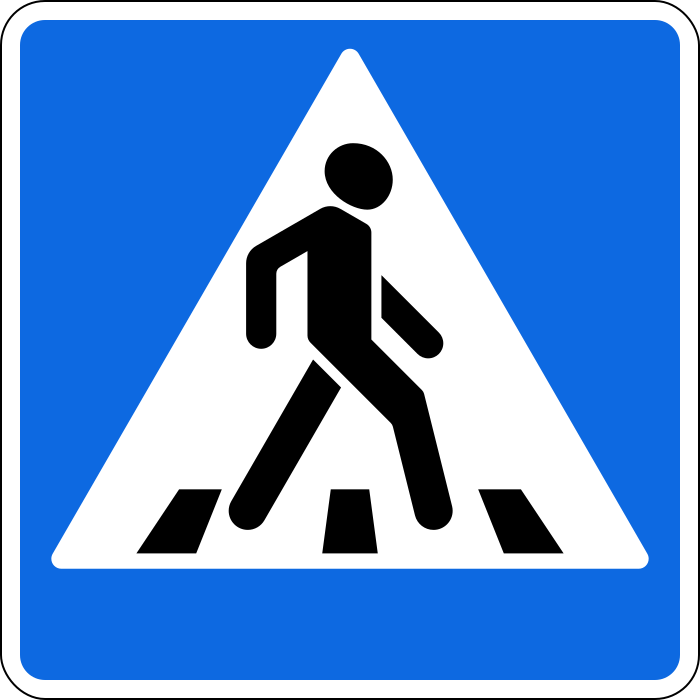
5.19.1 | Pedestrian crossing | Marks the crossing. With no markings, it stands at the far boundary |
 |
5.19.2 | Pedestrian crossing | Marks the crossing. With no markings, it stands at the near boundary |
 |
5.20 | Artificial bump | Marks the bump itself, at its near boundary |
Common trap: The same picture in a red triangle only warns ahead. Signs 1.22 and 1.17 announce what is coming. Signs 5.19.1, 5.19.2 and 5.20 mark the place itself. At a crossing, you give way to pedestrians.
Residential zones
Section titled “Residential zones”| Sign | No. | Name | Meaning |
|---|---|---|---|
 |
5.21 | Residential zone | Residential zone rules begin |
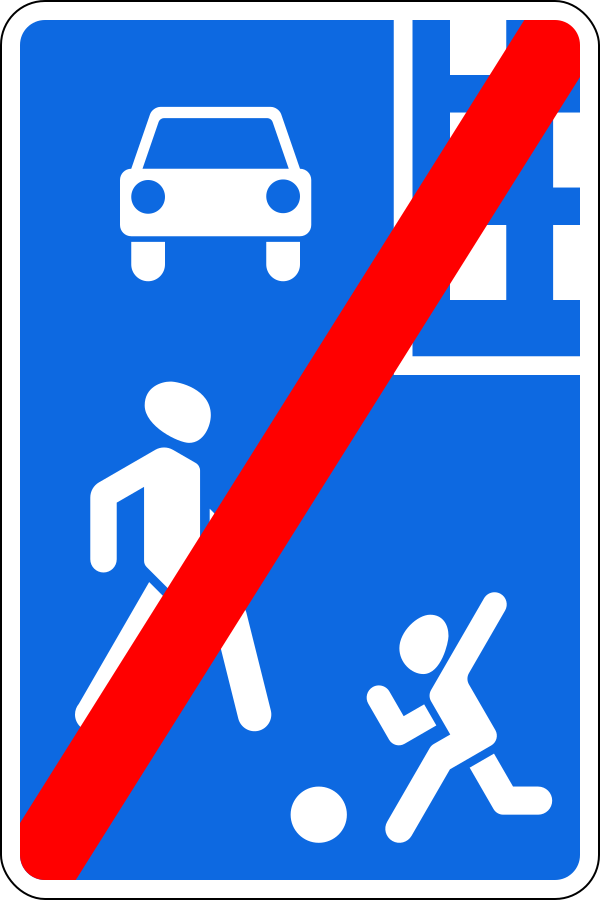 |
5.22 | End of residential zone | Those rules end |
Inside the zone the limit is 20 km/h for every vehicle. Pedestrians may walk on the pavement or the carriageway, and they have priority. Through traffic and learner driving are prohibited.
Leaving gives you no priority. It takes priority away: at sign 5.22 you must give way to other vehicles and must not obstruct pedestrians.
Built-up areas
Section titled “Built-up areas”Color decides everything here.
| Sign | No. | Name | Meaning |
|---|---|---|---|
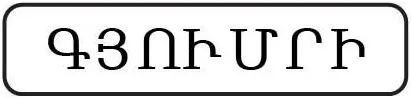 |
5.23.1 | Beginning of built-up area | Built-up area rules begin, so 60 km/h |
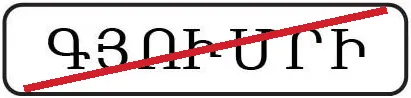 |
5.24.1 | End of built-up area | Those rules end |
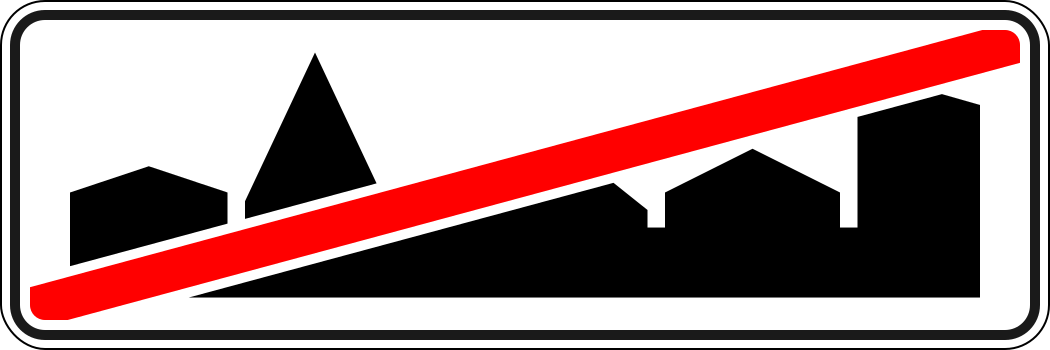 |
5.24.2 | End of built-up area | Those rules end |
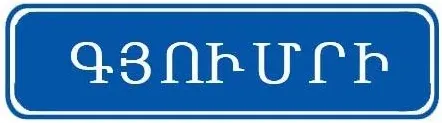 |
5.25 | Beginning of built-up area | Only gives the name. Built-up area rules do not apply |
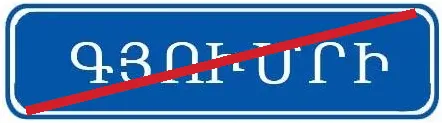 |
5.26 | End of built-up area | The named place ends. Built-up area rules don’t apply here either |
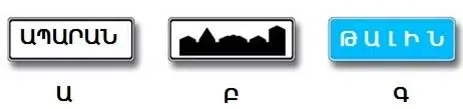
Ա (A) is 5.23.1 and Բ (B) is 5.23.2, the skyline version. Both bring in built-up area rules. Գ (C) is 5.25, and it doesn’t.
The rules begin at the white sign, not where the buildings begin.
Zone signs
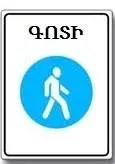
Section titled “Zone signs”A white rectangle with the word ZONE (in Armenian, ԳՈՏԻ) covers a whole area. Its effect isn’t ended by the next intersection, but by the matching end sign.
| Sign | No. | Name | Meaning |
|---|---|---|---|
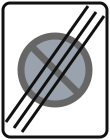 |
5.28 | End of the zone with parking restriction | Ends zone 5.27 |
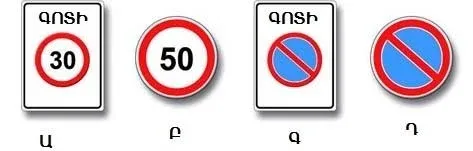
Ա (A) is 5.31 “Zone with a maximum speed limit”, which ends at sign 5.32. Գ (C) is 5.27 “Zone with parking restriction”. Բ (B) and Դ (D) are ordinary signs that last to the nearest intersection.
Sign 5.33 “Pedestrian zone” bans all vehicles, bicycles included.
Try it yourself
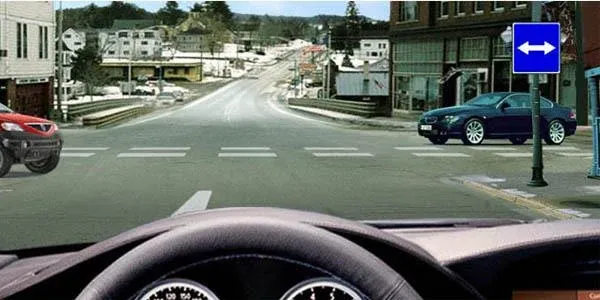
Section titled “Try it yourself”The blue square ahead is sign 5.5.
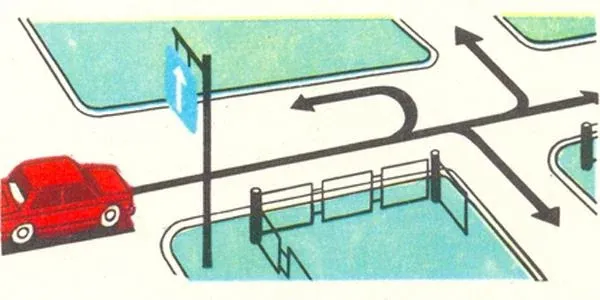
Which ways are open? Straight, right and left. The fourth path is a U-turn, which is prohibited on a one-way road.
You are leaving a residential zone, and a truck approaches from the left.
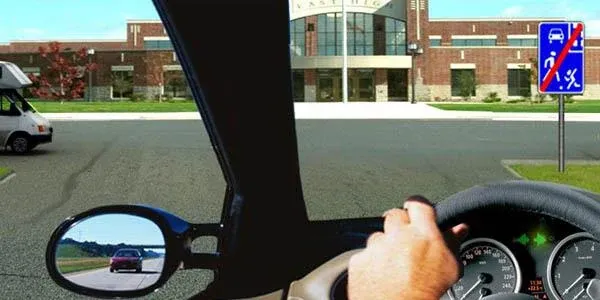
Must you give way? Yes. Leaving a residential zone gives you no priority.
You are in the far left lane, and the panel above shows only a left turn.
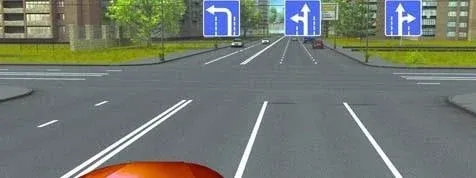
Where may you go? Left, or a U-turn. The left edge lane brings the U-turn with it, and the panel has no straight arrow.
Key points
Section titled “Key points”- Blue rectangles describe the road. A red diagonal ends what the matching sign began.
- No U-turn on a one-way road. Until you pass sign 5.6, the road is still one-way.
- 5.7 and 5.13 signs ban no manoeuvre. Under a 5.13 sign, follow the plain arrow.
- Left turn permitted from the left edge lane means a U-turn is too. Only there.
- Residential zone: 20 km/h, pedestrians first, no through traffic, no learner driving, give way on leaving.
- White town sign: built-up area rules. Blue town sign: no change.
- A ZONE sign lasts until its end sign, not until the next intersection.
Practice questions
Section titled “Practice questions”Question 20. Which of the signs shows a section of road with one-way traffic?
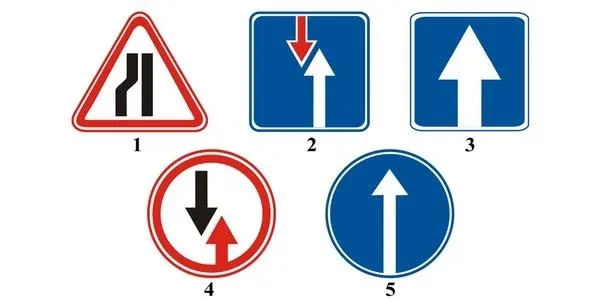
- 1
- 2
- 3
- 4
- 5
Show answer
Correct: 3. 3
A section of road with one-way traffic is shown by special-regulation sign 5.5 “Road with one-way traffic” - a blue SQUARE carrying a large white upward arrow - which is number 3; on such a road traffic runs in one direction across the full width. Number 5 is the blue CIRCLE with an upward arrow, which is mandatory sign 4.1.1 “Straight ahead only” and orders a direction rather than describing the road. Numbers 2 and 4 are the priority signs 2.7 and 2.6, both about passing a narrow section, and number 1 is warning sign 1.20 “Narrowing of the road”. Sign 3 is therefore correct.
Question 42. Traffic of which vehicles is permitted on roads under the effect of this sign?
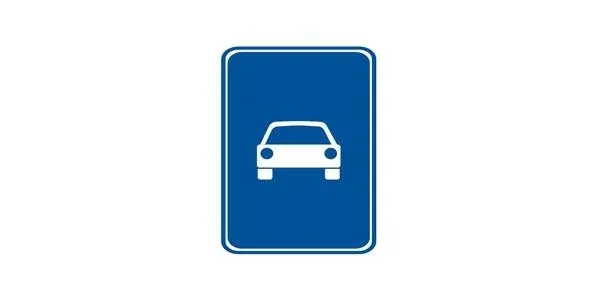
- Mechanical vehicles.
- All vehicles.
- Automobiles and motorcycles.
- Those vehicles whose maximum speed exceeds 40 km/h.
Show answer
Correct: 3. Automobiles and motorcycles.
This is sign 5.3 “Road for automobiles”, on which the movement of automobiles - buses included, since Article 2 of the law counts a bus as an automobile - and of motorcycles is permitted, so “Automobiles and motorcycles.” is correct. “All vehicles.” is wrong because mopeds, bicycles, horse-drawn carts, tractors and self-propelled machines may not use such a road, and “Mechanical vehicles.” is too wide, since a tractor is a mechanical vehicle too. The speed option does not state what the sign means: although point 117 of the Rules extends the motorway requirements to roads with sign 5.3, including the ban on vehicles that cannot exceed 40 km/h (point 116), the right to enter such a road is decided by the type of vehicle and not by speed alone - a fast tractor still may not use it.
Question 45. Which of the signs is called “End of one-way road”?
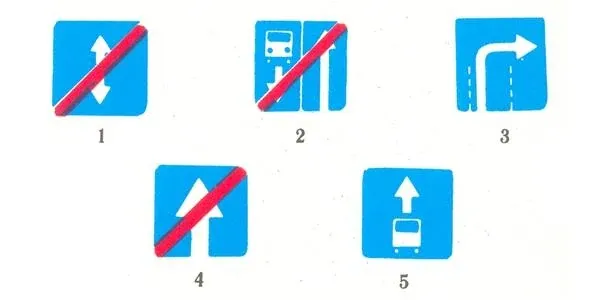
- 1
- 2
- 3
- 4
- 5
Show answer
Correct: 4. 4
“End of one-way road” is sign 5.6 - a blue square carrying an upward arrow struck through by a red line - which is number 4. Number 1 is 5.9 “End of reversible traffic”, whose arrow is double-headed rather than single; number 2 is 5.12.1 “End of the road with a lane for public-use transport vehicles”; number 5 is 5.14 “Lane for public-use transport vehicles”; and number 3 shows a direction of travel by lane. None of them marks the end of a one-way road. Sign 4 is therefore the correct choice.
Question 63. The following road sign indicates:
- At the intersection one must drive to the left or to the right.
- Reversible traffic is organised on the intersecting road.
- One-way traffic is organised on the intersecting road.
Show answer
Correct: 2. Reversible traffic is organised on the intersecting road.
This is sign 5.10 “Exit to a road with reversible traffic”, by which the Rules tell the driver that the road being joined carries reversible traffic - a road where the direction of travel on one or more lanes can be turned to face the other way, marked by sign 5.8 “Reversible traffic”. So reversible traffic is organised on the intersecting road. “At the intersection one must drive to the left or to the right.” describes a direction sign, not 5.10, and one-way traffic on the intersecting road would be shown by the exit-to-a-one-way-road signs 5.7.1 and 5.7.2, which mean something different.
Question 64. In this situation, is the driver obliged to give way to the truck?
- He is obliged.
- He is not obliged.
Show answer
Correct: 1. He is obliged.
The sign on the right is 5.22 “End of residential zone”, so the driver is leaving a residential zone. Under point 120 of the Traffic Rules, drivers leaving a residential zone must give way to the drivers of other vehicles and must not obstruct pedestrians. The truck approaching from the left is travelling along the very road the driver is joining, so he is obliged to give way to it. “He is not obliged.” is wrong, because coming out of a residential zone confers no priority whatever - it takes it away.
Question 78. In which direction is a light passenger car permitted to travel?
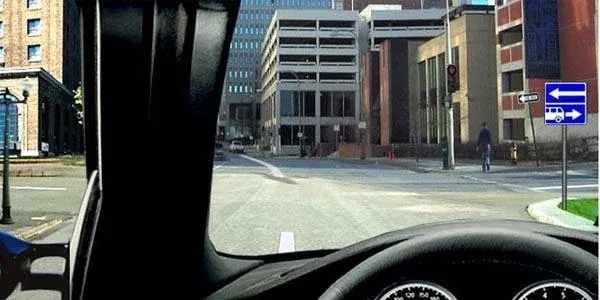
- To the left and in the opposite direction.
- In any direction.
- Straight, left and in the opposite direction.
Show answer
Correct: 3. Straight, left and in the opposite direction.
The sign is 5.13.1 “Exit to a road with a lane for public-use transport vehicles”. On such a road, as sign 5.11.1 defines it, the public-transport lane runs AGAINST the general flow, so for every other vehicle the crossing road is one-way in the direction of the sign’s upper arrow - to the left. A light passenger car may therefore go straight on, turn left with the general flow, and also make a U-turn, since this intersection is not among the places where point 50 of the Traffic Rules prohibits one and no sign forbids it. “In any direction.” is wrong because a right turn would mean driving against that one-way flow, along the lane reserved for public-use vehicles, and “To the left and in the opposite direction.” is wrong because going straight on is permitted as well.
Question 105. From the indicated lane, in which directions is driving permitted?
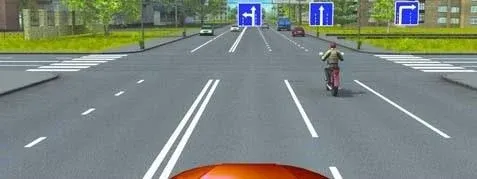
- Only left
- Straight and left
- Straight, left and the opposite direction
Show answer
Correct: 3. Straight, left and the opposite direction
The overhead panels are sign 5.15.1 “Directions of travel by lanes”. From the lane in question the arrows permit going straight and turning left, and under the Rules a lane from which a left turn is allowed also allows a U-turn from it. The permitted directions are therefore straight, left and the opposite direction. “Only left” is wrong because going straight is allowed as well, and “Straight and left” is wrong because the permitted left turn carries the U-turn with it.
Question 114. From where do the rules of driving in a built-up area (residential area) begin to apply?
- Only after built-up area (residential area) start signs with a white background
- Only after signs containing the name of the built-up area on a white or blue background
- Only after the developed territory physically begins
Show answer
Correct: 1. Only after built-up area (residential area) start signs with a white background
The rules for driving in a built-up area apply only after the white-background signs 5.23.1/5.23.2 ‘Beginning of a built-up area’, which is why ‘Only after built-up area (residential area) start signs with a white background’ is correct. Sign 5.25 ‘Beginning of a built-up area’ has a blue background and only announces the name - on a road marked with it the built-up-area rules do NOT apply. That is why ‘Only after signs containing the name of the built-up area on a white or blue background’ is wrong. ‘Only after the developed territory physically begins’ is wrong too: the regime is set by the signs, not by where the buildings actually start.
Question 117. From the indicated lane, in which direction may you continue driving?
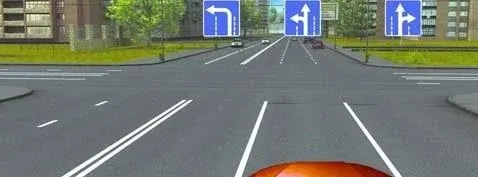
- Only straight
- Left and straight
- Left, straight and a U-turn
Show answer
Correct: 2. Left and straight
The blue panels above the carriageway show which directions each lane may take. The panel over the indicated lane carries a straight arrow and a left arrow, so from that lane you may continue left and straight. The U-turn arrow appears only on the panel over the left-hand lane, so a U-turn may be made from that lane and not from this one - which is why “Left, straight and a U-turn” is wrong. “Only straight” is wrong as well, because the left arrow on the panel plainly permits the left turn.
Question 134. When travelling in the indicated lane, movement is permitted
- Only left
- Only straight
- Left and U-turn
Show answer
Correct: 3. Left and U-turn
The panels above the lanes are signs 5.15.2 “Directions of travel by lane”, and the panel over the far left lane bears a left-turn arrow only. Under the road-signs annex, signs 5.15.1 and 5.15.2 that permit a left turn from the LEFT EDGE lane permit a U-turn from that lane as well. Travelling in the indicated lane, both the left turn and the U-turn are therefore permitted. “Only left” is wrong because the U-turn comes with the left turn here, and “Only straight” is wrong because the panel over this lane carries no straight-ahead arrow at all.
Question 298. In which direction may the driver continue driving in this situation
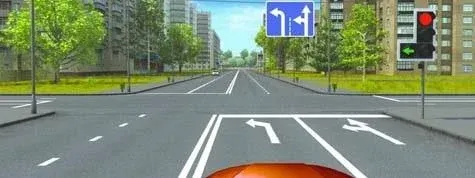
- Only left
- He must wait for the permitting signal
- Left and in the opposite direction
Show answer
Correct: 3. Left and in the opposite direction
You are in the left lane. Sign 5.15.1 “Directions of travel by lanes” assigns the left turn to this lane, and the additional section shows a green left arrow beside the red main signal. Under the Rules a sign 5.15.1 that permits a left turn from the LEFT EDGE lane permits a U-turn from it as well, and under point 8 a green arrow in an additional section permits movement in the direction it shows. The driver may therefore travel to the left and in the opposite direction. “Only left” is wrong because a U-turn is permitted from a left-turn edge lane too, and “He must wait for the permitting signal” is wrong because the green left arrow IS the permitting signal.
Question 300. Driving straight from the indicated lane is
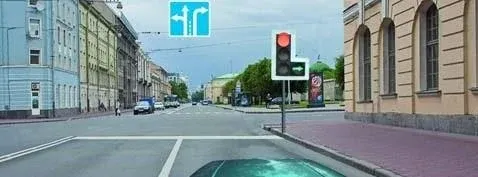
- Permitted
- Permitted only after the main green signal comes on
- Prohibited
Show answer
Correct: 3. Prohibited
Sign 5.15.1 “Directions of travel by lanes” assigns this lane the right-hand direction only - its arrow curves right and there is no straight-ahead arrow on it. Under the Rules vehicles must travel only in the directions sign 5.15.1 permits for their lane, so driving straight ahead from this lane is prohibited. “Permitted” and “Permitted only after the main green signal comes on” are both wrong because the lane itself is set aside for the right turn: no phase of the traffic light can add a direction the lane sign does not allow.
Question 606. In which direction is movement allowed?
- Only straight ahead.
- Straight ahead and to the right.
- Straight ahead, to the right and to the left.
- In all directions.
Show answer
Correct: 3. Straight ahead, to the right and to the left.
The blue square ahead of you is sign 5.5 “Road with one-way traffic”, which means the carriageway ahead is given over to travel in one direction across its full width. At the intersection you may therefore go straight on, to the right and to the left, since none of those directions is restricted. The fourth trajectory drawn in the picture is a U-turn, and that IS prohibited: under point 50 of the Traffic Rules a U-turn is forbidden on roads with one-way traffic, because it would put you head-on into the flow. “In all directions.” is wrong for that reason, while “Only straight ahead.” and “Straight ahead and to the right.” are incomplete, since the left turn is permitted.
Question 701. In which directions is travel permitted?
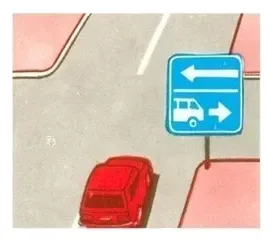
- Only to the left.
- Straight, to the left and a U-turn.
- Only straight.
Show answer
Correct: 2. Straight, to the left and a U-turn.
Sign 5.13.1 “Exit to a road with a lane for public-use transport vehicles” stands on the right: the nearest lane of the crossing road is set aside for route vehicles, and under point 124 of the Traffic Rules the movement of other vehicles in that lane is prohibited - so the right turn, which would mean entering it, is barred. Travel straight ahead and to the left is not restricted by the sign, and a U-turn is permitted, because none of the cases in which point 50 forbids one is present here: no pedestrian crossing, tunnel, bridge or level crossing, and no stretch with visibility under 100 m. “Only to the left.” and “Only straight.” are wrong because straight ahead, the left turn and the U-turn are all available.
Question 867. In built-up areas whose entrances and exits are marked with the “Residential zone” and “End of residential zone” road signs, what is not prohibited:
- The movement of pedestrians along the carriageway.
- Through traffic of vehicles.
- Learner driving.
Show answer
Correct: 1. The movement of pedestrians along the carriageway.
Under point 119 of the Traffic Rules, in a residential zone pedestrians may move both along the pavements and along the carriageway, and they have priority there. That is why “The movement of pedestrians along the carriageway.” is the one item on this list that is not prohibited. Point 121 bans the other two outright in residential zones: “Learner driving.” by sub-point 1 and “Through traffic of vehicles.” by sub-point 2.
Question 1037. What is prohibited by this road sign
- Travel at more than 20 km/h
- Travel by motor vehicles
- Travel by all vehicles
Show answer
Correct: 3. Travel by all vehicles
The sign is 5.33 “Pedestrian zone” - a white rectangle bearing the word ZONE above a blue disc with a pedestrian on it - which marks the place where an area open only to pedestrians begins. It therefore prohibits the movement of ALL vehicles. “Travel at more than 20 km/h” is wrong because this is not a speed limit sign, and “Travel by motor vehicles” is wrong because what is prohibited in the zone is not only mechanical vehicles but every vehicle, bicycles included.
Question 1051. In the zone of effect of which sign do the rules of driving in a built-up area not apply?
- Only Ա (A)
- Only Գ (C)
- Բ (B) and Գ (C)
Show answer
Correct: 2. Only Գ (C)
The question is in whose zone of action the rules for movement in a built-up area do NOT apply. Sign Գ (C) is 5.25 “Beginning of built-up area” on a BLUE ground, which merely gives the settlement’s name: on such a road the built-up-area rules do not operate. Ա (A) and Բ (B) are signs 5.23.1 and 5.23.2 “Beginning of built-up area” on a WHITE ground, from which the built-up-area rules do begin to apply. The correct answer is therefore Գ (C) alone; “Only Ա (A)” and “Բ (B) and Գ (C)” are wrong because the white-ground signs introduce the built-up-area regime rather than exempting from it.
Question 1052. Which of the signs prohibits a U-turn?
- Only Ա (A)
- Only Ա (A) and Գ (C)
- None of them
Show answer
Correct: 3. None of them
The question is which of the signs prohibits a U-turn. Ա (A) and Բ (B) are signs 5.7.1 and 5.7.2 “Exit to a road with one-way traffic”, and Գ (C) and Դ (D) are signs 5.13.1 and 5.13.2 “Exit to a road with a lane for public-use transport vehicles” - all of them blue INFORMATION signs, and none of them prohibits a U-turn. A U-turn is prohibited only by sign 3.19 “No U-turn”, which is not among them. The correct answer is therefore “None of them”; “Only Ա (A)” and “Only Ա (A) and Գ (C)” are wrong because none of these information signs introduces a prohibition on turning round.
Question 1056. Which of the signs is used to mark an artificial bump?
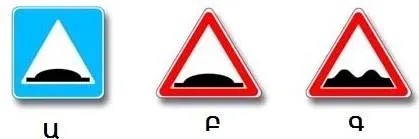
- Only Ա (A)
- Only Բ (B)
- Բ (B) and Գ (C)
Show answer
Correct: 1. Only Ա (A)
Sign Ա (A) is 5.20 “Artificial bump”, which under the Rules shows the boundaries of the artificial bump and is placed at the near boundary as the vehicle approaches - that is, it MARKS the bump itself. Sign Բ (B) is the warning sign 1.17 “Artificial bump”, which only gives advance warning that a bump is coming and does not mark it, and Գ (C) is the warning sign 1.16 “Uneven road”, a different hazard altogether. The artificial bump is therefore marked by Ա (A) alone.
Question 1060. Which signs indicate the section where drivers must give way to pedestrians crossing the carriageway?
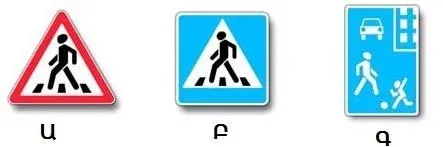
- Only Ա (A) and Բ (B)
- Only Բ (B) and Գ (C)
- All
Show answer
Correct: 2. Only Բ (B) and Գ (C)
Sign Բ (B) is 5.19.1 “Pedestrian crossing”, which marks the place of a pedestrian crossing where drivers must give way to the pedestrians on it, and Գ (C) is 5.21 “Residential zone”, where under point 119 of the Rules pedestrians have the advantage and drivers are obliged to give way to them. Both therefore mark sections where drivers must give way to pedestrians crossing the carriageway. Sign Ա (A) is the WARNING sign 1.22 “Pedestrian crossing”, a red triangle, which only gives advance notice that a crossing is coming and does not itself mark such a section. The correct answer is Բ (B) and Գ (C); “Only Ա (A) and Բ (B)” and “All” are wrong.
Question 1061. In which of the indicated directions is movement permitted?
- Only Բ (B)
- Only Ա (A) and Բ (B)
- Only Բ (B) and Գ (C)
- All
Show answer
Correct: 4. All
The blue sign is 5.7.2 “Exit to a road with one-way traffic”, an information sign which only shows that the crossing road carries one-way traffic - its arrow gives the direction - and which prohibits no manoeuvre at all. The trajectories drawn either enter that road in the permitted direction or stay on the road being travelled, so movement is permitted in all the indicated directions. “Only Բ (B)”, “Only Ա (A) and Բ (B)” and “Only Բ (B) and Գ (C)” are wrong, because sign 5.7.2 introduces no restriction that would bar any of them.