Trams at Intersections
A tram is step 3 of the method, Rail, and it beats the right-hand rule. Learn where that priority applies and where it ends, and these questions become some of the easiest at an intersection.
Who goes first, the tram or me?
Section titled “Who goes first, the tram or me?”The tram. At an intersection of equal roads, a tram has priority over non-rail vehicles, whatever direction it is going (point 98). Point 100 adds that this covers non-rail vehicles going the same way as the tram or the opposite way.
So it doesn’t matter where the tram comes from or where you are going:
| Where is the tram? | Do you give way? |
|---|---|
| Coming from your right | Yes |
| Coming from your left | Yes, although the right-hand rule wouldn’t ask you to |
| Oncoming and turning left | Yes, although a left-turning vehicle would normally wait for you |
| Beside you, going your way, as you go straight or turn left | Yes |
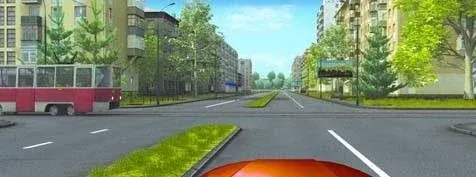
The tram comes from the left, and you still give way. On equal roads, the rails come first.
Two trams at once? You give way to both. Each tram has priority over your car, wherever it comes from.
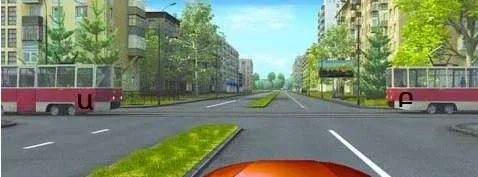
Common trap: “We can go through at the same time as the tram” sounds fair when it runs beside you. It is wrong: you give way to it.
Extra: Why trams need the extra room
Not from the question bank.
A tram can’t steer around you: it has to stay on its rails, and all it can do is brake. It is also heavy, so it needs a long distance to stop, and its passengers may be standing. Don’t cut in front of one.
What happens after the tram?
Section titled “What happens after the tram?”The tram only settles Rail. Steps 4 and 5 still apply to everyone else, so non-rail drivers sort themselves by the right-hand rule. If a tram is on your left and a truck on your right, you give way to both. Either one alone isn’t the full answer.
Paths that don’t cross still go together. A tram and a car on the same road, going opposite ways and both straight, pass at the same time.
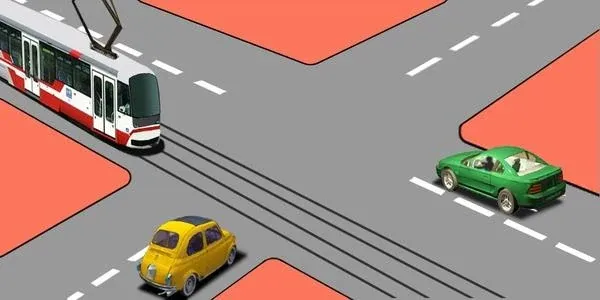
The tram and the green car go together. The yellow car gives way to the tram, and to the green car on its right, so it goes last.
If you are going straight, an oncoming car turning left isn’t someone you wait for: it waits for you. If it shares the road with an oncoming tram, you give way to the tram alone.
Where does tram priority end?
Section titled “Where does tram priority end?”Tram priority applies at intersections of equal roads. Step 2 comes before step 3, so a tram on a secondary road gives way to vehicles on the main road, like any other vehicle.
Remember: Sign first, then rail. Check for priority signs before you give a tram the way.
A trolleybus isn’t a tram. It runs on wires, not rails, and has no special priority.
Try it yourself
Section titled “Try it yourself”A tram, a green car and a yellow bus reach an intersection with no signs. The tram comes from the top left, and the green car is on the bus’s right.
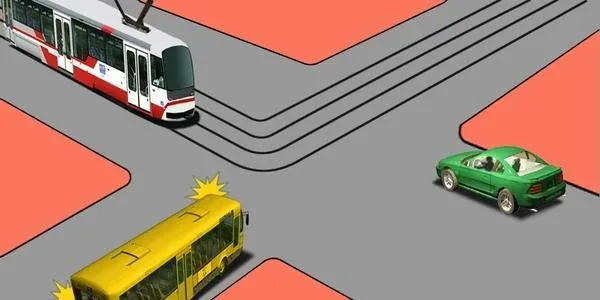
What is the order? Tram, car, bus. Light and Sign: none. Rail: the tram goes first. Right: the car is on the bus’s right, so it goes second and the bus goes last.
You want to turn left. A tram approaches from your left and a truck from your right.
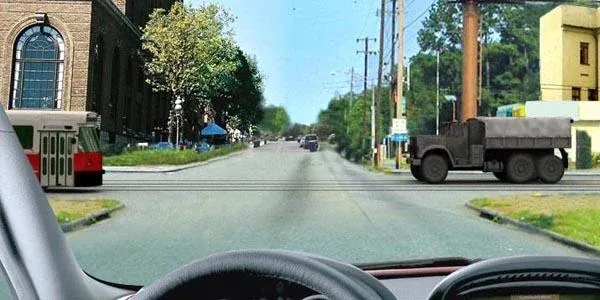
Who do you give way to? All of them. Rail: the tram has priority. Right: the truck is on your right.
You are going straight. An oncoming tram is indicating left. Beside it, an oncoming car is also indicating left.
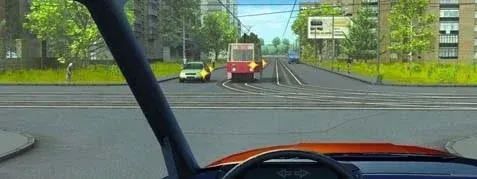
Who do you give way to? Only the tram. Rail: its priority covers its left turn. Left: the car turning left has to give way to you.
Key points
Section titled “Key points”- On equal roads, a tram goes before non-rail vehicles, whatever its direction.
- It doesn’t matter whether the tram comes from the right, the left, ahead or beside you.
- With two trams, give way to both.
- After the tram, the right-hand rule and the left-turn rule still sort everyone else.
- A tram and a vehicle on paths that don’t cross go together.
- A tram on a secondary road gives way to the main road. A trolleybus has no tram priority.
Practice questions
Section titled “Practice questions”Question 330. The vehicles will cross the intersection in the following order:
- The tram, the yellow car, the green car.
- The tram and the green car, the yellow car.
- The green car, the yellow car, the tram.
Show answer
Correct: 2. The tram and the green car, the yellow car.
This is an unregulated intersection of roads of equal importance with tram tracks. Under point 98 of the Rules a tram at such an intersection has priority over non-rail vehicles whatever direction it is travelling in, and a non-rail driver gives way to those approaching from his right. The tram and the green car are on the same road going in opposite directions, both straight ahead, so their paths do not cross and they pass together. The yellow car must give way both to the tram, which has priority under point 98, and to the green car on its right. The order is therefore the tram and the green car at the same time, then the yellow car. The other options are wrong because the tram does not go last and the yellow car does not go before them.
Question 333. Which vehicle’s driver must give way?
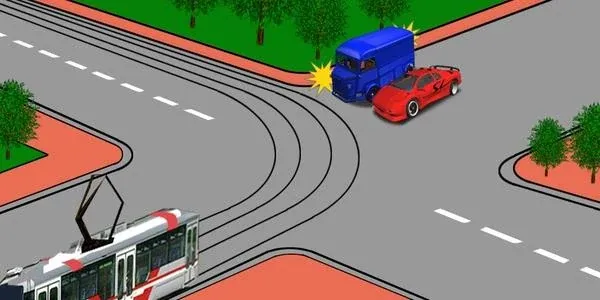
- The tram driver.
- The truck driver.
- The car drivers.
Show answer
Correct: 3. The car drivers.
This is an unregulated intersection of roads of equal importance with tram tracks. Under point 98 of the Rules a tram at such an intersection has priority over non-rail vehicles whatever direction it is travelling in. The ones who must give way are therefore the drivers of the non-rail vehicles - the car and the van. “The tram driver.” is wrong because the tram is the one with priority, and “The truck driver.” taken alone is wrong because every non-rail driver here must yield to the tram, not the van only.
Question 351. The vehicles will pass the intersection in the following order:
- The passenger car, the bus, the tram.
- The tram, the bus, the passenger car.
- The tram, the passenger car, the bus.
Show answer
Correct: 3. The tram, the passenger car, the bus.
This is an unregulated intersection — there is no traffic light and no priority signs, so the roads are of equal importance. Under point 98 of the Rules, at an intersection of roads of equal importance the tram has priority over non-rail vehicles regardless of its direction of travel, so the tram goes first. The same item requires the driver of a non-rail vehicle to give way to a vehicle approaching from the right, and the green passenger car is on the bus’s right, so the passenger car goes second and the bus last. “The tram, the bus, the passenger car.” is wrong, because the bus cannot go before the car on its right. “The passenger car, the bus, the tram.” is wrong, because the tram does not go last here — the priority is the tram’s.
Question 374. We are obliged to give way to
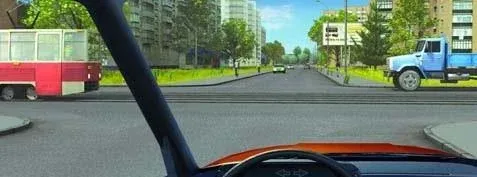
- Only the tram driver
- The truck driver
- Both drivers
Show answer
Correct: 3. Both drivers
This is an unregulated intersection of roads of equal importance with tram tracks. Under point 98 of the Rules a tram at such an intersection has priority over non-rail vehicles whatever direction it is travelling in, and a non-rail driver must also give way to those approaching from his right. The truck is approaching from your right, so you must yield to it, and you must yield to the tram as well by virtue of its priority. You are therefore obliged to give way to both drivers. “Only the tram driver” and “The truck driver” each name just one of the two duties that apply here.
Question 385. When crossing the intersection straight, the driver
- May go first
- Must give way to the tram
- Must give way to both drivers
Show answer
Correct: 2. Must give way to the tram
This is an unregulated intersection of roads of equal importance, with tram tracks; there is no traffic light and there are no priority signs. The oncoming tram has its left-turn indicator on, so its path crosses the path of the driver going straight. Under point 98 of the Rules, at an intersection of equal roads the tram has priority over non-rail vehicles regardless of its direction of travel, so “Must give way to the tram” is correct. “May go first” is wrong, because going straight gives no priority over a tram. “Must give way to both drivers” is wrong, because the oncoming passenger car is turning left as well, and under point 99 a driver of a non-rail vehicle making a left turn must himself give way to the driver coming straight from the opposite direction.
Question 396. To give way to the tram we
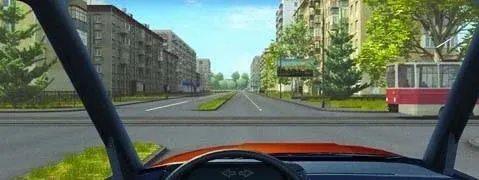
- Are obliged
- Are not obliged
Show answer
Correct: 1. Are obliged
This is an unregulated intersection of roads of equal importance, with tram tracks. Under point 98 of the Rules, at an intersection of equal roads the tram has priority over non-rail transport regardless of its direction. Giving way to the tram is therefore obligatory. “Are not obliged” is wrong, because at an intersection of equal roads the tram’s priority is mandatory.
Question 409. When making a left turn, to give way to the tram we
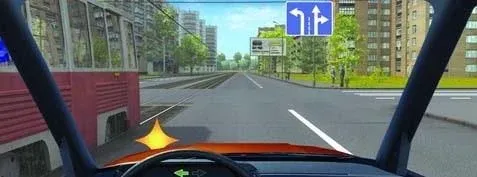
- Are obliged
- Are not obliged
Show answer
Correct: 1. Are obliged
Under point 100 of the Rules, at unregulated intersections a tram has priority over non-rail vehicles travelling on a road of equal importance in the same or the opposite direction, whatever direction the tram itself is taking. Here the tram is running in the same direction as you, on the tracks to your left, so in turning left you would cross its path and you are obliged to give way to it. “Are not obliged” is wrong because on equal terms a non-rail vehicle has no advantage over a tram - travelling alongside it does not change that.
Question 413. In this situation
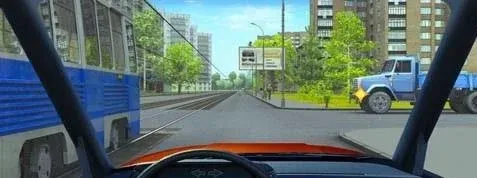
- We are obliged to give way to the truck driver
- We can cross the intersection simultaneously with the tram.
Show answer
Correct: 1. We are obliged to give way to the truck driver
This is an unregulated intersection of roads of equal importance. Under point 98 of the Rules the driver of a non-rail vehicle must give way to those approaching from his right, so you are obliged to give way to the truck driver on your right. The same point 98 gives a tram at such an intersection priority over non-rail vehicles whatever direction it is taking, so “We can cross the intersection simultaneously with the tram.” is wrong - the tram must be given way to as well, not accompanied through.
Question 421. To give way to the tram driver
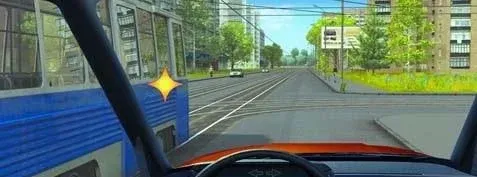
- We are obliged
- We are not obliged
Show answer
Correct: 1. We are obliged
This is an unregulated intersection of roads of equal importance, with no priority signs. Under point 98 of the Rules a tram at such an intersection has priority over non-rail vehicles whatever direction it is travelling in, so you are obliged to give way to the tram driver. “We are not obliged” is wrong because at an intersection of equal roads a non-rail vehicle has no advantage over a tram - the rails come first.
Question 424. To give way to the tram we
- Are obliged
- Are not obliged
Show answer
Correct: 1. Are obliged
This is an unregulated intersection of roads of equal importance, with no priority signs. Under point 98 of the Rules, at an intersection of equal roads the tram has priority over non-rail vehicles regardless of its direction of travel. Giving way to the tram is therefore obligatory. “Are not obliged” is wrong, because at an intersection of equal roads a non-rail vehicle has no priority over the tram.
Question 733. If you intend to make a left turn at the intersection, to which vehicle must you give way?
- To the truck.
- To all vehicles.
- To no one.
Show answer
Correct: 2. To all vehicles.
This is an unregulated intersection of roads of equal importance. Under point 98 of the Traffic Rules a driver must give way to vehicles approaching from his right, and at such an intersection a tram has priority over non-rail vehicles whatever direction it is travelling in. In the picture the tram approaches from the left and the truck from the right, so before turning left you must give way both to the tram - because it runs on rails - and to the truck approaching on your right. “To the truck.” alone and “To no one.” are therefore wrong: you give way to all the vehicles.
Question 1074. When crossing the intersection straight you are obliged to give way to
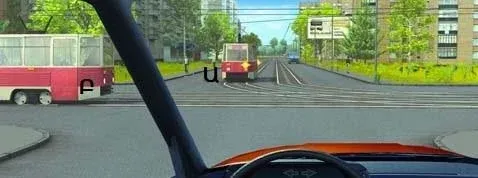
- Only the driver of tram Ա (A)
- Only the driver of tram Բ (B)
- Both drivers
- No one
Show answer
Correct: 3. Both drivers
This is an unregulated intersection of roads of equal importance with tram tracks. Under point 98 of the Rules, at an intersection of roads of equal importance a tram has the advantage over non-rail transport whatever direction it is travelling in. There are two trams here, Ա (A) and Բ (B), so in crossing straight ahead you must give way to both tram drivers. “Only the driver of tram Ա (A)”, “Only the driver of tram Բ (B)” and “No one” are wrong, because both trams have the advantage over your non-rail car.
Question 1077. To which tram driver are we obliged to give way?
- Only Ա (A)
- Only Բ (B)
- Both trams
Show answer
Correct: 3. Both trams
This is an unregulated intersection of roads of equal importance with tram tracks. Under point 98 of the Rules, at such an intersection a tram has the advantage over non-rail transport whatever direction it is travelling in. There are two trams here, Ա (A) and Բ (B), so as the driver of a non-rail vehicle you are obliged to give way to both of them. “Only Ա (A)” and “Only Բ (B)” are wrong, because both trams have the advantage over your car.