Emergency and Special Vehicles
Beacons come in several colors, and each one asks something different of you. Learn the colors and most of this lesson’s questions answer themselves.
What does each beacon ask of me?
Section titled “What does each beacon ask of me?”| What you see | What you do | Point |
|---|---|---|
| Blue beacon and special sound signal, approaching | Give way so it passes unobstructed | 28 |
| Blue and red beacons and special sound signal, approaching | Reduce speed and give way to it and to the vehicles it escorts | 29 |
| Stationary vehicle with blue, or blue and red, beacons | Reduce speed so that you can stop immediately | 30 |
| Stationary vehicle with a red beacon, in your direction | Stop, and continue only after receiving permission | 31 |
| Yellow or orange beacon | Take care: it warns of danger and gives no priority | 32 |
| Moon-white beacons and special sound signal | The vehicle is under attack and is calling police officers and others. It gives no priority | 35 |
Common trap: “Reduce speed and give way” is the blue and red rule. For blue alone, the answer is simply “give way”. Red stationary means stop, not just slow down.
Public transport gets no exemption. Running on an established route doesn’t excuse a bus driver from any of these duties.
What gives a vehicle priority?
Section titled “What gives a vehicle priority?”The blue beacon and the special sound signal together (point 26). The beacon alone gives no priority, and neither does the sound signal alone. Blue and red beacons work the same way, only with the sound signal. The driver may use that priority only after making sure that others are actually giving way.
The paint doesn’t count. An “Ambulance” with its beacon and sound signal off is an ordinary vehicle, so the bus in this picture doesn’t have to give way to it.
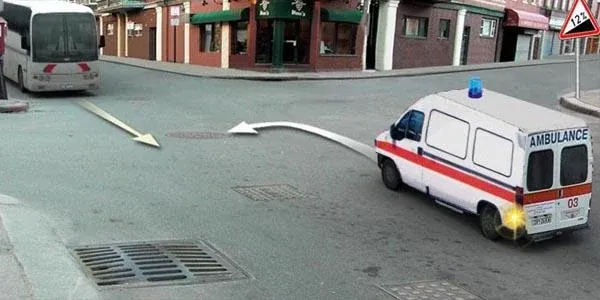
Once both are on, you give way. It doesn’t matter that you have a green light, that you are on the main road, or that it is coming out of an adjacent area or from behind a stop sign.
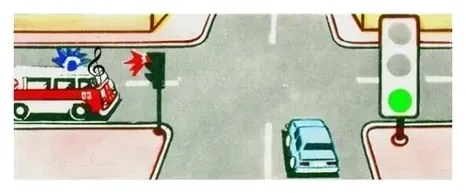
The car has the green light, and the ambulance has priority anyway. The car’s driver must give way.
What do yellow and orange beacons really mean?
Section titled “What do yellow and orange beacons really mean?”They warn you about danger and give no priority (point 32). Point 34 lets some such vehicles depart from certain rules, signs and markings when safety is ensured, but that gives them no priority over you.
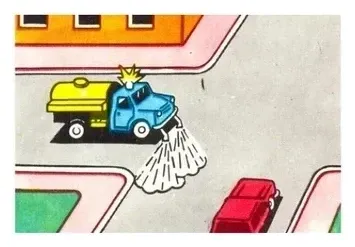
The road machine has a yellow beacon, so it gets no priority. It follows the ordinary rules. The right of priority here belongs to the passenger car’s driver.
Remember: Blue plus sound means give way. Yellow, orange and moon-white give nobody priority.
Extra: Making way calmly
Not from the question bank.
When you hear a siren, check your mirrors before you do anything else. Signal, move over smoothly and keep your movements predictable, so the emergency driver can read what you will do. Don’t stop where you block a junction, and after it has passed, look out for a second vehicle following it.
How do I work out the order at an intersection?
Section titled “How do I work out the order at an intersection?”- The vehicle with its blue beacon and sound signal on goes first.
- Everyone else follows the normal rules: traffic light, then signs, then the right-hand rule.
The emergency vehicle comes on top of your other duties and doesn’t replace them. When you turn left on green, you give way to oncoming traffic and to the emergency vehicle. If the lights are out and your left turn follows a main road that bends, a truck on the secondary road must wait for you, but the police car with its beacon and sound signal on still goes first.
Try it yourself
Section titled “Try it yourself”You are the black car on the main road, going straight. A fire engine has its beacon and sound signal on. The oncoming green car is signalling left.
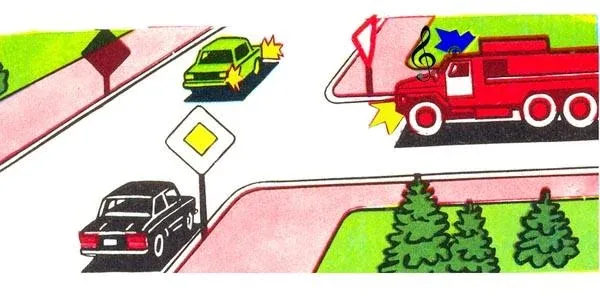
When do you go? Second. The fire engine goes first. The green car turns left, so it waits for you.
You are turning left on green. The bus is oncoming, and a truck with a yellow beacon comes from the right.
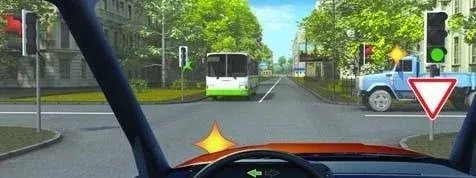
Who do you give way to? Only the bus. The light is what counts here, so the sign beside it doesn’t apply. You give way to oncoming traffic when turning left. The truck’s yellow beacon gives it nothing.
You are the blue car, on the secondary road. A police car with its beacon and sound signal on stands by the stop sign. The green and red cars are on the main road.
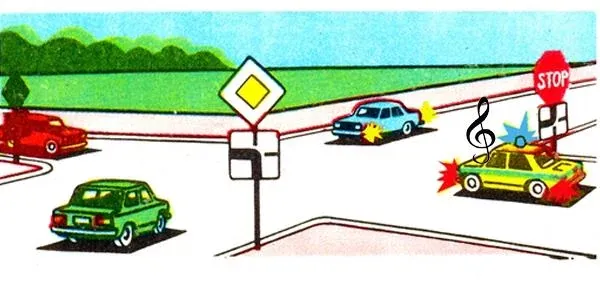
When do you go? Last. The police car goes first, even from behind a stop sign. Then the two cars on the main road go, and you follow.
Key points
Section titled “Key points”- Blue beacon and sound signal: give way. Add reduced speed for blue and red.
- Stationary red beacon: stop and wait for permission.
- Priority needs the beacon and the sound signal together. The vehicle’s paint means nothing.
- Priority beats a green light, a main road and a stop sign.
- Yellow, orange and moon-white beacons give no priority.
- Turning left on green: give way to oncoming traffic and to an emergency vehicle.
Practice questions
Section titled “Practice questions”Question 734. If you intend to make a left turn at the intersection, to which vehicle must you give way?
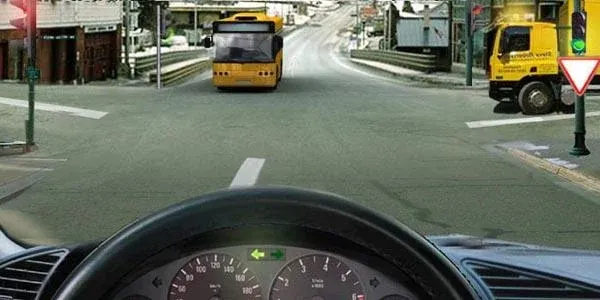
- To no one.
- Only to the bus.
- Only to the truck with its beacon switched on.
- To all vehicles.
Show answer
Correct: 2. Only to the bus.
The truck has an orange beacon switched on, but an orange beacon confers no advantage whatever - it only warns of a hazard, and its driver must keep to the ordinary rules. That truck is approaching on the secondary road and must itself give way to you. The bus is coming from the opposite direction and continuing straight ahead, and under the Rules a driver turning left must give way to vehicles coming from the opposite direction travelling straight ahead or turning right. You must therefore give way only to the bus - which is why “To no one.”, “Only to the truck with its beacon switched on.” and “To all vehicles.” are all wrong.
Question 810. When approaching a stationary vehicle with a red flashing beacon switched on, drivers of public transport vehicles travelling in that direction must:
- Stop and continue driving only after receiving permission.
- Reduce speed so that, if necessary, they have the possibility to stop immediately.
- Continue driving, since they are travelling on an established route.
Show answer
Correct: 1. Stop and continue driving only after receiving permission.
Under point 31 of the Traffic Rules, when approaching a stationary vehicle with a red flashing beacon switched on, drivers travelling in that direction must “Stop and continue driving only after receiving permission”. The requirement covers every driver going that way, drivers of public transport vehicles included, so “Continue driving, since they are travelling on an established route” gives no exemption. “Reduce speed so that, if necessary, they have the possibility to stop immediately” is what point 30 requires for a blue, or blue and red, beacon — not for a red one — so it is not enough here.
Question 811. When a vehicle with a blue flashing beacon and a special audible signal switched on approaches, drivers of public transport vehicles must:
- Continue driving, since they are travelling on an established route.
- Give way, in order to ensure the unobstructed passage of the said vehicle.
- Reduce speed and give way, in order to ensure the unobstructed passage of the said vehicle.
Show answer
Correct: 2. Give way, in order to ensure the unobstructed passage of the said vehicle.
Under point 28 of the Traffic Rules, when a vehicle with a blue flashing beacon and a special audible signal approaches, drivers must “Give way, in order to ensure the unobstructed passage of the said vehicle” — which is the keyed answer. The requirement applies to all drivers, and running on an established route gives a public transport driver no exemption, so “Continue driving, since they are travelling on an established route” is wrong. “Reduce speed and give way, in order to ensure the unobstructed passage of the said vehicle” is the requirement of point 29, which applies when a vehicle has blue and red flashing beacons switched on.
Question 824. When approaching a stationary vehicle with a red flashing beacon switched on, drivers of vehicles travelling in that direction must:
- Stop and continue driving only after receiving permission.
- Reduce speed so that, if necessary, they have the possibility to stop immediately.
Show answer
Correct: 1. Stop and continue driving only after receiving permission.
Under point 31 of the Traffic Rules, a driver travelling in that direction who approaches a stationary vehicle with a red flashing beacon switched on must “Stop and continue driving only after receiving permission.” The red beacon closes the passage until permission is given, so the driver has no right to decide on his own to move on. “Reduce speed so that, if necessary, they have the possibility to stop immediately.” is the requirement of point 30, and it applies to a stationary vehicle with blue, or blue and red, flashing beacons switched on, so it is not enough where the beacon is red.
Question 825. For what purpose are orange or yellow flashing beacons fitted on vehicles?
- To obtain priority over the other road users.
- To warn the other road users about danger.
Show answer
Correct: 2. To warn the other road users about danger.
Point 32 of the Traffic Rules states directly that orange or yellow flashing beacons give no priority in traffic and serve “To warn the other road users about danger.” — which is exactly why that option is the keyed one. For that same reason “To obtain priority over the other road users.” is wrong: under point 34 a driver with such a beacon switched on gains only the right to depart from the requirements of certain points, provided traffic safety is ensured, but no priority over anyone.
Question 826. When a vehicle with a blue flashing beacon and a special sound signal switched on approaches, drivers must:
- Give way, to ensure the unobstructed passage of the said vehicle.
- Reduce speed and give way, to ensure the unobstructed passage of the said vehicle.
Show answer
Correct: 1. Give way, to ensure the unobstructed passage of the said vehicle.
Under point 28 of the Traffic Rules, when a vehicle with a blue flashing beacon and a special sound signal switched on approaches, drivers must “Give way, to ensure the unobstructed passage of the said vehicle.” The additional requirement to reduce speed is set by point 29 and only for a vehicle with blue and red flashing beacons and a special sound signal switched on, together with the vehicles escorted by it, so “Reduce speed and give way, to ensure the unobstructed passage of the said vehicle.” does not apply to this case.
Question 827. The blue car will pass the intersection:
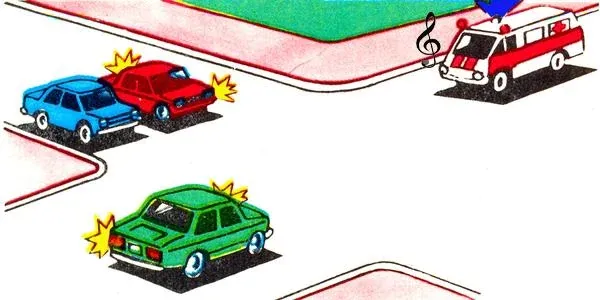
- First, simultaneously with the red one.
- Second, simultaneously with the red one.
- Third, simultaneously with the red one.
Show answer
Correct: 3. Third, simultaneously with the red one.
This is an unregulated intersection of roads of equal importance. The ambulance has its flashing beacon and its audible signal switched on, so under point 28 of the Rules every other driver must give way and let it through unobstructed: it goes first. Among the rest, point 98 applies - a driver gives way to the vehicle approaching from his right. The green car is on the right of the red and blue cars, so it goes second. The red and blue cars are on the same road, one behind the other and travelling the same way, so their paths do not cross and they enter the intersection together, third. “First, simultaneously with the red one.” and “Second, simultaneously with the red one.” are wrong, because the ambulance and the green car both go before them.
Question 828. When a vehicle with blue and red flashing beacons and a special sound signal switched on approaches, drivers must:
- Give way, to ensure the unobstructed passage of the said vehicle.
- Reduce speed and give way, to ensure the unobstructed passage of the said vehicle as well as of the vehicles escorted by it.
Show answer
Correct: 2. Reduce speed and give way, to ensure the unobstructed passage of the said vehicle as well as of the vehicles escorted by it.
Under point 29 of the Traffic Rules, when a vehicle with blue and red flashing beacons and a special sound signal switched on approaches, drivers must “Reduce speed and give way, to ensure the unobstructed passage of the said vehicle as well as of the vehicles escorted by it.” The blue-and-red combination means the vehicle is escorting a convoy, so slowing down and letting the escorted vehicles through is part of the duty. “Give way, to ensure the unobstructed passage of the said vehicle.” is the wording of point 28 and covers only a vehicle with a blue beacon.
Question 829. Which vehicle’s driver has the right of priority passage?
- The road machine driver.
- The light passenger car driver.
Show answer
Correct: 2. The light passenger car driver.
The road machine - the yellow tanker at work washing the street - has a yellow (orange) flashing beacon lit on its cab roof. Under point 32 of the Traffic Rules yellow or orange flashing beacons confer NO priority in traffic and serve only to warn the other road users of a danger, and point 34 lets such a vehicle depart from certain items, markings and signs without granting it priority. The road machine therefore travels on the general footing, and the right of priority travel belongs to the light passenger car’s driver. “The road machine driver.” is wrong because point 32 expressly denies a yellow or orange beacon any advantage.
Question 830. The black car will pass the intersection:
- First.
- Second.
- Last.
Show answer
Correct: 2. Second.
The fire engine on the right has its blue flashing beacon and its special audible signal switched on, so under point 28 of the Traffic Rules every driver must give way to it and it passes first. The black car is on the main road - sign 2.1 “Main road” faces its approach - and is travelling straight ahead, while the oncoming green car is signalling a left turn and under point 99 must give way to oncoming vehicles going straight. The black car will therefore cross the intersection second, after the fire engine and before the green one, which is why “First.” and “Last.” are wrong.
Question 831. Which vehicle’s driver must give way?
- The ambulance driver.
- The light passenger car driver.
Show answer
Correct: 2. The light passenger car driver.
The ambulance has its blue flashing beacon on together with the special sound signal. Under point 28 of the Traffic Rules, drivers must give way to such a vehicle when it approaches, so as to ensure its unobstructed passage, and point 26 allows its driver, while carrying out an urgent official assignment, not to comply with the traffic-light signal either. Therefore, despite the green signal lit for his direction, the driver of the light passenger car must give way. The option “The ambulance driver” is wrong, because a vehicle with a blue beacon and a special sound signal switched on holds priority and does not give way.
Question 832. The blue car will pass the intersection:
- First.
- Second.
- Third.
- Last.
Show answer
Correct: 4. Last.
The police car has its flashing beacon and its audible signal switched on, so under point 28 of the Rules the other drivers must give way to it. That holds even though it is standing on the secondary road behind sign 2.5 “Movement without stopping prohibited”, so it is the police car that crosses first. Sign 2.1 “Main road” stands at the intersection with plate 8.13 “Direction of the main road”, and the green and red cars are on the main road as that plate draws it, so they follow the police car. The blue car comes from the secondary road and must give way to both cars on the main road, so it crosses the intersection last. “First.”, “Second.” and “Third.” are wrong.
Question 833. Does a yellow (orange) flashing beacon switched on on a vehicle give priority in traffic?
- It does.
- It does not.
Show answer
Correct: 2. It does not.
Under point 32 of the Traffic Rules, a yellow or orange flashing beacon gives no priority in traffic; it serves to warn the other road users about danger, so the answer is “It does not.” “It does.” is wrong: priority over the other road users is given only by a blue flashing beacon together with a special sound signal (point 26). Point 34 does release certain drivers with a yellow beacon from the requirements of individual points, but that is an exemption from the Rules, not priority over anyone.
Question 834. The driver of a vehicle with moon-white flashing beacons switched on gives a special sound signal in order to:
- Obtain priority over the other road users.
- Attract the attention of police officers and other persons.
Show answer
Correct: 2. Attract the attention of police officers and other persons.
Under point 35 of the Traffic Rules, moon-white flashing beacons are switched on together with a special sound signal only when those vehicles are being attacked; they give no priority in traffic and serve only “To attract the attention of police officers and other persons.” That is why this option is the keyed one. “Obtain priority over the other road users.” is wrong: for priority over the other road users, point 26 requires a blue flashing beacon and a special sound signal.
Question 835. The driver of a vehicle equipped with a blue flashing beacon has priority over the other road users if:
- He has switched on the flashing beacon.
- He is giving a special sound signal.
- He has switched on the blue flashing beacon and the special sound signal.
Show answer
Correct: 3. He has switched on the blue flashing beacon and the special sound signal.
Under point 26 of the Traffic Rules, to obtain priority over the other road users such a driver must have “switched on the blue flashing beacon and the special sound signal” — the two together. That is why only this option is correct: “He has switched on the flashing beacon.” alone, or “He is giving a special sound signal.” alone, gives no priority. The same point adds that the driver may use that priority only after making sure that the way is actually being given to him.
Question 881. In order to gain priority over the other road users, the driver of a patrol-service vehicle must switch on:
- The blue flashing beacon.
- The blue and red flashing beacons.
- The blue flashing beacon and the special sound signal.
Show answer
Correct: 3. The blue flashing beacon and the special sound signal.
Under point 26 of the Traffic Rules, to gain priority over the other road users a driver must switch on “The blue flashing beacon and the special sound signal.” — the siren being an alternation of high and low tones. “The blue flashing beacon.” on its own therefore grants no priority; it only permits departing from certain requirements of the Rules while carrying out an urgent official task. “The blue and red flashing beacons.” belong, under point 29, to escort vehicles, and they too work only together with the special sound signal, so that option is not right either.
Question 882. Is the bus driver required to give way to the “Ambulance” vehicle if the blue flashing beacon and the special sound signal are not switched on?
- He is required.
- He is not required.
Show answer
Correct: 2. He is not required.
A vehicle in special livery, an “Ambulance” included, gains an advantage only when the blue flashing beacon AND the special sound signal are switched on - those two together are what oblige other drivers to give way. The question states that they are not switched on, so the vehicle is travelling on ordinary terms and the bus driver is not required to give way to it. “He is required.” ties the advantage to how the vehicle is painted, whereas it is tied to the signals being on.
Question 928. Giving way to a driver leaving an adjacent area with special sound and light signals switched on we are
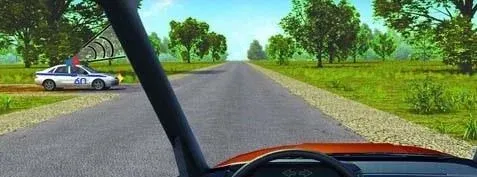
- Not obliged
- Obliged
Show answer
Correct: 2. Obliged
The car leaving the adjacent territory has its blue and red flashing beacons and its special audible signal switched on - the beacons and the sound waves are drawn on its roof. Under point 29 of the Traffic Rules, when such a vehicle approaches, drivers must reduce speed and give way so as to allow it to pass unobstructed, and under point 26 it is precisely the flashing beacon TOGETHER with the special audible signal that confers priority over the other road users. “Not obliged” is therefore wrong: point 29 makes no exception for a vehicle coming out of an adjacent territory.
Question 929. When going straight through the intersection, are we obliged to give way to the driver of the truck with flashing yellow beacons switched on
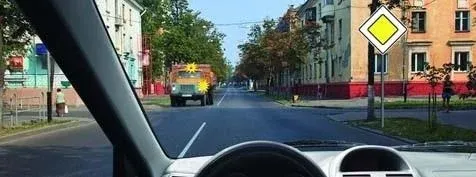
- Yes
- No
Show answer
Correct: 2. No
The truck ahead has its yellow flashing beacons switched on, and under point 32 of the Traffic Rules yellow or orange flashing beacons confer no priority in traffic: they serve only to warn the other road users of a danger. Sign 2.1 “Main road” stands on the right, so your advantage at this intersection is unaffected, and “Yes” is wrong. A duty to give way arises only from blue, or blue and red, beacons used together with a special audible signal (points 28 and 29).
Question 930. We are obliged to give way to
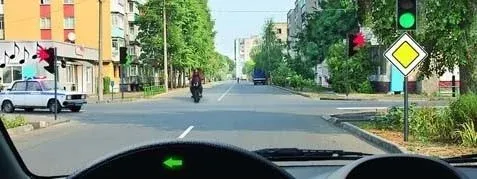
- The motorcycle driver
- The driver of the car with special light and sound signals switched on
- Both drivers
Show answer
Correct: 3. Both drivers
You are turning left on the green signal - the left indicator is lit on the dashboard - and under point 90 of the Traffic Rules a driver turning left on green must give way to vehicles coming from the opposite direction and travelling straight ahead or turning right, which here is the motorcycle coming towards you. The car entering the intersection from the left has its blue and red flashing beacons and special audible signal switched on, and under point 29 drivers must reduce speed and give way to it. Each single-driver option covers only half of that duty, so you must give way to both.
Question 931. We are obliged to give way to
- Both drivers
- The driver of the truck with the flashing yellow beacon
- Only the driver of the bus
Show answer
Correct: 3. Only the driver of the bus
The traffic light facing you on the right shows green and your left indicator is on: under point 90 of the Traffic Rules a driver turning left on green must give way to vehicles coming from the opposite direction and travelling straight ahead or to the right - that is the bus. The yellow flashing beacon on the truck approaching from the right on the crossing road gives it no priority, since under point 32 yellow or orange beacons only warn of a danger, and in any case the light for the crossing road is showing a prohibiting signal. Sign 2.4 “Give way” on your right does not operate here, because under point 173 the traffic light signals prevail over the priority signs. Giving way to both drivers, or to the truck driver, is therefore wrong.
Question 932. In this situation
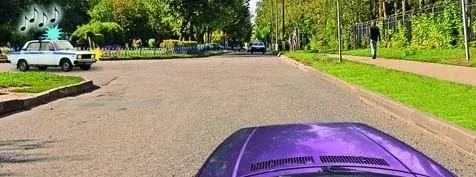
- You will pass the intersection first
- You must give way to the driver approaching from the left.
Show answer
Correct: 2. You must give way to the driver approaching from the left.
A police car is approaching from the left with its blue flashing beacon and its special audible signal switched on - the sound marks in the picture show it. Under point 26 of the Traffic Rules such a vehicle acquires priority precisely when the blue beacon and the special audible signal are switched on together, and point 28 obliges drivers to give way so as to let it pass unobstructed. You therefore cannot cross the intersection first: you must give way to the driver approaching from the left.
Question 933. We are obliged to give way to
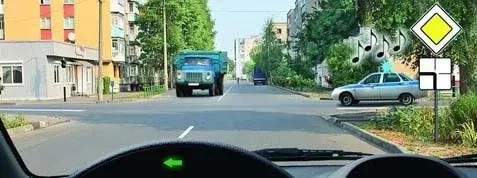
- Everyone
- The driver of the police car
- No one
Show answer
Correct: 2. The driver of the police car
Sign 2.1 “Main road” with plate 8.13 on your right shows that the main road runs from your direction and turns left, so your left turn keeps you on the main road, while the direction the truck comes from is drawn as a thin line - a secondary road. The traffic light is not working, so under point 95 the intersection is unregulated and the priority signs govern. The truck is therefore obliged by point 96 to give way to YOU, and the duty in point 99 to yield when turning left applies only to oncoming vehicles on a road of EQUAL importance - which is why “Everyone” is wrong. But the police car has its blue flashing beacon and special audible signal switched on, so under point 28 you must give way to it and let it pass unobstructed - which is why “No one” is wrong as well.
Question 934. When making a left turn
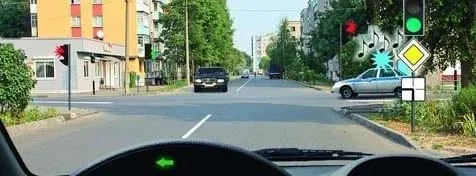
- You will pass the intersection first
- You will give way only to the driver of the police car
- You will give way to all drivers
Show answer
Correct: 3. You will give way to all drivers
Here the intersection is a regulated one and the light facing you is green, so sign 2.1 “Main road” gives you no advantage: under point 173 of the Traffic Rules the traffic light signals prevail over the priority signs. Turning left on green, point 90 obliges you to give way to the oncoming car travelling straight ahead, and also to the police car, whose blue flashing beacon and special audible signal are switched on and which must be allowed to pass unobstructed under points 26 and 28. Neither passing first nor giving way only to the police car is therefore right: you must give way to all the drivers named.