U-turns and Reversing
Both manoeuvres put you against the flow of traffic, so the Rules list the places where you may not do them. Learn one short list and you can answer nearly every question here, because the same list covers U-turns and reversing.
Where is a U-turn prohibited?
Section titled “Where is a U-turn prohibited?”Point 50 lists these places:
- On pedestrian crossings.
- In tunnels.
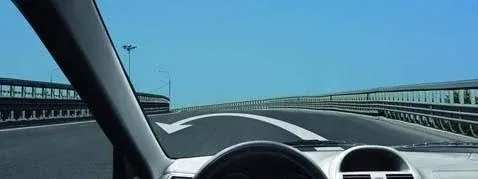
- On and under bridges, overpasses and elevated roads.
- At railway crossings.
- Where visibility in even one direction is less than 100 m.
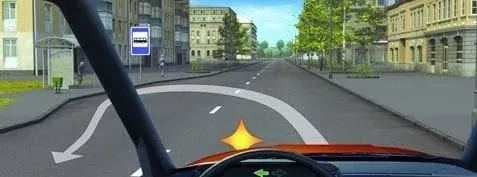
- At stopping points for public-use transport.
- On roads with one-way traffic.
These bans attach to the place, not to the traffic. It doesn’t help that no bus is at the stop, or that you would obstruct nobody. On a bridge, good visibility doesn’t help either: the 100 m test belongs to its own line of the list.
Common trap: On a one-way road, the answer is “in no case”. Neither visibility nor an empty road makes a U-turn lawful, because it would point you into the whole flow.
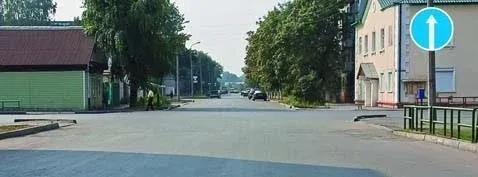
The one-way ban lasts until the one-way section ends. Signs 5.6 “End of one-way road” and 1.21 “Two-way traffic” tell you that it ends ahead, so where they stand you are still on a one-way road.
When is a U-turn allowed?
Section titled “When is a U-turn allowed?”A U-turn is allowed unless a sign, a marking or point 50 stops it. So at an ordinary intersection, or on a straight open road, you may turn.
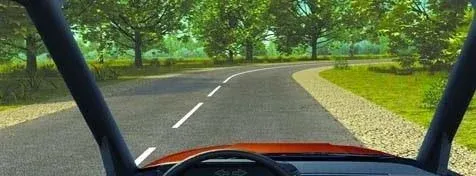
The visibility test: where you can see at least 100 m in both directions, you may turn. A bend or a crest can take this away, so the right answer is often “permitted if visibility is 100 metres or more”. Whether you can turn in one manoeuvre isn’t a test the Rules apply.
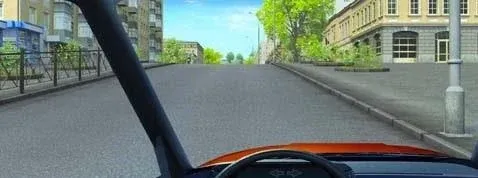
The crest limits how far you can see. Turn here only if you can see 100 m both ways.
Warning signs prohibit nothing. A sign warning of bends, of a pedestrian crossing or of a railway crossing only tells you what lies ahead. The ban starts at the crossing itself, so a U-turn before it is allowed.
Which signs and lines matter?
Section titled “Which signs and lines matter?”| Sign | U-turn? |
|---|---|
| 3.19 “No U-turn” | Prohibited. This is the sign that bans it. |
| 3.18.2 “No left turn” | Allowed: it bans only the left turn |
| 4.1.3 “Movement to the left” | Allowed: signs that permit a left turn also permit a U-turn |
| 5.7.1 “Exit to a road with one-way traffic” | Allowed: it bans nothing |
| 6.3.1 “Place for turning” | Allowed at that place. A plate reading 200 m tells you how far ahead it is. |
| 5.15.1 “Directions of travel by lanes” | Allowed only if the left edge lane has a left-turn arrow |
| 3.1 “No entry” on the road you would finish in | That path is prohibited. Choose one that doesn’t enter that road. |
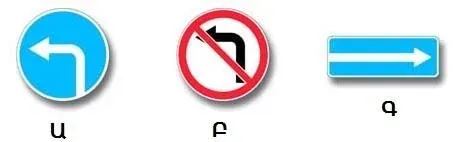
All three signs allow a U-turn.
Sign 4.1.1 “Straight ahead only”: while it applies, you may only go straight on, so a U-turn on the stretch before the intersection is prohibited. Once you have passed straight through the intersection, the sign has ended and you may turn. The questions disagree about a U-turn at the intersection itself, so this lesson leaves that open. Learn those pictures from their practice answers.
Lines: a U-turn may cross a broken line. It may not cross a solid one.
Where do I start the U-turn?
Section titled “Where do I start the U-turn?”Start from the left edge lane (point 40). If you are in the wrong lane and a solid line keeps you from the left one, you can’t make that U-turn lawfully at all.
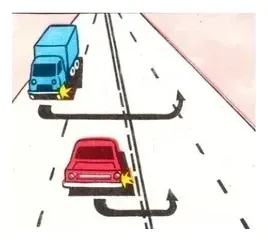
The red car has taken the lane beside the centre line, so it is correct. The blue truck turns across another lane.
- Same-direction tram tracks on your left, at road level: turn from the tracks without obstructing a tram, unless signs 5.15.1, 5.15.2 or marking 1.18 say otherwise (point 40).
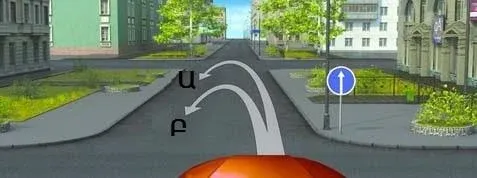
- Road with a dividing strip: go round the end of the strip and finish on the correct side. Don’t end up on the side for oncoming traffic (point 41).
- Pedestrian crossing nearby: your path must not run across it.
Where nothing else limits you, the Rules set no specific U-turn path, so any path that leaves you correctly placed is allowed.
A traffic officer’s signal may permit the U-turn, but it gives you no priority. If your paths cross and the Rules fix no order, give way to a vehicle approaching from your right (point 45).
When may I reverse?
Section titled “When may I reverse?”Only when it is safe and obstructs nobody (point 48). If you can’t see behind you, ask someone to help. A horn or hazard lights only warn others. They don’t show you what is behind.
Point 49 prohibits reversing:
- At intersections.
- When driving out onto a road from an adjacent area.
- At all the places in point 50: pedestrian crossings, tunnels, bridges, railway crossings, public transport stops and the rest.
Remember: Where a U-turn is prohibited by point 50, reversing is prohibited too. “If it doesn’t obstruct anyone” doesn’t rescue it.
So you may not back up to a passenger on a bridge, in a tunnel or at a bus stop. On a clear stretch with none of these, you may. If you overshoot your turn at an intersection, don’t reverse: carry on and turn round where it is allowed.
The ban depends on the place, not the lane. Reversing outside the right edge lane isn’t prohibited by itself.
Reversing into a yard entrance to turn round is permitted if it obstructs nobody and isn’t at one of the banned places.
Extra: Look before you get in
Not from the question bank.
Small children and low objects can be hidden behind a car, even with a reversing camera. Walk round the car before you reverse, reverse slowly, and keep looking through the rear window as well as at the mirrors.
Try it yourself
Section titled “Try it yourself”The arrow shows a U-turn before this railway crossing.
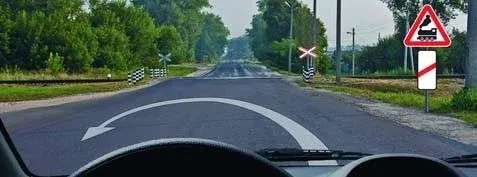
Is it allowed? Yes. The ban covers the crossing itself, and you are not on it. No train condition applies.
You want to make a U-turn past these two signs.
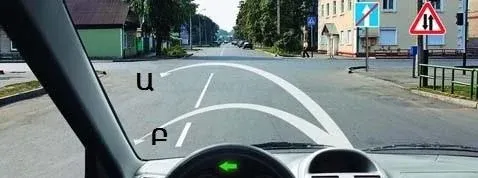
Which path? Neither. You are still on the one-way road, so a U-turn is prohibited on both.
You want to reverse into the yard on the right, and a bus stop with its marking is close by.
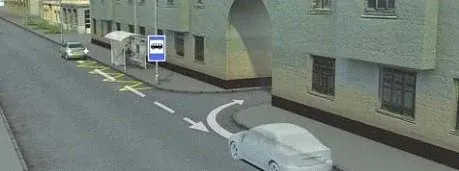
Is it allowed? No. Reversing is prohibited at public transport stops, even if you obstruct nobody.
Key points
Section titled “Key points”- No U-turn on pedestrian crossings, in tunnels, on or under bridges, at railway crossings, at public transport stops or on one-way roads.
- No U-turn with under 100 m of visibility in even one direction.
- Only sign 3.19 bans U-turns by name. “No left turn” doesn’t.
- Start from the left edge lane, and never cross a solid line.
- Reverse only when it is safe. If you can’t see, get help.
- Reversing is prohibited at intersections, when driving out from an adjacent area and at all the point 50 places.
Practice questions
Section titled “Practice questions”Question 74. In this situation, does the driver have the right to make a U-turn at a distance of 200 m from the sign?
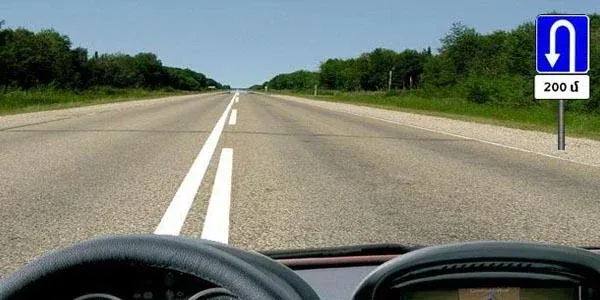
- He has the right.
- He does not have the right.
Show answer
Correct: 1. He has the right.
The blue square with the U-turn arrow is sign 6.3.1 “Place for turning”, and the plate reading 200 m beneath it is 8.1.1 “Distance to the object”, giving the distance in the direction of travel from the sign to that place. Sign 6.3.1 marks the place where a U-turn is permitted, so after 200 m the driver reaches exactly that place and may turn round - he has the right. “He does not have the right.” is wrong: sign 6.3.1 prohibits only the left turn there, while expressly permitting the U-turn it depicts, and plate 8.1.1 merely says the permitted turning place lies 200 m ahead - it forbids nothing.
Question 85. Making a U-turn from the indicated lane is
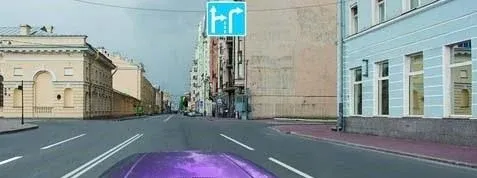
- Permitted
- Prohibited
Show answer
Correct: 2. Prohibited
Sign 5.15.1 “Directions of travel by lanes” shows that from the left lane it is permitted to go straight on or to turn right, and from the right lane to turn right only: no lane carries a left-turn arrow at all. Under the rules for applying these signs, 5.15.1 and 5.15.2 permit a U-turn only where they permit a left turn from the left edge lane, and here they do not. A U-turn from the indicated lane is therefore prohibited, and “Permitted” contradicts the arrows on the sign.
Question 101. How will you act if you need to change your direction of travel to the opposite?
- You will make a U-turn at this intersection
- You will make a U-turn after passing straight through the intersection
- Both options are permitted.
Show answer
Correct: 2. You will make a U-turn after passing straight through the intersection
Before the intersection stands sign 4.1.1 “Movement straight ahead”, which permits travel only straight on, so a U-turn may not be made at this intersection. Under the Rules the effect of sign 4.1.1 placed at the beginning of a section of road extends only as far as the nearest intersection: once you have passed straight through it the sign no longer applies, and a U-turn to reverse your direction of travel is permitted. “You will make a U-turn at this intersection” and “Both options are permitted.” are therefore wrong.
Question 288. When making a U-turn in this situation, to give way to the other driver we are
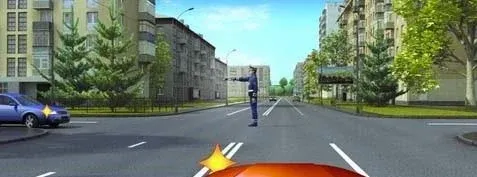
- Not obliged
- Obliged
Show answer
Correct: 2. Obliged
The traffic controller’s right arm is extended forward. From his left side, where you are, non-rail vehicles may travel in all directions, so the U-turn is permitted; from his chest side, where the passenger car is, movement is permitted to the right only (point 16). That car is not oncoming - it approaches on the crossing road from the left - so point 90 does not apply here. Your paths do cross and the Rules fix no order of passage for this case, so point 45 governs: the driver to whom a vehicle is approaching from the RIGHT gives way, and as you complete the U-turn the right-turning car is coming at you from exactly that side. We are therefore obliged to give way. “Not obliged” is wrong because the controller’s signal permits the manoeuvre without granting priority.
Question 460. Is it permitted to make a U-turn at the indicated place?
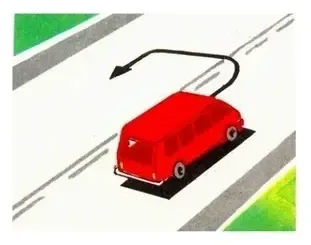
- It is permitted.
- It is prohibited.
Show answer
Correct: 1. It is permitted.
The line to the left of the vehicle is a broken one - marking 1.5 - which separates the opposing streams of traffic and may be crossed from either side. The U-turn here requires crossing exactly that broken line, so making a U-turn at the indicated place is permitted. “It is prohibited.” would be right only if the line were a solid one, as it is in the companion picture over the same stretch of road.
Question 686. A U-turn is prohibited:
- On pedestrian crossings.
- In tunnels.
- On and under bridges, overpasses and elevated roads.
- At railway crossings.
- In all the listed cases.
Show answer
Correct: 5. In all the listed cases.
Point 50 of the Traffic Rules bans a U-turn “On pedestrian crossings.”, “In tunnels.”, “On and under bridges, overpasses and elevated roads.” and “At railway crossings.” All four places named in the question come from that one list, and each of them is a ban in its own right, so naming only one would be an incomplete answer. The correct choice is therefore “In all the listed cases.” The same point also forbids a U-turn where visibility along the road is less than 100 m in even one direction.
Question 689. A U-turn is prohibited if visibility in even one direction of the road is less than:
- 100 m.
- 150 m.
- 300 m.
Show answer
Correct: 1. 100 m.
Point 50 of the Traffic Rules forbids a U-turn where visibility along the road is under 100 m in even one direction, because with less sight distance than that the driver cannot be sure the manoeuvre will not obstruct oncoming traffic. The figure the rule sets is therefore “100 m.” “150 m.” and “300 m.” are not distances the rules attach to a U-turn at all.
Question 693. Which vehicle’s driver is performing the U-turn correctly?
- The blue car’s driver.
- The red car’s driver.
- Both drivers.
Show answer
Correct: 2. The red car’s driver.
Under point 40 of the Traffic Rules, before a turn or a U-turn the driver must move in advance into the appropriate outermost lane of the carriageway for that direction, that is, into the outermost left lane. In the picture the red car’s driver has correctly taken the outermost left lane adjacent to the dividing strip and makes the U-turn from there, while the blue lorry’s driver begins the U-turn from the right lane, crossing the whole carriageway, which breaks that requirement.
Question 700. A U-turn is prohibited
- On pedestrian crossings and in tunnels.
- On and under bridges, overpasses and elevated roads.
- At railway crossings.
- At places on the road with less than 100 m visibility in even one direction.
- In all the listed cases.
Show answer
Correct: 5. In all the listed cases.
Point 50 of the Traffic Rules forbids a U-turn on pedestrian crossings and in tunnels, on and under bridges, overpasses and elevated roads, at railway crossings, and at places with less than 100 m visibility in even one direction of the road. All four groups listed in the question come straight from that list and each is a ban on its own, so choosing only one of them would leave the rule half-stated. The correct choice is “In all the listed cases.”
Question 748. A U-turn at the indicated place
- Is permitted if there is no approaching train
- Is permitted
- Is prohibited
Show answer
Correct: 2. Is permitted
The U-turn arrow marked on the road lies BEFORE the railway crossing, and under point 50 of the Traffic Rules a U-turn is prohibited on railway crossings themselves, not on the approach to them. Since there is no railway crossing at the indicated place, and none of the other prohibiting conditions is present either - no bridge, tunnel or pedestrian crossing, and no stretch with visibility under 100 m - a U-turn at the indicated place is permitted. “Is permitted if there is no approaching train” adds a condition the Rules do not attach here, since you are not on the crossing at all.
Question 753. A U-turn at this intersection
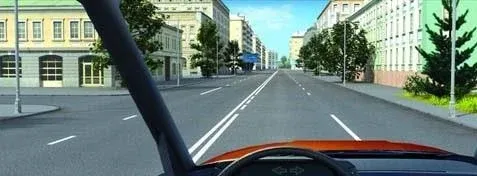
- Is permitted
- Is prohibited
Show answer
Correct: 1. Is permitted
There is nothing at this intersection that forbids a U-turn - no sign 3.19 “No U-turn” and no solid marking that may not be crossed. A U-turn is a permitted manoeuvre in itself and becomes prohibited only where a sign, a marking or an express provision of the Rules says so, so a U-turn at this intersection is permitted. In making it you still have to keep to point 41 and not end up on the side of oncoming traffic as you leave the intersection of the carriageways.
Question 755. Is a U-turn permitted at this place?
- Yes
- It is permitted if visibility is 100 metres or more
- No
Show answer
Correct: 2. It is permitted if visibility is 100 metres or more
Under point 50 of the Traffic Rules, a U-turn is prohibited in places where road visibility in even one direction is less than 100 metres. In the picture the road bends sharply and visibility ahead is limited, so a U-turn is permitted only if road visibility in both directions is 100 m or more.
Question 759. A U-turn at the indicated place
- Is permitted
- Is permitted if it does not obstruct the drivers of public-use vehicles
- Is prohibited
Show answer
Correct: 3. Is prohibited
Under sub-point 6 of point 50 of the Traffic Rules, a U-turn is prohibited at places where there are stopping points for public-use transport vehicles. In the picture sign 5.16 “Bus (trolleybus) stop” is visible on the left-hand side of the road, which confirms that the driver is within the area of a bus stopping point. A U-turn at the indicated place is therefore prohibited, whatever the visibility and whether or not any other vehicle is there - so “Is permitted if it does not obstruct the drivers of public-use vehicles” is wrong: the ban does not depend on obstructing anybody.
Question 762. While within the limits of a bridge, is a U-turn permitted?
- It is permitted if visibility is 100 metres or more
- It is prohibited
Show answer
Correct: 2. It is prohibited
In the picture the vehicle is within the limits of a bridge. Under point 50 of the Traffic Rules a U-turn is prohibited on and under bridges, overpasses and flyovers, REGARDLESS of the visibility conditions. A U-turn on the bridge is therefore prohibited. “It is permitted if visibility is 100 metres or more” borrows the visibility condition from a different limb of point 50 - the one about stretches of limited visibility - which has nothing to do with the ban on bridges.
Question 764. Is a U-turn permitted at this place?
- Yes
- It is permitted if visibility is 100 metres or more
- No
Show answer
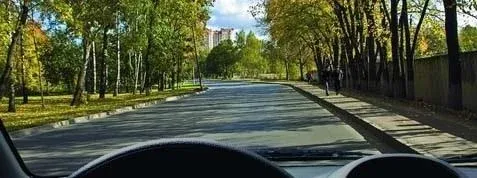
Correct: 2. It is permitted if visibility is 100 metres or more
Under sub-point 5 of point 50 of the Traffic Rules, a U-turn is prohibited in places where road visibility in even one direction is less than 100 m. The picture shows a straight, open road where the field of view is wide in both directions and nothing limits visibility. A U-turn at this place is therefore permitted if visibility is 100 metres or more.
Question 766. A U-turn in this place
- Is permitted
- Is prohibited
Show answer
Correct: 1. Is permitted
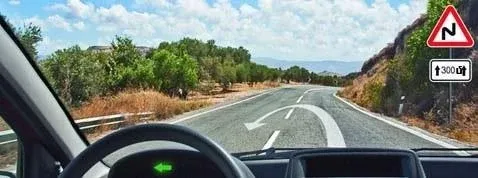
Under point 50 of the Traffic Rules a U-turn is prohibited only at the places it specifically lists - on pedestrian crossings, in tunnels, on bridges, at railway crossings, at places where visibility is less than 100 m, and so on. The dangerous-turn warning sign 1.12 visible in the picture, with its 300 m plate, does not prohibit a U-turn: it only warns of the bends ahead. Since the centre line of the road is broken and neither a prohibitory sign nor any of the listed conditions is present, a U-turn at this place is permitted.
Question 768. Is it permitted to make a U-turn at an intersection by reversing
- Yes
- Yes, if it does not create an obstacle for those travelling through the intersection
- No
Show answer
Correct: 3. No
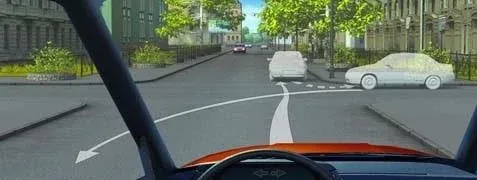
Reversing at an intersection is prohibited. Under point 49 of the Traffic Rules, reversing is prohibited at intersections, where a road is entered from an adjacent territory, and at the places listed in point 50. In the picture the driver is at an intersection and the arrow shows an attempt to make a U-turn by reversing, which is not permitted, so the answer is no. “Yes, if it does not create an obstacle for those travelling through the intersection” is wrong because the ban on reversing at an intersection is unconditional - obstructing nobody does not make it lawful.
Question 771. When reversing where visibility is lacking, the driver must
- Give a sound signal
- Switch on the hazard warning lights
- Turn to the help of other persons
Show answer
Correct: 3. Turn to the help of other persons
Under point 48 of the Road Traffic Rules, reversing is allowed only if it is safe and creates no obstruction, and where necessary the driver must turn to the help of other persons. A lack of visibility is exactly that case — the driver cannot see the path behind unaided — so the required action is “Turn to the help of other persons”. “Give a sound signal” and “Switch on the hazard warning lights” only warn the others; neither shows the driver what is behind, so neither replaces this requirement.
Question 772. Making a U-turn in this situation by using the yard entrance while reversing
- Is permitted, if it does not obstruct other road users
- Is prohibited
Show answer
Correct: 1. Is permitted, if it does not obstruct other road users
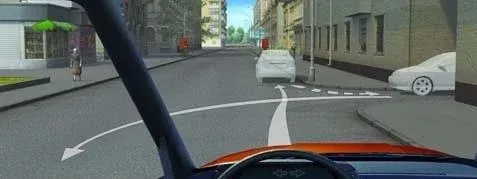
Under point 48 of the Rules, reversing a vehicle is permitted provided it is safe to do so and creates no obstruction for the other road users. In the picture the U-turn is made by using the yard entrance on the right, NOT at an intersection, so the prohibition in point 49 - which bars reversing at intersections and where a road is entered from an adjacent territory - does not apply. Such a U-turn is therefore permitted in this situation, if it does not obstruct other road users.
Question 774. In which option is reversing permitted
- At intersections
- In lanes that are not the right-hand edge lane
- At pedestrian crossings
Show answer
Correct: 2. In lanes that are not the right-hand edge lane
Under point 49 of the Traffic Rules, reversing is prohibited at intersections, when driving out onto the road from an adjoining territory, and in the places listed in point 50 of the Rules, which include pedestrian crossings. So the options “At intersections” and “At pedestrian crossings” are wrong, because reversing is directly prohibited in those places. “In lanes that are not the right-hand edge lane” — that is, the lanes of the carriageway other than the one at the right-hand edge — is not prohibited, because the Rules attach the ban on reversing to the place, not to which lane you are in, and that is why this is the correct option. Reversing is permitted only where the Rules do not prohibit it, and, under point 48, only when it is safe and creates no obstruction for other road users.
Question 777. Is the driver of the passenger car permitted to approach the passenger on a bridge by reversing
- Yes
- Yes, if it does not create an obstacle for other participants
- No
Show answer
Correct: 3. No
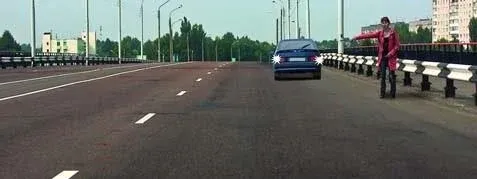
Under point 49 of the Traffic Rules reversing is prohibited at the places listed in point 50, and point 50 expressly includes bridges - “on and under bridges, overpasses and flyovers”. In the picture the car is on a bridge, with the parapet visible on both sides, and the passenger is standing on the bridge at the edge of the road. The driver is therefore prohibited from approaching the passenger by reversing, and the ban is absolute: it does not matter whether an obstruction would be created, so “Yes, if it does not create an obstacle for other participants” is wrong.
Question 778. Is it permitted to make a U-turn in this situation
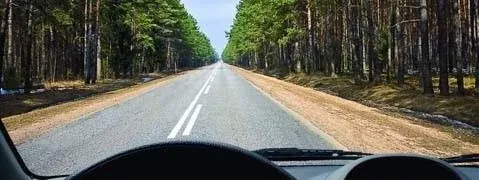
- It is permitted, if we are visible to road users behind from 100 metres and more
- It is prohibited
Show answer
Correct: 1. It is permitted, if we are visible to road users behind from 100 metres and more
It is permitted, provided the road is visible to those following for 100 metres and more. The picture shows a straight road through woodland where visibility in both directions is plainly over 100 m, and there is no tunnel, bridge, pedestrian crossing or other prohibiting condition. Under sub-point 5 of point 50 of the Traffic Rules a U-turn is prohibited only at places where the visibility of the road in even one direction is less than 100 m, so in this situation a U-turn is permitted while that visibility condition holds.
Question 782. Is it permitted, at an intersection passed by accident, to correct by reversing and continue travel in the direction we need
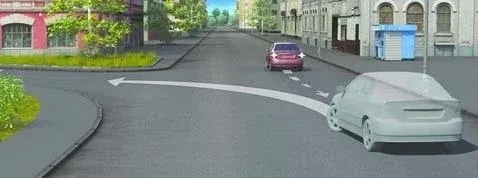
- Yes
- No
Show answer
Correct: 2. No
Under point 49 of the Traffic Rules reversing is prohibited at intersections. The picture shows a car that has missed the direction it wanted, with the arrow showing the driver intending to reverse back to the intersection to correct it, while another vehicle approaches from ahead. Since reversing at an intersection is expressly prohibited, such a manoeuvre is not permissible, and the answer is no - the lawful correction is to carry on and turn round somewhere it is allowed.
Question 784. Is it permitted to enter the yard on the right by reversing in the indicated situation
- Yes, if we do not obstruct public transport vehicles
- No
Show answer
Correct: 2. No
In the picture a public-use transport stop sign with a marked stopping point stands on the left, and the car is reversing into the yard on the right. Under point 49 of the Traffic Rules reversing is prohibited where a road is entered from an adjacent territory and at the places listed in point 50, which include the stopping points of public-use transport. Entering the yard on the right by reversing is therefore not permitted in this situation, and the no-obstruction condition in the other option does not help: the ban does not depend on it.
Question 786. In this situation, is it permitted to approach the passenger by reversing
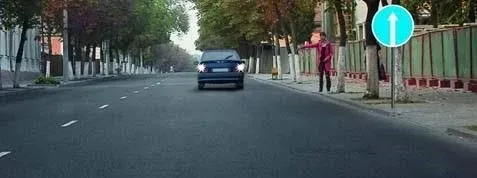
- Yes
- No
Show answer
Correct: 1. Yes
In the picture the car has passed a passenger standing at the edge of the road, and the stretch is clear - there is no intersection, no pedestrian crossing and no public-transport stopping point. Under point 48 of the Traffic Rules reversing is permitted provided it is safe and creates no obstruction for the other road users, and none of the places prohibited by point 49 - an intersection, an entry from an adjacent territory, or the places in point 50 - is present here. Approaching the passenger by reversing is therefore permitted in this situation.
Question 788. Is reversing permitted in this situation
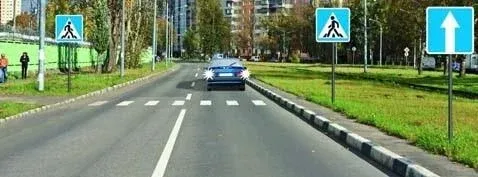
- It is prohibited
- It is permitted up to the pedestrian crossing
Show answer
Correct: 1. It is prohibited
Under point 49 of the Traffic Rules reversing is prohibited at the places listed in point 50, and sub-point 1 of point 50 puts pedestrian crossings among those places. In the picture the “Pedestrian crossing” signs are in place, the zebra is marked, and the car is standing on it. Reversing in this situation is therefore prohibited. “It is permitted up to the pedestrian crossing” does not help: the vehicle is already on the crossing, which is precisely where the ban bites.
Question 790. Approaching the passenger by reversing in this situation
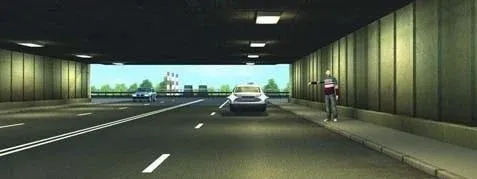
- Is permitted
- Is permitted, if it does not obstruct the travel of other drivers
- Is prohibited
Show answer
Correct: 3. Is prohibited
Under point 49 of the Traffic Rules reversing is prohibited at the places where a U-turn is prohibited by point 50, and sub-point 2 of point 50 prohibits a U-turn in tunnels. In the picture the vehicle is inside a tunnel, so reversing there to approach the passenger is prohibited. The answer is therefore that it is prohibited, and the no-obstruction condition does not save it: in a tunnel there is nowhere for anyone to go around you.
Question 792. A U-turn at this intersection
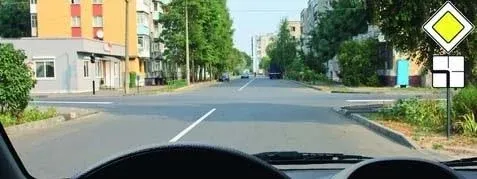
- Is permitted
- Is prohibited
Show answer
Correct: 1. Is permitted
Under point 50 of the Traffic Rules a U-turn is prohibited only on pedestrian crossings, in tunnels, on and under bridges, at railway crossings, at places where the visibility of the road in even one direction is less than 100 m, in the area of public-use transport stopping points, and on roads with one-way traffic. The picture shows an ordinary intersection with a main-road sign, where none of those prohibitions applies and the visibility of the road is ample. A U-turn at this intersection is therefore permitted.
Question 797. Making a U-turn after the sign is permitted
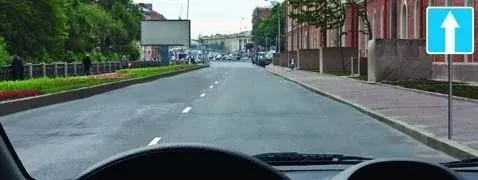
- Only with 100 metres of visibility on both sides
- When no obstacle is created
- In no case
Show answer
Correct: 3. In no case
The picture shows sign 5.5 “Road with one-way traffic”, and under point 50 of the Traffic Rules a U-turn is prohibited on roads with one-way traffic. Sub-point 7 of point 50 forbids it on such roads outright, so neither a visibility of 100 metres nor the absence of any obstruction makes it permissible - a U-turn there would put you head-on into the whole flow. The correct answer is therefore “In no case”.
Question 801. A U-turn at the indicated place
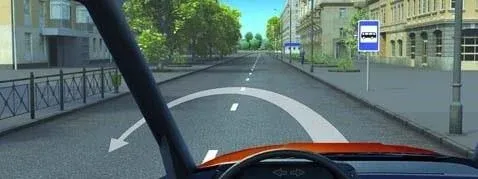
- Is permitted
- Is permitted if there are no public-use vehicles
- Is prohibited
Show answer
Correct: 3. Is prohibited
A U-turn at the indicated place is prohibited. The road sign visible on the right marks the stopping place of a public-use transport vehicle, and under point 50 of the Traffic Rules a U-turn is prohibited on those sections of the carriageway where there are stopping points for public-use transport. The correct answer is therefore that it is prohibited, regardless of whether any public-use vehicle happens to be there at that moment - the ban attaches to the place, not to the traffic.
Question 804. Is it permitted to approach the passenger by reversing?
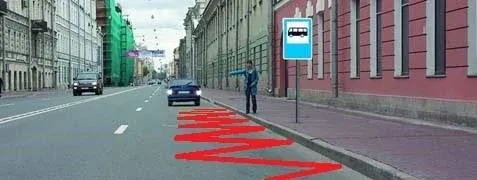
- Yes
- No
Show answer
Correct: 2. No
No. The picture shows a public-use transport stopping point - the bus stop sign, with the zigzag marking along the kerb - beside which the passenger is standing. Under point 49 of the Traffic Rules reversing is prohibited at the places listed in point 50, which include the sections of road where there are stopping points for public-use transport. Approaching the passenger by reversing at the stop is therefore prohibited.
Question 806. When moving in the direction of this upgrade, a U-turn is permitted if
- It is possible to perform it in one manoeuvre
- Visibility of 100 metres from both sides is ensured
- It is prohibited
Show answer
Correct: 2. Visibility of 100 metres from both sides is ensured
In the picture the road is a straight upgrade whose crest limits how far ahead you can see. Under sub-point 5 of point 50 of the Traffic Rules a U-turn is prohibited at places where the visibility of the road in even one direction is less than 100 m, so here a U-turn is permitted only if visibility of at least 100 metres is assured in both directions. “It is possible to perform it in one manoeuvre” is not a test the Rules apply to a U-turn at all, and “It is prohibited” is wrong because with sufficient visibility there is no ban.
Question 808. A U-turn at this place is permitted
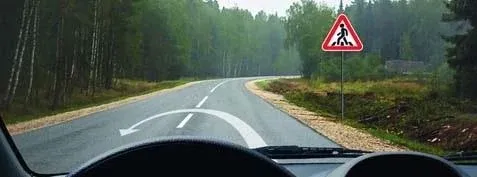
- It is permitted under conditions of 100 m visibility from both sides
- It is prohibited
Show answer
Correct: 1. It is permitted under conditions of 100 m visibility from both sides
Under sub-point 5 of point 50 of the Traffic Rules a U-turn is prohibited only at places where the visibility of the road in even one direction is less than 100 m, so on this open stretch it is permitted provided visibility of at least 100 metres is assured in both directions. The pedestrian-crossing WARNING sign on the right merely informs the driver that a crossing lies ahead and does not itself prohibit a U-turn here, and none of the other prohibitions in point 50 - tunnels, bridges, railway crossings, public-transport stopping points, one-way roads - applies to this place.
Question 1016. Along which trajectory is the U-turn permitted
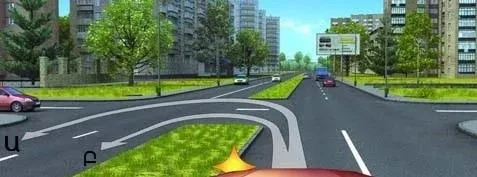
- Only Ա (A)
- Only Բ (B)
- Along both trajectories
Show answer
Correct: 1. Only Ա (A)
The road has a dividing strip, so it has two carriageways, and the U-turn has to be made round the end of that strip. Trajectory Ա (A) does exactly that and brings the car out on the right-hand side of the opposite carriageway - the correct side. Trajectory Բ (B) begins the turn earlier and would bring the car out on the side intended for oncoming traffic, contrary to point 41 of the Rules, under which a vehicle leaving the intersection of the carriageways must not end up on the side of oncoming traffic. The U-turn is therefore permitted only along trajectory Ա (A).
Question 1018. Along which trajectory is the driver permitted to make the U-turn
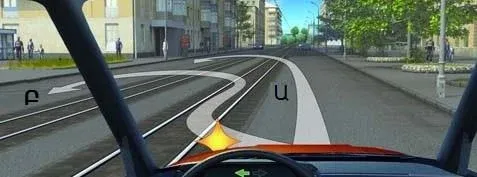
- Only Ա (A)
- Only Բ (B)
- Any
Show answer
Correct: 2. Only Բ (B)
On the left of the carriageway, at the same level, there are tram tracks running in the same direction, and there are no signs 5.15.1 or 5.15.2 and no marking 1.18 here to prescribe any other arrangement. Under point 40 of the Traffic Rules the U-turn must in that case be made FROM those tram tracks, without obstructing a tram - which is exactly trajectory Բ (B). Trajectory Ա (A) makes the U-turn from a lane of the carriageway, which point 40 does not permit in this case, so “Any” is wrong as well.
Question 1021. Along which trajectory is the U-turn permitted
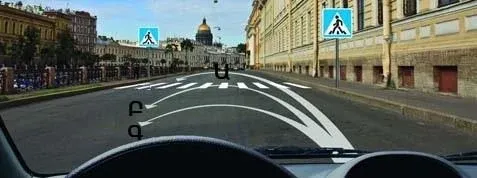
- Only Ա (A)
- Ա (A) or Գ (C)
- All
Show answer
Correct: 2. Ա (A) or Գ (C)
Under point 50 of the Traffic Rules a U-turn is prohibited on pedestrian crossings. In the picture trajectory Բ (B) passes across the pedestrian crossing, so it is not permitted; trajectories Ա (A) and Գ (C) both carry out the U-turn clear of the crossing and break no such rule. The correct answer is therefore “Ա (A) or Գ (C)”.
Question 1026. Along which trajectory is a U-turn permitted
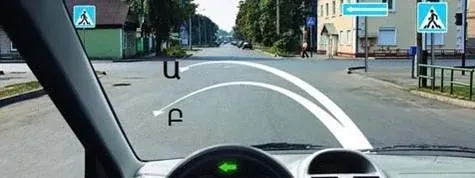
- Only Ա (A)
- Only Բ (B)
- Any
Show answer
Correct: 1. Only Ա (A)
Signs 5.19.2 and 5.19.1 “Pedestrian crossing” stand ahead of the car on the right and on the left; with no marking present, 5.19.2 is placed at the near boundary of the crossing and 5.19.1 at the far one, so the pedestrian crossing lies directly in front of the car, before the intersection. Under point 50 of the Traffic Rules a U-turn is prohibited on pedestrian crossings, and trajectory Բ (B) makes the U-turn on that very crossing. Trajectory Ա (A) takes the car past the crossing and the U-turn is completed in the intersection, where none of the prohibitions of point 50 applies, so the “only Բ (B)” and “any” options are wrong.
Question 1027. Along which trajectory is a U-turn permitted
- Any
- Only Բ (B)
- Only Ա (A)
Show answer
Correct: 1. Any
point 50 of the Traffic Rules lists the places where a U-turn is prohibited: on pedestrian crossings, in tunnels, on bridges and overpasses, at railway crossings, in places with visibility of less than 100 m, in the areas of public-transport stops, and on one-way roads. None of these is present at the intersection in the picture — there are no 5.19.1/5.19.2 “Pedestrian crossing” signs and no crossing marking, and sign 3.19 “No U-turn” is not installed. The rules set no specific U-turn trajectory at an intersection, and both Ա (A) and Բ (B) leave the car correctly placed for the new direction, in that half of the carriageway (point 52 of the Traffic Rules), so any trajectory is permitted.
Question 1033. Along which trajectory is it permitted to make a U-turn
- Only Ա (A)
- Only Բ (B)
- Neither
Show answer
Correct: 3. Neither
On the right stand signs 5.6 “End of one-way road” and 1.21 “Two-way traffic”, which means that the section you are travelling on is STILL a road with one-way traffic and that the oncoming traffic begins further ahead. Under point 50 of the Traffic Rules a U-turn is prohibited on roads with one-way traffic, so it cannot be made here. Trajectories Ա (A) and Բ (B) differ only in the width of their arc, while the prohibition covers the whole one-way section, so neither trajectory is permissible.
Question 1034. Along which trajectory is it permitted to make a U-turn
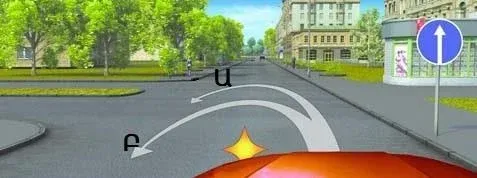
- Only Ա (A)
- Only Բ (B)
- It is prohibited along both trajectories
Show answer
Correct: 1. Only Ա (A)
Sign 4.1.1 “Movement straight ahead” is in place, permitting travel only straight on, and under the Rules the effect of that sign placed at the beginning of a section of road extends as far as the nearest intersection. Trajectory Բ (B) turns round before the intersection, inside the sign’s zone of action, and is therefore prohibited. Trajectory Ա (A) turns round at the intersection, where the effect of sign 4.1.1 has already ended, and is therefore permitted. A U-turn may accordingly be made only along trajectory Ա (A).
Question 1035. Along which trajectory is it permitted to make a U-turn
- At the intersection — Ա (A)
- Before the intersection — Բ (B)
- It is permitted along both trajectories
- It is prohibited along both trajectories
Show answer
Correct: 1. At the intersection — Ա (A)
Sign 4.1.1 “Movement straight ahead” is in place. Under the Rules the effect of sign 4.1.1 placed at the beginning of a section of road extends only as far as the nearest intersection, so on the stretch before the intersection the “straight ahead only” requirement is in force and a U-turn there, along trajectory Բ (B), is prohibited. At the intersection the sign’s effect has ended, so the U-turn along trajectory Ա (A) is permitted. “It is permitted along both trajectories” and “It is prohibited along both trajectories” each ignore the fact that the sign’s zone ends at the intersection itself.
Question 1058. Along which path is making a U-turn permitted?
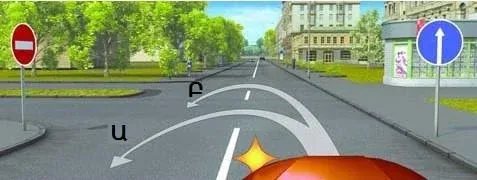
- Only Ա (A)
- Only Բ (B)
- Any
Show answer
Correct: 2. Only Բ (B)
On the road to the left stands sign 3.1 “No entry”, which under the Rules prohibits entering that road in the direction it faces. Trajectory Ա (A) enters that very road, so a U-turn along it would take the car onto a road it may not enter - and onto the side of oncoming traffic - contrary to point 41, which requires a U-turn to be made so that the vehicle does not end up on the oncoming side. Trajectory Բ (B) completes the U-turn without entering the prohibited road, so only Բ (B) is permitted. “Only Ա (A)” and “Any” are wrong because trajectory Ա (A) breaches both the prohibition in sign 3.1 and point 41.
Question 1069. Which signs permit a U-turn?
- All except Գ (C)
- All
- Only Ա (A)
Show answer
Correct: 2. All
Sign Ա (A) is 4.1.3 “Movement to the left”, and under the Rules signs permitting a left turn also permit a U-turn, so it allows one. Sign Բ (B) is 3.18.2 “Left turn prohibited”, which forbids the left turn but does NOT forbid a U-turn - a U-turn is prohibited only by sign 3.19 “No U-turn”. Sign Գ (C) is the information sign 5.7.1 “Exit to a road with one-way traffic”, which introduces no prohibition on turning round. All three therefore permit a U-turn, so “All except Գ (C)” and “Only Ա (A)” are wrong.
Question 1098. A U-turn in the indicated manner at this intersection
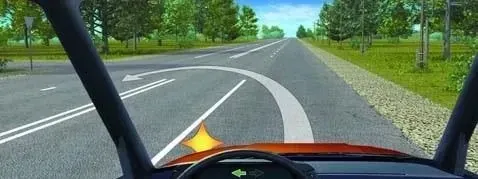
- Is prohibited
- Is permitted
Show answer
Correct: 1. Is prohibited
A U-turn is begun from the lane closest to the left-hand edge, and on this road that is the left-hand lane. The car is in the right-hand lane, separated from the left-hand one by a solid line, which may not be crossed. The trajectory drawn crosses precisely that line - swinging out to the right first and then turning back - so the driver has no way of making this U-turn: he cannot even lawfully reach the lane a U-turn may be started from. A U-turn in the indicated manner at this intersection is therefore prohibited, and “Is permitted” is wrong.
Question 1107. Along which trajectory is a U-turn permitted
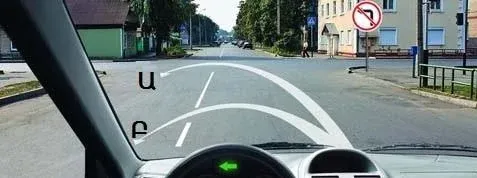
- Only Ա (A)
- Only Բ (B)
- Any
Show answer
Correct: 3. Any
Sign 3.18.2, “No left turn”, is placed before the intersection; it applies to the intersection of carriageways before which it is placed and prohibits the left turn only. A U-turn is prohibited separately, by sign 3.19 “No U-turn”, which is not present here. None of the circumstances listed in point 50 of the Traffic Rules (pedestrian crossing, bridge, tunnel, one-way traffic and so on) is present either, and the centre line is broken marking 1.5, which may be crossed. A U-turn is therefore permitted along both trajectory Ա (A) and trajectory Բ (B).