Bleeding and Wounds
Heavy bleeding can kill within minutes. This lesson teaches you to read the blood, stop it, and place the casualty correctly for each injury.
Remember: This lesson does not replace a first-aid course.
How do I protect myself?
Section titled “How do I protect myself?”A casualty’s blood can carry infection. Avoid touching the wound directly, and use sterile gloves or, if there are none, whatever barrier is to hand. Refusing to help is not protection.
How dangerous is this bleeding?
Section titled “How dangerous is this bleeding?”| Major artery: most dangerous | Vein: dangerous, but slower | |
|---|---|---|
| Color | Bright red | Dark |
| Flow | Spurts in a jet or like a fountain | Flows steadily or slowly |
Blood clotting within 10 minutes is normal, not a danger sign.
How do I stop bleeding from a major artery?
Section titled “How do I stop bleeding from a major artery?”- Press the damaged artery with your fingers. This works at once.
- Apply a tourniquet above the wound, as close to it as possible. Blood comes from the heart’s direction, so below the wound is useless.
- Note on it the time it was applied.
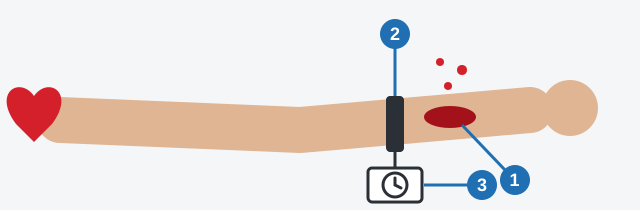
The wound (1), the tourniquet between it and the heart (2), and the note with the time (3).
A tourniquet cuts off the blood supply, so its time is limited: not more than 1 hour in warm weather, and not more than half an hour in cold weather.
For severe bleeding, a dressing alone soaks through. Apply a pressure bandage to the injured part and press at the artery’s pressure point above the wound. Never pour ashes in.
Common trap: The times feel backwards. A limb without blood is damaged faster in the cold, so cold means half an hour.
Extra: Direct pressure and tourniquets in first-aid courses
Not from the question bank.
Most courses start with firm, direct pressure on the wound using a clean pad, adding more on top if blood soaks through. A tourniquet is kept for life-threatening limb bleeding that pressure can’t control. Once it is on, courses teach you not to loosen or remove it yourself: leave that to medical staff and tell them the time.
How do I stop bleeding from a vein or smaller artery?
Section titled “How do I stop bleeding from a vein or smaller artery?”- Raise the limb above the level of the heart, which lowers the pressure in the wound.
- Apply a pressure bandage at the place of the injury, not above or below it, so it presses on the damaged vessel.
- Press and release a nail below the bandage. If it turns pink again with difficulty, circulation is impaired and the bandage is too tight. Pain and discomfort don’t tell you this.
Should I clean the wound?
Section titled “Should I clean the wound?”There is no single rule. The questions treat these cases separately:
| Situation | What to do |
|---|---|
| Dangerous wound | Stop the bleeding and bandage it. Washing costs time and removes the clot. |
| Injury caused by an accident, first steps | Put on medical gloves. Cover the wound, without cleaning it, with a sterile gauze napkin. Secure the edges with adhesive plaster or bandage it. |
| Less dangerous wound | Wash with soap and clean water, then bandage. |
So at an accident, stop the bleeding and cover the wound. Washing applies only to a wound called “less dangerous”, a term the questions don’t define, so read the wording carefully.
Common trap: Iodine, vodka, perfume and cologne burn the tissue and do nothing for bleeding. Keep them out of the wound. Cotton is wrong too, because it sticks.
What if something is stuck in the wound?
Section titled “What if something is stuck in the wound?”Leave it in. It is often pressing the damaged vessel shut, so pulling it out can start heavy bleeding. Pack dressings around it so it stays immobile.
How do I treat a nosebleed?
Section titled “How do I treat a nosebleed?”- Sit the casualty down.
- Tilt the head forward and down, so blood stays out of the throat.
- Press the nose for 10-15 minutes.
Don’t tilt the head back, use a cotton tampon or leave it to stop on its own.
Extra: Where to press on the nose
Not from the question bank.
First-aid courses teach you to pinch the soft part of the nose, just below the bony bridge, while the person breathes through the mouth. If the bleeding won’t stop, get medical help.
How do I treat head, chest and abdominal injuries?
Section titled “How do I treat head, chest and abdominal injuries?”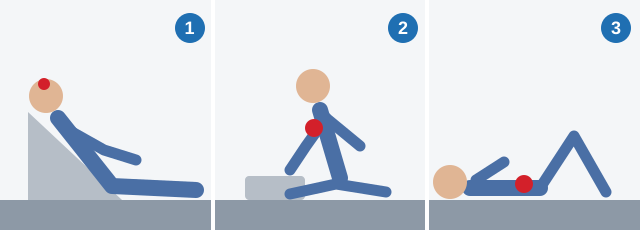
The head injury (1), chest injury (2) and abdominal injury (3) positions from the table below.
| Injury | What to do | Why |
|---|---|---|
| Head injury | Semi-reclined, head and upper body raised | Limits pressure inside the skull. Don’t raise the legs or lay flat. |
| Chest injury | Sit up, leaning onto the injured side | The healthy lung stays free. |
| Abdominal injury | Lay down, legs bent at the knees | The abdominal wall slackens. |
| Organs protruding from the abdomen | Cover with clean damp cloth and polyethylene film | They must not dry out. Never push them back. |
| Suspected internal abdominal bleeding | Lay down, cold compress on the injury | Cold narrows the vessels. No hot water bottle, pressure bandage or large drinks. |
| Closed soft-tissue limb injury, first hours | Cold compress, and raise the part | Limits bleeding and swelling. No warm or alcohol compress. |
For a craniocerebral injury with a wound on the hairy part of the head:
- Stop the bleeding by direct pressure on the wound.
- Apply a pressure bandage over it.
- If consciousness is lost, use the stable side (recovery) position.
- If possible, apply cold to the area.
Extra: If the skull feels dented
Not from the question bank.
If the skull feels soft or dented, or you see bone, don’t press hard on that spot. Press gently around the wound and call an ambulance.
Try it yourself
Section titled “Try it yourself”A pedestrian has a wound about 5 cm long on the forearm. Dark blood flows steadily from it.
What stops the bleeding? Raise the arm and apply a pressure bandage. Dark, steady blood means a vein. Water doesn’t stop bleeding, and iodine damages the tissue.
Key points
Section titled “Key points”- Bright red and spurting: major artery. Dark and steady: vein.
- Major artery: fingers, then a tourniquet above the wound with the time noted.
- Tourniquet: 1 hour at most in warm weather, half an hour in cold.
- Vein or smaller artery: pressure bandage at the place of the injury.
- At an accident, stop the bleeding and cover the wound. Leave foreign bodies in, and never push organs back.
Practice questions
Section titled “Practice questions”Question 550. When giving assistance to a casualty with a head injury, you must:
- Lay him down with his legs raised.
- Lay him down with his head and torso (upper body) raised, providing a semi-reclined position.
- Lay him down in a horizontal position.
Show answer
Correct: 2. Lay him down with his head and torso (upper body) raised, providing a semi-reclined position.
A conscious casualty with a head injury is laid down with the head and upper body slightly raised, so “Lay him down with his head and torso (upper body) raised, providing a semi-reclined position.” is correct. The raised head helps blood drain from the brain and holds down the rise of pressure inside the skull, while the body lying flat prevents a fall if the casualty weakens. “Lay him down with his legs raised.” is wrong: that is the anti-shock position and it drives more blood towards the head, which makes a head injury worse. “Lay him down in a horizontal position.” is wrong because a flat position does nothing to limit the rise of pressure inside the skull.
Question 552. When giving assistance to a casualty with a nosebleed, you must:
- Tilt the casualty’s head back.
- Tilt the casualty’s head down and press the upper part of the nose.
- Put a cotton tampon into the casualty’s nose.
- Leave it to bleed and stop on its own.
Show answer
Correct: 2. Tilt the casualty’s head down and press the upper part of the nose.
For a nosebleed the casualty is sat down, the head tipped forward, and the soft part of the nose just below the bony bridge pressed for 10-15 minutes — which is what “Tilt the casualty’s head down and press the upper part of the nose.” describes. The forward tilt keeps blood from running into the throat, and direct pressure closes the vessels at the front of the septum, where most nosebleeds start. “Tilt the casualty’s head back.” is wrong: the blood then runs into the stomach or the airway and the bleeding does not stop. “Put a cotton tampon into the casualty’s nose.” is wrong because packing damages the fragile vessels and tears the clot away when it is removed, and “Leave it to bleed and stop on its own.” is wrong because without pressure the blood loss simply continues.
Question 556. As a result of an accident a pedestrian has fallen and injured his arm. There is a large wound on the forearm (about 5 cm long), from which dark-colored blood flows steadily. What must be done in order to stop the bleeding?
- Wash the wound with water.
- Raise the casualty’s arm and apply a pressure bandage.
- Apply alcoholic iodine solution to the wound.
Show answer
Correct: 2. Raise the casualty’s arm and apply a pressure bandage.
Blood that is dark in colour and flows steadily is venous bleeding. It is stopped by raising the injured limb above the level of the heart, which lowers the pressure in the wound, and by applying a pressure bandage over it. “Wash the wound with water.” does not stop the bleeding and can introduce infection, and “Apply alcoholic iodine solution to the wound.” damages the tissue inside a 5 cm open wound - iodine goes on the edges of a wound only and does nothing against bleeding.
Question 557. In case of closed soft-tissue injuries of the limbs, when giving assistance in the first hours you must:
- Apply a warming compress to the injury.
- Apply a cold compress to the injured part and raise it.
- Apply a cold compress to the injured part and keep it below heart level.
- Apply an alcohol compress to the injury.
Show answer
Correct: 2. Apply a cold compress to the injured part and raise it.
In the first hours after a closed soft-tissue injury the aim is to limit the bleeding under the skin and the swelling. A cold compress narrows the blood vessels and reduces that internal bleeding, and holding the injured part raised reduces the swelling - which is why “Apply a cold compress to the injured part and keep it below heart level.” is wrong even though it gets the cold right: below the heart the blood flow increases and the swelling grows. “Apply a warming compress to the injury.” and “Apply an alcohol compress to the injury.” both widen the vessels and in the first hours only make the bleeding and swelling worse.
Question 562. In case of a chest injury you must:
- Lay the casualty down in a horizontal position.
- Sit him up, leaning onto the injured side.
- Sit him up, leaning onto the healthy side.
Show answer
Correct: 2. Sit him up, leaning onto the injured side.
With a chest injury the casualty is sat up and leaned onto the INJURED side. In that position the damaged side is restricted while the healthy lung stays free and breathes fully, which is the main thing that matters here. “Sit him up, leaning onto the healthy side.” presses on the very lung that has to do the work, and “Lay the casualty down in a horizontal position.” makes breathing harder and lets blood from the injured side spread towards the healthy one.
Question 563. In case of organs protruding from an open wound on the casualty’s abdomen, you must:
- Wash and carefully try to put the protruding organs back in place.
- Cover the protruding organs with clean damp cloth and polyethylene film.
- Cut off the protruding organs and bandage the wound.
- Do not touch, transport to hospital in that condition.
Show answer
Correct: 2. Cover the protruding organs with clean damp cloth and polyethylene film.
Organs protruding from an open abdominal wound must never be pushed back in - that enlarges the injury and carries infection into the abdominal cavity, so “Wash and carefully try to put the protruding organs back in place.” is wrong. They are covered with clean damp cloth so they do not dry out, and polyethylene film over it to keep the moisture in. “Cut off the protruding organs and bandage the wound.” is a lethal injury and no part of first aid, and “Do not touch, transport to hospital in that condition.” leaves them to dry out and be damaged beyond recovery within minutes.
Question 565. In case of severe bleeding you must:
- Only cover the wound with a bandage.
- Apply a pressure bandage to the injured part and apply pressure at the artery’s pressure point.
- Pour ashes into the wound.
Show answer
Correct: 2. Apply a pressure bandage to the injured part and apply pressure at the artery’s pressure point.
With severe bleeding you apply a pressure bandage to the injured part and at the same time press above the wound at the artery’s pressure point, so that less blood reaches the wound. “Only cover the wound with a bandage.” does not stop severe bleeding - the dressing simply soaks through. “Pour ashes into the wound.” introduces infection, gets in the way of treating the wound afterwards, and does nothing whatever against the bleeding.
Question 567. If there is a foreign body in the casualty’s wound, then when giving assistance you must:
- Remove the foreign body from the wound.
- Let the injured part bleed.
- Ensure the foreign body remains immobile.
- Treat the area of the wound with alcohol.
Show answer
Correct: 3. Ensure the foreign body remains immobile.
A foreign body left in a wound is often what is pressing the damaged vessel shut and holding the bleeding back. Pulling it out can start heavy bleeding and deepen the injury, so it is not removed: it is packed around with dressings to ensure the foreign body remains immobile until medical help arrives. “Remove the foreign body from the wound.” is therefore wrong, “Let the injured part bleed.” is blood lost for no benefit, and “Treat the area of the wound with alcohol.” damages the tissue and does nothing at all about the foreign body.
Question 571. When giving assistance in case of suspected internal abdominal bleeding you must:
- Lay the casualty down and place a cold compress on the injury.
- Place a hot water bottle on the abdomen.
- Apply a pressure bandage to the abdomen.
- Give the casualty a large amount of liquid to drink.
Show answer
Correct: 1. Lay the casualty down and place a cold compress on the injury.
Where internal abdominal bleeding is suspected, the casualty is laid down and a cold compress placed on the injury: cold narrows the vessels and slows the bleeding. “Place a hot water bottle on the abdomen.” does the opposite, widening the vessels and increasing the bleeding. “Apply a pressure bandage to the abdomen.” is useless because the bleeding is inside and cannot be pressed shut from outside, and “Give the casualty a large amount of liquid to drink.” is dangerous - such a casualty usually goes to surgery, and a full stomach is a further risk.
Question 574. To check blood circulation in the limbs, you press and release the nail of the casualty’s injured limb below the bandage. You determine that blood circulation in the limb is impaired if:
- The casualty feels pain.
- The casualty feels discomfort.
- When pressed, the nail whitens with difficulty.
- The nail turns pink again with difficulty.
Show answer
Correct: 4. The nail turns pink again with difficulty.
Pressing the nail squeezes the blood out and the nail whitens; when you release it, the colour comes back almost at once if the circulation is intact. The sign of impairment is therefore that the nail turns pink again with difficulty - the blood is struggling to return, which means the bandage is too tight. “When pressed, the nail whitens with difficulty.” measures the opposite direction and is not the sign this test looks for, while “The casualty feels pain.” and “The casualty feels discomfort.” come from the injury itself and say nothing about the circulation.
Question 576. A sign of the most dangerous bleeding is if:
- The blood clots within 10 minutes.
- The blood spurts in a jet from the wound.
- The blood is dark red in color.
- The blood flows steadily from the wound.
Show answer
Correct: 2. The blood spurts in a jet from the wound.
The most dangerous is arterial bleeding, and its sign is that the blood spurts in a jet from the wound, in time with the heartbeat and bright red in colour; such bleeding can cause a fatal loss of blood within minutes. “The blood is dark red in color.” and “The blood flows steadily from the wound.” are the signs of venous bleeding - dangerous, but not as fast - and “The blood clots within 10 minutes.” is the normal course of events rather than a sign of danger.
Question 578. To protect against infection when giving first aid you must:
- Avoid touching the wound directly and give assistance only with sterile gloves.
- Not assist those casualties who have bleeding.
Show answer
Correct: 1. Avoid touching the wound directly and give assistance only with sterile gloves.
Contact with a casualty’s blood is a route for infection, so to protect yourself you avoid touching the wound directly and give assistance only with sterile gloves - or, if there are none, with whatever barrier is to hand. “Not assist those casualties who have bleeding.” is not protection but a refusal to help, and those are exactly the casualties who die soonest without it.
Question 580. A casualty with an abdominal injury must be:
- Laid down with the head in a raised position.
- Laid down with the legs raised.
- Laid down with the legs bent at the knee joints.
Show answer
Correct: 3. Laid down with the legs bent at the knee joints.
A casualty with an abdominal injury is laid down with the legs bent at the knee joints. In that position the muscles of the abdominal wall slacken, the pain eases, and the wound is not stretched. “Laid down with the legs raised.” and “Laid down with the head in a raised position.” both stretch the abdominal wall and increase the pain and the injury - raising the legs belongs to fainting, not to an abdominal injury.
Question 585. When treating less dangerous wounds you must:
- Wash the wound with soap and clean water, then bandage it.
- Treat the wound with alcohol-based substances (iodine, vodka, perfume, etc.).
Show answer
Correct: 1. Wash the wound with soap and clean water, then bandage it.
A less dangerous wound is washed with soap and clean water, which removes the dirt and germs, and then bandaged. “Treat the wound with alcohol-based substances (iodine, vodka, perfume, etc.).” burns the living tissue in the wound, slows the healing and causes severe pain - such substances go on the edges of a wound only, never into it.
Question 586. When treating dangerous wounds you must:
- Wash the wound with soap and clean water.
- Treat the wound with alcohol-based substances (iodine, vodka, cologne, etc.).
- Stop the bleeding and bandage the wound.
Show answer
Correct: 3. Stop the bleeding and bandage the wound.
With a dangerous wound the main threat is loss of blood, not infection, so you stop the bleeding and bandage the wound. “Wash the wound with soap and clean water.” costs time, washes away the clot and restarts the bleeding, and “Treat the wound with alcohol-based substances (iodine, vodka, cologne, etc.).” burns deeply damaged tissue and does nothing whatever about the bleeding.
Question 590. What first aid should be given for a craniocerebral injury with a wound on the hairy part of the head?
- Stop the bleeding by direct pressure on the wound, apply a pressure bandage over the wound. If consciousness is lost, place the casualty in the stable side (recovery) position. If possible, apply cold to the area of the head injury.
- Immobilize the cervical part of the spine using an improvised splint (collar). Place a sterile cotton swab on the wound, lay the casualty on their back with the legs raised. If possible, apply cold to the head.
- Applying a cervical splint is prohibited. The wound must be covered with medical adhesive plaster and the casualty laid on their side.
Show answer
Correct: 1. Stop the bleeding by direct pressure on the wound, apply a pressure bandage over the wound. If consciousness is lost, place the casualty in the stable side (recovery) position. If possible, apply cold to the area of the head injury.
A wound on the hairy part of the head bleeds very heavily, so the first task is to stop the bleeding by direct pressure on the wound and to apply a pressure bandage over it. If consciousness is lost, the casualty is placed in the stable side (recovery) position so the airway stays open, and cold is applied to the area of the head injury if possible, to reduce the swelling. The second answer puts a cotton swab on the wound, which sticks to it, and lays the casualty on their back with the legs raised - which with a head injury raises the pressure inside the skull. The third is wrong in its opening words: applying a cervical splint is not prohibited with such an injury, and adhesive plaster does not stop heavy bleeding.
Question 592. How long may a tourniquet that stops bleeding remain applied?
- In warm weather not more than half an hour, and in cold weather not more than one hour
- In warm weather not more than 1 hour, and in cold weather not more than half an hour
- The time the tourniquet remains applied is not limited
Show answer
Correct: 2. In warm weather not more than 1 hour, and in cold weather not more than half an hour
A tourniquet cuts off the limb’s blood supply completely, so it may stay on only for a limited time, after which the tissue begins to die. In warm weather that time is not more than 1 hour, and in cold weather not more than half an hour, because in the cold a limb without blood is damaged faster. The answer reversing the two - half an hour in warm weather and an hour in cold - leaves the limb twice as long without blood in exactly the conditions that are worse for it, and “The time the tourniquet remains applied is not limited” means losing the limb.
Question 594. What are the signs of bleeding from a major artery, and how does first aid begin in case of major arterial bleeding?
- Dark-coloured blood flows slowly out of the wound. A pressure bandage is applied to the wound, with a note on it about the time it was applied to the wound.
- Bright red blood flows from the wound, spurting strongly, in an intermittent jet or like a fountain. The damaged artery must be pressed with the fingers, then a tourniquet stopping the bleeding is applied above the wound, as close to the wound as possible, with a note on it about the time it was applied.
- Blood flows slowly out of the wound. A tourniquet stopping the bleeding is applied below the injury, with a note on it about the time it was applied
Show answer
Correct: 2. Bright red blood flows from the wound, spurting strongly, in an intermittent jet or like a fountain. The damaged artery must be pressed with the fingers, then a tourniquet stopping the bleeding is applied above the wound, as close to the wound as possible, with a note on it about the time it was applied.
Bleeding from a major artery shows itself in blood that is bright red and flows from the wound spurting strongly, in an intermittent jet or like a fountain, because it is pushed out with every beat of the heart. Assistance begins by pressing the damaged artery with the fingers, which works at once, and then a tourniquet is applied above the wound, as close to the wound as possible, with a note on it about the time it was applied. Dark-coloured blood flowing slowly is the sign of venous bleeding, not arterial, and a tourniquet applied below the injury is useless: the blood comes from the direction of the heart, so the pressure must be above the wound.
Question 596. How is bleeding stopped in case of injury to veins and non-major arteries?
- Apply a pressure bandage at the place of the injury.
- Apply a pressure bandage in the section above the wound.
- Apply a pressure bandage in the section below the wound.
Show answer
Correct: 1. Apply a pressure bandage at the place of the injury.
With injuries to veins and non-major arteries the bleeding is stopped by applying a pressure bandage at the place of the injury, because the bandage presses directly on the damaged vessel and closes it. “Apply a pressure bandage in the section above the wound.” and “Apply a pressure bandage in the section below the wound.” both leave the damaged vessel unpressed and still bleeding, and pressure higher up is more than this size of bleeding needs and damages the tissue.
Question 597. What are the initial steps of first aid in case of injuries caused by an accident?
- Wash the wound with water, remove foreign bodies from the wound, place sterile cotton on the wound, securing it with a bandage dressing.
- Put on medical gloves, clean the wound with an alcoholic solution of iodine, apply medicinal ointment and cover with adhesive plaster.
- Put on medical gloves, cover the wound without cleaning it with a sterile gauze napkin, securing the edges with adhesive plaster or bandaging it.
Show answer
Correct: 3. Put on medical gloves, cover the wound without cleaning it with a sterile gauze napkin, securing the edges with adhesive plaster or bandaging it.
The first steps with an injury caused by an accident are to put on medical gloves and to cover the wound without cleaning it with a sterile gauze napkin, securing the edges with adhesive plaster or bandaging it. A wound is not cleaned at the scene: it costs time, restarts the bleeding and pushes the dirt deeper. “Wash the wound with water, remove foreign bodies from the wound, place sterile cotton on the wound, securing it with a bandage dressing.” does all of that harm - and a foreign body may be the thing holding the bleeding back, while cotton sticks to the wound. “Put on medical gloves, clean the wound with an alcoholic solution of iodine, apply medicinal ointment and cover with adhesive plaster.” burns the tissue of the wound and gets in the way of the treatment that follows.