Railway Crossings
A train can’t steer around you, so a railway crossing leaves little room for your own judgement. The Rules tell you where to cross, where to wait and when to stay out, and the exam checks those details closely.
Where may I cross, and what do I watch?
Section titled “Where may I cross, and what do I watch?”You may cross railway tracks only at railway crossings, giving way to the train (point 109). You don’t choose your own spot, however convenient or clear it looks.
As you approach, point 110 tells you to follow all of these, and to make sure no train is coming:
- The instructions of the crossing attendant, the person in charge of the crossing.
- The traffic lights, signs and markings of the crossing.
- The position of the barrier.
When must I stay out?
Section titled “When must I stay out?”Point 113 prohibits entering a crossing in each of these cases:
| What you see | What it means |
|---|---|
| Barrier closed or closing | Stay out, whatever the traffic light shows |
| Traffic light showing a prohibiting signal | Stay out, whatever the barrier is doing |
| Attendant giving a prohibiting signal | Stay out, even if the barrier is open |
| Congestion beyond the crossing | Stay out if it would force you to stop on the crossing |
The attendant prohibits entry by standing with the chest or back towards you, by showing a baton, a red lamp or a flag raised above the head, or by holding the arms out to the sides.
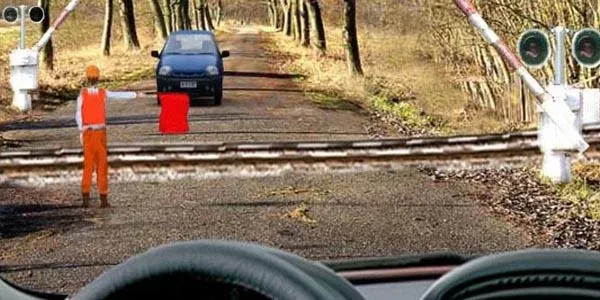
The barrier is open, but the attendant has his back to you. You must not enter.
Common trap: “No train is coming” changes nothing in any of these cases. Nor does it help that the attendant is also stopping the car coming the other way: the same signal stops you.
What does the white lamp mean?
Section titled “What does the white lamp mean?”A flashing round moon-white signal permits you to cross (point 15). If the moon-white and red signals are both off, you may cross within the limits of visibility, provided no train is approaching.
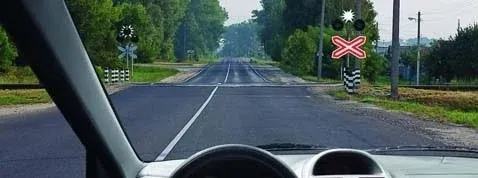
The white lamp is lit and no red signal is showing, so you may cross.
Where exactly do I stop?
Section titled “Where exactly do I stop?”Point 111 gives a chain. Work down it and use the first step that fits your crossing.
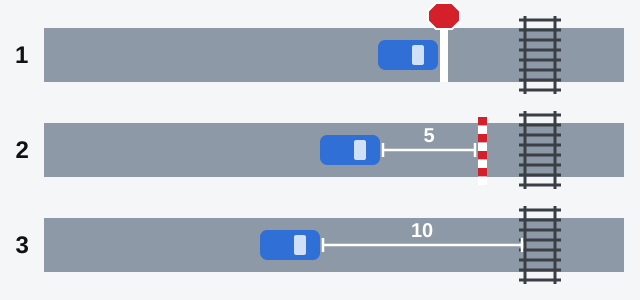
1: at the stop line 1.12, sign 2.5 “Movement without stopping prohibited” or the traffic light. 2: if there are none, no less than 5 m from the barrier. 3: if there is no barrier either, no less than 10 m from the nearest rail.
At step 1 you stop right at the line or sign, with no extra gap. The X-shaped sign that marks the crossing fixes no stopping place, so don’t stop at it if a sign 2.5 stands further on. This chain is for railway crossings. For sign 2.5 at an intersection, see the lesson on priority signs.
Common trap: 5 m is measured from the barrier and 10 m from the rail. “5 m from the nearest rail” is wrong, and so is stopping right at the barrier. The Rules give no 1.5 m, 2.5 m, 3 m or 7 m distance here.
What else is forbidden?
Section titled “What else is forbidden?”- Opening the barrier yourself or going around it. There’s no exception for an official assignment, for a crossing with no attendant present, or for your own view that no train is near.
- Pulling into the oncoming lane to pass the vehicles waiting before a crossing.
- Moving agricultural, road, construction and other machines across a crossing unless they are in transport condition, set up for travel rather than work. A barrier makes no difference to this.
- Crossing without the permission of the head of the railway section with slow-moving machines at a speed lower than 8 km/h, or with tractors coupled to rollers.
Did you know? The Rules set no 30 km/h limit for crossing. The exam offers one as a wrong answer.
What if I’m forced to stop on a crossing?
Section titled “What if I’m forced to stop on a crossing?”Point 112 tells you to stay by your vehicle and give the general alarm signal, which is one long and three short sound signals, repeated. Think of it as a long beep, then beep-beep-beep. It’s the same for every driver, bus drivers included.
To stop a train, make a circular movement of the hand. In daytime, hold a bright-coloured cloth or any clearly visible object. At night, use a torch or a lantern.
Extra: Your passengers come first on a blocked crossing
Not from the question bank.
If your vehicle is stuck on the tracks, get your passengers out and send them well away from the rails. A vehicle can be replaced. People should not stand near it while a train may be coming.
Try it yourself
Section titled “Try it yourself”A red-and-white STOP sign stands before a multi-track crossing, and a train is passing.
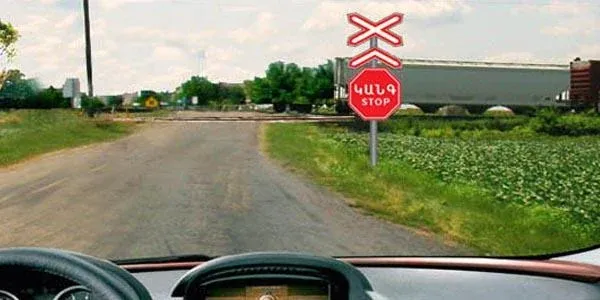
What do you do? Stop before the sign, then cross when it is safe. Sign 2.5 makes the stop compulsory.
The truck ahead has stopped just past the rails. No train is in sight.
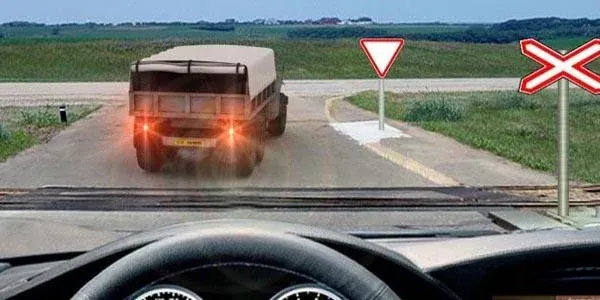
May you cross? No. You would have to stop on the crossing, which point 113 prohibits.
Key points
Section titled “Key points”- Cross only at railway crossings, and follow the attendant, lights, signs, markings and barrier.
- Barrier closed or closing, a prohibiting light or attendant, or a queue past the rails: stay out.
- Stop at the line, sign or light. Otherwise 5 m from the barrier. Otherwise 10 m from the nearest rail.
- Never open or go around a barrier.
- Stuck on a crossing: stay by the vehicle and sound one long and three short.
- Stop a train with a circular movement of the hand.
Practice questions
Section titled “Practice questions”Question 72. How must the driver act in this situation?
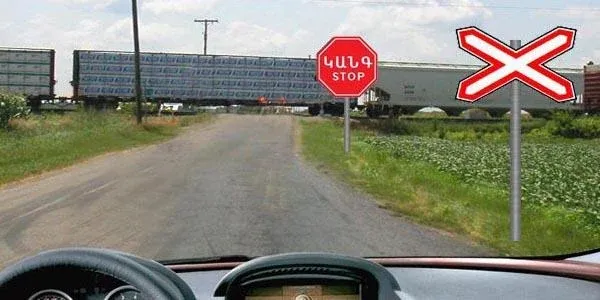
- It is necessary to stop at the first sign.
- It is necessary to stop before the second sign.
- It is necessary to stop at a distance of no less than 5 metres from the first railway track.
Show answer
Correct: 2. It is necessary to stop before the second sign.
The train is occupying the crossing, so movement across it is prohibited. Under point 111 of the Rules, where movement across a crossing is prohibited the driver must stop at the stop line 1.12, at sign 2.5 “Movement without stopping prohibited” or at the traffic light. Here the second sign is that STOP sign 2.5, so the driver must stop before it. Stopping at the first sign is wrong because the first sign is 1.3.1 “Single-track railway”, the X-shaped crossbuck, which only marks the crossing and fixes no stopping place. Stopping no less than 5 metres from the first rail is wrong because no such rule exists: under point 111, where there is no stop line, no sign 2.5 and no traffic light, the driver stops no less than 5 m from the barrier, and where there is no barrier, no less than 10 m from the nearest rail.
Question 76. How must the driver act in this situation?
- Cross the railway crossing, ensuring safety.
- Cross the railway crossing without stopping.
- Stop before the sign and, maintaining safety, cross the multi-track railway crossing.
Show answer
Correct: 3. Stop before the sign and, maintaining safety, cross the multi-track railway crossing.
Sign 1.3.2 “Multi-track railway” marks a railway crossing of two or more tracks that has no barrier, and sign 2.5 “Movement without stopping prohibited” stands before it. Where 2.5 is placed before a railway crossing the driver must stop at the stop line, or where there is none, at the sign itself, and only then go on; here a train is passing, so the crossing stays closed until it is clear. The driver must therefore stop before the sign and then, maintaining safety, cross the multi-track crossing. “Cross the railway crossing, ensuring safety.” and “Cross the railway crossing without stopping.” are wrong because sign 2.5 makes the stop before the crossing compulsory - it cannot be crossed without stopping.
Question 291. Crossing the railway crossing is
- Permitted
- Prohibited
Show answer
Correct: 1. Permitted
At the railway crossing the round moon-white signal is lit and no red signal is showing. Under point 15 of the Rules a flashing round moon-white signal at a railway crossing PERMITS vehicles to cross - and where both the moon-white and the red signals are off, crossing is permitted within the limits of visibility provided no train is approaching. Crossing is therefore permitted. “Prohibited” is wrong because no red signal is lit: at a crossing the white lamp is the one that lets you go.
Question 465. The signal for stopping a train is:
- A circular movement of the hand (in daytime — with a bright-coloured cloth or any clearly visible object, at night — with a torch or a lantern).
- A hand raised above the head with a disc or a red flag.
- A hand extended forward.
- A hand extended forward, swinging up and down.
Show answer
Correct: 1. A circular movement of the hand (in daytime — with a bright-coloured cloth or any clearly visible object, at night — with a torch or a lantern).
Point 112 of the Rules defines the signal for stopping a train as “A circular movement of the hand (in daytime — with a bright-coloured cloth or any clearly visible object, at night — with a torch or a lantern)”, which is why that option is correct. This one gesture is what the Rules require the train driver to read as a demand to stop. “A hand raised above the head with a disc or a red flag”, “A hand extended forward” and “A hand extended forward, swinging up and down” are wrong, because the Rules do not establish any of them as a train stop signal.
Question 467. At what distance from the “Stop line” or the “Movement without stopping is prohibited” sign must the vehicle be stopped in order to give way to an approaching train?
- 1.5 m.
- 2.5 m.
- 5 m.
- 10 m.
- Immediately at the “Stop line” and (or) the sign.
Show answer
Correct: 5. Immediately at the “Stop line” and (or) the sign.
Point 111 of the Rules says that when movement across the crossing is prohibited the driver stops at the 1.12 “Stop line” marking, at the 2.5 “Movement without stopping is prohibited” sign or at the traffic light, and only where none of these exists does the rule of 5 m from the barrier, or 10 m from the nearest rail without a barrier, apply. In this question the stop line or the sign is present, so the vehicle must be halted “Immediately at the “Stop line” and (or) the sign.” “1.5 m.”, “2.5 m.”, “5 m.” and “10 m.” are wrong: 5 m and 10 m are measured only when the line, the sign and the traffic light are all absent, and the Rules set no 1.5 m or 2.5 m distance at all.
Question 473. If movement across a railway crossing is prohibited and there is no traffic light, road signs, marking or barrier, then the driver must stop:
- No less than 5 m from the nearest rail.
- No less than 7 m from the nearest rail.
- No less than 10 m from the nearest rail.
Show answer
Correct: 3. No less than 10 m from the nearest rail.
Point 111 of the Rules builds a chain: the driver stops at the 1.12 “Stop line” marking, the 2.5 “Movement without stopping is prohibited” sign or the traffic light; if none is there, no less than 5 m from the barrier; and if the barrier is missing too, no less than 10 m from the nearest rail. Here the traffic light, the signs, the marking and the barrier are all absent, so the last step of the chain applies and “No less than 10 m from the nearest rail.” is correct. “No less than 5 m from the nearest rail.” is wrong because those 5 m are measured from a barrier, which this crossing does not have, and the Rules set no 7 m distance at all.
Question 477. If movement across a railway crossing is prohibited and there is no traffic light, road signs or marking, then the driver must stop:
- No less than 5 m from the barrier.
- No less than 3 m from the barrier.
- Immediately before the barrier.
Show answer
Correct: 1. No less than 5 m from the barrier.
Point 111 of the Rules has the driver stop at the 1.12 “Stop line” marking, the 2.5 “Movement without stopping is prohibited” sign or the traffic light; where those are absent, no less than 5 m from the barrier; and only where the barrier is absent as well, no less than 10 m from the nearest rail. This crossing has a barrier but no traffic light, signs or marking, so the distance is measured from the barrier and “No less than 5 m from the barrier.” is correct. “No less than 3 m from the barrier.” is a distance the Rules never set, and “Immediately before the barrier.” would leave the vehicle under the boom as it comes down.
Question 666. The driver is prohibited from
- Crossing a railway crossing at a speed of more than 30 km/h
- Crossing a railway crossing at a speed of less than 30 km/h
- Travelling across the crossing without the permission of the head of the railway section with slow-moving machines at a speed lower than 8 km/h and with tractors coupled to rollers
Show answer
Correct: 3. Travelling across the crossing without the permission of the head of the railway section with slow-moving machines at a speed lower than 8 km/h and with tractors coupled to rollers
Sub-point 4 of point 114 of the Traffic Rules prohibits “travelling across the crossing without the permission of the head of the railway section with slow-moving machines at a speed lower than 8 km/h and with tractors coupled to rollers” — that is the keyed option. The Rules contain no prohibition on crossing a railway crossing at more than 30 km/h or at less than 30 km/h, so both of the 30 km/h options state a rule that does not exist.
Question 820. What general alarm signal, by repetition of sound signals, is the driver obliged to give in case of a forced stop on a railway crossing?
- Three long and one short.
- One long and three short.
- One long and two short.
Show answer
Correct: 2. One long and three short.
Under sub-point 3 of point 112 of the Traffic Rules, in case of a forced stop on a railway crossing the driver must stay by the vehicle and give the general alarm signal. The same point defines that signal as “One long and three short” sound signals given one after the other, which is why that is the answer. The other combinations offered — “Three long and one short” and “One long and two short” — are not established by the Rules.
Question 822. The general alarm signal given at a railway crossing is the following combination of sound signals:
- Two long and two short.
- One long and three short.
- Three long and three short.
- Three long and one short.
Show answer
Correct: 2. One long and three short.
Point 112 of the Traffic Rules defines the general alarm signal as the combination of “One long and three short” sound signals given one after the other. This is the very signal the driver is obliged to give in case of a forced stop on a crossing, while remaining by the vehicle. The remaining options — “Two long and two short”, “Three long and three short” and “Three long and one short” — are not combinations provided for by the Rules.
Question 855. Is it allowed to move agricultural, road, construction and other machines and mechanisms across a railway crossing?
- It is allowed, if the crossing is not equipped with a barrier.
- It is allowed, if they are in a non-transport condition.
- It is allowed, if they are in a transport condition.
Show answer
Correct: 3. It is allowed, if they are in a transport condition.
Point 114, sub-point 3 of the Traffic Rules forbids a driver to move agricultural, road, construction and other machines and mechanisms across a crossing while they are in a non-transport condition. Such a move is therefore permitted only “if they are in a transport condition.”, which is the correct answer. The non-transport condition is precisely what the ban rests on, and whether the crossing is equipped with a barrier has nothing to do with this requirement.
Question 856. Where is it allowed to cross railway tracks?
- At those places where visibility in both directions is at least 1000 m.
- At the driver’s discretion, at the places most convenient for it.
- At the places designated for it.
- At a distance of at least 1000 m from railway stations.
Show answer
Correct: 3. At the places designated for it.
Under point 109 of the Traffic Rules, drivers may cross railway tracks only at railway crossings, giving way to the train — that is, “At the places designated for it.”, which is the correct answer. The Rules do not leave the choice of crossing point to the driver’s discretion. Nor do they set any condition of 1000 m visibility in both directions or of 1000 m from a railway station.
Question 857. Is it allowed, while carrying out an official assignment, to open the barrier on one’s own or to bypass it?
- It is prohibited.
- It is allowed.
- It is allowed, at the driver’s discretion, if there is no approaching train nearby.
- It is allowed, in the absence of the crossing attendant.
Show answer
Correct: 1. It is prohibited.
Point 114, sub-point 2 of the Traffic Rules forbids the driver to open the barrier on his own, and point 113, sub-point 1 forbids entering a crossing when the barrier is closed or closing — which is exactly what bypassing it amounts to. Neither prohibition makes an exception for carrying out an official assignment, so the answer is “It is prohibited.” “It is allowed, in the absence of the crossing attendant.” and “It is allowed, at the driver’s discretion, if there is no approaching train nearby.” are both wrong: the ban does not depend on whether an attendant is on duty, nor on the driver’s own judgement that no train is coming.
Question 858. Is it allowed to move agricultural, road, construction and other machines and mechanisms across a railway crossing?
- It is allowed.
- It is allowed, if they are in a transport condition.
- It is prohibited.
Show answer
Correct: 2. It is allowed, if they are in a transport condition.
Point 114, sub-point 3 of the Traffic Rules bans moving across a crossing only those agricultural, road, construction and other machines and mechanisms that are not in a transport condition. So “It is allowed, if they are in a transport condition.” is right — once the machine is set up for travel rather than for work, the ban no longer reaches it. “It is allowed.” drops that limit altogether, and “It is prohibited.” extends the ban to machines the rule does not cover.
Question 859. What must the driver be guided by when approaching a railway crossing?
- By the position of the barrier and the traffic light signals.
- By the requirements of road signs and markings.
- By the instructions of the crossing attendant.
- By all the listed requirements.
Show answer
Correct: 4. By all the listed requirements.
Point 110 of the Traffic Rules requires a driver approaching a railway crossing to be guided by the instructions of the crossing attendant, by the traffic lights, signs and markings provided for the crossing, and by the position of the barrier, and to make sure that no train is approaching. Because the rule lists all of these together, “By all the listed requirements.” is the answer. “By the position of the barrier and the traffic light signals.”, “By the requirements of road signs and markings.” and “By the instructions of the crossing attendant.” each name only part of what point 110 demands.
Question 877. What general-alarm signal, by repeated sound signals, is a bus driver required to give in the event of a forced stop on a railway crossing?
- Three long and one short.
- One long and three short.
- One long and two short.
- Two long and two short.
Show answer
Correct: 2. One long and three short.
Point 112 of the Traffic Rules requires a driver forced to stop on a railway crossing to stay by his vehicle and give the general-alarm signal. The same point defines that signal precisely: a run of sound signals given one after another, “One long and three short.” The other options — “Three long and one short.”, “One long and two short.” and “Two long and two short.” — do not match that definition.
Question 893. Is it permitted to enter the railway crossing in this situation?
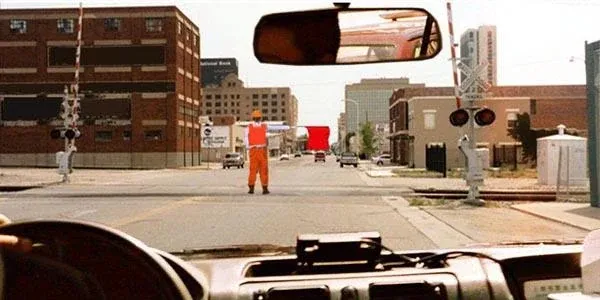
- It is permitted.
- It is prohibited.
Show answer
Correct: 2. It is prohibited.
The crossing attendant is standing turned towards the driver with a raised red signal. Under point 113 of the Rules a driver is prohibited from entering a crossing on the attendant’s prohibiting signal, and the attendant standing with his chest towards the driver - or holding up a red lamp or flag, or with his arms extended to the sides - is exactly such a prohibiting signal. Entry to the crossing is therefore prohibited. “It is permitted.” ignores the attendant’s signal, which point 110 obliges the driver to obey.
Question 894. Is it permitted to enter the railway crossing in this situation?
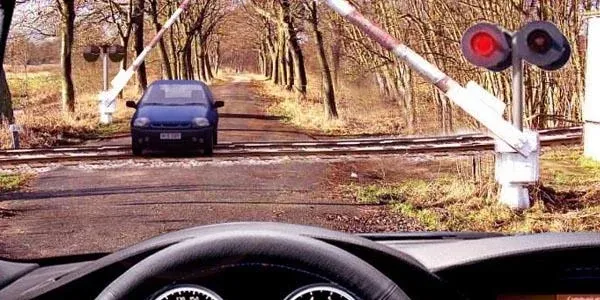
- It is permitted if no train is approaching.
- It is permitted if the barrier is open.
- It is prohibited.
Show answer
Correct: 3. It is prohibited.
The barrier is lowered across the road and the red signal is lit. Under point 113 of the Rules a driver is prohibited from entering a crossing when the barrier is closed or closing (whatever the traffic light is doing) and when the traffic light shows a prohibiting signal (whatever the barrier is doing). Both conditions are present here, so entry is prohibited. “It is permitted if no train is approaching.” and “It is permitted if the barrier is open.” are wrong: the barrier is closed and the red signal is lit, and the absence of a train does not lift the prohibition in point 113.
Question 895. How should one act in this situation?
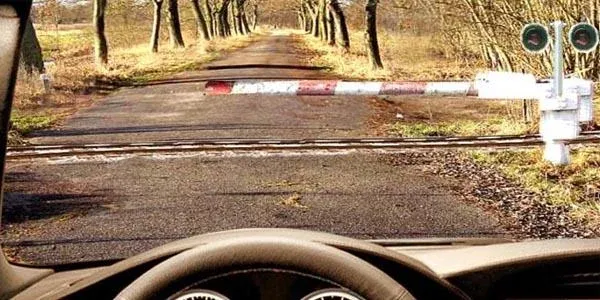
- In the absence of a train, bypass the barrier and continue driving.
- Stop and wait for the barrier to open.
Show answer
Correct: 2. Stop and wait for the barrier to open.
The barrier is closed across the road. Under point 113 of the Rules a driver is prohibited from entering a crossing when the barrier is closed or closing, whatever the traffic light is doing, and point 114 additionally prohibits opening a barrier on one’s own initiative and driving out into the oncoming lane to pass the vehicles waiting before a crossing. The only lawful action is therefore to stop and wait for the barrier to open. “In the absence of a train, bypass the barrier and continue driving.” is prohibited outright by points 113 and 114, even when no train can be seen - a barrier is closed for a reason you cannot always see.
Question 896. In this situation, is it permitted to cross the railway crossing?
- It is permitted if no train is approaching.
- It is permitted.
- It is prohibited.
Show answer
Correct: 3. It is prohibited.
The truck ahead has stopped just beyond the crossing, so a car entering now would be forced to stop on the crossing itself. Under point 113 of the Rules a driver is prohibited from entering a crossing where congestion has formed beyond it that would force him to stop on the crossing. Crossing now is therefore prohibited. “It is permitted if no train is approaching.” and “It is permitted.” are wrong: the absence of a train is beside the point when stopping on the rails is unavoidable, which is precisely what point 113 forbids.
Question 897. In this situation, is it permitted to cross the railway crossing?
- It is prohibited.
- It is permitted if there is no approaching train.
- It is permitted, since the crossing attendant is prohibiting the passage of the oncoming vehicle.
Show answer
Correct: 1. It is prohibited.
The crossing attendant is standing on the crossing with his back towards your car, holding a red flag out to the side. Under point 113 of the Rules a driver is prohibited from entering a crossing on the attendant’s prohibiting signal, and the same item counts as prohibiting his position with the chest OR THE BACK towards the driver, a baton, a red lamp, a flag raised above the head, or arms extended to the sides - so the passage is barred even though the barrier is open. The absence of an approaching train changes nothing, since point 110 obliges the driver to follow the attendant’s directions; and the fact that he is also stopping the oncoming vehicle gives you no advantage, because the same signal prohibits you too.