Overtaking and Oncoming Traffic
Overtaking puts you on the wrong side of the road for a while, so the Rules decide when you may start and where you may never do it. This lesson also covers who gives way when two vehicles can’t pass each other.
What must I check before I start?
Section titled “What must I check before I start?”On a road with one lane each way, overtaking means using the oncoming lane. Point 73 asks for all of this at once:
- The oncoming lane is free for a sufficient distance.
- The driver behind you hasn’t started to overtake you.
- The driver ahead hasn’t signalled a left turn.
- You can return to your lane safely, without obstructing anyone.
The marking must allow it too. You may cross a broken line. With a solid line combined with a broken one, marking 1.11, you may not start an overtake from the solid side. A slow tractor ahead doesn’t change that.
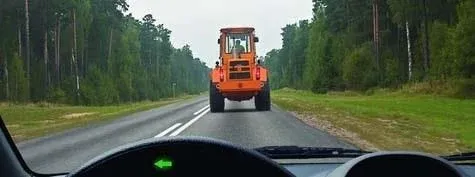
The solid side of the marking is yours, so you may not move out to overtake.
Your vehicle type and the other’s speed don’t ban it by themselves: a truck may overtake a bus travelling at 60 km/h where no prohibition applies.
Which side do I overtake on?
Section titled “Which side do I overtake on?”The left (point 74). There is one exception: if the driver ahead has signalled a left turn and started the manoeuvre, you pass on the right. You also have the choice of waiting until he has gone.
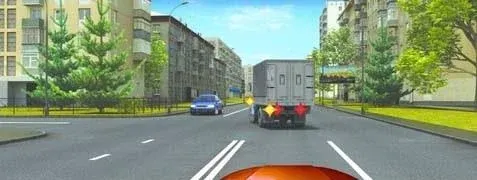
You may pass on the right or wait. Both are permitted.
Passing on the right needs a lane of carriageway. Point 61 prohibits driving on the shoulder, so if there is only a shoulder beside him, wait.
Where is overtaking prohibited?
Section titled “Where is overtaking prohibited?”| Place | Rule |
|---|---|
| Intersections | Prohibited, regulated or unregulated (point 77) |
| Railway crossings | Prohibited on them and up to 100 m before them |
| Pedestrian crossings | Prohibited, whether or not anyone is crossing |
The railway ban has a clear start and end. Outside built-up areas, the first sign 1.1 “Railway crossing with a barrier” stands 150 to 300 m before the crossing, so beside it you may still overtake if the line allows. The ban ends at the crossing: you may start straight after it, with no 100 m wait.
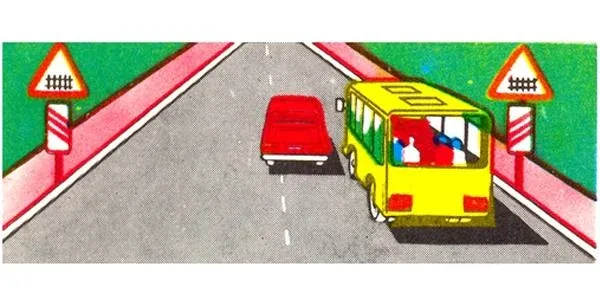
These are the first warning signs, before the 100 m zone starts, so this overtake is allowed.
For an intersection, the whole overtake must be finished before you reach it. A warning sign ahead means you may overtake only if you can complete it before the intersection.
What if I am on the main road? The questions that ask this directly say the ban still holds. Priority lets you go first at the intersection, and it doesn’t let you overtake there. The explanation of question 1097 words the ban differently, but no main road appears in its picture, so its answer is the same either way.
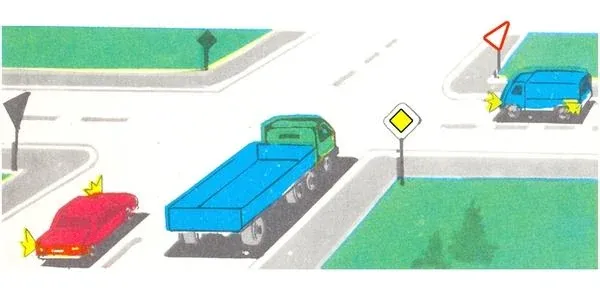
The red car is on the main road, but the truck is at the intersection, so overtaking is prohibited.
May I overtake someone who is overtaking?
Section titled “May I overtake someone who is overtaking?”No. If the vehicle ahead is overtaking or bypassing an obstacle, you may not overtake it. What it is doing decides this, not how fast it is going.
Common trap: Many options offer “if its speed is less than 30 km/h”. In these questions that condition is never the answer. Speed doesn’t open a ban at an intersection, at a crossing, or behind a vehicle that is overtaking.
What do the overtaking signs mean?
Section titled “What do the overtaking signs mean?”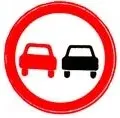
Sign 3.20 “Overtaking prohibited”: no overtaking, by any type of vehicle. You may still overtake slow-moving vehicles, horse-drawn carts, two-wheeled motorcycles without a sidecar, mopeds and bicycles.
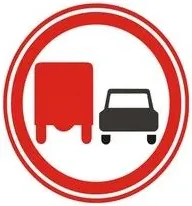
Sign 3.22 “Overtaking by lorries prohibited”: motorcycles, passenger cars, buses and trucks with a permissible maximum mass up to 3.5 t may still overtake.
Under sign 3.20, the question is what the vehicle ahead is. A truck stays a truck at any speed. Under sign 3.22, the question is what you are driving.
What if someone is overtaking me?
Section titled “What if someone is overtaking me?”You have no duty to give way, but you must not obstruct him by speeding up or by any other action (point 75). The ban covers only obstructing an overtake: speeding up to clear an intersection is fine.
Extra: Why an oncoming car arrives sooner than it looks
Not from the question bank.
If you and an oncoming car each travel at 90 km/h, the gap between you closes at 180 km/h, which is 50 metres every second. Overtaking also takes longer than most drivers expect. If you are in doubt, stay behind.
Who gives way when we can’t pass each other?
Section titled “Who gives way when we can’t pass each other?”Three cases cover it:
- Narrow section with sign 2.6 or 2.7: follow the sign.
- Slope with sign 1.13 or 1.14: the driver going down gives way, wherever the obstacle is (point 46).
- Anything else: the driver with the obstacle on his side gives way (point 46).
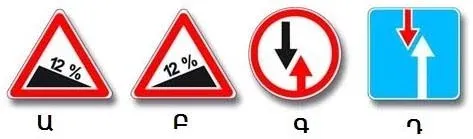
From left to right: 1.13 “Steep descent”, 1.14 “Steep ascent”, 2.6 “Priority of oncoming traffic” and 2.7 “Priority over oncoming traffic”. The first and third make you give way.
Narrow sections: sign 2.7 gives you priority, and the oncoming driver faces sign 2.6. Sign 2.6 doesn’t close the road. You may enter if this doesn’t obstruct anyone coming the other way.
Slopes: stopping on a climb and moving off again is much harder, so the climbing vehicle goes first. Public-use vehicles get no special priority here.
Remember: The slope rule beats the obstacle rule. Going downhill, you give way even if the rocks are on the other side. Climbing, you go first even if the broken-down truck is on your side.
Check which sign you have. Sign 1.13 makes you give way, but a falling rocks sign is no slope sign, so the obstacle rule applies.
Fixed obstacles: on a two-way road with no signs, markings or dividing strip, pass safety islands, bollards and bridge supports on the right (point 64). Going left would put you in the oncoming lane.
Try it yourself
Section titled “Try it yourself”You are the car behind the tanker. It has stopped in your lane with hazard lights on and a warning triangle behind it. A car is coming the other way.
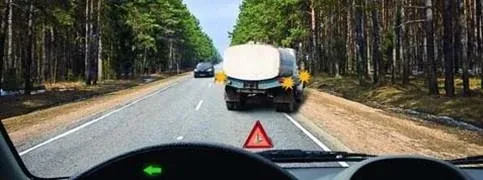
Must you give way? Yes. The obstacle is on your side, and no slope sign applies.
Same tanker, but now sign 1.14 “Steep ascent” stands beside the road.
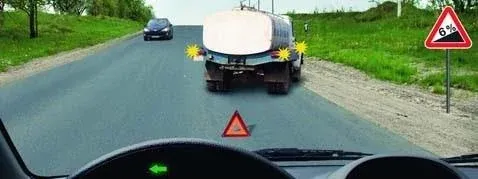
Must you give way? No, you may go first. The driver coming down gives way, even though the obstacle is on your side.
You are in the green car, and the red car ahead is going round roadworks.
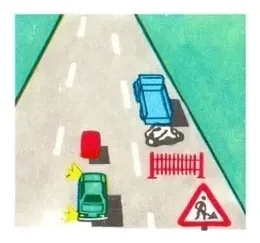
May you overtake? No. The red car is bypassing an obstacle, so overtaking it is prohibited.
Key points
Section titled “Key points”- Before overtaking: free oncoming lane, nobody overtaking you, no left signal ahead, safe return. All of them.
- Overtake on the left, or on the right if the driver ahead has signalled and started a left turn. Never on the shoulder.
- No overtaking at intersections, on pedestrian crossings, or on railway crossings and up to 100 m before them.
- Never overtake a vehicle that is overtaking or bypassing an obstacle. A speed of 30 km/h changes nothing.
- Being overtaken: don’t speed up or obstruct.
- Who gives way: follow signs 2.6 and 2.7. On a marked slope, the driver going down. Otherwise, the driver with the obstacle on his side.
Practice questions
Section titled “Practice questions”Question 18. Is the bus driver permitted to overtake in the zone of action of this sign?
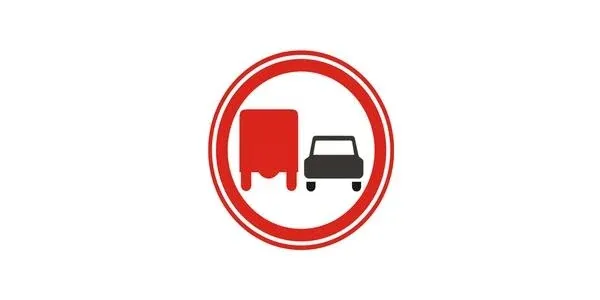
- Permitted in all cases, observing the rules of overtaking.
- Not permitted.
- Permitted if the speed of the overtaken vehicle does not exceed 30 km/h.
Show answer
Correct: 1. Permitted in all cases, observing the rules of overtaking.
This is prohibitory sign 3.22 “Overtaking by lorries prohibited”, under which overtaking is banned for everyone except motorcycles, light passenger cars, buses and lorries with a permissible maximum mass of up to 3.5 t. A bus is expressly outside that ban, so the bus driver may overtake anywhere in the sign’s zone of action, observing the rules of overtaking. “Not permitted.” is wrong because buses are excepted, and the condition that the overtaken vehicle’s speed does not exceed 30 km/h belongs to a different sign, 3.20 “Overtaking prohibited”, not to 3.22.
Question 87. In this situation
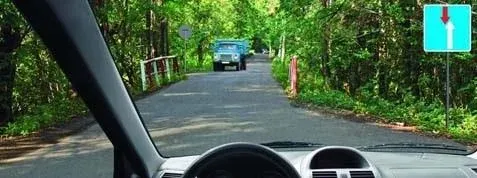
- We are obliged to give way to the truck driver
- We may pass the narrow section first
Show answer
Correct: 2. We may pass the narrow section first
The sign facing you is 2.7 “Priority over oncoming traffic”, which the Rules use to mark a narrow section of road where the driver travelling in your direction has priority over oncoming vehicles. You may therefore pass the narrow section first: the oncoming truck is looking at the opposite sign, 2.6 “Priority of oncoming traffic”, and is obliged to give way. “We are obliged to give way to the truck driver” is wrong because on this narrow section the priority is yours, not the oncoming vehicle’s.
Question 122. Is overtaking permitted in this situation?
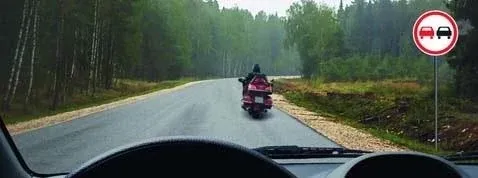
- Yes
- Yes, if the motorcycle’s speed is less than 30 km/h
- No
Show answer
Correct: 1. Yes
This is sign 3.20 “Overtaking prohibited”. Under the road-signs rules 3.20 bans overtaking by all types of vehicle, but overtaking slow-moving vehicles, horse-drawn carts, two-wheeled motorcycles without a sidecar, mopeds and bicycles remains permitted. Ahead is a two-wheeled motorcycle without a sidecar - one of those named exceptions - so overtaking it is permitted and the answer is “Yes”. “Yes, if the motorcycle’s speed is less than 30 km/h” is wrong because the permission rests on what the vehicle IS, not on its speed; a speed condition belongs to the separate “slow-moving vehicle” exception, which is a different category. “No” is wrong because 3.20 expressly lifts the ban for a two-wheeled motorcycle without a sidecar.
Question 504. Are you obliged to give way to the truck?
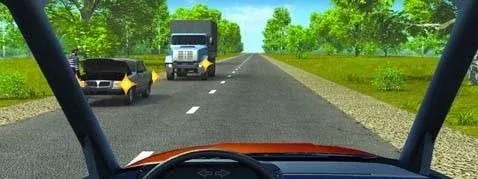
- Yes
- No
Show answer
Correct: 2. No
Passing is made difficult by a broken-down car, and that obstruction lies ahead of the truck, on the truck’s side of the road. Under point 46 of the Rules, where oncoming traffic is obstructed the driver on whose side the obstruction stands must give way. It is therefore the truck that must yield, and you are not obliged to give way to it. “Yes” is wrong because the obstruction is on the truck’s side, which puts the advantage with you.
Question 531. This marking overtaking
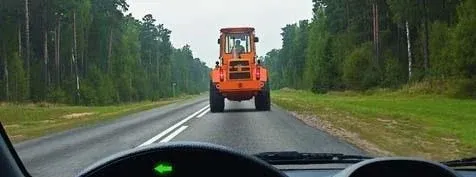
- Permits
- Prohibits
- Permits only tractors to overtake
Show answer
Correct: 1. Permits
The line separating the opposing streams here is a broken one, and a broken line may be crossed from either side. This marking therefore introduces no prohibition on overtaking and permits it; it would prohibit overtaking only if the line were solid. “Prohibits” is wrong for that reason, and “Permits only tractors to overtake” makes no sense - a marking does not distinguish between types of vehicle.
Question 536. Overtaking with this marking
- Is permitted
- Is permitted, if the vehicle ahead is slow-moving
- Is prohibited
Show answer
Correct: 3. Is prohibited
The centre of the road carries marking 1.11, a solid line combined with a broken one, and the solid half is on the side of the lane you occupy. Under the markings section, line 1.11 may be crossed from the side of the BROKEN line, and from the side of the solid line only when finishing an overtake or a bypass already begun. Moving out into the oncoming lane to START an overtake is therefore prohibited here. “Is permitted” is wrong because from your side the line may not be crossed, and “Is permitted, if the vehicle ahead is slow-moving” is wrong because the low speed of the tractor ahead gives no right to cross the solid side of 1.11 - it is the marking, not the traffic, that decides.
Question 668. A driver is prohibited from increasing speed if
- It will prevent the driver of the vehicle overtaking him from completing the overtaking.
- It is necessary in order to clear the way for a driver who has stopped to give way to him.
- It is done in order to clear the intersection
Show answer
Correct: 1. It will prevent the driver of the vehicle overtaking him from completing the overtaking.
Point 75 of the Traffic Rules forbids the driver of a vehicle being overtaken to obstruct the overtaking by increasing speed or by any other action, so raising speed is prohibited when “It will prevent the driver of the vehicle overtaking him from completing the overtaking.” The Rules attach no such prohibition to speeding up in order “to clear the way for a driver who has stopped to give way to him” or “in order to clear the intersection”.
Question 694. In the absence of road signs, markings and a dividing strip, on roads with two-way traffic drivers must bypass the elements of road structures located on the carriageway
- From the right side.
- From the left side.
Show answer
Correct: 1. From the right side.
Point 64 of the Traffic Rules says that on a two-way road with no dividing strip the driver must pass safety islands, bollards and the elements of road structures (bridge and overpass supports and the like) standing on the carriageway on their right side, unless signs or markings direct otherwise. The question states that there are no signs, no markings and no dividing strip, so this default applies and the answer is “From the right side.” Passing “From the left side.” would put the driver into the lane used by oncoming traffic, which is allowed only where a sign or marking says so.
Question 704. Which vehicle’s driver has the right of way?
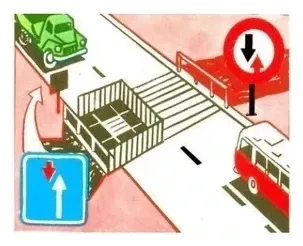
- The truck’s driver.
- The bus driver.
Show answer
Correct: 1. The truck’s driver.
The truck is approaching the narrow section under sign 2.7 “Priority over oncoming traffic” - the blue square with a large white upward arrow and a small red downward one - which gives its driver priority over oncoming vehicles in the narrow section. Facing the bus from the other side is sign 2.6 “Priority of oncoming traffic”, a red disc, which prohibits entering the narrow section if that would obstruct oncoming traffic. Under the definitions of signs 2.6 and 2.7 in the priority-signs section of the Rules, the right of priority travel therefore belongs to the truck’s driver.
Question 706. If it is difficult to pass on the slopes marked with the appropriate sign, you must give way
- To a vehicle going downhill
- To a public vehicle
- Vehicle going uphill
Show answer
Correct: 3. Vehicle going uphill
Under point 46 of the Traffic Rules, on sections with signs 1.13 “Steep descent” and 1.14 “Steep ascent”, the driver going downhill must give way when passing is difficult, because stopping and moving off again on a climb is much harder. So you give way to the vehicle going uphill. A public vehicle gets no special priority here.
Question 707. Which vehicle’s driver must give way?
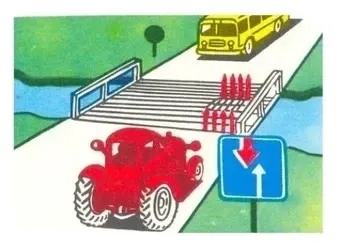
- The tractor’s driver.
- The bus driver.
Show answer
Correct: 2. The bus driver.
On the tractor’s side stands sign 2.7 “Priority over oncoming traffic” - blue, with a large white upward arrow and a small red downward one - and under the Rules a driver travelling in that sign’s direction has priority over oncoming vehicles. On the bus’s side sign 2.6 “Priority of oncoming traffic” applies, which prohibits entering the narrow section if that would obstruct oncoming traffic and obliges the driver to give way. The one who must give way is therefore the bus driver.
Question 711. Which vehicle’s driver must give way?
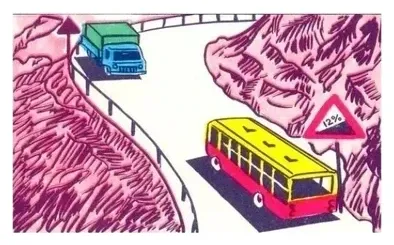
- The bus driver.
- The car’s driver.
Show answer
Correct: 2. The car’s driver.
Under point 46 of the RA Traffic Rules, on sections of road with a longitudinal gradient marked by signs 1.13 “Steep descent” and 1.14 “Steep ascent”, the driver travelling in the DESCENDING direction must give way, regardless of where the obstruction lies. The picture shows a narrow mountain road with a 12% gradient warning sign, on which the car is descending towards the ascending bus, so the car’s driver must give way - a vehicle stopped on a climb has far more difficulty moving off again.
Question 714. If on road sections with a longitudinal gradient equipped with the corresponding signs the oncoming traffic is impeded, then the way must be given to
- The vehicle travelling in the downhill direction.
- The public-use vehicle.
- The vehicle travelling in the uphill direction.
Show answer
Correct: 3. The vehicle travelling in the uphill direction.
Under point 46 of the Road Traffic Rules, on road sections with a longitudinal gradient equipped with signs 1.13 “Steep descent” and 1.14 “Steep ascent”, the driver travelling downhill must give way, whatever side the obstruction is on. Priority therefore belongs to “The vehicle travelling in the uphill direction”, because stopping and moving off again on a slope is considerably harder for it. “The vehicle travelling in the downhill direction” states the rule the wrong way round, and being “The public-use vehicle” gives no priority here.
Question 726. In this situation, do you have the right to make the indicated maneuver?
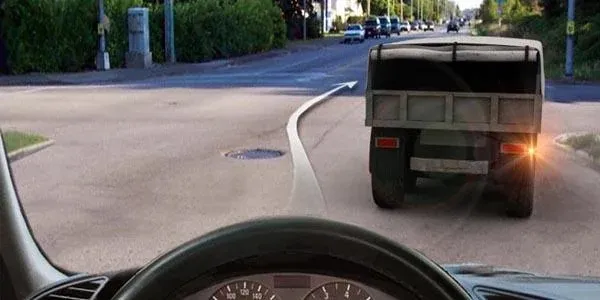
- Yes.
- No.
Show answer
Correct: 2. No.
Under sub-point 1 of point 77 of the Traffic Rules, overtaking is prohibited at intersections. In the picture the truck ahead is approaching the intersection with its right indicator on, and the overtake shown by the arrow would be carried out on the intersection itself, so the manoeuvre is prohibited. Although point 74 permits overtaking on the left in general, the prohibition that applies at an intersection excludes it, so “Yes.” is wrong.
Question 739. Are we obliged in this situation to give way to the driver of the car approaching from the opposite direction?
- Yes
- NO
Show answer
Correct: 1. Yes
The tanker is standing in our own traffic lane with its hazard warning lights on and a warning triangle behind it, and to continue we must move out into the oncoming lane to pass it. Under point 46 of the Traffic Rules, where passing oncoming traffic is made difficult, the driver on whose side the obstruction lies must give way. The obstruction is on our side, so we are obliged to give way to the driver of the car approaching from the opposite direction.
Question 740. In this situation you are obliged to
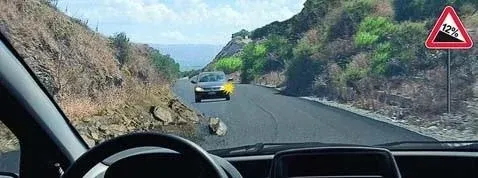
- Give way
- Go first
Show answer
Correct: 1. Give way
The triangular sign on the right is 1.13 “Steep descent”: the black slope on it falls from left to right and is marked 12%, so the gradient runs downhill in your direction of travel - you are the one descending and the oncoming car is climbing. Rocks have fallen onto the carriageway ahead, on the oncoming driver’s side, so passing each other is difficult. Under point 46 of the Traffic Rules, on sections marked with signs 1.13 “Steep descent” and 1.14 “Steep ascent”, where there is an obstruction, the driver travelling in the descending direction must give way regardless of which side the obstruction lies on. The rocks being on the other side therefore does not help you: “Go first” is wrong, and because you are descending you must give way to the ascending car.
Question 741. In the given situation
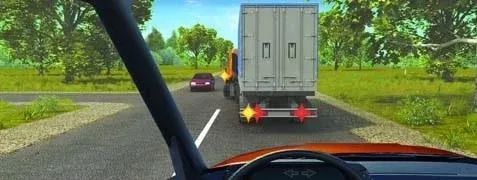
- We may bypass the truck on the right side, along the shoulder.
- Continue driving only after the truck has passed.
- Both actions are permitted
Show answer
Correct: 2. Continue driving only after the truck has passed.
The truck ahead is braking with its left indicator on - it is beginning a left manoeuvre - and a passenger car is approaching in the oncoming lane, so passing on the left is impossible. Under point 74 of the Traffic Rules, where the driver ahead has signalled a left turn and begun the manoeuvre, overtaking is done on the RIGHT; but here there is no free lane of carriageway on the right, only a shoulder, and point 61 prohibits the movement of vehicles along shoulders. Bypassing the truck on the right along the shoulder is therefore not permitted, and the correct action is to continue only after the truck has passed.
Question 742. In this situation
- You must give way
- You may go first
Show answer
Correct: 2. You may go first
Sign 1.14 “Steep ascent” stands on the road, so you are travelling up the gradient while the oncoming car is coming down it. The tanker is standing on your side, with hazard lights on and a warning triangle behind it, which makes passing difficult. But under point 46 of the Traffic Rules, on sections marked with signs 1.13 “Steep descent” and 1.14 “Steep ascent”, the driver travelling in the DESCENDING direction must give way REGARDLESS of where the obstruction lies - so the obstruction being on your side does not change it, and you may go first.
Question 743. In the given situation, when driving straight ahead, it is permitted to
- Bypass the truck on the right side.
- Continue driving only after the truck has passed
- Both indicated cases are permissible
Show answer
Correct: 3. Both indicated cases are permissible
The driver of the truck ahead has given the left-turn signal and begun the manoeuvre, so under point 74 of the Traffic Rules the general rule about overtaking on the left does not apply and such a vehicle is passed on the RIGHT. At the same time the driver is not obliged to make that manoeuvre: waiting until the truck has completed its turn and cleared the carriageway, and then carrying straight on, is equally lawful. Both of the indicated cases are therefore permissible.
Question 744. In this situation you have
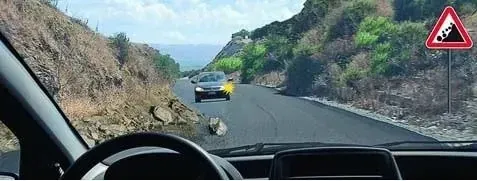
- Give way
- You have the right to travel first.
Show answer
Correct: 2. You have the right to travel first.
The triangular sign warns of falling rocks, not of a steep descent, so the mountain-road rule under which a driver going down gives way to one coming up does not apply here. The rocks that have come down onto the road narrow the carriageway, and under point 46 of the Rules, where oncoming traffic is obstructed, the driver on whose side the obstruction lies must give way. The obstruction is on the oncoming car’s side, so you have the right to travel first. “Give way” would be the answer to the version of this picture that carries the steep-descent sign instead.
Question 809. Is it permitted to cross the bridge if this does not obstruct the motorcycle driver?
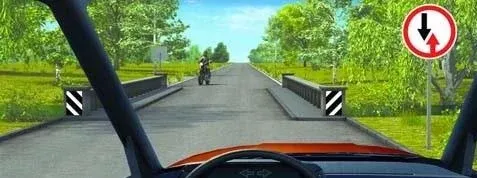
- Yes
- No
Show answer
Correct: 1. Yes
Yes. Sign 2.6 “Priority of oncoming traffic” stands on the right. Under the Rules that sign prohibits entering a narrow section of road - which this bridge is - ONLY where doing so would obstruct oncoming traffic. Since your passing does not obstruct the motorcyclist visible on the bridge, crossing it is permitted: 2.6 does not close the narrow section absolutely, it settles who gives way if the two cannot pass.
Question 836. Within what distance before a railway crossing is overtaking prohibited?
- Up to 50 m before.
- Up to 100 m before.
- Up to 150 m before.
Show answer
Correct: 2. Up to 100 m before.
Under sub-point 3 of point 77 of the Traffic Rules, overtaking is prohibited on railway crossings and within 100 m before them, so “Up to 100 m before.” is the correct answer. “Up to 50 m before.” understates the prohibited zone and would allow overtaking where it is forbidden, while “Up to 150 m before.” is longer than the distance the Rules set.
Question 837. Is it allowed to overtake vehicles at an intersection, on a road that is the major one relative to the crossed road?
- It is allowed.
- It is prohibited.
Show answer
Correct: 2. It is prohibited.
Subpoint 1 of point 77 of the Traffic Rules prohibits overtaking at intersections without any exception, including for a driver travelling on the road that is the major one relative to the crossed road, so the answer is “It is prohibited.” “It is allowed.” is wrong: the status of the major road gives the right to pass the intersection first, not the right to overtake on it.
Question 838. Is the light passenger car driver allowed to overtake in the situation shown?
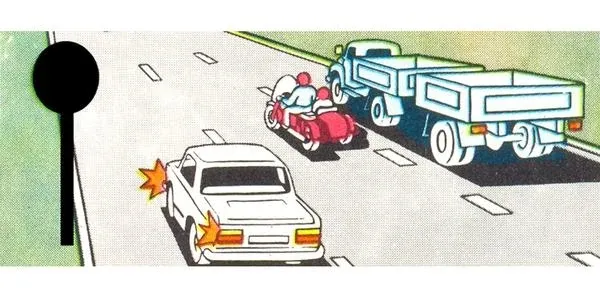
- It is allowed.
- It is allowed, if the motorcycle’s speed does not exceed 30 km/h.
- It is prohibited.
Show answer
Correct: 3. It is prohibited.
The motorcycle has already pulled out into the oncoming lane and is overtaking the lorry. Under the Rules a driver is prohibited from overtaking a vehicle that is itself overtaking, so the light passenger car’s driver may not overtake in the situation shown. “It is allowed.” ignores exactly that prohibition, and the 30 km/h condition is borrowed from a different rule and has no bearing here: what matters is what the vehicle in front is doing, not how fast it is going.
Question 839. Overtaking is prohibited:
- At intersections.
- 150 m before railway crossings.
- In both cases.
Show answer
Correct: 1. At intersections.
Subpoint 1 of point 77 of the Traffic Rules prohibits overtaking at intersections, which is why “At intersections.” is the correct answer. Before railway crossings the prohibited zone is 100 m under sub-point 3 of the same point, not 150 m, so “150 m before railway crossings.” states the wrong figure. Since that option is wrong, “In both cases.” cannot be correct either.
Question 840. Overtaking is prohibited:
- At regulated intersections.
- At unregulated intersections.
- In both cases.
Show answer
Correct: 3. In both cases.
Point 77, sub-point 1 of the Traffic Rules prohibits overtaking at intersections without separating them into regulated and unregulated ones. The ban therefore holds “In both cases.”, which is why that is the correct answer. “At regulated intersections.” and “At unregulated intersections.” are each only half of the rule, so each one leaves part of the prohibition out.
Question 841. Is it allowed to overtake the road train in this situation, if its speed does not exceed 30 km/h?
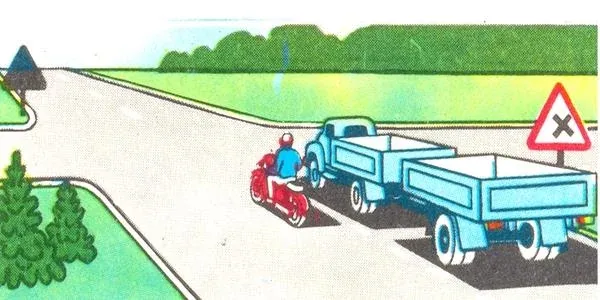
- It is prohibited.
- It is allowed.
Show answer
Correct: 1. It is prohibited.
Under point 77 of the Traffic Rules overtaking is prohibited at intersections, and in the picture the road train is already at the crossing with the road joining from the left, which the warning sign 1.6 “Intersection of roads of equal importance” announces. The motorcyclist may therefore not overtake here, and the road train’s low speed changes nothing: point 77 provides no exception for overtaking a vehicle travelling slower than 30 km/h.
Question 842. Is the green car’s driver allowed to overtake?
- It is allowed.
- It is prohibited.
- It is allowed, if the red car is travelling at a speed lower than 30 km/h.
Show answer
Correct: 2. It is prohibited.
There are roadworks on the right, fenced off and marked with the warning sign for them, and the red car ahead is bypassing that obstacle. Under the Rules a driver is prohibited from overtaking a vehicle that is overtaking or bypassing an obstacle, so the green car’s driver may not overtake. “It is allowed, if the red car is travelling at a speed lower than 30 km/h.” has nothing to do with this prohibition: it comes from the manoeuvre the car in front is making, not from its speed.
Question 843. Is the red car’s driver allowed to overtake in this situation?
- It is allowed.
- It is prohibited.
- It is allowed, if the speed of the overtaken car does not exceed 30 km/h.
Show answer
Correct: 2. It is prohibited.
Under point 77 of the Traffic Rules overtaking is prohibited at intersections, and in the picture the lorry is already at the crossing of the roads. Sign 2.1 “Main road” gives the red car priority over the van on the crossing road, but priority does NOT authorise overtaking: point 77 makes no exception for intersections on a main road. The option about 30 km/h is wrong for the same reason - point 77 contains no exception based on the speed of the vehicle being overtaken.
Question 844. Is it allowed to overtake the bus at the place shown?
- It is allowed.
- It is prohibited.
Show answer
Correct: 1. It is allowed.
Under point 77 of the Traffic Rules overtaking is prohibited on railway crossings and within less than 100 m before them. Here the car is only at the first warning sign 1.1 “Railway crossing with a barrier”, with the three-stripe approach posts beside it, and outside built-up areas that sign is placed 150 to 300 m before the crossing - so the prohibited zone has not yet begun. The centre line is broken, so overtaking the bus at the place shown is permitted. “It is prohibited.” would be right only within less than 100 m of the crossing.
Question 878. Does the intercity bus driver have the right to overtake the motorcycle, which is travelling at a speed of 70 km/h?
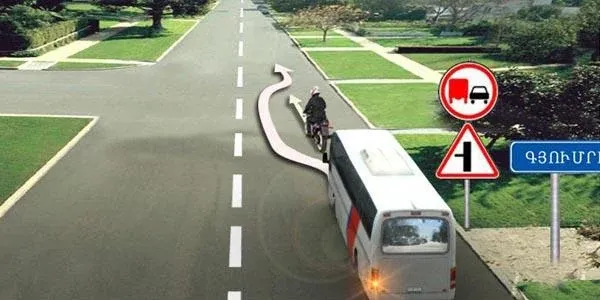
- Does not have the right.
- Has the right.
Show answer
Correct: 1. Does not have the right.
The round sign is 3.22 “Overtaking by lorries prohibited”, and it binds lorries, not a bus. The name of the locality is written on a BLUE plate, which means the built-up-area rules are not yet in force: on a white plate the limit would become 60 km/h, whereas here the 90 km/h limit still applies, so the motorcycle’s 70 km/h is not in itself the obstacle. The obstacle is something else. The overtake drawn is carried out on the intersection itself, and sub-point 1 of point 77 of the Rules prohibits overtaking at intersections without exception, including for a driver travelling on the main road. The manoeuvre would have to be finished before the junction or begun after it, so at the moment shown the bus driver “Does not have the right.”, and “Has the right.” is wrong.
Question 883. Overtaking is prohibited:
- On railway crossings and up to 100 m before them.
- On railway crossings and up to 150 m before them.
- On railway crossings and up to 250 m before them.
Show answer
Correct: 1. On railway crossings and up to 100 m before them.
Point 77(3) of the Traffic Rules prohibits overtaking “On railway crossings and up to 100 m before them.” That is the distance the Rules actually fix, so “On railway crossings and up to 150 m before them.” and “On railway crossings and up to 250 m before them.” do not match the text of point 77. The ban applies on the approach to any crossing, whether or not it has barriers.
Question 891. Is the truck driver permitted to overtake the bus, which is travelling at a speed of 60 km/h?
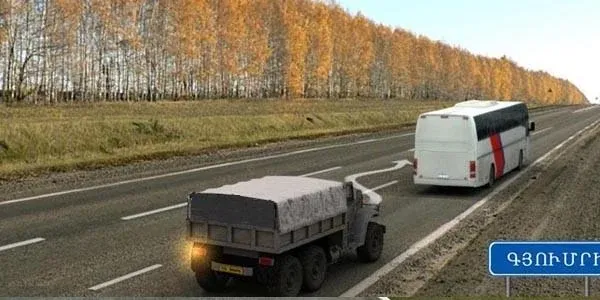
- It is prohibited.
- It is permitted.
Show answer
Correct: 2. It is permitted.
The picture shows a road outside a populated area with broken-line marking, no oncoming traffic, and no railway crossing, junction, bridge or “Overtaking prohibited” sign: none of the cases in which point 77 of the Rules prohibits overtaking is present here. There is no provision prohibiting a truck from overtaking, nor one prohibiting overtaking merely because the vehicle being overtaken is travelling at 60 km/h, so the manoeuvre is allowed — “It is permitted” is the correct answer. “It is prohibited” would be correct only if one of the conditions of point 77 were present (a crossing, a junction, a solid line, limited visibility and so on), which is not the case here.
Question 892. Is overtaking permitted in this situation?
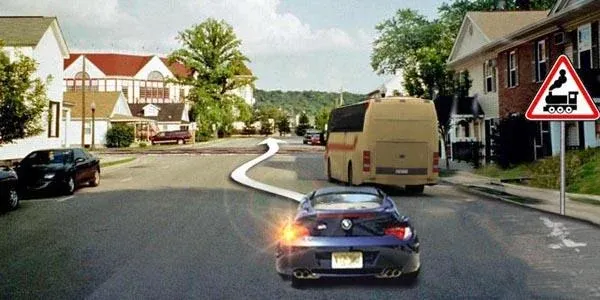
- It is prohibited.
- It is permitted.
- It is permitted if the bus is travelling at a speed less than 30 km/h.
Show answer
Correct: 1. It is prohibited.
The warning sign bearing a locomotive and the crossing visible ahead show that the car is approaching a railway crossing and intends to overtake the bus just before it. point 77 of the Rules expressly prohibits overtaking “on railway crossings and within less than 100 m before them”, so overtaking here is prohibited. “It is permitted.” ignores that prohibition, and “It is permitted if the bus is travelling at a speed less than 30 km/h.” is wrong because the ban before a crossing carries no such speed exception.
Question 898. In this situation, where may overtaking be started?
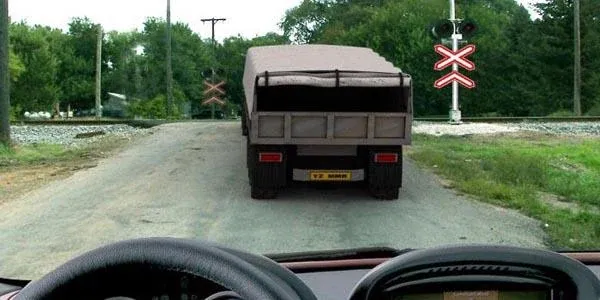
- At the railway crossing.
- After passing the railway crossing.
- After passing 100 metres beyond the railway crossing.
Show answer
Correct: 2. After passing the railway crossing.
You are following the lorry towards a railway crossing - the crossbuck and the red lights are visible ahead. point 77 of the Rules prohibits overtaking on railway crossings and within less than 100 m before them, and places no restriction at all once the crossing has been passed. Overtaking may therefore be started only after passing the railway crossing. “At the railway crossing.” is exactly what point 77 forbids, and “After passing 100 metres beyond the railway crossing.” invents a restriction that does not exist: the 100 m limit applies BEFORE a crossing, not after it.
Question 899. In this situation, is it permitted to overtake?
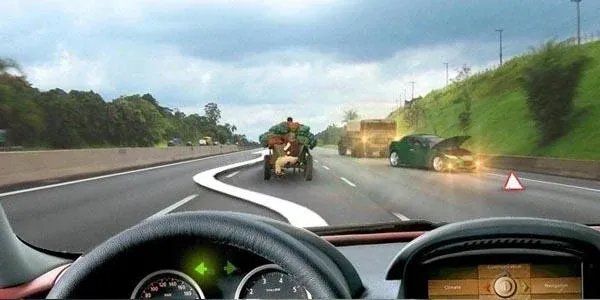
- It is permitted, since there is no oncoming vehicle.
- It is prohibited.
- It is permitted if the horse-drawn cart is moving at a speed less than 30 km/h.
Show answer
Correct: 2. It is prohibited.
The car ahead has already pulled out and is overtaking the horse-drawn cart, and under the Rules a driver is prohibited from overtaking a vehicle that is itself overtaking. There is a vehicle approaching from the opposite direction as well, so “It is permitted, since there is no oncoming vehicle.” is wrong on the facts of the picture too. The 30 km/h condition has no bearing on this prohibition, so in this situation overtaking is prohibited.
Question 901. Is it permitted to overtake the motorcycle?
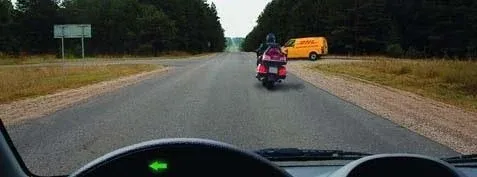
- It is permitted
- It is prohibited
Show answer
Correct: 2. It is prohibited
Under the Rules, before beginning to overtake a driver must be satisfied that the oncoming lane is clear for far enough to complete the overtaking and that the manoeuvre will obstruct nobody. A vehicle is approaching from the opposite direction in the picture, so the oncoming lane is not clear for the length of the overtake and overtaking the motorcycle is prohibited. “It is permitted” ignores exactly that condition: the prohibition here comes not from a sign but from the vehicle coming the other way.
Question 902. In which case is it permitted to overtake using the oncoming traffic lane on roads having one lane in each direction?
- Only when the lane in the oncoming direction is free for a sufficient distance.
- Only when we are not being overtaken.
- Both conditions must be satisfied.
Show answer
Correct: 3. Both conditions must be satisfied.
On a road with one lane in each direction, overtaking means moving out into the oncoming lane, so before starting it point 73 of the Rules must be satisfied in full: the oncoming lane must be free for a distance sufficient for the overtake (without obstructing oncoming traffic), AND the driver behind must not already have begun overtaking you, while the driver ahead must not have signalled a left turn, so that the manoeuvre can be completed and a safe return to your own lane is assured. Because both of these must hold at the same time, the correct answer is “Both conditions must be satisfied.” Either one on its own — “Only when the lane in the oncoming direction is free for a sufficient distance.” or “Only when we are not being overtaken.” — is not enough under point 73.
Question 903. Is it permitted to overtake in the situation shown?
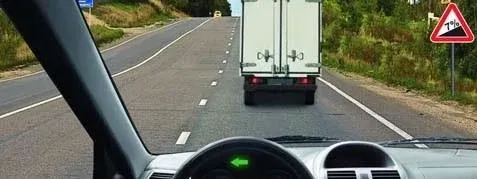
- It is prohibited.
- It is permitted if the manoeuvre will be completed within the limits of visibility.
- It is permitted.
Show answer
Correct: 3. It is permitted.
The centre line is broken, there is no oncoming traffic nearby, and the situation is not at an intersection, a pedestrian or railway crossing, a bridge or within a no-overtaking zone, so none of the prohibitions in point 77 of the Rules applies and the requirements of point 73 - a free oncoming lane for a sufficient distance and a safe return - can be met. Overtaking is therefore permitted. “It is prohibited.” has no basis here, and “It is permitted if the manoeuvre will be completed within the limits of visibility.” misstates the rule: point 73 requires the oncoming lane to be free for a sufficient distance and the return to be safe, not merely that the manoeuvre end within sight.
Question 904. Is it permitted to overtake the truck?
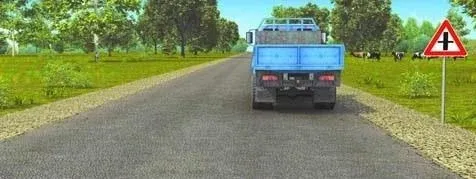
- Yes
- Yes, if the overtaking will be completed before the intersection
- No
Show answer
Correct: 2. Yes, if the overtaking will be completed before the intersection
The warning sign at the roadside - 1.6 “Intersection of roads of equal importance” - announces an unregulated intersection of equal roads ahead, and point 77 of the Rules prohibits overtaking at intersections. Overtaking the truck is therefore permissible only if it is begun AND completed before that intersection. A plain “Yes” is wrong, because the overtake may not be carried on across the intersection itself, and “No” is wrong too: nothing prohibits overtaking on the stretch before the intersection, provided the conditions of point 73 are satisfied.
Question 905. What is required of the driver of the vehicle being overtaken?
- He is obliged to give way to the one overtaking.
- He must not obstruct the overtaking driver in any way — by increasing speed or by performing any other action
Show answer
Correct: 2. He must not obstruct the overtaking driver in any way — by increasing speed or by performing any other action
The question is about the driver of the vehicle that is being overtaken. Point 75 of the Rules directly forbids that driver to hinder the overtake by increasing speed or by any other action. So the correct answer is that “he must not obstruct the overtaking driver in any way — by increasing speed or by performing any other action”. “He is obliged to give way to the one overtaking.” is wrong: point 75 places no duty to give way on him, it only bans actively obstructing the overtake.
Question 906. Is it permitted to overtake in this situation?
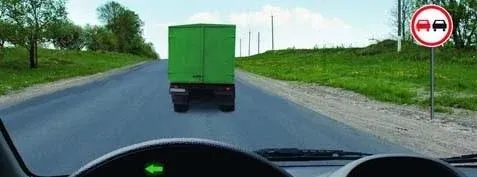
- It is prohibited
- It is permitted if the truck’s speed is less than 30 km/h.
- It is permitted
Show answer
Correct: 1. It is prohibited
On the right stands sign 3.20 “Overtaking prohibited”, which the Rules define as a ban on overtaking by all types of vehicle, permitting it only in respect of slow-moving vehicles, horse-drawn carts, two-wheeled motorcycles without a sidecar, mopeds and bicycles. The vehicle ahead is an ordinary lorry, in none of the excepted classes, so overtaking is prohibited. “It is permitted” ignores sign 3.20, and “It is permitted if the truck’s speed is less than 30 km/h.” is wrong because the sign’s exception is for particular TYPES of vehicle (and for slow-moving vehicles as a defined class), not for anything happening to travel below 30 km/h.
Question 907. Is the truck driver permitted to overtake the tractor, if the permissible maximum mass is 3 tonnes?
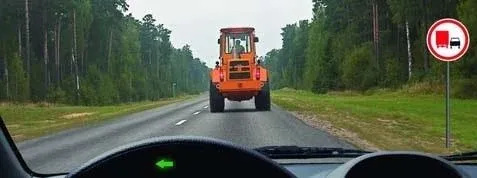
- Yes
- Yes, if the tractor is travelling at less than 30 km/h
- No
Show answer
Correct: 1. Yes
On the right stands sign 3.22 “Overtaking by lorries prohibited”, which under the Rules bans overtaking by all types of vehicle EXCEPT motorcycles, light passenger cars, buses and lorries with a permissible maximum mass of up to 3.5 tonnes. Here the truck’s permissible maximum mass is 3 tonnes - not more than 3.5 t - so it falls within the exception and may overtake the tractor. “No” misreads the sign, and “Yes, if the tractor is travelling at less than 30 km/h” is wrong: under sign 3.22 the permission depends on the truck’s own mass being within 3.5 t, not on the tractor’s speed.
Question 908. If oncoming traffic is difficult in this situation, then the way must be given by
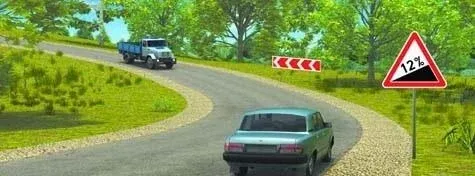
- The truck driver
- The passenger car driver
Show answer
Correct: 1. The truck driver
The 12% sign at the roadside marks a steep gradient - signs 1.13 “Steep descent” and 1.14 “Steep ascent” - and the road is too narrow for the truck and the car to pass freely. point 46 of the Rules provides that on a section with a longitudinal gradient marked by signs 1.13 and 1.14, where passing oncoming traffic is difficult, the driver travelling in the DESCENDING direction must give way, regardless of where the obstruction lies. The truck is the one going down the gradient, so it must give way, and the light passenger car climbing the hill has the advantage.
Question 909. Overtaking on a pedestrian crossing is
- Prohibited only when a pedestrian is present.
- Prohibited
- Permitted
Show answer
Correct: 2. Prohibited
Point 77 of the Rules lists the places where overtaking is forbidden, and pedestrian crossings are one of them — an unconditional ban. So on a pedestrian crossing overtaking is “Prohibited”, which is the marked answer. “Prohibited only when a pedestrian is present.” is wrong, because point 77 bans overtaking on the crossing whether or not a pedestrian is there, and “Permitted” directly contradicts point 77.
Question 1014. In case of oncoming traffic on a steep downgrade, the way must be given to
- The public-use vehicle.
- The vehicle climbing upward.
- The vehicle descending downward.
Show answer
Correct: 2. The vehicle climbing upward.
Under point 46 of the Traffic Rules, on road sections marked with signs 1.13 “Steep descent” and 1.14 “Steep ascent”, where oncoming traffic is obstructed, the driver travelling in the descending direction must give way regardless of where the obstruction lies. The way is therefore given to “The vehicle climbing upward.” - a vehicle stopped on an ascent has much more difficulty moving off again, so priority goes to it. “The vehicle descending downward.” is wrong because that is the driver who must yield, and “The public-use vehicle.” is wrong because point 46 turns on the direction of travel, not on the type of vehicle.
Question 1045. With which of the signs must you give way to oncoming traffic in the narrow section
- Only Գ (C)
- Ա (A) and Գ (C)
- Բ (B) and Գ (C)
Show answer
Correct: 2. Ա (A) and Գ (C)
The question is which sign obliges YOU to give way to oncoming traffic in the narrow section. Sign Գ (C) is 2.6 “Priority of oncoming traffic”, under which the driver must give way to oncoming vehicles in the narrow section. Sign Ա (A) is 1.13 “Steep descent”, marked 12 %: under point 46 of the Rules, on sections with a longitudinal gradient marked by signs 1.13 and 1.14, and regardless of where the obstruction lies, the driver travelling in the DESCENDING direction must give way - so under Ա (A) you must give way too. Sign Բ (B) is 1.14 “Steep ascent”, where it is the driver coming down who yields, and Դ (D) is 2.7 “Priority over oncoming traffic”; neither puts the duty on you. The correct answer is therefore Ա (A) and Գ (C).
Question 1097. Along which trajectory is overtaking permitted?
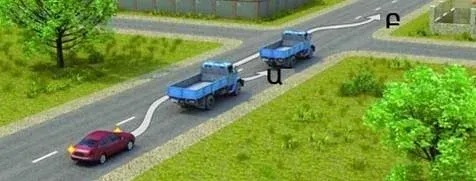
- Any
- Only Ա (A)
- Only Բ (B)
Show answer
Correct: 2. Only Ա (A)
Beyond the lorries the road is crossed by another road, and along trajectory Բ (B) the car would still be in the oncoming lane at the intersection itself - which point 77 of the Rules prohibits, overtaking being forbidden at intersections where the driver is not travelling on a main road, and there is no priority sign here to make this road the main one. Trajectory Ա (A) overtakes only the first lorry and returns to its own lane in the gap between the two lorries, before the intersection, which is permitted: the centre line is broken, and a non-rail vehicle is overtaken on the left (point 74). “Any” is wrong precisely because it also includes trajectory Բ (B).