When the Main Road Turns
These pictures look crowded, but each one is a sorting job you already know. Once you can read the plate, you only need two groups and the three steps from the equal-roads lesson.
How do I read plate 8.13?
Section titled “How do I read plate 8.13?”Plate 8.13 “Direction of the main road” hangs under a priority sign. It draws the intersection from above, with your road at the bottom.
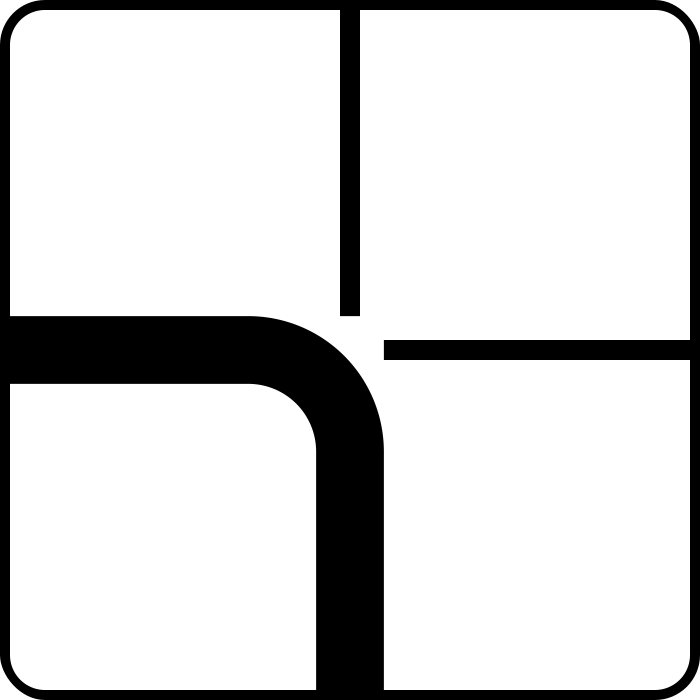
- Thick line: the main road, here bending to the left.
- Thin lines: the secondary roads.
Sign 2.1 above the plate puts you on the thick line. Signs 2.4 and 2.5 put you on a thin line.
How do I work out the order?
Section titled “How do I work out the order?”- Place everyone on the plate. A vehicle ahead is at the top. A vehicle on your left is on the left arm, and a vehicle on your right is on the right arm.
- Make two groups. Thick line and thin lines.
- Thick goes before thin, whatever direction anyone takes (point 96).
- Inside each group, use equal-road rules (point 97): Rail, Right, Left.
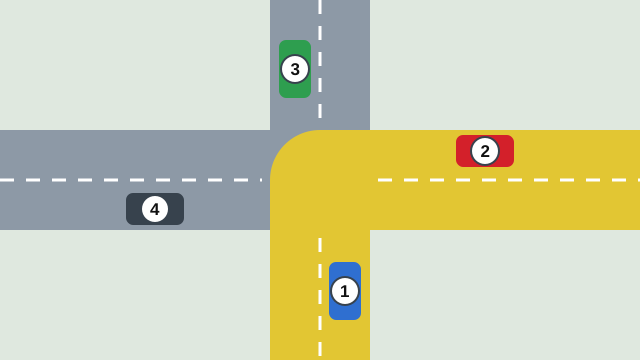
All four cars go straight. Cars 1 and 2 are on the main road (yellow), and 3 and 4 are on secondary roads. Car 2 is on the right of car 1, so 2 goes first and 1 second. Car 4 is on the right of car 3, so 4 goes third and 3 last.
What if I’m on the main road?
Section titled “What if I’m on the main road?”Sign 2.1 is above the plate. Your duty depends on which way the thick line bends.
| The main road bends | Vehicle on your right | Vehicle on your left | Oncoming vehicle |
|---|---|---|---|
| To the right | On the main road: you give way | On a secondary road: it gives way | On a secondary road: it gives way |
| To the left | On a secondary road: it gives way | On the main road: it gives way, because you are on its right | On a secondary road: it gives way |
This holds whether you go straight, turn left or make a U-turn. Following the bend gives you no extra priority, and leaving it costs you none. Only the right-hand test decides between two main-road vehicles.
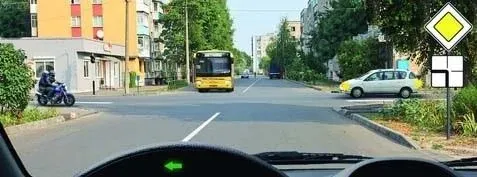
The main road bends left and you turn left. The motorcycle is on the main road too, but you are on its right. The bus and the white car are on secondary roads. You give way to no one.
Common trap: The main road bends away, and you turn left or make a U-turn. The oncoming vehicle is now on a secondary road, so it gives way to you. Point 99 only covers oncoming vehicles on an equal road.
What if I’m on the secondary road?
Section titled “What if I’m on the secondary road?”Sign 2.4 or 2.5 is above the plate. You give way to everyone on the thick line, wherever they are going. That usually means two vehicles, so an answer naming only one is wrong.
A vehicle on the other thin line shares your group, so you and it use the right-hand rule:
- It is on your right: you give way to it too.
- It is on your left: it gives way to you.
If you can pass without obstructing the vehicle with priority, you may turn. The turn isn’t banned: you just have to give way first.
Who else changes the order?
Section titled “Who else changes the order?”- A tram on a thin line goes after the thick line, like any other vehicle. Being a tram gives it no advantage over a main road.
- A tram on the thick line with you has priority over you, even from the left. A car on that same left side doesn’t.
- A tram among secondary-road vehicles goes before the non-rail ones.
- An ambulance with beacons and siren off is an ordinary vehicle.
- A trolleybus is a non-rail vehicle with no special priority.
- A cyclist on the main road with you counts in the right-hand test like anyone else.
Flashing yellow changes nothing here: the intersection is unregulated, so the signs decide.
When no paths cross, nobody waits. A bus turning left and a car turning right along the main road can pass together, along with a truck turning right from the secondary road.
Try it yourself
Section titled “Try it yourself”You are going straight, under sign 2.1 with a plate bending right. A white car is on your right, a truck comes towards you and a motorcycle is on your left.
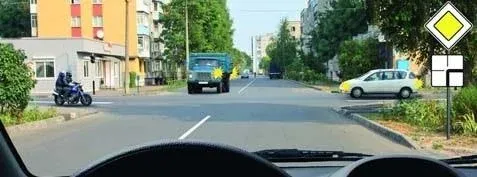
Who do you give way to? The white car. Sign: you and the car are on the thick line, while the truck and the motorcycle are on thin lines and wait for you. Right: the car is on your right.
You are at sign 2.4, and the plate shows the main road coming from ahead and bending to your right. A bus is ahead, a white car on your right and a motorcycle on your left.
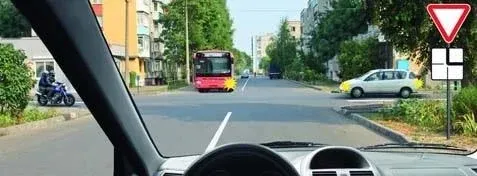
Who do you give way to? The bus and the car. Sign: both are on the thick line. Right: the motorcycle is on a thin line like you, and you are on its right, so it gives way to you.
Four vehicles meet. Red and green are on the main road, and it bends here. Blue and black are on secondary roads, with sign 2.5 beside the black car.
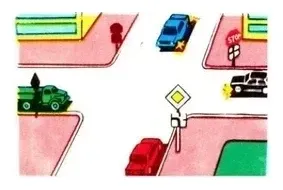
What is the order? Red, green, blue, black. Sign: red and green go first. Right: red is on green’s right, so red leads. Right again: blue is on black’s right, so blue goes third and black last.
Key points
Section titled “Key points”- Thick line: main road. Thin lines: secondary roads. Your road is at the bottom of the plate.
- Sign 2.1 puts you on the thick line, and signs 2.4 and 2.5 put you on a thin line.
- Thick goes before thin, whatever direction anyone takes.
- Inside each group, use Rail, Right and Left.
- Main road bending right: give way to the vehicle on your right.
- Main road bending left: you give way to no one, unless a tram shares the main road with you.
- On a thin line: give way to everyone on the thick line, and to a vehicle on your right.
- A tram gets priority only against others in its own group.
Practice questions
Section titled “Practice questions”Question 303. The vehicles will pass the intersection in the following order:
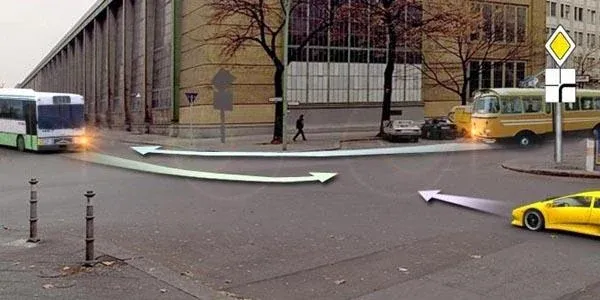
- The light passenger car, the bus, the trolleybus.
- The trolleybus and the bus, the light passenger car.
- The trolleybus, the light passenger car, the bus.
Show answer
Correct: 3. The trolleybus, the light passenger car, the bus.
The sign is 2.1 “Main road” with plate 8.13, which shows that the main road CHANGES DIRECTION at this intersection. The light passenger car travels straight along the main road and the trolleybus is on it too, turning right to follow its bend - both are on the main road - while the bus is on the secondary one. Under point 96 the bus must give way to both vehicles on the main road, so it goes last. Between the two on the bending main road, point 97 says they must treat each other by the rules for an intersection of EQUAL roads, and under point 98 a driver gives way to a vehicle approaching from his right: the trolleybus is to the right of the light passenger car, so the car yields to it. The order is therefore the trolleybus, the light passenger car, the bus.
Question 316. In what order will the vehicles cross the intersection?
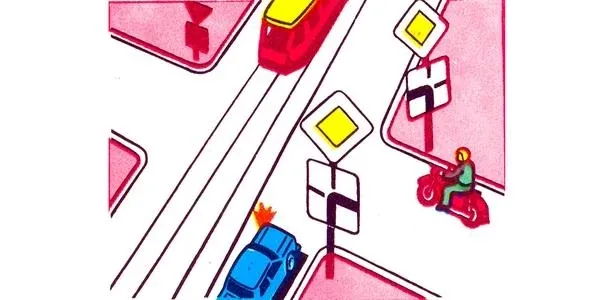
- The motorcycle, the car, the tram.
- The tram, the car, the motorcycle.
- The tram, the motorcycle, the car.
Show answer
Correct: 1. The motorcycle, the car, the tram.
The sign on the right is 2.1 “Main road” with plate 8.13, showing the direction of the main road at this intersection. The motorcycle and the car are both on the main road, while the tram is on the secondary one. Under point 96 the tram on the secondary road must give way to the vehicles travelling on the main road, so it goes LAST - being a tram gives it no advantage over traffic on a main road. Between the motorcycle and the car, both on the main road that changes direction, point 97 makes them treat each other by the rules for equal roads, and under point 98 a driver gives way to whoever approaches from his right; the motorcycle is to the car’s right, so the motorcycle goes first and the car second. The order is the motorcycle, the car, the tram.
Question 322. The intersection will be crossed first by:
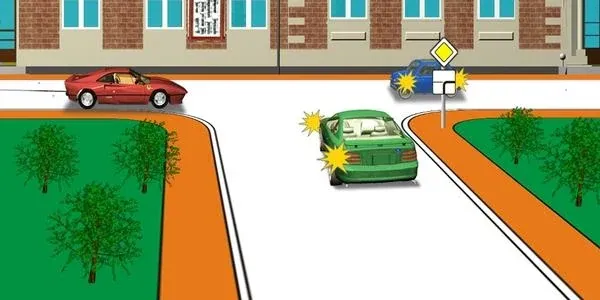
- The red car.
- The green car.
- The blue car.
Show answer
Correct: 3. The blue car.
The sign on the right is sign 2.1 “Main road” with plate 8.13, which shows that the main road changes direction at this intersection. The blue and the green car are both on the main road and both turn left, while the red car travels straight along the secondary road. Under point 96 the red car on the secondary road must give way to the vehicles on the main road, so it passes last. Between the blue and the green car, which are on the main road that changes direction, point 97 has them apply the rules for crossing intersections of equal roads to each other, and under point 98 a driver gives way to a vehicle approaching from the right; the blue car is to the right of the green one, so the blue car passes first. The answer “The blue car” is therefore correct. “The red car” is wrong, because it is on the secondary road and gives way to both cars on the main road; “The green car” is wrong, because under the right-hand rule it gives way to the blue car on the main road that changes direction.
Question 327. The intersection will be crossed third by:
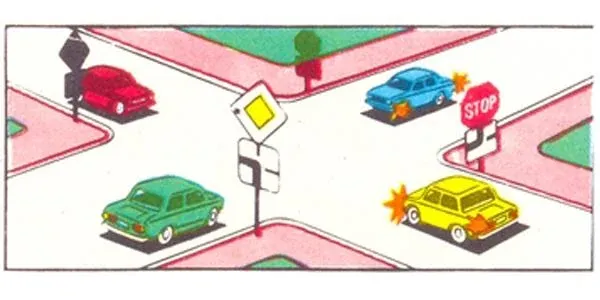
- The yellow car.
- The red car.
- The blue car.
- The green car.
Show answer
Correct: 3. The blue car.
Sign 2.1 “Main road” stands at the intersection with plate 8.13 “Direction of the main road” beneath it. The red and green cars are on that main road, so under point 96 of the Traffic Rules they cross first and second. The blue and yellow cars come from the secondary road, where sign 2.5 “Movement without stopping prohibited” is in place, and both of them must give way to the cars on the main road. Between themselves they are on equal terms, and under point 98 of the Rules a driver must give way to a vehicle approaching from his right: the blue car is on the yellow car’s right, so the intersection is crossed third by the blue car and last by the yellow one. “The yellow car.”, “The red car.” and “The green car.” are wrong.
Question 329. The vehicles will cross the intersection in the following order:
- The red, the green, the blue, the black.
- The green, the red, the black, the blue.
- The green, the red, the blue, the black.
Show answer
Correct: 1. The red, the green, the blue, the black.
The central sign 2.1 “Main road” with plate 8.13 shows that the main road is the road of the red and the green vehicle, so under point 96 of the Traffic Rules they pass first; since the main road changes direction, under point 97 the rules for equal roads apply between them, and under the right-hand rule of point 98 the green car gives way to the red one approaching from its right — the red car is first, the green second. The blue and the black car are on secondary roads (next to the black one stands sign 2.5 “Movement without stopping is prohibited”), and under point 97 those travelling on secondary roads are likewise governed between themselves by the rules for equal roads; under the right-hand rule of point 98 the black car gives way to the blue one approaching from its right, so the blue car is third and the black one last. The other options are wrong, because in them the green car is placed before the red one although the red approaches from the green car’s right, and in one of them the black car is also placed before the blue one, which contradicts the right-hand rule.
Question 336. Which vehicle’s driver has the right of way?
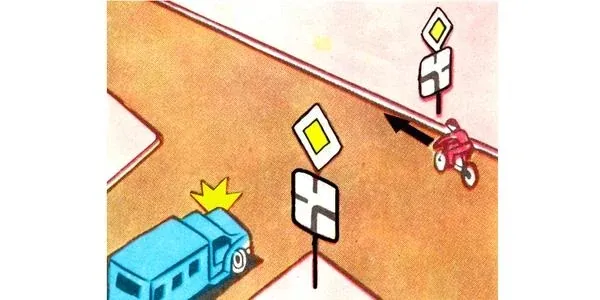
- The car driver.
- The cyclist.
Show answer
Correct: 2. The cyclist.
Both drivers face sign 2.1 “Main road” with plate 8.13 “Direction of the main road” beneath it - one panel stands before the car and the other before the cyclist - so both are on the main road, and it changes direction at this intersection. Under point 97 they must therefore treat each other by the rules for an intersection of roads of EQUAL importance, and under point 98 a driver gives way to a vehicle approaching from his right. The cyclist is approaching on the car’s right, so the car gives way whatever direction it means to take, and the right of way belongs to the cyclist. “The car driver.” is wrong because once both are on the main road the order is decided by the right-hand rule, and the cyclist is the one on the right.
Question 339. Which vehicle’s driver must give way?
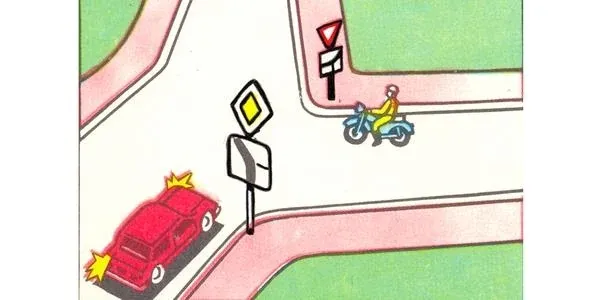
- The car driver.
- The motorcycle driver.
Show answer
Correct: 2. The motorcycle driver.
There is no traffic light at this intersection — priority is set by the signs. Facing the car stands sign 2.1 “Main road” with plate 8.13 “Direction of the main road”, while facing the motorcycle stands sign 2.4 “Give way” with the same plate, so the car is on the main road and the motorcycle is on the secondary one. Under point 96 of the Rules, at an intersection of roads of unequal importance a driver approaching on the secondary road must give way to vehicles travelling on the main road, whatever direction they go on to take. The one who must give way is therefore “The motorcycle driver.” “The car driver.” is wrong because the car is travelling on the main road and has priority at this intersection.
Question 347. The second to pass the intersection will be:
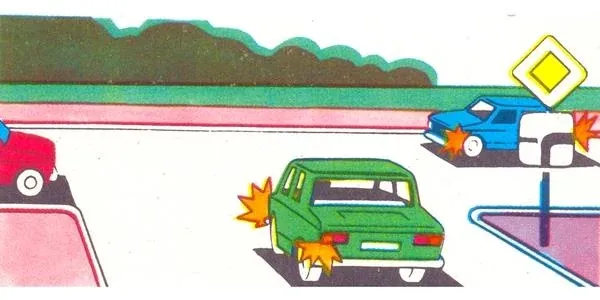
- The green car.
- The blue car.
- The red car.
Show answer
Correct: 1. The green car.
The yellow diamond on the right is sign 2.1 “Main road” with plate 8.13 “Direction of the main road”: the main road runs through the approaches of the blue and green cars, changing direction at the intersection, while the road of the red car is secondary. Under point 96 the red car gives way to the two cars travelling on the main road and passes last. Between the blue and the green car, since the main road changes direction, the rules for equal roads apply (point 97); under point 98 (the “right-hand rule”) the green car gives way to the blue car approaching from its right, so the blue car passes first and the green car second, which is the correct answer. “The blue car” is wrong, because it passes first; “The red car” is wrong, because coming from the secondary road it passes last.
Question 349. The yellow car will pass the intersection:
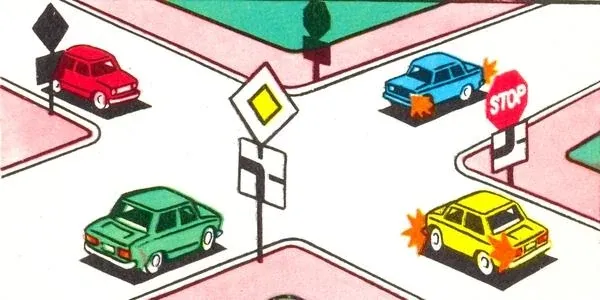
- First.
- Second.
- Third
- Last.
Show answer
Correct: 4. Last.
The yellow diamond is sign 2.1 “Main road” with plate 8.13 “Direction of the main road”, showing that the main road runs through the red and green cars’ approaches; sign 2.5 “Movement without stopping prohibited” stands at the yellow car’s approach, and the blue car is on the other secondary road. Under point 96 a driver approaching on a secondary road must give way to vehicles on the main road whatever direction they then take, so the red and green cars go first and second. Between the two secondary roads point 97 applies the equal-roads rules, and sign 2.5 additionally obliges the yellow car to stop and give way - including to the blue car, which under point 98 is on its right. The yellow car therefore passes last, and “First.”, “Second.” and “Third” are all wrong: it may move only once the other three have cleared the intersection.
Question 354. The vehicles will pass the intersection in the following order:
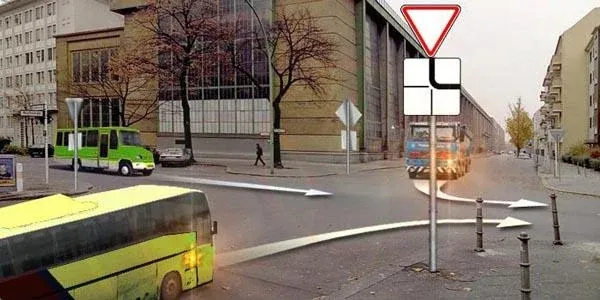
- The yellow bus, the truck, the green bus.
- The truck, the yellow bus, the green bus.
- The yellow bus, the green bus, the truck.
Show answer
Correct: 2. The truck, the yellow bus, the green bus.
Sign 2.4 “Give way” with plate 8.13 “Direction of the main road” stands at the yellow bus’s approach, and the plate shows the main road running through the lorry’s approach and turning towards the right-hand exit - so both the yellow and the green buses are on secondary roads. Under point 96 they must give way to the lorry travelling on the main road, which passes first. Between the two secondary-road drivers point 97 applies the equal-roads rules, and by the right-hand rule of point 98 the green bus gives way to the yellow bus approaching on its right. The order is the lorry, the yellow bus, the green bus. The other options are wrong because the yellow bus cannot go ahead of the lorry on the main road, and the green bus yields to both and goes last.
Question 355. The vehicles will pass the intersection in the following order:
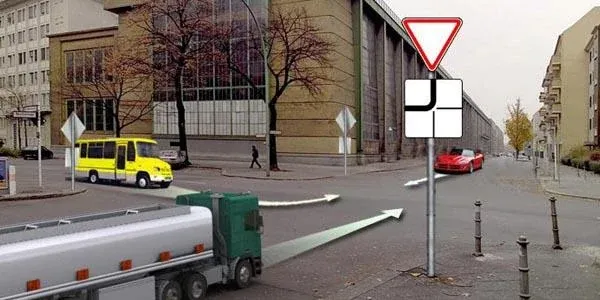
- The bus, the passenger car and the truck simultaneously.
- The passenger car and the truck simultaneously, the bus.
Show answer
Correct: 1. The bus, the passenger car and the truck simultaneously.
Sign 2.4 “Give way” with plate 8.13 stands at the lorry’s approach, while the main road runs through the bus’s and the light passenger car’s approaches, changing direction at the intersection. The bus turning left and the passenger car turning right both stay on the main road and their paths do not cross each other, and the lorry turning right from the secondary road crosses nobody’s path either. All three vehicles may therefore pass the intersection at the same time (points 96 and 97): a driver gives way only where paths actually conflict. “The passenger car and the truck simultaneously, the bus.” is wrong because the bus is on the main road and obstructs no one, so it has no reason to hold its left turn back.
Question 357. The vehicles will pass the intersection in the following order:
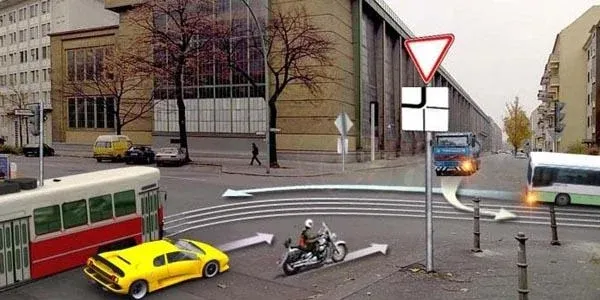
- The lorry, the tram and the bus, the motorcycle and the light passenger car.
- The tram and the bus, the motorcycle and the light passenger car, the lorry.
Show answer
Correct: 1. The lorry, the tram and the bus, the motorcycle and the light passenger car.
Sign 2.4 “Give way” with plate 8.13 stands at the foreground road, the one carrying the tram, the motorcycle and the light passenger car, while the main road runs through the lorry’s approach and turns towards the left-hand road. Only the lorry is on the main road, so under point 96 it passes first - a tram on a secondary road has no advantage over traffic on a main one. Among the secondary-road users point 97 applies the equal-roads rules: under points 98 and 100 the tram has priority over non-rail vehicles whatever direction it takes, and the bus’s path does not cross the tram’s, so those two pass together, second. The motorcycle and the light passenger car give way both to the tram and to the bus approaching on their right and go last. “The tram and the bus, the motorcycle and the light passenger car, the lorry.” is wrong because the lorry, being on the main road, cannot go last.
Question 358. The vehicles will pass the intersection in the following order:
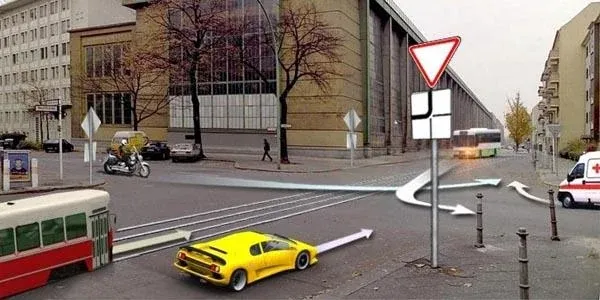
- The “Ambulance” car, the tram, the motorcycle, the bus, the light passenger car.
- The motorcycle, the bus, the tram and the “Ambulance” car, the light passenger car.
Show answer
Correct: 2. The motorcycle, the bus, the tram and the “Ambulance” car, the light passenger car.
Sign 2.4 “Give way” with plate 8.13 makes the roads of the tram, the “Ambulance” car and the light passenger car secondary, and shows the main road running through the motorcycle’s and the bus’s approaches. The ambulance has neither its flashing beacons nor its audible signal switched on, so it enjoys no special priority and counts as an ordinary non-rail vehicle. Under point 96 the vehicles on the secondary roads give way to those on the main road, so the motorcycle and the bus go first - and between them, on the bending main road, points 97 and 98 put the motorcycle first, since nothing is on its right. Among the three secondary-road vehicles, point 100 gives the tram priority over non-rail vehicles whatever direction it takes, and nothing stands on the ambulance’s right, so the tram and the ambulance pass together as the third step, their paths not crossing; the light passenger car yields to both and goes last. The option beginning with the “Ambulance” car is wrong precisely because its beacons and siren are off, so it must yield to the main road like anyone else.
Question 359. The vehicles will pass the intersection in the following order:
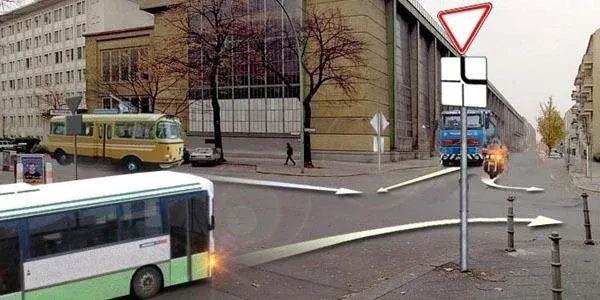
- The lorry and the motorcycle, the bus, the trolleybus.
- The lorry and the bus, the motorcycle, the trolleybus.
Show answer
Correct: 1. The lorry and the motorcycle, the bus, the trolleybus.
Sign 2.4 “Give way” with plate 8.13 makes the bus’s and the trolleybus’s roads secondary and shows the main road running through the lorry’s and the motorcycle’s approaches. A trolleybus, despite its name, is a non-rail vehicle and has no special priority. Under point 96 the bus and the trolleybus must give way to the lorry and the motorcycle on the main road, whatever direction those then take; the lorry and the motorcycle have non-crossing paths here, so they pass together as the first step. Between the two secondary-road vehicles point 97 applies the equal-roads rules and, by the right-hand rule of point 98, the trolleybus gives way to the bus on its right. The order is the lorry and the motorcycle, then the bus, then the trolleybus. The other option is wrong because the bus is on a secondary road and cannot go together with the lorry.
Question 360. The vehicles will pass the intersection in the following order:
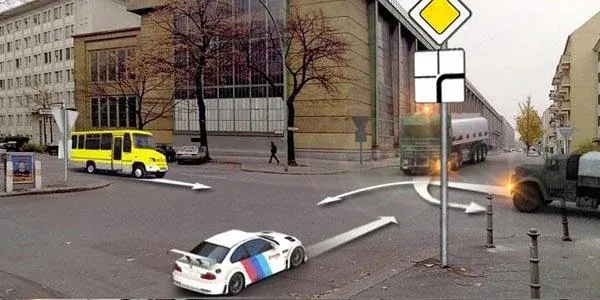
- The lorry, the light passenger car, the bus, the tanker truck.
- The lorry, the bus, the light passenger car, the tanker truck.
Show answer
Correct: 1. The lorry, the light passenger car, the bus, the tanker truck.
Sign 2.1 “Main road” with plate 8.13 shows that the main road comes from the light passenger car’s side and bends to the right, to where the lorry emerges; the bus on the left and the tanker truck turning left from the opposite side are both on secondary roads. Under point 97, where the main road changes direction its users treat each other by the equal-roads rules, so by point 98 the light passenger car gives way to the lorry approaching on its right: the lorry goes first, the passenger car second. Under point 96 the secondary-road drivers follow only after them, and between themselves (point 97) the left-turning tanker gives way to the bus on its right. The other option is wrong because a bus on a secondary road cannot pass ahead of a light passenger car travelling on the main one.
Question 361. The light passenger car will pass the intersection:
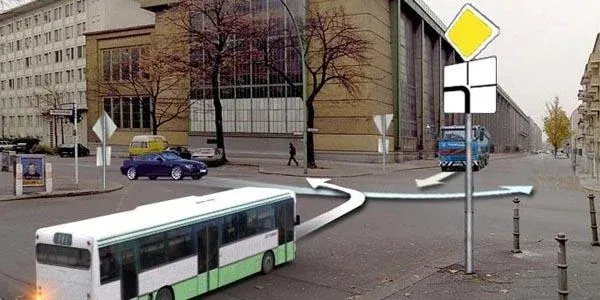
- First.
- Second, after the bus.
- Third.
Show answer
Correct: 2. Second, after the bus.
Sign 2.1 “Main road” with plate 8.13 stands at the bus’s approach: the main road runs through it and turns at the intersection towards the light passenger car’s approach, while the lorry’s road is secondary. Because the main road changes direction, point 97 makes the bus and the passenger car treat each other by the equal-roads rules, and by the right-hand rule of point 98 the passenger car gives way to the bus approaching on its right - so the bus goes first and the light passenger car second, after the bus. The lorry, on the secondary road, gives way under point 96 to both vehicles on the main road and passes last. “First.” is wrong because the bus is on the passenger car’s right, and “Third.” is wrong because the last to pass is the lorry.
Question 363. The vehicles will pass the intersection in the following order:
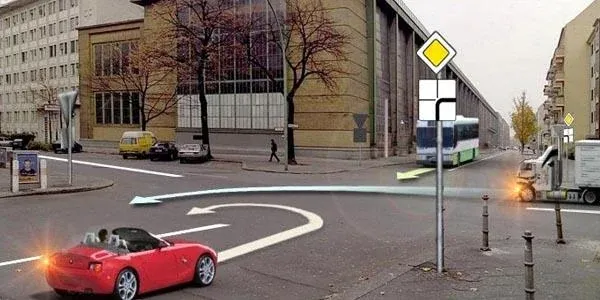
- The lorry, the light passenger car, the bus.
- The bus, the lorry, the light passenger car.
- The bus, the light passenger car, the lorry.
Show answer
Correct: 1. The lorry, the light passenger car, the bus.
Sign 2.1 “Main road” stands at the intersection with plate 8.13 “Direction of the main road”, which shows that the main road changes direction here. The lorry’s path runs along that main road exactly as the plate draws it, so it goes first. The light passenger car is on the main road too, but its path follows it only in part and crosses the lorry’s, so it gives way to the lorry and goes second. Sign 2.4 “Give way” stands at the bus’s approach, so the bus is on the secondary road and under point 96 of the Traffic Rules it gives way to the other two and passes last. “The bus, the lorry, the light passenger car.” and “The bus, the light passenger car, the lorry.” are wrong.
Question 365. To whom are you obliged to give way in the given situation?
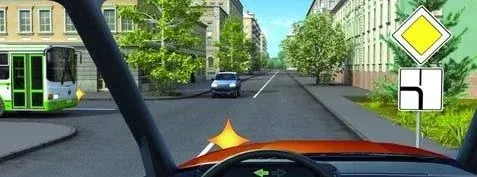
- Only to the bus
- To the light passenger car
- To no one
Show answer
Correct: 3. To no one
Sign 2.1 “Main road” with plate 8.13 shows that the main road turns left at this intersection, so by turning left you STAY on the main road. The oncoming light passenger car is on the secondary road - the straight continuation - and under point 96 it is the one obliged to give way to you; point 99 does not apply here, because it governs oncoming vehicles on a road of EQUAL importance. The bus is also on the main road, but where the main road changes direction points 97 and 98 make its users treat each other by the equal-roads rules, and the bus approaching from your left must give way to you as the vehicle on its right. You are therefore obliged to give way to no one.
Question 372. We are obliged to give way to
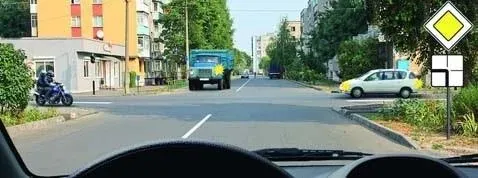
- The motorcycle driver
- The passenger car
- No one
Show answer
Correct: 3. No one
Sign 2.1 “Main road” with plate 8.13 “Direction of the main road” shows that the main road turns left at this intersection, so we enter the intersection on the main road. The oncoming truck and the light passenger car approaching from the right are on secondary roads and, under point 96, are obliged to give way to us whatever direction they then take. The motorcycle is on the main road too, but where the main road changes direction its users treat each other by the equal-roads rules (point 97), and under point 98 a driver gives way to those approaching from his RIGHT - the motorcycle comes at us from the left, so it is the one that yields. We are therefore obliged to give way to no one.
Question 373. In this situation, when making a left turn we are obliged to give way to
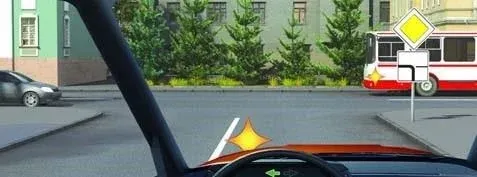
- The passenger car driver
- The bus driver
- No one
Show answer
Correct: 3. No one
We are turning left along the main road: sign 2.1 “Main road” with plate 8.13 shows that at this T-shaped intersection the main road turns to the left. The bus approaches from the right on a secondary road and under point 96 must give way to us whatever direction it then takes. The light passenger car is on the main road as well, but where the main road changes direction its users apply the equal-roads rules between themselves (point 97), and under point 98 the light passenger car’s driver gives way, because we are approaching him from his right. We are therefore obliged to give way to no one.
Question 375. You must give way to
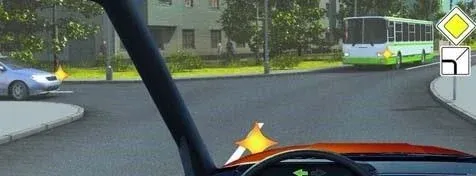
- The bus driver
- Both drivers
- No one
Show answer
Correct: 3. No one
Sign 2.1 “Main road” with plate 8.13 “Direction of the main road” stands on your own approach, so you are travelling on the main road. Under the Rules a driver approaching an intersection on the secondary road must give way to vehicles travelling on the main road, whatever direction those then take. The bus and the passenger car are both on secondary roads, so it is they who give way to you, and you give way to no one. “The bus driver” and “Both drivers” are wrong for that reason.
Question 379. In this situation, during a left turn we are obliged to give way to
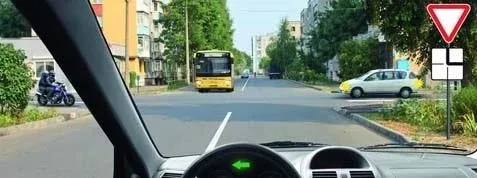
- All drivers
- Only the passenger car driver
- The bus and the passenger car drivers
Show answer
Correct: 3. The bus and the passenger car drivers
Sign 2.4 “Give way” with plate 8.13 “Direction of the main road” shows the main road running from the oncoming direction across to our right, so the oncoming bus and the light passenger car approaching from the right are both on the main road. Under point 96, when turning left we must give way to both of them whatever direction they then take, which is why naming only the passenger car’s driver is not enough. The motorcycle is on the other secondary road, and secondary-road drivers treat each other by the equal-roads rules (point 97): under point 98 the motorcyclist gives way to us, since we approach him from his right. “All drivers” is therefore wrong as well.
Question 381. In this situation, may the driver make the left turn
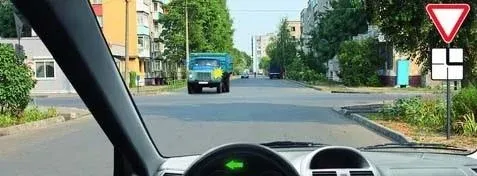
- Yes
- Yes, if he will not obstruct the truck driver
- No
Show answer
Correct: 2. Yes, if he will not obstruct the truck driver
Sign 2.4 “Give way” with plate 8.13 shows that the main road comes from the oncoming direction and turns to the right, while you are approaching on a secondary road. The oncoming truck is therefore on the main road, and under point 96 of the Rules a driver approaching on a secondary road must give way to vehicles travelling on the main one whatever direction they then take. The left turn is thus permitted only on condition that you do not obstruct the truck driver. An unqualified “Yes” ignores the truck’s priority, and “No” is wrong because the turn is not prohibited here at all - you simply have to yield first.
Question 386. When making a left turn, whom is the driver obliged to give way to
- The bus driver
- The passenger car driver
- No one
Show answer
Correct: 1. The bus driver
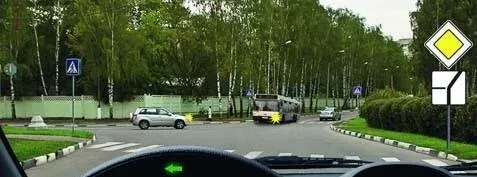
Sign 2.1 “Main road” with plate 8.13 shows the main road running in your direction of travel and turning into the branch ahead on the right, so both you and the bus approaching along that branch are on the main road. Under point 97 you must therefore treat each other by the rules for an intersection of roads of equal importance, and under those rules, turning left, you give way to the bus approaching on your right (point 98). The light passenger car comes from the road on the left, which the plate marks as secondary, and under point 96 its driver must give way to you - which is why “The passenger car driver” and “No one” are both wrong.
Question 388. When making a left turn, whom is the driver obliged to give way to
- Both drivers
- The passenger car driver
- The bus driver
Show answer
Correct: 1. Both drivers
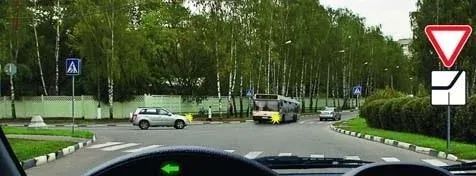
You are approaching under sign 2.4 “Give way” with plate 8.13, which shows the main road coming from the road on the left and turning into the branch ahead on the right, so your own road is the secondary one. Both the light passenger car approaching from the left and the bus coming along that right-hand branch are on the main road, and under point 96 a driver approaching on a secondary road must give way to those travelling on the main one whatever direction they then take. Giving way only to the passenger car, or only to the bus, is therefore not enough: both of them are on the main road.
Question 393. When making a left turn you must give way to
- The bus and the motorcycle drivers
- The bus driver
- Everyone
Show answer
Correct: 3. Everyone
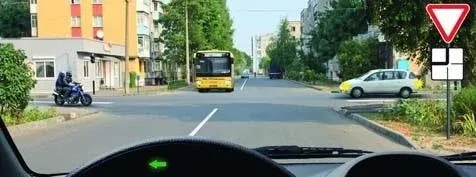
You are approaching the intersection on a secondary road: sign 2.4 “Give way” with plate 8.13 “Direction of the main road” shows the main road coming from the oncoming approach and turning to the left, so both the oncoming bus and the motorcycle approaching from the left are on the main road, and under point 96 you must give way to them whatever direction they then take. The white passenger car on the right is on a secondary road like yours, so between the two of you the equal-roads rules apply (points 97 and 98), and since it approaches from your right you must give way to it as well. Turning left you therefore give way to everyone: naming only the bus and the motorcycle leaves out the car on your right, and naming only the bus leaves out the motorcycle on the main road too.
Question 395. When travelling straight you are obliged to give way to
- Both drivers
- Only the passenger car
- No one
Show answer
Correct: 1. Both drivers
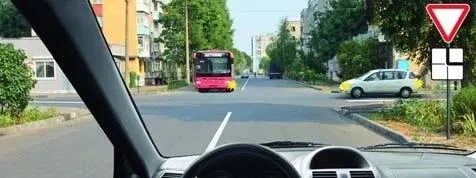
Sign 2.4 “Give way” with plate 8.13 “Direction of the main road” shows the main road coming from the oncoming approach and turning to the right, so both the oncoming bus - whose left indicator shows it is following the main road round - and the passenger car approaching from the right are on the main road. Under point 96 a driver approaching on a secondary road must give way to vehicles on the main one whatever direction they then take, so travelling straight you give way to both. “Only the passenger car” is wrong because the bus is on the main road too, and “No one” is wrong because you are the one on the secondary road, standing at a give-way sign.
Question 398. When making a left turn you are obliged to give way to
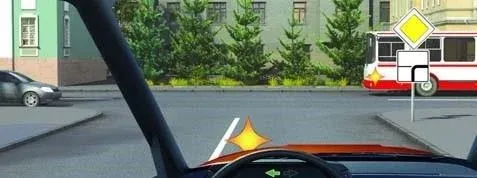
- Only the bus driver
- Both drivers
- No one
Show answer
Correct: 1. Only the bus driver
You are on the main road (sign 2.1), but plate 8.13 shows that it turns to the right at the intersection, and the bus with its left indicator on is approaching along exactly that right-hand branch - so the bus is on the main road too. Under point 97, where the main road changes direction its users treat each other by the equal-roads rules, and under point 98 you give way to the one approaching from your right, which is the bus driver. The dark passenger car on the left is on a secondary road and under point 96 must give way to you, so “Both drivers” is wrong, and “No one” overlooks the bus coming along the main road from your right.
Question 401. When making a left turn you are obliged to give way to
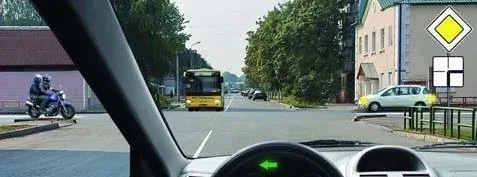
- Only the passenger car driver
- The passenger car and the bus driver
- No one
Show answer
Correct: 1. Only the passenger car driver
Sign 2.1 with plate 8.13 shows that the main road turns from your direction to the right, so the white passenger car approaching from the right with its left indicators on is on the main road as well, while the oncoming bus and the motorcycle on the left are on secondary branches. Under point 97 the drivers on a main road that changes direction treat each other by the equal-roads rules, and under point 98 you give way to the one approaching from your right - the passenger car’s driver. The bus and the motorcycle are themselves obliged by point 96 to give way to you, so “The passenger car and the bus driver” and “No one” are both wrong.
Question 404. We are obliged to give way to
- The passenger car driver
- The bus and the passenger car drivers
- All drivers
Show answer
Correct: 2. The bus and the passenger car drivers
Sign 2.4 “Give way” with plate 8.13 shows the main road coming from the oncoming approach and turning to the right, so the oncoming bus - indicating left, following the main road round - and the passenger car approaching from the right are both on the main road, and under point 96 you must give way to them whatever direction they then take. The motorcycle on the left is on a secondary road like yours; between the two of you the equal-roads rules apply (points 97 and 98), and since you are on ITS right it is the motorcyclist who gives way to you. That is why “All drivers” is wrong, while “The passenger car driver” alone leaves out the bus travelling on the main road.
Question 406. Under a flashing yellow traffic-light signal, when crossing the intersection straight we are obliged to
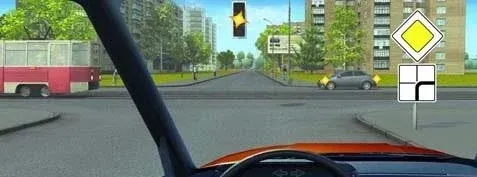
- Stop and wait for the green permitting signal to come on
- Give way to the passenger car driver
- Give way to the tram driver
Show answer
Correct: 2. Give way to the passenger car driver
A flashing yellow signal permits movement and tells the driver that the intersection is unregulated (points 7 and 95), so priority is settled by the signs: sign 2.1 “Main road” with plate 8.13 shows the main road turning to the right. The passenger car approaching from the right is on that main road too, so under points 97 and 98 you treat each other by the equal-roads rules and you must give way to the one on your right. There is no need to stop and wait for a green, because flashing yellow permits movement, and the tram is on the secondary road and under point 96 is itself obliged to give way to you.
Question 408. When making a U-turn, whom must you give way to
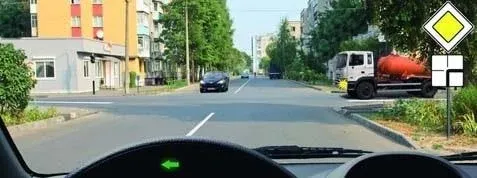
- The truck driver
- The passenger car driver
- Both drivers
Show answer
Correct: 1. The truck driver
Sign 2.1 with plate 8.13 shows that the main road turns to the right, so the truck approaching from the right is on the main road just as you are. Under points 97 and 98 the drivers on a main road that changes direction follow the equal-roads rules between themselves, so making the U-turn you must give way to the one approaching from your right - the truck driver. The oncoming light passenger car is on the secondary road, because the main road bends away to the right, so under point 96 it gives way to you whatever direction you take. That is why “Both drivers” is wrong as well: only the truck has priority over you here.
Question 412. When turning left we are obliged to give way to
- The driver of the passenger car
- The driver of the bus
- The driver of the motorcycle
- No one
Show answer
Correct: 4. No one
Sign 2.1 “Main road” with plate 8.13 shows that the main road turns to the left - exactly where you are turning - so you remain on the main road throughout. The oncoming bus and the light passenger car on the right are on secondary roads and, under point 96, must give way to you whatever direction you then take. The motorcycle is on the main road as well, but under points 97 and 98 you treat each other by the equal-roads rules, and since it approaches from your left it is the motorcyclist who yields to you. You therefore give way to no one.
Question 414. When crossing the intersection we are obliged to give way to
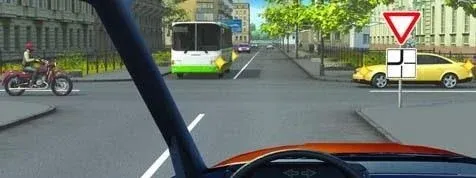
- The motorcycle driver
- The motorcycle and bus drivers
- The bus and passenger car drivers
- All drivers
Show answer
Correct: 4. All drivers
Sign 2.4 “Give way” with plate 8.13 stands before you: the main road runs from the road ahead across to the road on the left, which puts you on a secondary road. The oncoming bus with its left indicator on and the motorcycle on the left are both travelling on the main road, and under point 96 you must give way to them whatever direction they then take. The yellow light passenger car on the right is on a secondary road like yours, so between the two of you the give-way-to-the-right rule applies (points 97 and 98) and you must yield to it as well. You are therefore obliged to give way to all three drivers, and every partial answer is wrong.
Question 415. In this situation you must give way to
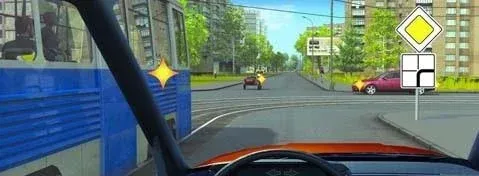
- Only the tram driver
- The passenger car driver
- The passenger car and tram drivers
- All drivers
Show answer
Correct: 3. The passenger car and tram drivers
Sign 2.1 with plate 8.13 shows the main road turning to the right, so the red light passenger car approaching from the right is on the main road just as you are; under points 97 and 98 you treat each other by the equal-roads rules and you give way to the one on your right. The tram is running along your road in the same direction, and under point 100 a tram at an unregulated intersection on a road of equal importance has priority over non-rail vehicles whatever direction it takes, so you must give way to it too. The oncoming motorcycle is on a secondary road, because the main road bends away to the right, and under point 96 it gives way to you - which is why “All drivers”, “Only the tram driver” and “The passenger car driver” are each wrong.
Question 417. When crossing the intersection straight it is necessary to give way to
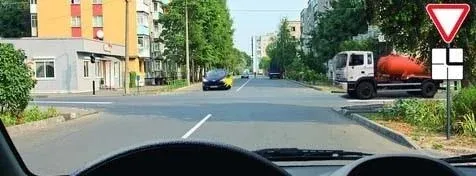
- The truck driver
- The passenger car driver
- Both drivers
Show answer
Correct: 3. Both drivers
Sign 2.4 “Give way” with plate 8.13 “Direction of the main road” shows that you are on a secondary road: the main road comes from the oncoming approach and turns towards your right. Both the tanker truck approaching from the right and the dark light passenger car coming head-on with its left indicator on are therefore travelling on the main road, and under point 96 a driver approaching an intersection of unequal roads on the secondary one must give way to them whatever direction they then take. Naming only the truck driver or only the passenger car’s driver is wrong, because both must be let through.
Question 419. We are obliged to give way to
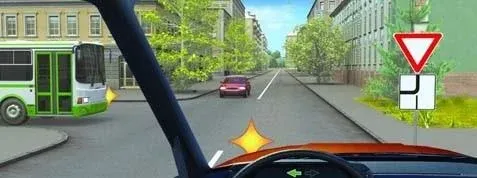
- Both drivers
- The passenger car driver
- The bus driver
Show answer
Correct: 1. Both drivers
Sign 2.4 “Give way” with plate 8.13 “Direction of the main road” shows that you are on a secondary road: the main road comes from the oncoming approach and turns to the left. Both the bus approaching from the left and the oncoming light passenger car are therefore on the main road, and under point 96 a driver approaching an intersection of unequal roads on the secondary one must give way to the vehicles travelling on the main road, whatever direction they then take. Naming only the passenger car’s driver or only the bus driver is wrong, because both must be let through.
Question 426. When travelling straight you must give way to
- The passenger car driver
- Everyone
- No one
Show answer
Correct: 1. The passenger car driver
Sign 2.1 “Main road” with plate 8.13 “Direction of the main road” shows the main road turning from your direction to the right, so the white light passenger car approaching from the right with its left indicators on is on the main road as well. Under point 97, where the main road changes direction its users treat each other by the equal-roads rules, and under point 98, travelling straight, you must give way to the one approaching from your right - the passenger car’s driver. The oncoming truck and the motorcycle on the left are on secondary approaches and under point 96 must give way to you, so “Everyone” is wrong; and “No one” is wrong because the passenger car is coming along the main road from your right.
Question 723. If you intend to continue straight ahead, to which vehicle must you give way?
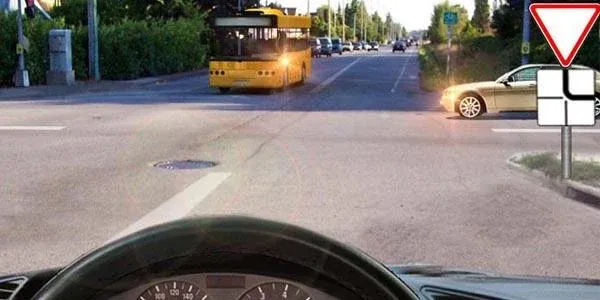
- To both vehicles.
- Only to the bus.
- Only to the passenger car.
- To none.
Show answer
Correct: 1. To both vehicles.
Sign 2.4 “Give way” with plate 8.13 “Direction of the main road” shows that you are approaching the intersection on a secondary road, while the main road comes from the oncoming direction and turns to the right at the intersection. The bus approaching head-on and the light passenger car approaching from the right are therefore both travelling on the main road, and under point 96 of the Traffic Rules you must give way to both of them whatever direction they then take. “Only to the bus.” and “Only to the passenger car.” are wrong because both are on the main road, and “To none.” is wrong because you are the one on the secondary road.
Question 724. If you intend to continue driving straight, to whom must you give way?
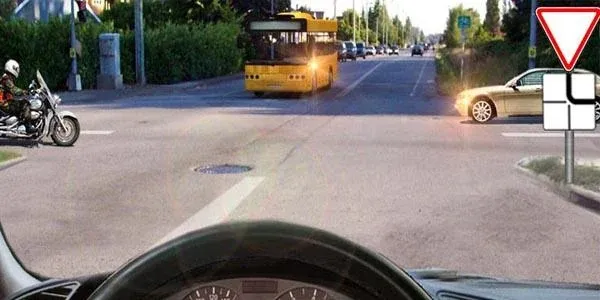
- Only to the passenger car.
- Only to the bus and the passenger car.
- To all the vehicles.
- Only to the motorcycle.
Show answer
Correct: 2. Only to the bus and the passenger car.
Sign 2.4 “Give way” with plate 8.13 shows that you are on a secondary road and that the main road comes from the oncoming direction and turns to the right at the intersection. Under point 96 of the Traffic Rules you must give way to the oncoming bus and to the light passenger car approaching from the right, both of which are on the main road, whatever direction they then take. The motorcycle approaching from the left is travelling on the crossing SECONDARY road; under points 97 and 98 the drivers of secondary roads treat each other by the equal-roads rules, and since you are on its right the motorcyclist must give way to you. “To all the vehicles.” is therefore wrong.
Question 727. You are continuing straight ahead; to which vehicle must you give way?
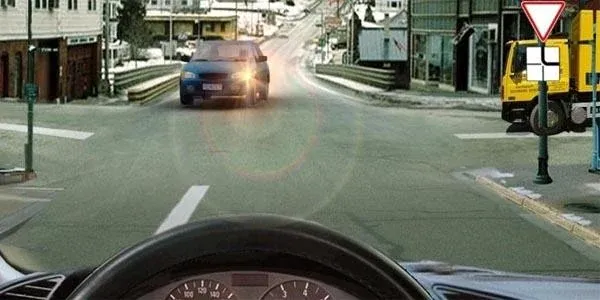
- Only to the passenger car.
- To the truck.
- To both vehicles.
- To none.
Show answer
Correct: 3. To both vehicles.
Sign 2.4 “Give way” with plate 8.13 “Direction of the main road” stands before you, and the plate shows the main road coming from ahead and turning at the intersection towards your right. Both the light passenger car approaching head-on and the truck on your right are therefore travelling on the main road, and under point 96 of the Traffic Rules a driver approaching an intersection on the secondary road must give way to the vehicles on the main one, whatever direction they then take. Continuing straight ahead you must give way to both vehicles; “To none.” and the single-vehicle answers are wrong because both are on the main road.
Question 735. If you intend to make a U-turn at the intersection, to which vehicle must you give way?
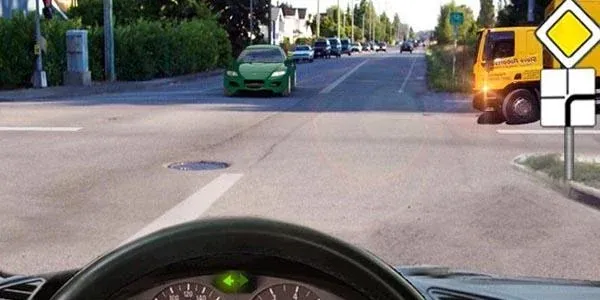
- To the truck.
- To the passenger car.
- To all vehicles.
- To no one.
Show answer
Correct: 1. To the truck.
Sign 2.1 with plate 8.13 shows that the main road turns to the right at the intersection, so both you and the truck approaching from the right are travelling on the main road. Under point 97 of the Traffic Rules the drivers on a main road that changes direction then treat each other by the equal-roads rules, and under point 98 you must give way to the one approaching from your right - the truck. The oncoming light passenger car is on the secondary road and under point 96 must give way to you, so before the U-turn you give way to the truck alone.
Question 736. If you intend to make a left turn, to which vehicle must you give way?
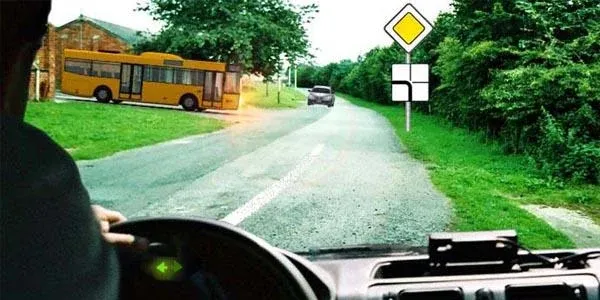
- To the bus.
- To the bus and the passenger car.
- To the passenger car.
- To no one.
Show answer
Correct: 4. To no one.
The plate 8.13 under sign 2.1 “Main road” shows that at this intersection the main road turns to the left, so in turning left you remain on the main road. The oncoming light passenger car is on the secondary road and under point 96 of the Traffic Rules must give way to you. The bus is on the main road as well, but under point 97 the drivers travelling on it treat each other by the equal-roads rules, and under point 98 the one who gives way is the driver approached from HIS right - you are approaching the bus from exactly that side, so the bus gives way. You are therefore obliged to give way to no one: the options naming the bus or the passenger car are wrong because both of them must let you through.
Question 1072. When making a left turn you are obliged to give way to
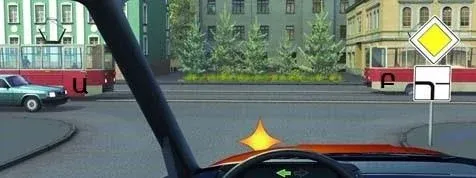
- The drivers of the light passenger car and of tram Ա (A)
- Only to the driver of tram Ա (A)
- To the drivers of the trams
- To no one
Show answer
Correct: 2. Only to the driver of tram Ա (A)
Sign 2.1 “Main road” with plate 8.13 “Direction of the main road” shows that the main road bends to the left from your approach, so in turning left you stay on the main road, and tram Բ (B) on the right is on a secondary road and under point 96 of the Rules must give way to you. Because the main road changes direction, point 97 makes the drivers travelling along it settle matters between themselves by the rules for an intersection of roads of equal importance: under point 98 the light passenger car and tram Ա (A) approach from your left, so the “give way to the one on your right” rule does not oblige you to yield to the car - but the last sentence of that same point 98 gives a tram the advantage over non-rail vehicles whatever direction it is travelling in. You must therefore give way only to the driver of tram Ա (A), which is why “The drivers of the light passenger car and of tram Ա (A)”, “To the drivers of the trams” (tram Բ (B) is on a secondary road) and “To no one” are wrong.
Question 1073. When crossing the intersection the driver is obliged to give way to
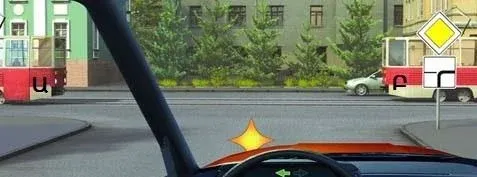
- Only the tram drivers
- The passenger car and the driver of tram Բ (B)
- No one
- Everyone
Show answer
Correct: 2. The passenger car and the driver of tram Բ (B)
Sign 2.1 “Main road” with plate 8.13 “Direction of the main road” shows that the main road bends to the right, so the light passenger car and tram Բ (B) approaching from the right are travelling on the main road, while tram Ա (A) on the left is on a secondary road and under point 96 of the Rules must give way to you. Because the main road changes direction, point 97 makes the drivers travelling along it settle matters between themselves by the rules for an intersection of roads of equal importance, and point 98 obliges you to give way to those approaching from the right - the light passenger car and tram Բ (B), the tram having the advantage over non-rail vehicles in any case. “Only the tram drivers” is wrong because tram Ա (A) is on a secondary road, and “No one” and “Everyone” contradict points 97 and 98.