Engine and Equipment
This is the longest part of the list, and the last stop of the check. It covers everything else: what leaks, what locks, what protects you and what must be on board.
Don’t try to memorize it as a list. Walk round the vehicle in order, and each item has a place.
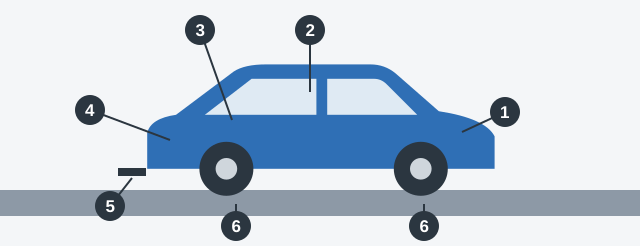
The walk: 1 engine and hood, 2 inside the cabin, 3 fuel cap and doors, 4 equipment on board, 5 tow hitch, 6 around the wheels.
1. Open the hood
Section titled “1. Open the hood”Section 5 of Annex 2 names only a few engine faults, so learn them exactly:
- Harmful substances in the exhaust gases are above the norms set by RA legislation.
- The seal of the crankcase ventilation system is broken.
- The seal of the fuel supply system is broken, which leaks fuel and is a fire hazard.
- The engine’s external noise is above the standard.
Other seals matter too. Operation is also prohibited when the seals or joints of the engine, gearbox, final drive or rear axle have lost their tightness.
The hood lock provided by the design must work.
Common trap: An engine that runs with interruptions, is hard to start or runs at an unstable temperature may worry you, but none of these is on the list. The engine faults that count are about exhaust, seals or noise.
2. Sit inside
Section titled “2. Sit inside”From the driver’s seat, check everything that protects you and everything you depend on:
- Seat belts provided by the design must be there, must work, and must have no visible tears in the webbing.
- Head restraints provided by the design must be there. They protect your neck in a rear-end collision.
- Seat adjustment: the mechanism for the driver’s seat must work.
- Speedometer: it must work. So must a tachograph or anti-theft device provided by the design.
- Horn: it must work and conform to the standard. It’s your only way of warning people by sound.
- Your view: nothing may be fitted that restricts it from the driver’s seat.
| Doesn’t work | On the list? |
|---|---|
| Speedometer | Yes |
| Horn | Yes |
| Fuel level indicator | No |
| Engine coolant temperature gauge | No |
| Passenger car interior light | No |
| Bus interior light | Yes |
| Audio player | No |
Remember: Of the gauges on the dashboard, the speedometer is the one you must have working. The fuel and temperature gauges aren’t on the list.
3. Walk round the body
Section titled “3. Walk round the body”These parts stop things from coming open or falling off:
- Locks on the body doors and cabin doors must work.
- The fuel tank cap provided by the design must work.
- The spare wheel holder must work, because a loose spare can fall off on the road.
- Mudguards and splash guards provided by the design must be there.
- The rear protective device provided by the design must be there.
The check is about whether they are there. Being dirty isn’t a fault.
Two more conditions apply to the vehicle as a whole:
- Nothing may be fitted that could injure road users.
- The vehicle’s design must not be changed without the permission of the body that registers vehicles.
4. Check what’s on board
Section titled “4. Check what’s on board”| Item | Must be carried by |
|---|---|
| First-aid kit | Bus, passenger car, truck, motorcycle with a side car |
| Fire extinguisher | Bus (see Bus Equipment) and truck |
| “Emergency stop” sign | Bus, passenger car, truck, wheeled tractor |
A motorcycle without a side car doesn’t need the “Emergency stop” sign. Fog lamps aren’t compulsory, so not having them is no fault.
5. Check the coupling
Section titled “5. Check the coupling”If you tow, the towing or coupling device of a tow hitch or trailer must work. Safety cables or chains provided by the design must be there and in working order. A failure here lets the trailer break loose.
Motorcycles and training cars
Section titled “Motorcycles and training cars”On a motorcycle, operation is prohibited if:
- The footrests provided by the design are missing.
- The safety bars provided by the design are missing.
- The transverse handhold for the passenger on the saddle is missing.
- There’s play in the joints between the frames of the motorcycle and its side car.
A vehicle used for practical driving instruction must carry its identification sign. The “Doctor” sign is different: it’s displayed at the driver’s own wish, so it isn’t a fault when it’s missing.
Extra: A one-minute check for every day
Not from the question bank.
You don’t need tools. Walk once round the car, look under it for fresh drips, and glance at the tyres and lamps. Inside, adjust your seat and mirrors, then fasten your belt. Once a week, or before a long trip, open the hood and check the oil, coolant, brake fluid and washer fluid against their marks. Stop as soon as it is safe if a warning light comes on while you’re driving, and check the handbook.
Try it yourself
Section titled “Try it yourself”A truck has white reflectors at the front, and its towing device is faulty. Which is the problem? Only the towing device. White is the correct color for front reflectors.
A car has no first-aid kit, and its reversing lamps are red. Which prohibits operation? Both. Cars must carry a first-aid kit, and reversing lamps must be white.
A motorcycle with a side car has tyres at 0.6 mm and no first-aid kit, and the passenger’s handhold is gone. Which prohibits operation? All three. Each one is a ground on its own.
Key points
Section titled “Key points”- Engine faults on the list: exhaust gases over the norm, broken crankcase or fuel seals, excess noise.
- A hard-starting engine, an uneven engine or an unstable temperature isn’t on the list.
- Belts must be there, work and have no tears. Head restraints must be there.
- The speedometer and horn must work. The fuel and temperature gauges don’t count.
- Door locks, the hood lock, the fuel cap and the spare wheel holder must work.
- Bus, car and truck carry a first-aid kit and an “Emergency stop” sign. Buses and trucks carry a fire extinguisher.
- Changing a vehicle’s design needs the permission of the registering body.
Practice questions
Section titled “Practice questions”Question 937. The operation of vehicles is prohibited if:
- There are displacements of the parts (details) and assemblies of the steering control not provided for by the construction, or the threaded connections are not tightened.
- A fire extinguisher is missing in a lorry.
- In both cases.
Show answer
Correct: 3. In both cases.
In Appendix N 2 to the Road Traffic Rules, section 2 (steering faults) prohibits operation when “there are displacements of the parts (details) and assemblies of the steering control not provided for by the construction, or the threaded connections are not tightened”, and section 6 (other faults and conditions) prohibits it when “a fire extinguisher is missing in a lorry”. Since each of the two situations is by itself a prohibiting condition, the correct answer is “In both cases.”
Question 944. Operation of vehicles is prohibited if:
- The content of harmful substances in the exhaust gases exceeds the norms established by the legislation of the RA.
- The footrests provided by the design are missing on the motorcycle.
- In both cases.
Show answer
Correct: 3. In both cases.
Section 5 of Annex N 2 (engine faults) prohibits operation when “The content of harmful substances in the exhaust gases exceeds the norms established by the legislation of the RA.” Section 6 (other faults) prohibits operation when “The footrests provided by the design are missing on the motorcycle.”, because the rider and the passenger then have nowhere to place their feet and lose their balance. Each condition prohibits operation on its own, so the correct answer is “In both cases.”
Question 945. Operation of vehicles is prohibited if:
- The seal of the engine crankcase ventilation system is broken.
- The seal of the engine fuel supply system is broken.
- In both cases.
Show answer
Correct: 3. In both cases.
Section 5 of Annex N 2 (engine faults) treats as prohibiting both the case where “The seal of the engine crankcase ventilation system is broken.” and the case where “The seal of the engine fuel supply system is broken.” In the first, crankcase gases escape; in the second, fuel leaks, which is a fire hazard. Both are in the list, so the correct answer is “In both cases.”
Question 947. Operation of vehicles is prohibited if:
- The windscreen washers provided by the design do not work.
- The permissible level of the engine’s external noise exceeds the norms established by the standard.
- In both cases.
Show answer
Correct: 3. In both cases.
Annex N 2 to the Road Traffic Rules (the list of malfunctions) prohibits operation when “The windscreen washers provided by the design do not work.”, because the driver then cannot clean the windscreen and loses visibility. The same annex also treats as prohibiting the case where “The permissible level of the engine’s external noise exceeds the norms established by the standard.” Both conditions are in the list, so the correct answer is “In both cases.”
Question 949. Operation of vehicles is prohibited if:
- Items or objects posing a danger of causing injuries to road users are fitted.
- The audible signalling device (horn) does not work.
- In both cases.
Show answer
Correct: 3. In both cases.
Annex N 2 (the list of malfunctions) prohibits operation when “Items or objects posing a danger of causing injuries to road users are fitted.”, because in a collision they injure a pedestrian or other road users. It is equally prohibiting when “The audible signalling device (horn) does not work.”, since the driver is left with no means of warning of danger. Each condition prohibits operation on its own, so the correct answer is “In both cases.”
Question 950. Operation of vehicles is prohibited if:
- There is play in the joints of the frames of the motorcycle and the sidecar.
- Fog lamps with yellow lights are fitted at the front.
- In both cases.
Show answer
Correct: 1. There is play in the joints of the frames of the motorcycle and the sidecar.
point 6 of Appendix No. 2 to the Traffic Rules prohibits operation when there is play in the joints of the frames of a motorcycle and its sidecar, so “There is play in the joints of the frames of the motorcycle and the sidecar.” is a prohibiting condition. Fog lamps showing yellow light at the front are not: sub-point “a” of point 3 bans light devices at the front in any colour other than white, yellow or orange, and yellow is among the colours it allows. Only one of the two situations therefore prohibits operation, so “In both cases.” is wrong.
Question 951. Operation of vehicles is prohibited if:
- The first-aid kit is missing in a truck.
- Reflecting devices of white colour are fitted at the front.
- In both cases.
Show answer
Correct: 1. The first-aid kit is missing in a truck.
Section 6 of Appendix No. 2 to the Traffic Rules requires a first-aid kit in buses, light passenger cars and lorries, so its absence from a truck prohibits operation and “The first-aid kit is missing in a truck.” is correct. Reflecting devices of white colour at the front are not a fault at all - white is the colour the front reflectors are required to be, and what the list prohibits is front reflectors of any colour other than white. Only one of the two situations prohibits operation, so “In both cases.” is wrong.
Question 952. Operation of vehicles is prohibited if:
- The first-aid kit is missing on a motorcycle with a sidecar.
- The towing coupling device is faulty.
- In both cases.
Show answer
Correct: 3. In both cases.
Section 6 of Appendix No. 2 to the Traffic Rules prohibits operation when a motorcycle with a sidecar has no first-aid kit, and it likewise prohibits operation when the coupling devices of a tow or a trailer are faulty. Each of the two situations is a ground for prohibition standing on its own - a missing first-aid kit leaves the crew unequipped for an injury, a faulty coupling can let the trailer break away - so both of the situations described prohibit operation and “In both cases.” is the correct answer.
Question 953. Operation of vehicles is prohibited if:
- The seat belts provided by the vehicle’s design do not work.
- Items or objects restricting the driver’s field of view from his seat are fitted.
- In both cases.
Show answer
Correct: 3. In both cases.
Section 6 of Appendix No. 2 to the Traffic Rules prohibits operation when the seat belts provided by the vehicle’s design are missing or do not work, and it separately prohibits operation when items or objects restricting the driver’s field of view from his seat are fitted. Each condition is a ground for prohibition by itself - one leaves the occupants unrestrained in a collision, the other stops the driver seeing the road - so “In both cases.” is the correct answer.
Question 954. Operation of vehicles is prohibited if:
- Changes (re-equipment) have been made to the vehicle’s design without the permission of the body carrying out the registration of the vehicle.
- Turn indicators with yellow lights are fitted at the front.
- In both cases.
Show answer
Correct: 1. Changes (re-equipment) have been made to the vehicle’s design without the permission of the body carrying out the registration of the vehicle.
Section 6 of Appendix No. 2 to the Traffic Rules prohibits operation when changes (re-equipment) have been made to a vehicle’s design without the permission of the body that registers the vehicle, so that option is a prohibiting condition. Turn indicators showing yellow light at the front are not a fault: yellow or orange is the colour front turn indicators are required to show. Only one of the two situations prohibits operation, so “In both cases.” is wrong.
Question 955. Operation of vehicles is prohibited if:
- A motor vehicle used for practical driving instruction does not have the corresponding identification sign.
- The fuel level indicator does not work.
- In both cases.
Show answer
Correct: 1. A motor vehicle used for practical driving instruction does not have the corresponding identification sign.
point 6 of Appendix No. 2 to the Traffic Rules, “Other malfunctions and conditions”, prohibits operation when a mechanical vehicle used for practical driving instruction does not carry the corresponding identification sign, so “A motor vehicle used for practical driving instruction does not have the corresponding identification sign.” is correct. A fuel level indicator that does not work is not a prohibiting condition: point 6 lists a closed set of design-fitted instruments that must work - the speedometer, the tachograph, the anti-theft device, the glass-heating devices and the like - and the fuel gauge is not among them. Only one of the two situations prohibits operation, so “In both cases.” is wrong.
Question 956. Operation of motorcycles is prohibited if:
- The safety bars provided by the design are missing.
- The minimum residual tread depth of the tyres is 1.6 mm.
- In both cases.
Show answer
Correct: 1. The safety bars provided by the design are missing.
Section 6 of Appendix No. 2 to the Traffic Rules prohibits the operation of a motorcycle when the safety bars provided by its design are missing, so “The safety bars provided by the design are missing.” is correct. A residual tread depth of 1.6 mm is not a prohibiting condition on a motorcycle: the minimum the Rules set for motorcycle tyres is 0.8 mm, and 1.6 mm is well above it. Only one of the two situations prohibits operation, so “In both cases.” is wrong.
Question 958. Operation of vehicles is prohibited if:
- Turn indicators with orange lights are fitted at the front.
- The towing device of the tow hitch is faulty.
- In both cases.
Show answer
Correct: 2. The towing device of the tow hitch is faulty.
The “Other” section of Appendix No. 2 to the Traffic Rules prohibits operation when the towing or coupling devices of a tow or a trailer section are faulty, or when the safety cables (chains) provided by the design are missing or faulty - a failure there lets the trailer break loose. “The towing device of the tow hitch is faulty.” is therefore the prohibiting condition. Turn indicators showing orange light at the front are a permitted colour and not a fault at all, so “In both cases.” is wrong.
Question 959. Operation of vehicles is prohibited if:
- White-coloured light-reflecting devices are installed at the front.
- The towing device of the tow is defective.
- In both cases.
Show answer
Correct: 2. The towing device of the tow is defective.
The “Other” section of Appendix No. 2 to the Traffic Rules prohibits operation when the towing or coupling devices are faulty or when the safety cables provided by the design are missing or faulty, so “The towing device of the tow is defective.” is the prohibiting condition. White-coloured light-reflecting devices at the front are not a fault: front reflectors are required to be white, and it is a front reflector of any other colour that the list prohibits. Only one of the two situations prohibits operation, so “In both cases.” is wrong.
Question 960. Operation of vehicles is prohibited if:
- The safety belts provided by the design are missing.
- Reversing lamps with white-coloured lights are installed at the rear.
- In both cases.
Show answer
Correct: 1. The safety belts provided by the design are missing.
The correct answer is “The safety belts provided by the design are missing.” Annex N 2 to the Road Traffic Rules — the list of faults and conditions that prohibit operation — bans driving in its “Other” section when the head restraints or the safety belts provided by the design are missing or do not work, or when the belt webbing has visible tears. “Reversing lamps with white-coloured lights are installed at the rear” is not a fault: reversing lamps are required to show white light. So only the missing belts prohibit operation.
Question 961. Operation of motorcycles with a side car is prohibited if:
- The transverse handhold provided by the design for the passenger on the saddle is missing.
- The residual height of the tyre tread is 0.6 mm.
- The medical first-aid kit is missing.
- In all the listed cases.
Show answer
Correct: 4. In all the listed cases.
For a motorcycle with a side car each of the three listed conditions bars it from the road on its own. The “Wheels and tyres” section of Annex N 2 to the Road Traffic Rules (the list of faults and conditions prohibiting operation) sets 0.8 mm as the minimum residual tread height for motorcycles, so “The residual height of the tyre tread is 0.6 mm” is below the limit; the “Other” section covers both “The transverse handhold provided by the design for the passenger on the saddle is missing” and “The medical first-aid kit is missing”, which is compulsory equipment on a motorcycle with a side car. Because each point is a ground for prohibition by itself, the correct answer is “In all the listed cases.”
Question 962. Operation of vehicles is prohibited if:
- The mechanism provided by the design for adjusting the position of the driver’s seat does not work.
- The interior lighting devices of the bus’s cabin do not work.
- In both cases.
Show answer
Correct: 3. In both cases.
Both cases prohibit operation. In the “Other” section of Annex N 2 to the Road Traffic Rules (the list of faults and conditions prohibiting the operation of vehicles), the units that must be in working order include both “the mechanism provided by the design for adjusting the position of the driver’s seat” and “the interior lighting devices of the bus’s cabin”. Since each one on its own is enough to bar the vehicle from the road, the correct answer is “In both cases.”
Question 963. Operation of vehicles is prohibited if:
- The interior lighting devices of a passenger car’s cabin do not work.
- The head restraints of the seats provided by the design are missing.
- In both cases.
Show answer
Correct: 2. The head restraints of the seats provided by the design are missing.
The correct answer is “The head restraints of the seats provided by the design are missing.” The “Other” section of Annex N 2 to the Road Traffic Rules (the list of faults and conditions prohibiting operation) bans driving when the head restraints or the safety belts provided by the design are missing or do not work. “The interior lighting devices of a passenger car’s cabin do not work” is not a prohibiting condition: that requirement applies to a bus’s cabin, not to a passenger car. So only the missing head restraints prohibit operation.
Question 964. Operation of vehicles is prohibited if:
- Red-coloured light-reflecting devices are installed at the rear.
- The speedometer provided by the design does not work.
- In both cases.
Show answer
Correct: 2. The speedometer provided by the design does not work.
The correct answer is “The speedometer provided by the design does not work.” The “Other” section of Annex N 2 to the Road Traffic Rules (the list of faults and conditions prohibiting operation) counts the speedometer among the instruments that must be in working order, so a dead speedometer bars the vehicle on its own. “Red-coloured light-reflecting devices are installed at the rear” is not a fault: rear reflectors are required to be red. The speedometer is therefore the only prohibiting condition here.
Question 967. Operation of vehicles is prohibited if:
- The medical first-aid kit is missing in a passenger car.
- Reversing lamps with red-coloured lights are installed at the rear.
- In both cases.
Show answer
Correct: 3. In both cases.
Both cases prohibit operation. Annex N 2 to the Road Traffic Rules (the list of faults and conditions prohibiting the operation of vehicles) requires a medical first-aid kit in a passenger car as well, so its absence is a prohibiting condition. The same annex bars a vehicle whose external lighting devices do not match the design in colour or mode of operation — reversing lamps must show white light, not red, so “Reversing lamps with red-coloured lights are installed at the rear” is itself a fault. Since each condition bars the car on its own, the correct answer is “In both cases.”
Question 972. Operation of vehicles is prohibited if:
- The audible signalling device (horn) does not work.
- The cooling system does not ensure a stable thermal regime of the engine’s operation.
- In both cases.
Show answer
Correct: 1. The audible signalling device (horn) does not work.
point 6 of Appendix No. 2 to the Traffic Rules, “Other malfunctions and conditions”, prohibits operation when the audible signalling device does not work or does not conform to the standard, so “The audible signalling device (horn) does not work.” is correct. A cooling system that fails to hold a stable thermal regime is not a prohibiting condition: point 5, which covers the engine, lists only a faulty exhaust gas system, a broken seal in the crankcase ventilation or fuel supply system, and excessive external noise. The cooling system is not among them, so “In both cases.” is wrong.
Question 973. Operation of vehicles is prohibited if:
- The threaded connections of the steering system are not tightened or not secured in the prescribed manner.
- The fire extinguishers are missing in the bus.
- In both cases.
Show answer
Correct: 3. In both cases.
Both situations prohibit operation. The “Malfunctions of steering systems” section of Appendix No. 2 to the Traffic Rules, the list of malfunctions prohibiting the operation of vehicles, prohibits operation when the threaded connections of the steering are not tightened or not secured in the prescribed manner - a connection that works loose can leave the driver without steering. The “Other” section requires a fire extinguisher in a bus. Each condition prohibits operation by itself, so “In both cases.” is the correct answer.
Question 980. Operation of vehicles is prohibited if:
- The interior lighting devices of a passenger car’s cabin do not work.
- The interior lighting devices of the bus’s cabin do not work.
- In both cases.
Show answer
Correct: 2. The interior lighting devices of the bus’s cabin do not work.
point 6 of Appendix No. 2 to the Traffic Rules, “Other malfunctions and conditions”, counts the interior lighting devices of a bus cabin among the equipment that must work, so “The interior lighting devices of the bus’s cabin do not work.” prohibits operation. The same requirement is not imposed on a light passenger car, whose interior light is not in that list, so a passenger car’s non-working cabin light does not prohibit operation and “In both cases.” is wrong.
Question 994. Operation of vehicles is prohibited if:
- The body door lock provided by the design does not work
- The cabin door lock provided by the design does not work
- In both cases
Show answer
Correct: 3. In both cases
point 6 of Appendix No. 2 to the Traffic Rules names the locks of the body or cab doors among the parts that must work. A body door lock provided by the design that does not work is therefore a ground for prohibiting operation, and a cab door lock that does not work is an independent ground under the same entry - a door that can open in motion is a danger either way. Each situation prohibits operation by itself, so “In both cases” is the correct answer.
Question 995. Operation of vehicles is prohibited if
- Turn indicators with red lights are fitted at the rear.
- The rear protective device provided by the design is missing
- In both cases
Show answer
Correct: 2. The rear protective device provided by the design is missing
point 6 of Appendix No. 2 to the Traffic Rules prohibits operation when the rear protective device, the mudguards or the splash guards provided by the design are missing, so “The rear protective device provided by the design is missing” is the prohibiting condition. Turn indicators showing red light at the rear are not prohibited: sub-point “b” of point 3 bans rear light devices in any colour other than red, yellow or orange, and red is among the colours it allows. “In both cases” is therefore wrong.
Question 997. Operation of vehicles is prohibited if:
- The parking brake system does not ensure a stationary state on the gradient established by the standard
- The tightness of the gearbox seals is broken
- In both cases
Show answer
Correct: 3. In both cases
point 1 of Appendix No. 2 to the Traffic Rules, “Malfunctions of braking systems”, prohibits operation when the parking brake system does not hold the vehicle stationary on the gradient the standard prescribes. point 6 separately prohibits operation when the seals or joints of the engine, gearbox, final drive, rear axle and the like have lost their tightness, so broken gearbox seals are an independent ground. Each situation prohibits operation by itself under the List, so “In both cases” is the correct answer.
Question 998. Operation of vehicles is prohibited if:
- The spare wheel holder does not work
- The tightness of the rear axle seals is broken
- In both cases
Show answer
Correct: 3. In both cases
point 6 of Appendix No. 2 to the Traffic Rules lists a spare wheel holder that does not work - together with its raising and lowering mechanism or winch - among the conditions prohibiting operation, since an unsecured spare wheel can come off in motion. The same item separately prohibits operation when the seals or joints of the engine, gearbox, final drive, rear axle and the like have lost their tightness, so broken rear axle seals are an independent ground. Each situation prohibits operation by itself, so “In both cases” is the correct answer.
Question 999. Operation of vehicles is prohibited if
- There are visible tears on the webbing of the seat belts provided by the design
- It is not equipped with fog lamps
- In both cases
Show answer
Correct: 1. There are visible tears on the webbing of the seat belts provided by the design
point 6 of Appendix No. 2 to the Traffic Rules prohibits operation when the seat belts provided by the design are missing or do not work, or when there are visible tears in the belt webbing - a torn belt can part under load. Not being equipped with fog lamps is not a fault: fog lamps are not in the compulsory equipment of the closed list in Appendix No. 2, so their absence is not a ground for prohibition. Only one of the two situations prohibits operation, so “In both cases” is wrong.
Question 1000. Operation of vehicles is prohibited if:
- The engine hood lock provided by the design does not work,
- The rear side windows are curtained and the 2 side rear-view mirrors are present
- In both cases
Show answer
Correct: 1. The engine hood lock provided by the design does not work,
point 6 of Appendix No. 2 to the Traffic Rules names the locks of the body or cab doors and of the engine hood among the parts that must work, so an engine hood lock provided by the design that does not work prohibits operation. Curtained rear side windows are not a fault when the 2 side rear-view mirrors are present: point 6 prohibits curtained rear side windows only where those 2 side mirrors are missing, and here they are fitted, so the driver still has rearward vision. “In both cases” is therefore wrong.
Question 1002. Operation of vehicles is prohibited if:
- The fuel tank cap provided by the design does not work
- The front side windows are curtained
- In both cases
Show answer
Correct: 3. In both cases
point 6 of Appendix No. 2 to the Traffic Rules names fuel tank caps among the parts that must work, so a fuel tank cap provided by the design that does not work prohibits operation. The same item separately prohibits operation when the windscreen or the front side windows are curtained - at the front the ban is outright, with no proviso about mirrors, because nothing may block the driver’s forward view. Each situation prohibits operation by itself, so “In both cases” is the correct answer.
Question 1011. Operation of vehicles is prohibited if
- The “Doctor” identification sign is missing on a car driven by a doctor-driver
- The fuel tank cap provided by the design does not work
- In both cases
Show answer
Correct: 2. The fuel tank cap provided by the design does not work
point 6 of Appendix No. 2 to the Traffic Rules names fuel tank caps among the parts that must work, so “The fuel tank cap provided by the design does not work” prohibits operation. A missing “Doctor” identification sign is not a fault at all: under point 175 of the Rules the “Doctor” and “Disabled person” signs are displayed at the driver’s own wish, so their absence can never be a ground for prohibition. Only one of the two situations prohibits operation, so “In both cases” is wrong.