Towing
A towed vehicle has no engine helping its brakes or steering, so two vehicles now depend on one link. The exam tests four things: how far apart the vehicles stay, who may ride, when towing is banned, and which lights to use.
What are the three ways to tow?
Section titled “What are the three ways to tow?”- Rigid coupling: a solid bar. It fixes both the distance and the direction between the vehicles.
- Flexible coupling: a rope or cable. It only pulls.
- Partial loading: the towed vehicle rests partly on the towing vehicle.
How far apart must the vehicles be?
Section titled “How far apart must the vehicles be?”Point 140 sets the distance for the two couplings.
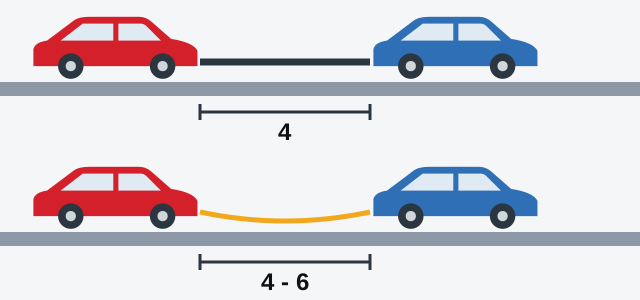
Rigid coupling (top): not more than 4 m. Flexible coupling (bottom): 4 to 6 m.
Too short, and the vehicles can collide. Too long, and the towed vehicle struggles to follow the same line.
Remember: Both couplings meet at 4 m. Rigid stops there. Flexible starts there and goes up to 6 m.
Who may ride?
Section titled “Who may ride?”Ask two questions: which method is being used, and is the person in the towed or the towing vehicle? All of this is point 139.
| Method | Place | People allowed? |
|---|---|---|
| Rigid or flexible | Towed bus or trolleybus | No |
| Rigid or flexible | Body of a towed truck | No |
| Rigid or flexible | Cabin of a towed truck | Yes |
| Rigid or flexible | Towed passenger car | Yes |
| Rigid or flexible | Towing bus | Yes |
| Rigid or flexible | Body of a towing truck | Yes |
| Partial loading | Cabin or body of the towed vehicle | No |
| Partial loading | Body of the towing vehicle | No |
| Partial loading | Cabin of the towing vehicle | Yes |
The ban on a towed bus has no exceptions. The type of coupling doesn’t change it, and neither does the number of seats or passengers. A towed vehicle must also have a driver at the wheel (point 138).
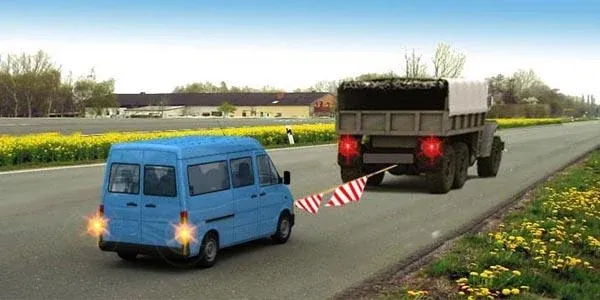
This minibus is being towed, so nobody may ride in its saloon, whatever the number of seats.
Common trap: The figure of 8 passengers has nothing to do with towing. It belongs to carrying people in a truck. Also, don’t confuse the two buses: the towed bus carries nobody, but the towing bus may carry passengers.
When is towing banned?
Section titled “When is towing banned?”On ice, a flexible coupling is prohibited (point 143). A rope can’t hold the towed vehicle on line or keep the two braking together on a slippery surface. A rigid coupling and partial loading stay allowed, and the same goes for a towed bus.
With motorcycles, the question is the side car. A motorcycle without a side car may not tow and may not be towed. A motorcycle with a side car may do both, and the Rules attach no coupling requirement to it.
Common trap: “Towing on ice is prohibited” is too broad, and “Towing on ice is permitted” is too. Only the flexible coupling is banned.
Which lights are used?
Section titled “Which lights are used?”- Towed vehicle: hazard warning lights (point 22). Main beam and dipped headlights are not the answer here.
- Towing vehicle: dipped headlights by day (point 133).
- Hazard lights missing or faulty: put the “Emergency stop” sign at the rear of the towed vehicle (point 24). This position is fixed, not left to the driver, because that’s where drivers coming from behind see it.
The speed limit for towing a mechanical vehicle is in the Speed lesson.
Extra: Towing smoothly
Not from the question bank.
Before you move, agree how the two drivers will signal each other. Start very gently to take up the slack, and brake early and softly so the towed vehicle doesn’t run up behind you. If the towed vehicle’s engine is off, its driver will need much more force on the brake pedal and the steering wheel.
Try it yourself
Section titled “Try it yourself”You are towing a bus on a rope, and the road ahead is icy. May you carry on? No. A flexible coupling is prohibited on ice. With a rigid coupling you could, but there still couldn’t be any passengers in the towed bus.
You are towing a truck by partial loading, and a friend wants a lift. Where may your friend sit? Only in the cabin of the towing vehicle. Partial loading rules out everywhere else, including the towing vehicle’s body.
Key points
Section titled “Key points”- Rigid coupling: not more than 4 m. Flexible coupling: 4 to 6 m.
- Nobody rides in a towed bus or trolleybus, or in the body of a towed truck.
- A towed passenger car and the cabin of a towed truck may carry people on a rigid or flexible coupling.
- Partial loading: people ride only in the cabin of the towing vehicle.
- On ice, a flexible coupling is prohibited. Rigid and partial loading are allowed.
- Motorcycles without a side car may neither tow nor be towed.
- The towed vehicle shows hazard lights. If they fail, the “Emergency stop” sign goes on its rear.
Practice questions
Section titled “Practice questions”Question 611. During towing, in case of absence or malfunction of the hazard light signal, the “Emergency stop” sign is placed:
- At the rear part of the towed vehicle.
- At the front part of the towing vehicle.
- At the driver’s discretion — on one of the vehicles, in a visible place.
Show answer
Correct: 1. At the rear part of the towed vehicle.
Under point 24 of the Traffic Rules, when the hazard warning lights are absent or out of order during towing, the “Emergency stop” sign is placed “At the rear part of the towed vehicle”, so that drivers coming up from behind can see where the combination ends. “At the front part of the towing vehicle” would put the sign exactly where those drivers cannot see it, and the point does not provide for that. The placement is not left to the driver either, so “At the driver’s discretion — on one of the vehicles, in a visible place” is wrong: point 24 fixes it unambiguously.
Question 612. During towing with a rigid coupling, the distance between the vehicles must not exceed:
- 2 m.
- 3 m.
- 4 m.
- 5 m.
- 6 m.
Show answer
Correct: 3. 4 m.
Under point 140 of the Traffic Rules, when towing with a rigid coupling the distance between the towing and the towed vehicle must not exceed “4 m”, so that is the correct option. “2 m” and “3 m” do not match the limit the point actually sets. “5 m” and “6 m” belong to towing with a flexible coupling, for which the same point sets a range of 4 to 6 m.
Question 613. Is the transport of people in the body of a truck permitted during towing with a rigid or flexible coupling:
- Permitted in the body of both the towing and the towed vehicles.
- Permitted only in the body of the towed vehicle.
- Permitted only in the body of the towing vehicle.
- Prohibited in the body of both vehicles.
Show answer
Correct: 3. Permitted only in the body of the towing vehicle.
Point 139 of the Traffic Rules forbids carrying people, when towing with a rigid or flexible coupling, in a towed bus, a towed trolleybus and the body of a towed truck, while riding in the body of the towing truck is barred only when towing by partial loading. In this case, therefore, “Permitted only in the body of the towing vehicle” is correct. “Permitted in the body of both the towing and the towed vehicles” and “Permitted only in the body of the towed vehicle” are wrong, because point 139 bans the body of the towed truck outright. “Prohibited in the body of both vehicles” is wrong as well: the blanket ban applies to towing by partial loading, whereas here the coupling is rigid or flexible, so the towing vehicle’s body remains permitted.
Question 614. During towing with a rigid or flexible coupling, in which of the listed cases is the transport of people in the towed vehicle permitted?
- Permitted in a bus.
- Permitted in a light passenger car.
- Permitted in the body of a truck — when towing with a rigid coupling.
Show answer
Correct: 2. Permitted in a light passenger car.
Point 139 of the Traffic Rules, for towing with a rigid or flexible coupling, forbids carrying people only in a towed bus, a towed trolleybus and the body of a towed truck; passengers in a towed light passenger car are therefore not covered by the ban, so “Permitted in a light passenger car” is correct. “Permitted in a bus” is wrong — that same point bans it outright. “Permitted in the body of a truck — when towing with a rigid coupling” is wrong as well: the body of a truck is barred whether the coupling is rigid or flexible.
Question 616. Towing in icy conditions is prohibited:
- With a flexible coupling.
- With a rigid coupling.
- By the partial-loading method.
Show answer
Correct: 1. With a flexible coupling.
Under point 143, sub-point 3 of the Traffic Rules, towing in icy conditions is prohibited “With a flexible coupling”, because on a slippery surface a flexible link leaves the driver unable to keep the towed vehicle under control. Towing “With a rigid coupling” is not caught by that ban and stays permitted on ice. Towing “By the partial-loading method” is not on the list of prohibitions either.
Question 618. Is the transport of people in the towed mechanical vehicle permitted in case of towing with a flexible or rigid coupling?
- Permitted — in a bus and a trolleybus.
- Permitted — only in a light passenger car.
- Permitted — in the body of a truck and in a light passenger car.
- Permitted — in the cabin of a truck and in a light passenger car.
- Prohibited.
Show answer
Correct: 4. Permitted — in the cabin of a truck and in a light passenger car.
When towing with a rigid or a flexible coupling, point 139 of the Traffic Rules bans carrying people in the towed bus, in the trolleybus and in the body of a truck. The cabin of a truck and a light passenger car are not on that list, so “Permitted — in the cabin of a truck and in a light passenger car” is the correct answer. “Permitted — in a bus and a trolleybus” contradicts the point directly, “Permitted — in the body of a truck and in a light passenger car” fails on that same ban, and “Prohibited” goes further than point 139 provides for.
Question 619. Towing in icy conditions:
- Is prohibited.
- Is permitted.
- Is permitted — when towing with a rigid coupling or by the partial-loading method.
Show answer
Correct: 3. Is permitted — when towing with a rigid coupling or by the partial-loading method.
Point 143, sub-point 3 of the Traffic Rules bans only towing with a flexible coupling in icy conditions, so “Is permitted — when towing with a rigid coupling or by the partial-loading method” states the rule correctly. “Is prohibited” is wrong because the ban covers the flexible coupling, not towing as such. The unqualified “Is permitted” is wrong too — it ignores the ban on the flexible coupling.
Question 621. In which case is towing prohibited?
- In icy conditions — with a rigid coupling.
- In icy conditions — with a flexible coupling.
- With motorcycles with a side car.
Show answer
Correct: 2. In icy conditions — with a flexible coupling.
Under point 143, sub-point 3 of the Traffic Rules, towing is prohibited “In icy conditions — with a flexible coupling”. Towing “In icy conditions — with a rigid coupling” does not fall under that ban and is allowed. Towing “With motorcycles with a side car” is allowed as well, because sub-point 2 of the same point bans only towing by motorcycles without a side car.
Question 623. Is the towing of motorcycles permitted?
- Permitted — the towing of motorcycles with a side car.
- Permitted — the towing of motorcycles without a side car.
- Permitted — in both cases.
Show answer
Correct: 1. Permitted — the towing of motorcycles with a side car.
Point 143, sub-point 2 of the Traffic Rules bans towing by motorcycles without a side car and also the towing of such motorcycles, so “Permitted — the towing of motorcycles with a side car” is the only case the Rules allow. “Permitted — the towing of motorcycles without a side car” falls directly under that ban. “Permitted — in both cases” is therefore wrong as well.
Question 624. During towing, what distance between the vehicles must the flexible coupling ensure?
- 1 - 3 m.
- 2 - 4 m.
- 3 - 6 m.
- 4 - 6 m.
- 4 - 8 m.
Show answer
Correct: 4. 4 - 6 m.
Under point 140 of the Traffic Rules, a flexible coupling must keep the towing and the towed vehicle “4 - 6 m” apart, while a rigid coupling must keep them not more than 4 m apart. That is why “1 - 3 m”, “2 - 4 m”, “3 - 6 m” and “4 - 8 m” do not match the range that point sets. Too short a coupling raises the risk of the two vehicles colliding, and too long a one makes it harder for the towed vehicle to hold the towing vehicle’s line.
Question 626. During towing with a rigid coupling, the distance between the vehicles must be not more than:
- 4 m.
- 5 m.
- 6 m.
Show answer
Correct: 1. 4 m.
Under point 140 of the Traffic Rules, when towing with a rigid coupling the distance between the towing and the towed vehicle must be not more than “4 m”. “5 m” and “6 m” exceed that limit. The 4-6 m range set by the same point belongs to towing with a flexible coupling, not a rigid one.
Question 627. During towing of mechanical vehicles by the partial-loading method, the transport of passengers is permitted:
- In the body of the towing vehicle.
- In the cabin of the towed vehicle.
- In the body of the towed vehicle.
- In the cabin of the towing vehicle.
Show answer
Correct: 4. In the cabin of the towing vehicle.
Under point 139 of the Traffic Rules, when towing by the partial-loading method it is prohibited for people to be in the cabin or in the body of the towed vehicle, and also in the body of the towing vehicle. Passengers may therefore travel only “In the cabin of the towing vehicle”, which the ban does not cover. “In the body of the towing vehicle”, “In the cabin of the towed vehicle” and “In the body of the towed vehicle” are each named directly in that ban, because with this method the towed vehicle’s steering and braking are not assured.
Question 628. Is it permitted to tow motorcycles with a side car?
- Permitted — only with a rigid coupling.
- Prohibited.
- Permitted.
Show answer
Correct: 3. Permitted.
Point 143, sub-point 2 of the Traffic Rules prohibits towing by motorcycles without a side car, and the towing of such motorcycles as well. A motorcycle that has a side car does not fall under that ban, so towing it is “Permitted”. The Rules attach no coupling requirement to this case, so “Permitted — only with a rigid coupling” adds a condition that does not exist, and “Prohibited” contradicts the wording of point 143.
Question 636. During towing with a rigid or flexible coupling, is the transport of people in the towed bus permitted?
- Permitted.
- Permitted up to 8 passengers.
- Prohibited.
Show answer
Correct: 3. Prohibited.
Under point 139 of the Traffic Rules, when towing with a rigid or a flexible coupling it is prohibited to carry people in the towed bus or trolleybus and in the body of a truck. So no passengers may be in the towed bus, whatever their number, and the answer is “Prohibited”. “Permitted up to 8 passengers” does not apply here: the threshold of 8 passengers belongs to point 150, on carrying people by trucks in the “C” category.
Question 637. Towing a bus in icy conditions is prohibited:
- With a flexible coupling.
- With a rigid coupling.
Show answer
Correct: 1. With a flexible coupling.
Under point 143(3) of the Traffic Rules, towing in icy conditions is prohibited “With a flexible coupling”, because on a slippery surface a flexible link cannot hold the towed vehicle on the line of the towing one or keep the two braking together. A rigid coupling keeps the distance and the direction between the two vehicles fixed, so the same point does not ban it in icy conditions and “With a rigid coupling” is not what is prohibited here.
Question 638. Is the transport of people in the towed mechanical vehicle permitted in case of towing with a flexible or rigid coupling?
- Permitted in a bus and a trolleybus.
- Permitted in the cabin of a truck and in a light passenger car.
- Permitted in the body of a truck and in a light passenger car.
- Prohibited.
Show answer
Correct: 2. Permitted in the cabin of a truck and in a light passenger car.
Under point 139 of the Road Traffic Rules, when towing with a rigid or flexible coupling the carriage of people in a towed bus, in a trolleybus and in the body of a truck is prohibited. That list does not cover the cabin of a truck and a light passenger car, so carriage in exactly those is permitted (a driver at the wheel is mandatory under point 138). The bus-and-trolleybus option and the truck-body option are directly prohibited, and the option of a complete ban is not provided for by the Rules.
Question 646. Is the transport of people in a towed bus allowed during towing with a rigid or flexible coupling?
- It is allowed.
- It is prohibited.
Show answer
Correct: 2. It is prohibited.
Under point 139 of the Road Traffic Rules, transporting people in a towed bus, in a trolleybus and in the cargo body of a truck is prohibited during towing with a rigid or flexible coupling. The prohibition covers both types of coupling and provides for no exception, so the answer “It is allowed” directly contradicts point 139.
Question 648. Is the transport of passengers in a towing bus allowed?
- It is prohibited.
- It is allowed.
Show answer
Correct: 2. It is allowed.
Point 139 of the Traffic Rules prohibits carrying people in a towed bus, in a trolleybus and in the cargo bed of a truck, and, when towing by partial loading, also in the cab or bed of the towed vehicle and in the bed of the towing one. That list is exhaustive and the cabin of the towing bus is not in it, so carrying passengers there remains permitted and “It is allowed” is correct. “It is prohibited” has no basis in the Rules: the restriction is on the bus being towed, not on the one doing the towing.
Question 653. Is the carriage of passengers in the bus saloon allowed in this situation?
- It is prohibited.
- It is allowed.
- It is allowed in accordance with the number of seats.
Show answer
Correct: 1. It is prohibited.
In the picture the blue minibus is being towed by a lorry, with the coupling marked by red-and-white warning flags and the hazard warning lights of the towed vehicle switched on. Under point 139 of the Traffic Rules, when towing on a rigid or a flexible coupling it is prohibited to carry people in the towed bus or trolleybus, or in the body of a lorry. Carrying passengers in the saloon of the towed bus is therefore prohibited - a towed vehicle has no engine assistance for its brakes or steering. “It is allowed.” contradicts point 139 directly, and “It is allowed in accordance with the number of seats.” is wrong because the prohibition is unconditional and the number of seats creates no exception.
Question 654. During towing with a rigid or flexible coupling, is the carriage of passengers in the towed bus allowed?
- It is prohibited.
- It is allowed during towing with a rigid coupling.
- It is allowed.
Show answer
Correct: 1. It is prohibited.
Under point 139 of the Traffic Rules, when towing with a rigid or a flexible coupling, carrying people in the towed bus is prohibited, so “It is prohibited” is the answer. The point sets no exception according to the type of coupling — the ban applies equally to a rigid and to a flexible one. “It is allowed during towing with a rigid coupling” therefore invents an exception the point does not make, and “It is allowed” contradicts it outright.
Question 655. During towing, the towed vehicle must have switched on:
- The high beam of the headlights.
- The low beam of the headlights.
- The hazard warning light signal.
Show answer
Correct: 3. The hazard warning light signal.
Under point 22(4) of the Traffic Rules, the hazard warning light signal must be switched on when a vehicle is being towed, and it is switched on precisely on the towed vehicle — so “The hazard warning light signal” is the answer. “The low beam of the headlights” is switched on during the day by the towing vehicle under point 133, not by the towed one, and the Rules make no provision at all for “The high beam of the headlights” on a towed vehicle.