Trams and Public Transport
Buses, trolleybuses and trams carry many people along fixed routes, so the Rules give them their own lanes, their own stops and priority in a few exact places. The exam tests when you may enter their lane and who goes first at a stop.
What counts as a public-use vehicle?
Section titled “What counts as a public-use vehicle?”Under Article 2 of the RA law, it is a tram, trolleybus or bus that carries passengers along a route with stopping points. A stopping point is a place on the route for boarding and alighting, equipped with the corresponding signs.
So a taxi is not a public-use vehicle, and neither is a tourist bus: it doesn’t run on an established route with fixed stops.
How do I recognise their lane?
Section titled “How do I recognise their lane?”Three things mark it:
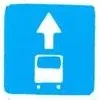
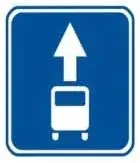
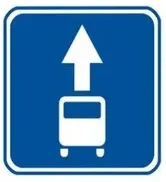
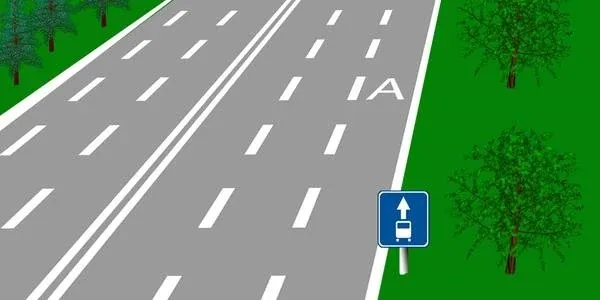
Sign 5.14 “Lane for public-use transport vehicles” acts on a lane of the road you are on.
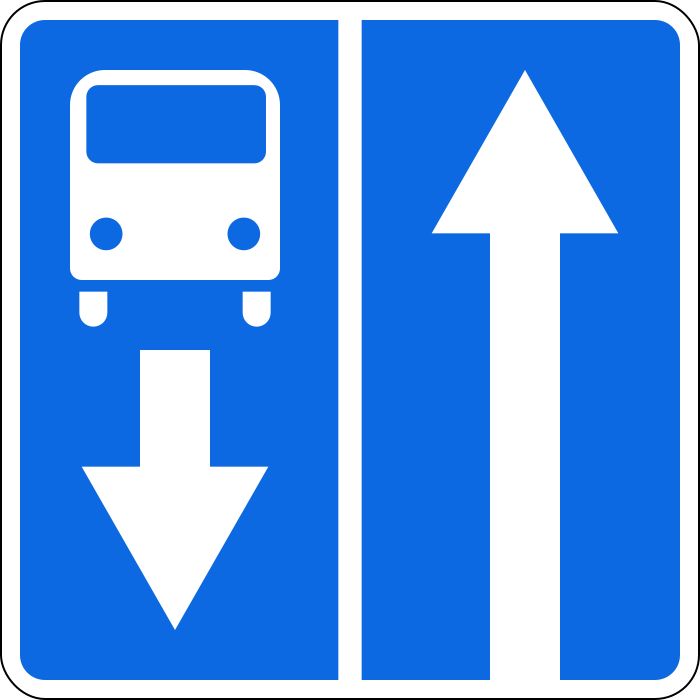
Sign 5.11.1: the left edge lane is for public-use vehicles running against the flow of traffic.
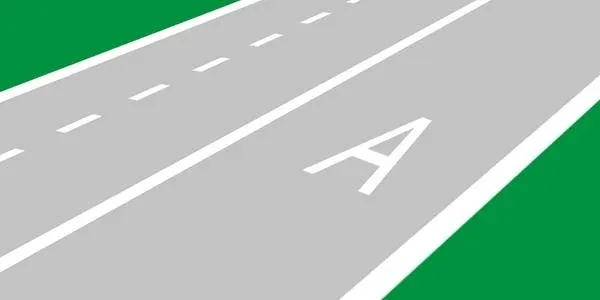
The third is the large letter A painted on the lane, marking 1.23.
Only public-use vehicles may travel in this lane. That means trolleybuses and public-use buses, not every bus. Point 124 prohibits the movement and stopping of other vehicles there.
When may I enter that lane?
Section titled “When may I enter that lane?”Look at the line that separates it from the rest of the carriageway.
| Line | Driving along the lane | Entering to turn off the road | Entering to set down or pick up passengers |
|---|---|---|---|
| Solid | No | No | No |
| Broken | No | Yes, giving way to public-use vehicles | Yes, at the right edge, without obstructing them |
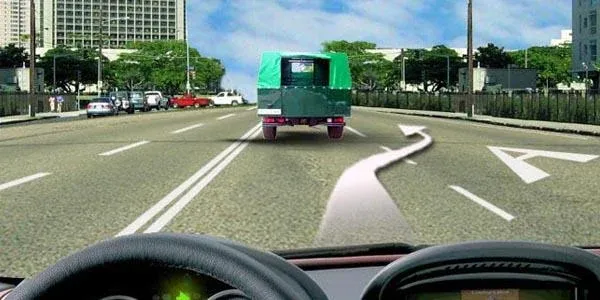
The line is broken, so you may follow the arrow to let passengers off. You may not do it to overtake the truck.
Sign 5.11.1 works the same way. If its lane is separated by a broken marking, you may cross it to turn off the road, for example into a courtyard, giving way to the public-use vehicles.
Common trap: Read the verb. A tourist bus may enter lane A over a broken line to turn or to let passengers off, but it may not travel along it.
Where may a bus stop?
Section titled “Where may a bus stop?”Public-use vehicles may stop only at their stopping points, except in a forced stop (point 85). A route bus gets no right to halt wherever the driver chooses, even to pick up someone waiting.
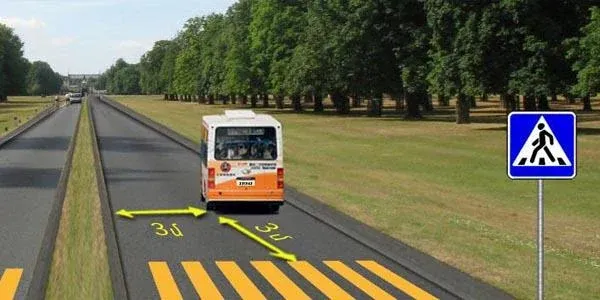
This is not a stopping point, so a bus on a scheduled route may not stop here for passengers.
Must I let a bus pull out?
Section titled “Must I let a bus pull out?”Inside built-up areas, yes. Point 125 makes you give way to trolleybuses and buses starting off from equipped and marked stopping points.
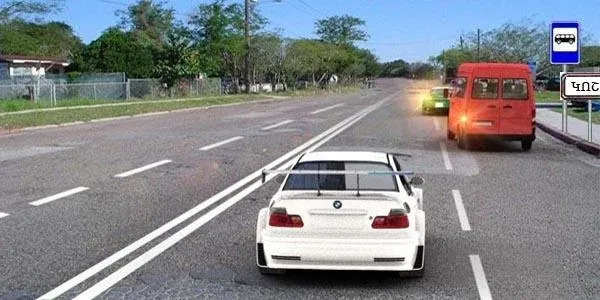
The white car must give way, even though the bus is moving into its lane.
The bus driver has a duty too: move off only after making sure you are giving way. An indicator is what the driver must use. A sound signal isn’t required.
Common trap: This priority exists only in built-up areas. On a road with the blue town sign 5.25, the rules for built-up areas don’t apply, so the bus leaving the stop must give way to you.
Who goes first when a tram crosses the road?
Section titled “Who goes first when a tram crosses the road?”Outside intersections, where tram tracks cross the carriageway, the tram has priority over non-rail vehicles (point 123). The only exception is a tram leaving a depot. Going straight ahead gives you no advantage.
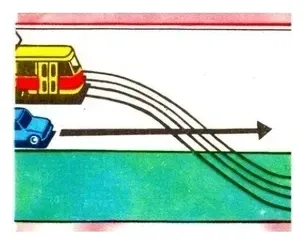
The tracks cross the car’s path and the tram is not leaving a depot, so the car gives way.
Try it yourself
Section titled “Try it yourself”You are driving the bus on an established route. The tram tracks curve across the road ahead.
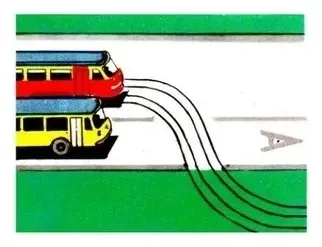
Must you give way? Yes. Being on a route gives a bus no priority over a tram here.
The bus is moving left out of its lane, and the red car is moving right into it.
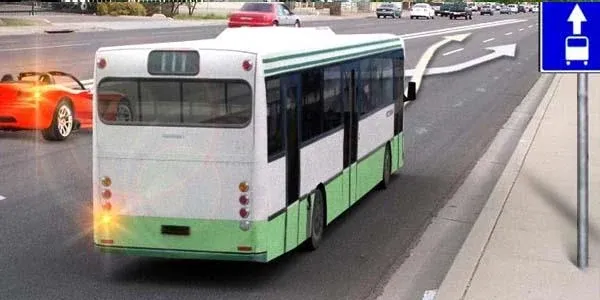
Who goes first? The bus. A driver entering the lane must give way to public-use vehicles. Also, when two vehicles change lanes at once, the one on the left gives way (point 39).
Key points
Section titled “Key points”- Public-use vehicles are route trams, trolleybuses and buses. Taxis and tourist buses aren’t.
- Solid line: stay out of the lane. Broken line: enter only to turn or for passengers, never to travel.
- Public-use vehicles stop only at their stopping points, except in a forced stop.
- In built-up areas, give way to buses and trolleybuses leaving a marked stop.
- Outside built-up areas, that priority doesn’t exist.
- Outside intersections, a tram crossing the road goes first, unless it is leaving a depot.
Practice questions
Section titled “Practice questions”Question 1. Is it permitted to enter the lane marked by this sign when making a right turn?
- It is permitted.
- It is prohibited.
- It is permitted if that lane is not separated from the rest of the carriageway by a solid marking line.
Show answer
Correct: 3. It is permitted if that lane is not separated from the rest of the carriageway by a solid marking line.
The picture shows sign 5.14, “Lane for public transport vehicles”. Under point 124 of the Rules, the movement and stopping of other vehicles in that lane are prohibited; however, if the lane is separated from the rest of the carriageway by a broken marking line, entering it is permitted in order to turn off that road (and also to set down and pick up passengers), giving way to public transport vehicles. The answer “It is permitted” is wrong because it ignores the case of a solid line, and “It is prohibited” is wrong because point 124 expressly permits entering a lane separated by a broken line in order to turn. The correct answer is therefore: it is permitted, if the lane is not separated by a solid marking line.
Question 36. Is it permitted to stop on the zone marked by this sign in order to pick up passengers?
- It is permitted, if that zone is near the right edge of the carriageway and is not separated from the rest of the carriageway by a solid marking line.
- It is prohibited.
- It is permitted.
Show answer
Correct: 1. It is permitted, if that zone is near the right edge of the carriageway and is not separated from the rest of the carriageway by a solid marking line.
This is sign 5.14 “Lane for route vehicles”. Under the Rules (point 124), the movement and stopping of other vehicles in that lane are prohibited; but if the lane is separated from the rest of the carriageway only by a broken — not solid — marking line, a driver entering the road may move into that lane to set down or pick up passengers at the right edge of the carriageway, provided this creates no obstruction for route vehicles. That is the marked answer. The “It is prohibited” option ignores this expressly provided exception, and the “It is permitted” option ignores its conditions (the right edge, a broken marking line, the absence of obstruction). Stopping is therefore permitted only under the stated conditions.
Question 438. Is it permitted in this case to stop in order to let a passenger off?
- It is permitted, if this does not create an obstruction to the movement of public transport vehicles.
- It is prohibited.
Show answer
Correct: 1. It is permitted, if this does not create an obstruction to the movement of public transport vehicles.
The right-hand lane is a lane for public-use vehicles - the signs and the letter A painted on it - and it is separated from the rest of the carriageway by a broken line. Under point 124 of the Rules, where such a lane is separated by a broken line it is permitted to enter it in order to set down and pick up passengers at the right edge of the carriageway, provided this does not obstruct the public-use vehicles travelling in that lane. Stopping to let a passenger off is therefore permitted on that condition. “It is prohibited.” is wrong because point 124 expressly allows it - it would be prohibited only if the line were solid.
Question 452. Which vehicles are permitted to travel in the right lane of the carriageway?
- All mechanical vehicles.
- Public transport vehicles and taxis.
- Only bicycles.
- Only public transport vehicles.
Show answer
Correct: 4. Only public transport vehicles.
The right-hand lane is marked with the letter A - marking 1.23 - which under the Rules indicates the special lane set aside for public-use transport vehicles. Here it is separated from the rest of the carriageway by a SOLID line, and under point 124 the movement of other vehicles in such a lane is prohibited. Travel in the right lane is therefore permitted only to public-use transport vehicles. “All mechanical vehicles.”, “Public transport vehicles and taxis.” and “Only bicycles.” are wrong, because the lane is reserved for public-use transport and the solid line shuts everyone else out of it.
Question 461. Is the driver of a bus travelling on a tourist route allowed, given this marking, to enter the lane marked “A”?
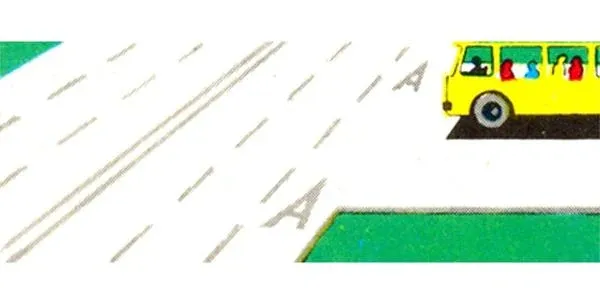
- It is allowed.
- It is prohibited.
Show answer
Correct: 1. It is allowed.
Here the public-transport lane lettered A is separated from the rest of the carriageway by a BROKEN line. Under point 124 of the Rules, where a route-vehicle lane is separated by a broken line, a driver must move across into it in order to turn, and may also enter it to set down and pick up passengers at the right edge of the carriageway, provided he does not obstruct the public-use vehicles. The driver of a bus on a tourist route - which is not itself a public-use route vehicle - is therefore allowed to enter lane A. “It is prohibited.” is wrong, because a broken separation permits entry in those cases; a solid one would not.
Question 478. Is a tourist bus allowed to travel in the lane marked “A”?
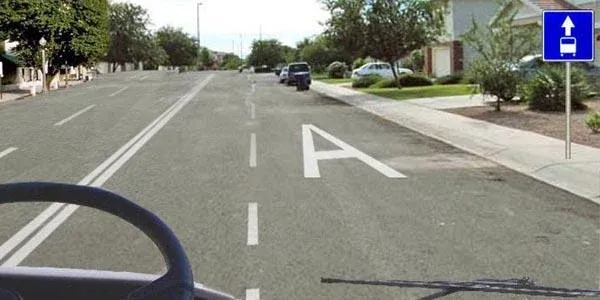
- It is prohibited.
- It is allowed.
Show answer
Correct: 1. It is prohibited.
Sign 5.14 “Lane for route transport vehicles” stands on the right and the right-hand edge lane is marked with the letter A: this lane is intended solely for route vehicles running on established routes with fixed stops. Under point 124 of the Rules, on roads marked with signs 5.14, 5.11, 5.13.1 and 5.13.2 the movement and stopping of other vehicles in that lane are prohibited. A tourist bus does not run on an established route and is not a public-use vehicle, so TRAVELLING along lane A is not permitted to it. That is a different question from briefly entering the lane to turn or to set a passenger down at the kerb, which point 124 does allow where the separating line is broken.
Question 481. Is it allowed to continue moving in the direction indicated by the arrow?
- It is prohibited.
- It is allowed in all cases.
- It is allowed in order to make a stop for the purpose of letting passengers off.
- It is allowed in order to overtake the truck.
Show answer
Correct: 3. It is allowed in order to make a stop for the purpose of letting passengers off.
Lane A - marking 1.23 - is a lane for public-use transport, and here it is separated from the rest of the carriageway by a broken line. Under point 124 of the Rules, where it is separated by a broken line it may be entered in order to set down and pick up passengers at the right edge of the carriageway, provided this does not obstruct the public-use vehicles. Movement in the direction the arrow shows is therefore permitted only in order to make a stop for letting passengers off. “It is prohibited.”, “It is allowed in all cases.” and “It is allowed in order to overtake the truck.” are wrong, because the lane may be entered only for setting down or picking up - not for ordinary travel, and not to overtake.
Question 488. Is the driver of a bus carrying out scheduled passenger transport permitted to stop at the indicated place for the purpose of picking up passengers?
- It is prohibited.
- It is permitted.
Show answer
Correct: 1. It is prohibited.
Under point 85 of the Rules, public-use transport vehicles may not stop outside the area of their stopping points, except where the stop is forced. The place indicated, beside the pedestrian crossing, is not a marked stopping point, so a bus carrying out scheduled passenger transport is not permitted to stop there to pick up passengers. “It is permitted.” is wrong because point 85 confines the stops of route vehicles to their stopping points - a restriction that applies to them and not to ordinary traffic.
Question 496. Outside the area of stopping points, are public-use vehicles permitted to stop?
- It is prohibited.
- It is permitted.
Show answer
Correct: 1. It is prohibited.
Point 85 of the Rules lets public-use vehicles stop only at the stopping points marked for them, and forbids stopping outside the area of those points except in a forced stop. That is why “It is prohibited.” is correct: passengers may board and alight only at the equipped stopping points. “It is permitted.” is wrong, since the Rules give route vehicles no right to halt wherever the driver chooses.
Question 545. Which vehicles may travel along the right edge lane of this road
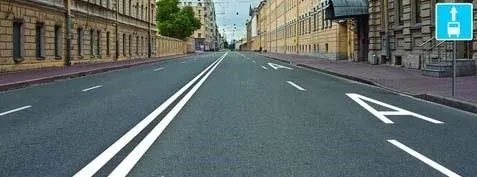
- Trolleybuses and public-use buses
- Trolleybuses and buses
- Only buses
Show answer
Correct: 1. Trolleybuses and public-use buses
The letter A painted in the right-hand lane is marking 1.23, which shows the special lane intended for public-use transport vehicles, and sign 5.14 “Lane for public-use transport vehicles” stands to the right of the road, acting on that lane. Under point 124 of the Rules the movement and stopping of other vehicles in that lane are prohibited, and Article 2 of the law “On ensuring road traffic safety” counts as a public-use vehicle one that carries passengers along routes with stopping points - a tram, a trolleybus or a bus. Trolleybuses and public-use buses may therefore travel in the right edge lane. “Trolleybuses and buses” is wrong because a bus that is not running a route with stopping points is not a public-use vehicle, and “Only buses” is wrong because a trolleybus is one too.
Question 682. Is it permitted to enter the courtyard at the indicated place?
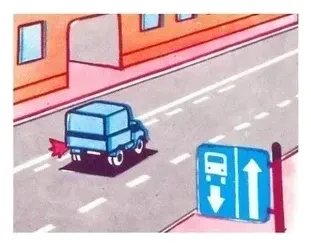
- It is permitted.
- It is prohibited.
Show answer
Correct: 1. It is permitted.
Sign 5.11.1 “Road with a lane for public-use transport vehicles” stands on the right: the left edge lane is set aside for route vehicles running AGAINST the flow, and it is separated from the rest of the carriageway by a broken marking. Under point 124 of the Traffic Rules, where that lane is separated by a broken marking it is permitted to enter it in order to turn off the road, giving way to the public-use transport vehicles. Entering the courtyard at the indicated place is therefore permitted, and “It is prohibited.” is wrong - with a broken marking point 124 expressly allows the lane to be crossed for a turn.
Question 705. Is the driver of the bus travelling on an established route obliged to give way in the indicated situation?
- He is obliged.
- He is not obliged.
- He is not obliged, since he is travelling straight.
Show answer
Correct: 1. He is obliged.
Under point 123 of the Traffic Rules, outside intersections, where tram tracks cross the carriageway, the tram has priority over non-rail vehicles - except when it is leaving a depot. In the picture the tram tracks curve across the carriageway in front of the bus and the tram is running along them rather than coming out of a depot, so the bus driver is obliged to give way. Neither travelling on an established route nor going straight ahead gives the bus any advantage: point 123 applies whatever direction it is taking, so both “He is not obliged.” answers are wrong.
Question 709. Are drivers of vehicles obliged, in built-up areas, to give way to public-use vehicles starting off from the area of equipped and marked stopping points?
- Yes.
- No.
Show answer
Correct: 1. Yes.
Under point 125 of the Road Traffic Rules, in built-up areas drivers are obliged to give way to trolleybuses and buses starting off from the area of equipped and marked stopping points. The driver of the route vehicle, in turn, may move off only after making sure that way is actually being given. This priority applies precisely within the boundaries of built-up areas, so the correct answer is “Yes.”
Question 712. Which vehicle’s driver must give way?
- The car’s driver.
- The tram’s driver.
Show answer
Correct: 1. The car’s driver.
There is no intersection here — the tram tracks curve off the carriageway to the right and cross the path of the car travelling straight ahead. Under point 123 of the Rules, outside intersections, where tram tracks cross the carriageway, the tram has priority over non-rail vehicles, except when it is leaving a depot. The tram here is running along its own tracks and is not leaving a depot, so it keeps that priority, and the one who must give way is “The car’s driver.” “The tram’s driver.” is wrong, because travelling straight ahead gives the car no priority — point 123 applies regardless of the tram’s direction of travel.
Question 717. How must the route bus driver act in the given situation?
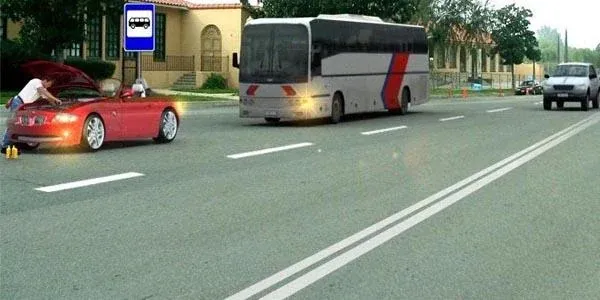
- Give way to the passenger car.
- Switch on the turn indicator, give an audible signal and start off.
- Start off, having made sure that the passenger car’s driver is giving way.
Show answer
Correct: 3. Start off, having made sure that the passenger car’s driver is giving way.
In the picture the route bus, with its left indicator on, is starting off from a marked stopping point inside a built-up area. Under point 125 of the Traffic Rules, in built-up areas drivers must give way to trolleybuses and buses starting off from equipped and marked stopping points - but the route driver may start only after satisfying himself that they ARE giving way to him. An audible signal is not required: under point 36 what must be switched on before a manoeuvre is the light indicator of the appropriate direction, so “Switch on the turn indicator, give an audible signal and start off.” is wrong, and “Give way to the passenger car.” reverses the priority point 125 gives him.
Question 718. In the given situation the white passenger car’s driver
- Must give way to the route bus, which is starting off from the indicated stopping point.
- Has the right of way, since the route bus is changing lanes by moving into the second lane.
Show answer
Correct: 1. Must give way to the route bus, which is starting off from the indicated stopping point.
Under point 125 of the Traffic Rules, in built-up areas drivers must give way to trolleybuses and buses starting off from the area of equipped and marked stopping points. In the picture the red route bus, indicator on, is starting off from a marked stopping point (sign 5.16), so the driver of the white light passenger car following behind must give way to it. The second option treats the bus as an ordinary vehicle changing lanes, but point 125 gives a route bus leaving a marked stop priority over the traffic behind it.
Question 719. Which vehicle’s driver has the right of way?
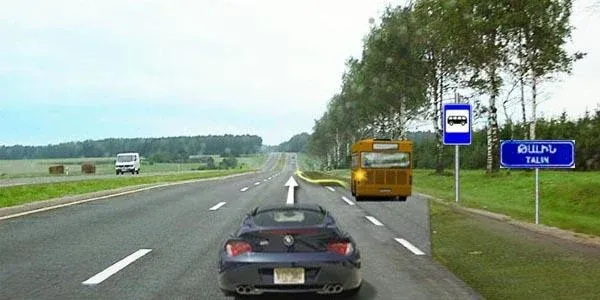
- The passenger car’s driver.
- The route bus driver.
Show answer
Correct: 1. The passenger car’s driver.
The blue sign 5.25 bearing the settlement name stands on the right, and it means that the requirements the Rules lay down for movement in built-up areas do NOT apply on this road. The duty in point 125 to give way to a route bus starting off from an equipped stopping point therefore does not arise here: it exists only within an area marked by the WHITE signs 5.23.1 and 5.23.2 “Beginning of built-up area”. So at this marked stopping point (sign 5.16) the bus driver, with his left indicator on, must give way to the light passenger car travelling on the road, and it is the car’s driver who has the right of way. “The route bus driver.” would be right only inside a built-up area established by signs 5.23.1 or 5.23.2, which is not the case here.
Question 720. Which vehicle’s driver has the right of way in the given situation?
- The bus driver.
- The passenger car’s driver.
- The passenger car’s driver has no right to move into the right lane.
Show answer
Correct: 1. The bus driver.
The right-hand lane is marked with sign 5.14 “Lane for public-use transport vehicles” and set apart by a broken marking, so under point 124 of the Traffic Rules a driver entering that lane must give way to the public-use transport vehicles. On top of that, under point 39, where two vehicles change lanes simultaneously the one on the left gives way, so the light passenger car moving into the right lane must let the bus - indicator on, moving into the left lane - go first. The right of way is therefore the bus driver’s. The third option is wrong because a broken marking does allow the passenger car to enter that lane, for instance to turn off the road, provided it gives way to the public-use vehicles.