Traffic Officers
An officer’s signal outranks lights and signs, so a wrong reading can send you straight into crossing traffic. There are only three signals to learn, and each one comes down to a single question: which side of the officer’s body are you facing?
Does the officer really outrank lights and signs?
Section titled “Does the officer really outrank lights and signs?”Yes. Under point 20, you must obey the officer’s signals even when they contradict the traffic lights or the requirements of signs and markings. He can see what is happening at the intersection right now, and a sign can’t.
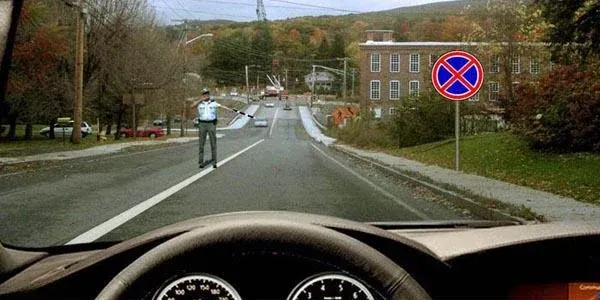
The officer directs you to stop here. You must stop, even though sign 3.27 “No stopping” is in place.
The practice questions sometimes call him the traffic controller. It is the same person.
Which signals do I need to know?
Section titled “Which signals do I need to know?”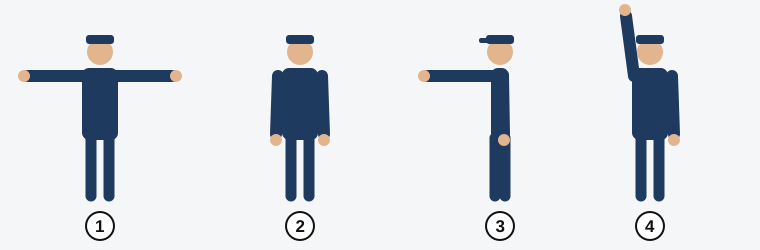
1: arms out to the sides. 2: arms lowered. 3: right arm forward. 4: arm raised. Positions 1 and 2 mean exactly the same.
For each signal, find out which part of the officer faces you: his chest, his back, his left side or his right side. The tables below use “non-rail vehicles” for everything except trams.
Arms out or lowered
Section titled “Arms out or lowered”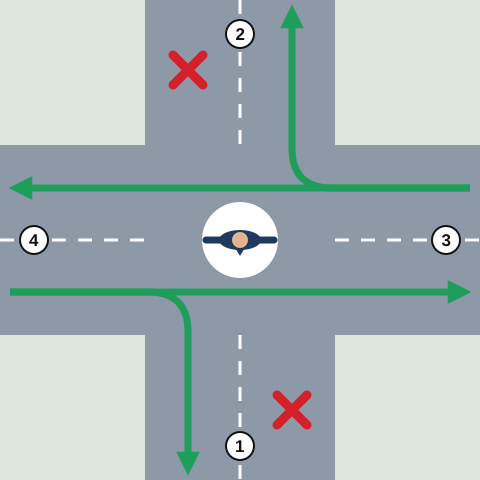
Seen from above. 1: his chest. 2: his back. 3: his left side. 4: his right side. Green arrows show what is permitted, and red crosses show where nobody may move.
| You come from his | Non-rail vehicles | Trams |
|---|---|---|
| Left or right side | Straight and right | Straight |
| Chest or back | No movement | No movement |
Think of the officer as a wall that runs along his arms. You can drive along the wall, but not through it. And it doesn’t matter whether his arms are out or down: the wall stands in the same place.
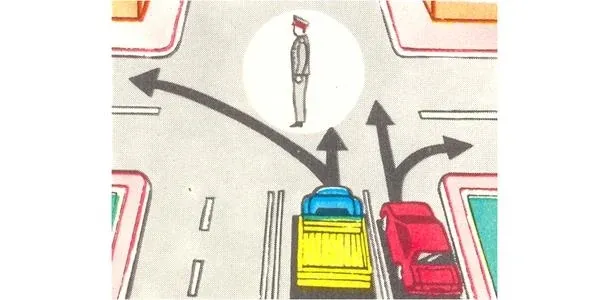
You approach from his side. The red car may go straight or right. The truck may go straight, but not left.
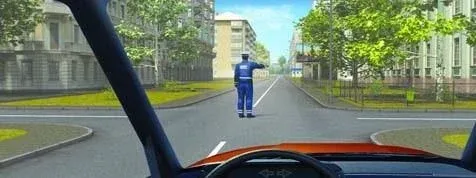
His back faces you, so you may not move in any direction.
Common trap: You can’t enter the intersection and wait there for a left turn, or turn left after giving way to oncoming traffic. Stop at the “Stop line” and wait for a signal that permits it (point 18).
Right arm forward
Section titled “Right arm forward”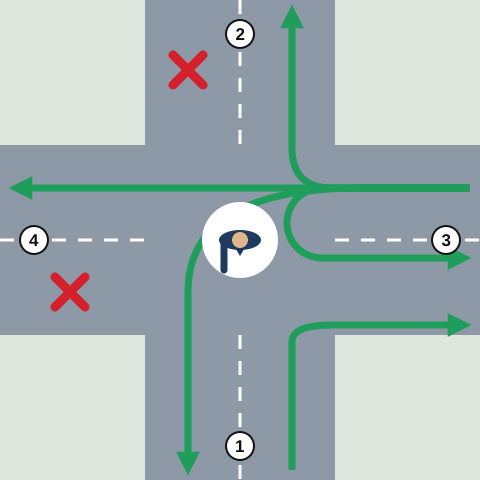
Same numbers: 1 is his chest, 2 his back, 3 his left side, 4 his right side.
| You come from his | Non-rail vehicles | Trams |
|---|---|---|
| Left side | All directions: straight, right, left, U-turn | Left only |
| Chest | Right only | Right only |
| Right side or back | No movement | No movement |
Walk around him in your mind. His left side is the open side, so everything is allowed there. Facing his chest, you can only slip away to the right. Behind him or at his right, you wait.
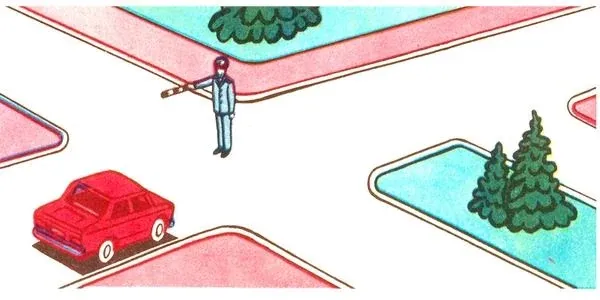
The red car faces his chest, so it may only turn right, by the first opening.
Trams follow this signal strictly. A tram at his left side may only go left, so a tram whose rails run straight ahead has to wait, while the cars beside it drive on.
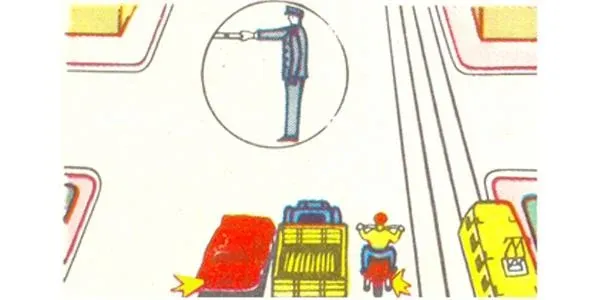
The car, truck and motorcycle may all move. The tram may not.
Common trap: The tram’s usual priority doesn’t help a tram that the officer has stopped. If you turn right from his chest side and the tram comes from his back, you go first.
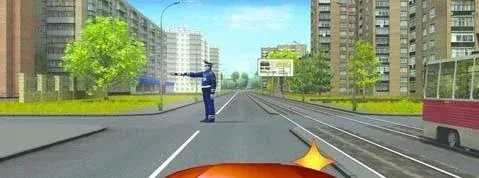
Your right turn is permitted. The tram is stopped by the signal.
Who else do I watch for when turning?
Section titled “Who else do I watch for when turning?”Turning from a permitted side, you still must not obstruct pedestrians crossing the road you enter (point 87). With the right arm forward, pedestrians may cross behind the officer’s back.
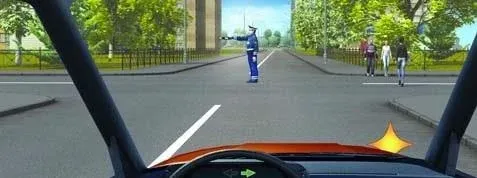
You come from his left, so a right turn is allowed, but only without obstructing the pedestrian.
A right turn from his chest side doesn’t cross the path of a car coming from his left. You owe that car nothing, and you go first.
What if he raises his arm?
Section titled “What if he raises his arm?”It works like the yellow light. Stop at the places point 18 gives: the stop line first, then the edge of the crossing carriageway. If you can’t stop without harsh braking, you may continue on your way (point 19).
What does his whistle mean?
Section titled “What does his whistle mean?”It draws your attention to him, and that is all (point 17). It isn’t a demand to stop. The demands come from his arms.
Extra: What to do if you can't read the signal
Not from the question bank.
If you are unsure what an officer wants, slow down early and keep away from the intersection until you are sure. Try to catch his eye. A pause is safer than a guess, and he can repeat the signal or point at you.
Try it yourself
Section titled “Try it yourself”Five vehicles, one officer. His arms are out. The green car faces his back, and the white car faces his chest. The blue car is on his side, signalling left. The red and yellow cars are on his sides, going straight or right.
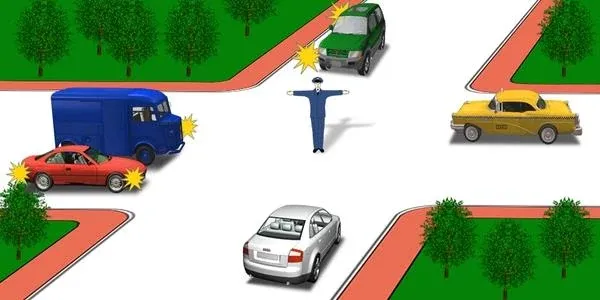
Who may not move? The blue, green and white cars. Back and chest are closed, and his sides allow only straight and right, so the blue car can’t turn left.
The officer’s right arm is forward. A motorcycle faces his chest, a car is at his left, a truck is at his right and a bus is behind him.
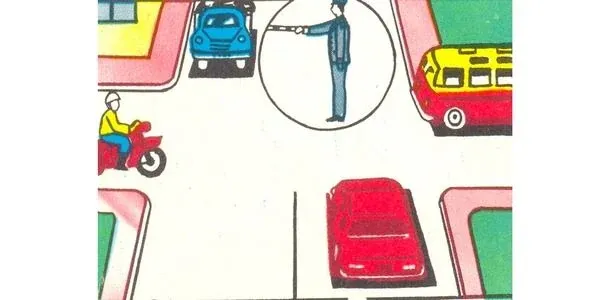
Who may go straight? Only the car. The motorcycle may only turn right, and the truck and bus must wait.
A red light and an officer together. His right arm is forward, and both vehicles come from his left. The yellow bus turns left and the blue car turns right.
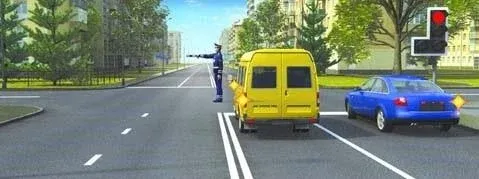
Who may continue? Both drivers. The officer outranks the light (point 20), and his left side is open in all directions.
Key points
Section titled “Key points”- The officer’s signals beat lights, signs and markings (point 20).
- Arms out or lowered mean the same: sides go straight or right, trams straight, chest and back stop.
- Right arm forward: left side all directions, chest right only, right side and back stop.
- A tram goes only left from his left side when his right arm is forward.
- From his chest, “right” means the first opening only. When you turn, don’t obstruct pedestrians.
- A raised arm works like yellow. You may continue only if you can’t stop without harsh braking.
- The whistle only draws attention.
Practice questions
Section titled “Practice questions”Question 75. In this case, is the driver obliged to stop at the place indicated by the traffic controller?
- He is not obliged, since the sign prohibits stopping.
- He is obliged.
Show answer
Correct: 2. He is obliged.
Under point 20 of the Rules, drivers and pedestrians must obey the orders and signals of a traffic controller EVEN where these contradict the traffic lights or the requirements of road signs and markings. The controller is directing the driver to stop, so although sign 3.27 “No stopping” is in place, the controller’s requirement takes precedence and the driver is obliged to stop where indicated. “He is not obliged, since the sign prohibits stopping.” is wrong for precisely that reason: point 20 puts the controller’s signals above road signs, sign 3.27 included.
Question 208. Traffic is prohibited for:
- The red and white cars.
- The blue, green and white cars.
- The white, blue and yellow cars.
Show answer
Correct: 2. The blue, green and white cars.
The controller stands with his arms extended to the sides. Under sub-point 2 of point 16 of the Traffic Rules, “the arms are extended to the sides or lowered”: “a. from the left and right sides, non-rail vehicles are permitted to proceed straight ahead and to the right, and trams straight ahead; pedestrians are permitted to cross the carriageway on the controller’s right and left sides; b. from the back and from the chest, the movement of all vehicles and of pedestrians is prohibited.” The green car approaches from the controller’s back side and the white car from his chest side, so traffic is prohibited for both under sub-point 16(b). The blue car is on the controller’s flank side and under ordinary conditions could proceed straight ahead or to the right; its turn indicator, however, shows an attempt to turn left, which is not among the directions permitted by sub-point 16(a) (“straight ahead and to the right”) — so traffic is prohibited for the blue car as well. The red and yellow cars are on the flank sides and are travelling in permitted directions (straight ahead or to the right), so they may proceed. Traffic is therefore prohibited for “the blue, green and white cars”. “The red and white cars” is wrong, because traffic is prohibited for the green car too (the back side), while the red car may proceed straight ahead or to the right from the flank under sub-point 16(a); “the white, blue and yellow cars” is wrong, because the yellow car is on the controller’s right flank side and is travelling in a direction permitted by sub-point 16(a), and the second prohibited car is the green one — not the yellow — from the controller’s back side.
Question 209. Which of the drivers has the right to travel straight ahead?
- The bus and motorcycle drivers.
- The passenger car and truck drivers.
- The passenger car driver.
Show answer
Correct: 3. The passenger car driver.
The traffic controller’s right arm is extended forward. Under sub-point 3 of point 16 of the Rules, with this signal non-rail vehicles approaching from the controller’s LEFT side may go in all directions, those approaching his CHEST may go only to the right, and those approaching from behind him or from his RIGHT side may not move at all. The light passenger car is on the controller’s left, so its driver alone has the right to travel straight ahead. The motorcycle faces his chest and is limited to a right turn, the truck is on his right side and the bus is behind him, so both are stopped - which is why every option including those drivers is wrong.
Question 211. If the traffic controller’s right arm is extended forward, then movement of non-rail vehicles is permitted:
- From the left side — to the left and in the opposite direction.
- From the right side — only to the right.
- From the left side — in all directions.
- From behind — only to the right.
Show answer
Correct: 3. From the left side — in all directions.
Under point 16 of the Traffic Rules, when the traffic controller’s right arm is extended forward, non-rail vehicles approaching from his left side may proceed in all directions; from the chest side only a right turn is allowed, and from the right side and from behind movement is prohibited. That makes “From the left side — in all directions.” correct. “From the left side — to the left and in the opposite direction.” narrows a permission that is in fact complete, while “From the right side — only to the right.” and “From behind — only to the right.” both allow movement from sides on which this signal permits none at all.
Question 213. In which answer are the vehicles that are permitted to travel correctly indicated?
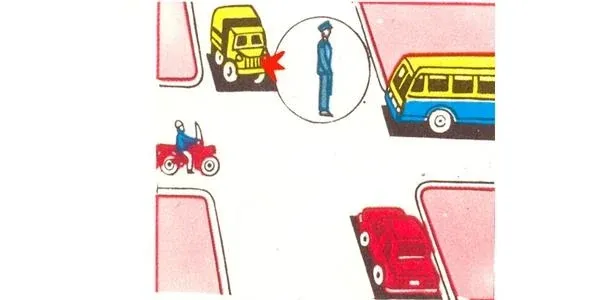
- The motorcycle.
- The truck.
- The bus.
- The passenger car.
- The passenger car and the truck.
Show answer
Correct: 4. The passenger car.
The traffic controller is standing with his arms lowered, turned towards the bus. Under the Rules, when the controller’s arms are lowered or extended to the sides, movement of all vehicles from the side of his chest and his back is prohibited, while from his left and right sides non-rail vehicles may travel straight ahead and to the right. The bus is on the side of his chest and the motorcycle on the side of his back, so neither may move. The truck and the passenger car are on his sides, but the truck’s lit indicator shows a left turn, which this signal does not permit from a side position. Movement is therefore permitted only to the passenger car, and “The passenger car and the truck.” is wrong for that reason.
Question 215. This signal of the traffic controller means that driving is permitted to
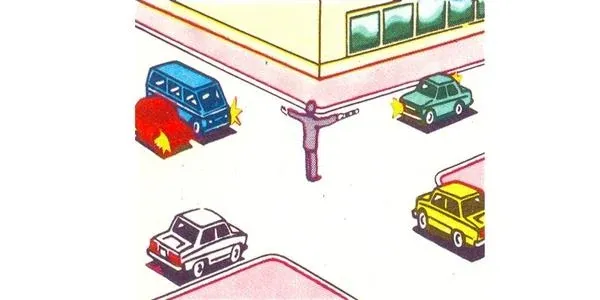
- The blue and green cars. It is prohibited to the red, the yellow and the white.
- The blue, red and green cars. It is prohibited to the yellow and the white.
Show answer
Correct: 2. The blue, red and green cars. It is prohibited to the yellow and the white.
The traffic controller’s arms are extended to the sides. Under the Rules, with this signal non-rail vehicles approaching from his left and right sides may travel straight ahead and to the right, while from the side of his chest and his back the movement of all vehicles is prohibited. The blue, red and green cars are on the controller’s sides, so they may move, and the yellow and the white cars are facing his chest and must stop.
Question 216. Which vehicles may make a right turn.
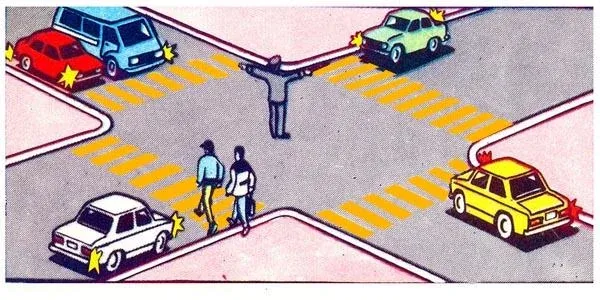
- Only the red car.
- All vehicles.
- The red and green cars.
Show answer
Correct: 3. The red and green cars.
The traffic controller stands facing the green car, with his right arm extended forward towards it and his left arm raised out to the side. The green car is on his chest side, and from there only a right turn is allowed, so the green car may turn right. The red car and the blue minibus are on the side his raised left arm covers, and from there a vehicle may go straight ahead or turn right, nothing more. The red car’s right turn is therefore allowed, while the blue minibus has its indicator on for a left turn, which that arm position does not permit. The white car is behind the controller’s back and the yellow car is on his right side, and neither may move at all. So the right turn is open to the red and green cars, and “Only the red car.” and “All vehicles.” are wrong.
Question 217. Driving is permitted
- Straight.
- To the right, by the first opening.
- To the right, by the second opening.
- To the right, by the first and second openings.
Show answer
Correct: 2. To the right, by the first opening.
The controller’s right arm is extended forward and the car is on his chest side. Under point 16 of the Traffic Rules, with this signal vehicles approaching from the chest side may move only to the right. Traffic is therefore allowed to the right, by the first (nearest) opening. “Straight” is wrong, because straight movement from the chest side is prohibited; “to the right, by the second opening” and “by the first and second openings” are wrong, because only the immediate right turn is permitted, not driving across the intersection.
Question 218. Driving is permitted
- To the right, by the first opening.
- Straight and to the right, by the first opening.
Show answer
Correct: 1. To the right, by the first opening.
The controller’s right arm is extended forward and the car is on his chest side. Under point 16 of the Rules, with this signal traffic from the chest side is permitted only to the right. Traffic is therefore permitted to the right, by the first (nearest) opening. “Straight and to the right, by the first opening” is wrong, because straight movement from the chest side is prohibited — only the right turn is permitted.
Question 220. If the traffic controller’s arms are extended to the sides or lowered, then the driving of non-rail vehicles is permitted
- From the back and chest sides, only to the right.
- From the left and right sides, straight and to the right.
- From the left and right sides, only straight.
Show answer
Correct: 2. From the left and right sides, straight and to the right.
Under point 16 of the Traffic Rules, when the traffic controller’s arms are extended to the sides or lowered, non-rail vehicles approaching from his left and right sides may go straight ahead and turn right, while from the chest and back sides no vehicle may move at all. That makes “From the left and right sides, straight and to the right.” correct. “From the back and chest sides, only to the right.” allows movement from the two sides that are closed, and “From the left and right sides, only straight.” leaves out the right turn that this same signal permits.
Question 222. Which vehicles are permitted to drive.
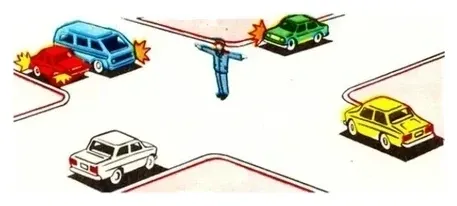
- The yellow and red cars.
- The green, red and white cars.
- The white and green cars.
Show answer
Correct: 1. The yellow and red cars.
The traffic controller’s arms are extended to the sides and he is turned towards the white car. Under the Rules the movement of all vehicles from the side of his chest and his back is prohibited, so the white and the green cars must stop. From his left and right sides non-rail vehicles may travel straight ahead and to the right, and those sides hold the red car together with the minibus, and the yellow car. The minibus’s lit indicator shows a left turn, which this signal does not permit, so movement is permitted to the yellow and red cars. “The green, red and white cars.” and “The white and green cars.” are wrong because both name cars standing at the controller’s chest or back.
Question 225. In which picture does the driver make the turn correctly.
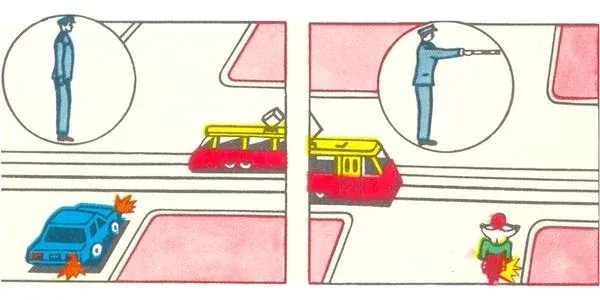
- In the left picture.
- In the right picture.
Show answer
Correct: 1. In the left picture.
A traffic controller’s LOWERED arms mean the same as arms extended to the sides: under point 16 of the Traffic Rules, non-rail vehicles approaching from his left and right sides may travel straight ahead and to the right. In the left picture the blue car approaches from the controller’s side with its right indicator on, so its right turn is correct. In the right picture the controller’s right arm is extended forward, and under the same point 16 all vehicles approaching from behind him or from his right side are stopped - the motorcyclist is coming from exactly that right side, so his turn is prohibited.
Question 228. If the traffic controller’s right arm is extended forward, then from his left side the traffic of non-rail vehicles is permitted
- In all directions.
- Only to the left.
Show answer
Correct: 1. In all directions.
Under point 16 of the Traffic Rules, when the traffic controller’s right arm is extended forward, non-rail vehicles approaching from his left side are permitted to move in all directions — straight ahead, to the right, to the left and in a U-turn. From the chest side only a right turn is allowed, and from the right side and from behind movement is prohibited. So “In all directions.” is correct, while “Only to the left.” restricts a permission that point 16 grants to the left side in full.
Question 230. Driving is permitted
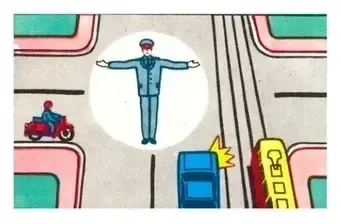
- To all vehicles.
- To the motorcycle.
- To the car and the motorcycle.
Show answer
Correct: 2. To the motorcycle.
The controller’s arms are extended to the sides. Under sub-point 2 of point 16 of the Traffic Rules, with this signal non-rail vehicles from the left and right sides are permitted to proceed straight ahead and to the right, while from the back and from the chest the movement of all vehicles is prohibited. The motorcycle is on the controller’s flank side, so it is permitted to proceed, while the car and the other vehicles are on the controller’s chest side, so their movement is prohibited. “To all vehicles” and “to the car and the motorcycle” are wrong, because vehicles on the chest side may not move.
Question 231. If the traffic controller’s arms are extended to the sides or lowered, then from his left and right sides the traffic of non-rail vehicles is permitted
- Straight and to the right.
- Only straight.
Show answer
Correct: 1. Straight and to the right.
Under point 16 of the Rules, when the traffic controller’s arms are extended to the sides or lowered, non-rail vehicles on his left and right sides are permitted to travel “Straight and to the right”, while movement from his chest and back sides is prohibited. That is exactly why the correct answer is “Straight and to the right”. The option “Only straight” is wrong, because the same signal also permits a right turn from those sides.
Question 233. Driving is prohibited to
- The green and white cars.
- The white, blue and green cars.
- The white and yellow cars.
- The green and yellow cars.
Show answer
Correct: 2. The white, blue and green cars.
The traffic controller stands with arms extended to the sides. Under point 16, sub-point 2 of the Road Traffic Rules, from the left and right sides non-rail vehicles are allowed to travel straight ahead and to the right, while from the back and chest sides all vehicles are prohibited from moving. The green car approaches from the controller’s back side and the white one from his chest side, so movement is prohibited for both; the blue car is on the side, but its indicator shows a left turn, which paragraph “a” of point 16, sub-point 2 does not permit, so it is prohibited for it as well. The red and yellow cars are on the sides and travel in permitted directions, so the options “Green and white”, “White and yellow” and “Green and yellow” are wrong — they leave out the blue car and wrongly prohibit the yellow one.
Question 237. In which answer are the vehicles whose movement is permitted correctly indicated?
- The cars and the motorcycle.
- All vehicles.
- The cars and the tram.
Show answer
Correct: 1. The cars and the motorcycle.
The traffic controller’s right arm is extended forward, and the car, the truck and the motorcyclist all approach from his LEFT side. Under point 16 of the Traffic Rules, non-rail vehicles coming from the controller’s left may travel in all directions, so the red car with its left indicator on, the truck going straight and the motorcyclist with his right indicator on may all move. With this signal a TRAM is permitted to move only from the controller’s left side and only to the LEFT, whereas this tram’s rails run straight ahead, so it may not move. “All vehicles.” and “The cars and the tram.” are wrong for that reason.
Question 238. If the traffic controller’s right arm is extended forward, then from his left side the movement of non-rail vehicles is permitted:
- Straight and to the left.
- In all directions.
Show answer
Correct: 2. In all directions.
Under point 16 of the Rules, when the traffic controller’s right arm is extended forward, non-rail vehicles on his left side are permitted to travel “In all directions”. With the same signal, only a right turn is permitted from his chest side, and movement from his back and right sides is prohibited. The option “Straight and to the left” is wrong, because from the left side a right turn and a U-turn are permitted as well, not only straight and left.
Question 239. Movement is prohibited:
- To the blue-yellow car — to the left.
- To the blue-yellow car — straight, to the red car — straight and to the right.
- To the red car.
Show answer
Correct: 1. To the blue-yellow car — to the left.
The cars approach the controller from his side while his arms are lowered. Under point 16 of the RA Road Traffic Rules, with this signal non-rail vehicles from the left and right sides may travel only straight ahead and to the right. The blue-yellow car is therefore prohibited precisely from turning left, while its straight-ahead movement and the red car’s straight and right-hand movement are permitted. The answer “To the blue-yellow car — straight, to the red car — straight and to the right” is wrong, because those directions are permitted, and the answer “To the red car” is wrong, because the directions shown for the red car are permitted.
Question 242. In which picture does the driver perform the turn correctly?
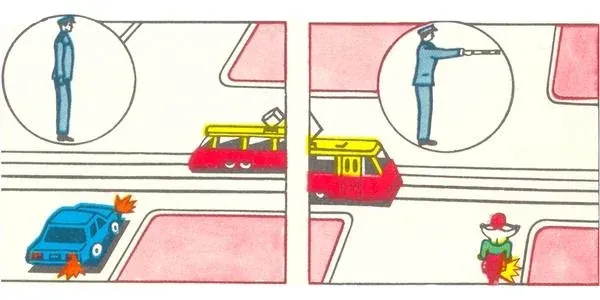
- In the left picture.
- In the right picture.
- In both pictures.
Show answer
Correct: 1. In the left picture.
A traffic controller’s LOWERED arms mean the same as arms extended to the sides: under point 16 of the Traffic Rules, non-rail vehicles approaching from his left and right sides may travel straight ahead and to the right. In the left picture the blue car approaches from the controller’s side with its right indicator on, so its right turn is correct. In the right picture the controller’s right arm is extended forward, and under the same point 16 all vehicles approaching from behind him or from his right side are stopped; the motorcyclist comes from exactly that right side, so his turn is prohibited - which also makes “In both pictures.” wrong.
Question 246. Movement is permitted:
- To the blue-yellow car — straight, to the red one — to the right.
- To the red car — straight and to the right, to the blue-yellow one — straight.
- To both cars — only straight.
Show answer
Correct: 2. To the red car — straight and to the right, to the blue-yellow one — straight.
The cars approach the controller from his side while his arms are lowered. Under point 16 of the RA Road Traffic Rules, with this signal non-rail vehicles from the left and right sides may travel only straight ahead and to the right. Both directions shown for the red car — straight and to the right — are therefore permitted, and for the blue-yellow car only the straight direction, but not the left turn. The answer “To the blue-yellow car — straight, to the red one — to the right” is wrong, because it denies the red car the permitted straight-ahead movement, and “To both cars — only straight” is wrong, because the red car is also permitted to turn right.
Question 247. Movement is permitted:
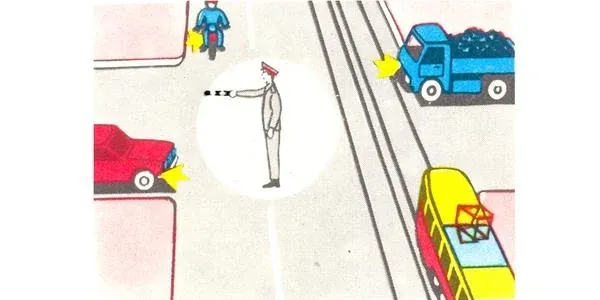
- To the red car.
- To the motorcycle.
- To the tram and the red car.
- To the tram.
- To the blue car.
Show answer
Correct: 1. To the red car.
The traffic controller’s right arm is extended forward and the red car approaches his CHEST. Under paragraph “b” of sub-point 3 of point 16 of the Traffic Rules, with this signal all vehicles facing his chest may move to the right, so the red car may continue by turning right. The tram is on the controller’s left side, where paragraph “a” permits a tram to go only to the LEFT, but the rails here run straight on and form no left turn, so the tram cannot move. The motorcycle, on his right side, and the blue truck, behind him, may not move at all under paragraph “c”.
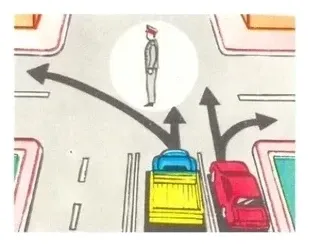
Question 249. In the given situation, which vehicles have the right to continue moving?
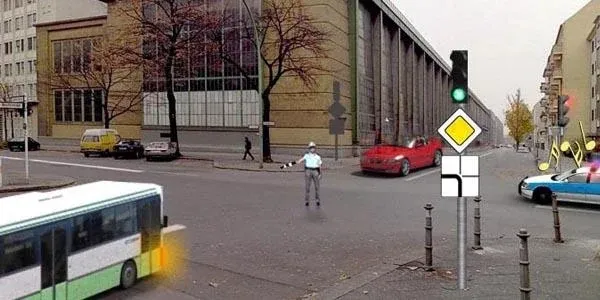
- The passenger car — straight, the patrol car — in all directions, the bus — only to the right.
- Only the patrol car — in all directions.
- The patrol car — in all directions, the bus — only to the right.
Show answer
Correct: 3. The patrol car — in all directions, the bus — only to the right.
The traffic controller stands with his right arm extended forward: his chest faces the bus, the patrol car approaches from his left side, and the red light passenger car is behind him. Under point 16 of the RA Traffic Rules, with this signal non-rail vehicles coming from the controller’s left may travel in all directions - that is the patrol car - those facing his chest may go only to the right - the bus, with its right indicator on - and movement from behind him, where the passenger car is, is prohibited. Although working traffic lights and priority signs can be seen at the intersection, point 20 obliges drivers to obey the controller’s signals even where these contradict them. The option reading “The passenger car - straight, the patrol car - in all directions, the bus - only to the right.” wrongly lets the passenger car go straight, and “Only the patrol car - in all directions.” wrongly denies the bus the right turn it is allowed.
Question 253. The right to continue movement along the indicated trajectories is held by:
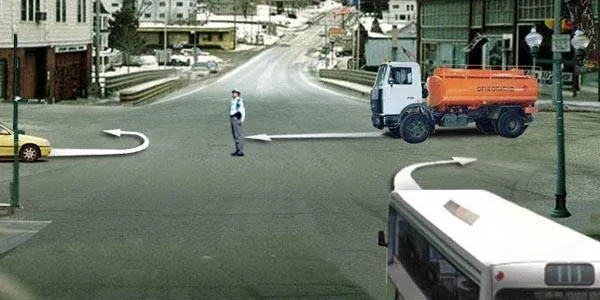
- The driver of the truck.
- The drivers of the bus and the trucks.
- The drivers of the passenger car and the bus.
- The driver of the bus.
Show answer
Correct: 4. The driver of the bus.
The controller’s arms are lowered. Under point 16 of the Traffic Rules, with the arms extended to the sides or lowered, non-rail vehicles coming from his left and right sides may travel straight ahead and to the right, while movement from the chest side and from behind his back is prohibited. The yellow car making the U-turn is on the controller’s chest side and the tanker truck is behind his back, so neither of them may continue along the trajectory shown. The bus approaches from his side and is turning right, which is exactly what this signal permits. “The driver of the truck.”, “The drivers of the bus and the trucks.” and “The drivers of the passenger car and the bus.” are therefore wrong.
Question 264. Is a right turn permitted in this situation
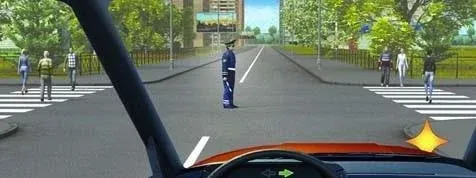
- Yes — without obstructing pedestrians
- No
Show answer
Correct: 1. Yes — without obstructing pedestrians
With the traffic controller’s arms lowered, point 16 of the Rules permits non-rail vehicles approaching from his side to travel straight ahead and to the right, so the right turn is allowed here. But under point 87 a driver making a turn must give way to the pedestrians crossing the carriageway. The right turn is therefore permitted, but only without obstructing the pedestrians. “No” is wrong because the turn itself is allowed - the only condition attached to it is yielding to the pedestrians.
Question 273. Is a right turn permitted in this situation
- No
- Yes — without obstructing the pedestrian
Show answer
Correct: 2. Yes — without obstructing the pedestrian
The controller’s right arm is extended forward and the car approaches from his left side, so under point 16 of the Traffic Rules non-rail vehicles may proceed in all directions, including to the right. The same item allows pedestrians to cross the carriageway behind the controller’s back — exactly where they are crossing in the picture — and under point 87 of the Traffic Rules a driver making a turn must not obstruct pedestrians crossing the carriageway while leaving the intersection. A right turn is therefore permitted, without obstructing the pedestrian, and the answer “No” is wrong.
Question 277. When making a right turn
- We are obliged to give way to the tram driver
- We will cross the intersection first
Show answer
Correct: 2. We will cross the intersection first
The traffic controller’s right arm is extended forward and you are on the side of his chest. Under the Rules, with this signal all vehicles on the side of his chest may travel only to the right - and a right turn is exactly what you are making, so your movement is permitted. The tram is coming from the opposite direction, that is from the side of the controller’s back, where the movement of all vehicles is prohibited; a tram’s usual advantage therefore does not arise here, and you will cross the intersection first.
Question 281. When making a left turn in this situation, one must
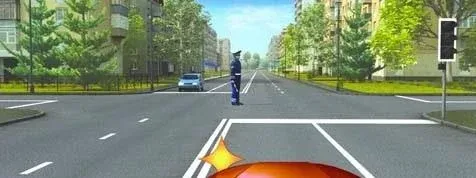
- Enter the intersection and wait for the traffic controller’s signal permitting a left turn
- Stop before the “Stop line” marking and wait for the traffic controller’s signal permitting a left turn
- Drive out into the intersection and, after giving way to the oncoming driver, cross the intersection.
Show answer
Correct: 2. Stop before the “Stop line” marking and wait for the traffic controller’s signal permitting a left turn
The traffic controller is standing side-on to you with his arms lowered, and under point 16 of the Traffic Rules non-rail vehicles approaching from his sides may then travel only straight ahead and to the right - a left turn is prohibited. Under point 18, where the controller’s signal is a prohibiting one the driver must stop before the stop-line marking. You must therefore stop before the “Stop line” and wait for a signal that permits the left turn. Driving into the intersection to wait there, or to cross after giving way to the oncoming driver, would breach both point 16 and point 18 - you may not enter on a signal that forbids your direction.
Question 284. When making a right turn
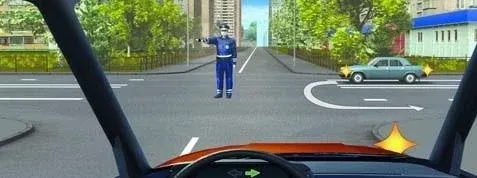
- You must give way to the driver of the passenger car
- You will cross the intersection first
Show answer
Correct: 2. You will cross the intersection first
The traffic controller’s right arm is extended forward and you are on the side of his chest, where travel is permitted only to the right - and a right turn is exactly what you are making. Turning right you enter the lane closest to the right-hand edge of the crossing road and do not cross the passenger car’s path, so no duty to give way to it arises and you will cross the intersection first. “You must give way to the driver of the passenger car” is wrong: with this signal a right turn from the chest side is a permitted manoeuvre, and it crosses nobody’s path.
Question 289. From this position, in which direction may the driver continue driving
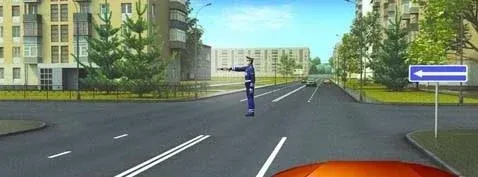
- Only straight
- Straight and right
- Straight and left
- All
Show answer
Correct: 1. Only straight
Under point 16 of the Traffic Rules the controller’s signal - right arm extended forward, with you approaching from his left side - permits non-rail vehicles to travel in all directions. But sign 5.7.2 “Exit to a road with one-way traffic” shows that traffic on the crossing road runs to the LEFT, so a right turn would mean driving out against that one-way flow, which is prohibited. A left turn or a U-turn is not possible either: under point 40 they are made only from the left edge lane, and you are in the right lane, behind a solid line. Movement may therefore continue only straight ahead, which is why the right, left and all-directions answers are all wrong.
Question 290. Which driver may continue driving
- No one
- Only the bus driver
- Both drivers
Show answer
Correct: 3. Both drivers
Under point 20 of the Traffic Rules drivers must obey the traffic controller’s signals even where these contradict the traffic lights, so the red signal does not govern here. The controller’s right arm is extended forward and both vehicles approach from his LEFT side, where point 16 permits non-rail vehicles to travel in all directions. Both the bus turning left and the light passenger car turning right may therefore continue. “No one” ignores the precedence the controller’s signals have over the light, and “Only the bus driver” is wrong because the same permission covers the passenger car.
Question 294. Driving is permitted
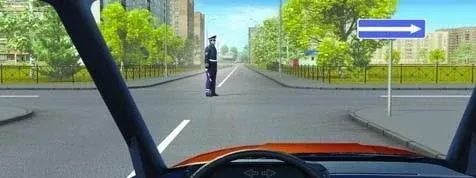
- Only straight
- Only right
- Straight and right
Show answer
Correct: 3. Straight and right
The controller stands side-on to the approaching car with his arms lowered, which under point 16 of the Traffic Rules is equivalent to the position “arms extended sideways”: from his sides, non-rail vehicles may proceed straight ahead and to the right. Sign 5.7.1 “Exit onto a one-way road” shows that traffic on the intersecting road runs to the right, so a right turn joins the one-way flow, which is permitted. “Only straight” is wrong, because a right turn is permitted as well, and “Only right” is wrong, because driving straight ahead is permitted as well.
Question 301. Driving is permitted
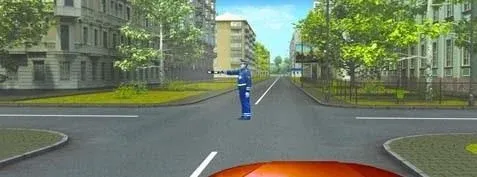
- Straight and right
- Only right
- In all directions
Show answer
Correct: 3. In all directions
The traffic controller’s right arm is extended forward and you are approaching from his LEFT side. Under point 16 of the Rules, non-rail vehicles coming from the controller’s left side may then travel in all directions. Driving is therefore permitted in all directions. “Straight and right” and “Only right” are wrong because with the right arm extended forward the signal given to his left side opens every direction, not a limited set - those restricted sets belong to the drivers facing his chest or standing behind him.
Question 302. In this situation driving is
- Permitted
- Prohibited
Show answer
Correct: 2. Prohibited
The traffic controller is standing with his arms lowered and you are on the side of his chest. Under the Rules, when the controller’s arms are lowered or extended to the sides, the movement of all vehicles from the side of his chest and his back is prohibited - in every direction. Driving in this situation is therefore prohibited, and you must stop until the signal changes. “Permitted” is wrong because facing the controller’s chest there is no direction at all in which you may move.
Question 873. The traffic controller gives a signal with a whistle:
- Only when he requires a vehicle to be stopped.
- In order to draw the attention of road users to himself.
Show answer
Correct: 2. In order to draw the attention of road users to himself.
Under point 17 of the Traffic Rules the traffic controller may also give a signal with a whistle “In order to draw the attention of road users to himself.” That is the whole meaning of the whistle — it attracts attention and by itself expresses no separate requirement. “Only when he requires a vehicle to be stopped.” is wrong: the Rules do not limit the whistle to a stopping demand, and the demands to stop and to direct traffic are expressed by the arm positions laid down in point 16.