Additional Plates
A plate is the small white sign under a main sign. It changes what the sign means, so reading the sign and skipping the plate is the fastest way to lose a mark. Each plate answers one question: how far, how long, which way, who, or when.
How do I recognize a plate?
Section titled “How do I recognize a plate?”Look for a small white rectangle fixed under another sign. On its own, a plate imposes no duty: it only changes the sign above it.
How far away, or how long?
Section titled “How far away, or how long?”This is the distinction the exam tests most. A single figure answers how far. Arrows at both ends of the figure answer how long.
| Sign | No. | Name | Meaning |
|---|---|---|---|
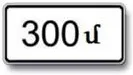 |
8.1.1 | Distance to the object | From the sign to where the danger or the rule begins |
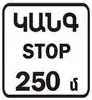 |
8.1.2 | Distance to the object | From sign 2.4 to an intersection with sign 2.5 |
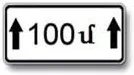 |
8.2.1 | Zone of action | The length of the section the sign covers |
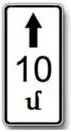 |
8.2.2 | Zone of action | The length of the zone of stopping and parking bans 3.27 to 3.30 |
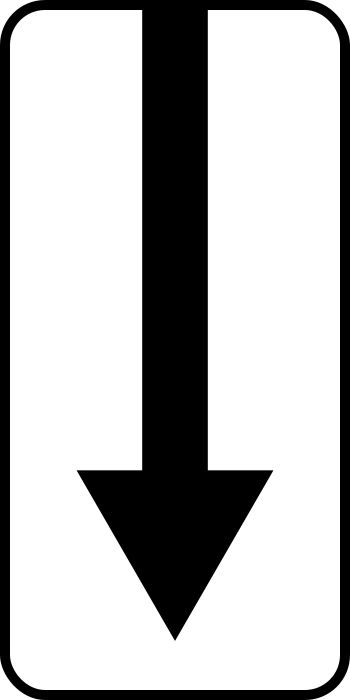 |
8.2.3 | Zone of action | The zone of a 3.27 to 3.30 sign ends here |
 |
8.2.4 | Zone of action | You are inside the zone of a 3.27 to 3.30 sign |
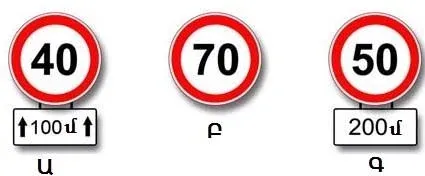
Ա (A): 40 applies from here, for 100 m. Բ (B): 70 applies from here, to the nearest intersection. Գ (C): 50 applies only after 200 m.
Common trap: With plate 8.2.4, the ban runs on both sides of the sign. Stopping is prohibited before it as well as after it. With 8.2.3, the ban ends at the sign, so parking past it is allowed.
Warning signs follow the same pattern. A warning sign with 8.2.1 still stands at its normal distance: outside a built-up area, a narrowing 100 m long begins 150 to 300 m after the sign. With 8.1.1, the figure replaces that distance.
Plate 8.1.2 carries the word STOP as a warning that a compulsory stop is coming, not another give-way.
Which way?
Section titled “Which way?”| Sign | No. | Name | Meaning |
|---|---|---|---|
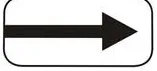 |
8.3.1 | Directions of action | The sign acts to the right. With the arrow reversed, to the left |
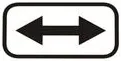 |
8.3.3 | Directions of action | The sign acts to the left and right |
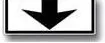 |
8.14 | Traffic lane | The sign acts only on the lane it hangs over |
These plates shrink a ban. Sign 3.2 with no plate closes every direction. With 8.3.3 under it, only left and right are closed, so you may go straight or make a U-turn. Sign 3.5 with an arrow to the right bans motorcycles only to the right.
Who does it apply to?
Section titled “Who does it apply to?”| Sign | No. | Name | Meaning |
|---|---|---|---|
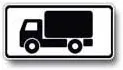 |
8.4.1 | Type of vehicle | Only trucks over 3.5 t |
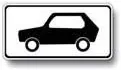 |
8.4.3 | Type of vehicle | Passenger cars and trucks up to 3.5 t. Not motorcycles |
 |
8.17 | Disabled persons | The sign applies only to motorised carriages and cars with the “Disabled person” sign |
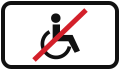 |
8.18 | Except for disabled persons | The sign doesn’t apply to those same vehicles |
Remember: Plate 8.4.1 shows a truck, so a passenger car or a 3 t truck ignores the sign above it. Plate 8.4.3 shows a car, but it covers trucks up to 3.5 t too.
Taxis get nothing from 8.18: the exception is for those with the “Disabled person” sign only.
| Sign | No. | Name | Meaning |
|---|---|---|---|
 |
8.5.1 | Saturdays, Sundays and holidays | The sign applies on those days |
 |
8.5.2 | Working days | The sign applies on working days |
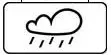 |
8.16 | Wet surface | The sign applies only while the carriageway is wet |
The asterisk isn’t snow. Plate 8.16 means wet, not icy. It doesn’t turn a recommendation into a limit, and it doesn’t turn a limit into advice: 40 in a red ring is a maximum on a wet road, and 40 on a blue square is advice on a wet road.
How do I park?
Section titled “How do I park?”| Sign | No. | Name | Meaning |
|---|---|---|---|
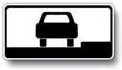 |
8.6.1 | Manner of placing a vehicle at parking places | On the carriageway along the pavement, for all vehicles |
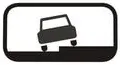 |
8.6.2 | Method of placing a vehicle in a parking place | At the kerb, for passenger cars and motorcycles only |
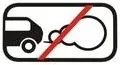 |
8.7 | Parking with the engine switched off | Park with the engine off |
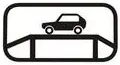 |
8.10 | Vehicle inspection place | A place to inspect vehicles |
Plates 8.6.2 to 8.6.9 all work like 8.6.2. Point 81 agrees: a truck may not park on the kerb under them.
Plates that add meaning
Section titled “Plates that add meaning”| Sign | No. | Name | Meaning |
|---|---|---|---|
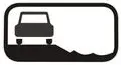 |
8.12 | Dangerous shoulder | With sign 1.25: driving onto the shoulder is dangerous because of repairs |
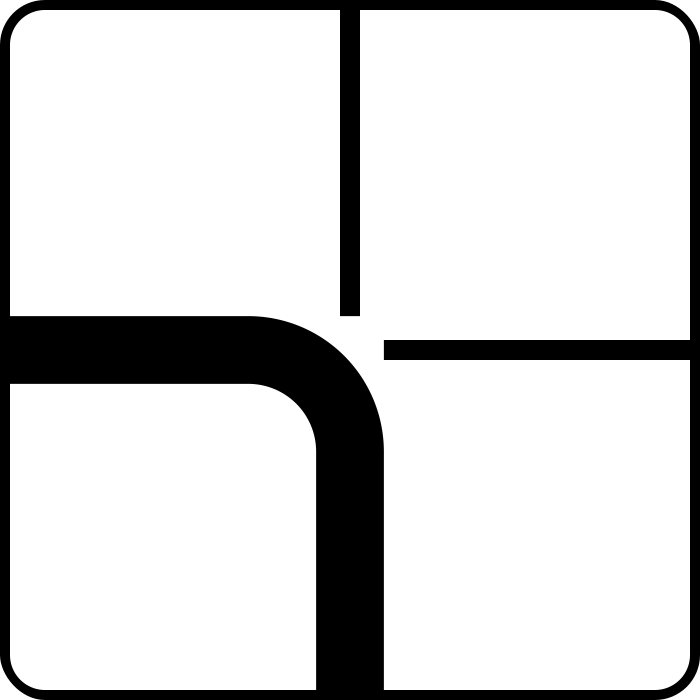 |
8.13 | Direction of the main road | The thick line is the main road’s only course |
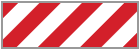 |
8.22 | Obstacle | Used with signs 4.2.1 to 4.2.3 to mark a local obstacle. In the question pictures it is red and white |
Plate 8.12 bans nothing. It says “dangerous”, not “prohibited”, so stopping isn’t affected. On plate 8.13, a thin line continuing straight is the secondary road. If the thick line bends left, the main road goes only left.
Try it yourself
Section titled “Try it yourself”Sign 3.2 stands before the intersection with this plate.
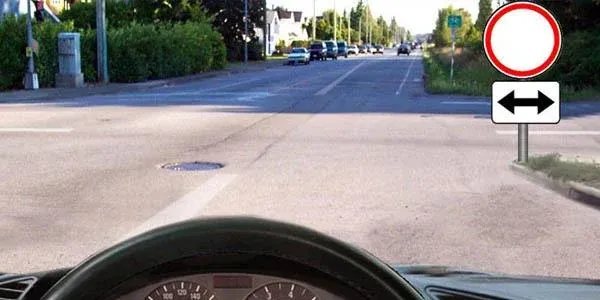
Where may you go? Straight, or back the way you came. The plate closes only left and right.
You drive a passenger car. Sign 4.1.4 hangs above the lane, with plate 8.4.1 under it.
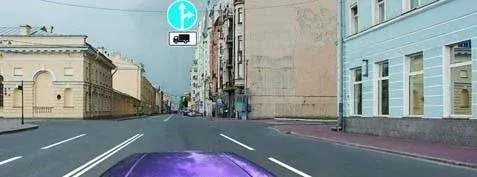
Where may you go? Straight, left, or back. The sign binds only trucks over 3.5 t. There is no exit on the right, so nothing is left to turn into there.
Key points
Section titled “Key points”- A plain figure is a distance. Arrows at both ends make it a length.
- 8.2.3 ends a stopping ban. 8.2.4 says you are inside one.
- 8.3 plates limit a sign to a direction. 8.14 limits it to a lane.
- 8.4.1: trucks over 3.5 t. 8.4.3: cars and trucks up to 3.5 t.
- Asterisk: weekends and holidays. Hammers: working days. Cloud: wet surface.
- 8.6.1 is for all vehicles. 8.6.2 to 8.6.9 are for cars and motorcycles only.
- On 8.13 the thick line is the main road.
Practice questions
Section titled “Practice questions”Question 9. These signs permit driving:
- Only to the left.
- Only straight.
- Only to the right.
- Straight, to the right and in the opposite direction.
Show answer
Correct: 4. Straight, to the right and in the opposite direction.
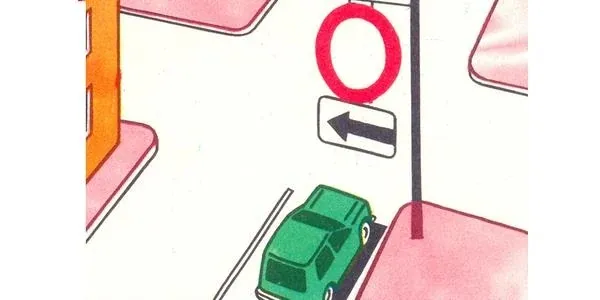
The red ring is sign 3.2 “No traffic”, and the plate beneath it, from the 8.3.1 to 8.3.3 “Directions of action” series, has its arrow pointing to the left, so the prohibition applies only to the road leading left out of the intersection. Travel straight ahead, to the right and in the opposite direction therefore remains permitted: no sign here prohibits a U-turn, and an ordinary intersection is not among the places point 50 of the Rules lists as prohibiting one. “Only to the left.” is precisely the direction that is closed, while “Only straight.” and “Only to the right.” each shut off other directions that are in fact open.
Question 11. What does the plate placed under the sign mean?
- The distance from the sign to the beginning of the first turn.
- The distance from the first turn to the beginning of the second turn.
- The length of the road section with dangerous turns.
Show answer
Correct: 3. The length of the road section with dangerous turns.
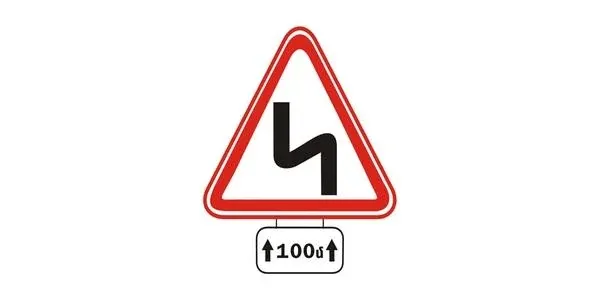
The plate under sign 1.12.2 “Dangerous turns” reads 100 m with an arrow at each end, which makes it plate 8.2.1 “Zone of action”: it shows the LENGTH of the dangerous section the warning sign covers - here the length of the stretch with dangerous turns. The distance from the sign to the beginning of the first turn would be shown by a different plate, 8.1.1 “Distance to the object”, which carries a single downward arrow. No plate exists that gives the distance from one turn to the next. “The length of the road section with dangerous turns.” is therefore correct.
Question 12. What do the following signs mean?
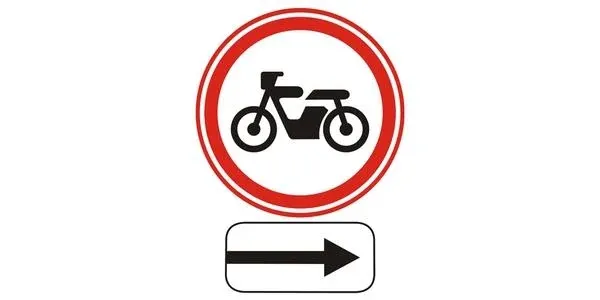
- Movement of motorcycles to the right is prohibited.
- Movement of motorcycles to the right is permitted.
Show answer
Correct: 1. Movement of motorcycles to the right is prohibited.
These signs are built on prohibitory sign 3.5 “Movement of motorcycles prohibited”, together with a plate whose arrow points to the right, so the prohibition applies in that direction. A prohibitory sign forbids the movement it depicts, it does not authorise it, so the pair means that the movement of motorcycles to the right is prohibited. “Movement of motorcycles to the right is permitted.” reverses the meaning of the red ring and is wrong.
Question 21. What does the plate placed under this sign show?
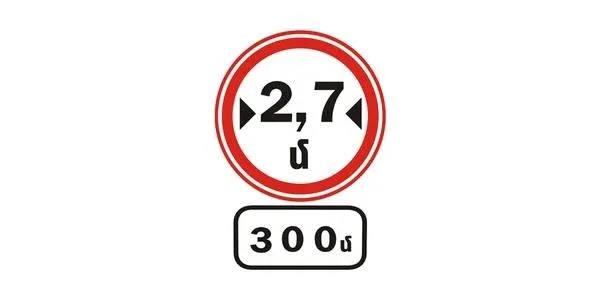
- The length of the narrow section of the road.
- The distance from the sign to the place of the restriction.
- The distance to the place of bypassing the narrow section of the road.
Show answer
Correct: 2. The distance from the sign to the place of the restriction.
The plate reading 300 m under sign 3.14 “Width limit” is plate 8.1.1 “Distance to the object”, which gives the distance, in the direction of travel, from the sign to the start of the dangerous section or to the place where the restriction takes effect - here to the point where the 2.7 m width limit begins. “The length of the narrow section of the road.” is wrong: a section’s length is shown by plate 8.2.1 “Zone of action”, which carries an arrow at each end. No plate exists that gives the distance to a place for bypassing a narrow section. The correct answer is therefore the distance from the sign to the place of the restriction.
Question 23. Which of the signs shows the zone of action of the road signs prohibiting the stopping and parking of vehicles?
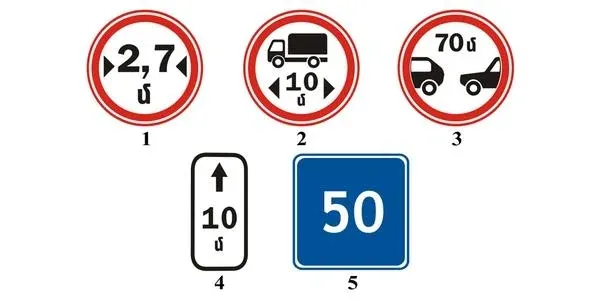
- 1
- 2
- 3
- 4
- 5
Show answer
Correct: 4. 4
The zone of action of signs 3.27–3.30, which prohibit stopping and parking, is shown by plate 8.2.2 “Zone of action” (a white rectangle with an upward arrow and a distance) — number 4. The others pictured are not plates: number 1 is 3.14 “Width limit”, number 2 is 3.15 “Length limit” and number 3 is 3.16 “Minimum distance limit”, all prohibitory signs, while number 5 is the information sign 6.2 “Recommended speed”. Sign 4 is therefore correct.
Question 24. Which of the following signs shows the length of the dangerous section of road over which warning signs act?
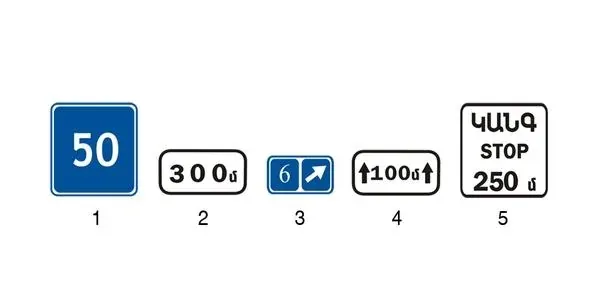
- 1
- 2
- 3
- 4
- 5
Show answer
Correct: 4. 4
The length of the dangerous road section marked by warning signs is shown by plate 8.2.1 “Zone of action” (“↑100 m↑”) — number 4. Number 2 is 8.1.1 and number 5 is 8.1.2 “Distance to object”, which show the distance, not the length of the section; number 3 is sign 6.14.2 “Route number”, and number 1 is the information sign 6.2 “Recommended speed”. Sign 4 is therefore correct.
Question 29. What do this sign and plate warn about?
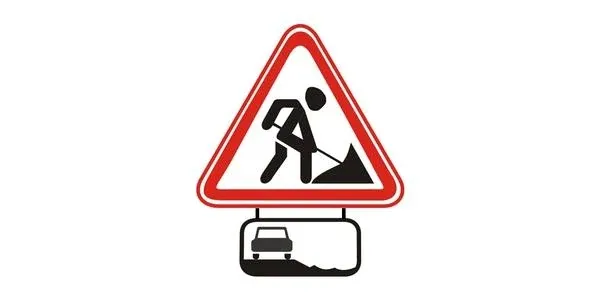
- Because of repair works being carried out, stopping on the road shoulder is prohibited.
- Because of repair works being carried out, entering the road shoulder is dangerous.
- Because of repair works being carried out, parking on the road shoulder is prohibited.
Show answer
Correct: 2. Because of repair works being carried out, entering the road shoulder is dangerous.
This is warning sign 1.25 “Road works” together with plate 8.12 “Dangerous shoulder”, which warns that entering the shoulder is dangerous because of the repair works being carried out, and which is used with sign 1.25 precisely for that purpose. The two options that speak of stopping or parking being PROHIBITED are wrong: a warning sign and its plate impose no prohibition at all - that would require the prohibitory signs 3.27 or 3.28, and neither is present here. What the pair tells the driver is that entering the shoulder is dangerous.
Question 35. Which of the following signs (plates) indicates the manner of positioning a vehicle in parking places?
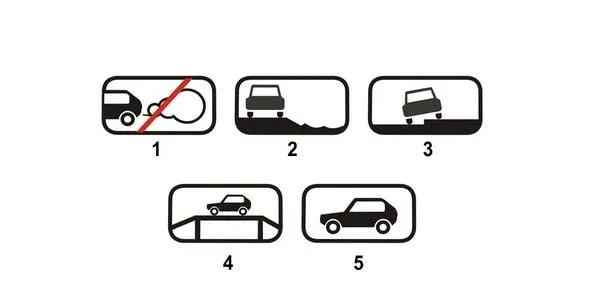
- 1
- 2
- 3
- 4
- 5
Show answer
Correct: 3. 3
The way a vehicle is to be positioned in parking places is shown by plates 8.6.1 to 8.6.9 “Manner of positioning a vehicle in parking places” - 8.6.1 for standing on the carriageway along the pavement, for all vehicles, and 8.6.2 to 8.6.9 for standing at the kerb, for light passenger cars and motorcycles. That is number 3, the plate showing a car half up on the kerb. The others serve different purposes: number 1 is 8.7 “Parking with the engine switched off”, number 2 is 8.12 “Dangerous shoulder”, number 4 is 8.10 “Vehicle inspection place” and number 5 is 8.4.3 “Type of vehicle”. None of them prescribes how to stand. Sign 3 is therefore correct.
Question 47. The following signs indicate:
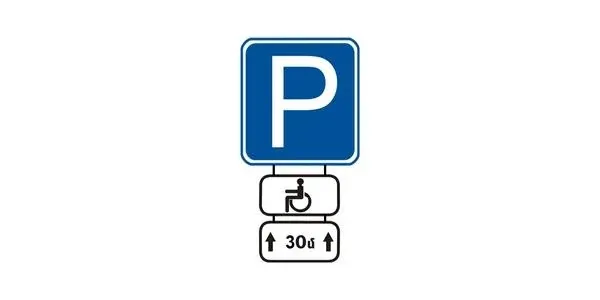
- The parking place from 30 metres, for automobiles equipped with the “Disabled” identification sign.
- The parking place in a zone 30 m long, for vehicles, except motorised carriages.
- The parking place in a zone 30 m long, for motorised carriages and automobiles equipped with the “Disabled” identification sign.
Show answer
Correct: 3. The parking place in a zone 30 m long, for motorised carriages and automobiles equipped with the “Disabled” identification sign.
The signs shown are 6.4 “Parking place”, plate 8.17 “Disabled persons”, and a zone-of-action plate 8.2.1 reading 30 m with an arrow at each end. Under plate 8.17 the effect of sign 6.4 extends only to motorised carriages and to automobiles carrying the “Disabled person” identification sign, so the parking place in a 30 m long zone is for motorised carriages and for automobiles with that sign. The option reading “from 30 metres” is wrong twice over: it drops the motorised carriages, and it reads the 30 m as a distance when the double-arrowed plate makes it a length. The option excluding motorised carriages reverses the meaning - that is what plate 8.18 “Except for disabled persons” would do.
Question 52. What do the indicated road signs show?
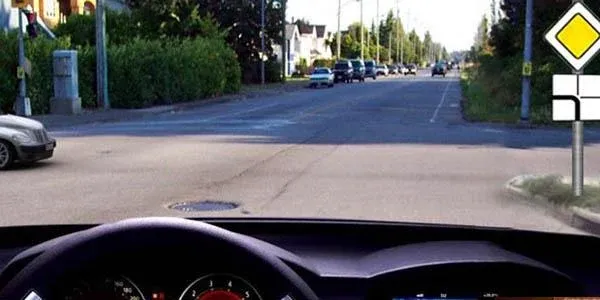
- The main road continues from the intersection to the left.
- The main road continues from the intersection straight and to the left.
Show answer
Correct: 1. The main road continues from the intersection to the left.
The signs are 2.1 “Main road” and plate 8.13 “Direction of the main road”, which shows how the main road runs through the intersection. On this plate the BOLD line comes up from the driver’s road and bends to the left, so the main road continues from the intersection to the left. “The main road continues from the intersection straight and to the left.” is wrong: on plate 8.13 the bold line marks the one and only course of the main road, and here the road carrying straight on is drawn as a thin line, which makes it the secondary one.
Question 54. The effect of which signs applies only during the period in which the surface of the carriageway is wet?
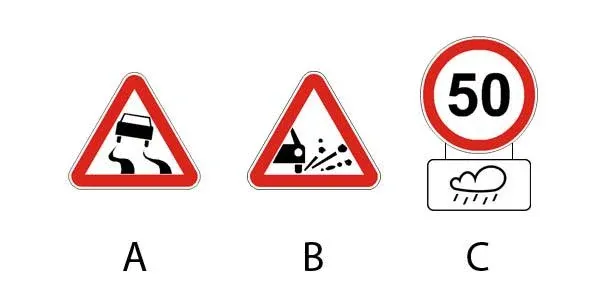
- Only A and C.
- Only B.
- Only C.
- All.
Show answer
Correct: 3. Only C.
Plate 8.16 “Wet surface” states that the sign above it applies only while the surface of the carriageway is wet, and in the picture that plate appears under C alone - sign 3.24 “Maximum speed limit”. A is the warning sign 1.15 “Slippery road” and B is 1.18 “Gravel ejection”; neither carries such a plate, so both apply whatever the state of the surface. “Only A and C.”, “Only B.” and “All.” are therefore wrong, and the correct answer is “Only C.”
Question 56. What do the indicated road signs show?
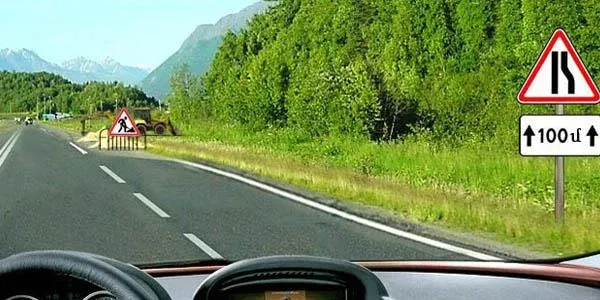
- 150-300 metres after the sign there is a narrowing of the road on the right side, the length of which is 100 m.
- 100 metres after the sign, there is a narrowing of the road on the right side of the road.
Show answer
Correct: 1. 150-300 metres after the sign there is a narrowing of the road on the right side, the length of which is 100 m.
The picture shows warning sign 1.20.2 “Road narrows” (on the right) and plate 8.2.1 “Zone of effect”, which gives the length of the hazardous section — 100 m. Under the Rules, signs 1.1, 1.2 and 1.5-1.33 are placed 150-300 m before the hazardous section outside built-up areas, so 150-300 m past the sign a narrowing 100 m long begins on the right — the correct answer. The “100 metres after the sign” option is wrong: the 100 m is the length of the narrowing given by the plate, not the distance to it, which would be shown by plate 8.1.1.
Question 57. In which direction is the driver permitted to drive?
- Only right and left.
- Only straight.
- Straight and in the opposite direction.
Show answer
Correct: 3. Straight and in the opposite direction.
The white disc with a red border is sign 3.2 “No traffic”, and the plate beneath it, carrying an arrow with a head at each end, is 8.3.3 “Directions of action”: it confines the prohibition to the roads leading left and right out of the intersection. The driver may therefore carry straight on or make a U-turn. “Only right and left.” names precisely the two directions that are closed, and “Only straight.” is wrong because nothing here prohibits the U-turn.
Question 58. What do the indicated road signs show?
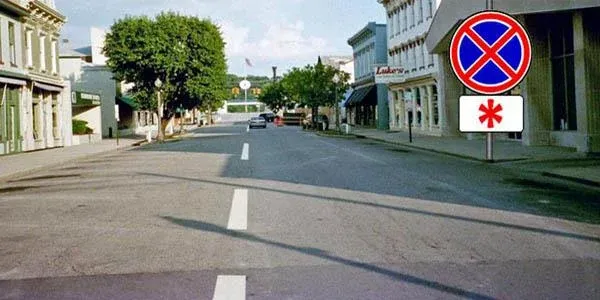
- Stopping is prohibited on Saturdays.
- Stopping is prohibited on Sundays.
- Stopping is prohibited at weekends and on holidays.
- Stopping is prohibited during snowfall.
Show answer
Correct: 3. Stopping is prohibited at weekends and on holidays.
The blue disc with a red border and a red cross is sign 3.27 “Stopping prohibited”, which bans both stopping and parking, and the white plate with the red six-pointed asterisk is 8.5.1 “Saturdays, Sundays and holidays”, which limits the sign’s operation to those days. Stopping is therefore prohibited on Saturdays, Sundays and holidays. The “on Saturdays” and “on Sundays” answers are incomplete, and the asterisk is the symbol of plate 8.5.1, not a warning about snowfall.
Question 60. What do the indicated road signs show?
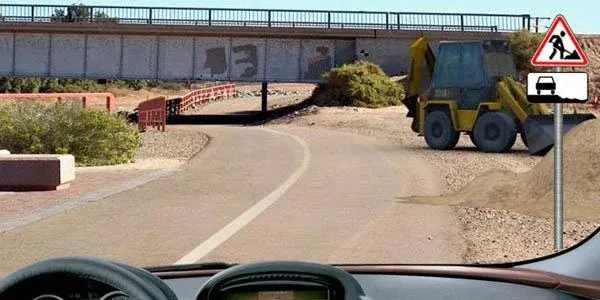
- Because of repair works, entering the shoulder is dangerous.
- Repair works are being carried out on the road.
Show answer
Correct: 1. Because of repair works, entering the shoulder is dangerous.
The signs are warning sign 1.25 “Road works” together with plate 8.12 “Dangerous shoulder”, which is used with 1.25 and warns that entering the shoulder is dangerous because of the repair works being carried out. That is the correct answer. “Repair works are being carried out on the road.” describes only sign 1.25 by itself and ignores what the plate adds, which is the particular danger the driver is being warned about - the shoulder.
Question 65. What do the following road signs show?
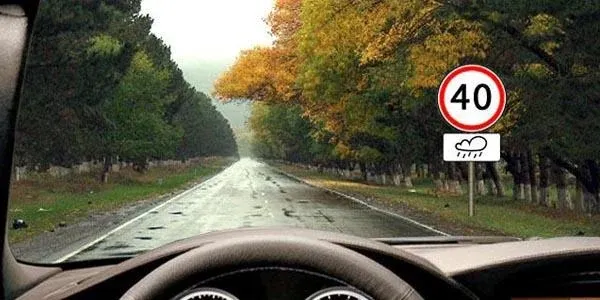
- When the road is icy, one must drive at a speed of 40 km/h.
- In case of a wet road surface, one must drive at a speed of not more than 40 km/h.
Show answer
Correct: 2. In case of a wet road surface, one must drive at a speed of not more than 40 km/h.
The signs shown are the prohibitory sign 3.24 “Maximum speed limit” (40 km/h) and the plate 8.16 “Wet surface”, which tells you that the sign applies only during the period when the surface of the carriageway is wet. So in case of a wet road surface one must drive at a speed of not more than 40 km/h — the correct answer. The option “When the road is icy” is wrong, because plate 8.16 refers precisely to a wet surface.
Question 66. What do the following road signs indicate?
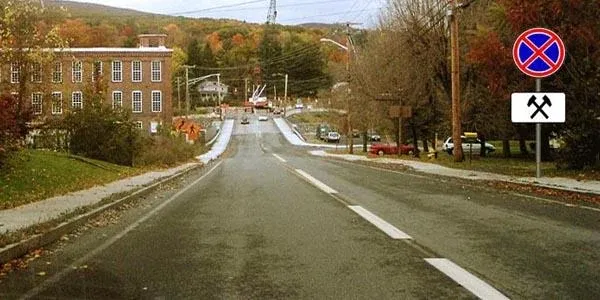
- Stopping is prohibited on Saturdays.
- Stopping is prohibited on Sundays.
- Stopping is prohibited on working days.
Show answer
Correct: 3. Stopping is prohibited on working days.
The sign shown is 3.27 “Stopping prohibited”, which prohibits both the stopping and the parking of vehicles, and beneath it, bearing crossed hammers, plate 8.5.2 “Working days”. Plates 8.5.1-8.5.3 state the days of the week on which the sign applies. Stopping is therefore prohibited only on working days — the correct answer. The “Saturdays” and “Sundays” options are wrong, because Saturdays, Sundays and holidays are indicated by plate 8.5.1, not by the 8.5.2 shown here.
Question 88. After these signs, the maximum travel speed set for the driver of a truck with a permissible maximum mass of no more than 3.5 tonnes is
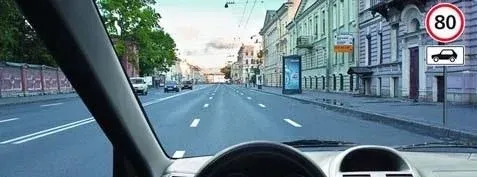
- 60 km/h
- 70 km/h
- 80 km/h
Show answer
Correct: 3. 80 km/h
The sign is 3.24 “Maximum speed limit” set to 80, and beneath it is plate 8.4.3 “Type of vehicle”, which extends the sign’s effect to light passenger cars and to lorries with a permissible maximum mass of up to 3.5 tonnes. A truck of no more than 3.5 t falls inside that plate, so the maximum speed the sign sets for it is 80 km/h. “60 km/h” and “70 km/h” are wrong because the sign sets 80 and no other figure is prescribed for this category here.
Question 92. What does the supplementary information plate indicate
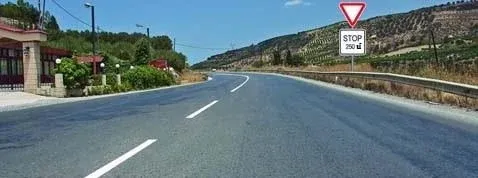
- The distance from the sign to the intersection, when the “Give way” sign is placed immediately before the intersection
- The distance from the sign to the intersection, when the “Movement without stopping is prohibited” sign is placed immediately before the intersection
- The location of the border checkpoint
Show answer
Correct: 2. The distance from the sign to the intersection, when the “Movement without stopping is prohibited” sign is placed immediately before the intersection
Under sign 2.4 “Give way” here stands a plate bearing STOP and 250 m - that is plate 8.1.2 “Distance to the object”. Under the road-signs annex, plate 8.1.2 gives the distance from sign 2.4 to an intersection before which sign 2.5 “Movement without stopping prohibited” is placed, which is the marked answer: the word STOP on the plate is the warning that a compulsory stop, not another give-way, is coming. The first option is wrong because 8.1.2 is used precisely for a following sign 2.5 and not for a repeated “Give way”, and plate 8.1.2 does not indicate the location of a border checkpoint.
Question 94. What speed regime is set on the road by these signs
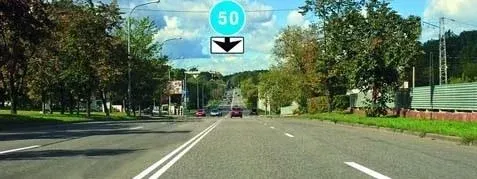
- Minimum speed — 50 km/h
- Recommended speed — 50 km/h
- Minimum speed in the left lane of the same direction — 50 km/h
Show answer
Correct: 3. Minimum speed in the left lane of the same direction — 50 km/h
The blue circular sign is 4.6 “Minimum speed limit” set to 50, which permits travel only at the speed shown or higher. It hangs above the left lane of the same direction with plate 8.14 “Traffic lane” beneath it, its arrow pointing down, and that plate confines the sign’s effect to the lane over which it hangs. The minimum of 50 km/h therefore applies only when travelling in the left lane of the same direction. “Minimum speed - 50 km/h” without the lane is wrong because plate 8.14 restricts the requirement to that lane, and “Recommended speed - 50 km/h” is wrong because 4.6 sets a compulsory minimum rather than a recommendation - the recommendation sign is 6.2.
Question 96. The signs inform that
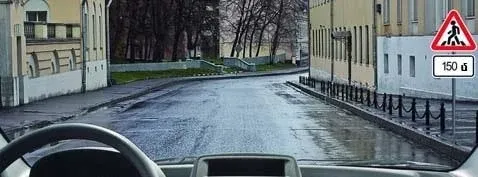
- On a 150 metre section of road there is a danger of pedestrians appearing on the carriageway
- In 150 metres there will be an unregulated pedestrian crossing
Show answer
Correct: 2. In 150 metres there will be an unregulated pedestrian crossing
The triangular sign is warning sign 1.22 “Pedestrian crossing”, which warns of a crossing marked by signs 5.19.1 and 5.19.2 or by markings 1.14.1 and 1.14.2, and the plate under it is 8.1.1 “Distance to the object”, reading 150 m. Together they say that in 150 metres there will be an unregulated pedestrian crossing. “On a 150 metre section of road there is a danger of pedestrians appearing on the carriageway” is wrong: with plate 8.1.1 the sign points to a crossing 150 m ahead, not to a dangerous stretch 150 m long - a length would need the double-arrowed plate 8.2.1 instead.
Question 103. With this plate, the effect of the sign used with it extends to
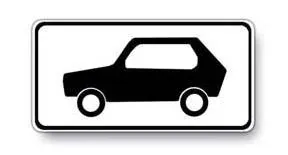
- Only passenger cars
- Passenger cars, as well as trucks with a maximum permissible mass of up to 3.5 tonnes
- Passenger cars and motorcycles
Show answer
Correct: 2. Passenger cars, as well as trucks with a maximum permissible mass of up to 3.5 tonnes
This is plate 8.4.3 “Type of vehicle”, bearing a light passenger car, and the sign it is used with extends to light passenger cars AND to lorries with a permissible maximum mass of up to 3.5 tonnes. “Only passenger cars” is wrong because lorries up to 3.5 t are covered as well, and “Passenger cars and motorcycles” is wrong because this plate does not reach motorcycles at all - a motorcycle would need its own plate.
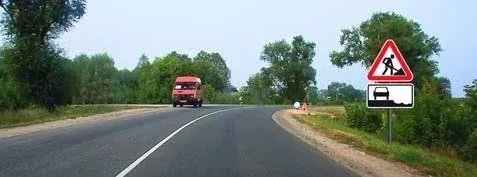
- Prohibits stopping on the shoulder
- Driving out onto the shoulder is dangerous because of repair works
- Stopping is permitted only on the carriageway
Show answer
Correct: 2. Driving out onto the shoulder is dangerous because of repair works
The triangular sign is warning sign 1.25 “Road works”, and the plate under it is 8.12 “Dangerous shoulder”, which warns that driving out onto the shoulder is dangerous because of the repair works being carried out. “Prohibits stopping on the shoulder” and “Stopping is permitted only on the carriageway” are both wrong, because this combination regulates stopping not at all - it warns about the state of the shoulder, and a prohibition would need a prohibitory sign.
Question 109. In which direction is the driver of a passenger car permitted to drive in this situation?
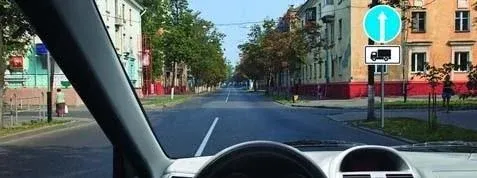
- Only straight
- Straight and right
- Any
Show answer
Correct: 3. Any
The sign is 4.1.1 “Straight ahead only”, but it is used with plate 8.4.1 “Type of vehicle”, which confines its effect to lorries with a permissible maximum mass of more than 3.5 tonnes. A light passenger car is not covered by plate 8.4.1, so the “straight ahead only” requirement does not reach it and its driver may travel in any direction. “Only straight” and “Straight and right” are wrong because the restriction applies solely to lorries heavier than 3.5 t.
Question 120. In which direction may you continue driving at the indicated intersection if you are driving a truck with a maximum permissible mass of 3 tonnes?
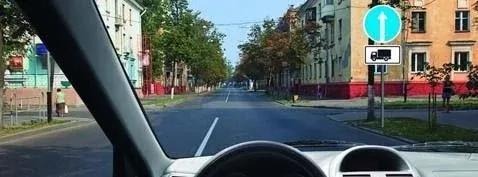
- Only straight
- Only straight and right
- Any
Show answer
Correct: 3. Any
The sign is 4.1.1 “Straight ahead only”, used with plate 8.4.1 “Type of vehicle”, which confines its effect to lorries with a permissible maximum mass of MORE than 3.5 tonnes. A lorry with a permissible maximum mass of 3 tonnes is not covered by plate 8.4.1, so the “straight ahead only” requirement does not reach it and it may continue in any direction at the intersection. “Only straight” and “Only straight and right” are wrong because the restriction applies solely to lorries heavier than 3.5 t.
Question 129. On which vehicles does the effect of the sign prohibiting stopping not extend in this case?
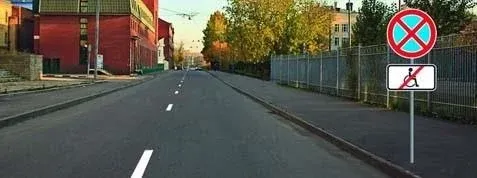
- Light passenger taxi cars
- Only motorcycle sidecars and cars fitted with the “Disabled” identification sign
- All of the listed
Show answer
Correct: 2. Only motorcycle sidecars and cars fitted with the “Disabled” identification sign
The sign is 3.27 “No stopping” with plate 8.18 “Except for disabled persons”, which under the road-signs annex states that the sign’s effect does not extend to motorcycle sidecars and cars carrying the “Disabled person” identification sign. The stopping prohibition is therefore lifted for those vehicles alone. “Light passenger taxi cars” is wrong because the plate exempts only vehicles carrying the “Disabled person” identification sign, and “All of the listed” is wrong because sign 3.27 goes on applying to every other vehicle.
Question 137. On the drivers of which vehicles does the effect of the signs extend?
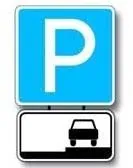
- Light passenger cars and motorcycles
- All
- Only light passenger cars
Show answer
Correct: 1. Light passenger cars and motorcycles
Under the “P” of sign 6.4 “Parking place” is one of the plates 8.6.2 to 8.6.9 “Manner of positioning a vehicle in parking places”, showing the car standing up on the pavement. Under the road-signs annex that kerbside manner of parking is provided only for light passenger cars and motorcycles, and point 81 of the Traffic Rules says the same: only light passenger cars, motorcycles, mopeds and bicycles may park on the pavement edge adjoining the carriageway. The signs therefore extend to light passenger cars and motorcycles. “All” would be right for plate 8.6.1, which puts the car on the carriageway, and “Only light passenger cars” is wrong because motorcycles are included too.
Question 383. The signs inform that
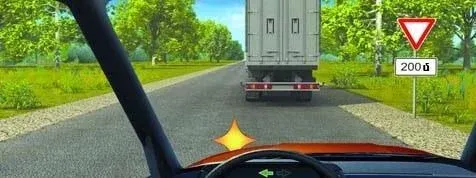
- In 200 metres there will be a need to give way to the one crossing the road.
- On the 200-metre section we must give way to everyone.
Show answer
Correct: 1. In 200 metres there will be a need to give way to the one crossing the road.
The sign is 2.4 “Give way” with plate 8.1.1 “Distance to the object” reading 200 m, which under the Rules gives the distance from the sign to the place where the requirement begins. The signs therefore inform you that in 200 metres there will be an intersection where you must give way to the vehicles crossing your road. “On the 200-metre section we must give way to everyone.” is wrong because plate 8.1.1 shows the distance to the START of the duty, not a 200 m zone in which it applies - a zone would be marked by a plate with an arrow at each end.
Question 685. In which direction is travel prohibited:
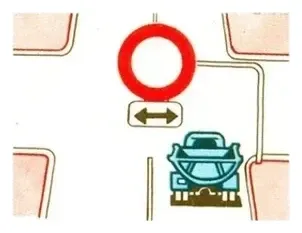
- To the left and to the right.
- Straight and in the opposite direction.
- Only straight.
- In all directions.
Show answer
Correct: 1. To the left and to the right.
Before the intersection stand sign 3.2 “No traffic” and, beneath it, plate 8.3.3 “Directions of action” carrying a double-headed arrow; under the catalogue of plates, 8.3.1 to 8.3.3 show the directions in which a sign placed before an intersection acts. With a double-headed arrow the prohibition of sign 3.2 extends to both the left and the right directions of the crossing road, so travel to the left and to the right is prohibited while straight ahead remains permitted. “Only straight.” and “Straight and in the opposite direction.” are wrong because straight ahead is precisely what IS allowed, and “In all directions.” would be right only for sign 3.2 standing without a plate.
Question 695. In which direction is travel prohibited?
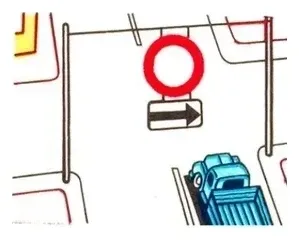
- Only to the left.
- Only to the right.
- Straight and to the left.
- In all directions.
Show answer
Correct: 2. Only to the right.
Sign 3.2 “Movement prohibited” is placed before the intersection together with plate 8.3.1 “Directions of action”, whose arrow points to the right; per the catalogue, plates 8.3.1–8.3.3 show the directions in which a sign placed before an intersection applies. The prohibition of sign 3.2 therefore covers only the road lying to the right, and only the right turn is prohibited, while travel straight ahead and to the left is not restricted by this sign. The options “Only to the left” and “Straight and to the left” misread the direction of the plate’s arrow, and “In all directions” would be correct only for a sign 3.2 placed without a plate.
Question 750. From this lane, in which direction may the driver of the passenger car continue driving
- Only straight
- Straight and right
- Any
- Straight, left and back the opposite way
Show answer
Correct: 4. Straight, left and back the opposite way
Above the lane stands the mandatory sign 4.1.4 “Movement straight or to the right”, and under it plate 8.4.1 “Type of vehicle” bearing a lorry, which confines the sign’s effect to lorries with a permissible maximum mass of more than 3.5 tonnes. The restriction therefore does not reach the light passenger car, which crosses the intersection under the general rules - and where a left turn is permitted a U-turn is permitted with it. On the right of the picture there is no exit at all: the kerb and pavement run on unbroken, while a crossing road opens to the left. Travel straight ahead, to the left and in the opposite direction is therefore allowed. “Only straight” and “Straight and right” repeat a restriction that does not apply to a passenger car, and “Any” is wrong because there is nothing to turn right into.
Question 1040. The effect of which sign extends only to the lane over which it is suspended
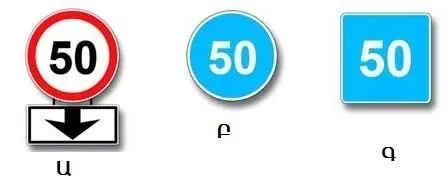
- Only Ա (A)
- Only Բ (B)
- Ա (A) and Բ (B)
Show answer
Correct: 1. Only Ա (A)
Sign Ա (A) is 3.24 ‘Maximum speed limit’ carrying plate 8.14 ‘Lane’ with a downward arrow, which shows the traffic lane the sign applies to; the effect of Ա (A) therefore extends only to the lane it is suspended over. Բ (B) (4.6 ‘Minimum speed limit’) and Գ (C) (6.2 ‘Recommended speed’) carry no 8.14 plate, so their effect is not confined to one lane. The correct answer is only Ա (A).
Question 1049. Which of the plates indicate the zone of effect of the sign placed with them?
- Only Ա (A)
- Only Բ (B)
- Բ (B) and Գ (C)
Show answer
Correct: 3. Բ (B) and Գ (C)
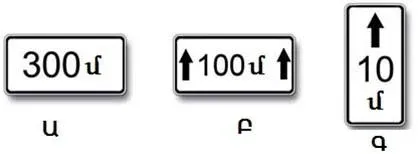
Plate Բ (B) is 8.2.1 ‘Zone of effect’ (its length given by the arrows) and Գ (C) is 8.2.2 ‘Zone of effect’ (with an upward arrow); both show the zone of effect of the sign placed with them. Plate Ա (A) is 8.1.1 ‘Distance to object’, which shows the distance from the sign to the start of the hazardous section or to the object, not the zone of effect. The correct answer is therefore ‘Բ (B) and Գ (C)’, and ‘Only Ա (A)’ and ‘Only Բ (B)’ are wrong.
Question 1050. In which case does the effect of the sign begin immediately from the place where it is installed?
- Only Ա (A) and Բ (B)
- Only Բ (B)
- All
Show answer
Correct: 1. Only Ա (A) and Բ (B)
Sign Ա (A) is 3.24 showing 40 with plate 8.2.1 “Zone of action” beneath it, so the restriction operates from the sign itself and runs for the 100 m shown; sign Բ (B) is 3.24 showing 70 with no plate, and its effect likewise begins where it stands and extends to the nearest intersection. Sign Գ (C) is 3.24 showing 50 with plate 8.1.1 “Distance to the object”, which says the restriction is introduced 200 m further on, not immediately. The correct answer is therefore “Only Ա (A) and Բ (B)”: “Only Բ (B)” and “All” are wrong, because Ա (A) also takes effect at once while Գ (C) does so only after 200 m.
Question 1068. With which plate does the effect of the applied sign extend to the driver of a truck with a permissible maximum mass lighter than 3.5 tonnes?
- Only Բ (B)
- Only Գ (C)
- Բ (B) and Գ (C)
- All
Show answer
Correct: 3. Բ (B) and Գ (C)
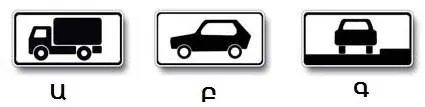
Plate Ա (A) is 8.4.1 ‘Type of vehicle’, with which the sign extends only to trucks with a permissible maximum mass over 3.5 tonnes, so it does not extend to a truck of up to 3.5 t. Plate Բ (B) is 8.4.3, with which the effect of the sign extends to passenger cars and to trucks with a permissible maximum mass up to 3.5 tonnes. Plate Գ (C) is 8.6.1 ‘Manner of placing a vehicle at parking places’, which prescribes standing on the carriageway along the pavement for all vehicles, including trucks up to 3.5 t. ‘Բ (B) and Գ (C)’ is therefore correct; ‘Only Բ (B)’ and ‘Only Գ (C)’ are incomplete, and ‘All’ is wrong, because with plate Ա (A) (8.4.1) the sign does not concern a truck of up to 3.5 t.