The Unconscious Casualty
An unconscious person can’t protect their own airway, so the first minute matters most. This lesson covers checking breathing, the recovery position, fainting, seizures and sudden illness.
Remember: This lesson does not replace a first-aid course.
At rest, an adult has a pulse of 60-80 beats per minute and 12-18 breathing movements per minute.
I’ve found someone unconscious. What now?
Section titled “I’ve found someone unconscious. What now?”- Open the airway. One hand on the forehead. With two fingers of the other hand, raise the chin and tilt the head back.
- Check breathing for 10 seconds. Feel for exhaled air on your cheek and watch the chest.
- If they are breathing, use the recovery position.
- If they are not breathing, start resuscitation at once.
Never give an unconscious person water: it goes into the lungs.
Common trap: Don’t check without tilting the head, as the tongue may block the airway. Watching the chest alone isn’t enough either.
Extra: What resuscitation looks like
Not from the question bank.
Adult CPR as widely taught: make sure an ambulance is called and send someone for a defibrillator if one is near. Put the heel of one hand on the center of the chest, the other hand on top, and push about 5 cm deep, 100-120 times a minute. If trained, give 2 rescue breaths after every 30 compressions. If not, keep compressing. Continue until help arrives or normal breathing returns.
What is the recovery position?
Section titled “What is the recovery position?”The stable side position, for a casualty who is unconscious but breathing, with circulation present.
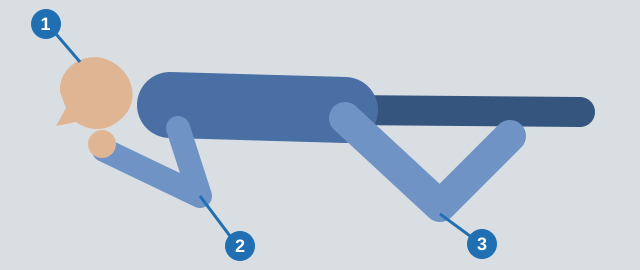
The head tilted back (1), the upper arm under the cheek (2) and the bent knee touching the ground (3).
The tongue can’t block the airway, and vomit drains out. Don’t lay them on their back, put a roll under the head or pull the tongue out.
What do I do when someone faints?
Section titled “What do I do when someone faints?”Fainting is a temporary drop in the brain’s blood supply. Lay the casualty down and raise the legs. Don’t sit them up, pour cold water on them or slap them.
Extra: If they don't come round
Not from the question bank.
If they don’t wake within a minute or so, treat them as unconscious and call an ambulance.
What do I do during a seizure?
Section titled “What do I do during a seizure?”A seizure normally ends on its own within a few minutes, so let the convulsions end.
- Don’t hold the casualty: this causes fractures and dislocations.
- Don’t open the mouth, hold the tongue or put anything between the teeth.
- Don’t tilt the head during the seizure. Afterwards, open the airway and check breathing.
Extra: Keeping someone safe during a seizure
Not from the question bank.
First-aid courses also teach you to move dangerous objects away, cushion the head and time the seizure. Call an ambulance if it lasts over 5 minutes, repeats, or the person doesn’t wake properly.
What about sudden illness?
Section titled “What about sudden illness?”| Situation | Do | Don’t |
|---|---|---|
| Driver has severe crushing chest pain and difficulty breathing | Immediately stop the car, switch on the hazard warning signal, call an ambulance to the spot | Drive on to hospital, give valerian, or walk for fresh air |
| Bronchial asthma attack | Semi-sitting position, chest free | Lay them down |
| Friend with diabetes feels unwell, unsure about insulin | Give sugar or a sweet liquid, as low blood sugar is the likely danger | Advise insulin or a few hours’ rest |
Give sugar only to someone awake: an unconscious casualty gets nothing by mouth.
Extra: Asthma inhalers
Not from the question bank.
Many people with asthma carry a reliever inhaler. First-aid courses teach you to help them use their own, and to call an ambulance if the attack is severe or doesn’t ease.
Try it yourself
Section titled “Try it yourself”A driver squats for a long time changing a wheel, stands up abruptly, loses consciousness and falls.
What must be done? Raise his legs. Blood returns to the brain. Sitting him up does the opposite.
Key points
Section titled “Key points”- Unconscious: open the airway, then check breathing for 10 seconds.
- Breathing: recovery position. Not breathing: resuscitation at once.
- Fainting: lying down, legs raised.
- Seizure: don’t restrain, nothing in the mouth.
- Asthma: semi-sitting. Diabetes: sugar or a sweet liquid.
Practice questions
Section titled “Practice questions”Question 553. While driving, the driver suddenly begins to complain of severe crushing chest pain and difficulty breathing. What must be done?
- Suggest that he go to the nearest hospital.
- Give a glass of water, 2 valerian tablets.
- Immediately stop the car and switch on the hazard warning signal.
- Advise him to walk a little and breathe fresh air.
Show answer
Correct: 3. Immediately stop the car and switch on the hazard warning signal.
Sudden severe crushing chest pain together with difficulty breathing is the typical picture of a heart attack and is life-threatening. The first steps are to stop all exertion and call emergency help, so “Immediately stop the car and switch on the hazard warning signal.” is correct: a person who may lose consciousness must not stay at the wheel, and the hazard signal warns the traffic around. “Suggest that he go to the nearest hospital.” is wrong because it means driving on — an ambulance must be called to the spot instead. “Give a glass of water, 2 valerian tablets.” is wrong, as valerian is a sedative with nothing to do with cardiac pain and only delays real help, and “Advise him to walk a little and breathe fresh air.” is wrong because exertion raises the heart muscle’s demand for oxygen and worsens the pain.
Question 554. What assistance must be given to a casualty in case of a convulsive seizure?
- Hold the casualty, trying to restrain the convulsions.
- Try to open the mouth, hold the tongue and place some object between the teeth.
- Try to open the airways by tilting the casualty’s head back.
- Do not touch, let the convulsions end.
Show answer
Correct: 4. Do not touch, let the convulsions end.
During a convulsive seizure, forcibly holding the casualty is what causes fractures and dislocations, so “Hold the casualty, trying to restrain the convulsions.” is wrong. “Try to open the mouth, hold the tongue and place some object between the teeth.” is wrong as well: it breaks teeth and injures the mouth, and a broken fragment can block the airway. “Try to open the airways by tilting the casualty’s head back.” belongs after the seizure, not during it. A seizure normally ends on its own within a few minutes, so the correct course is not to touch the casualty and to let the convulsions end - clearing dangerous objects from around them and protecting the head - and only then to open the airways and check the breathing.
Question 558. A driver was squatting for a long time while changing a car wheel. Standing up abruptly, he grabs his head and, suddenly losing consciousness, falls. What must be done?
- Try to sit him up.
- Raise his legs.
- Pour cold water on his face.
- Slap his face.
Show answer
Correct: 2. Raise his legs.
Standing up abruptly after a long squat drops the blood supply to the brain for a moment, and the person faints. The casualty should therefore be left lying and his legs raised, so that the blood returns to the brain. “Try to sit him up.” does the opposite - it lifts the head again and prolongs the faint - and “Pour cold water on his face.” and “Slap his face.” do nothing for the circulation, are not a way of bringing anyone round, and can cause harm.
Question 564. A casualty who is unconscious and breathing must be:
- Laid on his back.
- Have his mouth opened and his tongue pulled out.
- Turned onto his side with his head tilted back.
Show answer
Correct: 3. Turned onto his side with his head tilted back.
A casualty who is unconscious but breathing is turned onto his side into the recovery position with the head tilted back. In that position the tongue cannot fall back and block the airway, and vomit or blood drains out freely instead of into the lungs. “Laid on his back.” creates exactly those two dangers - the tongue falling back, and choking on his own vomit - and “Have his mouth opened and his tongue pulled out.” is no longer done: it causes injury and is no substitute for the correct position.
Question 568. At rest, an adult’s pulse is:
- 40-60 beats per minute.
- 60-80 beats per minute.
- 80-100 beats per minute.
Show answer
Correct: 2. 60-80 beats per minute.
At rest an adult’s pulse is 60-80 beats per minute, and that is the norm against which a casualty’s reading is compared. “40-60 beats per minute.” is below the norm - a slow pulse for an adult at rest - and “80-100 beats per minute.” is above it; either is a sign that the person is not at rest or that something is wrong.
Question 569. At rest, an adult’s breathing is:
- 12-18 breathing movements per minute.
- 20-30 breathing movements per minute.
- 40-60 breathing movements per minute.
Show answer
Correct: 1. 12-18 breathing movements per minute.
At rest an adult’s breathing is 12-18 breathing movements per minute. “20-30 breathing movements per minute.” is fast breathing and not the norm for an adult at rest, and “40-60 breathing movements per minute.” is very fast breathing that points to a serious condition.
Question 573. After finding a casualty who is unconscious, first of all you must:
- Give him cold water to drink.
- Bring him into the lateral recovery position.
- Maintain normal body temperature.
- Open the airways and check breathing.
Show answer
Correct: 4. Open the airways and check breathing.
On finding a casualty who is unconscious, the first thing is to open the airways - head tilted back, chin lifted - and check breathing. Everything else depends on that: if there is no breathing, resuscitation must start at once. “Bring him into the lateral recovery position.” is a right step, but only once you know he is breathing. “Maintain normal body temperature.” comes later, and “Give him cold water to drink.” is dangerous with an unconscious person - the liquid goes into the lungs.
Question 575. Your friend, who has diabetes, feels unwell and does not remember when he last took insulin. What must be done first in this case?
- Give him sugar or a sweet liquid.
- Suggest that he rest for a few hours.
- Advise him to inject insulin.
Show answer
Correct: 1. Give him sugar or a sweet liquid.
In a person with diabetes, the commonest and most dangerous cause of feeling unwell is low blood sugar, which leads to loss of consciousness within minutes. So you give him sugar or a sweet liquid: if low sugar is the cause he improves quickly, and if his sugar is in fact high, that small amount does no real harm. “Advise him to inject insulin.” pushes it the other way and is lethal when the sugar is already low - all the more so as he does not remember when he last took it - and “Suggest that he rest for a few hours.” loses time while the condition is getting worse fast.
Question 579. In case of an attack in a casualty with bronchial asthma you must:
- Help him take a semi-sitting position.
- Lay him down and raise his legs.
- Lay him down with his legs bent at the knee joints.
- Lay him down with his head in a raised position.
Show answer
Correct: 1. Help him take a semi-sitting position.
During an attack of bronchial asthma it is breathing out that becomes difficult, and the person needs a position in which the breathing muscles can work fully. Sat half up, the chest is free, the diaphragm is not pressed on, and breathing is easier. “Lay him down and raise his legs.”, “Lay him down with his legs bent at the knee joints.” and “Lay him down with his head in a raised position.” all press on the chest and the diaphragm and only make the attack worse.
Question 581. In case of fainting, the casualty must be:
- Helped to take a semi-sitting position.
- Laid down with the legs raised.
- Laid down with the legs bent at the knee joints.
- Laid down with the head in a raised position.
Show answer
Correct: 2. Laid down with the legs raised.
Fainting is caused by a temporary drop in the blood supply to the brain, so the casualty is laid down with the legs raised, so that blood returns from the limbs to the brain and consciousness comes back. “Helped to take a semi-sitting position.” and “Laid down with the head in a raised position.” do the opposite - the head stays up and the brain’s blood supply does not improve - and “Laid down with the legs bent at the knee joints.” is the position for an abdominal injury and changes nothing in a faint.
Question 591. In case of loss of consciousness, when breathing and blood circulation are present, in what position should the casualty be laid in order to give first aid?
- On the back, with a roll placed under the head
- On the back, with the legs spread apart
- Place the casualty in the stable side (recovery) position so that the bent knees touch the ground and the upper arm is under the cheek.
Show answer
Correct: 3. Place the casualty in the stable side (recovery) position so that the bent knees touch the ground and the upper arm is under the cheek.
When a casualty has lost consciousness but is breathing and the circulation is present, they are placed in the stable side (recovery) position so that the bent knees touch the ground and the upper arm is under the cheek. That position is stable - the body cannot roll back by itself, the tongue cannot block the airway, and vomit drains out freely. “On the back, with a roll placed under the head” and “On the back, with the legs spread apart” both leave the airway at risk, and a roll under the head bends the neck further and narrows the airway.
Question 593. How is the presence of breathing determined in a casualty who has lost consciousness?
- Take hold of the casualty’s chin, tilt the head back and watch the movement of the chest for 10 seconds.
- Place one hand on the casualty’s forehead, and with two fingers of the other hand raising the chin and tilting the head back, watch the breathing for 10 seconds, trying to feel the exhaled air on your cheek and watching the movement of the chest
- Without tilting the casualty’s head, you must lean over their face and watch their breathing for 10 seconds, trying to feel the exhaled air on your cheek and watching the movement of the chest.
Show answer
Correct: 2. Place one hand on the casualty’s forehead, and with two fingers of the other hand raising the chin and tilting the head back, watch the breathing for 10 seconds, trying to feel the exhaled air on your cheek and watching the movement of the chest
Before checking breathing the airway has to be opened, or the tongue of an unconscious person may block it and a breathing casualty will look like one who is not. So you place one hand on the casualty’s forehead and, with two fingers of the other hand raising the chin and tilting the head back, watch the breathing for 10 seconds, trying to feel the exhaled air on your cheek and watching the movement of the chest. The answer that checks “Without tilting the casualty’s head” makes exactly the mistake described. The answer that takes hold of the chin and watches only the chest is incomplete: the chest can move without air actually entering, so you must feel and listen for the exhaled air as well.