Warning Signs
A warning sign tells you what is coming before you can see it, so you have time to slow down. The exam checks three things: what each picture means, how far ahead the sign stands, and what the sign doesn’t do.
How do I recognize a warning sign?
Section titled “How do I recognize a warning sign?”Look for a triangle with a red border, point up. The shape settles it: a sign that warns of something ahead is a triangle.
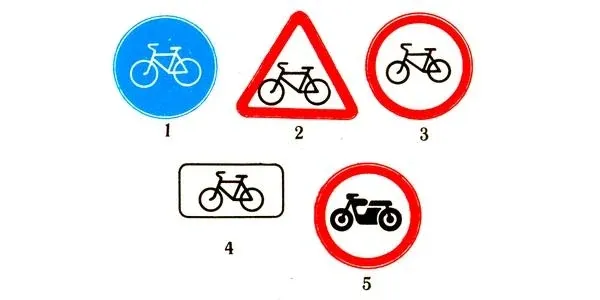
Only number 2, the triangle, warns: it is sign 1.24 “Intersection with a cycle path”. The blue disc orders, the red rings forbid, and the plate only adds information to another sign.
Remember: A warning sign warns and nothing more. It creates no duty to give way and it prohibits nothing. Sign 1.5 doesn’t tell you to yield to a tram, and sign 1.24 doesn’t tell you to yield to a cyclist. The priority rules decide who goes first.
How far ahead does the sign stand?
Section titled “How far ahead does the sign stand?”Signs 1.1, 1.2 and 1.5 to 1.33 stand before the start of the dangerous section. The distance depends only on where you are:
| Where | Distance from the sign to the danger |
|---|---|
| In a built-up area | 50 to 100 m |
| Outside built-up areas | 150 to 300 m |
So in a built-up area the danger begins at least 50 m after the sign, and outside at least 150 m after it. If some other distance is needed, it is written on plate 8.1.1 “Distance to the object”.
Common trap: The danger doesn’t begin at the sign. The gap is there to give you time to slow down. 300 to 500 m, 25 to 50 m and 100 to 150 m are not distances the Rules use for these signs.
Railway crossings
Section titled “Railway crossings”| Sign | No. | Name | Meaning |
|---|---|---|---|
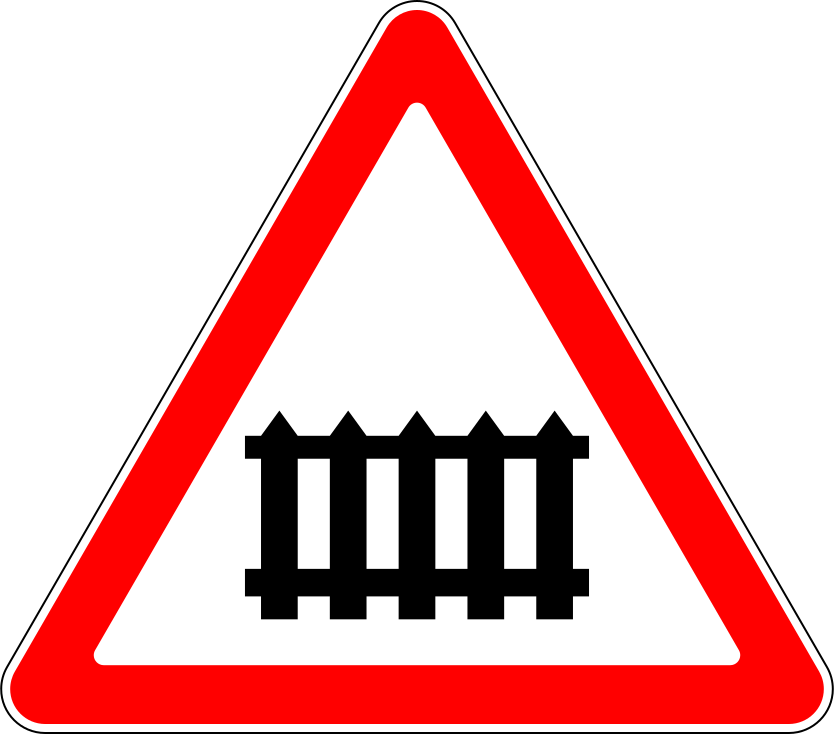 |
1.1 | Railway crossing with a barrier | The crossing ahead has a barrier |
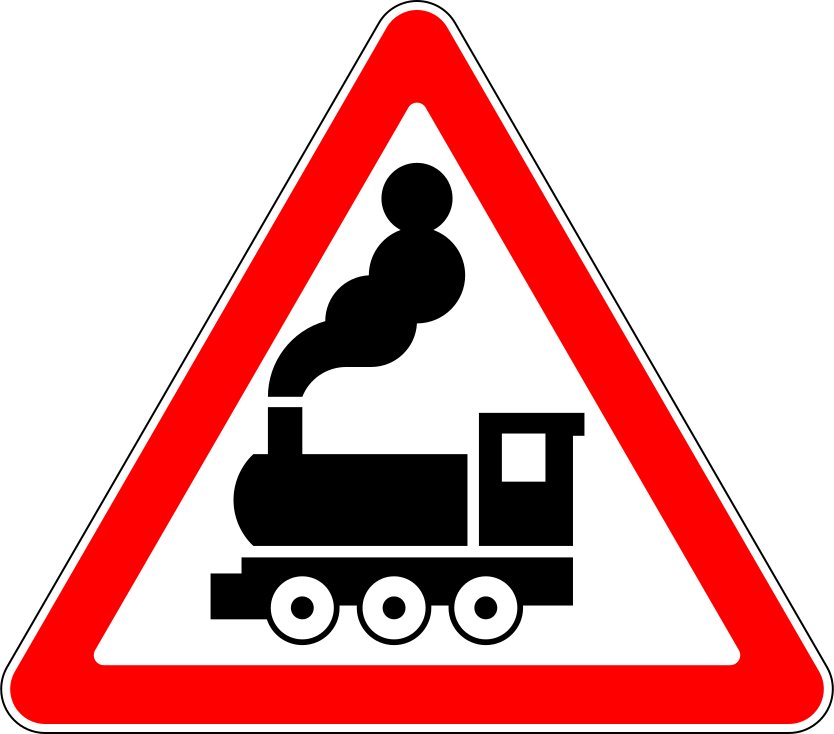 |
1.2 | Railway crossing without a barrier | The crossing ahead has no barrier |
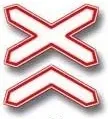 |
1.3.2 | Multi-track railway | Marks a crossing with two or more tracks |
Picture the barrier on 1.1 and the train you must watch for on 1.2. Neither says how many tracks there are. Only the crossed boards do: a single cross is 1.3.1 “Single-track railway”, and a cross with a chevron under it is 1.3.2.
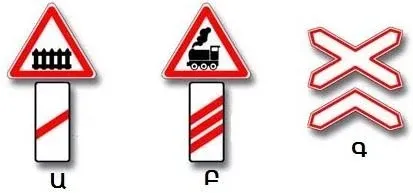
The striped posts under signs 1.1 and 1.2 belong to group 1.4 “Approach to a railway crossing”. Only Գ (C) tells you about two or more tracks.
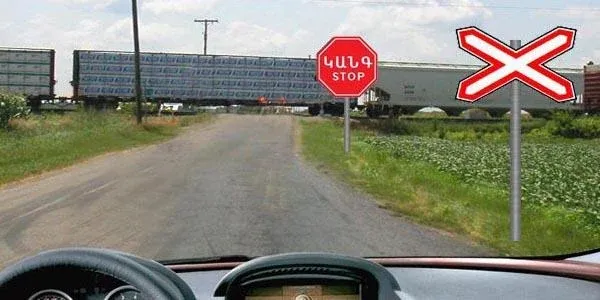
The single cross on the right is sign 1.3.1. It marks the crossing itself.
Intersections and people on the road
Section titled “Intersections and people on the road”| Sign | No. | Name | Meaning |
|---|---|---|---|
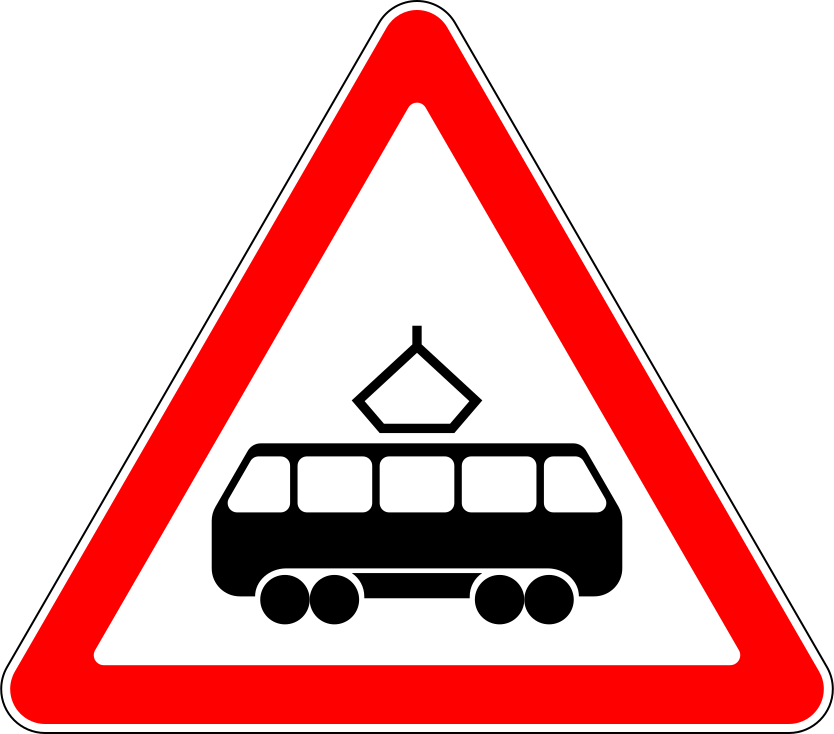 |
1.5 | Intersection with a tram line | The road crosses tram tracks |
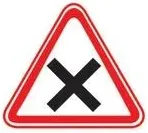 |
1.6 | Intersection of roads of equal importance | A crossing with arms of equal weight: neither road is the main one |
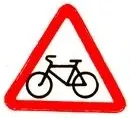 |
1.24 | Intersection with a cycle path | The road crosses a cycle path |
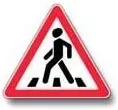 |
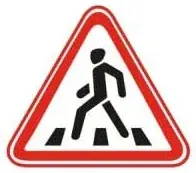
1.22 | Pedestrian crossing | A crossing marked by signs 5.19.1 and 5.19.2 or by road markings |
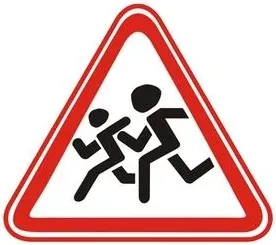 |
1.23 | Children | Warns of children on the road |
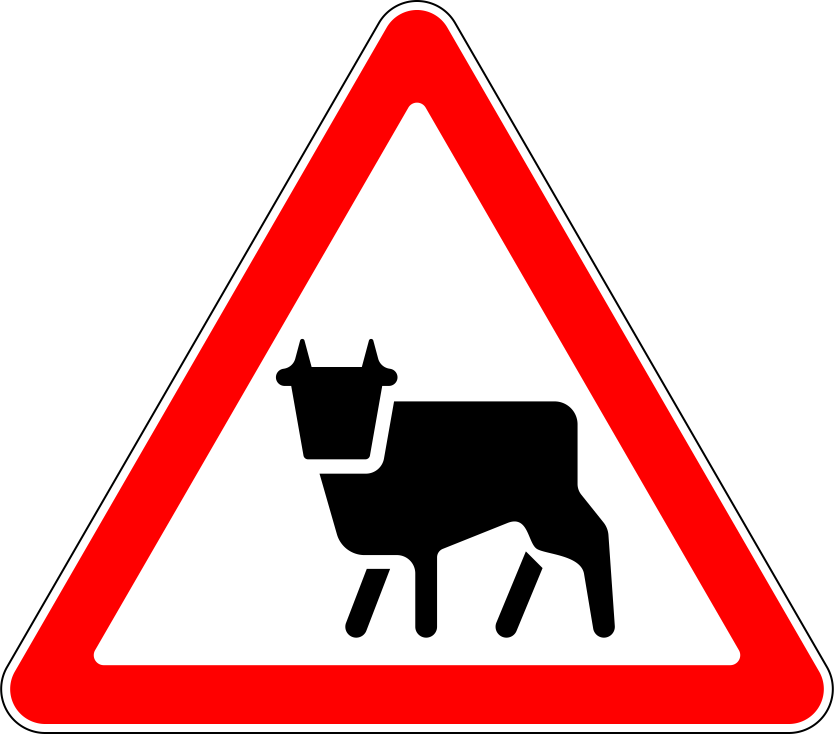 |
1.26 | Cattle | Warns of livestock being driven across |
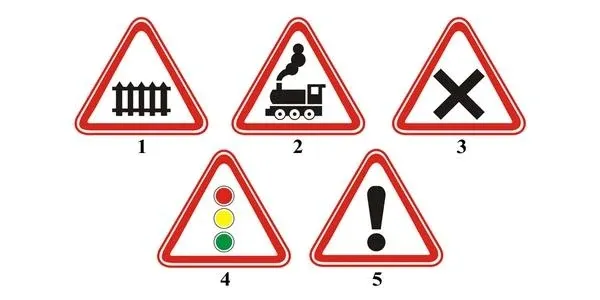
Two more signs appear in the exam: 1.8 “Traffic light regulation”, a triangle with three lights (number 4 below), and 1.33 “Other dangers”, a triangle with an exclamation mark (number 5).
Bends, slopes and the road surface
Section titled “Bends, slopes and the road surface”| Sign | No. | Name | Meaning |
|---|---|---|---|
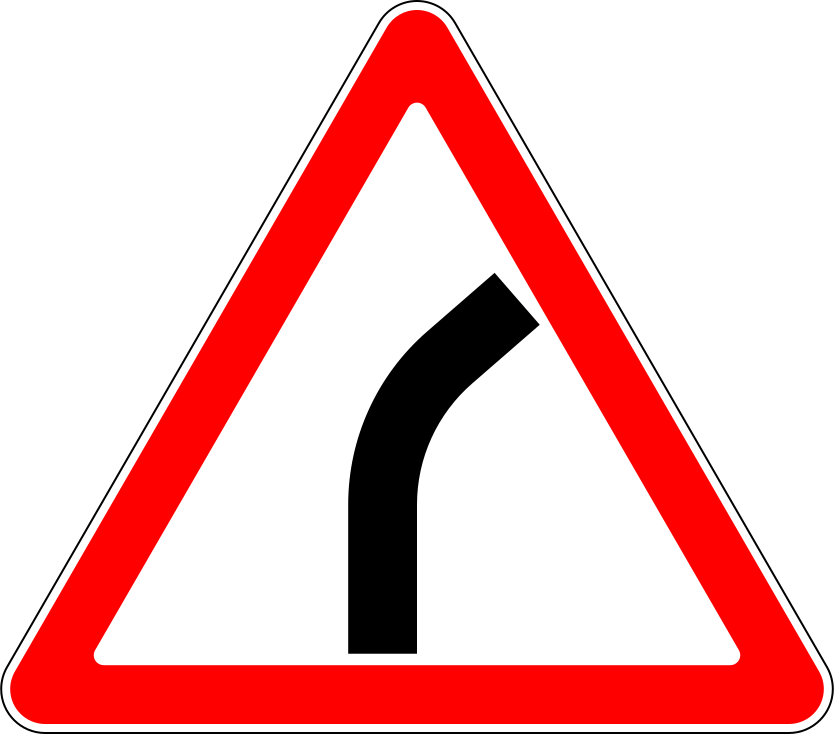 |
1.11.1 | Dangerous turn | A turn to the right |
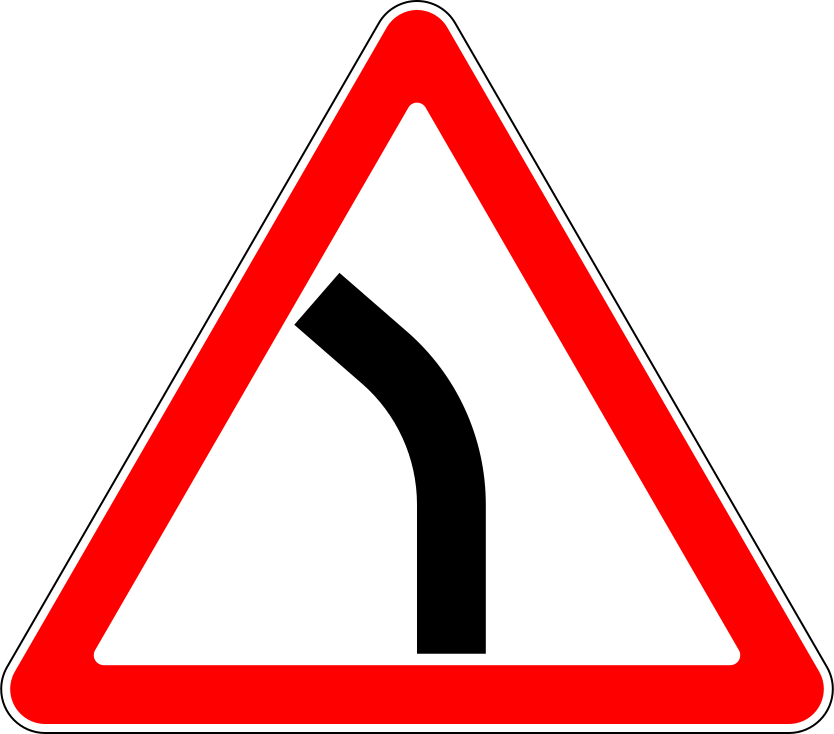 |
1.11.2 | Dangerous turn | A turn to the left |
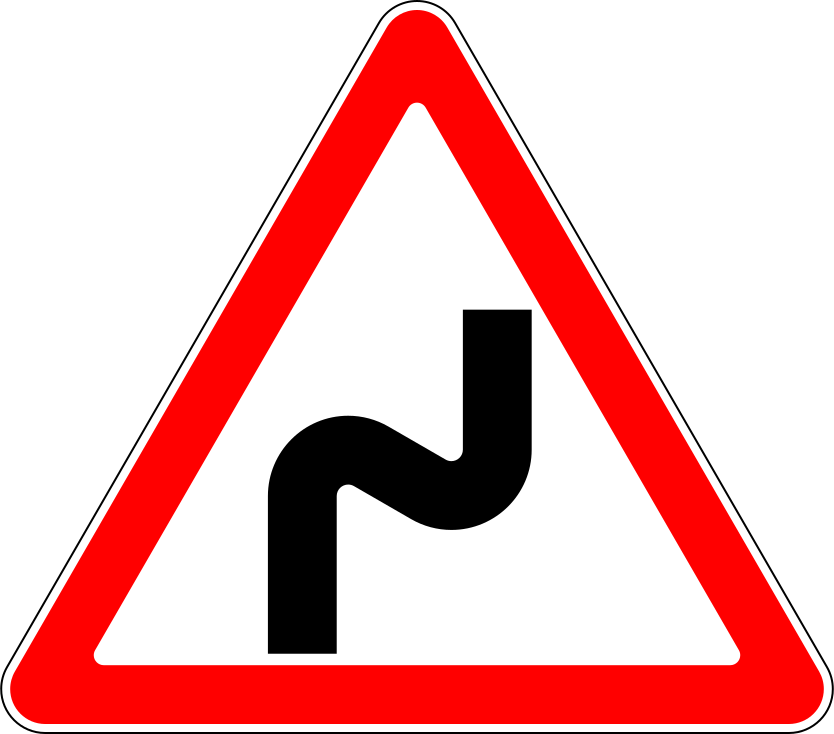 |
1.12.1 | Dangerous turns | Several turns, the first to the right |
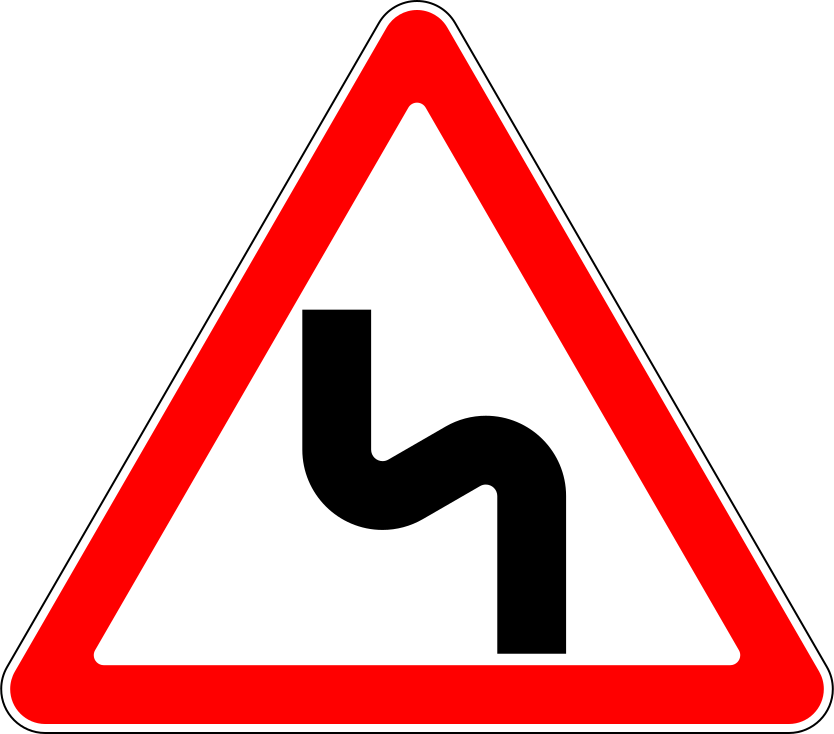 |
1.12.2 | Dangerous turns | Several turns, the first to the left |
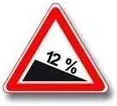 |
1.13 | Steep descent | The road drops steeply ahead |
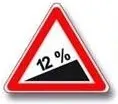 |
1.14 | Steep ascent | The road climbs steeply ahead |
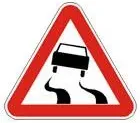 |
1.15 | Slippery road | The carriageway is unusually slippery |
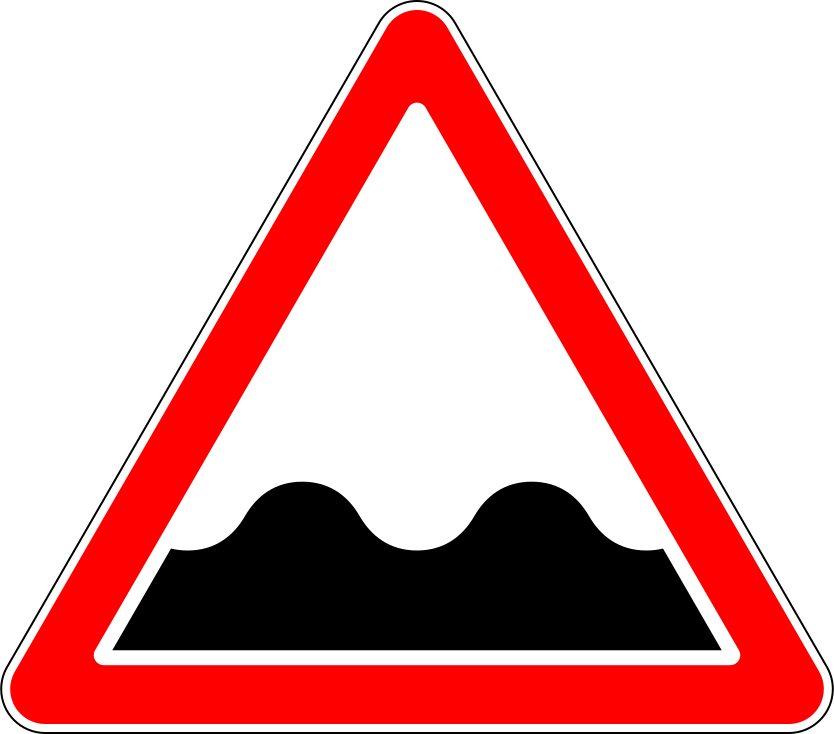 |
1.16 | Uneven road | The surface is uneven |
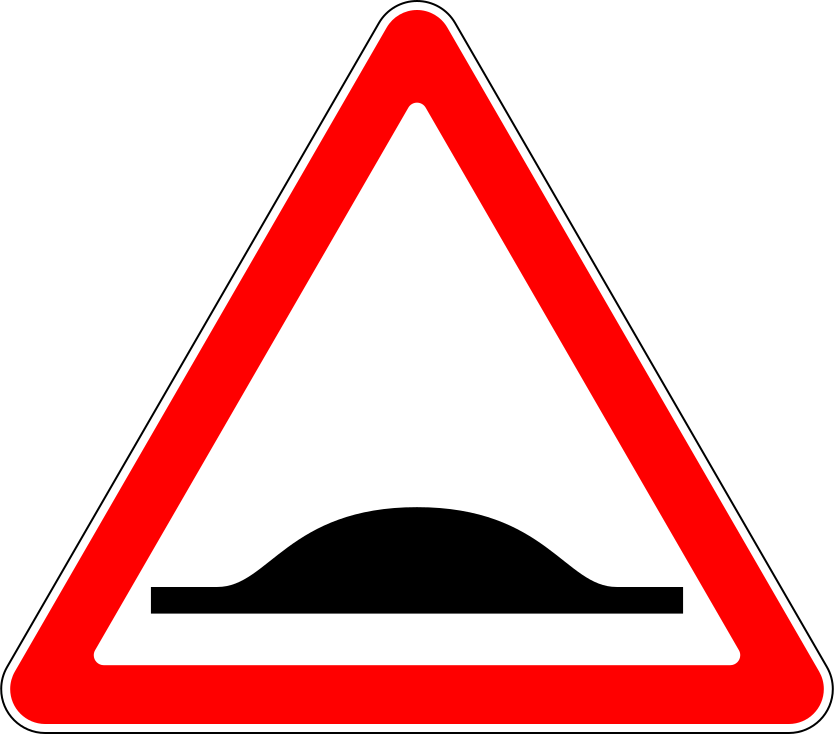 |
1.17 | Artificial bump | Advance warning of a bump |
 |
1.18 | Gravel ejection | Gravel and small stones may be thrown from wheels |
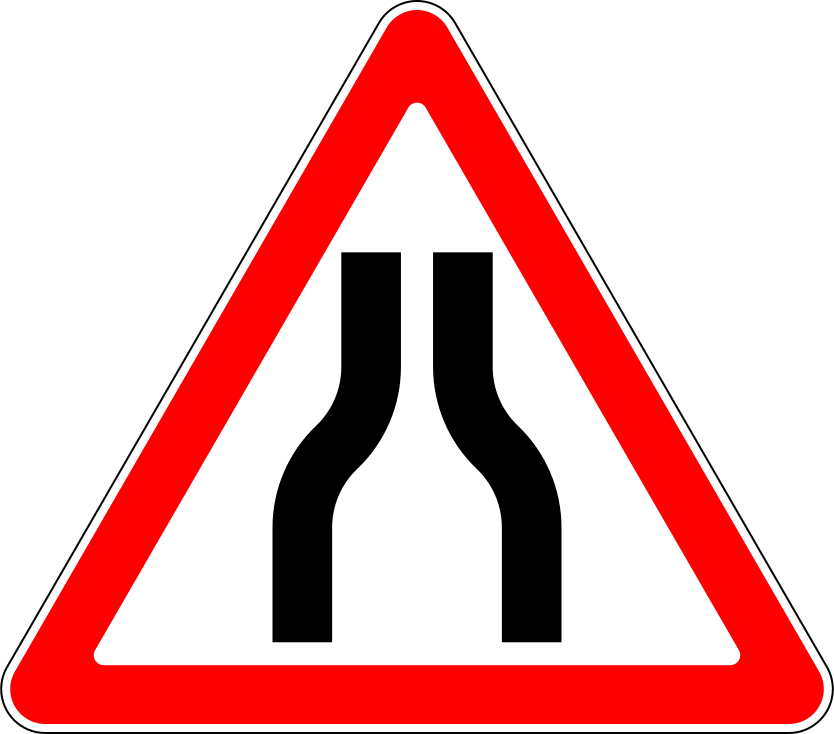 |
1.20.1 | Narrowing of the road | The road narrows from both sides |
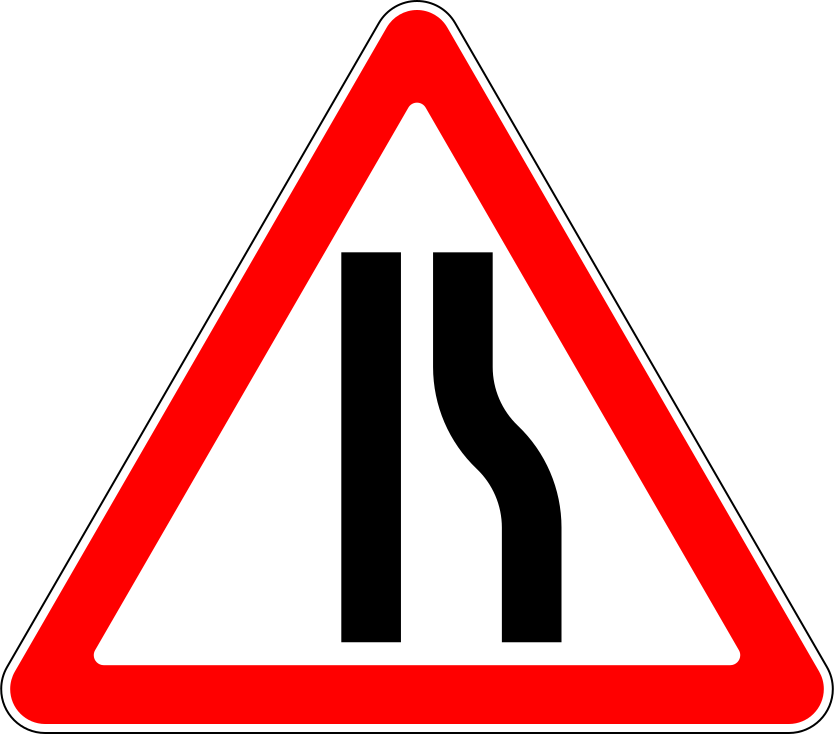 |
1.20.2 | Narrowing of the road | The road narrows on the right |
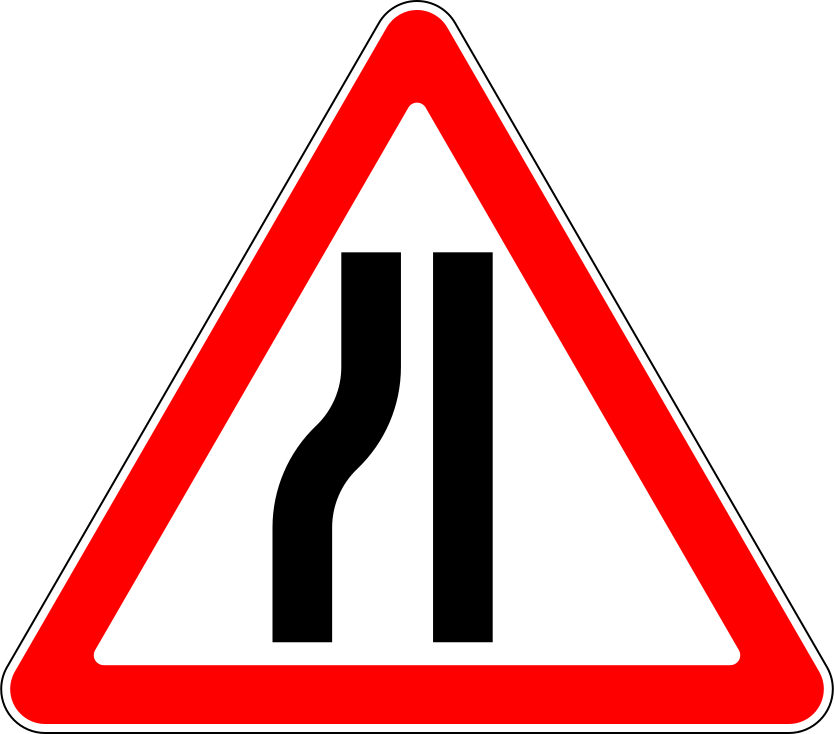 |
1.20.3 | Narrowing of the road | The road narrows on the left |
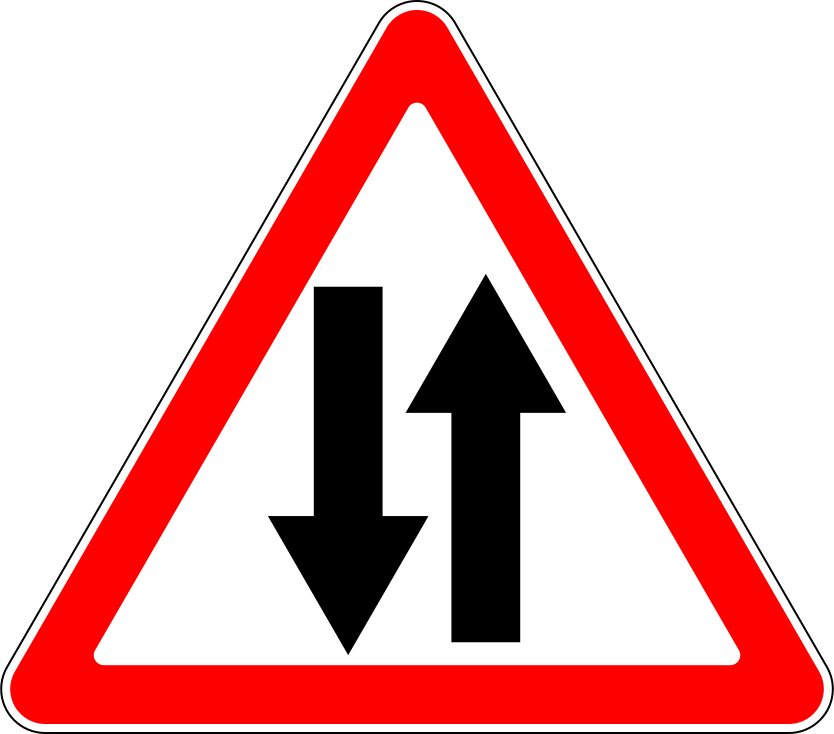 |
1.21 | Two-way traffic | A section with oncoming traffic begins ahead |
On a section with signs 1.13 and 1.14, if passing is difficult, the driver going downhill must give way, because moving off again on a climb is much harder (point 46).
Other dangers ahead
Section titled “Other dangers ahead”| Sign | No. | Name | Meaning |
|---|---|---|---|
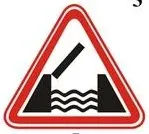 |
1.9 | Opening bridge | A drawbridge or ferry crossing |
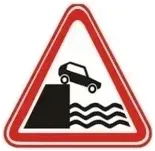 |
1.10 | Emergence onto an embankment | The road comes out onto a quay or bank |
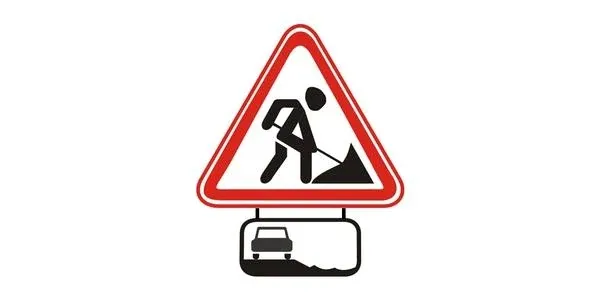 |
1.25 | Road works | Repairs are under way. The plate shown here is 8.12 |
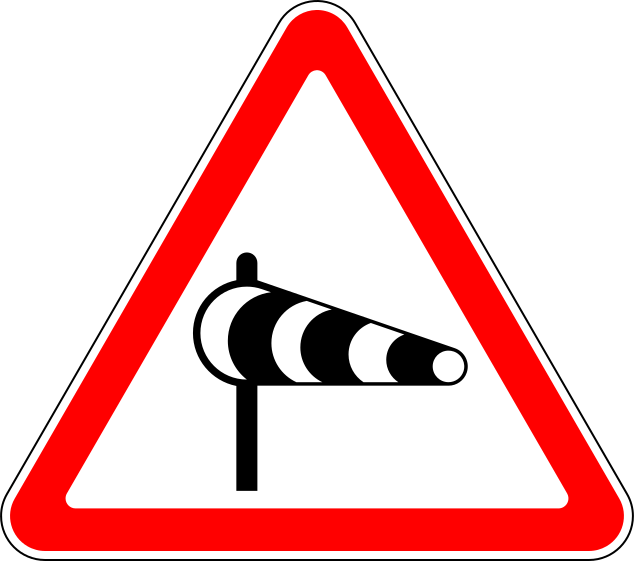 |
1.29 | Side wind | Wind from the side |
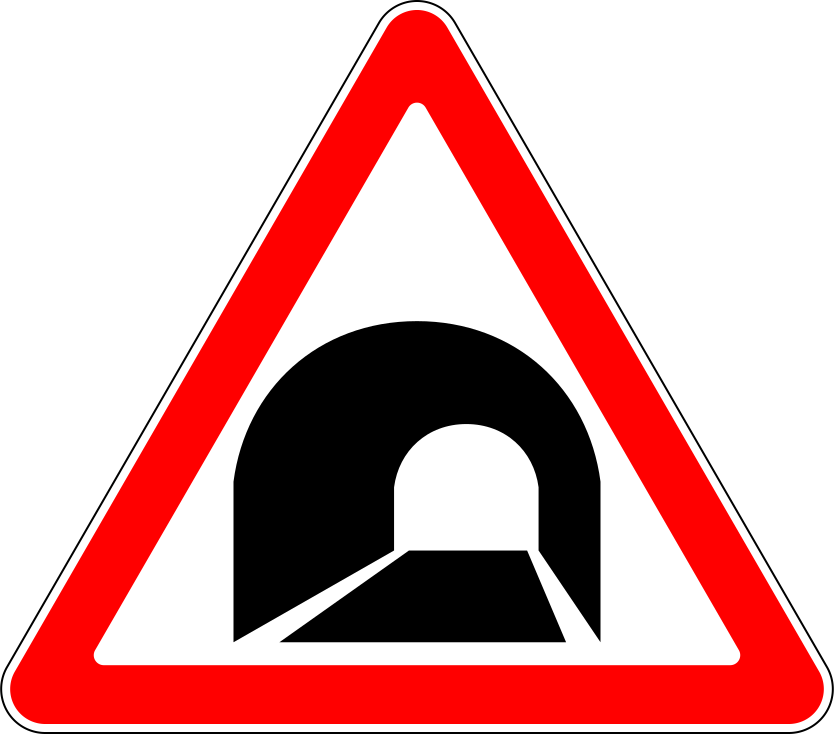 |
1.31 | Tunnel | A tunnel with no artificial lighting, or with an entrance that is hard to see |
Two signs that break the triangle rule
Section titled “Two signs that break the triangle rule”| Sign | No. | Name | Meaning |
|---|---|---|---|
 |
1.34.3 | Direction of the turn | Shows the ways you can go at a T-shaped intersection or a fork. It prohibits nothing |
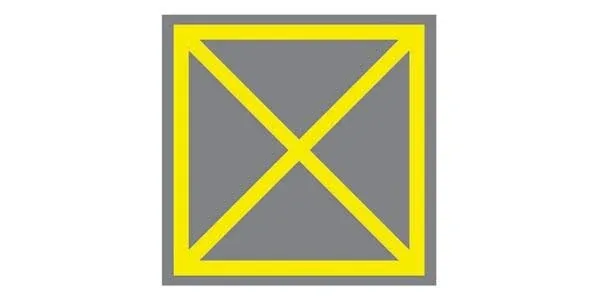 |
1.35 | Intersection area | Marks an intersection with the yellow grid, marking 1.26 |
Sign 1.35 looks nothing like a warning sign, and it comes with a real rule. Don’t enter the intersection if a jam ahead would force you to stop inside it and block crossing traffic. Turning right or left is the exception.
The condition matters. A jam ahead alone isn’t enough: the ban applies when it would make you stop there.
Sign 1.35 stands at the boundary of the intersection. At a complex intersection, if it can’t stand there, it stands no more than 30 m from the boundary.
Try it yourself
Section titled “Try it yourself”You are on a road through the forest, outside a built-up area.
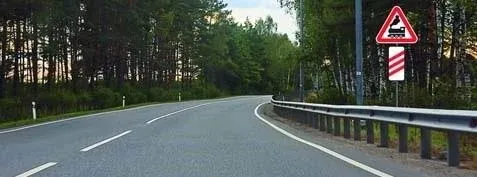
What is ahead? A railway crossing without a barrier, 150 to 300 m on. The locomotive means no barrier, and this road is outside a built-up area. The sign says nothing about the number of tracks.
You are in a built-up area and see this sign.
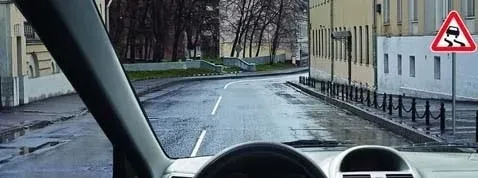
Where does the slippery section begin? At least 50 m after the sign. Not immediately after it, and not at least 100 m: 50 m is the shortest distance used in a built-up area.
Key points
Section titled “Key points”- Warning signs are triangles with a red border. They warn, and they create no duty of their own.
- Built-up area: 50 to 100 m before the danger. Outside: 150 to 300 m. Plate 8.1.1 gives any other distance.
- 1.1 shows a barrier, 1.2 a locomotive without one. Only the crossed boards 1.3 tell you the tracks.
- 1.6 is a plain cross of equal arms: neither road is the main one.
- 1.31 warns of a tunnel with no artificial lighting or a hard-to-see entrance.
- Under 1.35, don’t enter if a jam would force you to stop inside. It stands no more than 30 m from the boundary.
Practice questions
Section titled “Practice questions”Question 2. This road sign indicates:
- A section of road where there is a pavement or a pedestrian path.
- A section of road where there is a pedestrian crossing.
- A section of road where there is no pavement or pedestrian path.
Show answer
Correct: 2. A section of road where there is a pedestrian crossing.
This is warning sign 1.22, “Pedestrian crossing”, which warns of a section of road where there is a pedestrian crossing marked by signs 5.19.1/5.19.2 and (or) markings 1.14.1–1.14.2 — so the marked answer is correct. A section with a pavement or a pedestrian path is the meaning of a different (mandatory/informational) sign, not of 1.22, and “a section with no pavement or pedestrian path” is not the meaning of any pedestrian-crossing sign at all. Only “a section of road where there is a pedestrian crossing” corresponds to sign 1.22.
Question 4. At what distance from the dangerous section of the road are these signs placed in built-up areas?
- 15 - 25 m.
- 25 - 50 m.
- 50 - 100 m.
- 100 - 150 m.
- 150 - 300 m.
Show answer
Correct: 3. 50 - 100 m.
These are warning signs, the first group. The Rules place signs 1.1, 1.2 and 1.5 to 1.33 ahead of the start of the dangerous section - 150 to 300 m before it outside built-up areas, and 50 to 100 m before it inside them. Inside a built-up area the answer is therefore “50 - 100 m.” “150 - 300 m.” is the distance used OUTSIDE built-up areas, which is the trap in this question, while “15 - 25 m.”, “25 - 50 m.” and “100 - 150 m.” are not distances the Rules prescribe for these signs at all.
Question 7. Which of the signs warns of approaching an intersection of roads of equal importance?
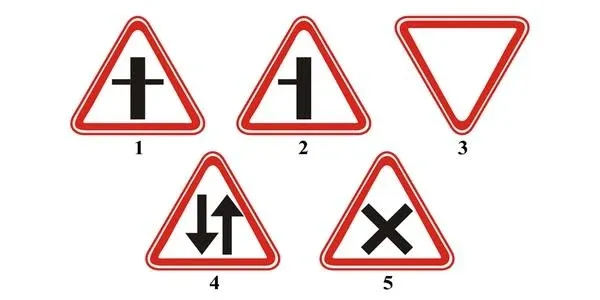
- 1
- 2
- 3
- 4
- 5
Show answer
Correct: 5. 5
The sign that warns of approaching an intersection of roads of equal importance is warning sign 1.6 “Intersection of roads of equal importance”, the triangle carrying a plain cross with arms of equal weight - that is number 5. The other signs are different warning or priority signs, such as a junction with a minor road or a main road, and each of them announces a different order of priority rather than an equal-rank crossroads. Sign 5 is therefore the correct answer.
Question 22. This road sign warns that ahead there is
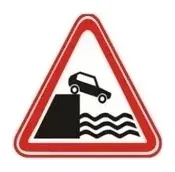
- A road section with a water obstacle that has no bridge or ferry crossing.
- A road section with a water obstacle spanned by an opening bridge (drawbridge).
- A place where the road comes out onto a bank or quay.
Show answer
Correct: 3. A place where the road comes out onto a bank or quay.
This is warning sign 1.10 “Exit onto a quay”, which under the Rules marks a place where the road comes out onto a quay or bank — exactly the answer given. The option “a road section with a water obstacle spanned by an opening bridge” describes a different warning sign, 1.9 “Opening bridge” (a drawbridge or a ferry crossing), not 1.10. The option “a road section with a water obstacle that has no bridge or ferry crossing” corresponds to no defined warning sign and is likewise not the meaning of 1.10. The correct answer is therefore the place where the road comes out onto a bank or quay.
Question 38. Which of the signs is called “Intersection with a cycle path”?
- 1
- 2
- 3
- 4
- 5
Show answer
Correct: 2. 2
The sign called “Intersection with a cycle path” is warning sign 1.24 - a white TRIANGLE with a red border carrying a bicycle - which is number 2. The shape is what settles it: a sign that warns of something ahead is a triangle. Number 1 is the blue mandatory sign 4.4.1 “Cycle path”, number 3 is the prohibitory 3.9 “Movement of bicycles prohibited” and number 5 the prohibitory 3.5 “Movement of motorcycles prohibited”, while number 4 is a rectangular plate bearing a bicycle. None of them warns of an intersection. Sign 2 is therefore the correct choice.
Question 39. Which of the signs shows the directions of traffic at a T-shaped intersection?
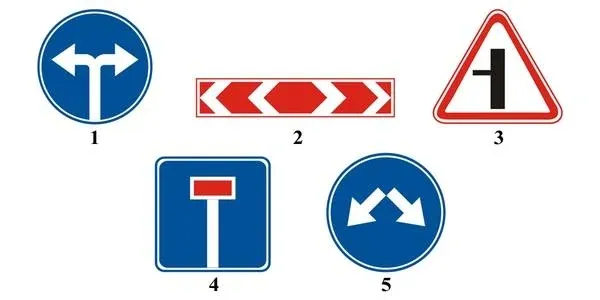
- 1
- 2
- 3
- 4
- 5
Show answer
Correct: 2. 2
The directions of traffic at a T-shaped intersection, or where a road branches, are shown by sign 1.34.3 “Direction of the turn” - the rectangular panel carrying chevrons that point both ways - which is number 2. Number 1 is the mandatory sign 4.1.6 “Movement to the right or to the left”, number 3 is the warning sign 2.3.3 “Adjoining of a minor road”, number 4 is the information sign 6.8.1 “Dead end” and number 5 is 4.2.3 “Bypassing the obstacle on the right or on the left”. None of those shows the directions of traffic at a T-shaped intersection. Sign 2 is therefore the correct choice.
Question 80. Which of the road signs presented below prohibits entering the intersection area if congestion (a traffic jam) has formed ahead in the direction of travel, except in cases of making a right or left turn?
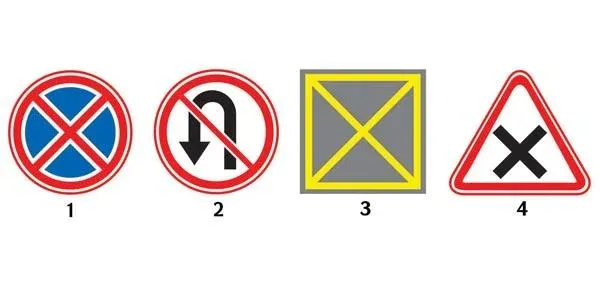
- 1
- 2
- 3
- 4
Show answer
Correct: 3. 3
The sign that prohibits entering an intersection when there is congestion ahead is number 3, sign 1.35 “Intersection area” - a grey square with a yellow border and a yellow cross. It marks the approach to an intersection area marked with marking 1.26, which may not be entered if congestion ahead in the direction of travel would force the driver to stop and so obstruct traffic crossing his path, except when he is turning right or left. Number 1 is 3.27 “No stopping”, number 2 is 3.19 “No U-turn” and number 4 is the warning sign 1.6 “Intersection of roads of equal importance”; none of them governs entering an occupied intersection. Sign 3 is therefore the only correct choice.
Question 81. At what maximum distance is the “intersection area” road sign placed at complex intersections, if it cannot be placed at the boundary of the intersection?
- 10 metres
- 20 metres
- 30 metres
Show answer
Correct: 3. 30 metres
Sign 1.35 “Intersection area” is normally placed exactly at the boundary of the intersection. The Rules add that if at a complex intersection the sign cannot be placed at the boundary, it is placed no more than 30 m from the boundary of the intersection — so “30 metres” is the correct answer. “10 metres” and “20 metres” are not the figure set by the Rules; the maximum permitted offset of sign 1.35 at complex intersections is exactly 30 m.
Question 82. What does the following road sign warn about?
- Stopping is prohibited.
- It is prohibited to enter the intersection area if congestion (a traffic jam) has formed ahead in the direction of travel that would force the driver to stop.
- It is prohibited to enter the intersection area if congestion (a traffic jam) has formed ahead in the direction of travel.
Show answer
Correct: 2. It is prohibited to enter the intersection area if congestion (a traffic jam) has formed ahead in the direction of travel that would force the driver to stop.
The picture shows sign 1.35 “Intersection area” (a square with a yellow border and a yellow cross). The Rules define it as the approach to an intersection (marked with marking 1.26) which may not be entered if congestion has formed ahead in the direction of travel that would force the driver to stop, obstructing crossing traffic — so the correct option is the one containing the words “that would force the driver to stop”. “Stopping is prohibited” describes a different sign (3.27), not 1.35. The third option drops the decisive condition: entry is prohibited only when the congestion would in fact force the driver to stop in the intersection, so a wording without that qualification distorts the rule and is wrong.
Question 108. What does the road sign warn about?
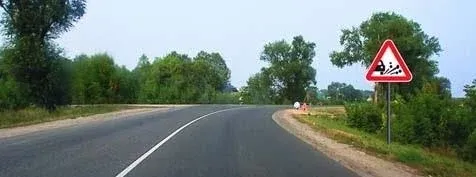
- Approaching a slippery road section
- Approaching a wet and dirty road section
- A road section where gravel may be thrown from the wheels
Show answer
Correct: 3. A road section where gravel may be thrown from the wheels
The triangular sign is warning sign 1.18 “Gravel ejection”, which under the Rules marks a section of road where gravel, small stones and the like may be thrown out from under vehicles’ wheels. It therefore warns of a section where gravel may be thrown from the wheels. “Approaching a slippery road section” and “Approaching a wet and dirty road section” are wrong because those are different warning signs with different pictograms; 1.18 warns specifically about stones flying out from under the wheels, which is why following at a distance matters here.
Question 113. In this case, after what minimum distance may an intersection of roads of equal importance be encountered?
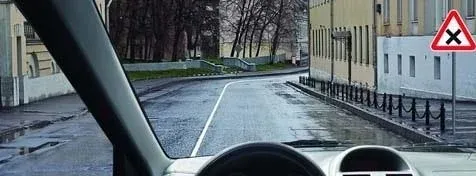
- 100 metres
- 150 metres
- 50 metres
Show answer
Correct: 3. 50 metres
The triangular sign is warning sign 1.6 “Intersection of roads of equal importance”. Under the Rules, warning signs 1.1, 1.2 and 1.5 to 1.33 are placed ahead of the dangerous section - 150 to 300 m before it outside built-up areas, and 50 to 100 m before it inside them. This is a built-up area, so the sign stands 50 to 100 m before the intersection, and the equal-rank intersection may therefore be encountered after a minimum of 50 metres. “100 metres” and “150 metres” are wrong because the shortest placement distance permitted in a built-up area is 50 m.
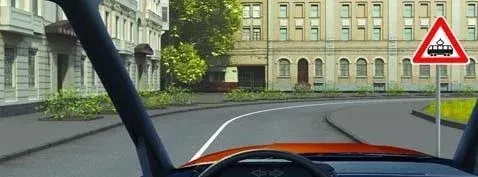
- Warns of a crossing with tram tracks
- About approaching a tram stopping point
- Requires giving way to the tram driver
Show answer
Correct: 1. Warns of a crossing with tram tracks
This is warning sign 1.5 “Intersection with a tram line”, which under the Rules warns of the place where the road crosses tram tracks. It therefore warns of a crossing with tram tracks. “About approaching a tram stopping point” is wrong because that is a different sign. “Requires giving way to the tram driver” is wrong because 1.5 is a warning sign and imposes no duty of its own: who gives way at the crossing is settled by the priority rules, not by this triangle.
Question 118. These signs warn
- Of approaching a triple-track railway crossing
- That at a distance of 150-300 m there will be a railway crossing without a barrier
- That after 50-100 metres there is a railway crossing
Show answer
Correct: 2. That at a distance of 150-300 m there will be a railway crossing without a barrier
The triangular sign is warning sign 1.2 “Railway crossing without a barrier”, accompanied by an approach post of the 1.4 “Approach to a railway crossing” group. Under the Rules these warning signs are placed 150 to 300 m ahead of the dangerous section outside built-up areas, and this is an out-of-town road, so they warn that at a distance of 150-300 m there will be a railway crossing without a barrier. “Of approaching a triple-track railway crossing” is wrong because 1.2 says the crossing has no barrier and says nothing about how many tracks it has, and “after 50-100 metres” is wrong because that is the placement distance used inside built-up areas.
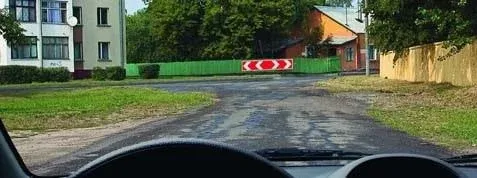
- Shows the directions of movement at the intersection
- Prohibits movement through the intersection
Show answer
Correct: 1. Shows the directions of movement at the intersection
This is warning sign 1.34.3 “Direction of the turn”, which under the Rules shows the directions of travel at a T-shaped intersection or where a road branches - its chevrons point the ways the road actually goes. It therefore shows the directions of movement at the intersection. “Prohibits movement through the intersection” is wrong because 1.34.3 is a sign that informs about the direction of the turn: it says where you MAY go, and prohibits nothing.
Question 128. In a built-up area, at what distance will the slippery road section begin?
- At a minimum of 100 metres
- At a minimum of 50 metres
- Immediately after the sign
Show answer
Correct: 2. At a minimum of 50 metres
The triangular sign is warning sign 1.15 “Slippery road”, which warns of a section where the carriageway is unusually slippery. Under the Rules, warning signs 1.1, 1.2 and 1.5 to 1.33 are placed 50 to 100 m ahead of the dangerous section inside built-up areas. In a built-up area the slippery section will therefore begin at a minimum of 50 metres beyond the sign. “At a minimum of 100 metres” is wrong because 50 m is the shortest placement distance permitted in a built-up area, and “Immediately after the sign” is wrong because a warning sign is always placed some way ahead of the danger, to leave the driver time to slow down.
Question 133. These road signs inform about
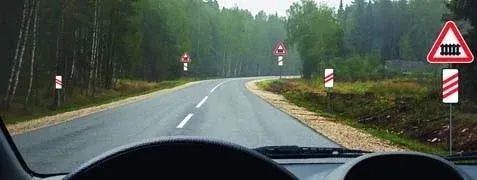
- The construction of a railway crossing
- Approaching a railway crossing with a barrier
- A railway crossing without a barrier
Show answer
Correct: 2. Approaching a railway crossing with a barrier
The triangular sign is warning sign 1.1 “Railway crossing with a barrier”, together with the striped approach posts of the 1.4 “Approach to a railway crossing” group. Together they inform the driver that he is approaching a railway crossing equipped with a barrier. “The construction of a railway crossing” is wrong - these are warning signs about a crossing that exists, not about building work. “A railway crossing without a barrier” is wrong because the pictogram inside the triangle is a barrier: the crossing WITHOUT one is sign 1.2, which shows a locomotive instead.
Question 135. This sign informs about approaching a tunnel
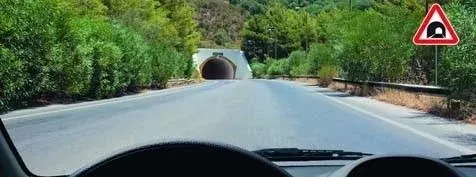
- Where road markings are absent
- Where artificial lighting is absent
Show answer
Correct: 2. Where artificial lighting is absent
This is warning sign 1.31 “Tunnel”, which under the Rules marks a tunnel that has no artificial lighting, or a tunnel whose portal is of limited visibility. It therefore informs the driver that he is approaching a tunnel where artificial lighting is absent. “Where road markings are absent” is wrong because 1.31 is about the lighting - or the visibility of the entrance - and says nothing about the markings.
Question 136. This sign gives advance information about
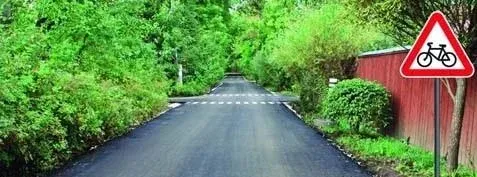
- The need to give way to a cyclist
- An intersection with a cycle path
- Approaching a cycling ground
Show answer
Correct: 2. An intersection with a cycle path
This is warning sign 1.24 “Intersection with a cycle path”, which under the Rules gives advance notice of the place where the road crosses a cycle path. It therefore gives advance information about an intersection with a cycle path. “The need to give way to a cyclist” is wrong because 1.24 is a warning sign and creates no duty to give way of its own - who yields is settled by the priority rules. “Approaching a cycling ground” is wrong because the sign marks a crossing with a cycle path, not a sports ground.
Question 603. Outside built-up areas, at what distance before the beginning of the dangerous section is this warning sign placed?
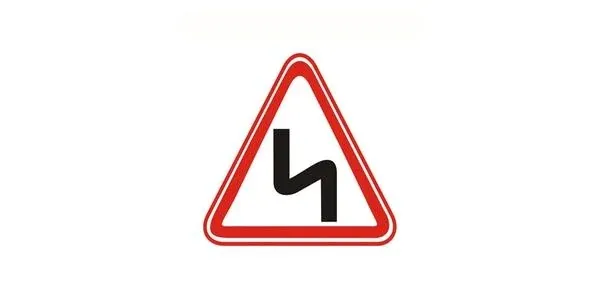
- 50 - 100 m.
- 150 - 300 m.
- 300 - 500 m.
Show answer
Correct: 2. 150 - 300 m.
The sign shown is warning sign 1.12.2 “Dangerous turns”, with the first turn to the left. Under the rules for applying the signs, signs 1.1, 1.2 and 1.5 to 1.33 are placed ahead of the start of the dangerous section 150 to 300 m before it outside built-up areas and 50 to 100 m before it inside them, so outside a built-up area this sign stands 150 to 300 m before the bends. “50 - 100 m.” is the distance used inside built-up areas, and “300 - 500 m.” is not a prescribed distance at all: where some other distance is needed it is written on plate 8.1.1 “Distance to the object”.
Question 854. At what distance before the start of the dangerous section is this warning sign placed in built-up areas?
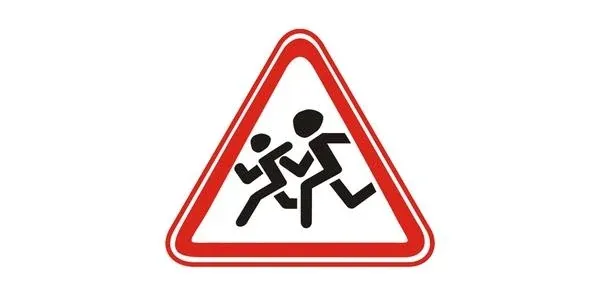
- 25 - 50 m.
- 50 - 100 m.
- 100 - 150 m.
Show answer
Correct: 2. 50 - 100 m.
The sign shown is warning sign 1.23 “Children” - a red-bordered triangle with the figures of running children. Under the road-signs annex, signs 1.1, 1.2 and 1.5 to 1.33 are placed ahead of the start of the dangerous section at 50 to 100 m in built-up areas and at 150 to 300 m outside them. “25 - 50 m.” and “100 - 150 m.” are therefore wrong: neither matches the distance prescribed for built-up areas, and where the sign has to be placed at some other distance, that distance is written on plate 8.1.1 “Distance to the object”.
Question 1062. Which of the signs warns of approaching the beginning of a road with oncoming traffic?
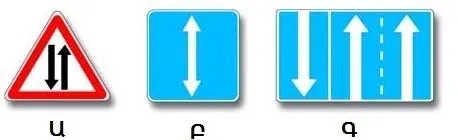
- Only Ա (A)
- Only Ա (A) and Բ (B)
- All
Show answer
Correct: 1. Only Ա (A)
Sign Ա (A) is the warning sign 1.21 “Two-way traffic”, which under the Rules marks the beginning of a section of road, or of a carriageway, with oncoming traffic - that is, it warns of approaching the start of a road with two-way traffic. Sign Բ (B) is a blue information sign and Գ (C) is the lane-directions sign; neither warns of the start of two-way traffic, and neither is even a warning sign. Only Ա (A) therefore gives that warning, so “Only Ա (A) and Բ (B)” and “All” are wrong.
Question 1067. In which case is information given about a railway crossing with two or more tracks?
- Ա (A) and Գ (C)
- Ա (A) and Բ (B)
- Only Գ (C)
- Բ (B) and Գ (C)
Show answer
Correct: 3. Only Գ (C)
Sign Գ (C) is St Andrew’s cross 1.3.2 “Multi-track railway”, which under the Rules marks a railway crossing with two or more tracks - the single-track version being 1.3.1. Signs Ա (A) and Բ (B) are the warning signs 1.1 “Railway crossing with a barrier” and 1.2 “Railway crossing without a barrier”, shown with their approach posts: they warn that a crossing is coming but say nothing about the number of tracks. Information about a crossing with two or more tracks is therefore given by Գ (C) alone, so “Ա (A) and Գ (C)”, “Ա (A) and Բ (B)” and “Բ (B) and Գ (C)” are wrong.