Traffic Lights
A traffic light tells you when you may move, and it settles who goes first when two drivers may move at once. Red and green are the easy part, so most of this lesson covers arrows, trams and reversible lanes.
What does each signal mean?
Section titled “What does each signal mean?”| Signal | Meaning | What you do |
|---|---|---|
| Green | Movement is permitted | Go, giving way where this lesson says so |
| Flashing green | Movement is permitted, but its time is ending and a prohibiting signal will come on soon | Judge now whether you can stop without braking sharply |
| Yellow | Stop, with one exception (point 19) | Stop at the places listed below |
| Red | Movement is prohibited | Stop |
| Red and yellow together | Movement is prohibited, and green will come on shortly | Get ready, but wait for green |
| Flashing yellow | Movement is permitted, and the intersection counts as unregulated | Follow the priority signs and priority rules |
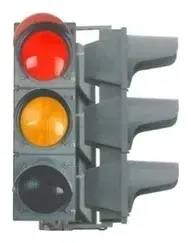
Red and yellow together, point 7: movement is still prohibited.
Common trap: Red with yellow is a warning to be ready, not a permission. It is a normal phase of a working light. It doesn’t mean the light is broken or that an emergency vehicle is coming.
May I carry on when yellow comes on?
Section titled “May I carry on when yellow comes on?”Only if you can’t stop without harsh braking (point 19). If you can stop calmly, stop.
Where exactly do I stop?
Section titled “Where exactly do I stop?”Point 18 gives the order:
- At the “Stop line” marking or sign 6.16 “Stop line”.
- If there is neither, before the intersection, at the edge of the crossing carriageway.
- In other places, before the traffic light.
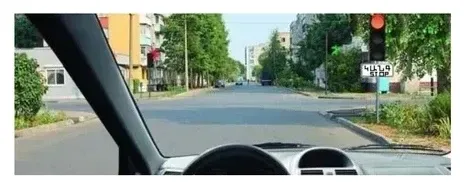
Sign 6.16 stands at the light, so you stop before the traffic light.
A big intersection can have a second stop line in the middle. Under point 93, you then obey each light separately. The first green carries you only as far as the second line.
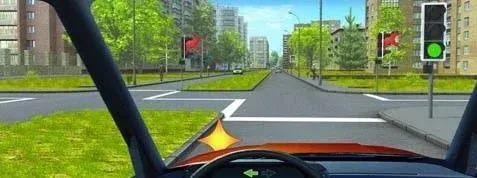
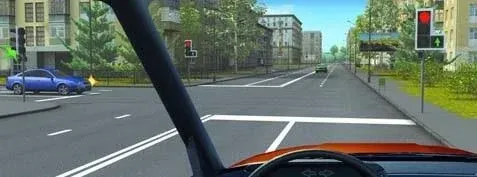
Turning left here, you enter, stop before the second “Stop line” and wait for its green.
The same goes for a U-turn past a light with sign 6.16. You finish it only on green, even if you are part-way through.
Do road signs still count when a light works?
Section titled “Do road signs still count when a light works?”Priority signs don’t. Under point 173, when a light contradicts a priority sign, you follow the light. The rule names priority signs only, so it doesn’t switch off prohibitory or mandatory signs.
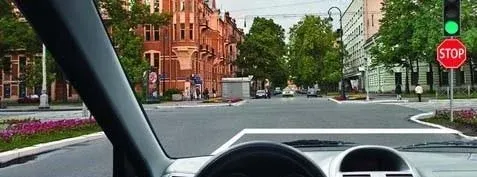
Green, with sign 2.5 “Movement without stopping prohibited” under it: you don’t have to stop.
Remember: The priority signs wait underneath the light. They take over when it is switched off or flashing yellow.
Who gives way on a plain green?
Section titled “Who gives way on a plain green?”- Turning left or making a U-turn: give way to oncoming vehicles going straight or turning right (point 90).
- Turning right: you owe oncoming traffic nothing, because your paths don’t cross. You must still give way to any pedestrians and cyclists on the road you enter (point 87).
- A vehicle with a blue flashing beacon and special sound signal: give way to it, as point 28 requires, even on your green.
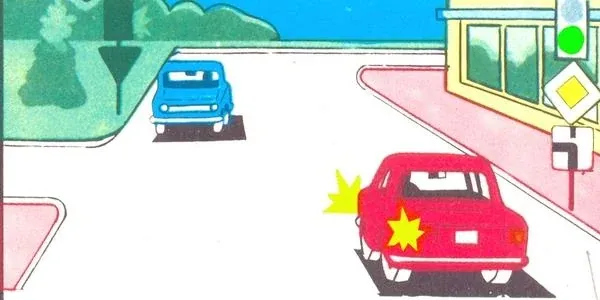
Both cars have green. The red car turns left, so the blue car goes first.
Extra: Green doesn't mean the way is clear
Not from the question bank.
Before you move off on green, glance left and right. A late driver or pedestrian may still be crossing. A second of checking costs you nothing.
What does a green arrow beside a red light mean?
Section titled “What does a green arrow beside a red light mean?”The arrow sits in an additional section next to the main light. It lets you move in its direction while everyone else waits.
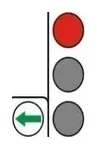
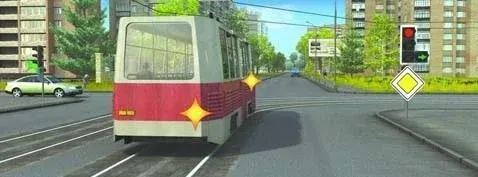
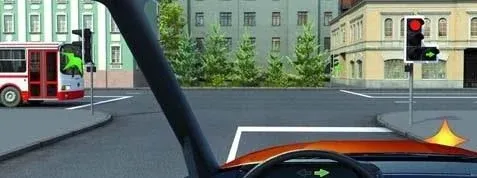
The arrow lets you go. It doesn’t let you go first. Under point 91, a driver moving on an arrow lit beside red must give way to vehicles coming from other directions. This holds wherever the arrow points, even straight ahead, and for a bus pulling out of a stop.
The arrow also acts only in its own direction (point 8):
- Right arrow: take the nearest opening only. Reaching a second opening would mean driving straight on, and red forbids that.
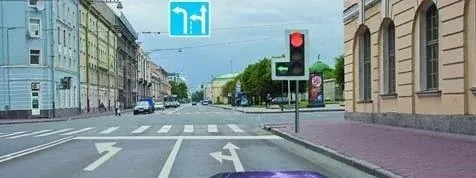
- Left arrow: it covers a U-turn only where signs 5.15.1 or 5.15.2 allow the left turn from the left edge lane. From the right lane, you may only turn left.
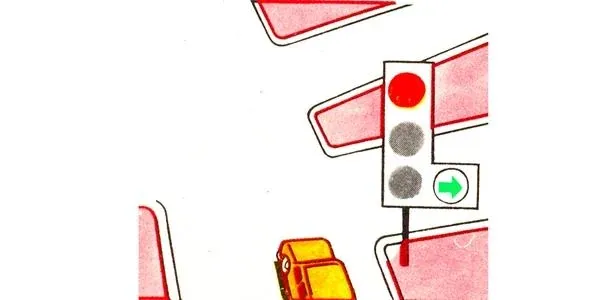
Only to the right, through the first opening.
Green main signals can have additional sections too:
- A section that is off prohibits movement in its direction (point 8).
- A black outline arrow on the main green shows which directions that green covers, and tells you a section exists for the rest (point 10). It doesn’t ban the other directions: their own section decides.
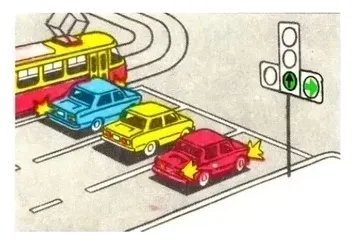
Straight and right are open, so the yellow and red cars may move. The left section is off, so the tram and the blue car wait.
When does a tram go first?
Section titled “When does a tram go first?”| Situation | Who goes first |
|---|---|
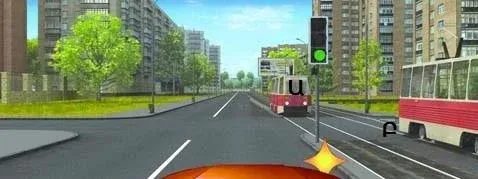
| Signals let a tram and other vehicles move at the same time | The tram, whichever way it is going (point 92) |
| The tram moves on an arrow beside its own red or yellow | Everyone else. The tram gives way (points 91, 92) |
| The tram’s signal doesn’t allow its direction | You. The tram has to wait |
| The tram and a bus both move on arrows, and their paths cross | The tram, then the bus |
| The tram and a car both move on arrows, on paths that don’t cross | They go together |
How do I read the tram light?
Section titled “How do I read the tram light?”Four moon-white lenses form a T. Trams use this light, and so do other public-use vehicles in separated lanes (point 14). Movement is permitted only when the bottom lens and an upper lens are lit together:
- Upper left: to the left.
- Upper middle: straight.
- Upper right: to the right.
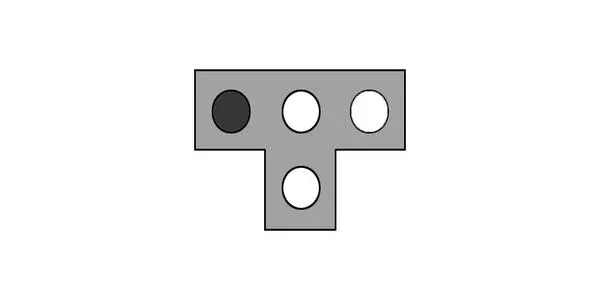
Straight and right are allowed. Only left is prohibited.
If the bottom lens is dark, the tram must stand still, however many upper lenses are lit.
What are reversible lights?
Section titled “What are reversible lights?”These lights hang over single lanes, especially lanes whose direction can be turned around. Each one governs only the lane under it, never the whole carriageway (point 13).
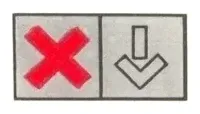
| Signal above the lane | Meaning |
|---|---|
| Red X | Movement in this lane is prohibited, so you can’t enter it to overtake either |
| Green downward arrow | Movement in this lane is permitted, for ordinary travel and not just overtaking |
| Off, with marking 1.9 on both sides of the lane | Entry is prohibited |
Common trap: A dark reversible light is a ban, not a free lane. You may not enter to overtake, even if the road is clear and the vehicle ahead is slow.
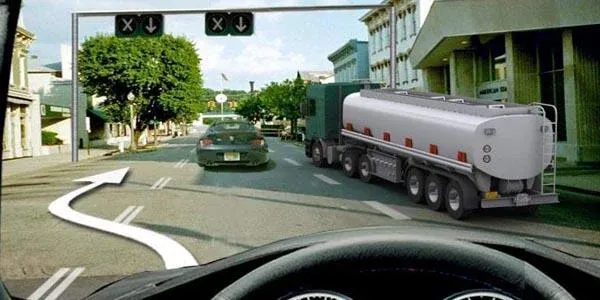
The lights are off, so this path is prohibited. A left turn doesn’t come from this lane either: make it from the proper edge lane.
Try it yourself
Section titled “Try it yourself”You are the red car, beside the blue car. Your main signal is red, with a green right arrow. A green car is on the crossing road.
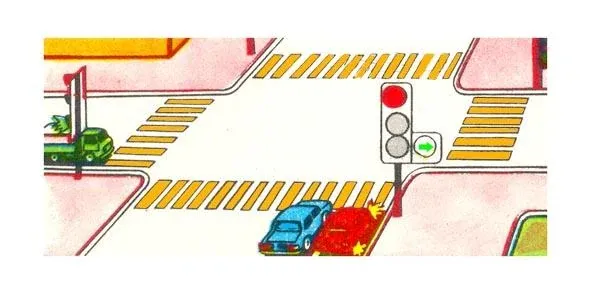
Who passes first? The green car. You and the blue car may turn right, but under point 91 you give way to it.
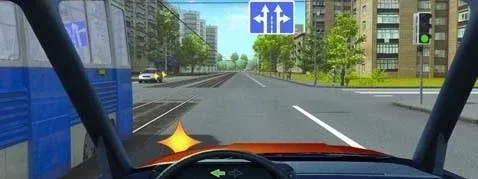
You are turning left on green. The tram beside you signals left too, but only its bottom and upper middle lenses are lit.
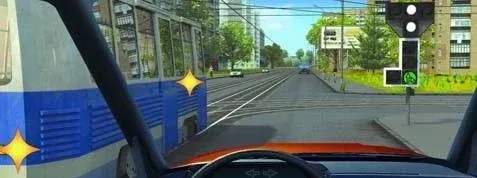
Who goes first? You do. The tram’s signal lets it go straight only, so its turn isn’t permitted and it has no priority over you (point 92).
Three vehicles, one light. The car has plain green. The tram and the bus face red with a right arrow.
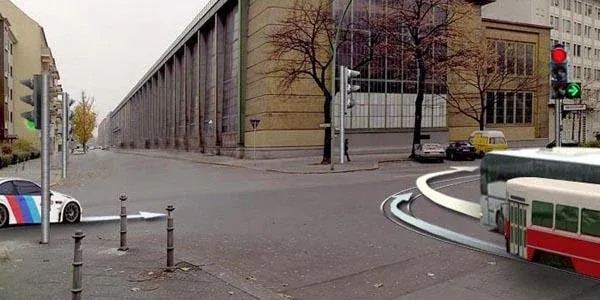
What is the order? Car, tram, bus. The arrow puts both behind the car (point 91), and point 92 puts the tram ahead of the bus.
Key points
Section titled “Key points”- Red with yellow still means stop. Flashing green still means go, but not for long.
- If yellow catches you and you can’t stop without harsh braking, you may continue.
- A working light overrides priority signs only.
- On green, a left turn or U-turn gives way to oncoming traffic going straight or right.
- A green arrow beside red means go after giving way, and only in that direction.
- A tram goes first when both of you may move, unless it is on an arrow beside its own red or yellow.
- A reversible light governs one lane, and when it is off, entry is prohibited.
Practice questions
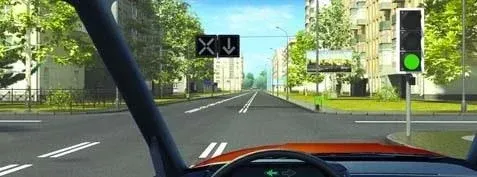
Section titled “Practice questions”Question 86. Are you obliged to stop before the “Stop line”
- Yes
- No
Show answer
Correct: 2. No
Marking 1.12 “Stop line” shows where the driver must stop when the traffic light shows a prohibiting signal or when sign 2.5 “Movement without stopping prohibited” is in place, and sign 2.5 does stand beside the light here. But the light is working and showing green, the permitting signal, and under point 173 of the Traffic Rules, where the meanings of the traffic light signals conflict with the requirements of the priority signs - 2.5 among them - drivers must be guided by the traffic light. On green you are therefore not obliged to stop before the stop line. “Yes” is wrong because the requirement of sign 2.5 applies when the light is switched off or flashing yellow.
Question 210. Which vehicle’s driver must give way?
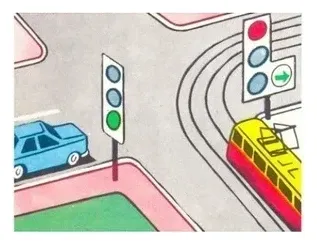
- The car driver.
- The tram driver.
Show answer
Correct: 2. The tram driver.
The traffic light for the car’s direction is showing green, while the light for the tram’s direction has a red main signal with the green arrow of an additional section switched on. Under the Rules a green arrow in an additional section, lit at the same time as a red main signal, permits movement in the direction the arrow shows but obliges the driver to give way to vehicles coming from the other directions. It is therefore the tram driver who must give way - a tram has the advantage on equal terms, and here the terms are not equal. “The car driver.” is wrong because the car is moving on a plain green signal.
Question 212. Vehicles will drive through the intersection in the following order:
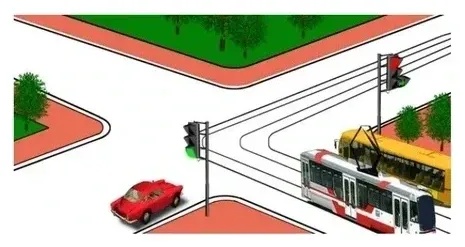
- Tram and bus, passenger car.
- Tram, passenger car, bus.
- Passenger car, tram and bus.
Show answer
Correct: 3. Passenger car, tram and bus.
The green traffic-light signal is lit for the passenger car, and under point 7 of the Rules it permits movement, so the car passes the intersection first. For the tram and the bus the red main signal is lit together with the green right-turn arrow of the additional section; under point 91 of the Rules (and, for the tram, point 92 as well), a driver moving in the direction of an arrow switched on at the same time as the red signal must give way to vehicles travelling from other directions. The options in which the tram and the bus — or the tram alone — pass ahead of the passenger car are therefore wrong: they complete the right turn only after the car has gone through.
Question 214. Which vehicle’s driver must give way:
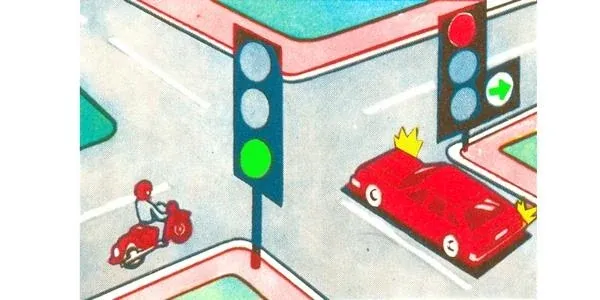
- The motorcycle driver.
- The car driver.
Show answer
Correct: 2. The car driver.
The traffic light for the motorcycle’s direction is showing green, while the light for the car’s direction has a red main signal with the green arrow of an additional section switched on. Under the Rules a green arrow in an additional section lit together with a red main signal permits movement in the direction of the arrow, but the driver must give way to vehicles coming from the other directions. It is therefore the car driver who must give way, and the motorcyclist, who is moving on an ordinary green signal, has the advantage.
Question 219. This traffic light prohibits driving
- Only to the left.
- Straight and to the left.
- Straight and to the right.
- Only to the right.
Show answer
Correct: 1. Only to the left.
This is the signal that regulates trams, with four moon-white lenses arranged in a T: the bottom one, the top middle one and the top right one are lit, while the top LEFT one is dark. Under point 14 of the Traffic Rules movement is permitted only when the bottom lens and the corresponding upper lens are lit together - the left one permits travel to the left, the middle one straight ahead, the right one to the right. This signal therefore prohibits travel only to the left. “Straight and to the left”, “Straight and to the right” and “Only to the right” are wrong because the lit lenses permit both straight ahead and to the right.
Question 221. The driver of the red car
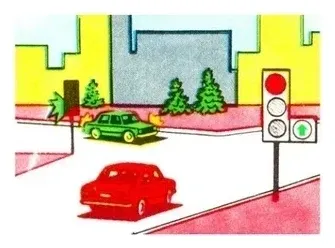
- Must give way.
- Has the right of way.
Show answer
Correct: 1. Must give way.
The red car is standing at a red main signal with a green arrow lit in the additional section, which permits it to move. Under point 91 of the Rules, a driver travelling in the direction of an arrow lit in an additional section at the same time as the red signal must give way to the vehicles coming from the other directions. The driver of the red car must therefore give way - here to the green car. “Has the right of way.” is wrong because point 91 obliges him to yield: the green arrow lets him go, it does not let him go first.
Question 223. At which traffic light signal may the car driver complete the U-turn.
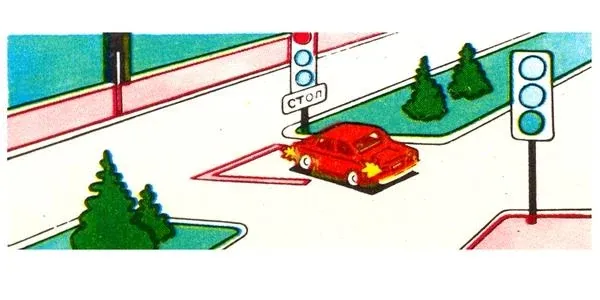
- Red.
- Green.
- Any.
Show answer
Correct: 2. Green.
Under point 7 of the Traffic Rules the green signal permits movement and the red signal prohibits it. Sign 6.16 “Stop line” is placed under the traffic light here, so under point 93 the driver must be guided by the signals of EACH traffic light he passes, and he may complete the U-turn on the green signal. “Red.” is wrong because a red signal prohibits movement, and “Any.” is wrong because carrying on with the U-turn is prohibited on a prohibiting signal - being already part-way through a manoeuvre does not release the driver from the light in front of him.
Question 224. What does the combination of the traffic light’s yellow and red signals mean.
- It is permitted to start driving.
- Driving is prohibited and it informs about the green signal coming on shortly.
- A vehicle with a special sound signal and flashing beacons switched on is approaching the intersection.
Show answer
Correct: 2. Driving is prohibited and it informs about the green signal coming on shortly.
Under point 7 of the Rules the combination of the red and yellow signals PROHIBITS movement and informs the driver that the green signal is about to come on. Both signals lit together therefore forbid moving off and warn that green is coming shortly. “It is permitted to start driving.” is wrong: the combination is a warning to be ready, not a permission - movement stays prohibited until green actually shows. “A vehicle with a special sound signal and flashing beacons switched on is approaching the intersection.” is not what this combination means at all.
Question 226. Is the tram driver obliged, at the traffic light’s green signal, to give way to vehicles approaching from other directions.
- He is obliged.
- He is not obliged.
Show answer
Correct: 1. He is obliged.
The traffic light here shows a red main signal together with the green arrow of the additional section, so the tram is moving in the direction of that arrow while the main signal is red. Under point 92 of the Rules, when a tram moves in the direction of an additional-section arrow lit at the same time as the red (or yellow) signal of the traffic light, the tram driver must give way to vehicles approaching from other directions. The tram driver is therefore obliged to give way. “He is not obliged” is wrong, because the tram has no priority in this case.
Question 227. This traffic light is used to regulate traffic

- Across the entire width of the carriageway.
- In those lanes of the carriageway where the direction of traffic may be changed to the opposite.
- Only in the lanes intended for the traffic of public-use vehicles.
Show answer
Correct: 2. In those lanes of the carriageway where the direction of traffic may be changed to the opposite.
This is a reversible traffic light, showing a red X and a green downward arrow. Under point 13 of the Rules such lights are used to regulate traffic in individual lanes of the carriageway, in particular those lanes whose direction of travel may be turned to face the other way. It therefore regulates traffic in the lanes where the direction may be reversed. “Across the entire width of the carriageway.” is wrong because it governs one lane at a time, and “Only in the lanes intended for the traffic of public-use vehicles.” is wrong because the lanes it controls are the reversible ones, not the bus lanes.
Question 229. Which vehicles’ traffic is permitted at this traffic light signal.
- The tram’s, the yellow and red cars’.
- The yellow and red cars’.
- All vehicles’.
Show answer
Correct: 2. The yellow and red cars’.
The main green signal is lit, carrying a black outline arrow pointing straight ahead, and the green arrow of the right additional section is on: under points 8 and 10 of the Traffic Rules that permits travel straight ahead and to the right. The left additional section is switched OFF, and under point 8 a signal that is off in an additional section PROHIBITS movement in the direction that section governs. Only the yellow car going straight and the red car with its right indicator on may therefore move. The tram, whose rails curve away to the left, and the blue car with its left indicator on must both wait, which is why the options including the tram and “All vehicles’.” are wrong.
Question 232. Which vehicle’s driver has priority of passage.
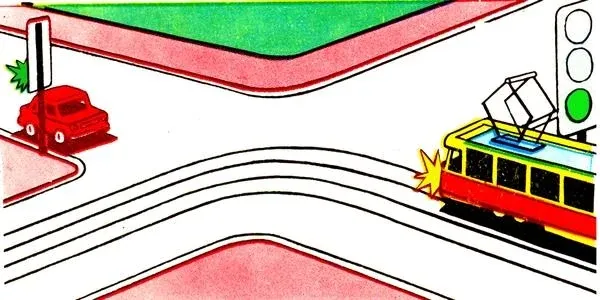
- The car driver.
- The tram driver.
Show answer
Correct: 2. The tram driver.
At this regulated intersection the traffic light signals permit the tram and the non-rail car to move at the same time. Under point 92 of the Rules, where the signals permit a tram and non-rail vehicles to move simultaneously, the TRAM has priority, whatever direction it is travelling in. Priority of passage therefore belongs to the tram driver. “The car driver.” is wrong because a non-rail vehicle has no priority over a tram when both are permitted to move together - the tram’s advantage does not depend on which way it is going.
Question 234. With the red signal of this traffic light, movement is prohibited:
- Across the entire width of the carriageway.
- At a speed of no more than 50 km/h.
- In the lane above which it is placed.
Show answer
Correct: 3. In the lane above which it is placed.
This is a reversible traffic light, with an X-shaped red signal and a green arrow pointing downwards. Under point 13 of the Rules these signals prohibit or permit movement in the lane ABOVE WHICH they are placed. With the red X showing, movement is therefore prohibited in the lane over which that signal hangs. “Across the entire width of the carriageway.” is wrong because a reversible light governs only its own lane, and “At a speed of no more than 50 km/h.” is wrong because the signal has nothing to do with speed at all.
Question 235. What is the meaning of the traffic light’s round green flashing signal.
- It informs that entry into the intersection is prohibited.
- It permits driving and informs that its period of operation is expiring and the prohibiting signal will come on soon.
Show answer
Correct: 2. It permits driving and informs that its period of operation is expiring and the prohibiting signal will come on soon.
Under point 7 of the Rules, a flashing green traffic light signal “permits driving and informs that its period of operation is expiring and the prohibiting signal will come on soon”. It gives the driver time to judge whether he can stop without braking sharply or should carry on. The option “It informs that entry into the intersection is prohibited” is wrong, because a flashing green is still a permitting signal, not a prohibiting one.
Question 236. The vehicles will pass the intersection in the following order:
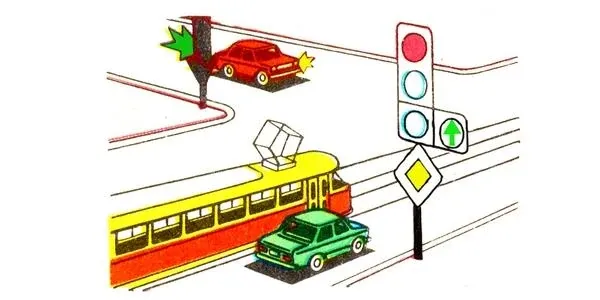
- The tram, the red car, the green car.
- The red car, the tram — simultaneously with the green car.
- The tram — simultaneously with the green car, the red car.
Show answer
Correct: 2. The red car, the tram — simultaneously with the green car.
The tram and the green car are standing at a red signal with the green arrow of an additional section lit alongside it. Under points 91 and 92 of the Traffic Rules a driver moving in the direction of that arrow - the tram driver included - must give way to the vehicles coming from the other directions, and sign 2.1 does not change this, because under point 173 drivers are guided by the traffic light signals. The red car, whose direction has the green signal, therefore goes first. The tram and the green car then pass at the same time, since both go straight ahead on parallel paths that do not cross. That is exactly why the options in which the tram goes first are wrong.
Question 240. In which direction is movement permitted?
- Straight and to the right — through the first opening.
- To the right — through the first opening.
- To the right — through the second opening.
- To the right — through the first and second openings.
Show answer
Correct: 2. To the right — through the first opening.
The main signal is red and the additional section shows a green arrow pointing to the right. Under point 7 of the Rules a red signal prohibits movement, and under point 8 a green arrow in an additional section permits movement only in the direction it shows. Travel is therefore permitted only to the right, through the first - the nearer - opening. “Straight and to the right” is wrong because the red main signal forbids going straight, and the options naming the second opening, or both openings, are wrong because only the nearer right turn is allowed by that arrow.
Question 241. The first to pass the intersection will be:
- The red car.
- The blue car.
- The green car.
Show answer
Correct: 3. The green car.
The red and blue cars are standing at a red main signal with the green right arrow of an additional section lit, so they may only turn right. Under point 91 of the Rules a driver moving in the direction of an arrow lit in an additional section at the same time as the red signal must give way to the vehicles coming from the other directions. The green car, which comes from another direction, therefore passes the intersection first. “The red car.” and “The blue car.” are wrong because point 91 obliges them both to give way to it.
Question 244. This traffic light is used:
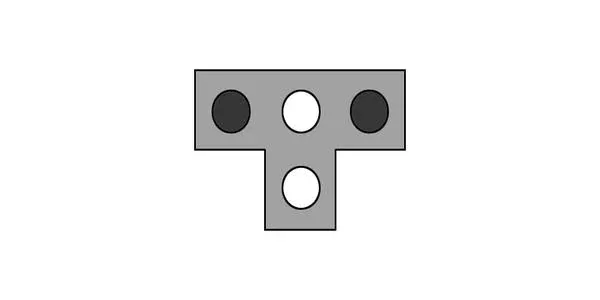
- To regulate the movement of trams and trolleybuses.
- Only to regulate the movement of trams.
- To regulate the movement of trams, as well as of other public-use vehicles moving in separated lanes.
Show answer
Correct: 3. To regulate the movement of trams, as well as of other public-use vehicles moving in separated lanes.
This is a traffic light with four round moon-white signals arranged in a T. Under point 14 of the Rules such lights are used to regulate the movement of trams, and also of other public-use vehicles travelling in separated lanes. “To regulate the movement of trams and trolleybuses.” is wrong because the signal is not limited to trolleybuses - it covers any route vehicle in a separated lane - and “Only to regulate the movement of trams.” is wrong because it regulates those other route vehicles as well.
Question 245. The car will pass the intersection:
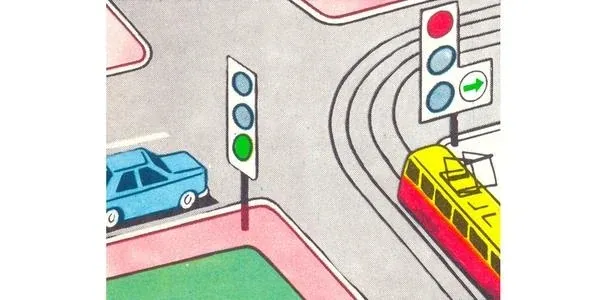
- First.
- Second.
Show answer
Correct: 1. First.
The car is travelling on the traffic light’s green signal, while the tram has a red main signal together with the green arrow of the additional section. Under point 92 of the Rules, when a tram travels in the direction of an additional-section arrow switched on at the same time as the red signal, the tram driver must give way to vehicles approaching from other directions. The car therefore passes the intersection first; “Second” is wrong, because a tram running on an additional-section arrow with a red main signal is obliged to give way to the car.
Question 248. Is it permitted to drive along the indicated trajectory when the reversible traffic lights are switched off?
- It is permitted.
- It is permitted for the purpose of overtaking.
- It is prohibited.
- It is permitted in the absence of oncoming vehicles.
Show answer
Correct: 3. It is prohibited.
The indicated trajectory runs into a reversible lane, and both of the reversible traffic lights hanging above the lanes in the picture are switched off. Under point 13 of the Traffic Rules, where the signals of a reversible traffic light above a lane marked on both sides with marking 1.9 are switched off, entry into that lane is PROHIBITED - an unlit reversible signal is a ban, not the absence of an instruction. Driving along the indicated trajectory is therefore prohibited. “It is permitted.”, “It is permitted for the purpose of overtaking.” and “It is permitted in the absence of oncoming vehicles.” are all wrong, because entry is barred whatever the purpose and whether or not anything is coming the other way.
Question 250. What does the traffic light signal inform?
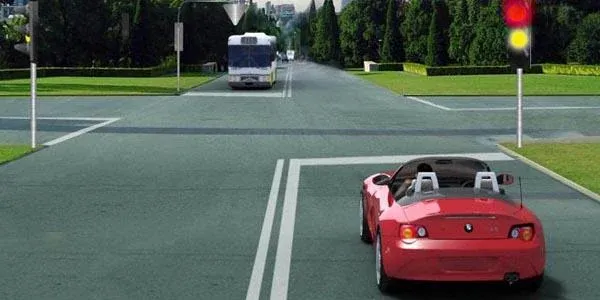
- The traffic light is out of order.
- When passing the intersection, drivers must be guided by the requirements of the road sign.
- Drivers must wait for the permitting signal of the traffic light.
Show answer
Correct: 3. Drivers must wait for the permitting signal of the traffic light.
The red and yellow signals are lit at the same time. Under point 7 of the Traffic Rules that combination prohibits movement and informs the driver that the green signal is about to come on, so drivers must wait for the permitting signal. “The traffic light is out of order.” is wrong because red-with-yellow is a normal phase of a perfectly serviceable light. “When passing the intersection, drivers must be guided by the requirements of the road sign.” is wrong because while the light is working it is the light that governs; the priority signs would take over only if it were switched off or flashing yellow.
Question 251. Is the driver of a light passenger car allowed to overtake the bus when the reversible-lane traffic light is switched off?
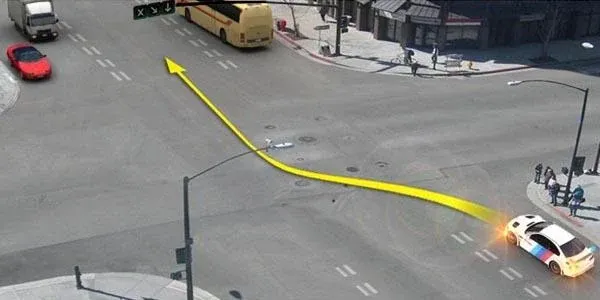
- Allowed.
- Allowed, if the bus is moving at a speed of 30 km/h.
- Allowed, if there are no oncoming vehicles.
- Prohibited.
Show answer
Correct: 4. Prohibited.
To get past the bus the car would have to cross marking 1.9 to its left and enter the lane governed by the reversible traffic lights, and in the picture those lights are switched off. Under point 13 of the Traffic Rules, where the reversible signals above a lane bounded on both sides by marking 1.9 are switched off, entry into that lane is prohibited; and with the reversible light off, marking 1.9 may be crossed only when it lies to the driver’s RIGHT. Overtaking is therefore prohibited. “Allowed.”, “Allowed, if the bus is moving at a speed of 30 km/h.” and “Allowed, if there are no oncoming vehicles.” are wrong because the ban is unconditional for as long as the reversible light stays off.
Question 254. The vehicles will pass the intersection in the following order.
- The tram, the passenger car, the bus.
- The passenger car, the tram, the bus.
- The passenger car, the bus, the tram.
Show answer
Correct: 2. The passenger car, the tram, the bus.
The intersection is signal-controlled: the passenger car’s direction has a plain green light, while the tram and the bus face a red main signal with a green right-pointing arrow in the additional section. Under point 91 of the Rules a driver moving in the direction of an arrow in an additional section switched on together with the red signal must give way to vehicles travelling from other directions, so both the tram and the bus give way to the car moving on green, and the car goes through first. Between the tram and the bus point 92 applies: when the signals permit a tram and non-rail vehicles to move at the same time, the tram has priority regardless of its direction of travel, so the tram goes before the bus and “The passenger car, the tram, the bus.” is correct. “The tram, the passenger car, the bus.” is wrong because the tram is moving on the additional-section arrow and cannot go before the car on green, and “The passenger car, the bus, the tram.” is wrong because the bus cannot go before the tram.
Question 256. In which direction may the driver continue movement?
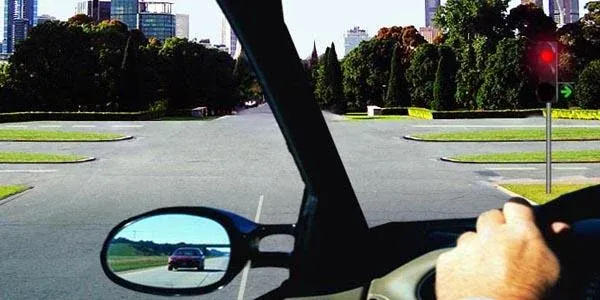
- To the right — through the first opening.
- To the right — through the first and second openings.
- To the left — through the first opening.
Show answer
Correct: 1. To the right — through the first opening.
The main round signal is red and a green arrow pointing right is lit in the additional section. Under sub-point 5 of point 7 of the Traffic Rules a red signal prohibits movement, and under point 8 the effect of a green arrow in an additional section extends only to the direction the arrow shows. The driver may therefore continue only to the right, through the first - the nearer - opening. “To the right - through the first and second openings.” is wrong because reaching the second opening would mean first travelling straight ahead, which the red signal forbids, and “To the left - through the first opening.” is wrong because the additional section permits no movement to the left.
Question 259. Which driver has the right of way?
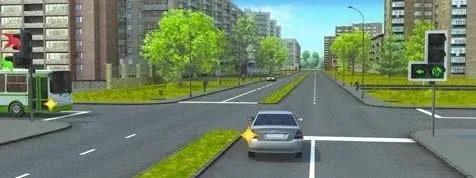
- The bus driver
- The passenger car driver
Show answer
Correct: 2. The passenger car driver
The main signal facing the light passenger car is green, so it is free to proceed. The trolleybus pulling out of the stop faces a red main signal with only the green arrow of the right-turn additional section lit. Under the Rules, a driver moving on the arrow of an additional section that is lit at the same time as a red signal must give way to vehicles coming from the other directions. The duty to give way to a route vehicle pulling out of a stop in a built-up area does not put the trolleybus ahead here, because its own traffic light does not release it against the passenger car. Right of way therefore belongs to the light passenger car driver, and “The bus driver” is wrong.
Question 260. In this situation, when making a left turn
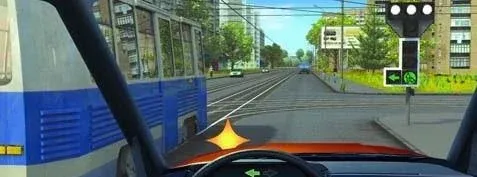
- We will give way to the tram
- I will pass the intersection first
Show answer
Correct: 2. I will pass the intersection first
On the tram’s T-shaped signal the upper moon-white lenses are lit but the bottom one is not, and under point 14 of the Traffic Rules the tram may move only when the bottom lens is lit together with the upper one - so the tram is stopped. Your own light shows green with a green left arrow in the additional section, so your left turn is permitted. Under point 92 a tram has priority only where the signals permit the tram and non-rail vehicles to move AT THE SAME TIME, and here the tram must stand still. You will therefore pass the intersection first, and “We will give way to the tram” is wrong.
Question 263. When making a right turn in this situation, to give way you are
- Obliged
- Not obliged
Show answer
Correct: 1. Obliged
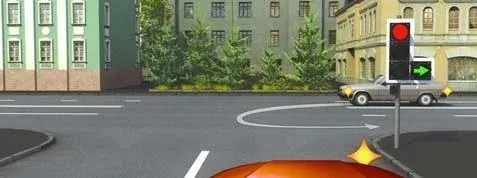
You are turning right on the green arrow of an additional section while the main signal is red. Under point 91 of the Rules a driver travelling in the direction of an arrow lit in an additional section at the same time as the red signal must give way to the vehicles coming from the other directions. You are therefore obliged to give way - here to the car approaching from another direction. “Not obliged” is wrong because point 91 requires you to yield: the arrow releases you to move, it does not give you priority.
Question 265. To give way to the tram driver in this situation you are
- Not obliged
- Obliged
Show answer
Correct: 2. Obliged
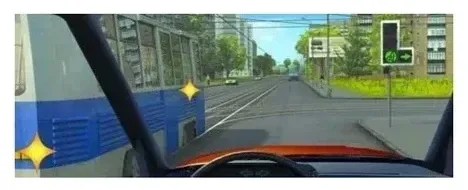
This is a regulated intersection: your signal is green, with a green arrow in the additional section, and the tram on the left is also moving on a permitting signal. Under point 92 of the Rules, where the traffic light signals permit a tram and non-rail vehicles to move at the same time, the priority belongs to the tram driver whatever direction he is going in - so you ARE obliged to give way to him. “Not obliged” is wrong: a tram loses that priority only when it is itself moving on an additional-section arrow lit together with its own red or yellow signal, which is not the case here.
Question 267. At this intersection the driver
- Will pass first
- Must give way to the tram
Show answer
Correct: 1. Will pass first
Your round green signal is lit, and on the tram’s T-shaped moon-white signal only the bottom lens and the top middle one are on. Under point 14 of the Traffic Rules that permits the tram to travel straight ahead only, so the tram, whose left indicator is flashing, may not make its turn - and the driver moving on the green signal will pass first. “Must give way to the tram” is wrong because under point 92 a tram has priority only where the signals permit the tram and the non-rail vehicle to move at the same time, whereas here the direction the tram has chosen is prohibited to it.
Question 268. When crossing the intersection straight, the driver
- May go first
- Must give way to the tram
- Must give way to both drivers
Show answer
Correct: 2. Must give way to the tram
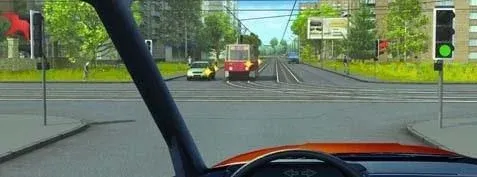
The intersection is signal-controlled: a green signal is lit for the driver’s direction, and the signals at the same time permit the oncoming tram to move. The tram has its left-turn indicator on, so its path crosses the path of the driver going straight. Under point 92 of the Rules, when the traffic-light signals permit a tram and non-rail vehicles to move at the same time, the tram has priority regardless of its own direction of travel, so “Must give way to the tram” is correct. “May go first” is wrong, because a green signal gives no priority over a tram. “Must give way to both drivers” is wrong, because the oncoming passenger car is a non-rail vehicle and, turning left, must itself give way to the driver going straight.
Question 270. When making a right turn, are you obliged to give way to the driver approaching from the oncoming direction
- Yes
- No
Show answer
Correct: 2. No
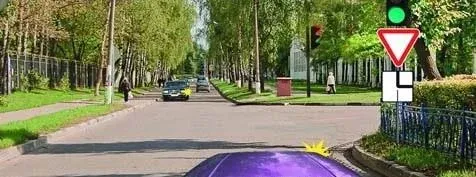
The traffic light is working and showing you green, so under point 89 of the Traffic Rules the intersection is a regulated one and the order of passage is settled by the light rather than by sign 2.4 “Give way” and plate 8.13 - priority signs fix the order only at UNregulated intersections. Turning right on green, your path does not cross that of oncoming vehicles going straight ahead or turning right, and the oncoming driver with his left indicator on is himself required by point 90 to give way to traffic coming the other way and going straight or right. You are therefore not obliged to give way, and “Yes” is wrong.
Question 271. When passing the intersection straight ahead
- We may pass first
- We are obliged to give way to the passenger car’s driver
Show answer
Correct: 2. We are obliged to give way to the passenger car’s driver
Beside your red main signal a green arrow pointing straight up is lit in the additional section, which permits you to cross the intersection straight ahead - but it is an additional-section arrow, not a green light. Under point 91 of the Traffic Rules a driver moving in the direction of an arrow lit in an additional section at the same time as the red signal must give way to the vehicles coming from the other directions. We are therefore obliged to give way to the passenger car crossing the intersection from the left. “We may pass first” is wrong because moving on an additional-section arrow beside a red signal carries no priority.
Question 274. When making the left turn
- You are obliged to give way to the tram driver
- To pass the intersection first
Show answer
Correct: 1. You are obliged to give way to the tram driver
You are turning left on the green signal, which permits the tram and non-rail vehicles to move at the same time. Under point 92 of the Rules, where that is so, the tram has priority whatever direction it is travelling in. You are therefore obliged to give way to the tram driver. “To pass the intersection first” is wrong because when both are permitted to move together the tram outranks your non-rail vehicle - the rails give way to nobody here.
Question 275. Which road signs do not apply when their requirements contradict the meaning of the traffic light signals?
- Priority signs
- Prohibitory signs
- Mandatory signs
- All of those listed.
Show answer
Correct: 1. Priority signs
Under point 173 of the Rules, when the meaning of the traffic light signals contradicts the requirements of the priority signs, drivers must be guided by the traffic light signals. So it is exactly the “Priority signs” that do not apply at that moment, because the order of passage is then decided by the light. “Prohibitory signs”, “Mandatory signs” and “All of those listed.” are wrong, because point 173 lays this rule down for priority signs only.
Question 276. In this situation the one obliged to give way is
- The passenger car’s driver
- The tram driver
Show answer
Correct: 2. The tram driver
The tram is travelling in the direction of a green right arrow lit in an additional section alongside the red signal, and under point 91 of the Traffic Rules a driver moving that way must give way to vehicles coming from the other directions. point 92 states expressly that in this case even a TRAM loses its priority and must give way - here to the light passenger car approaching from the left on its own green signal. Sign 2.1 “Main road” does not settle the order here, because with the traffic light working the intersection is a regulated one (point 89). The one obliged to give way is therefore the tram driver.
Question 279. When making a left turn
- I will perform the maneuver without stopping.
- After entering the intersection I will stop before the second “Stop line” and wait for the green signal to come on
Show answer
Correct: 2. After entering the intersection I will stop before the second “Stop line” and wait for the green signal to come on
This is a large intersection with separate traffic lights and a second stop-line marking 1.12 painted across the middle of it. Under point 93 of the Rules, where marking 1.12 “Stop line” is present before traffic lights placed along the direction of travel, the driver must be guided by the signals of EACH of those lights separately. After entering the intersection he must therefore stop before the second stop line and wait for its green signal. “I will perform the maneuver without stopping.” is wrong because marking 1.12 obliges him to obey each light in turn - the first green releases him only as far as the second line.
Question 287. Are you obliged to give way to the bus
- Yes
- No
Show answer
Correct: 1. Yes
You are turning right in the direction of a green arrow lit in an additional section at the same time as the red signal. Under point 91 of the Rules a driver moving that way must give way to the vehicles coming from the other directions. The bus is crossing the intersection from the left on its own permitting signal, so yes - you are obliged to give way to it. “No” is wrong because travelling on an arrow lit beside a red signal gives you no priority at all.
Question 292. Where must you stop in obeying the traffic light signal
- Before the traffic light
- Before the intersecting carriageway
- Anywhere
Show answer
Correct: 1. Before the traffic light
Under point 18 of the Rules, on a prohibiting signal the driver must stop before the stop-line marking or sign 6.16 “Stop line”; where there is neither, before the intersection at the edge of the crossing carriageway; and in other places, before the traffic light. Here sign 6.16 stands at the light, so you must stop before the traffic light. “Before the intersecting carriageway” applies only at an intersection with no stop line at all, and “Anywhere” is wrong because point 18 fixes the stopping place precisely.
Question 293. Making a left turn is permitted
- From the reversible lane
- From the lane indicated in the picture
Show answer
Correct: 2. From the lane indicated in the picture
The reversible traffic lights above the carriageway are switched off - neither the X nor the downward arrow is lit. Under point 13 of the Rules, where the reversible signals above a lane bounded on both sides by marking 1.9 are switched off, entry into that lane is prohibited. And under point 40 a left turn is made from the appropriate EDGE lane for that direction, which here is the lane shown in the picture, not the reversible one. The left turn is therefore permitted from the lane indicated in the picture. “From the reversible lane” is wrong twice over: entry there is barred while the signals are off, and a left turn is not made from a reversible lane at all.
Question 296. The arrows depicted on the traffic light’s green signal inform that
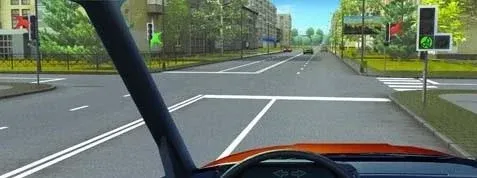
- A right turn is prohibited
- Traffic in the right direction is regulated by an additional section.
Show answer
Correct: 2. Traffic in the right direction is regulated by an additional section.
Under point 10 of the Rules the black outline arrow or arrows on a traffic light’s main green signal tell drivers that an additional section exists, and show the other permitted directions of travel that the additional section’s own signal does not cover. The arrows therefore inform the driver that traffic in the right direction is regulated by an additional section. “A right turn is prohibited” is wrong: a black outline arrow is there to inform about the additional section, not to forbid the turn - whether you may turn right is told by that section’s own signal.
Question 297. Is overtaking the truck permitted
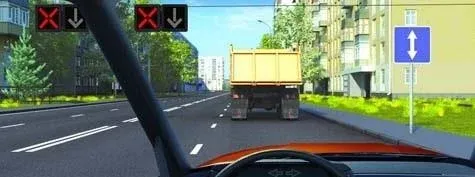
- Yes
- No
Show answer
Correct: 2. No
To overtake the truck you would have to cross marking 1.9 and enter the lane controlled by the reversible traffic lights, and those lights are showing the prohibiting X signal. Under point 13 of the Rules the red X-shaped signal prohibits movement in the lane above which it is placed, so entering that lane - and crossing 1.9 to overtake - is prohibited. Overtaking the truck is therefore not permitted, and “Yes” is wrong because the reversible lane is closed by the X.
Question 299. Entering the reversible traffic lane in this situation is
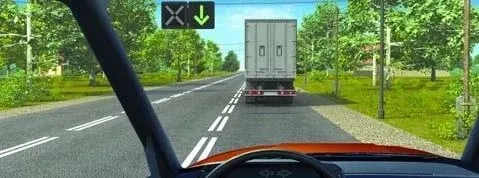
- Permitted
- Permitted only for the purpose of overtaking
- Prohibited
Show answer
Correct: 1. Permitted
The reversible traffic light above this lane is showing a green arrow pointing downwards. Under point 13 of the Rules the X-shaped signal and the green downward arrow respectively prohibit and permit movement in the lane above which they are placed, so a green downward arrow permits travel in that lane. Entering the reversible traffic lane is therefore permitted. “Permitted only for the purpose of overtaking” is wrong because the green arrow permits ordinary travel in the lane, not just a manoeuvre, and “Prohibited” is wrong because the signal shown is a permitting one.
Question 306. The blue car will pass the intersection:
- First.
- Second.
Show answer
Correct: 1. First.
The traffic light is green for both cars. Under point 90 of the Rules, a driver turning left or making a U-turn on green must give way to vehicles coming from the opposite direction that are travelling straight ahead or turning right. The red car is turning left - its left indicator is on - while the blue car is oncoming and going straight, so the red car must give way to it. The blue car will therefore pass the intersection first. “Second.” is wrong because an oncoming vehicle going straight has priority over one turning left across its path.
Question 334. The red car will pass the intersection:
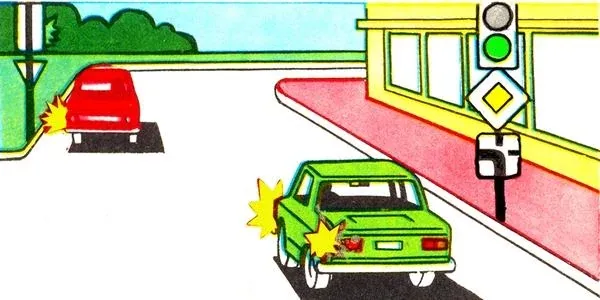
- First.
- Second.
Show answer
Correct: 1. First.
The traffic light is green, so the intersection is a regulated one and the priority signs do not operate. Under point 90 of the Rules a driver turning left or making a U-turn on green must give way to vehicles coming from the opposite direction that are travelling straight ahead or turning right. The green car is turning - its indicator is on - while the red car is oncoming and going straight, so the green car gives way and the red car passes first. “Second.” is wrong because on a green signal an oncoming vehicle going straight has priority over one that is turning across it.
Question 731. If you intend to make a left turn, to which vehicle must you give way?
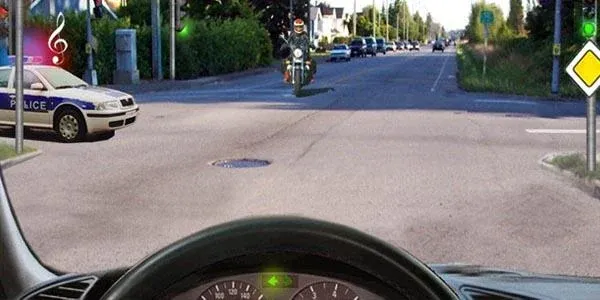
- To the motorcycle.
- To the patrol car.
- To all vehicles.
Show answer
Correct: 3. To all vehicles.
The intersection is a regulated one: your direction has the green signal, and under point 173 of the Traffic Rules, where the traffic light signals conflict with the requirements of the priority signs, drivers are guided by the light - so sign 2.1 is not taken into account. Turning left, point 90 requires you to give way to the motorcycle coming straight from the opposite direction, and point 28 requires you to give way to the patrol car with its blue flashing beacon and special audible signal switched on, so as to let it through unobstructed. You must therefore give way to all the vehicles.
Question 737. If you intend to make a right turn, are you obliged to give way to the passenger car?
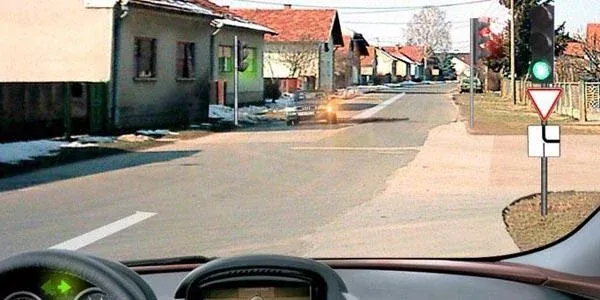
- You are obliged.
- You are not obliged.
Show answer
Correct: 2. You are not obliged.
Your direction has the green signal, and under point 173 of the Traffic Rules, where the traffic light signals conflict with the requirements of the priority signs, drivers must be guided by the light - so the “Give way” sign placed under the traffic light does not operate. Under point 90, on a green signal the duty to give way to oncoming vehicles travelling straight ahead or turning right falls only on a driver turning LEFT or making a U-turn; there is no such duty when turning right, because your paths do not cross. You are therefore not obliged to give way.
Question 738. If you intend to make a right turn, to which vehicle must you give way?
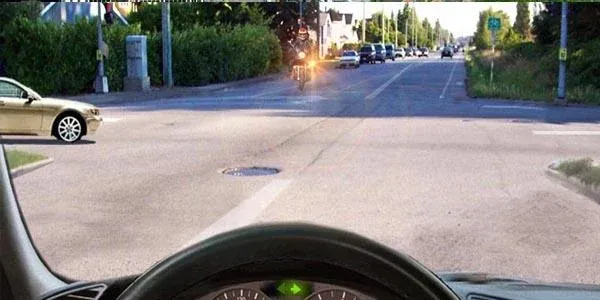
- To no one.
- To the passenger car.
- To the motorcycle and the passenger car.
Show answer
Correct: 1. To no one.
On the green main signal travel is permitted in all directions (point 7 of the Traffic Rules), and the traffic on the crossing road to the left is held by a red signal. Turning right you keep as close as possible to the right-hand edge of the carriageway (point 41), so you do not cross the path of the oncoming motorcycle travelling straight ahead, and there are no pedestrians or cyclists on the road you are turning into (point 87). There is therefore no one you need give way to.
Question 793. In which direction is travel permitted
- Only left
- Straight and left
- Left and a U-turn
Show answer
Correct: 1. Only left
Sign 5.15.1 “Directions of travel by lanes” stands before the intersection and the same directions are repeated in the road marking: from the left lane only a left turn is permitted, and from the right lane travel straight ahead or to the left. Your car is in the right lane. The main traffic light signal is red, and a green arrow pointing left is lit in the additional section. Under point 8 of the Rules an arrow-shaped signal acts only in the direction its arrow shows, and the same is true of the green arrow of an additional section. “Straight and left” is therefore wrong, because travel straight ahead is prohibited by the red main signal. “Left and a U-turn” is wrong too: an arrow permitting a left turn permits a U-turn only where signs 5.15.1 and 5.15.2 allow the left turn from the LEFT EDGE lane, and you are in the right lane, for which the sign and the marking prescribe only straight ahead and left. Only the left turn is therefore available - and remember point 91: moving on an additional-section arrow lit beside a red signal, you must give way to vehicles coming from the other directions.
Question 871. If the meanings of the traffic light signals contradict the requirements of the priority signs, then drivers must be guided by:
- The requirements of the signs.
- The traffic light signals.
Show answer
Correct: 2. The traffic light signals.
Point 173 of the Traffic Rules provides that where the meanings of the traffic light signals contradict the requirements of the priority signs, drivers must be guided by “The traffic light signals.” A working light therefore makes the intersection a controlled one, and the priority signs (2.1, 2.4 and the rest) do not apply while it is running. “The requirements of the signs.” is wrong: the signs govern only when the light is switched off or is showing the flashing yellow signal, that is, when the intersection becomes uncontrolled.
Question 872. Is the driver allowed to continue driving when the traffic light’s yellow signal comes on or the traffic controller raises his hand?
- It is prohibited.
- It is allowed, if the driver has no possibility to stop without harsh braking.
Show answer
Correct: 2. It is allowed, if the driver has no possibility to stop without harsh braking.
Under point 19 of the Traffic Rules, when the yellow signal comes on or the traffic controller raises his hand, drivers who cannot stop at the places listed in point 18 without harsh braking may continue on their way. The correct option is therefore “It is allowed, if the driver has no possibility to stop without harsh braking.” “It is prohibited.” is wrong because it ignores the express exception in point 19, which exists precisely to avoid harsh braking.
Question 1078. In this situation, to which tram driver must you give way?
- To none
- To both trams
- Only to Ա (A)
Show answer
Correct: 2. To both trams
The traffic light is showing green, so the intersection is a regulated one (point 89 of the Rules) and you and the trams are permitted to move at the same time. Under point 92, where the traffic light’s signal permits a tram and non-rail vehicles to move simultaneously, the tram has the advantage whatever direction it is travelling in. You must therefore give way to the drivers of both tram Ա (A) and tram Բ (B). “To none” contradicts the tram’s advantage, and “Only to Ա (A)” is wrong because tram Բ (B) has exactly the same advantage.