People and Vehicles
The rules you must follow depend on what the law calls you, and on what it calls your vehicle. All the definitions in this lesson come from Article 2 of the RA law, and the exam often changes a single word in them.
Who counts as a driver?
Section titled “Who counts as a driver?”The person at the wheel, and two others:
- A driving instructor. The person teaching someone to drive is treated as a driver, with a driver’s duties and responsibility.
- A person driving pack or riding animals, or livestock, along a road. The words “along a road” decide it: someone herding animals across a field is not a driver.
Who counts as a passenger?
Section titled “Who counts as a passenger?”A passenger is a person in or on a vehicle, and also a person getting on or off it, except the driver and the driving instructor. So you are a passenger from the moment you start boarding until you have got off.
Who counts as a pedestrian?
Section titled “Who counts as a pedestrian?”A pedestrian is a person on the road outside a vehicle. There is one exception: a person authorized to carry out works on the road and doing them in the manner set by law.
These people are treated as pedestrians too:
- Disabled persons in a wheelchair without an engine.
- Disabled persons in a wheelchair with an engine, at pedestrian speed.
- Persons wheeling a bicycle, moped or motorcycle on foot.
- Persons pulling or pushing a handcart, sledge, pram or wheelchair.
Remember: Riding makes you a driver. Pushing makes you a pedestrian.
Who may regulate traffic?
Section titled “Who may regulate traffic?”The law’s term is traffic regulator, and the questions say “traffic controller”. It means a person who has the authority to regulate traffic and does so in the manner set by legislation. Both parts are needed. A driver or passenger who jumps out to wave cars along has no such authority.
What is an emergency situation?
Section titled “What is an emergency situation?”An emergency situation arises from the action or inaction of a traffic participant, or of the traffic regulator, and creates a real danger of an accident. So the danger can come from the person directing traffic too.
Common trap: The wrong option stops at “a traffic participant”. The full definition adds the traffic regulator.
What counts as a vehicle?
Section titled “What counts as a vehicle?”A vehicle is a device for carrying people, goods, or equipment mounted on it, along a road. The test is what it is for, not what type it is. So a trailer, a bicycle and a horse-drawn cart all count, not only cars and motorcycles.
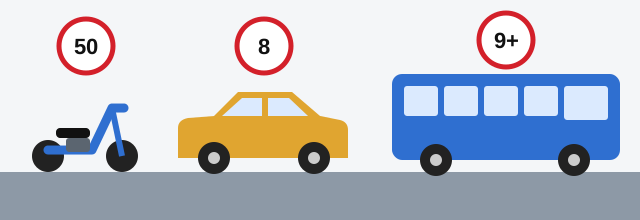
Three numbers to learn. Moped: 50, for both engine volume and speed. Passenger car: up to 8 passenger seats. Bus: 9 or more.
| Term | Definition in plain words |
|---|---|
| Motor car | A mechanical vehicle for carrying people or goods along a road, or for towing a vehicle that carries goods. It includes agricultural tractors for which this is an additional function. |
| Light passenger car | A motor car with not more than 8 passenger seats, built for carrying passengers and luggage safely and comfortably. |
| Bus | The same, but with more than 8 passenger seats. |
| Truck | A motor car built for carrying goods. The definition has no weight in it. |
| Moped | Two or three wheels, an engine of not more than 50 cubic cm, and a maximum speed of not more than 50 km/h. |
| Bicycle | At least two wheels, normally moved by the muscle power of the person on it, by pedals or a handle. A wheelchair is excluded. It may also have a small motor of not more than 0.25 kW. |
| Trailer (semi-trailer) | A vehicle with no engine, set in motion by a mechanical vehicle and travelling as one whole with it. Special trailers are included. |
| Public-use vehicle | A vehicle with stopping points that runs along routes and carries passengers and (or) luggage: a tram, trolleybus or bus. |
Common trap: “More than 8” is not “8 or more”. A vehicle with exactly 8 passenger seats is a light passenger car, not a bus.
Common trap: A taxi is not a public-use vehicle, because it has no fixed stops or routes. Nor is a vehicle on a tourist route.
A towed mechanical vehicle doesn’t become a trailer: it still has its own engine.
What is the permissible maximum mass?
Section titled “What is the permissible maximum mass?”It is the mass of the fully equipped and fuelled vehicle loaded with the driver, passengers and cargo, which the manufacturing organisation has set as the maximum permissible. It is the full weight, not the empty one, and every part of the definition counts.
Try it yourself
Section titled “Try it yourself”Your motorcycle runs out of fuel and you push it along the road. What are you now? A pedestrian, because a person wheeling a motorcycle on foot is treated as one.
A van has a driver’s seat and 8 passenger seats. Is it a bus? No. A bus needs more than 8 passenger seats, so this one is still a light passenger car.
An instructor sits beside a learner. Is the instructor a passenger? No. The instructor is excluded from “passenger” and treated as a driver.
Key points
Section titled “Key points”- A driving instructor, and a person driving animals along a road, are treated as drivers.
- Boarding and getting off are part of being a passenger.
- Wheeling a bicycle, moped or motorcycle on foot makes you a pedestrian. A road worker doing lawful work isn’t one.
- Passenger car: up to 8 passenger seats. Bus: more than 8. Moped: 50 cubic cm and 50 km/h.
- A truck’s definition has no weight. A trailer has no engine.
- Public-use vehicles are trams, trolleybuses and buses, never taxis.
- Permissible maximum mass is the fully loaded figure set by the manufacturer.
Practice questions
Section titled “Practice questions”Question 139. According to the RA law “On ensuring road traffic safety”, a passenger is considered to be:
- A person who is in the compartment (cabin) of a vehicle or on a vehicle, except the driver and the driving instructor.
- A person who is in the compartment (cabin) of a vehicle or on a vehicle, as well as a person boarding (getting on) the vehicle and getting out of (getting off) it, except the driver and the driving instructor.
Show answer
Correct: 2. A person who is in the compartment (cabin) of a vehicle or on a vehicle, as well as a person boarding (getting on) the vehicle and getting out of (getting off) it, except the driver and the driving instructor.
Under Article 2 of the RA law ‘On ensuring road traffic safety’, a passenger is ‘a person who is in the compartment (cabin) of a vehicle or on a vehicle, as well as a person boarding (getting on) the vehicle and getting out of (getting off) it, except the driver and the driving instructor’. So passenger status already begins at the moment of boarding and ends only once the person has got off. The option limited to ‘a person who is in the compartment (cabin) of a vehicle or on a vehicle’ is incomplete, because it leaves out those boarding and alighting.
Question 145. According to the RA law “On ensuring road traffic safety”, a pedestrian is considered to be:
- A person who is on the road outside a vehicle, except a person authorized to carry out works on the road and carrying out those works in the manner established by law.
- A person who is on the road outside a vehicle, including a person authorized to carry out works on the road and carrying out those works in the manner established by law.
Show answer
Correct: 1. A person who is on the road outside a vehicle, except a person authorized to carry out works on the road and carrying out those works in the manner established by law.
Under Article 2 of the RA law ‘On ensuring road traffic safety’, a pedestrian is a person who is on the road outside a vehicle, ‘except a person authorized to carry out works on the road and carrying out those works in the manner established by law’. The definition itself therefore leaves that worker out of the notion of a pedestrian, which is why the option built on ‘except’ is the correct one. The option worded ‘including a person authorized to carry out works on the road’ claims the opposite - it counts that worker as a pedestrian - and does not match the law.
Question 150. According to the RA law “On ensuring road traffic safety”, a moped is considered:
- A two-wheeled or three-wheeled vehicle with an engine of not more than 50 cubic cm working volume and a maximum speed of not more than 50 km/h.
- A two-wheeled or three-wheeled vehicle with an engine of not more than 60 cubic cm working volume and a maximum speed of not more than 60 km/h.
- A two-wheeled or three-wheeled vehicle with an engine of not more than 70 cubic cm working volume and a maximum speed of not more than 70 km/h.
Show answer
Correct: 1. A two-wheeled or three-wheeled vehicle with an engine of not more than 50 cubic cm working volume and a maximum speed of not more than 50 km/h.
Under Article 2 of the RA law “On ensuring road traffic safety”, a moped is a two-wheeled or three-wheeled vehicle with an engine of not more than 50 cubic cm working volume and a maximum speed of not more than 50 km/h. Both limits are 50, so the option beginning “A two-wheeled or three-wheeled vehicle with an engine of not more than 50 cubic cm working volume…” is the correct one. The options that raise the figures to 60 cubic cm and 60 km/h, and to 70 cubic cm and 70 km/h, describe vehicles the law no longer treats as mopeds.
Question 154. According to the RA law “On ensuring road traffic safety”, a public-use vehicle is considered:
- A vehicle having stopping points (stops), moving along routes, carrying passengers and (or) luggage (tram, trolleybus, bus).
- A vehicle having stopping points (stops), moving along routes, carrying passengers and (or) luggage (tram, trolleybus, bus), as well as a light passenger taxi car.
Show answer
Correct: 1. A vehicle having stopping points (stops), moving along routes, carrying passengers and (or) luggage (tram, trolleybus, bus).
Under Article 2 of the RA law “On ensuring road traffic safety”, a public-use vehicle is one that has stopping points (stops), moves along routes and carries passengers and (or) luggage — a tram, trolleybus or bus. That is why the option listing only “(tram, trolleybus, bus)” is correct. The option that adds “as well as a light passenger taxi car” is wrong: a taxi has no fixed stops and does not move along set routes, so it falls outside this definition.
Question 155. According to the RA law “On ensuring road traffic safety”, the following are treated as equivalent to pedestrians:
- Disabled persons moving in wheelchairs without an engine.
- Persons pulling (pushing) a handcart, sledge, pram or wheelchair.
- All the listed persons.
Show answer
Correct: 3. All the listed persons.
Under Article 2 of the RA law “On ensuring road traffic safety”, both “Disabled persons moving in wheelchairs without an engine.” and “Persons pulling (pushing) a handcart, sledge, pram or wheelchair.” are treated as equivalent to pedestrians. Because the law names both groups, “All the listed persons.” is correct. Picking either group on its own would leave out people the law also protects as pedestrians.
Question 156. According to the RA law “On ensuring road traffic safety”, a trailer (semi-trailer) is considered:
- Any mechanical vehicle towed by a rigid coupling.
- A vehicle not equipped with an engine, intended to be set in motion by a mechanical vehicle and to travel as one whole as part of it (including a special trailer).
Show answer
Correct: 2. A vehicle not equipped with an engine, intended to be set in motion by a mechanical vehicle and to travel as one whole as part of it (including a special trailer).
Under Article 2 of the RA law “On ensuring road traffic safety”, a trailer (semi-trailer) is “A vehicle not equipped with an engine, intended to be set in motion by a mechanical vehicle and to travel as one whole as part of it (including a special trailer).” Having no engine of its own is the decisive part of the definition, which is why that option is correct. “Any mechanical vehicle towed by a rigid coupling.” is wrong: such a vehicle has its own engine, and being towed on a rigid coupling does not turn it into a trailer.
Question 167. According to the RA law “On ensuring road traffic safety”, the permissible maximum mass is considered:
- The mass of the fully equipped and fuelled vehicle.
- The mass of the fully equipped and fuelled vehicle loaded with the driver, passengers and cargo.
Show answer
Correct: 2. The mass of the fully equipped and fuelled vehicle loaded with the driver, passengers and cargo.
Under Article 2 of the RA law “On ensuring road traffic safety”, the permissible maximum mass is the mass of the fully equipped and fuelled vehicle loaded with the driver, passengers and cargo. It is a loaded figure, not an empty one: the driver, the passengers and the load all count towards it. That is why the answer is “The mass of the fully equipped and fuelled vehicle loaded with the driver, passengers and cargo.” and not “The mass of the fully equipped and fuelled vehicle.”, which leaves all three out.
Question 168. According to the RA law “On ensuring road traffic safety”, a traffic controller is considered:
- A person having the authority to regulate road traffic and carrying out that regulation in the manner established by legislation.
- Any road traffic participant (driver, passenger or pedestrian) who, when the need arises, performs regulating actions.
- All the listed persons.
Show answer
Correct: 1. A person having the authority to regulate road traffic and carrying out that regulation in the manner established by legislation.
Under Article 2 of the RA law “On ensuring road traffic safety”, a traffic controller is a person having the authority to regulate road traffic and carrying out that regulation in the manner established by legislation. Both halves are needed, the authority and the legally established manner, which is why the answer is “A person having the authority to regulate road traffic and carrying out that regulation in the manner established by legislation.” An ordinary road user holds no such authority, so “Any road traffic participant (driver, passenger or pedestrian) who, when the need arises, performs regulating actions.” does not fit the definition, and neither does “All the listed persons.”
Question 169. According to the RA Law on Ensuring Road Traffic Safety, a bicycle is considered:
- A vehicle with a muscular force of at least two wheels and normally a person on it, in particular the one driven with the aid of a pedal or a handle, as well as a wheelchair, which may also have a a switching motor engine in case of speed exceeding 25km/h, with the nominal maximum power not exceeding 0,25 kW in the long-term load mode
- A vehicle with a muscular force of at least two wheels and normally a person on it, in particular the one driven with the aid of a pedal or a handle, except for a wheelchair, which may also have a a switching motor engine in case of speed exceeding 25km/h, with the nominal maximum power not exceeding 0,25 kW in the long-term load mode
Show answer
Correct: 2. A vehicle with a muscular force of at least two wheels and normally a person on it, in particular the one driven with the aid of a pedal or a handle, except for a wheelchair, which may also have a a switching motor engine in case of speed exceeding 25km/h, with the nominal maximum power not exceeding 0,25 kW in the long-term load mode
Under Article 2 of the RA law “On ensuring road traffic safety”, a bicycle is a vehicle having at least two wheels and normally set in motion by the muscular force of the person on it, in particular by means of a pedal or a handle, except for a wheelchair. For that reason the option that excludes the wheelchair is correct. The option that includes the wheelchair contradicts the definition, which leaves the wheelchair out explicitly, and under the same article a person moving in a wheelchair without an engine is equated with a pedestrian.
Question 170. According to the RA law “On ensuring road traffic safety”, a person teaching how to drive a vehicle:
- Is treated as equivalent to a driver.
- Is not treated as equivalent to a driver.
Show answer
Correct: 1. Is treated as equivalent to a driver.
Under Article 2 of the RA law “On ensuring road traffic safety”, the definition of a driver also covers the person teaching someone to drive. So an instructor sitting beside a learner carries a driver’s duties and a driver’s responsibility, and the answer is “Is treated as equivalent to a driver.”
Question 171. According to the RA law “On ensuring road traffic safety”, an emergency situation is considered:
- A situation arising as a result of the action and (or) inaction of a traffic participant, during which a real danger of a road traffic accident is created.
- A situation arising as a result of the action and (or) inaction of a traffic participant and (or) of the traffic controller, during which a real danger of a road traffic accident is created.
Show answer
Correct: 2. A situation arising as a result of the action and (or) inaction of a traffic participant and (or) of the traffic controller, during which a real danger of a road traffic accident is created.
According to Article 2 of the RA law “On ensuring road traffic safety”, an emergency situation is a situation arising as a result of the action and (or) inaction of a traffic participant and (or) of the traffic controller, during which a real danger of a road traffic accident is created. So the danger can come not only from a driver or a pedestrian, but also from a wrong action or a failure to act by the person controlling the traffic. That is why the option naming “a traffic participant and (or) of the traffic controller” is the right one, while the option that stops at “the action and (or) inaction of a traffic participant” is incomplete - it leaves the traffic controller out.
Question 173. According to the RA law “On ensuring road traffic safety”, a bus is considered:
- A motor car having more than 8 seats intended for passengers, intended by its construction and equipment for the safe and comfortable carriage of passengers and luggage.
- A motor car having 8 and more seats intended for passengers, intended by its construction and equipment for the safe and comfortable carriage of passengers and luggage.
Show answer
Correct: 1. A motor car having more than 8 seats intended for passengers, intended by its construction and equipment for the safe and comfortable carriage of passengers and luggage.
According to Article 2 of the RA law “On ensuring road traffic safety”, a bus is a motor car “having more than 8 seats intended for passengers”, intended by its construction and equipment for the safe and comfortable carriage of passengers and luggage. The whole difference lies in that wording: “more than 8” means 9 seats or more. The option “having 8 and more seats intended for passengers” would also cover a car with exactly 8 passenger seats, which the law does not treat as a bus.
Question 174. According to the RA law “On ensuring road traffic safety”, a light passenger car is considered:
- A motor car having not more than 8 seats intended for passengers, intended by its construction and equipment for the safe and comfortable carriage of passengers and luggage.
- A motor car having not more than 4 seats intended for passengers (except children under 12 years of age), intended by its construction and equipment for the safe and comfortable carriage of passengers and luggage.
Show answer
Correct: 1. A motor car having not more than 8 seats intended for passengers, intended by its construction and equipment for the safe and comfortable carriage of passengers and luggage.
According to Article 2 of the RA law “On ensuring road traffic safety”, a light passenger car is a motor car “having not more than 8 seats intended for passengers”, intended by its construction and equipment for the safe and comfortable carriage of passengers and luggage. Those 8 seats are the dividing line: anything above that is already a bus. The law’s definition contains no limit of “not more than 4 seats intended for passengers (except children under 12 years of age)”.
Question 175. According to the RA law “On ensuring road traffic safety”, the following are treated as equivalent to pedestrians:
- Disabled persons moving in a wheelchair having an engine, at pedestrian speed.
- Persons wheeling a bicycle, moped or motorcycle on foot.
- All the listed persons.
Show answer
Correct: 3. All the listed persons.
When Article 2 of the RA law “On ensuring road traffic safety” defines a pedestrian, it treats as equivalent to pedestrians both “Disabled persons moving in a wheelchair having an engine, at pedestrian speed” and “Persons wheeling a bicycle, moped or motorcycle on foot”. The reason is the same in both cases: the person is moving at walking pace, or is pushing the vehicle instead of riding it, so the pedestrian’s rules apply rather than the driver’s. Because both groups fall inside that definition, the correct answer is “All the listed persons”.
Question 183. According to the RA law “On ensuring road traffic safety”, a public-use vehicle is considered:
- A vehicle having stopping points (stops), moving along routes, carrying passengers and (or) luggage (tram, trolleybus, bus), as well as a light passenger taxi car.
- A vehicle having stopping points (stops), moving along routes, carrying passengers and (or) luggage (tram, trolleybus, bus).
- A vehicle moving along a tourist route, carrying passengers and (or) luggage.
Show answer
Correct: 2. A vehicle having stopping points (stops), moving along routes, carrying passengers and (or) luggage (tram, trolleybus, bus).
Article 2 of the RA law “On ensuring road traffic safety” defines a public-use vehicle as a vehicle having stopping points (stops), moving along routes and carrying passengers and (or) luggage - a tram, a trolleybus or a bus. A light passenger taxi car falls outside that definition because it has no stopping points and runs on no fixed route, so the option that adds the taxi to the list is wrong. The option describing a vehicle moving along a tourist route is wrong for the same reason: a tourist route is not a public-use route with stopping points.
Question 184. According to the RA law “On ensuring road traffic safety”, the permissible maximum mass of a vehicle is considered:
- The maximum mass of the fully equipped and fuelled vehicle.
- The mass of the fully equipped and fuelled vehicle loaded with the driver, passengers and cargo, which the manufacturing organisation has set as the maximum permissible.
- The mass of the vehicle loaded with the driver, passengers and cargo, which the manufacturing organisation has set as the maximum permissible.
Show answer
Correct: 2. The mass of the fully equipped and fuelled vehicle loaded with the driver, passengers and cargo, which the manufacturing organisation has set as the maximum permissible.
Article 2 of the RA law “On ensuring road traffic safety” defines the permissible maximum mass as the mass of the fully equipped and fuelled vehicle loaded with the driver, passengers and cargo, which the manufacturing organisation has set as the maximum permissible. Both halves of that are required. “The maximum mass of the fully equipped and fuelled vehicle.” is wrong because it leaves out the driver, the passengers and the cargo. “The mass of the fully equipped and fuelled vehicle loaded with the driver, passengers and cargo, which the manufacturing organisation has set as the maximum permissible.” is the definition in full, which is why it is the correct answer, while the remaining option drops the words “fully equipped and fuelled”.
Question 1030. According to the RA law “On ensuring road traffic safety”, a driver also means:
- A person driving pack and (or) riding animals, or livestock, along a road.
- A person driving pack and (or) riding animals, or livestock.
Show answer
Correct: 1. A person driving pack and (or) riding animals, or livestock, along a road.
Article 2 of the RA law “On ensuring road traffic safety” treats as a driver also a person driving pack and (or) riding animals, or livestock, ALONG A ROAD. The words “along a road” are the deciding part of the definition: it is being on the road that makes such a person a participant in road traffic and puts a driver’s duties on them. The option that leaves those words out is wider than the law, since someone herding animals across a field is not a driver, so “A person driving pack and (or) riding animals, or livestock.” does not match the definition.
Question 1099. According to the RA law “On ensuring road traffic safety”, a truck is considered:
- A motor car intended by its construction and equipment for the carriage of goods, weighing more than 3.5 tonnes.
- A motor car intended by its construction and equipment for the carriage of goods.
Show answer
Correct: 2. A motor car intended by its construction and equipment for the carriage of goods.
Article 2 of the RA Law “On Ensuring Road Traffic Safety” defines a truck as a motor car intended by its construction and equipment for the carriage of goods, and that is the whole definition. The option that adds “weighing more than 3.5 tonnes” is wrong, because the Law uses that figure only for particular traffic and operating restrictions, not for classifying a vehicle as a truck, so a goods-carrying car lighter than 3.5 t is a truck as well.
Question 1100. According to the RA law “On ensuring road traffic safety”, a vehicle is considered:
- A device intended for carrying people, goods, or equipment mounted on it, along a road.
- The motor car and the motorcycle.
Show answer
Correct: 1. A device intended for carrying people, goods, or equipment mounted on it, along a road.
Under the RA law “On ensuring road traffic safety”, a vehicle is a device intended for carrying people, goods, or equipment mounted on it, along a road. The definition is built on what the thing is for, not on what type it is, so it covers not only a car and a motorcycle but also a trailer, a bicycle, a horse-drawn cart and any device carrying equipment mounted on it. “The motor car and the motorcycle.” is not a definition but two examples, and it leaves out everything else.
Question 1102. According to the RA law “On ensuring road traffic safety”, a motor car is considered:
- A mechanical vehicle intended for carrying people or goods along a road, or for towing a vehicle used for carrying goods, including such vehicles as agricultural tractors, for which such use is an additional function.
- A mechanical vehicle intended for carrying people or goods along a road, or for towing a vehicle used for carrying goods, except for such vehicles as agricultural tractors, for which such use is an additional function.
Show answer
Correct: 1. A mechanical vehicle intended for carrying people or goods along a road, or for towing a vehicle used for carrying goods, including such vehicles as agricultural tractors, for which such use is an additional function.
The two answers are word for word the same except for one word: one says INCLUDING and the other says EXCEPT FOR. In the definition given by the RA law “On ensuring road traffic safety”, agricultural tractors are included - “including such vehicles as agricultural tractors, for which such use is an additional function”. The first answer is therefore the correct one, and the second is the same definition with exactly those vehicles cut out of it.