Using Your Lights
Lights do two jobs: they help you see, and they tell others you are there and what is happening. The exam tests which light belongs to which situation, so this lesson goes through them one situation at a time.
The Traffic Rules speak of dipped headlights and main-beam headlights. The practice questions call them the “low beam” and the “high beam”. They mean the same thing.
Which lights do I need in the dark?
Section titled “Which lights do I need in the dark?”In the dark, and whenever visibility is insufficient, every moving mechanical vehicle must have main beam or dipped headlights on (point 127). This applies however well the road is lit, and in tunnels too. A bus on an established route is no exception.
Common trap: Answers saying “only the low beam” or “only the high beam” are wrong. The Rules ask for one or the other and leave the choice to you.
When must I dip my lights?
Section titled “When must I dip my lights?”Main beam reaches far, and it blinds anyone who looks into it. Point 128 tells you when to switch to dipped headlights:
- On a lit road in a built-up area.
- Not less than 150 m from an oncoming vehicle, or further if its driver flashes the lights at you.
- Anywhere else main beam could dazzle another driver.
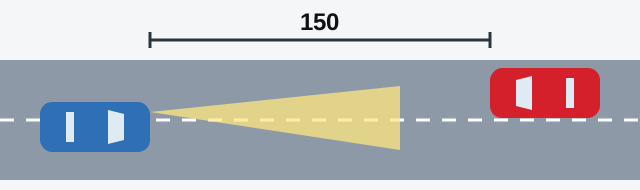
Dip your lights while the oncoming vehicle is still at least 150 m away.
What if I am dazzled?
Section titled “What if I am dazzled?”Your first move is the hazard warning lights (point 129). Then, without changing lane, slow down and stop if you need to. The hazard lights warn the drivers behind that you are slowing.
Common trap: “Switch to low beam” is the wrong first step here. You dip your lights before you meet an oncoming vehicle. A sound signal isn’t the answer either.
Extra: Where to look when headlights blind you
Not from the question bank.
Don’t stare at the bright lights. Look towards the right-hand edge of the road and use it to hold your position. After the glare passes, your eyes need a few seconds to recover, so don’t speed up straight away.
Which vehicles use dipped headlights by day?
Section titled “Which vehicles use dipped headlights by day?”Point 133 requires dipped headlights in daylight so that a moving vehicle stands out:
- Motorcycles and mopeds: always, while in traffic, with no conditions.
- Public transport vehicles in a specially designated lane against the main flow.
- Vehicles carrying organized groups of children.
- The towing vehicle when towing.
Remember: By day, a children’s bus uses dipped headlights. Main beam would dazzle other drivers, and the hazard lights and interior lights are not what the Rules ask for.
When may I use fog lamps and spotlights?
Section titled “When may I use fog lamps and spotlights?”Rear fog lamps may be used only in insufficient visibility (point 131). Being in a convoy, in a tunnel or unloading is not a reason to switch them on.
Spotlights and search lamps may be used only outside built-up areas, when there are no oncoming or same-direction vehicles (point 134). Inside built-up areas, only drivers of vehicles with blue, or blue and red, flashing beacons and a special sound signal may use them, on an official assignment. Darkness or poor visibility alone doesn’t allow it, and neither does your own sense that you need one.
When must hazard lights be on?
Section titled “When must hazard lights be on?”Point 22 lists four cases:
| Situation | Who switches them on |
|---|---|
| Road traffic accident | The vehicle involved |
| Forced stop where stopping is prohibited | The stopped vehicle |
| Dazzled by headlights | The dazzled driver |
| Towing | The towed mechanical vehicle |
Entering a tunnel or driving in an organized motorcade is not on the list.
Common trap: Many questions end with “in both cases” or “in all the listed cases”. If each option is one of these four situations, that last answer is the right one.
Where does the “Emergency stop” sign go?
Section titled “Where does the “Emergency stop” sign go?”The sign must warn approaching drivers in time (point 23). A flashing red lamp can do the same job.
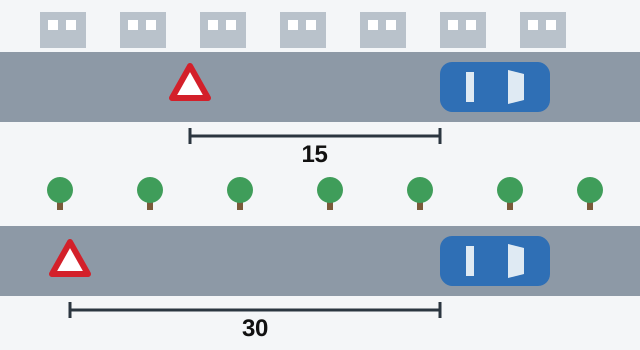
Place the sign not less than 15 m from the vehicle in a built-up area, and 30 m from it outside built-up areas.
There is one special case. If the hazard lights are missing or faulty during towing, the sign goes at the rear of the towed vehicle (point 24), where drivers coming up from behind can see it.
Extra: Staying safe while you place the sign
Not from the question bank.
Get everyone out on the side away from traffic and away from the vehicle. Carry the sign in front of you, facing the oncoming drivers, and stay close to the edge of the road. A reflective vest makes you much easier to see at night.
Try it yourself
Section titled “Try it yourself”You are driving at night on an unlit road with main beam on. A car appears ahead, coming towards you.
When must you dip? Not less than 150 m away. If its driver flashes the lights, dip sooner.
The car then passes you with its main beam on, and you can’t see. What comes first? Hazard warning lights. Then stay in your lane, slow down, and stop if you need to.
Key points
Section titled “Key points”- In the dark or in insufficient visibility: main beam or dipped headlights, however well the road is lit.
- Dip at not less than 150 m from an oncoming vehicle.
- Dazzled: hazard lights first, stay in lane, slow down, and stop if needed.
- By day, motorcycles and mopeds always use dipped headlights, as do children’s buses and public transport in a contraflow lane.
- Rear fog lamps: only in insufficient visibility.
- Hazard lights: accident, forced stop where stopping is prohibited, dazzle, towed vehicle.
- “Emergency stop” sign: not less than 15 m in a built-up area, 30 m outside.
Practice questions
Section titled “Practice questions”Question 813. During the dark time of day, on unlit sections of the road, a bus travelling on an established route must have switched on:
- Only the low beam of the headlights.
- Only the high beam of the headlights.
- The high beam or the low beam of the headlights.
Show answer
Correct: 3. The high beam or the low beam of the headlights.
Under sub-point 1 of point 127 of the Traffic Rules, during the dark time of day — whatever the lighting of the road — every mechanical vehicle must have “The high beam or the low beam of the headlights” switched on, and a bus is a mechanical vehicle even when it runs on an established route. The Rules leave the choice between the two to the driver, so “Only the low beam of the headlights” and “Only the high beam of the headlights” are both wrong. The high beam has to be switched to the low beam only in the cases set out in point 128 — on a lit road in a built-up area, and at not less than 150 m from an oncoming vehicle.
Question 814. During the daylight hours, is it mandatory for the low beam of the headlights to be switched on for public transport vehicles travelling in a specially designated lane against the main flow?
- It is mandatory.
- It is not mandatory.
Show answer
Correct: 1. It is mandatory.
Sub-point 3 of point 133 of the Traffic Rules states directly that, during the daylight hours, in order to mark a moving vehicle, the low beam of the headlights must be switched on for public transport vehicles travelling in a specially designated lane against the main flow. That is precisely the case described in the question, so “It is mandatory” is correct and “It is not mandatory” contradicts the point.
Question 846. In the dark time of day and in conditions of insufficient visibility, regardless of the road’s illumination, mechanical vehicles in motion must have switched on:
- The high beam of the headlights.
- The low beam of the headlights.
- The high beam or the low beam of the headlights.
Show answer
Correct: 3. The high beam or the low beam of the headlights.
Under point 127, sub-point 1 of the Traffic Rules, in the dark time of day and in conditions of insufficient visibility — regardless of how the road is lit — every mechanical vehicle in motion must have “The high beam or the low beam of the headlights.” switched on, and the choice between the two is left to the driver. The Rules do not require specifically “The high beam of the headlights.” or specifically “The low beam of the headlights.”, so the options naming only one of them are wrong. The high beam has to be switched to low only in the cases listed in point 128.
Question 847. In which case must the low beam of the headlights be switched on on a motorcycle during the daylight time of day?
- When travelling in conditions of insufficient visibility.
- When travelling on a motorcycle with defects, moving towards a parking place.
- In any case, while in traffic.
- When transporting a sick passenger.
Show answer
Correct: 3. In any case, while in traffic.
Under point 133, sub-point 1 of the Traffic Rules, the low beam of the headlights must be switched on on motorcycles and mopeds during the daylight time of day, so that the moving vehicle is marked out. The requirement is unconditional, which is why “In any case, while in traffic.” is correct. The options that limit it — “When travelling in conditions of insufficient visibility.”, “When travelling on a motorcycle with defects, moving towards a parking place.” and “When transporting a sick passenger.” — are wrong.
Question 848. What must the driver do first if dazzled by the headlight light of an oncoming vehicle?
- Switch the high beam of the headlights (if switched on) to low beam.
- Switch on the hazard warning light signal.
- Give a sound signal: one long and three short.
- Give a sound signal: one short and three long.
Show answer
Correct: 2. Switch on the hazard warning light signal.
Under point 129 of the Traffic Rules, a driver who is dazzled must switch on the hazard warning light signal and, without changing lane, reduce speed and if necessary stop. The first thing to do is therefore to switch on the hazard warning light signal. “Switch the high beam of the headlights (if switched on) to low beam.” is wrong here: dipping the beam is required by point 128 BEFORE meeting an oncoming vehicle, not as the response once you have already been dazzled. The two sound-signal options are wrong because point 129 prescribes the hazard light signal when dazzled, not an audible one.
Question 850. In the dark time of day, on unlit sections of the road, a mechanical vehicle in motion must have switched on:
- The high beam or the low beam of the headlights.
- Only the low beam of the headlights.
- Only the high beam of the headlights.
Show answer
Correct: 1. The high beam or the low beam of the headlights.
Under point 127, sub-point 1 of the Traffic Rules, every mechanical vehicle moving in the dark time of day must have “The high beam or the low beam of the headlights.” switched on, and the choice between the two is left to the driver. That is why the options demanding “Only the low beam of the headlights.” or “Only the high beam of the headlights.” are wrong. On an unlit section the high beam must be switched to low only in the cases named in point 128 — not less than 150 m from an oncoming vehicle, and wherever it could dazzle.
Question 851. Rear fog lamps may be used:
- In the dark time of day, when travelling in a vehicle convoy.
- When travelling in tunnels.
- Only in conditions of insufficient visibility.
- In the dark time of day, when unloading the vehicle.
- In all the listed cases.
Show answer
Correct: 3. Only in conditions of insufficient visibility.
Under point 131 of the Traffic Rules, rear fog lamps may be used “Only in conditions of insufficient visibility.” — which is exactly the correct answer. Travelling in a vehicle convoy, driving through a tunnel and unloading the vehicle are not grounds for switching them on, so “In all the listed cases.” is wrong too. In tunnels it is point 127 that applies, requiring the high beam or the low beam of the headlights, not the rear fog lamps.
Question 852. At what distance from an oncoming vehicle must the high beam of the headlights be switched to low beam?
- Not less than 100 m.
- Not less than 150 m.
- Not less than 300 m.
Show answer
Correct: 2. Not less than 150 m.
Under point 128, sub-point 2 of the Traffic Rules, the high beam must be switched to the low beam not less than 150 m from an oncoming vehicle — and at a greater distance if that vehicle’s driver signals the need by flashing the lights. “Not less than 100 m.” is below the established minimum and does not rule out dazzling the other driver, and “Not less than 300 m.” is not a figure the Rules set.
Question 853. The headlamp is allowed to be used:
- Only outside populated areas when there are no oncoming or passing vehicles.
- Only in conditions of insufficient visibility.
- In any places, if it is necessary.
- In the dark time of the day on all sections of roads.
Show answer
Correct: 1. Only outside populated areas when there are no oncoming or passing vehicles.
Under point 134 of the Traffic Rules, a spotlight-headlamp and a search lamp may be used only outside populated areas, when there are no oncoming or same-direction vehicles. Within populated areas such lamps may be used only by drivers of vehicles fitted, in the established manner, with blue or blue-and-red flashing beacons and a special sound signal, while carrying out an official assignment. Neither insufficient visibility, nor a need judged by the driver, nor the dark time of day is in itself grounds for using such a lamp.
Question 862. The hazard warning light signal on a vehicle must be switched on:
- In the case of a road traffic accident.
- In places where stopping is prohibited — in the case of a forced stop.
- In both cases.
Show answer
Correct: 3. In both cases.
Point 22 of the Traffic Rules requires the hazard warning light signal in both of the situations listed here: sub-point 1 covers a road traffic accident, and sub-point 2 covers a forced stop in a place where stopping is prohibited. Both duties come from the same point, so “In both cases.” is the answer. Taken alone, “In the case of a road traffic accident.” and “In places where stopping is prohibited — in the case of a forced stop.” each give only half of what the rule requires.
Question 863. The hazard warning light signal on a vehicle must be switched on:
- In the case of a road traffic accident.
- In the case of towing (on the towed mechanical vehicle).
- In places where stopping is prohibited — in the case of a forced stop.
- In all the listed cases.
Show answer
Correct: 4. In all the listed cases.
Point 22 of the Traffic Rules makes the hazard warning light signal compulsory in a road traffic accident (sub-point 1), in towing, on the towed mechanical vehicle (sub-point 4), and in a forced stop in a place where stopping is prohibited (sub-point 2). All three situations the question lists fall under that one point, which is why “In all the listed cases.” is correct. “In the case of a road traffic accident.”, “In the case of towing (on the towed mechanical vehicle).” and “In places where stopping is prohibited — in the case of a forced stop.” each narrow the rule to a single situation.
Question 864. At what distance from the vehicle is the “Emergency stop” sign placed?
- In built-up areas — not less than 15 m, outside built-up areas — 30 m.
- In built-up areas — not less than 10 m, outside built-up areas — 20 m.
- In built-up areas — not less than 5 m, outside built-up areas — 10 m.
Show answer
Correct: 1. In built-up areas — not less than 15 m, outside built-up areas — 30 m.
Under point 23 of the Traffic Rules, and so that approaching drivers are warned in time, the “Emergency stop” sign (or a flashing red lamp) is placed not less than 15 m from the vehicle in built-up areas and 30 m outside built-up areas. So “In built-up areas — not less than 15 m, outside built-up areas — 30 m.” is correct. “In built-up areas — not less than 10 m, outside built-up areas — 20 m.” and “In built-up areas — not less than 5 m, outside built-up areas — 10 m.” are not distances the Rules set and are shorter than the prescribed minimum, so they do not warn approaching drivers in time.
Question 865. The hazard warning lights on a vehicle must be switched on:
- In the case of the driver being dazzled by the light of headlamps.
- In the case of towing (on the towed mechanical vehicle).
- In both cases.
Show answer
Correct: 3. In both cases.
point 22 of the Rules lists the situations in which a vehicle’s hazard warning light signal must be switched on, and both being dazzled by the light of headlamps and towing - on the towed mechanical vehicle - are among them. In the dazzling case point 129 requires the driver to switch the hazard warning signal on and, without changing lane, reduce speed and stop, so that other drivers can see the slowing vehicle. In towing, the signal shows that the vehicle is not moving under its own power. Both duties are set by that same point 22, so “In both cases.” is correct, while “In the case of the driver being dazzled by the light of headlamps.” and “In the case of towing (on the towed mechanical vehicle).” each cover only half of it.
Question 866. The hazard warning light signal on a vehicle must be switched on:
- In the event of a road traffic accident.
- In the event of towing (on the towed mechanical vehicle).
- In both cases.
Show answer
Correct: 3. In both cases.
Point 22 of the Traffic Rules requires the hazard warning light signal both in a road traffic accident (sub-point 1) and in towing, on the towed mechanical vehicle (sub-point 4). Both duties are set by the same point, so “In both cases.” is correct. “In the event of a road traffic accident.” and “In the event of towing (on the towed mechanical vehicle).” each cover only part of that duty.
Question 885. The hazard warning lights are switched on:
- Before entering a tunnel.
- In the event of a road traffic accident.
- When driving as part of an organized motorcade.
Show answer
Correct: 2. In the event of a road traffic accident.
Point 22 of the Traffic Rules lists the cases in which the hazard warning lights must be on, and the very first of them is “In the event of a road traffic accident.” — the others being a forced stop where stopping is prohibited, dazzling, and towing. “Before entering a tunnel.” does not appear in that list at all. Nor are the hazard lights used “When driving as part of an organized motorcade.”: under point 3 a motorcade travels with its headlamps permanently on and is led by a vehicle showing blue and red flashing beacons.
Question 890. During daylight hours, when transporting organized groups of children, the bus must have switched on:
- The high beam headlights.
- The low beam headlights.
- The hazard warning light signal.
- The interior lighting devices of the cabin.
Show answer
Correct: 2. The low beam headlights.
Point 133, sub-point 4 of the Rules requires that a vehicle carrying organized groups of children run in daylight hours with “the low beam headlights” switched on, so that the moving vehicle is marked for everyone else — which is why that is the correct answer. “The high beam headlights” are not what point 133 calls for, because high beam would dazzle other drivers. “The hazard warning light signal” is switched on only in the cases point 22 lists (a crash, a forced stop, being dazzled, towing), and “the interior lighting devices of the cabin” are not required for this purpose anywhere in the Rules.