Carrying People and Loads
What you carry changes how your vehicle behaves and what other drivers can see. The exam checks who may travel where, and exact numbers for loads that stick out.
Where may people travel?
Section titled “Where may people travel?”In a cargo trailer: nowhere. Point 158 prohibits it outright. There is no exception, not even for someone accompanying the load.
In the body of a truck not equipped for people: only someone accompanying the load or travelling to receive it, and only on a seat placed below the level of the sides (point 154). Point 153 fixes those seats at least 0.3 m below the top edge of the side and 0.3 to 0.5 m above the floor.
In a truck that follows the rules for carrying people: a driver with categories B and C may carry up to 8 passengers. More than that also requires category D or DE, or sub-category D1 or D1E (point 150).
In a bus: on intercity and tourist routes, and when carrying organized groups of children, the number of people must not exceed the number of seats (point 152).
Common trap: The exception in the truck body doesn’t reach the trailer. Someone accompanying a load may ride in a flat-sided truck, but never in a cargo trailer. It also has nothing to do with the type of road.
What about children?
Section titled “What about children?”Children under 12 must not be carried (point 159):
- On the rear seat of a motorcycle.
- In the body of a truck with a sided body. A van-bodied truck is the exception.
An organized group of children in a bus needs at least one adult escort in the cabin (point 155). The bus also uses dipped headlights by day. The Safe Driving lesson covers children in the front seat of a car.
What must a load never do?
Section titled “What must a load never do?”Distribute a load and secure it if needed. Point 164 prohibits carrying a load that:
- Restricts your field of vision.
- Makes the vehicle harder to handle or reduces its stability.
- Covers lights, reflectors, number plates or identification signs, or makes hand signals hard to see.
- Makes considerable noise, raises dust, or soils the road and the environment.
Remember: If the load can’t be carried this way, you must fix the problem or stop driving (point 165). Taking it “just to the nearest unloading place” is not allowed.
Extra: Packing a load so it stays put
Not from the question bank.
Put the heaviest items low and near the centre of the vehicle. Fasten everything so that it can’t slide, because hard braking throws a loose load forward with great force. Stop after a short distance and check the straps again, since loads settle.
When must a load be marked?
Section titled “When must a load be marked?”Point 162 has two thresholds, and the load must go over them to need marking.
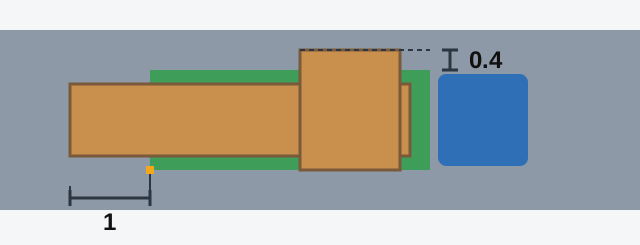
More than 1 m beyond the front or rear of the vehicle, or more than 0.4 m to the side beyond the outer edge of the side marker light.
Over either threshold, mark the load with:
- By day: the “Oversized load” identification sign.
- In the dark and in insufficient visibility: the sign, plus white lamps in front and red lamps or reflectors at the rear.
| Load sticks out | Threshold | Mark it? |
|---|---|---|
| 1.2 m at the rear | 1 m | Yes |
| 0.6 m at the rear | 1 m | No |
| 0.5 m to the side | 0.4 m | Yes |
| 0.3 m to the side | 0.4 m | No |
Common trap: The Rules set no limit of 0.8 m at the rear, and no ban on a load rising above the sides of the platform. Don’t apply the side figure of 0.4 m to the rear, or the rear figure of 1 m to the side.
Try it yourself
Section titled “Try it yourself”You are carrying pipes that stick out 1.2 m behind your truck. It is getting dark. What do you need? The “Oversized load” sign, plus white lamps in front and red lamps or reflectors at the rear. 1.2 m is over the 1 m threshold.
You are halfway to the depot when the load shifts and covers your rear lights. What now? Fix it or stop driving. You can’t carry on, even for a short distance.
Key points
Section titled “Key points”- Nobody rides in a cargo trailer.
- Truck body not equipped for people: only people with the load, on seats below the level of the sides.
- Categories B and C: up to 8 passengers in a truck.
- Children under 12: not on a motorcycle’s rear seat or in a sided truck body.
- Organized group of children in a bus: at least one adult escort.
- Mark a load over 1 m at the front or rear, or over 0.4 m at the side.
- If a load breaks the rules, fix it or stop.
Practice questions
Section titled “Practice questions”Question 630. The load is distributed on the vehicle and, if necessary, also secured, so that it:
- Does not project above the sides of the platform.
- Does not make considerable noise, does not raise dust or soil the road and the surrounding environment.
- Does not project more than 0.8 m beyond the rear edge of the vehicle.
Show answer
Correct: 2. Does not make considerable noise, does not raise dust or soil the road and the surrounding environment.
Under point 164, sub-point 4 of the Traffic Rules, carrying a load is prohibited if it makes considerable noise, raises dust or soils the road and the surrounding environment — the load is distributed and secured precisely to prevent that, which is why the answer is “Does not make considerable noise, does not raise dust or soil the road and the surrounding environment”. The same point also requires that the load not restrict the driver’s view, not make the vehicle harder to handle, and not cover the lighting devices or the number plates. The Rules set no requirement that the load “Does not project above the sides of the platform”. For projection past the rear, point 162 sets a threshold of 1 m, beyond which the load is marked with the “Oversize load” identification sign — not the ban in “Does not project more than 0.8 m beyond the rear edge of the vehicle”.
Question 632. Is the transport of people in a cargo trailer permitted?
- Prohibited.
- Permitted.
- Permitted — only for persons accompanying the load.
Show answer
Correct: 1. Prohibited.
Point 158, sub-point 1 of the Traffic Rules prohibits carrying people in a cargo trailer, so the answer is “Prohibited”. The ban admits no exception and therefore covers persons accompanying the load as well, which rules out “Permitted — only for persons accompanying the load”. The special arrangement for people accompanying a load or travelling to receive it is set by point 154 and applies only to the body of a flat-sided truck, not to a trailer.
Question 633. Is the transport of children under 12 years of age on the rear seat of a motorcycle permitted?
- Permitted.
- Prohibited.
Show answer
Correct: 2. Prohibited.
Under point 159.3 of the Traffic Rules, carrying children under 12 years of age on the rear seat of a motorcycle is prohibited, as is carrying them in the body of a truck (other than a van-bodied one). The point allows no exception and sets no further condition, so “Prohibited” is the answer and “Permitted” contradicts the Rules directly.
Question 634. Is the presence of people in the body of a truck during travel permitted, if it is not equipped for transporting people?
- Prohibited.
- Permitted — on roads not considered motorways.
- Permitted — only for persons accompanying the load or travelling to receive it, on the condition that they are provided with seats placed below the level of the vehicle’s sides.
Show answer
Correct: 3. Permitted — only for persons accompanying the load or travelling to receive it, on the condition that they are provided with seats placed below the level of the vehicle’s sides.
Under point 154 of the Traffic Rules, a person may be in the body of a flat-sided truck that is not equipped for carrying people only if they are accompanying the load or travelling to receive it, and only if they are provided with seats meeting point 153. Point 153 requires those benches to be fixed at least 0.3 m below the top edge of the side and 0.3-0.5 m above the floor, which is what the answer means by seats “placed below the level of the vehicle’s sides”. A flat “Prohibited” is therefore stricter than the Rules, and “Permitted — on roads not considered motorways” states a condition the Rules do not set.
Question 635. The transport of people in a cargo trailer:
- Is prohibited.
- Is permitted.
- Is permitted only for persons accompanying the load.
Show answer
Correct: 1. Is prohibited.
Point 158, sub-point 1 of the Traffic Rules prohibits carrying people in a cargo trailer, which is why the answer is “Is prohibited”. The ban is unconditional and makes no exception for persons accompanying the load, so “Is permitted only for persons accompanying the load” is wrong. The special arrangement for people accompanying a load, set by point 154, covers only the body of a flat-sided truck and does not extend to a trailer.
Question 639. The transport of people is prohibited if:
- In the cabin of a bus travelling on tourist routes the number of people exceeds the number of seats provided.
- In the cabin of a bus travelling on intercity routes the number of people exceeds the number of seats provided.
- In both cases.
Show answer
Correct: 3. In both cases.
Point 152 of the Traffic Rules requires that in the cabin of buses travelling on intercity and tourist routes, as well as buses carrying organized groups of children, the number of people must not exceed the number of seats provided. The point lists tourist and intercity routes together under one and the same prohibition, so the answer is “In both cases”. Taken on its own, “In the cabin of a bus travelling on tourist routes the number of people exceeds the number of seats provided” or “In the cabin of a bus travelling on intercity routes the number of people exceeds the number of seats provided” states only half of that prohibition and is incomplete.
Question 640. When transporting organized groups of children by bus, there must be in the cabin at least:
- One adult escort.
- Two adult escorts.
- Three adult escorts.
Show answer
Correct: 1. One adult escort.
Under point 155 of the Traffic Rules, when an organized group of children is carried by bus they must be accompanied by at least one adult escort - where children are carried in the side-walled bed of a lorry the minimum is not fewer than two. The minimum required in the saloon of a bus is therefore one adult escort. “Two adult escorts.” and “Three adult escorts.” are wrong because point 155 sets the minimum for carriage by bus at one escort, not two or three.
Question 670. If the load projects 0.5 m beyond the outer edge of the side marker light on the side of the vehicle, must it be marked during the daylight hours of the day with the “Oversized load” identification sign, and during the dark time of day and in conditions of insufficient visibility also with white lamps in front and red lamps or reflectors at the rear:
- Yes
- No
Show answer
Correct: 1. Yes
Under point 162 of the Rules, a load must be marked with the “Oversized load” identification sign — and, during the dark time of day and in conditions of insufficient visibility, also with white lamps in front and red lamps or reflectors at the rear — when it projects on the side more than 0.4 m beyond the outer edge of the side marker light. Here the projection is 0.5 m, which exceeds that threshold, so the marking is mandatory and “Yes” is the correct answer. “No” is wrong, because a projection of more than 0.4 m already calls for both the identification sign and, in the dark, the lamps or reflectors.
Question 671. With a truck whose driver holds a licence for the right to drive vehicles of categories B and C, observing the rules for transporting people in trucks, it is permitted to transport up to
- 8 passengers
- 9 passengers
- 4 passengers
Show answer
Correct: 1. 8 passengers
Under point 150 of the Traffic Rules, a category “C” vehicle — a truck — may carry up to 8 passengers, and carrying more people requires the driver to hold a licence for category “D” or “DE”, or sub-category “D1” or “D1E”, as well. For a driver holding only categories B and C the answer is therefore “8 passengers”: “9 passengers” exceeds the limit set for him, and “4 passengers” is not a figure the Rules use at all.
Question 672. It is prohibited to transport children under 12 years of age
- In the body of a truck with a sided body.
- In the body of a van-bodied truck
Show answer
Correct: 1. In the body of a truck with a sided body.
Point 159.3 of the Traffic Rules prohibits carrying children under 12 years of age on the rear seat of a motorcycle and in the body of a truck, with the exception of a van-bodied vehicle. The prohibition therefore applies exactly to the option “In the body of a truck with a sided body”, while “In the body of a van-bodied truck” is the express exception named by that same point.
Question 673. Must a load projecting 1.2 m beyond the rear edge of the vehicle be marked during the daylight hours of the day with the “Oversized load” identification sign, and during the dark time of day and in conditions of insufficient visibility also with white lamps in front and red lamps or reflectors at the rear
- Yes
- No
Show answer
Correct: 1. Yes
Here the load projects 1.2 m beyond the rear edge of the vehicle. point 162 of the Rules sets two different thresholds: at the front or the rear a load is marked with the “Oversized load” identification sign if it projects more than 1 m, and on the side if it projects more than 0.4 m beyond the outer edge of the side marker light. A rear projection of 1.2 m exceeds the 1 m threshold, so during the daylight hours the load must carry the identification sign, and during the dark time of day and in conditions of insufficient visibility also white lamps in front and red lamps or reflectors at the rear — “Yes” is the correct answer. “No” contradicts point 162, because 1.2 m is more than the 1 m rear threshold.
Question 674. Transport of a load is prohibited if it
- restricts the driver’s field of vision.
- makes handling of the vehicle difficult and reduces its stability
- covers the external lighting devices and reflectors, the license plates or the identification signs, as well as making hand signals hard to see
- in all the listed cases.
Show answer
Correct: 4. in all the listed cases.
Point 164 of the Traffic Rules prohibits carrying a load if it “restricts the driver’s field of vision”, if it “makes handling of the vehicle difficult and reduces its stability”, or if it “covers the external lighting devices and reflectors, the license plates or the identification signs, as well as making hand signals hard to see”. Each of these is a separate sub-point of the same rule and is on its own enough to forbid the transport, so no single one of them is the full answer. That is why the correct choice is “in all the listed cases”.
Question 675. If the condition and arrangement of the load do not make it possible to carry out its transport in accordance with the requirements of the rules, then the driver must
- Safely deliver the load to the nearest unloading place.
- Eliminate the violations or stop further travel
Show answer
Correct: 2. Eliminate the violations or stop further travel
Point 165 of the Traffic Rules says that when the condition and the arrangement of the load make it impossible to carry it as the rules require, the driver must take steps to remove the breach, and where that cannot be done, must not drive on. Those are exactly the two actions named in “Eliminate the violations or stop further travel”, and the rule offers no third one. “Safely deliver the load to the nearest unloading place.” is wrong because the rules never allow driving on with the breach still in place, not even for a short distance.
Question 676. Must a load projecting 0.6 m beyond the rear edge of the vehicle be marked during the daylight hours of the day with the “Oversized load” identification sign, and during the dark time of day and in conditions of insufficient visibility also with white lamps in front and red lamps or reflectors at the rear
- Yes
- No
Show answer
Correct: 2. No
Under point 162 of the Rules, a load projecting beyond the front or the rear is marked with the “Oversized load” identification sign — and, during the dark time of day and in conditions of insufficient visibility, also with white lamps in front and red lamps or reflectors at the rear — only when it projects more than 1 m. Here the projection is 0.6 m, less than that threshold, so no marking is required and “No” is the correct answer. “Yes” is wrong, because the 1 m rear threshold has not been exceeded, and the 0.4 m side threshold does not apply to this case.
Question 677. If the load projects 0.3 m beyond the outer edge of the side marker light on the side of the vehicle, must it be marked during the daylight hours of the day with the “Oversized load” identification sign, and during the dark time of day and in conditions of insufficient visibility also with white lamps in front and red lamps or reflectors at the rear:
- Yes
- No
Show answer
Correct: 2. No
Under point 162 of the Rules, a load projecting on the side is marked with the “Oversized load” identification sign — and, during the dark time of day and in conditions of insufficient visibility, also with white lamps in front and red lamps or reflectors at the rear — only when it projects more than 0.4 m beyond the outer edge of the side marker light. Here the projection is 0.3 m, less than that threshold, so no marking is required and “No” is the correct answer. “Yes” is wrong, because 0.3 m does not reach the 0.4 m threshold, and the 1 m threshold that applies at the front or the rear is not the one at issue here.