Licences and Categories
A licence is only valid for the vehicles in its category, and each category has its own minimum age. The exam asks for these numbers exactly, so this lesson puts them in one table and adds the few rules around it.
How old must I be?
Section titled “How old must I be?”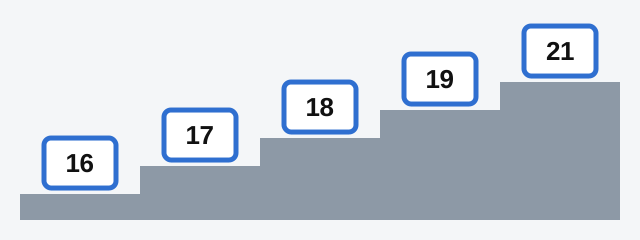
The ages to know. 16: practical exam for subcategory “AM”. 17: practical exam for everything else. 18: licence for “A”, “B” and “C”. 19: licence for trailer combinations. 21: licence for “D” and “D1”.
Article 27 of the RA law sets these ages:
| Category | National licence | Conditions | International licence |
|---|---|---|---|
| “A”, “B” | 18 | 18 | |
| “C” | 18 | 21 | |
| “BE”, “CE”, “DE”, “C1E”, “D1E” | 19 | You already hold “B”, “C” or “D”, or the matching subcategory | 21 |
| “D”, “D1” | 21 | You already hold “B”, “C” or “C1” | 21 |
International licences for subcategories “AM”, “A1” and “B1” also start at 18. For “C1” they start at 21.
Common trap: Category “C” is the one that catches people. The national licence comes at 18, but the international one only at 21.
Common trap: For “D” and “D1” both conditions are needed: age 21 and a “B”, “C” or “C1” licence. Age alone isn’t enough.
Persons conscripted into the RA armed forces and other troops have one exception. They may get “D” and “D1” at 19, if they already hold “B”, “C” or “C1”.
Where does training begin?
Section titled “Where does training begin?”Initial practical training takes place on a driving range or driving ground. Where there is none, it takes place in a closed area isolated from road traffic. Only after this stage may you train on roads. So a first lesson never takes place on a public road, not even a quiet one.
When can I take the practical exam?
Section titled “When can I take the practical exam?”To sit the practical exam in the Road Police subdivisions, you must be a candidate driver, and you become one at 17. The exception is a candidate driver of a subcategory “AM” vehicle, for whom 16 is enough.
When may I actually drive?
Section titled “When may I actually drive?”The right to drive begins from the moment you receive your licence, or from the moment its digital version is issued. Passing the exam only entitles you to have it issued.
Remember: Passing is not the finish line. Until the licence is issued, you have no right to drive.
How long does a licence last?
Section titled “How long does a licence last?”- National licence: 10 years, after which it has to be exchanged.
- International licence: up to 3 years, and never longer than your national licence is valid.
Can I tow a trailer?
Section titled “Can I tow a trailer?”If you hold “B”, “C”, “D”, “C1” or “D1”, you may also drive that vehicle with a trailer, as long as the trailer’s permissible maximum mass is not more than 750 kg.

750 kg is the trailer’s permissible maximum mass: its loaded figure, not its empty weight.
A heavier trailer needs the matching licence: “BE”, “CE”, “DE”, “C1E” or “D1E”.
Try it yourself
Section titled “Try it yourself”You are 17 and have just passed the practical exam for category “B”. May you drive? No. The licence for “B” is issued at 18, and the right to drive begins when you receive it.
You are 20, hold a “C” licence, and want to drive buses. May you get “D”? Not yet, unless you are a conscript. You hold the right licence, but “D” needs age 21.
You hold “B” and want to tow a trailer with a permissible maximum mass of 1,000 kg. Is your licence enough? No. That is over 750 kg, so you need “BE”.
Key points
Section titled “Key points”- “A”, “B” and “C” at 18. Trailer combinations at 19. “D” and “D1” at 21, and only with “B”, “C” or “C1”.
- International licences: 18 for “A” and “B”, 21 for “C”, “D” and the trailer combinations.
- Conscripts may get “D” and “D1” at 19, if they hold “B”, “C” or “C1”.
- Practical exam from 17, or 16 for “AM”. Initial training is never on a public road.
- The right to drive begins when you receive the licence, not when you pass.
- National licence 10 years. International up to 3 years.
- Trailer on your existing licence: up to 750 kg permissible maximum mass.
Practice questions
Section titled “Practice questions”Question 140. According to the RA law “On ensuring road traffic safety”, a driving licence for category “A” vehicles may be issued to:
- Persons who have reached 16 years of age.
- Persons who have reached 17 years of age.
- Persons who have reached 18 years of age.
Show answer
Correct: 3. Persons who have reached 18 years of age.
Under Article 27 of the RA law ‘On ensuring road traffic safety’, a driving licence for category ‘A’ vehicles is issued to persons who have reached 18 years of age. The age of majority in Armenia is likewise 18, and the law sets no lower age for category ‘A’. So ‘Persons who have reached 16 years of age.’ and ‘Persons who have reached 17 years of age.’ fall below the age fixed by law, and ‘Persons who have reached 18 years of age.’ is correct.
Question 141. According to the RA law “On ensuring road traffic safety”, a driving licence for category “BE” vehicles may be issued to:
- Persons who have reached 17 years of age.
- Persons who have reached 18 years of age.
- Persons who have reached 19 years of age.
Show answer
Correct: 3. Persons who have reached 19 years of age.
Under Article 27 of the RA law “On ensuring road traffic safety”, a licence for categories “BE”, “CE” and “DE” and subcategories “C1E” and “D1E” is issued to persons who have reached 19 years of age and already hold a licence of category “B”, “C” or “D” (or of the corresponding subcategory). Category “BE” is a combination based on a category “B” car with a trailer, so the law sets the higher threshold of 19 years, and the 17-year and 18-year options fall below it.
Question 144. According to the RA law “On ensuring road traffic safety”, a driving licence for category “D” and subcategory “D1” vehicles may be issued to:
- Persons who have reached 18 years of age.
- Persons who have reached 19 years of age.
- Persons who have reached 20 years of age.
- Persons who have reached 21 years of age.
Show answer
Correct: 4. Persons who have reached 21 years of age.
Under Article 27 of the RA law ‘On ensuring road traffic safety’, a driving licence for category ‘D’ and subcategory ‘D1’ vehicles is issued to persons who have reached 21 years of age. Category ‘D’ and subcategory ‘D1’ are the buses that carry passengers, so the law sets the highest age threshold for them. ‘Persons who have reached 18 years of age.’, ‘Persons who have reached 19 years of age.’ and ‘Persons who have reached 20 years of age.’ all fall below that threshold, so ‘Persons who have reached 21 years of age.’ is correct.
Question 146. According to the RA law “On ensuring road traffic safety”, the initial training in the practical driving of a vehicle is carried out:
- Outside built-up areas, on roads, taking into account the intensity of vehicle traffic.
- On a closed ground or a driving range.
- On any road (except motorways), taking into account the intensity of vehicle traffic.
Show answer
Correct: 2. On a closed ground or a driving range.
Under Article 28 of the RA law ‘On ensuring road traffic safety’, the initial practical driving training is carried out at a driving range or a driving ground, and where there is none, in a closed area isolated from road traffic. At this first stage the learner does not enter general traffic at all, which is why ‘On a closed ground or a driving range.’ is correct. Training driving on roads is allowed only after that initial stage, so ‘Outside built-up areas, on roads, taking into account the intensity of vehicle traffic.’ and ‘On any road (except motorways), taking into account the intensity of vehicle traffic.’ describe the later stage, not the initial training.
Question 148. According to the RA law “On ensuring road traffic safety”, persons holding a driving licence for categories “B”, “C” and “D” vehicles are permitted to drive them also with trailers, if the permissible maximum mass of the trailer does not exceed
- 750 kilograms.
- 800 kilograms.
- 1000 kilograms.
Show answer
Correct: 1. 750 kilograms.
Under Article 27 of the RA law “On ensuring road traffic safety”, a person holding a licence for category “B”, “C” or “D” may also drive that vehicle with a trailer, provided the trailer’s permissible maximum mass does not exceed 750 kg. That is why “750 kilograms.” is correct. “800 kilograms.” and “1000 kilograms.” are wrong, because a trailer heavier than 750 kg requires the matching “BE”, “CE” or “DE” category.
Question 149. According to the RA law “On ensuring road traffic safety”, a driving licence for categories “B” and “C” vehicles may be issued to:
- Persons who have reached 16 years of age.
- Persons who have reached 17 years of age.
- Persons who have reached 18 years of age.
Show answer
Correct: 3. Persons who have reached 18 years of age.
Under Article 27 of the RA law “On ensuring road traffic safety”, a driving licence for categories “B” and “C” is issued to persons who have reached 18 years of age. That is why “Persons who have reached 18 years of age.” is correct. “Persons who have reached 16 years of age.” and “Persons who have reached 17 years of age.” are below the age the law sets for these two categories, and no licence is issued at those ages.
Question 159. According to the RA law “On ensuring road traffic safety”, a licence for the right to drive vehicles of category “D” and subcategory “D1” may be issued to persons conscripted into the RA armed forces and other troops:
- To persons who have reached 18 years of age.
- To persons who have reached 19 years of age.
- To persons who have reached 20 years of age.
- To persons who have reached 21 years of age.
Show answer
Correct: 2. To persons who have reached 19 years of age.
Under Article 27 of the RA law “On ensuring road traffic safety”, a licence for category “D” and subcategory “D1” is as a rule issued to persons who have reached 21 years of age. For persons conscripted into the RA armed forces and other troops the law lowers this: it may be issued once they have reached 19 years of age, provided they already hold a licence of category “B” or “C” or subcategory “C1”. That is why “To persons who have reached 19 years of age.” is correct here, while “To persons who have reached 18 years of age.”, “To persons who have reached 20 years of age.” and “To persons who have reached 21 years of age.” do not match the age set for this exception.
Question 176. According to the RA law “On ensuring road traffic safety”, the right to drive vehicles arises:
- From the moment of passing the practical examinations for driving vehicles in the Road Police subdivisions.
- From the moment of receiving the driving licence.
Show answer
Correct: 2. From the moment of receiving the driving licence.
Under Article 27 of the RA law “On ensuring road traffic safety”, the right to drive vehicles arises “From the moment of receiving the driving licence” (or from the moment its digital version is issued). Passing the examination only entitles you to be issued that licence; until the document itself is issued there is still no right to drive. So the option “From the moment of passing the practical examinations for driving vehicles in the Road Police subdivisions” is wrong.
Question 177. According to the RA law “On ensuring road traffic safety”, international driving licences for driving vehicles of categories “A” and “B” may be issued:
- To persons who have reached 16 years of age.
- To persons who have reached 17 years of age.
- To persons who have reached 18 years of age.
Show answer
Correct: 3. To persons who have reached 18 years of age.
Under Article 27 of the RA law “On ensuring road traffic safety”, international driving licences for vehicles of categories “A” and “B” (and of subcategories “AM”, “A1” and “B1”) are issued “To persons who have reached 18 years of age”. In other words, such a licence cannot be issued before the 18th birthday. The options “To persons who have reached 16 years of age” and “To persons who have reached 17 years of age” are below the age the law sets.
Question 178. According to the RA law “On ensuring road traffic safety”, an international driving licence for driving vehicles of category “C” may be issued:
- To persons who have reached 18 years of age.
- To persons who have reached 20 years of age.
- To persons who have reached 21 years of age.
Show answer
Correct: 3. To persons who have reached 21 years of age.
Under Article 27 of the RA law “On ensuring road traffic safety”, international driving licences for categories “C”, “D”, “BE”, “CE” and “DE” and subcategories “C1”, “D1”, “C1E” and “D1E” are issued “To persons who have reached 21 years of age”. Category “C” is in exactly that list - the heavy goods group, for which the law sets a higher age than the 18 years required for categories “A” and “B”. So the options “To persons who have reached 18 years of age” and “To persons who have reached 20 years of age” are below the threshold the law requires.
Question 179. According to the RA law “On ensuring road traffic safety”, national driving licences are issued:
- For a period of 5 years.
- For a period of 10 years.
- For a period of 20 years.
- Without a time limit.
Show answer
Correct: 2. For a period of 10 years.
Under Article 27 of the RA law “On ensuring road traffic safety”, a national driving licence is issued “For a period of 10 years”, after which it has to be exchanged. That term is set by the law itself, so “For a period of 5 years”, “For a period of 20 years” and “Without a time limit” do not match it. A convenient pairing to remember: the national licence runs for 10 years, the international one for up to 3 years.
Question 180. According to the RA law “On ensuring road traffic safety”, international driving licences are issued:
- For a period of 1 year.
- For a period of 3 years.
- For a period of 5 years.
- Without a time limit.
Show answer
Correct: 2. For a period of 3 years.
Under Article 27 of the RA law “On ensuring road traffic safety”, an international driving licence is issued for a term of up to 3 years, and never for longer than the national licence itself is valid. So the correct option is “For a period of 3 years”, with that ceiling tied to the national licence. “For a period of 1 year”, “For a period of 5 years” and “Without a time limit” do not match the term the law sets.
Question 181. According to the RA law “On ensuring road traffic safety”, in the Road Police subdivisions (except for a candidate driver of a subcategory “AM” vehicle) a candidate driver may take part in the practical examination if he has reached the age of
- 15 years.
- 16 years.
- 17 years.
Show answer
Correct: 3. 17 years.
Under Article 28 of the RA law “On ensuring road traffic safety”, only a candidate driver may sit the practical examination, and a person becomes a candidate driver on reaching 17 - except a candidate driver of a subcategory “AM” vehicle, for whom 16 is enough. For any vehicle other than subcategory “AM” the practical examination therefore opens at 17, so “17 years.” is correct. “15 years.” and “16 years.” are below the age the law sets for this case, 16 being the concession that applies only to subcategory “AM”.
Question 185. According to the RA law “On ensuring road traffic safety”, persons holding a licence for the right to drive vehicles of categories “B”, “C”, “D” and subcategories “C1”, “D1” are also permitted to drive them with trailers, if the trailer’s maximum permissible mass is:
- 950 kilograms.
- 850 kilograms.
- 750 kilograms.
Show answer
Correct: 3. 750 kilograms.
Under Article 27 of the RA law “On ensuring road traffic safety”, a person holding a licence for category “B”, “C” or “D” or subcategory “C1” or “D1” may also drive those vehicles with a trailer, provided the trailer’s permissible maximum mass does not exceed 750 kilograms. A heavier trailer takes the combination outside that licence and calls for a “BE”, “CE”, “DE”, “C1E” or “D1E” licence instead. The threshold the law sets is therefore “750 kilograms.”, and “850 kilograms.” and “950 kilograms.” both exceed what the licence already held allows.
Question 187. According to the RA law “On ensuring road traffic safety”, a licence for the right to drive vehicles of category “D” and subcategory “D1” may be issued to those persons who have:
- A driving licence for driving vehicles of category “B” or “C” or subcategory “C1”, and have reached 21 years of age.
- A driving licence for driving vehicles of category “B” or subcategory “B1”, and have reached 18 years of age.
- A driving licence for driving vehicles of categories “AB” or subcategories “A1B1”, and have reached 18 years of age.
- A driving licence for driving vehicles of category “B” or “C” or subcategory “C1”, and have reached 20 years of age.
Show answer
Correct: 1. A driving licence for driving vehicles of category “B” or “C” or subcategory “C1”, and have reached 21 years of age.
Under Article 27 of the RA law “On ensuring road traffic safety”, a licence for category “D” and subcategory “D1” is issued only to a person who has reached 21 years of age and who already holds a driving licence for category “B” or “C” or subcategory “C1”. Both conditions must be satisfied together, which is why the option naming a category “B” or “C” or subcategory “C1” licence with 21 years of age is correct. The option pairing the same licences with 20 years of age fails the age condition; the option naming a category “B” or subcategory “B1” licence at 18, and the one naming categories “AB” or subcategories “A1B1” at 18, fail both the age and the required licence.
Question 188. According to the RA law “On ensuring road traffic safety”, an international licence for the right to drive vehicles of categories “D”, “DE” and subcategories “D1” and “D1E” may be issued:
- To persons who have reached 19 years of age.
- To persons who have reached 20 years of age.
- To persons who have reached 21 years of age.
- To persons who have reached 22 years of age.
Show answer
Correct: 3. To persons who have reached 21 years of age.
Under Article 27 of the RA law “On ensuring road traffic safety”, international driving licences for categories “C”, “D”, “BE”, “CE” and “DE” and for subcategories “C1”, “D1”, “C1E” and “D1E” are issued to persons who have reached 21 years of age. Categories “D” and “DE” and subcategories “D1” and “D1E” are inside that list, so the international licence for them is issued “To persons who have reached 21 years of age.” Persons who have reached 19 or 20 years of age have not yet reached the age the law fixes, and 22 years of age is later than the law requires.