Places You Must Not Stop
A vehicle standing in the wrong place blocks the view or the way for everyone else. This lesson puts every place and distance into one table, because the exam asks for exact figures.
How do the two lists fit together?
Section titled “How do the two lists fit together?”Point 84 lists where stopping is prohibited. Point 86 then says parking is prohibited in all those places, and adds a few more of its own. So every place in the first list is closed to both.
The reason for your stop doesn’t help. Picking up a passenger is still a stop.
The table to learn
Section titled “The table to learn”| Place | Stopping | Parking |
|---|---|---|
| Railway crossing | Prohibited on the crossing only | Prohibited on it and closer than 50 m, on both sides |
| Pedestrian crossing | Prohibited on it and closer than 5 m before it | Same as stopping |
| Intersection, including a roundabout | Prohibited in it and closer than 5 m from the edge of the intersecting carriageway | Same as stopping |
| Stopping point of public-use vehicles | Prohibited within marking 1.17, or closer than 15 m from the indicators if there is no marking | Same as stopping |
| Beside a solid line (not an edge line), a dividing strip or the opposite edge of the carriageway | Prohibited if less than 3 m would remain | Same as stopping |
| Dangerous turn with visibility under 100 m | Prohibited on the carriageway | Same as stopping |
| Tunnels; on and under bridges, flyovers, elevated roads and overpasses | Prohibited | Same as stopping |
| Pavements | Prohibited | Same as stopping, unless sign 6.4 and a plate allow it |
| Where you would make others’ movement impossible, such as across an entrance | Prohibited | Same as stopping |
| Carriageway of a road with sign 2.1 “Main road”, outside built-up areas | Allowed | Prohibited |
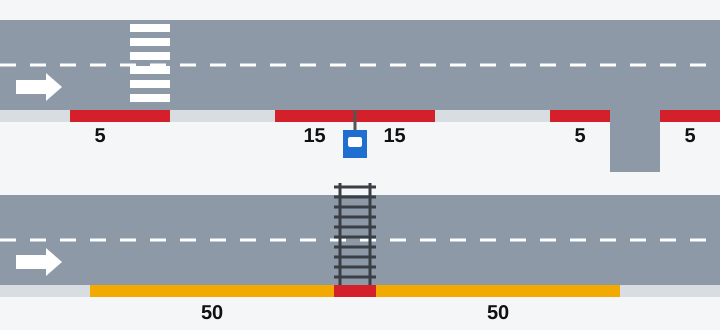
Traffic runs left to right. Red means no stopping or parking, and amber means stopping is allowed but parking isn’t. Top road: a pedestrian crossing, a stopping point with no marking, and a side road. Bottom road: a railway crossing.
Remember: The Rules say “closer than” and “less than”. At exactly 5 m, 15 m or 3 m you are outside the ban.
Common trap: Don’t swap the numbers. 50 m near a railway crossing is for parking, never stopping. 15 m belongs to stopping points, and the 100 m before a crossing is about overtaking.
Pedestrian crossings: before, not after
Section titled “Pedestrian crossings: before, not after”The 5 m applies only before the crossing, in your direction of travel. Just past it, stopping is allowed.
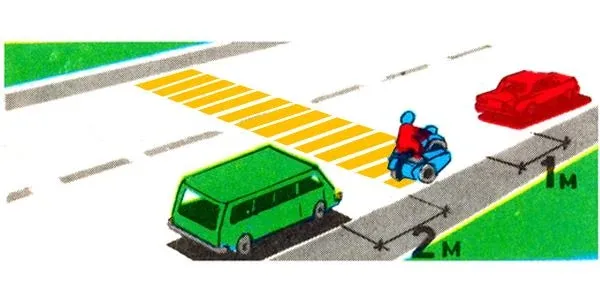
The van is too close and the motorcycle is on the crossing. The red car is correct, because it is past it.
Measure to the near edge of the crossing, the one you are approaching.
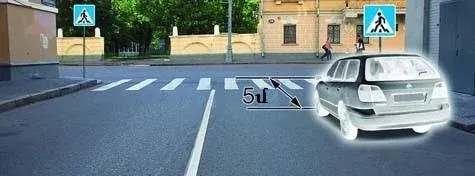
The 5 m here reaches the far edge, so it includes the crossing itself. The real gap is under 5 m, so stopping is prohibited.
The 3 m rule
Section titled “The 3 m rule”This leaves room for others to pass. Measure from your vehicle to the line, not from the kerb.
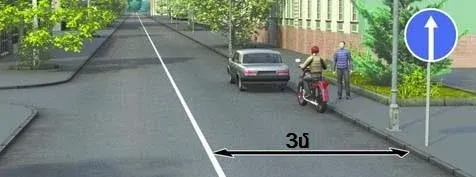
The whole strip is 3 m wide. With a vehicle standing in it, less than 3 m remains, so nobody may stop here. A motorcycle is narrower, but it still leaves less than 3 m.
A strip 4 m wide fails the same way once a car stands in it. Only a solid line counts, and not one marking the edge of the carriageway. A broken line sets no such limit.
Stopping points
Section titled “Stopping points”This area is kept for route transport, so only the driver of a public-use vehicle may stop there.
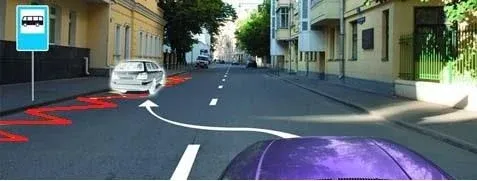
Sign 5.16 and the zigzag marking 1.17 show the stopping point. Stopping is prohibited along the marking.
Bends and bridges
Section titled “Bends and bridges”The bend rule covers the carriageway only, and a dangerous-turn sign bans nothing by itself. So you may stand clear of the carriageway at the edge of the road, even near the bend. In tunnels and on bridges, there’s no such way out.
Extra: Why a car before a crossing is a danger
Not from the question bank.
A car standing just before a crossing hides people who are about to step out, and it hides approaching traffic from them. A child is the hardest to see. Past the crossing, the same car hides much less.
Try it yourself
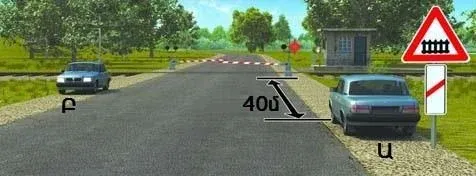
Section titled “Try it yourself”Two cars stand on the approach to a railway crossing. Car Ա (A) is 40 m away, and car Բ (B) is on the other side of the road.
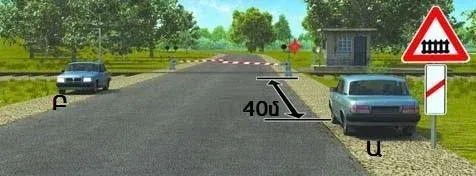
Did either break the rules of stopping? No. Stopping is banned only on the crossing itself. If they are parked, though, both are in breach, because they are inside the 50 m zone.
Key points
Section titled “Key points”- Wherever stopping is prohibited, parking is too.
- Railway crossing: no stopping on it, and no parking on it or within 50 m on either side.
- Pedestrian crossing: nothing on it or closer than 5 m before it. Just past it is fine.
- Intersection: 5 m. Stopping point: marking 1.17, or 15 m from the indicators.
- Leave at least 3 m to a solid line, measured from your vehicle.
- No stopping in tunnels, or on or under bridges, even for a passenger.
Practice questions
Section titled “Practice questions”Question 433. Parking is prohibited:
- On bridges, elevated roads and overpasses.
- Under bridges, elevated roads and overpasses.
- In all the listed cases.
Show answer
Correct: 3. In all the listed cases.
Point 84 of the Rules prohibits stopping on bridges, elevated roads and overpasses as well as under them, and under point 86 parking is prohibited in every place where stopping is prohibited. So parking is banned both “On bridges, elevated roads and overpasses.” and “Under bridges, elevated roads and overpasses.” — that is, “In all the listed cases.” Each of those two options is true on its own but incomplete, because the ban covers both.
Question 437. At what distance from railway crossings is parking of vehicles prohibited?
- 300 m.
- 150 m.
- 100 m.
- 50 m.
- 25 m.
Show answer
Correct: 4. 50 m.
Under point 86, sub-point 4 of the Rules, parking a vehicle closer than 50 m to a railway crossing is prohibited. In other words, parking is banned within a 50 m zone around the crossing, and that is the distance the Rules set. The correct answer is therefore “50 m.”, while the figures “300 m.”, “150 m.”, “100 m.” and “25 m.” are not set by the Rules as a parking distance from a railway crossing.
Question 464. In which picture has the driver correctly made a stop to let passengers off?
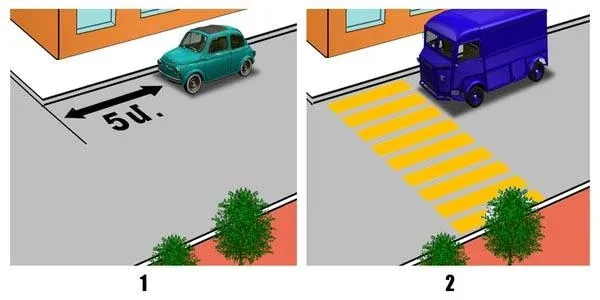
- In the left picture.
- In both pictures.
- In the right picture.
Show answer
Correct: 1. In the left picture.
Under point 84 of the Rules, stopping is prohibited on pedestrian crossings and within 5 m before them. In the left picture the car has stopped outside the prohibited zone, about 5 m away, which is correct; in the right picture the van is standing on the pedestrian crossing itself, which is prohibited. The driver therefore made his stop correctly only in the left picture. “In both pictures.” and “In the right picture.” are wrong, because stopping ON a pedestrian crossing breaches point 84 whatever the reason for the stop.
Question 472. Stopping is prohibited if the distance between the solid line and the stopped vehicle is:
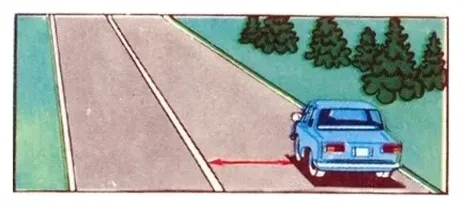
- 6 m.
- 5.5 m.
- 4 m.
- 3.5 m.
- 2.5 m.
Show answer
Correct: 5. 2.5 m.
Under point 84 of the Rules, stopping is prohibited where the distance between the stopped vehicle and a solid line - other than one marking the edge of the carriageway - a dividing strip or the opposite edge of the carriageway is LESS than 3 m; the point of the rule is to leave room for other traffic to pass. Of the distances offered, only 2.5 m is less than 3 m, so stopping is prohibited at 2.5 m. “6 m.”, “5.5 m.”, “4 m.” and “3.5 m.” are all 3 m or more, so this rule does not prohibit stopping at any of them.
Question 474. At what distance from railway crossings is parking of vehicles prohibited?
- 15 m.
- 50 m.
- 100 m.
- 150 m.
Show answer
Correct: 2. 50 m.
Point 86 of the Rules lists where parking is prohibited and expressly includes closer than 50 m to a railway crossing, which keeps the view and the space on the approach to the rails clear. That is why “50 m.” is the correct answer. “15 m.” is the distance measured from the markers of public-transport stopping points, not from a crossing; “100 m.” is the stretch before a crossing where overtaking is banned; and the Rules attach no 150 m distance to crossings at all.
Question 476. The drivers of which vehicles have made an incorrect stop to let passengers off?
- The driver of the passenger car.
- The driver of the motorcycle.
- The driver of the bus.
- The drivers of the motorcycle and the bus.
- All the drivers.
Show answer
Correct: 4. The drivers of the motorcycle and the bus.
Under point 84 of the Rules, stopping is prohibited on pedestrian crossings and within 5 m BEFORE them - but not after them. The bus has stopped about 2 m before the crossing, inside that 5 m zone, and the motorcycle is standing on the crossing itself, so both stopped incorrectly. The light passenger car has stopped about 1 m beyond the crossing, where stopping is not prohibited. The drivers who stopped incorrectly are therefore the motorcycle’s and the bus’s; any answer including the light passenger car, or naming all the drivers, is wrong, because stopping after a crossing is permitted.
Question 498. Is stopping permitted in the indicated place?
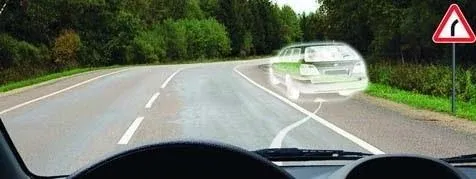
- Yes
- No
Show answer
Correct: 1. Yes
Under point 84 of the Rules, near a dangerous turn where visibility along the road is less than 100 m, stopping is prohibited ON THE CARRIAGEWAY. Here the vehicle has stopped off the carriageway, on the verge at the edge of the road, and the dangerous-turn sign is only a warning that imposes no stopping ban of its own. Stopping at the indicated place is therefore permitted. “No” is wrong because the bend-related prohibition in point 84 applies to the carriageway and not to a vehicle standing clear of it.
Question 500. Is it permitted to stop in the indicated place?
- Yes
- It is prohibited
- Only for the purpose of picking up a passenger
Show answer
Correct: 2. It is prohibited
This is a stopping point for public-use transport vehicles, marked with sign 5.16 and with the zigzag marking 1.17 drawn along the edge. Under sub-point 7 of point 84 of the Rules, stopping is prohibited within the area of a stopping point marked by marking 1.17, and where there is no such marking, nearer than 15 m from the stopping-point indicators. Stopping at the indicated place is therefore prohibited. “Yes” is wrong, and “Only for the purpose of picking up a passenger” is wrong because point 84 provides no such exception - that is precisely what the stopping point is reserved for.
Question 501. Is stopping for the purpose of picking up a passenger permitted in the indicated situation?
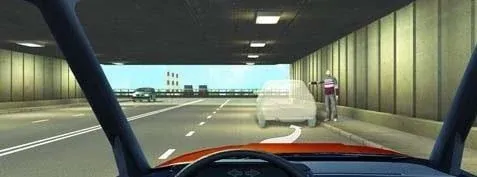
- Yes
- No
Show answer
Correct: 2. No
This is inside a tunnel. Under point 84 of the Rules, stopping is prohibited at railway crossings, in tunnels, and on and under flyovers, bridges and overpasses. Stopping to pick up a passenger is still stopping, so it is not permitted in a tunnel. “Yes” is wrong because point 84 forbids stopping in tunnels whatever the purpose - there is no room to pass a stopped vehicle and no escape for anyone on foot.
Question 502. Stopping is prohibited:
- At the railway crossing
- At the railway crossing and within 50 m of the crossing
- At the railway crossing and 50 m before the crossing
Show answer
Correct: 1. At the railway crossing
Point 84 of the Rules prohibits stopping on the railway crossing itself, so “At the railway crossing” is the correct answer. The 50 m figure does not belong to stopping at all — it is the parking restriction set by point 86. That is why “At the railway crossing and within 50 m of the crossing” and “At the railway crossing and 50 m before the crossing” are wrong: both bring a parking rule into a question about stopping.
Question 503. Parking is prohibited
- On a railway crossing
- On a railway crossing and 50 m close to the crossing
- On a railway crossing and 50 m before the crossing
Show answer
Correct: 2. On a railway crossing and 50 m close to the crossing
Under point 86 of the Rules, sub-points 1 and 4, parking is prohibited both where stopping is prohibited — on a railway crossing, by point 84 — and closer than 50 m to a crossing. That 50 m zone applies on both sides of the crossing, so “On a railway crossing and 50 m close to the crossing” is the correct answer. “On a railway crossing” is incomplete because it leaves out the 50 m zone, and “On a railway crossing and 50 m before the crossing” narrows the ban to one side only.
Question 505. Stopping in the indicated place
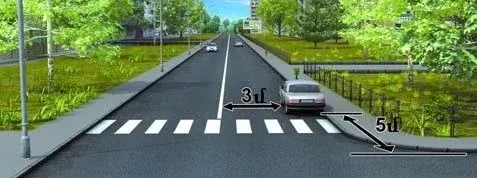
- Is permitted
- Is prohibited
Show answer
Correct: 1. Is permitted
Under point 84 of the Rules, stopping is prohibited on a pedestrian crossing and within 5 m before it, but not after it. The vehicle stands beyond the pedestrian crossing, where this prohibition does not apply, so stopping in the indicated place is permitted. “Is prohibited” is wrong, because the 5 m restriction applies only before the crossing, not after it.
Question 508. In the indicated situation, is it permitted to stop for the purpose of picking up a passenger?
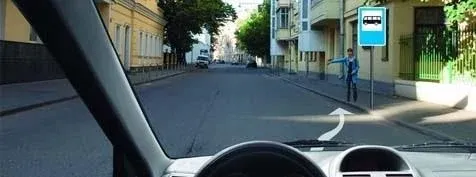
- Yes
- It is permitted only to the driver of a public-use vehicle
- No
Show answer
Correct: 2. It is permitted only to the driver of a public-use vehicle
Sign 5.16 marks the bus stopping point, and point 84 of the Rules prohibits stopping within the area of a public-use transport stopping point - where marking 1.17 is absent, nearer than 15 m from the indicator - with no exception for picking up a passenger, so an ordinary driver may not stop here. A public-use transport vehicle is in the opposite position: under point 85 it must make its stops at exactly such points. Stopping is therefore permitted only to the driver of a public-use vehicle. “Yes” contradicts the prohibition in point 84, and “No” overlooks that this is the very place where route transport picks passengers up.
Question 510. Is it permitted to stop in the indicated place?
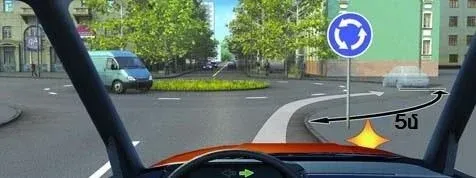
- No
- Yes
Show answer
Correct: 1. No
A roundabout is an intersection. Under point 84 of the Rules stopping — and under point 86 parking as well — is prohibited at intersections and closer than 5 m from the edge of the intersecting carriageway. The indicated place lies within 5 m of the roundabout, so stopping there is prohibited. “Yes” is wrong, because points 84 and 86 prohibit both stopping and parking at an intersection and within 5 m of it.
Question 511. Who has violated the rules of stopping?
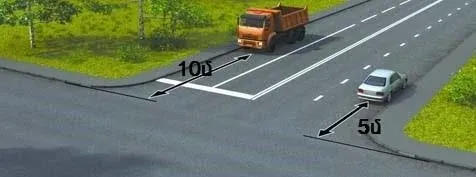
- Both drivers
- Only the truck driver
- Only the passenger-car driver
- No one
Show answer
Correct: 2. Only the truck driver
The truck has stopped where the solid marking line runs immediately alongside it, and point 84 of the Rules prohibits stopping where the distance between the standing vehicle and a solid line - other than one marking the edge of the carriageway - is less than 3 m; being 10 m from the intersection does not change that. The light passenger car is standing 5 m from the edge of the crossing carriageway, and point 84 prohibits stopping only at LESS than 5 m, so it has committed no offence. Only the truck driver has therefore broken the rules of stopping, and “Both drivers”, “Only the passenger-car driver” and “No one” are wrong.
Question 513. Is it permitted to stop on a bridge for the purpose of picking up a passenger?
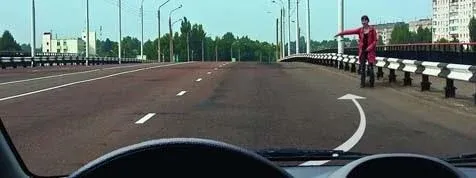
- Yes
- No
Show answer
Correct: 2. No
The road here runs across a bridge. Under point 84 of the Rules, stopping is prohibited at railway crossings, in tunnels, and on and under flyovers, bridges and overpasses. Stopping to pick up a passenger is still stopping, so it is not permitted on a bridge. “Yes” is wrong because point 84 forbids stopping on bridges whatever the purpose: a bridge has no shoulder to pull onto and no room to pass a stopped vehicle.
Question 515. Is it permitted to stop in the indicated place?
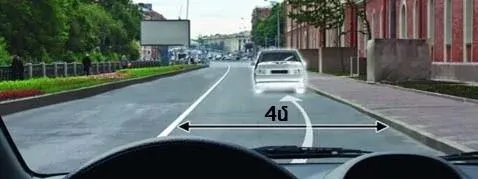
- Yes
- No
Show answer
Correct: 2. No
Between the solid line on the left and the kerb the carriageway here is only 4 m wide, so less than 3 m would remain between a car standing at the kerb and the solid line. Under point 84 of the Rules, stopping is prohibited where the distance between the standing vehicle and the solid line, the dividing strip or the opposite edge of the carriageway is less than 3 m; stopping in the indicated place is therefore not permitted.
Question 518. Is it permitted to stop in the indicated place?
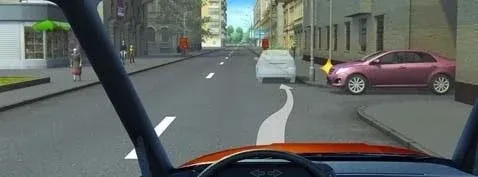
- Yes
- No
Show answer
Correct: 2. No
On the left stands sign 5.16, marking a stopping point for public-use transport vehicles, and the zigzag marking 1.17 is painted along the kerb beside it to show the extent of that stopping point. Under point 84 of the Rules stopping is prohibited within the area of a stopping point marked by marking 1.17, so stopping at the indicated place is not permitted. “Yes” is wrong: that area is reserved for route transport, and standing in it obstructs the very vehicles it exists for.
Question 519. Parking at the indicated place
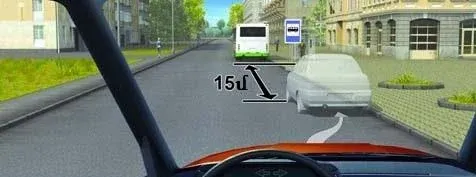
- Is permitted
- Is prohibited
Show answer
Correct: 1. Is permitted
Ahead, sign 5.16 “Bus and (or) trolleybus stop” together with the standing bus marks a stopping point for route vehicles. Under sub-point 7 of point 84 of the Road Traffic Rules, stopping is prohibited within the area of the stopping point or less than 15 m from its indicators, and the 15 m distance shown in the picture is already outside that prohibited zone. Parking in the indicated place is therefore permitted, and the option “Is prohibited” is wrong — the 15-metre ban around the stopping point does not extend to this place.
Question 520. Stopping in the indicated place
- Is permitted
- Is permitted for the purpose of picking up a passenger
- Is prohibited
Show answer
Correct: 3. Is prohibited
point 84 of the Rules prohibits stopping on a pedestrian crossing and closer than 5 m before it in the direction of travel. The 5 m marked in the picture is measured from the car to the FAR edge of the crossing, so it takes in the width of the crossing itself. The rule’s 5 m, however, is counted to where the crossing begins - the edge the driver is approaching. The real gap between the car and the crossing is therefore less than 5 m, so stopping in the place shown is prohibited. “Is permitted” is wrong, and “Is permitted for the purpose of picking up a passenger” all the more so: picking up a passenger is itself a stop, and a stop is what is forbidden here.
Question 521. Are the drivers permitted to stop in the indicated place?
- Yes
- Only the motorcycle driver
- No
Show answer
Correct: 3. No
The 3 m in the picture is the width of the strip between the solid line on the carriageway and the right-hand kerb, and both the car and the motorcycle are standing within that strip - so the space left between each standing vehicle and the solid line is less than 3 m. Under sub-point 3 of point 84 of the Rules, stopping is prohibited where the distance between a standing vehicle and a solid line - other than one marking the edge of the carriageway - is less than 3 m. “Yes” is therefore wrong, and “Only the motorcycle driver” is wrong too: although the motorcycle is narrower it still leaves less than 3 m, and the prohibition applies to any standing vehicle.
Question 525. Stopping in the indicated place
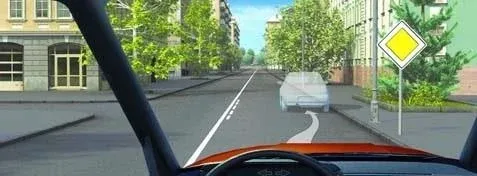
- Is permitted
- Is permitted if the distance from the vehicle to the marking is more than 3 metres.
- Is prohibited
Show answer
Correct: 3. Is prohibited
Under point 84 of the Rules stopping is prohibited where the distance between the stopped vehicle and a solid marking line - other than one marking the edge of the carriageway - is less than 3 metres. A solid line 1.1 runs right alongside the indicated place, and the carriageway between it and the kerb is not wide enough to leave 3 metres from a standing car to that line. Stopping at the indicated place is therefore prohibited, and the condition offered by the second answer simply cannot be met here. Sign 2.1 “Main road” on the right prohibits no stopping - the prohibition comes from the line, not from the sign.
Question 1079. Of those indicated, in which place is it permitted to stop?
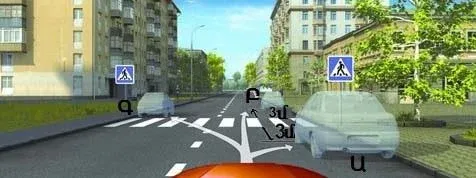
- Only Ա (A)
- Only Բ (B)
- Only Բ (B) and Գ (C)
- In no place
Show answer
Correct: 2. Only Բ (B)
Marking 1.14.1, the “zebra”, together with the pedestrian crossing signs indicates the crossing, and under point 84 of the Traffic Rules stopping is prohibited on pedestrian crossings and closer than 5 m to them in the direction of travel. Place Ա (A) is only 3 m before the crossing, so stopping there is prohibited, while place Բ (B) is 3 m past the crossing, where the 5-metre restriction no longer applies and stopping is permitted. Place Գ (C) is at the opposite edge of the road, directly beside the crossing, which for a driver travelling in that direction is closer than 5 m to it, so stopping is prohibited there as well. The answers “Only Ա (A)”, “Only Բ (B) and Գ (C)” and “In no place” are therefore wrong: stopping may be made only at place Բ (B).
Question 1085. In which case has the driver violated the rules of stopping?
- Only Ա (A)
- Only Բ (B)
- No one
- Both have violated
Show answer
Correct: 3. No one
Under point 84 of the Rules stopping is prohibited at railway crossings themselves; the 50 m zone belongs to PARKING under point 86, not to stopping. Both cars are standing well clear of the crossing - about 40 m away and further - and neither is on the crossing, so neither driver has broken the rules of stopping. “Only Ա (A)”, “Only Բ (B)” and “Both have violated” are wrong because no one has stopped on the crossing.
Question 1086. In which case has the driver violated the rules of parking?
- Only Ա (A)
- Only Բ (B)
- Both have violated
- No one
Show answer
Correct: 3. Both have violated
Under point 86 of the Rules, parking is prohibited nearer than 50 m to a railway crossing. One car is standing about 40 m from the crossing and the other is likewise within 50 m of it, so both drivers have broken the rules of parking. “Only Ա (A)”, “Only Բ (B)” and “No one” are wrong, because both cars are parked inside the prohibited 50 m zone of the crossing.