Brakes and Steering
A fault you find on the driveway is an inconvenience, but the same fault at speed can be a crash. This chapter turns the exam’s list of faults into a check you can do before you drive, starting with the two systems that control the car.
How does the list work?
Section titled “How does the list work?”Annex 2 to the Traffic Rules lists the faults and conditions that prohibit operating a vehicle. “Operating” here means using it on the road. If a fault is on the list, the vehicle must not be used. If it isn’t, it doesn’t count: an audio player that doesn’t work, for example, isn’t on the list.
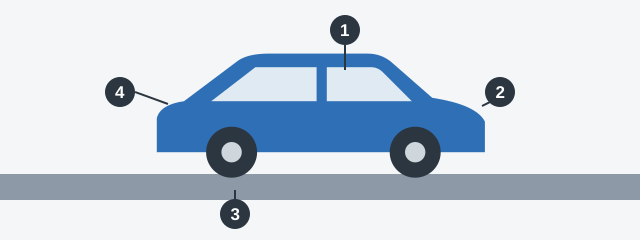
The four stops of the check. 1: from the seat, test brakes and steering (this lesson). 2: walk round the lights and glass. 3: look at each wheel and tyre. 4: go through the engine and equipment.
Common trap: Most of these questions end with “In both cases”. Test each option on its own. An option can be perfectly normal, such as a tyre that’s still above its limit.
Stop 1: Brakes
Section titled “Stop 1: Brakes”- Hydraulic brakes: the seal of the brake line must be intact. A broken seal lets the fluid escape.
- Pneumatic (air) brakes: the pressure gauge must work.
- Parking brake: it must hold the vehicle still on the gradient set by the standard.
Stop 1: Steering
Section titled “Stop 1: Steering”The steering has some free play: how far the wheel turns before the road wheels respond. Too much, and your steering arrives late.
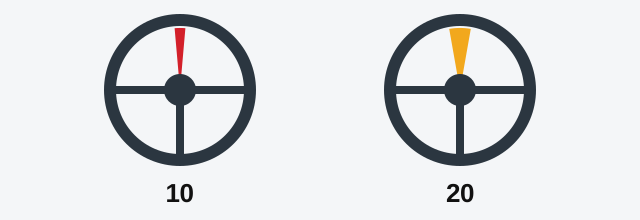
The limit is 10 degrees for a passenger car and for a bus built on a passenger car base, and 20 degrees for any other bus.
Remember: The base decides. A free play of 15 degrees prohibits operating a bus built on a passenger car base, but it is within the limit on an ordinary bus.
Operation is also prohibited if:
- Steering parts or assemblies move in ways the design doesn’t provide for.
- Threaded connections aren’t tightened or secured in the prescribed manner.
- The power steering booster provided by the design is faulty or missing.
Extra: Feeling for faults from the driver's seat
Not from the question bank.
With the engine running and the wheels straight, turn the steering wheel gently each way until the road wheels begin to move. A long dead zone, clunks or stiff spots need a mechanic. Press the brake pedal firmly: it should feel solid and not sink slowly to the floor. Oily patches under the car are worth investigating too.
Try it yourself
Section titled “Try it yourself”The mudguards are missing from a car with 12 degrees of free play. Which is the fault? Both. The limit for a car is 10 degrees, and missing mudguards or splash guards provided by the design are also on the list.
Key points
Section titled “Key points”- Annex 2 is a list: a fault prohibits operation only if it’s on it.
- A broken hydraulic brake seal or a dead pneumatic brake pressure gauge prohibits operation.
- Free play limit: 10 degrees for a car or a bus on a car base, 20 degrees for other buses.
- Loose steering connections and a faulty power steering booster prohibit operation.
Practice questions
Section titled “Practice questions”Question 935. The operation of vehicles is prohibited if:
- The residual height of the tread of light passenger cars’ tyres is 1.8 mm.
- The tightness of the hydraulic brake line is broken.
- In both cases.
Show answer
Correct: 2. The tightness of the hydraulic brake line is broken.
Under the RA Law “On Ensuring Road Traffic Safety” the operation of a vehicle is prohibited when its technical condition does not conform to the Government-approved List of malfunctions prohibiting operation, and section 1 (brake-system malfunctions) of Appendix No. 2 to the Traffic Rules states that operation is prohibited when the hermetic sealing of the hydraulic brake transmission is broken. The same appendix sets the smallest residual tread that a light passenger car’s tyres may keep at 1.6 mm, so the 1.8 mm in the first option is still above that limit and is not a prohibiting condition — only the broken hydraulic brake-drive sealing prohibits operation.
Question 936. Operation of vehicles is prohibited if:
- The residual tread depth of a truck’s tyres is 1.6 mm.
- The pressure gauge of the pneumatic brake drive does not work.
- In both cases.
Show answer
Correct: 2. The pressure gauge of the pneumatic brake drive does not work.
Section 1 of Appendix No. 2 to the Traffic Rules - the list of malfunctions and conditions prohibiting operation, covering brake systems - prohibits operation when the pressure gauge of the pneumatic or pneumo-hydraulic brake drive does not work. A residual tread depth of 1.6 mm on a truck’s tyres is above the minimum the Rules allow for lorries, not below it, so it is not a prohibiting condition. Operation is therefore prohibited by the non-working pressure gauge alone, which is why “The pressure gauge of the pneumatic brake drive does not work.” is correct and “In both cases.” is wrong.
Question 965. Operation of vehicles is prohibited if:
- The total free play of a passenger car’s steering system exceeds 10 degrees.
- The mudguards and splash guards provided by the design are missing.
- In both cases.
Show answer
Correct: 3. In both cases.
Both cases prohibit operation. The steering-system section of Annex N 2 to the Road Traffic Rules (the list of faults and conditions prohibiting operation) bars a car when “the total free play of a passenger car’s steering system exceeds 10 degrees”, and the “Other” section bars a vehicle when “the mudguards and splash guards provided by the design are missing”. Since each condition is a ground for prohibition by itself, the correct answer is “In both cases.”
Question 974. Operation of vehicles is prohibited if:
- There are displacements of the steering system’s parts (details) and assemblies not provided by the design.
- Turn indicators with white-coloured lights are installed at the front.
- In both cases.
Show answer
Correct: 1. There are displacements of the steering system’s parts (details) and assemblies not provided by the design.
point 2 of Appendix No. 2 to the Traffic Rules, “Malfunctions of steering systems”, prohibits operation where there are displacements of steering parts and assemblies that the design does not provide for, so “There are displacements of the steering system’s parts (details) and assemblies not provided by the design.” is correct. Turn indicators showing white light at the front are not a fault: sub-point “a” of point 3 prohibits at the front only light devices whose light is a colour other than white, yellow or orange, so white is a permitted colour there. “In both cases.” is therefore wrong.
Question 981. Operation of vehicles is prohibited if:
- For a bus built on a passenger car base, the total free play of the steering system exceeds 10 degrees.
- The mudguards and splash guards provided by the design are missing.
- In both cases.
Show answer
Correct: 3. In both cases.
Both situations prohibit operation. The “Malfunctions of steering systems” section of Appendix No. 2 to the Traffic Rules sets a total free play limit of 10 degrees for light passenger cars and for buses built on a passenger car base, so exceeding 10 degrees on such a bus prohibits operation. The “Other” section separately prohibits operation when the mudguards and splash guards provided by the design are missing. Each condition prohibits operation in itself, so “In both cases.” is the correct answer.
Question 982. Operation of vehicles is prohibited if:
- The total free play of the steering system of a bus built on a passenger car base is 15 degrees.
- The total free play of a bus’s steering system is 15 degrees.
- In both cases.
Show answer
Correct: 1. The total free play of the steering system of a bus built on a passenger car base is 15 degrees.
The “Malfunctions of steering systems” section of Appendix No. 2 to the Traffic Rules sets the total free play limit by vehicle class: 10 degrees for a bus built on a passenger car base, and 20 degrees for an ordinary bus. A free play of 15 degrees therefore exceeds the limit for a bus built on a passenger car base and prohibits its operation, which is why that option is correct. On an ordinary bus the same 15 degrees is still inside the 20-degree limit and is not a fault, so “In both cases.” is wrong.
Question 996. Operation of vehicles is prohibited if:
- The power steering booster provided by the design is faulty or missing
- The audio player does not work
- In both cases
Show answer
Correct: 1. The power steering booster provided by the design is faulty or missing
point 2 of Appendix No. 2 to the Traffic Rules, “Malfunctions of steering systems”, prohibits operation when the power steering booster provided by the design is faulty or missing - without it the steering effort is not what the vehicle was built for. An audio player that does not work does not appear anywhere in Appendix No. 2, which is a closed list, so it is not a malfunction prohibiting operation. Only one of the two situations prohibits operation, so “In both cases” is wrong.