Where to Stop and Park
Many questions here turn on one word: was that a stop, or was it parking? Learn the difference first, then the side of the road and the way the vehicle must stand.
Stopping or parking: which am I doing?
Section titled “Stopping or parking: which am I doing?”Both mean deliberately bringing your vehicle to a standstill. The RA law separates them by two things only: time and purpose.
| Stopping | Parking | |
|---|---|---|
| Time | Up to 5 minutes | More than 5 minutes |
| Passengers, loading | As long as boarding, alighting, loading or unloading needs, even past 5 minutes | Not parking, however long it takes |
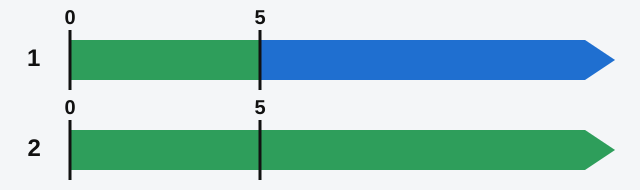
Green is stopping and blue is parking, with time in minutes. Bar 1 is an ordinary halt. Bar 2 is a halt for passengers, or for loading or unloading.
Try it on real halts:
| You halt… | It is |
|---|---|
| For 3 minutes to check a map | Stopping |
| For 20 minutes to unload the van | Stopping |
| For 10 minutes to wait for a friend | Parking |
A halt to prevent a collision is not parking either, whatever its length.
Remember: A ban on stopping also bans parking. A ban on parking doesn’t ban stopping.
Which side of the road?
Section titled “Which side of the road?”Use the right-hand side (point 78). The place depends on what the road offers:
- Next to the pavement, or on the shoulder.
- Only if there is neither, at the edge of the carriageway.
If there is a shoulder, the whole vehicle goes on it. You may cross the edge line 1.2 to do this.
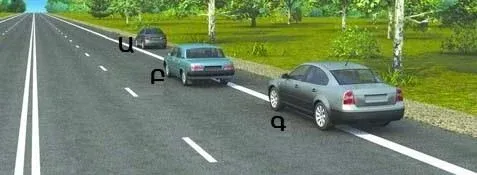
Car Ա (A) stands fully on the shoulder, which is correct. Car Բ (B) is on the carriageway and Գ (C) is on the line with its left side still on the carriageway. Both are wrong.
When may I use the left side?
Section titled “When may I use the left side?”Only in a built-up area, and only on one of these roads (point 79):
- A one-way road.
- A road with one lane in each direction and no tram tracks in the middle.
Trucks with a permissible maximum mass over 3.5 t may stop on the left only to load, unload, or set down and pick up passengers. Buses have no such limit. Outside built-up areas, you can’t use the left side at all, so check the town sign.
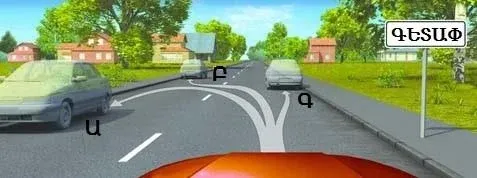
Black on white: built-up area rules apply on this road, so all three places are allowed.
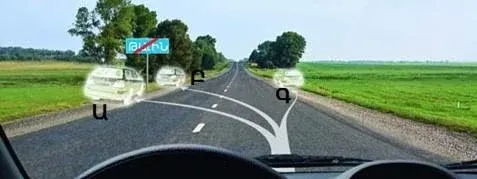
Blue, crossed out, sign 5.26: built-up area rules don’t apply, so only Գ (C) on the right-hand shoulder has stopped correctly.
Common trap: Permission to use the left side doesn’t cancel other rules. A car on the left of a one-way road is still wrong if it stands too close before a crossing or blocks a courtyard entrance.
How must the vehicle stand?
Section titled “How must the vehicle stand?”Parallel to the edge of the carriageway, in a single row (point 80). There are two exceptions:
- A place, such as a local widening of the carriageway, where a marking permits another arrangement.
- Two-wheeled vehicles without a sidecar, which may stand two abreast.
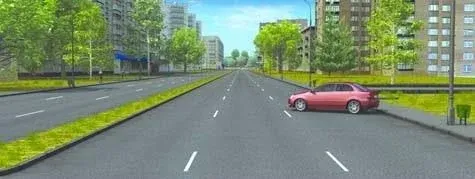
Angled, with no marking that allows it. Stopping like this is not permitted, for passenger cars too.
May I stand on the pavement?
Section titled “May I stand on the pavement?”No. Point 84 prohibits stopping on pavements, and that covers parking too. Only light passenger cars, motorcycles, mopeds and bicycles may use the pavement edge, and only where sign 6.4 “Parking place” stands with a plate showing that manner of parking (point 81). The lesson on stopping signs covers those plates.
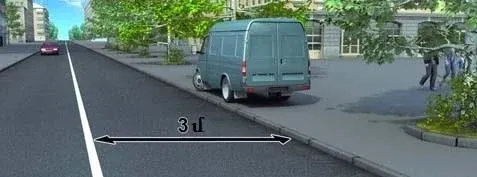
No sign 6.4 and no plate here, so this driver has broken the rules of stopping.
Where may I take a long rest?
Section titled “Where may I take a long rest?”Outside built-up areas, parking for a long rest, an overnight stay or the like is allowed only in places specially provided for parking, or beyond the limits of the road (point 82).
Common trap: The shoulder feels like a safe answer, but it isn’t one. Neither is the right side of the carriageway.
Also outside built-up areas, you must not park on the carriageway of a road marked with sign 2.1 “Main road”, at any hour (point 86). A stop to pick up passengers is still fine.
Where do big vehicles park in residential zones?
Section titled “Where do big vehicles park in residential zones?”Buses other than minibuses, and trucks over 3.5 t, may park in residential zones and courtyards only in places provided for it, with the corresponding signs and marking (points 121 and 122).
Extra: Before you open a door
Not from the question bank.
Check your mirror and look over your shoulder before you open a door on the traffic side. A cyclist or a motorcycle may be passing close to you. Ask passengers to get out on the kerb side where they can.
Try it yourself
Section titled “Try it yourself”You are on an open road between fields. A car stands on the left, and a motorcycle stands on the carriageway beside a free shoulder.
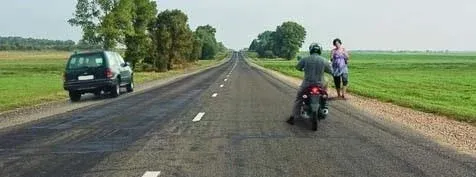
Who broke the rules? Both. Outside a built-up area the left side is not allowed, and the motorcycle should have pulled onto the shoulder.
Key points
Section titled “Key points”- Stopping: up to 5 minutes, or as long as passengers, loading or unloading need. Parking: anything longer.
- Stand on the right: next to the pavement or on the shoulder, and at the edge only if there is neither.
- Left side: built-up areas only, on one-way roads or roads with one lane each way and no central tram tracks.
- Stand parallel to the edge in a single row, and stay off the pavement unless sign 6.4 and a plate allow it.
- Long rest outside built-up areas: a provided place or beyond the road, not the shoulder.
Practice questions
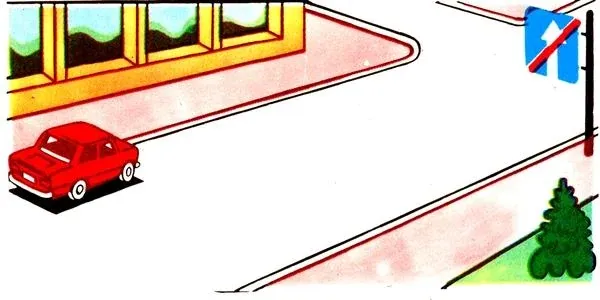
Section titled “Practice questions”Question 436. Is parking of the car permitted at the indicated place?
- It is permitted.
- It is prohibited.
Show answer
Correct: 1. It is permitted.
Sign 5.6 “End of one-way road” stands ahead, which means that where the car is standing the traffic is still one-way, and the buildings around show that this is a built-up area. Under point 79 of the Traffic Rules, in built-up areas stopping and parking on the LEFT side of the carriageway are permitted on roads with one-way traffic, so the light passenger car may park at the indicated place. “It is prohibited.” is wrong: the restriction on the left side applies only to lorries with a permissible maximum mass over 3.5 t, which may stop there only to load, unload or set down and pick up passengers.
Question 466. In built-up areas, stopping and parking on the left side of roads that have one lane in each direction and no tram tracks in the middle is:
- Allowed.
- Prohibited.
Show answer
Correct: 1. Allowed.
Point 79 of the Rules permits stopping and parking on the left-hand side of the carriageway in built-up areas on roads with one lane in each direction and no tram tracks in the middle, and on one-way roads. The road described in the question meets exactly those conditions, so “Allowed.” is the correct answer. “Prohibited.” is wrong, because the left-hand side is closed only where a direction has more than one lane or where tram tracks run down the middle.
Question 470. Which vehicle’s driver has violated the parking rules?
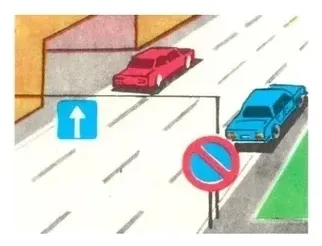
- The driver of the blue car.
- The driver of the red car.
- Both drivers have violated them.
- Neither driver has violated them.
Show answer
Correct: 3. Both drivers have violated them.
Sign 5.5 “Road with one-way traffic” shows that the road is one-way, and under point 79 of the Rules standing on the left-hand side is permitted on such a road in a built-up area. The red car, however, has been left directly in front of a courtyard entrance, and under point 84 of the Rules stopping is prohibited in places where the vehicle would make the movement of other vehicles impossible — their entry into an adjoining territory or their exit from it. The permission to stand on the left therefore does not help here, and the driver of the red car is in breach. The blue car is standing on the side of the road where sign 3.28 “No parking” is placed, so its driver has broken the rules as well. Both drivers have therefore violated them, and “The driver of the blue car.”, “The driver of the red car.” and “Neither driver has violated them.” are wrong.
Question 471. Where is parking allowed for a long rest, an overnight stay, or other such purposes outside built-up areas?
- On the shoulders of the road.
- On areas designated for parking or outside the limits of the road.
- On the right side of the carriageway of the road, without obstructing the movement of other vehicles.
- On the left side of the road, ensuring the safety of road traffic.
Show answer
Correct: 2. On areas designated for parking or outside the limits of the road.
Point 82 of the Rules allows parking outside built-up areas for a long rest, an overnight stay and similar purposes only in places specially provided for parking or beyond the limits of the road, so that a vehicle left standing for hours is clear of the traffic space altogether. That makes “On areas designated for parking or outside the limits of the road.” correct. “On the shoulders of the road.”, “On the right side of the carriageway of the road, without obstructing the movement of other vehicles.” and “On the left side of the road, ensuring the safety of road traffic.” are wrong, because point 82 rules out a long stop on the road itself however carefully it is placed.
Question 489. Does the driver of a tourist bus have the right to stop at the indicated place for the purpose of a long rest?
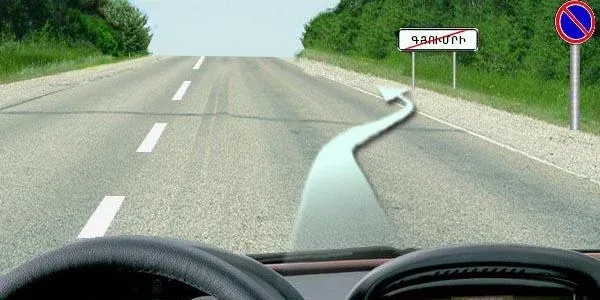
- He does not have the right.
- He has the right.
Show answer
Correct: 1. He does not have the right.
The white plate bearing the settlement name with a red diagonal across it is sign 5.24.1 “End of built-up area”, so beyond it the rules for movement outside built-up areas apply, and beside it stands sign 3.28 “No parking”, whose zone of action begins right here. On top of that, under point 82 of the Rules, outside built-up areas vehicles may be left standing for a long rest, an overnight stop or the like ONLY on specially provided sites or off the road - and the shoulder is neither. The driver of a tourist bus therefore does not have the right to stop there; “He has the right.” fails on both the sign and point 82.
Question 495. Are stopping and parking of buses permitted in built-up areas on the left side of the carriageway — on one-way roads?
- It is permitted.
- It is prohibited.
- It is permitted only for stopping.
Show answer
Correct: 1. It is permitted.
Point 79 of the Rules allows stopping and parking on the left-hand side of the carriageway in built-up areas on one-way roads; the only restriction there falls on lorries with a permissible maximum mass over 3.5 t, which may stop only for loading and unloading or for picking up and setting down passengers. A bus is not such a lorry, so “It is permitted.” is correct. “It is prohibited.” and “It is permitted only for stopping.” are wrong, because point 79 gives a bus on such a road both stopping and parking on the left.
Question 497. Is parking of buses permitted in residential zones and courtyard areas?
- It is prohibited.
- It is permitted — in the places designated for it.
- It is permitted.
Show answer
Correct: 2. It is permitted — in the places designated for it.
Point 121 of the Rules forbids parking buses, other than minibuses, and lorries over 3.5 t in residential zones anywhere except places provided for it and equipped with the corresponding signs and marking, and point 122 extends the same requirement to courtyard areas. So “It is permitted — in the places designated for it.” is correct. “It is prohibited.” is wrong because a designated place is allowed, and “It is permitted.” is wrong because parking anywhere else in a residential zone or a courtyard remains banned.
Question 499. Is parking permitted in this situation?
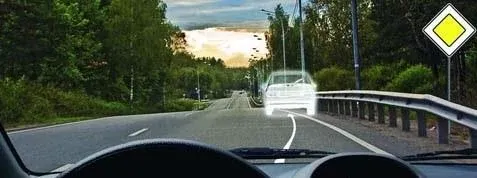
- Yes
- Only during the daylight hours of the day
- No
Show answer
Correct: 3. No
Sign 2.1 “Main road” is in place and the scene is outside a built-up area. Under sub-point 3 of point 86 of the Rules, parking is prohibited outside built-up areas on the carriageway of roads marked with sign 2.1 “Main road”, so parking in this situation is not permitted. “Yes” is wrong because the car would be standing on the carriageway of the main road itself, and “Only during the daylight hours of the day” is wrong because the prohibition applies whatever the time of day - if anything, darkness makes it more dangerous, not less.
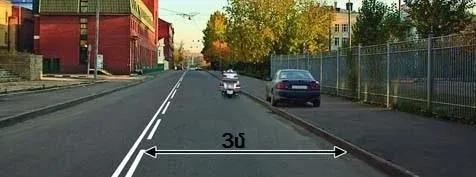
Question 507. Has the truck driver violated the rules of stopping?
- Yes
- No
Show answer
Correct: 1. Yes
The truck is standing beyond the kerb, on the pavement where pedestrians are walking. Under point 84 of the Rules stopping is prohibited on pavements, and under point 81 standing at the pavement edge is permitted only to light passenger cars, motorcycles, mopeds and bicycles, and only where sign 6.4 “Parking place” is in place together with one of the plates showing the manner of standing - neither of which is here. The 3 m in the picture is the distance from the solid line to the kerb, so the point 84 rule about being less than 3 m from a solid line is NOT breached; stopping on the pavement is prohibited all the same. “No” is therefore wrong: the truck driver has violated the rules of stopping.
Question 509. Which of the drivers has violated the parking rules?
- Both drivers
- Only the passenger-car driver
- Only the motorcycle driver
- No one.
Show answer
Correct: 2. Only the passenger-car driver
The light passenger car is standing beyond the kerb, on the pavement, while the motorcycle is at the right-hand edge of the carriageway. Under point 84 stopping is prohibited on pavements, and under point 86 parking is prohibited wherever stopping is; point 81 allows light passenger cars, motorcycles, mopeds and bicycles to park at the pavement edge only where sign 6.4 “Parking place” stands together with one of the plates showing the manner of standing, and neither is in the picture. The motorcycle is standing where point 78 allows - at the right-hand side of the road, next to the pavement. Only the passenger-car driver has therefore broken the parking rules, which is why “Both drivers”, “Only the motorcycle driver” and “No one.” are wrong.
Question 514. Which driver has violated the rules of stopping?
- The automobile driver
- The motorcycle driver
- Both drivers
- No one
Show answer
Correct: 3. Both drivers
The scene is outside a built-up area - open fields, no buildings. Under point 78 of the Rules stopping and parking are permitted on the right-hand side of the road, next to the pavement or on the shoulder, and only where there is neither, at the edge of the carriageway; point 79 permits stopping on the left side only inside built-up areas. The car is standing on the left-hand side of the road, and the motorcycle is standing on the carriageway although there is a free shoulder on the right that it should have pulled onto. Both drivers have therefore broken the rules of stopping, so the single-driver answers and “No one” are wrong.
Question 522. Is stopping permitted in the manner of the automobile’s placement?
- Yes
- Only for passenger cars
- No
Show answer
Correct: 3. No
The car is placed at an angle rather than parallel to the edge of the carriageway, and there is no marking here permitting any other arrangement. Under point 80 of the Rules a vehicle may be placed parallel to the edge of the carriageway in a single row, except at places - a local widening of the carriageway - where a marking permits some other arrangement; only two-wheeled vehicles without a sidecar may stand two abreast. Stopping in this manner is therefore not permitted. “Only for passenger cars” is wrong because point 80 makes no exception for them, and “Yes” contradicts the requirement to stand parallel to the edge.
Question 1081. Of those indicated, in which case is it permitted to stop?
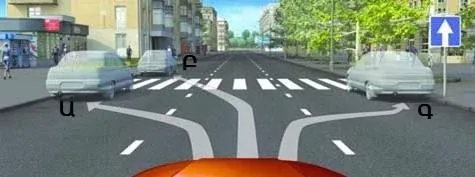
- Only Բ (B)
- Only Գ (C)
- Ա (A) and Գ (C)
- In all cases.
Show answer
Correct: 1. Only Բ (B)
The blue square sign 5.5 shows that the road is one-way, so under point 79 of the Rules stopping in a built-up area is permitted on the left side of the carriageway as well. point 84, however, prohibits stopping on pedestrian crossings and closer than 5 m before a crossing in the direction of travel, and cars Ա (A) and Գ (C) stand exactly before the crossing, at the left and the right edge respectively, that is, in the prohibited zone. Only car Բ (B) stands correctly, at the left edge already past the crossing, so the options “Only Գ (C)”, “Ա (A) and Գ (C)” and “In all cases” are wrong.
Question 1082. In which option is the one stopping correctly indicated?
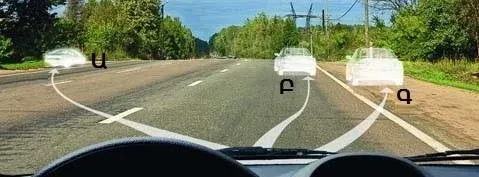
- Only Գ (C)
- Only Ա (A) and Գ (C)
- Only Բ (B) and Գ (C)
- In all three cases it is allowed.
Show answer
Correct: 1. Only Գ (C)
Under point 78 of the Rules, stopping is permitted on the right-hand side of the road, next to the pavement or on the shoulder, and only where these are absent at the edge of the carriageway. Beyond the solid line 1.2 marking the edge of the carriageway there is a shoulder here, and only car Գ (C) is standing entirely on it, so it is the one that has stopped correctly. Car Բ (B) has stopped on the carriageway itself even though a shoulder is available, and car Ա (A) is standing on the left-hand side of the road, which point 78 does not allow - point 79 permits that only in built-up areas, and this is a road outside a built-up area. “Only Ա (A) and Գ (C)”, “Only Բ (B) and Գ (C)” and “In all three cases it is allowed.” are therefore wrong.
Question 1083. In which option is the driver who parked in a prohibited position indicated?
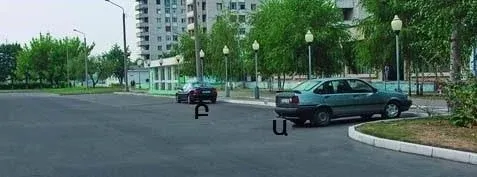
- Only Ա (A)
- Only Բ (B)
Show answer
Correct: 1. Only Ա (A)
Car Ա (A) is standing beyond the kerb, at the edge of the pavement, while car Բ (B) has been left on the carriageway. Under point 84 of the Rules stopping is prohibited on pavements, and under point 81 standing at the pavement edge is permitted only to light passenger cars, motorcycles, mopeds and bicycles, and only where sign 6.4 “Parking place” is in place together with one of the plates of group 8.6 showing the manner of standing. Neither the sign nor the plate is present in this picture, so it is car Ա (A) that is standing in a prohibited position. “Only Բ (B)” is wrong because car Բ (B) is standing on the carriageway, where no such prohibition applies.
Question 1087. Which driver has stopped correctly?
- Only Գ (C)
- Բ (B) or Գ (C)
- All the drivers.
Show answer
Correct: 1. Only Գ (C)
The picture shows sign 5.26 “End of built-up area” - the settlement’s name on a blue panel crossed out by a red diagonal - so the requirements laid down for built-up areas no longer apply on this road, and the exception in point 79 of the Rules allowing stopping on the left-hand side cannot be used. Under point 78 stopping and parking are permitted on the right-hand side of the road, next to the pavement or the shoulder, and only where these are absent at the edge of the carriageway. Only Գ (C) is standing on the right-hand shoulder and has stopped correctly; Ա (A) and Բ (B) are standing on the left-hand side of the road, so “Բ (B) or Գ (C)” and “All the drivers.” are wrong.
Question 1088. Of those indicated, in which place is stopping permitted?
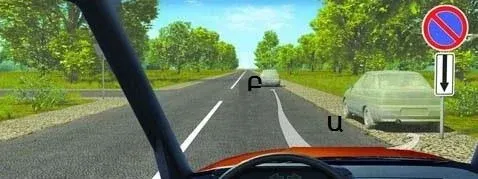
- Only Ա (A)
- Only Բ (B)
- Any.
Show answer
Correct: 1. Only Ա (A)
Under point 78 of the Rules stopping is permitted on the right-hand side of the road, next to the pavement or the shoulder, and only where these are absent at the edge of the carriageway. At place Ա (A) the car is standing on the shoulder, outside the edge line of the carriageway, which is the correct way. At place Բ (B) the car has been left on the carriageway itself even though there is a shoulder beside it, so stopping there is not permitted and “Any.” is wrong too. The round sign 3.28 “Parking prohibited” prohibits parking, not stopping, so it does not make stopping at place Ա (A) prohibited.
Question 1090. Which driver has violated the rules of stopping?
- Only Բ (B)
- Only Բ (B) and Գ (C)
- All of them
Show answer
Correct: 2. Only Բ (B) and Գ (C)
Under point 78 of the Rules stopping is permitted on the right-hand side of the road, next to the pavement or the shoulder, and only where these are absent at the edge of the carriageway - and here there is a shoulder beyond the solid edge line. Car Ա (A) is standing entirely on the shoulder, outside the line, and has stopped correctly. Car Բ (B) is standing entirely on the carriageway, and car Գ (C) is standing on the line with its left-hand side still on the carriageway, so both of them have breached point 78. “Only Բ (B)” therefore leaves out Գ (C), and “All of them” is wrong because Ա (A) has committed no breach.
Question 1091. Of those indicated, in which case is stopping permitted?
- Only Գ (C)
- Only Բ (B) and Գ (C)
- In all cases.
Show answer
Correct: 3. In all cases.
The picture carries sign 5.23.1 “Beginning of built-up area” - the name in black letters on a white ground - so the rules for movement in built-up areas apply on this road. Under point 78 stopping is permitted on the right-hand side of the road, which is case Գ (C), and under sub-point 1 of point 79 stopping in built-up areas is permitted on the left-hand side of the carriageway as well, when the road has one lane in each direction and no tram tracks down the middle - which covers cases Ա (A) and Բ (B). Stopping is therefore permitted in all three cases; “Only Գ (C)” and “Only Բ (B) and Գ (C)” are wrong because they ignore point 79, which allows stopping on the left.