Prohibitory Signs
A prohibitory sign imposes or lifts a restriction: a ban on entry, on speed, on mass or on a manoeuvre. To answer the exam you need three things for each one: what it bans, who it covers, and where the ban ends.
What do they look like?
Section titled “What do they look like?”Three looks cover the whole family:
- A red ring: something is banned. The picture or number inside tells you what.
- A red ring on blue: a ban on stopping or parking.
- A white disc with black diagonal stripes: a restriction ends.
Not every red-bordered sign belongs here. The inverted triangle 2.4 “Give way” and the red ring 2.6 are priority signs.
The official names say “lorry”. That means a truck.
Signs that close the road
Section titled “Signs that close the road”| Sign | No. | Name | Meaning |
|---|---|---|---|
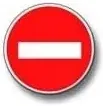 |
3.1 | No entry | No entry in this direction, with no exception for residents |
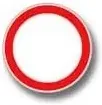 |
3.2 | No traffic | No vehicle may travel here. People who live or work in the zone may enter |
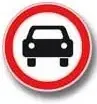 |
3.3 | Movement of mechanical vehicles prohibited | Bans all mechanical vehicles, not only cars |
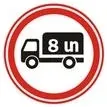 |
3.4 | Movement of lorries prohibited | No figure: bans trucks over 3.5 t. With a figure: trucks over that mass |
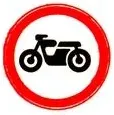 |
3.5 | Movement of motorcycles prohibited | Bans motorcycles |
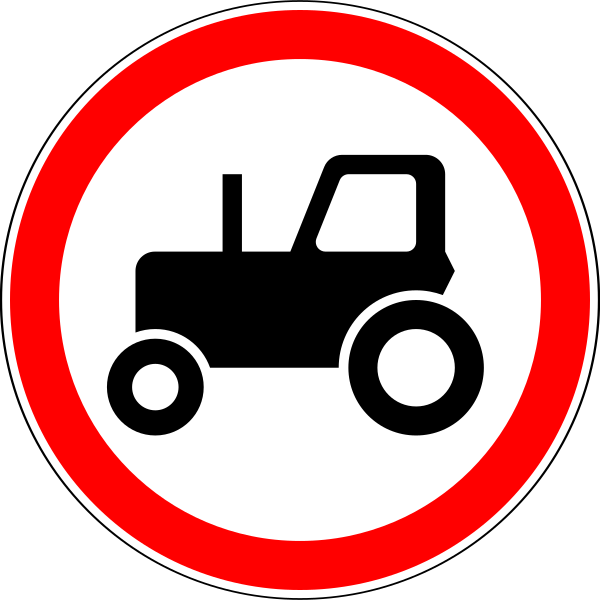 |
3.6 | Movement of tractors prohibited | Bans tractors and self-propelled machines |
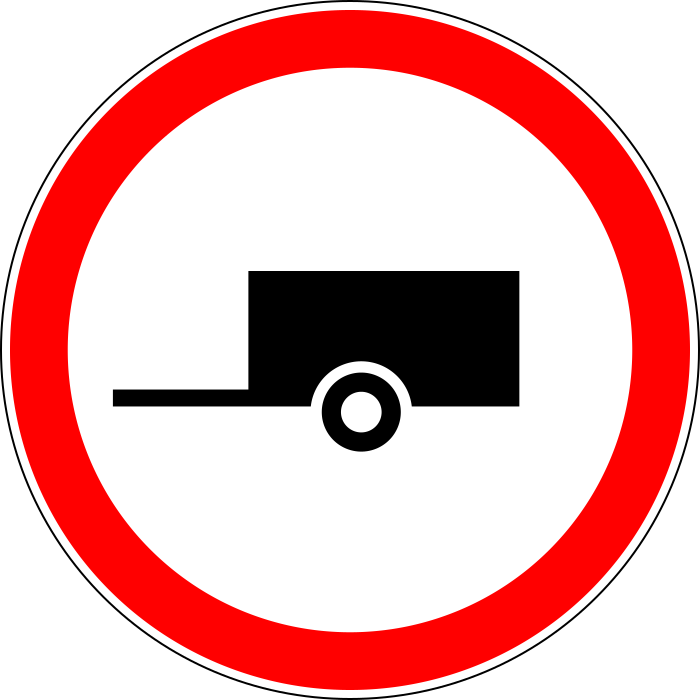 |
3.7 | Movement with a trailer prohibited | Bans trucks and tractors with any trailer, and towing a mechanical vehicle |
 |
3.9 | Movement of bicycles prohibited | Bans bicycles |
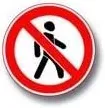 |
3.10 | Movement of pedestrians prohibited | Bans pedestrians on the side where it stands |
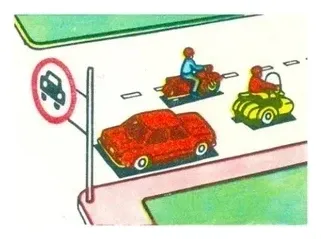
Common trap: The car on sign 3.3 stands for every mechanical vehicle. The car, the motorcycle and the motorcycle with a sidecar all break it. And sign 3.7 doesn’t reach a passenger car with a trailer, because a passenger car is neither a truck nor a tractor.
Who is exempt? The ban of signs 3.1 to 3.3, 3.18.1, 3.18.2 and 3.19 doesn’t apply to public-use transport vehicles. Sign 3.2 also spares vehicles that serve premises in the zone or belong to people who live or work there. They enter and leave by the intersection nearest their destination. Signs 3.1 and 3.3 give residents no such exception.
Signs that set a limit
Section titled “Signs that set a limit”| Sign | No. | Name | Meaning |
|---|---|---|---|
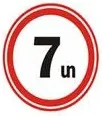 |
3.11 | Mass limit | No vehicle or road train heavier in total than the figure |
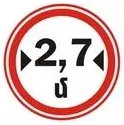 |
3.14 | Width limit | Limits the vehicle’s overall width |
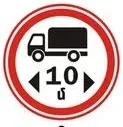 |
3.15 | Length limit | Limits the vehicle’s overall length |
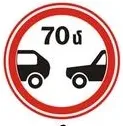 |
3.16 | Minimum distance limit | Don’t drive closer than the figure to the vehicle ahead |
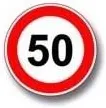 |
3.24 | Maximum speed limit | Don’t drive faster than the figure |
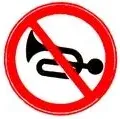 |
3.26 | Audible signal prohibited | Don’t use the horn, except to prevent an accident |
Sign 3.11 counts the whole road train. A 5 t truck with a 4 t trailer weighs 9 t, so it can’t pass a 5 t sign.
Signs that stop you until you are allowed on
Section titled “Signs that stop you until you are allowed on”| Sign | No. | Name | Meaning |
|---|---|---|---|
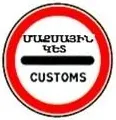 |
3.17.1 | Customs post | Don’t pass the post without stopping |
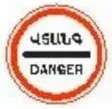 |
3.17.2 | Danger | No vehicle may go further because of an accident, fire, breakdown or other danger |
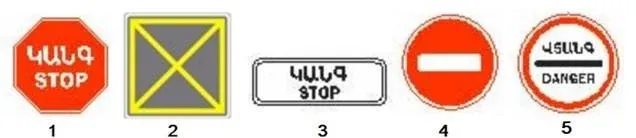
After sign 3.17.2, you may move again only with permission. Only police, ambulance, rescue services and others removing the danger are excepted. This is the opposite of sign 2.5, where you decide when to go.
Turning and overtaking
Section titled “Turning and overtaking”| Sign | No. | Name | Meaning |
|---|---|---|---|
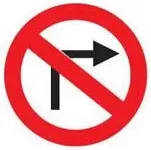 |
3.18.1 | No right turn | Bans the right turn at this intersection |
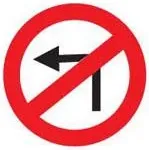 |
3.18.2 | No left turn | Bans the left turn at this intersection |
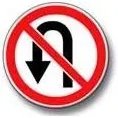 |
3.19 | No U-turn | Bans the U-turn only |
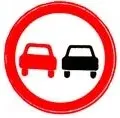 |
3.20 | Overtaking prohibited | Bans overtaking |
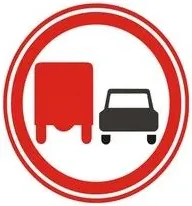 |
3.22 | Overtaking by lorries prohibited | Bans overtaking by trucks over 3.5 t |
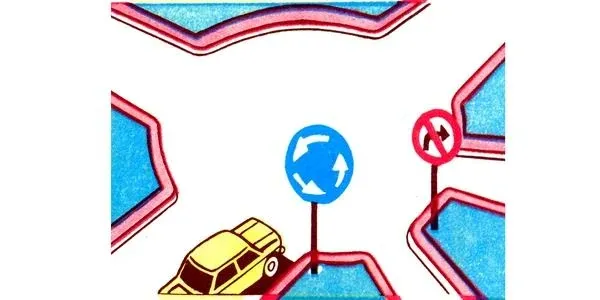
Signs 3.18.1 and 3.18.2 stand immediately before the intersection of carriageways they act on. Each sign acts where it stands: if 3.18.1 guards only the second opening on your right, the first stays open.
Common trap: A turn ban isn’t a U-turn ban. Under 3.18.1 and 3.18.2 you may still turn back the way you came. Only 3.19 bans that. And 3.19 leaves straight, left and right open.
Sign 3.20 applies to all types of vehicle, and its standard exceptions name slow-moving vehicles, horse-drawn carts, two-wheeled motorcycles without a sidecar, mopeds and bicycles. Sign 3.22 leaves motorcycles, passenger cars, buses and trucks up to 3.5 t free to overtake.
Stopping and parking
Section titled “Stopping and parking”| Sign | No. | Name | Meaning |
|---|---|---|---|
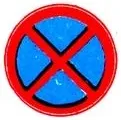 |
3.27 | No stopping | Bans stopping and parking |
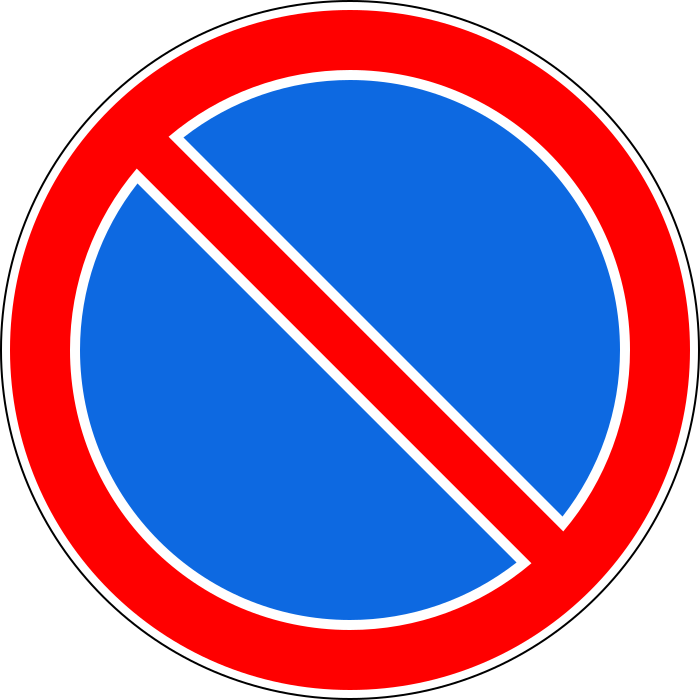 |
3.28 | No parking | Bans parking only |
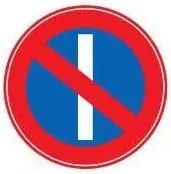 |
3.29 | No parking on odd days of the month | One stroke: odd days |
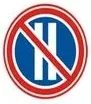 |
3.30 | No parking on even days of the month | Two strokes: even days |
Under 3.28 you may still stop briefly, for example to pick up a passenger. Count the strokes on 3.29 and 3.30: one is odd, two is even.
Remember: Signs 3.10 and 3.27 to 3.30 act only on the side of the road where they stand.
Where does a ban end?
Section titled “Where does a ban end?”The effect of signs 3.16, 3.20, 3.22, 3.24 and 3.26 to 3.30 runs from the sign to the nearest intersection beyond it. In a built-up area with no intersection, it runs to the end of the built-up area.
Places for turning round, breaks in the dividing strip and exits from adjacent areas don’t end it. An intersection or an end sign does.
| Sign | No. | Name | Meaning |
|---|---|---|---|
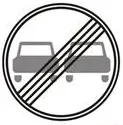 |
3.21 | End of the overtaking prohibition zone | Ends sign 3.20 |
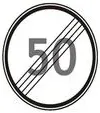 |
3.25 | End of maximum speed limit zone | Ends the limit with that figure |
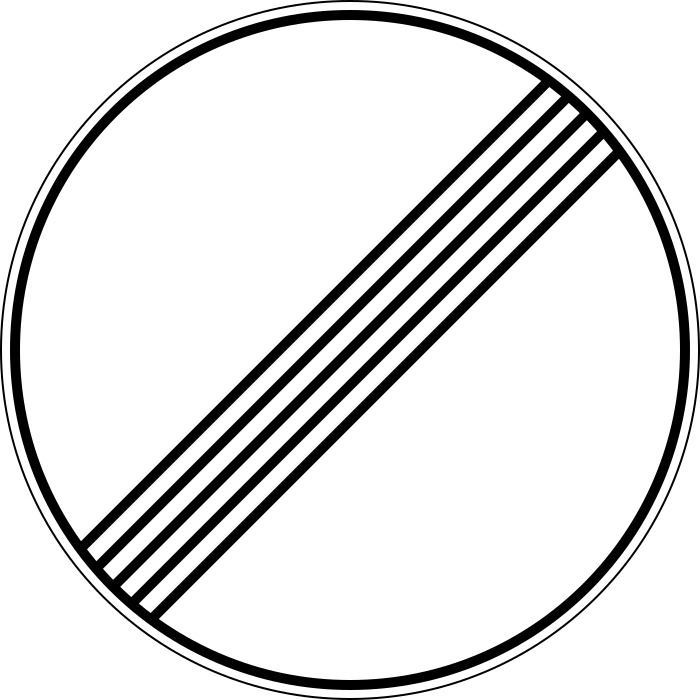 |
3.31 | End of the zone of all restrictions | Ends 3.16, 3.20, 3.22, 3.24 and 3.26 to 3.30 at once |
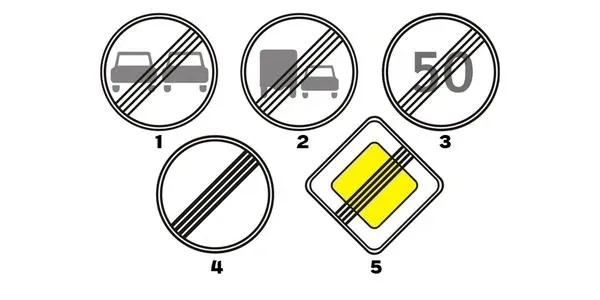
Sign 3.23 ends the ban on overtaking by trucks. It is number 2 in this picture, with 3.21, 3.25 and 3.31 as numbers 1, 3 and 4:
A plain 3.24 or 3.28 and a white ZONE plate carrying the same picture work differently. A zone sign covers a whole area until its end-of-zone sign. See Special Regulation Signs.
Try it yourself
Section titled “Try it yourself”The driver has stopped beyond a place for turning round.
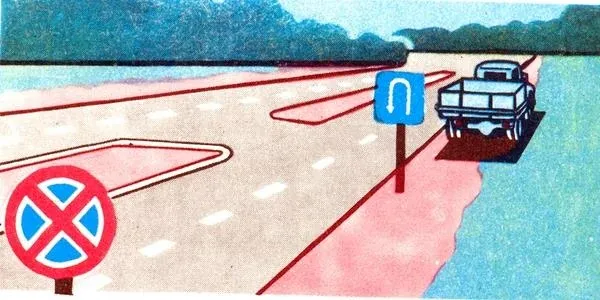
Does sign 3.27 still apply there? Yes. There is no intersection between the sign and the truck, and a place for turning round doesn’t end the zone.
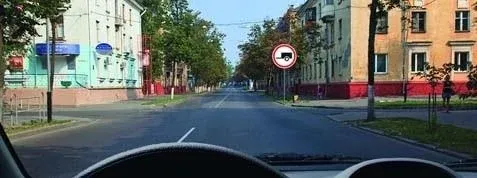
You are driving a truck with a maximum permissible mass of exactly 3.5 t. A red ring with a truck and no figure stands at the road ahead.
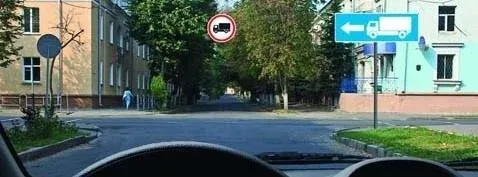
Which way may you go? Any way. With no figure, sign 3.4 covers trucks of more than 3.5 t, and yours is not more than that.
Key points
Section titled “Key points”- Red ring: a ban. Red ring on blue: stopping or parking. Black stripes on white: an ending.
- 3.3 bans all mechanical vehicles. 3.7 doesn’t touch a passenger car with a trailer.
- Public transport is exempt from 3.1 to 3.3, 3.18.1, 3.18.2 and 3.19. Only 3.2 lets residents and workers in.
- 3.27 bans stopping and parking, 3.28 only parking. One stroke is odd days, two is even.
- 3.17.2: move on only with permission.
- Most bans end at the nearest intersection. A turning place or a break in the strip doesn’t end them.
Practice questions
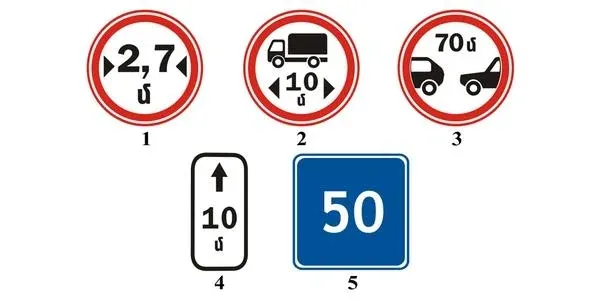
Section titled “Practice questions”Question 3. Which of the signs prohibits driving with a gap smaller than the one depicted on the sign?
- 1
- 2
- 3
- 4
- 5
Show answer
Correct: 3. 3
Driving with a gap smaller than the one shown is prohibited by prohibitory sign 3.16, “Minimum distance limit”: driving is prohibited if the gap is smaller than the figure on the sign (here 70 m) — that is sign number 3. Numbers 1 and 2 are the prohibitory signs 3.14, “Width limit” (2.7 m) and 3.15, “Length limit” (10 m), which restrict overall dimensions; number 4 is plate 8.2.1, “Zone of action”, and number 5 is informational sign 6.2, “Recommended speed” — none of them regulates the gap. The correct answer is therefore sign 3.
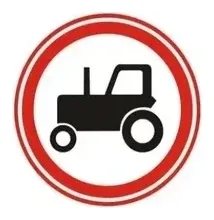
- Prohibits the movement of all power-driven vehicles, except two-wheeled motorcycles without a side car.
- Prohibits the movement of all vehicles, except wheeled tractors.
- Prohibits the movement of tractors and self-propelled machines.
Show answer
Correct: 3. Prohibits the movement of tractors and self-propelled machines.
This is prohibitory sign 3.6 “Movement of tractors prohibited”, which bans the movement of tractors and self-propelled machines - that is what the sign’s own pictogram shows. Prohibiting all power-driven vehicles except two-wheeled motorcycles without a sidecar is the meaning of a different prohibitory sign, “Movement of mechanical vehicles prohibited”, and not of 3.6. Prohibiting all vehicles except wheeled tractors is not the meaning of any standard prohibitory sign. Only “Prohibits the movement of tractors and self-propelled machines.” matches sign 3.6.
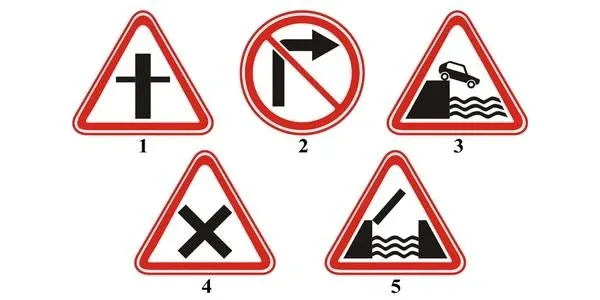
Question 8. Which of the signs is placed immediately before the intersection of carriageways?
- 1
- 2
- 3
- 4
- 5
Show answer
Correct: 2. 2
Sign 2 is 3.18.1 “No right turn”. Under the road-signs annex, signs 3.18.1 and 3.18.2 act on the intersection of carriageways before which they are placed, so they are the signs put immediately before that intersection. Sign 1 is 2.3.1 “Junction with a minor road”, which only gives advance warning that a junction is coming. Signs 3 (1.10 “Emergence onto an embankment”), 4 (1.6 “Intersection of roads of equal importance”) and 5 (1.9 “Opening bridge”) are warning signs, and warning signs are placed ahead of the dangerous section - 50 to 100 m before it in built-up areas and 150 to 300 m outside them - not right at the intersection.
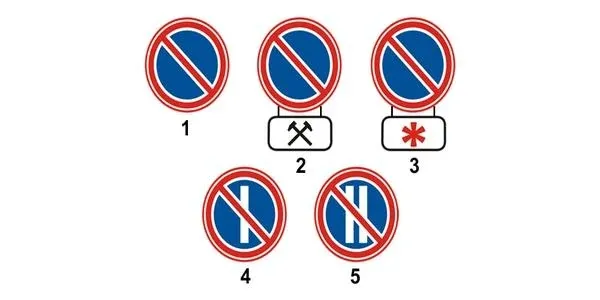
Question 13. Which of the signs prohibits parking on even days of the month?
- 1
- 2
- 3
- 4
- 5
Show answer
Correct: 5. 5
Parking on even days of the month is prohibited by sign 3.30 “No parking on even days of the month”, which carries TWO white vertical strokes - that is number 5. Number 4 is 3.29, with a single stroke, which prohibits parking on odd days. Number 1 is the general prohibition 3.28 “No parking”. Numbers 2 and 3 are that same sign 3.28 with plates fixing the days on which it applies - 8.5.2 for working days and 8.5.1 for Saturdays, Sundays and holidays. Counting the strokes is what separates the two: one for odd, two for even. Sign 5 is therefore correct.
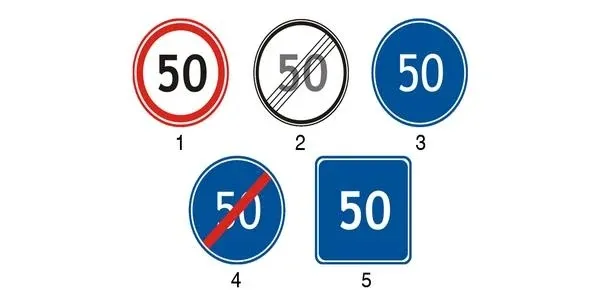
Question 28. Which of the signs shows the end of the zone of the 50 km/h maximum speed restriction?
- 1
- 2
- 3
- 4
- 5
Show answer
Correct: 2. 2
The 50 km/h limit is imposed by prohibitory sign 3.24 “Maximum speed limit”, and its zone of effect is ended by prohibitory sign 3.25 “End of maximum speed limit zone” — that is sign number 2. The other numbered signs are different signs (the end of other restriction zones, or other restrictions), and none of them lifts the 50 km/h maximum speed limit. Sign number 2 is therefore the correct choice.
Question 31. Which of the signs cancels all previous restrictions?
- 1
- 2
- 3
- 4
- 5
Show answer
Correct: 4. 4
The sign that cancels several previous restrictions at once is prohibitory sign 3.31 “End of the zone of all restrictions”, which the Rules define as marking the simultaneous end of the zones of action of signs 3.16, 3.20, 3.22, 3.24 and 3.26 to 3.30 - that is number 4, the plain disc with diagonal stripes and no pictogram on it. Each of the other numbered signs cancels or imposes only one particular restriction, or is a different kind of sign altogether, and none of them lifts every restriction at once. Sign 4 is therefore the correct choice.
Question 37. In the presence of this road sign:
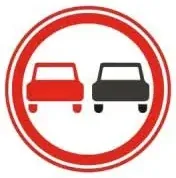
- Overtaking by all types of vehicles is prohibited, except slow-moving vehicles, horse-drawn carts, two-wheeled motorcycles without a sidecar, mopeds and bicycles.
- Overtaking by lorries with a permissible maximum mass of not more than 3.5 t is permitted.
- Overtaking is permitted if the speed of the overtaking vehicle does not exceed 30 km/h.
Show answer
Correct: 1. Overtaking by all types of vehicles is prohibited, except slow-moving vehicles, horse-drawn carts, two-wheeled motorcycles without a sidecar, mopeds and bicycles.
This is prohibitory sign 3.20 ‘Overtaking prohibited’, which under the Rules bans overtaking by all types of vehicles (the marked answer states that ban, with the standard exceptions for slow-moving vehicles, horse-drawn carts, two-wheeled motorcycles without a sidecar, mopeds and bicycles). ‘Overtaking by lorries with a permissible maximum mass of not more than 3.5 t is permitted’ is wrong, because that exception is the meaning of a different sign - 3.22 ‘Overtaking by lorries prohibited’, which exempts motorcycles, passenger cars, buses and lorries up to 3.5 t - and not of 3.20. ‘Overtaking is permitted if the speed of the overtaking vehicle does not exceed 30 km/h’ is wrong, because the Rules attach no 30 km/h condition to sign 3.20. So under 3.20 overtaking is prohibited for every vehicle except the slow-moving, horse-drawn and two-wheeled ones listed.
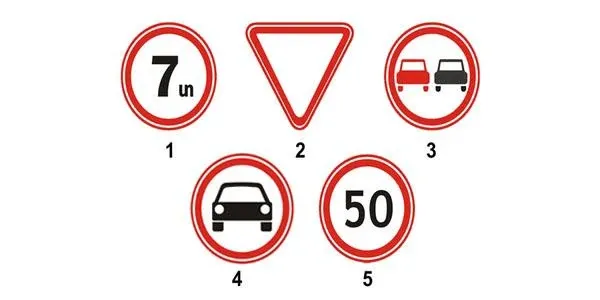
Question 41. The effect of which sign does not extend to public transport vehicles?
- 1
- 2
- 3
- 4
- 5
Show answer
Correct: 4. 4
The Rules’ general provisions on prohibitory signs state that the effect of signs 3.1 to 3.3, 3.18.1, 3.18.2 and 3.19 does not extend to public-use transport vehicles. Number 4 is sign 3.3 “Movement of mechanical vehicles prohibited” - the red ring containing a car - which is on that list, so its prohibition does not reach a bus, trolleybus or route vehicle. The other numbered signs are a weight limit, a give-way sign, an overtaking ban and a speed limit, and none of them is exempted in this way. Sign 4 is therefore the correct choice.
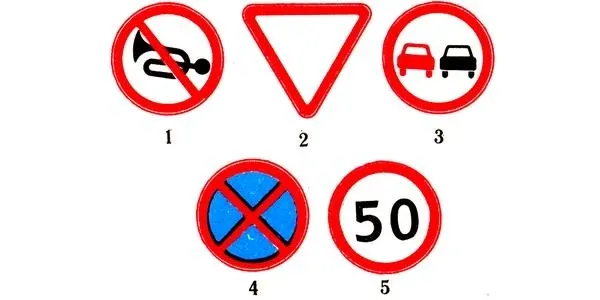
Question 43. Which of these road signs is not considered prohibitory?
- 1
- 2
- 3
- 4
- 5
Show answer
Correct: 2. 2
Prohibitory signs are the third group in the Rules: they impose or lift particular restrictions on traffic, such as a ban on entry, on speed, on mass or on a manoeuvre. Four of the numbered signs belong to that group. Number 2 does not - it is the inverted triangle, priority sign 2.4 “Give way”, which belongs to the priority group and imposes no restriction on traffic at all; it orders who goes first. Sign 2 is therefore the one that is not a prohibitory sign.
Question 49. Traffic of which vehicle does this road sign prohibit?
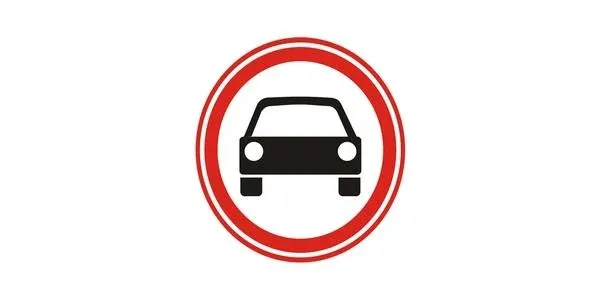
- Mechanical vehicles.
- Only automobiles.
- Only light passenger cars.
Show answer
Correct: 1. Mechanical vehicles.
This is prohibitory sign 3.3 “Movement of mechanical vehicles prohibited”, which under the Rules bans the movement of mechanical vehicles as a class. “Only automobiles.” and “Only light passenger cars.” are both too narrow: sign 3.3 stops the whole class - light passenger cars and lorries, buses, motorcycles, tractors and self-propelled machines alike - and not just automobiles or just passenger cars. The correct answer is therefore the prohibition on the movement of mechanical vehicles.
Question 59. Which road sign prohibits a U-turn?
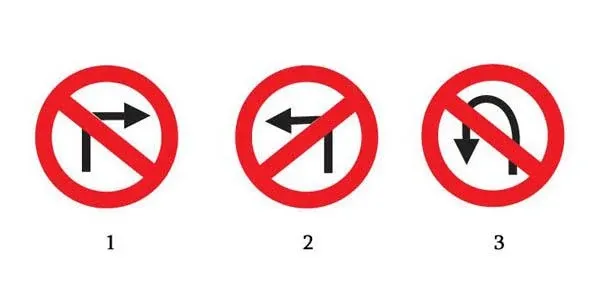
- 1
- 2
- 3
Show answer
Correct: 3. 3
A U-turn is prohibited by prohibitory sign 3.19 “No U-turn”, whose arrow doubles back on itself - that is number 3. Number 1 is 3.18.1 “No right turn” and number 2 is 3.18.2 “No left turn”: both forbid a turn into a side road, and neither forbids turning round to go back the way you came. Sign 3 is therefore the correct choice.
Question 62. The effect of which road signs does not extend to public transport vehicles?
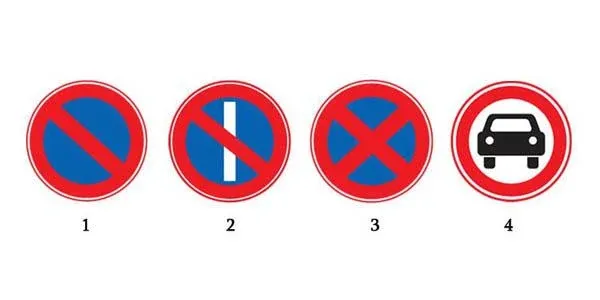
- None of them.
- Only the first one.
- Only the fourth one.
Show answer
Correct: 3. Only the fourth one.
Under the Rules’ general provisions on prohibitory signs, the effect of signs 3.1 to 3.3, 3.18.1, 3.18.2 and 3.19 does not extend to public-use transport vehicles. Of the signs shown, only the fourth belongs to that group - it is 3.3 “Movement of mechanical vehicles prohibited”, the red ring containing a car - so only its effect spares a bus, trolleybus or route vehicle. “None of them.” is wrong because such a sign is present, and “Only the first one.” is wrong because the first is a parking prohibition, which is not among the signs the exemption lists.
Question 70. The effect of these road signs extends to:
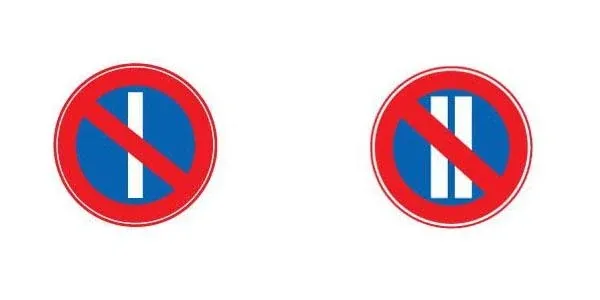
- The left side of the road.
- The right side of the road.
- The side of the road on which they are placed.
Show answer
Correct: 3. The side of the road on which they are placed.
The signs shown are 3.29 “No parking on odd days of the month”, with one stroke, and 3.30 “No parking on even days of the month”, with two. Under the Rules the effect of signs 3.10 and 3.27 to 3.30 extends only to the side of the road on which they are placed, so these parking prohibitions apply on whichever side the sign itself stands. “The left side of the road.” and “The right side of the road.” are wrong because the rule fixes no side at all: it ties the prohibition to where the sign is physically erected.
Question 91. In which direction is travel permitted
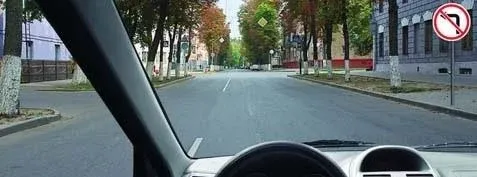
- Only straight
- Straight and in the opposite direction
- In all directions
Show answer
Correct: 2. Straight and in the opposite direction
The sign on the right is 3.18.1 “No right turn”, which prohibits the right turn and nothing else. Going straight remains permitted, and a U-turn would be prohibited only by sign 3.19 “No U-turn”, which is not present here. At this junction the side street joins only from the right, so there is no left turn to be made, and the movements available are straight ahead and the opposite direction - the U-turn. “Only straight” is wrong because the U-turn remains permitted, and “In all directions” is wrong because 3.18.1 forbids the right turn.
Question 97. In which direction may you continue driving at this intersection if you are driving a truck with a maximum permissible mass of 3.5 tonnes?
- Only left
- Right, left or the opposite direction
- Any
Show answer
Correct: 3. Any
Sign 3.4 “Movement of lorries prohibited” stands before the intersection, and where no mass is written on it, it prohibits lorries with a permissible maximum mass of MORE than 3.5 tonnes. A permissible maximum mass of exactly 3.5 tonnes is not more than 3.5 tonnes, so the sign does not reach your vehicle, and at this intersection - where the crossing road opens both to the left and to the right - you may continue in any direction. The blue sign 6.15.1 “Direction of movement for lorries” on the right is only a recommended direction for those lorries whose movement in some direction is prohibited, and it imposes no ban. “Only left” and “Right, left or the opposite direction” therefore impose restrictions that do not apply to a 3.5 tonne lorry.
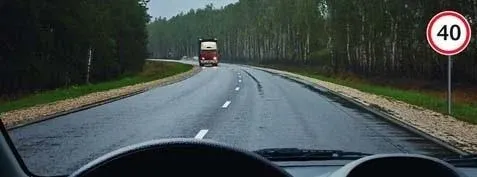
- Recommends driving at a speed of 40 km/h
- Permits driving only at 40 km/h or a higher speed
- Prohibits driving at a speed higher than 40 km/h
Show answer
Correct: 3. Prohibits driving at a speed higher than 40 km/h
This is sign 3.24 “Maximum speed limit” set to 40, which under the Rules prohibits travelling faster than the figure shown on it. It therefore prohibits driving at a speed higher than 40 km/h. “Recommends driving at a speed of 40 km/h” is wrong because 3.24 is a binding limit and not a recommendation - a recommendation would be a blue square. “Permits driving only at 40 km/h or a higher speed” describes the minimum-speed sign 4.6, which is the exact reverse of 3.24.
Question 116. These signs require keeping a distance from the vehicle ahead of
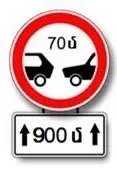
- Less than 70 metres on a 900-metre section
- More than 70 metres on a 900-metre section
- 70 m, after 900 metres.
Show answer
Correct: 2. More than 70 metres on a 900-metre section
The sign is 3.16 “Minimum distance limit” set to 70 m, which prohibits movement where the gap between vehicles is SMALLER than the figure shown - so a distance of no less than 70 metres must be kept from the vehicle in front. Beneath it is plate 8.2.1 “Zone of action” reading 900 m, so the requirement holds over a section 900 metres long. “Less than 70 metres on a 900-metre section” is wrong because 70 m is the minimum to keep, not a maximum, and “70 m, after 900 metres” is wrong because the 900 m is the LENGTH of the zone of action, not the distance to where the requirement starts - a plate with an arrow at each end always gives a length.
Question 125. Is it permitted to approach the work site in the zone of action of these signs?
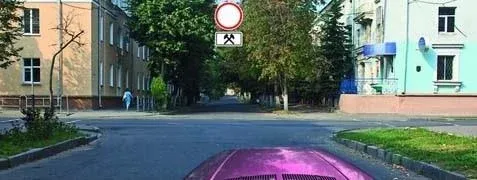
- Permitted only on working days
- Permitted only on non-working days
- Permitted on all days
- Prohibited
Show answer
Correct: 3. Permitted on all days
The sign is 3.2 “No traffic” with plate 8.5.2 “Working days”, so the prohibition operates on working days only. Under the road-signs annex the effect of sign 3.2 does not extend to vehicles that service the premises inside the zone or belong to citizens living or working there; those enter and leave by the intersection nearest their destination. Both halves of the answer therefore hold: on non-working days the sign does not operate at all, and on working days the exception for people who work in the zone applies to you. Approaching your work site is permitted on all days, which is why “Permitted only on working days”, “Permitted only on non-working days” and “Prohibited” are each wrong.
Question 126. Is a light passenger car towing a trailer permitted to travel straight ahead at this intersection?
- Yes
- Permitted only to residents of that area
- No
Show answer
Correct: 1. Yes
The sign is 3.7 “Movement with a trailer prohibited”, which under the Rules prohibits the movement of LORRIES and tractors with a trailer of any kind, and also the towing of mechanical vehicles. A light passenger car towing a trailer is neither a lorry nor a tractor, so sign 3.7 does not extend to it and it may cross the intersection straight ahead. “Permitted only to residents of that area” and “No” are wrong because 3.7 places no restriction on a passenger car with a trailer.
Question 138. With which sign may movement not be resumed after stopping without permission?
- Only 2
- 1 and 5
- Only 5
- All
Show answer
Correct: 3. Only 5
Number 5 is sign 3.17.2 “Danger”, which under the road-signs annex prohibits all vehicles from going any further because of a road accident, a fire, a breakdown or another danger - only the police, the ambulance service, rescue services and others attending to remove the danger are excepted - and movement may be resumed only after permission is given. It is therefore the sign after which movement may not be resumed without permission. “Only 2” and “1 and 5” are wrong because number 1 is sign 2.5 “Movement without stopping prohibited”, which requires a stop and then lets the driver continue on his own judgement after giving way, and number 2 imposes no requirement to be released at all. “All” is wrong for the same reasons.
Question 309. In which direction is traffic prohibited?
- To the right, by the first opening.
- To the right, by the second opening.
- To the right, by the first and second openings.
Show answer
Correct: 2. To the right, by the second opening.
Sign 3.18.1 “No right turn” is placed at the second opening on the right, and under the Rules it prohibits the right turn there. There is no such sign at the first opening, so turning right into it is not prohibited. Traffic is therefore prohibited only to the right through the second opening. “To the right, by the first opening.” and “To the right, by the first and second openings.” are wrong because sign 3.18.1 guards only the second one - a prohibitory sign acts where it stands.
Question 435. Does the prohibitory sign affect that section of the road where the driver has stopped?
- It does affect.
- It does not affect.
Show answer
Correct: 1. It does affect.
Under the Rules the zone of action of sign 3.27 “No stopping” runs from where the sign stands to the nearest intersection beyond it, and that effect is NOT interrupted at places for turning round, at breaks in the dividing strip, or at exits from adjacent territories. Between the sign and the place where the driver has stopped there is no intersection and no sign ending the zone, and the turning place does not break it. The prohibitory sign therefore does affect that section of road. “It does not affect.” is wrong because a place for a U-turn does not bring the sign’s zone of action to an end.
Question 702. The drivers of which vehicles have violated the requirements of the road sign?
- The motorcycle drivers.
- The drivers of the car and of the motorcycle with a sidecar.
- Only the car’s driver.
- The drivers of all the vehicles.
Show answer
Correct: 4. The drivers of all the vehicles.
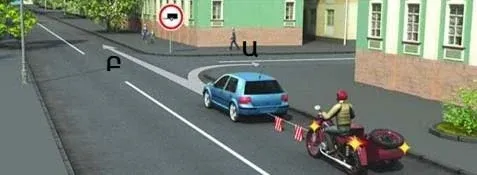
The sign in the picture is the prohibitory 3.3 “Movement of mechanical vehicles prohibited” - a car in a red ring. Under the Rules that sign bars the movement of ALL mechanical vehicles, and the pictogram of a car does not narrow it to cars. Since the car, the motorcycle and the motorcycle with a sidecar are all mechanical vehicles, the drivers of every vehicle shown have violated the sign’s requirements.
Question 870. In which picture are the permitted directions of travel shown?
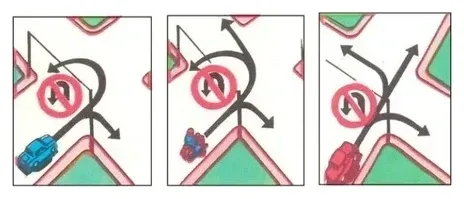
- In the left picture.
- In the middle picture.
- In the right picture.
- In the middle and right pictures.
Show answer
Correct: 3. In the right picture.
Sign 3.19 “No U-turn” is placed on this approach, so from here it is permitted to go straight ahead, to turn left and to turn right, and only the U-turn is prohibited. Those are exactly the three trajectories drawn in the right-hand picture, and there is no U-turn among them. The left and middle pictures both include a U-turn trajectory, which sign 3.19 forbids, so they are wrong - and so is the option that includes the middle picture.
Question 874. Is the road train allowed to pass over the bridge in the given situation?
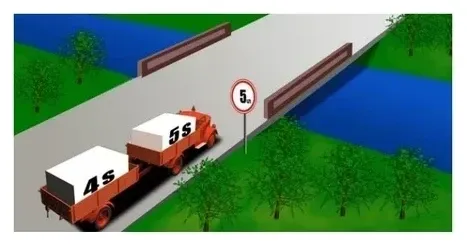
- It is allowed.
- It is prohibited.
Show answer
Correct: 2. It is prohibited.
Before the bridge stands sign 3.11 “Mass limit” showing 5 t, which prohibits the movement of vehicles - road trains included - whose total actual mass is greater than the figure on the sign. In the picture the lorry’s mass is 5 t and the trailer’s is 4 t, so the road train’s total actual mass is 9 t, which exceeds 5 t, and passing over the bridge is prohibited. “It is allowed.” is wrong because sign 3.11 takes the combined mass of the whole road train and not the mass of each unit separately.
Question 1041. The effect of which signs extends in the direction of travel up to the nearest intersection
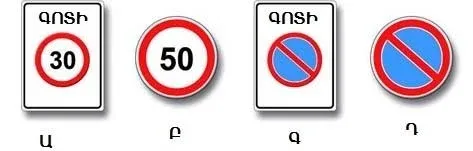
- Ա (A) and Գ (C)
- Բ (B) and Դ (D)
- Գ (C) and Դ (D)
Show answer
Correct: 2. Բ (B) and Դ (D)
Under the signs annex the effect of signs 3.16, 3.20, 3.22, 3.24 and 3.26 to 3.30 extends from the place where the sign stands to the nearest intersection beyond it. Բ (B), which is 3.24 “Maximum speed limit”, and Դ (D), which is 3.28 “No parking”, are signs of exactly that group and carry no supplementary plates, so their effect runs to the nearest intersection. Ա (A) is 5.31 “Zone with a maximum speed limit” and Գ (C) is 5.27 “Zone with parking restriction”: those are ZONE signs - white rectangles carrying the sign - and their effect covers the whole marked area until the corresponding end-of-zone sign, 5.32 or 5.28, rather than stopping at the nearest intersection. The correct answer is therefore Բ (B) and Դ (D).
Question 1053. After which signs is driving prohibited without a permit?
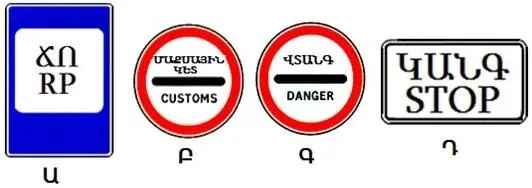
- Only Ա (A) and Դ (D)
- Only Բ (B) and Գ (C)
- Only Դ (D) and Գ (C)
- All
Show answer
Correct: 2. Only Բ (B) and Գ (C)
Sign Բ (B) is 3.17.1 “Customs post”, which prohibits passing the customs post without stopping, and sign Գ (C) is 3.17.2 “Danger”, after which movement may be continued only once permission has been given - so it is after signs Բ (B) and Գ (C) that driving on without a permit is prohibited. Sign Ա (A) is the service sign 7.12 “Traffic police patrol post”, which only informs the driver that a post is there, and Դ (D) is 6.16 “Stop line”, which shows where to stop on a prohibiting signal from a traffic light or a controller, with no requirement of permission at all. “Only Ա (A) and Դ (D)”, “Only Դ (D) and Գ (C)” and “All” are therefore wrong.
Question 1054. In which of the directions indicated by the arrows may towing be continued?
- Only Ա (A)
- Only Բ (B)
- In both directions
Show answer
Correct: 1. Only Ա (A)
The sign is 3.7 “Movement with a trailer prohibited”, of which the road-signs guide says that it prohibits “the movement of lorries and tractors with a trailer of any kind, and also the towing of mechanical vehicles”. In the picture a disabled vehicle is being towed by another, so the towing combination may not enter the zone of action of sign 3.7: the towing may continue only in a direction that does not pass through the section the sign closes. Direction Ա (A) continues without entering the sign’s zone of action, so towing may be continued only in direction Ա (A). “Only Բ (B)” is wrong because direction Բ (B) leads into the zone closed by sign 3.7, where towing a mechanical vehicle is prohibited, and “In both directions” is wrong for the same reason.
Question 1104. Which of the signs shows the end of the zone of the overtaking prohibition?
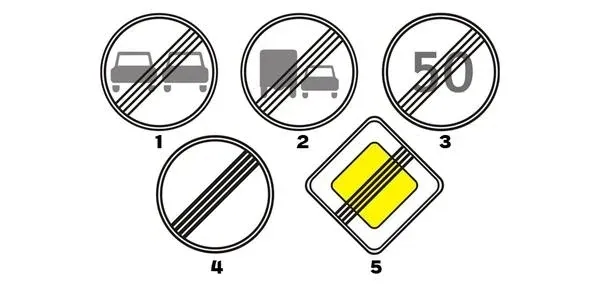
- 1
- 2
- 3
- 4
- 5
Show answer
Correct: 1. 1
The end of the zone of the overtaking prohibition is shown by sign 3.21 - the white disc with two cars struck through by diagonal lines - which is number 1. Number 2 is 3.23, the end of the zone where overtaking by lorries is prohibited, and so concerns lorries only. Number 3 is 3.25, the end of a maximum speed limit zone, with the figure 50 struck through. Number 4 is 3.31, the end of the zone of all restrictions, which ends every restriction rather than the overtaking one specifically. Number 5 is 2.2, the end of the main road, which has nothing to do with overtaking at all.
Question 1106. A road equipped with which sign may you enter, if you live there?
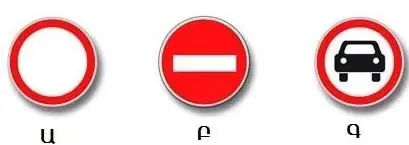
- Only Ա (A)
- Only Բ (B)
- Only Գ (C)
- All
Show answer
Correct: 1. Only Ա (A)
Sign Ա (A) is 3.2 “Movement prohibited” - the red ring with an empty white field. It is this sign whose effect does not extend to vehicles belonging to citizens living or working in the marked zone, so if you live there you may enter. Sign Բ (B) is 3.1 “No entry” - the red disc with a white horizontal bar - which admits no such exception, and entry in that direction is closed to everyone. Sign Գ (C) is 3.3, the prohibition on the movement of mechanical vehicles, which the residents’ exception does not reach. “Only Ա (A)” is therefore the answer.