Mandatory Signs
A mandatory sign gives an order: go this way, pass on this side, keep to this speed. The exam tests how far each order reaches, because the same arrow means something different before an intersection and at the start of a road section.
What do they look like?
Section titled “What do they look like?”Look for a round blue sign with a white picture.
Remember: Shape tells you how seriously to take a blue sign. A blue disc compels. A blue rectangle or square informs or describes. Sign 4.1.1 orders you straight on, but the blue square 5.5 only says the road is one-way.
Which way may I go?
Section titled “Which way may I go?”| Sign | No. | Name | Meaning |
|---|---|---|---|
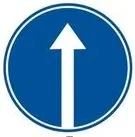 |
4.1.1 | Straight ahead only | Straight on only |
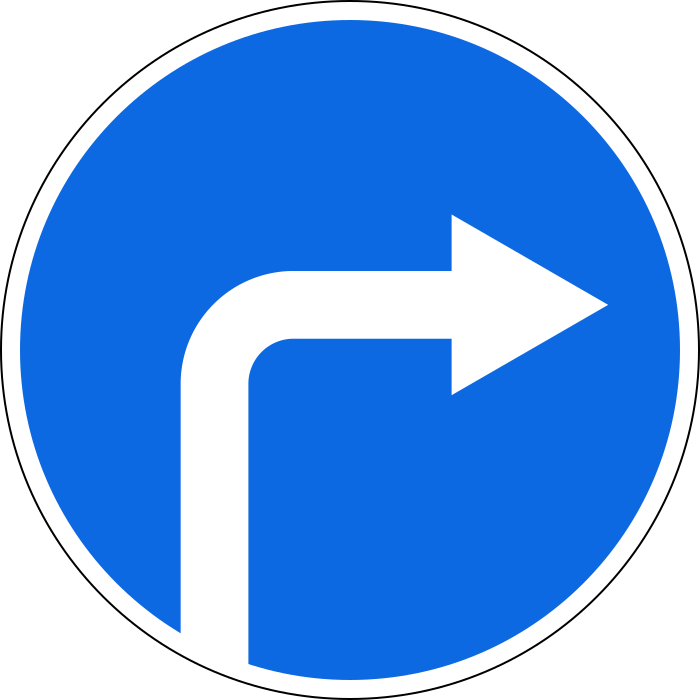 |
4.1.2 | Movement to the right | Right only. Every driver must turn right |
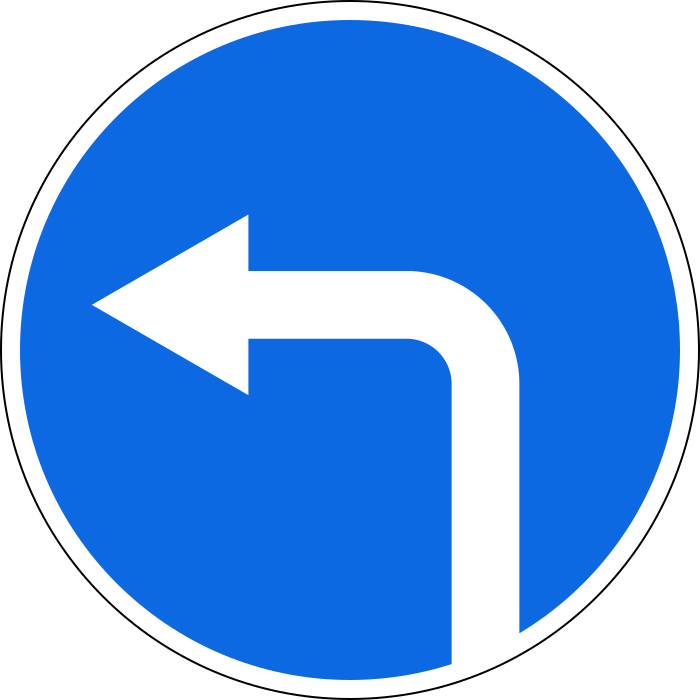 |
4.1.3 | Movement to the left | Left only, and a U-turn is allowed |
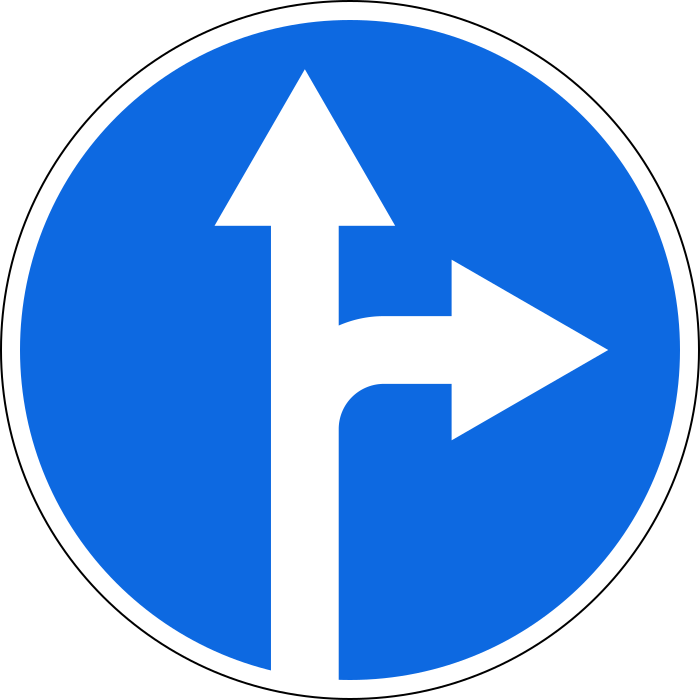 |
4.1.4 | Movement straight or to the right | Straight or right |
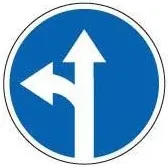 |
4.1.5 | Movement straight or to the left | Straight or left, and a U-turn is allowed |
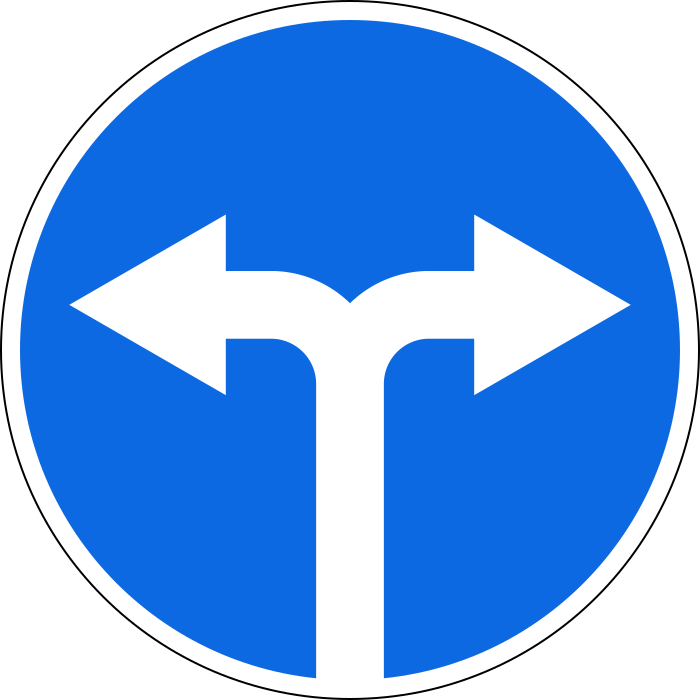 |
4.1.6 | Movement to the right or to the left | Right or left, and a U-turn is allowed. Not straight on |
You may go only where the arrows point, with one addition: a sign that permits a left turn also permits a U-turn. You still need the right lane. Point 40 sends you to the left edge lane for a left turn or U-turn and to the right edge lane for a right turn, so under sign 4.1.6 the left lane can’t turn right.
How far does the order reach?
Section titled “How far does the order reach?”It depends on where the sign stands.
Before an intersection, it acts on that intersection of carriageways only. If the crossing road has a dividing strip, you meet two intersections of carriageways. The sign covers the first, and the second is outside its reach.
At the start of a road section, sign 4.1.1 acts as far as the nearest intersection. The next intersection beyond that is free again. On that stretch you may not turn left or make a U-turn, but it doesn’t stop you turning right into a courtyard or other area next to the road.
Common trap: The courtyard exception works on the right only. Left needs a left turn, which sign 4.1.1 forbids. And a blue square showing a U-turn place further on doesn’t give you permission here.
Passing an obstacle
Section titled “Passing an obstacle”| Sign | No. | Name | Meaning |
|---|---|---|---|
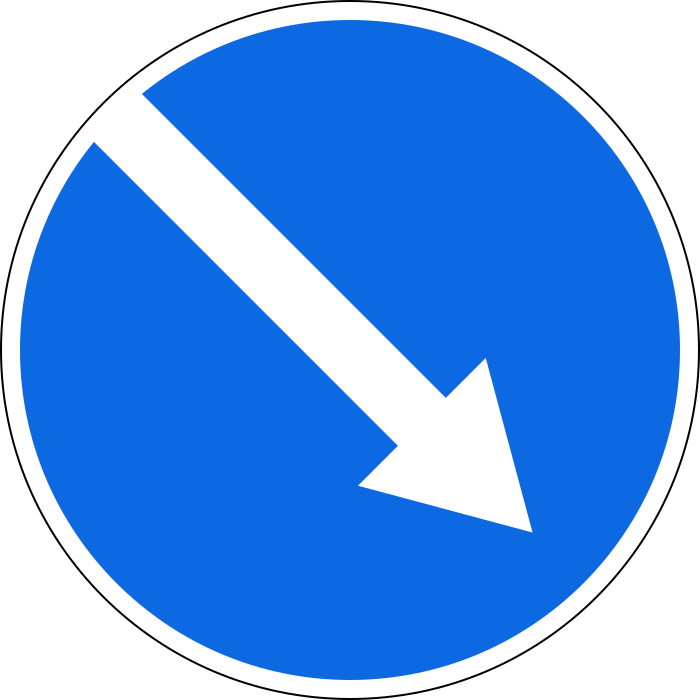 |
4.2.1 | Bypassing the obstacle on the right | Pass on the right only |
 |
4.2.2 | Bypassing the obstacle on the left | Pass on the left only |
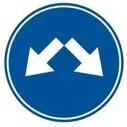 |
4.2.3 | Bypass the obstacle on the right or on the left | Pass on either side |
These arrows slant downwards, while the direction signs above curve or point straight. The sign may be fixed to a striped board, plate 8.22 “Obstacle”.
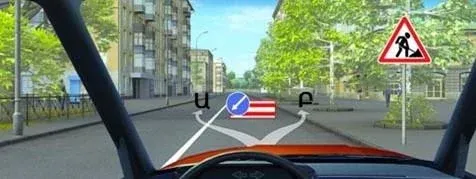
Sign 4.2.2 on a red and white board. You may pass only on the left, path Ա (A).
Other orders
Section titled “Other orders”| Sign | No. | Name | Meaning |
|---|---|---|---|
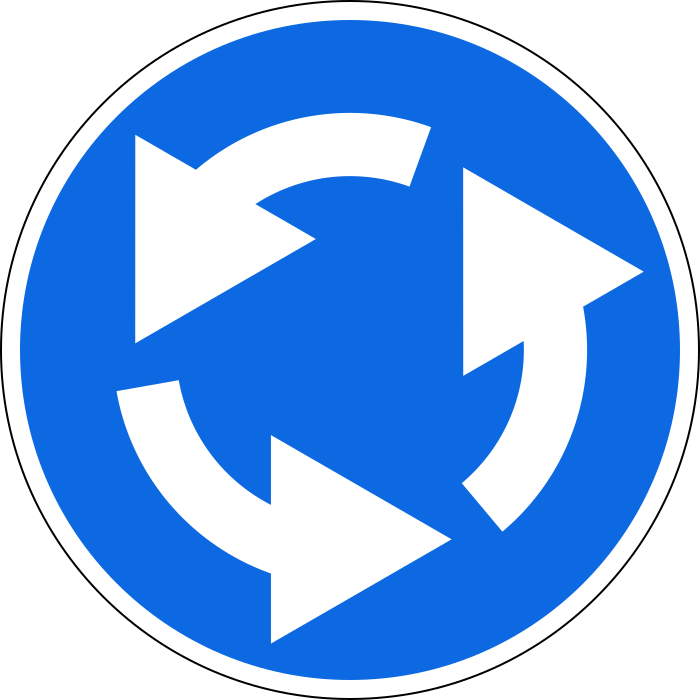 |
4.3 | Roundabout | Travel only in the direction of the arrows, round the central island |
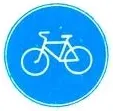 |
4.4.1 | Cycle path | Marks a cycle path |
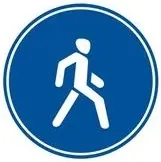 |
4.5.1 | Footpath | Marks a path for pedestrians only |
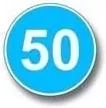 |
4.6 | Minimum speed limit | Travel only at this speed or higher |
Three signs carry a walking figure and do three different things:
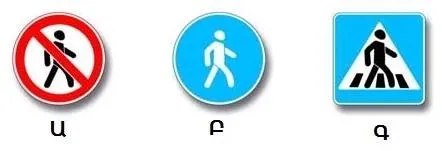
Ա (A) is 3.10, which bans pedestrians. Բ (B) is 4.5.1, the only one that marks a footpath. Գ (C) is 5.19.1, which marks a crossing.
Three signs also show a speed. The blue disc 4.6 is a floor. The red ring 3.24 is a ceiling. The blue square 6.2 is only advice.
Try it yourself
Section titled “Try it yourself”The sign before you is 4.1.1, and the crossing road has a dividing strip.
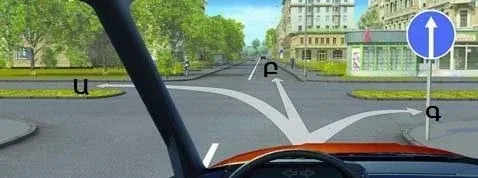
Which paths are open? Ա (A) or Բ (B). Straight on is what the sign orders. The left turn at the second carriageway is outside its reach. The right turn at the first carriageway, Գ (C), is what it forbids.
Three drivers, three manoeuvres. Sign 4.1.1 is in pictures 1 and 2, and sign 5.5 is in picture 3.
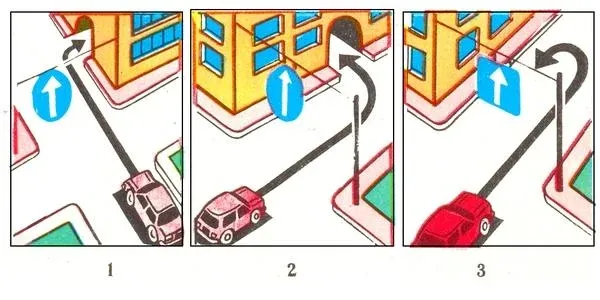
Who is right? Picture 1. The right turn into a courtyard is the exception. The left turn in picture 2 isn’t, and a U-turn on a one-way road is prohibited by point 50.
An obstacle lies ahead, with this sign on it.
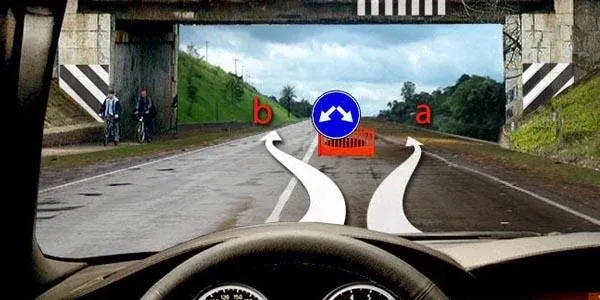
Which path is allowed? Both. Sign 4.2.3 lets you pass on either side.
Key points
Section titled “Key points”- Round and blue means an order. Go only where the arrows point.
- A sign that permits a left turn permits a U-turn too.
- Before an intersection, the sign acts on that intersection of carriageways only.
- At the start of a section, 4.1.1 lasts to the nearest intersection, and right turns into courtyards stay allowed.
- 4.2.1 right, 4.2.2 left, 4.2.3 either side.
- 4.6 sets a minimum speed. Don’t confuse it with 3.24 or 6.2.
Practice questions
Section titled “Practice questions”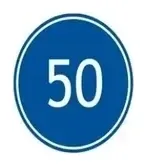
- Permits travelling only at the indicated or a higher speed.
- Prohibits travelling at a speed higher than that indicated on the sign.
- Shows the speed at which it is recommended to travel on the given section of road.
Show answer
Correct: 1. Permits travelling only at the indicated or a higher speed.
This is mandatory sign 4.6, “Minimum speed limit”: travel is permitted only at the indicated speed (km/h) or higher. Prohibiting travel at a speed higher than the one indicated is the meaning of prohibitory sign 3.24, “Maximum speed limit” (with a red border), and the recommended speed is shown by informational sign 6.2, “Recommended speed” (a blue square). Only “permits travelling only at the indicated or a higher speed” corresponds to this blue round sign.
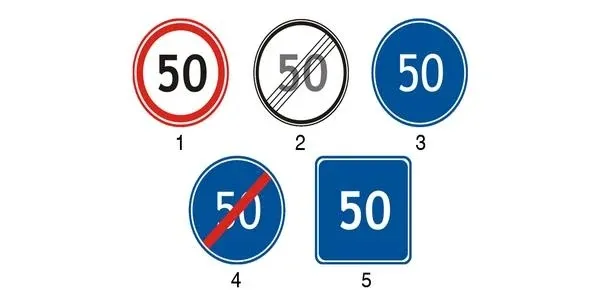
Question 19. Which of the following signs permits travelling only at the indicated (km/h) or a higher speed?
- 1
- 2
- 3
- 4
- 5
Show answer
Correct: 3. 3
The sign permitting travel only at the indicated (km/h) speed or higher is the mandatory sign 4.6 “Minimum speed limit” — that is the sign numbered 3. The other signs are different signs (for example, a maximum speed prohibition or a recommended speed sign), and none of them sets a minimum permitted speed. Sign 3 is therefore correct.
Question 50. Which of the signs indicates bypassing the obstacle from the right or from the left?
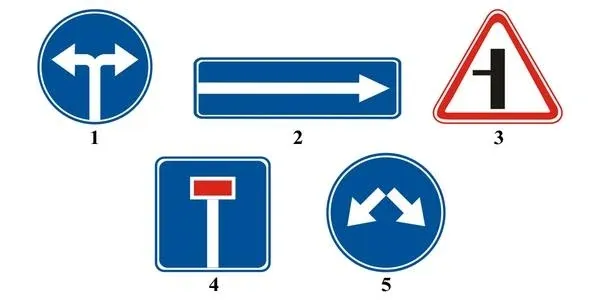
- 1
- 2
- 3
- 4
- 5
Show answer
Correct: 5. 5
Bypassing an obstacle either on the right or on the left is permitted by mandatory sign 4.2.3 “Bypassing the obstacle on the right or on the left” - a blue disc with arrows diverging to both sides - which is number 5; signs 4.2.1 and 4.2.2 permit a bypass on one side only and are not shown here. Number 1 is 4.1.6 “Movement to the right or to the left”, which directs traffic at a junction rather than round an obstacle; number 2 is a rectangular sign with a single-direction arrow; number 3 is 2.3.3 “Adjoining of a minor road”; and number 4 is 6.8.1 “Dead end”. None of them tells the driver how to pass an obstacle. Sign 5 is therefore correct.
Question 68. Which road sign obliges the driver to drive only to the left or to the right?
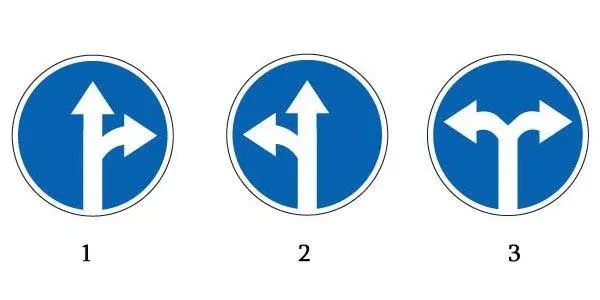
- 1
- 2
- 3
Show answer
Correct: 3. 3
Under points 4.1.1 to 4.1.6 of the Rules these mandatory signs permit travel only in the directions their arrows show. Number 3 is 4.1.6 “Movement to the right or to the left”: its arrows point left and right and there is no straight arrow, so it obliges the driver to go only left or right. Numbers 1 and 2 are 4.1.4 “Movement straight or to the right” and 4.1.5 “Movement straight or to the left”; each of them keeps a straight arrow as well, so neither obliges the driver to turn. Sign 3 is therefore correct.
Question 71. In this situation, along which trajectory is bypassing the obstacle permitted?
- Only “a”.
- Only “b”.
- “a” and “b”.
Show answer
Correct: 3. “a” and “b”.
The blue sign on the obstacle is 4.2.3 “Bypassing the obstacle on the right or on the left”, and under the Rules that sign permits the obstacle to be passed on either side. Trajectory “a” goes to the right of the obstacle and “b” to the left, so both are permitted and “a” and “b” is the answer. “Only a” and “Only b” are wrong because, unlike signs 4.2.1 “Bypassing the obstacle on the right” and 4.2.2 “Bypassing the obstacle on the left”, which allow a bypass only on the side their arrow points, 4.2.3 expressly allows either side.
Question 107. Which courtyard is the driver permitted to enter?
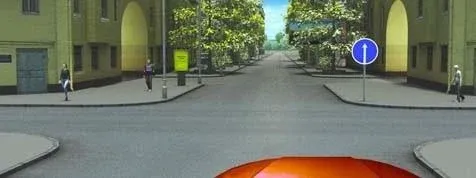
- Left
- Right
- No courtyard may be entered
- Both courtyards are permitted
Show answer
Correct: 2. Right
The sign on the right is mandatory sign 4.1.1 “Straight ahead only”. Under the road-signs annex, a 4.1.1 placed at the start of a section acts as far as the nearest intersection, but it does NOT prohibit turning right into courtyards and other areas adjoining the road. Entering the left courtyard would need a left turn, which 4.1.1 forbids, while the right courtyard can be reached by the right turn that remains permitted. “Left” and “Both courtyards are permitted” are therefore wrong, and “No courtyard may be entered” is wrong because entry to the right-hand one is not prohibited at all.
Question 111. Is it permitted to enter the indicated courtyard?
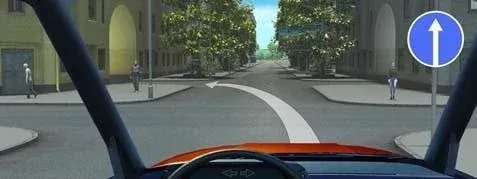
- Yes
- No
Show answer
Correct: 1. Yes
Sign 4.1.1 “Movement straight ahead” is in place, but it does not prohibit a right turn into courtyards and other territories adjoining the road - and that is exactly the entrance shown on the right of the picture. Entering the indicated courtyard is therefore permitted. “No” reads sign 4.1.1 as an absolute prohibition, whereas its effect is on travel along the road and not on turning off it into an adjoining territory.
Question 262. Which driver violates the traffic rules when making a turn
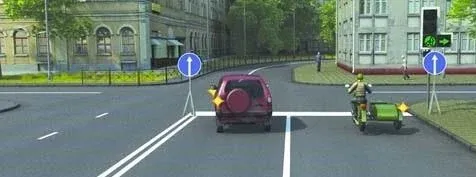
- The passenger car’s
- The motorcycle’s
- Both drivers
- No one
Show answer
Correct: 3. Both drivers
Sign 4.1.1 “Straight ahead only” is in place here, and under the Rules it permits movement only in the direction its arrow shows - straight on. Both the light passenger car and the motorcycle are turning instead of going straight, so both drivers are breaking the rules. Naming only the passenger car or only the motorcycle is wrong because each of them turns against sign 4.1.1, and “No one” is wrong because turning is prohibited wherever 4.1.1 requires travel straight ahead.
Question 678. Which of the signs is called “Bypassing the obstacle on the left”?
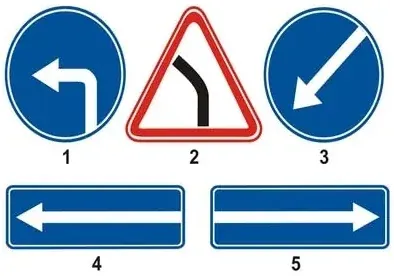
- 1
- 2
- 3
- 4
- 5
Show answer
Correct: 3. 3
“Bypassing the obstacle on the left” is sign 4.2.2 - the blue disc whose arrow points diagonally down and to the left - which is number 3. Number 1 is 4.1.3 “Movement to the left”, a direction of travel and not a bypass. Number 2 is a warning triangle about a dangerous turn and is not a mandatory sign at all. Numbers 4 and 5 are the blue rectangular information signs 5.7.2 and 5.7.1 “Exit to a road with one-way traffic”, which show the direction of an exit rather than how to pass an obstacle.
Question 684. In which answer is the permitted direction of travel correctly indicated?
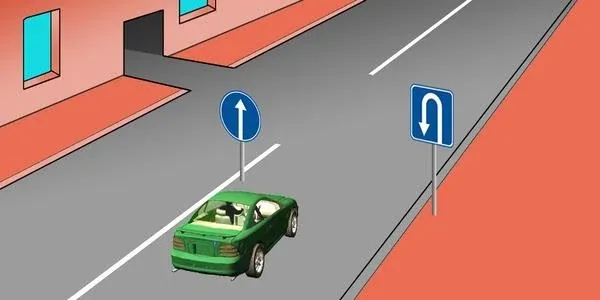
- Only a U-turn.
- Straight and a U-turn.
- Only straight.
Show answer
Correct: 3. Only straight.
The road carries sign 4.1.1 “Straight ahead only”, and under the description of signs 4.1.1–4.1.6 in the Traffic Rules travel is permitted only in the direction shown by the arrow — here, straight ahead. A 4.1.1 sign placed at the start of a road section applies as far as the nearest intersection, and the only exception is a right turn into yards and other areas adjoining the road; a left turn and a U-turn are not permitted. The only permitted direction at this point is therefore straight ahead.
Question 688. In which answer is the permitted direction of travel correctly indicated?
- Straight and to the left, entering the yard.
- Only straight.
- Only a U-turn.
- Straight and a U-turn.
Show answer
Correct: 2. Only straight.
The round blue sign above the lane is the mandatory sign 4.1.1 “Straight ahead only”, and under point 4.1.1 of the Traffic Rules travel is permitted only in the direction shown by the arrow on the sign. The square blue sign on the right is an information sign only: it indicates where the place provided for U-turns is located, but it does not permit a U-turn or travel in any other direction at this point. Only travelling straight ahead is therefore permitted here.
Question 692. In which picture is the driver performing the manoeuvre correctly?
- 1
- 2
- 3
Show answer
Correct: 1. 1
Sign 4.1.1 “Straight ahead only”, placed at the start of a section, acts as far as the nearest intersection and does NOT prohibit turning right into courtyards and other areas adjoining the road, so in picture 1 the driver turning right into a courtyard is acting correctly. In picture 2 the driver turns LEFT into a courtyard within the sign’s zone, which breaks the straight-ahead requirement - the exception covers the right turn only. In picture 3 the driver makes a U-turn on a road with one-way traffic (sign 5.5), and point 50 of the Traffic Rules expressly prohibits a U-turn on one-way roads.
Question 783. From this lane, continuing travel is permitted
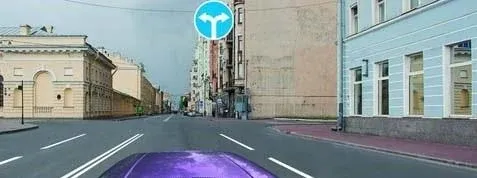
- Only in the left direction
- In the left and opposite directions
- In the right, left and opposite directions
Show answer
Correct: 2. In the left and opposite directions
Before the intersection stands the mandatory sign 4.1.6 “Movement to the right or to the left”, under which travel is permitted only in the directions its arrows show - and a sign permitting a left turn permits a U-turn as well. But under point 40 of the Traffic Rules a driver must take the appropriate edge lane in advance: the left edge lane for a left turn or a U-turn, the right edge lane for a right turn. The car is in the LEFT edge lane, so from this lane travel may be continued only to the left and in the opposite direction. “Only in the left direction” is wrong because the U-turn is allowed too, and “In the right, left and opposite directions” is wrong because a right turn may not be made from the left edge lane.
Question 1036. Traffic is permitted
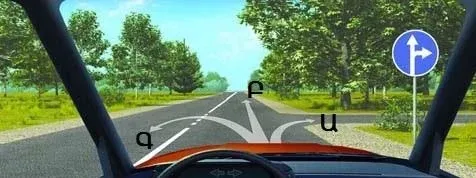
- Only in direction Բ (B)
- Only in directions Ա (A) or Բ (B)
- In any direction
Show answer
Correct: 2. Only in directions Ա (A) or Բ (B)
On the right of the road stands sign 4.1.4 “Movement straight or to the right”, which permits travel only in the directions its arrows show - straight ahead or to the right. In the picture trajectory Բ (B) is travel straight ahead and Ա (A) is the right turn, so travel is permitted only in directions Ա (A) or Բ (B). “Only in direction Բ (B)” is wrong because the sign permits the right turn as well, and “In any direction” is wrong because the left turn - Գ (C) - and a U-turn are not permitted by this sign.
Question 1046. Which sign marks a pedestrian path?
- Բ (B)
- Բ (B) and Գ (C)
- All
Show answer
Correct: 1. Բ (B)
Sign Բ (B) is 4.5.1 “Footpath” - a pedestrian in a blue disc - which permits only the movement of pedestrians, and so is the sign that marks a pedestrian path. Sign Ա (A) is 3.10 “Movement of pedestrians prohibited”, which marks no path but forbids pedestrians, and sign Գ (C) is 5.19.1 “Pedestrian crossing”, which marks a crossing rather than a path. All three carry a pedestrian figure, but only one of them is a mandatory blue disc marking a path, so the correct answer is Բ (B) alone, and “Բ (B) and Գ (C)” and “All” are wrong.
Question 1047. At this intersection, in which of the indicated directions may you continue driving?
- Only Ա (A)
- Բ (B) or Գ (C)
- Ա (A) or Բ (B)
Show answer
Correct: 3. Ա (A) or Բ (B)
The blue sign standing before the intersection on the right is 4.1.1 “Straight ahead only”, and its effect extends only to the intersection of carriageways before which it is placed. The crossing road here has a dividing strip, so the junction consists of TWO intersections of carriageways: at the first, only travel straight ahead is permitted, which rules out trajectory Գ (C), the right turn into the nearer carriageway. The second intersection is already outside the sign’s zone of action, so the left turn there - Ա (A) - is permitted, and travelling straight ahead - Բ (B) - is permitted by the sign itself. The answer is therefore Ա (A) or Բ (B): “Only Ա (A)” ignores the permitted straight direction, and “Բ (B) or Գ (C)” includes the right turn barred at the first crossing.
Question 1055. Which of the signs requires the driver of a truck with a mass of 5 tonnes to make a right turn at the intersection?
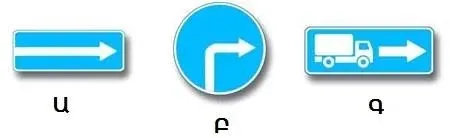
- Only Ա (A)
- Only Բ (B)
- Ա (A) and Բ (B)
- Բ (B) and Գ (C)
Show answer
Correct: 2. Only Բ (B)
Sign Բ (B) is the mandatory sign 4.1.2 “Movement to the right”, under which travel is permitted only in the direction its arrow shows - so it requires every driver, including the driver of a 5 tonne truck, to turn right at the intersection. Sign Ա (A) is the information sign 5.7.1 “Exit to a road with one-way traffic”, which requires no right turn, and Գ (C) is likewise an information sign rather than a mandatory one. The shape tells them apart: a blue DISC compels, a blue rectangle merely informs. Only Բ (B) therefore requires the driver of the 5 tonne truck to turn right.
Question 1065. At the next intersection, in which of the indicated directions may you continue movement?
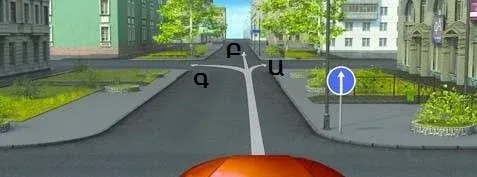
- Only Բ (B)
- Ա (A) or Բ (B)
- All
Show answer
Correct: 3. All
The sign is 4.1.1 “Movement straight ahead”. Under the Rules, the effect of sign 4.1.1 placed at the beginning of a section of road extends only as far as the nearest intersection. The intersection in question here is the one beyond it, where the sign’s effect has already ended, so movement may be continued in any of the indicated directions. “Only Բ (B)” and “Ա (A) or Բ (B)” are wrong because the “straight ahead only” restriction of sign 4.1.1 no longer operates at that further intersection.
Question 1094. On which side may the obstacle be bypassed
- Only Ա (A)
- Only Բ (B)
- Either
Show answer
Correct: 1. Only Ա (A)
On the red-and-white striped board - plate 8.22 “Obstacle” - there is a blue round sign whose arrow points down and to the left, that is sign 4.2.2 “Bypass the obstacle on the left”, and under the section on mandatory signs the obstacle may be bypassed only on the side the arrow shows. The obstacle may therefore be bypassed only on the left, along trajectory Ա (A). “Only Բ (B)” is wrong because that is a bypass on the right, against the arrow, and “Either” would be right only for sign 4.2.3 “Bypass the obstacle on the right or on the left”, which is not here.