Intersections: Equal Roads
Passing-order questions ask you to sort several vehicles into a queue, and at an intersection of equal roads no sign gives you the answer. This lesson gives you a five-step method you can repeat on every picture, then teaches the two steps that settle equal roads.
What is the five-step method?
Section titled “What is the five-step method?”Five words, always in this order: Light, Sign, Rail, Right, Left.
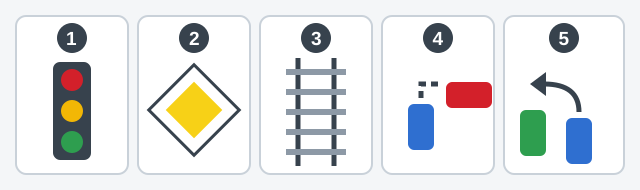
Tiles 1 to 5 are the five steps: Light, Sign, Rail, Right, Left.
| Step | Ask | What follows |
|---|---|---|
| 1. Light | Does an officer or a working traffic light set the order? | Follow the signal. A light that is off or flashing yellow doesn’t count, so go on. |
| 2. Sign | Do priority signs or road surfaces make one road main? | The secondary road waits for the main road. Run steps 3 to 5 inside each group. |
| 3. Rail | Is a tram on a road equal to yours? | The tram goes before non-rail vehicles. |
| 4. Right | Is a vehicle approaching from your right? | Give way to it. |
| 5. Left | Are you turning left or making a U-turn, with someone oncoming going straight or right? | Give way to them. |
Steps 3 to 5 add up, so you may owe the way to several vehicles at once. When you have run the steps, build the queue:
- Whoever waits for nobody goes first.
- Cross them off and ask again.
- Vehicles whose paths don’t cross go together.
This lesson covers steps 1, 4 and 5. Trams at Intersections covers step 3. Main and Secondary Roads and When the Main Road Turns cover step 2.
When are roads equal?
Section titled “When are roads equal?”An intersection is regulated when an officer or a traffic light sets the order (point 89). If neither does, it is unregulated. A light that is off, or flashing yellow, leaves the intersection unregulated (point 95). Flashing yellow permits you to move, so don’t wait for a green.
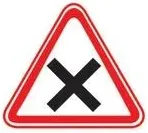
An unregulated intersection with no priority signs is an intersection of equal roads. Sign 1.6 “Intersection of roads of equal importance” warns you that one is coming.
Common trap: A “Dead end” sign beside the crossing road sets no priority. It only tells you the road has no way through, so a truck coming out of that road on your right still goes first.
Who goes first? The vehicle on the right
Section titled “Who goes first? The vehicle on the right”Point 98 gives one test: at an intersection of equal roads, give way to vehicles approaching from your right. The test ignores everything else:
- Size: A bus gives way to a motorcycle on its right.
- Type: A bicycle or a horse-drawn cart counts like any other vehicle.
- Direction: Your direction gives you no advantage. Going straight or turning left, you still give way to the right.
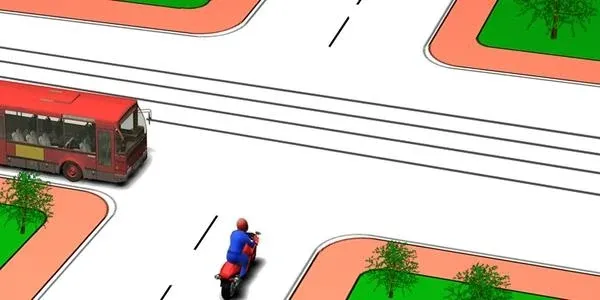
The motorcycle is on the bus’s right, so the bus gives way.
The rule works in one direction only. A vehicle on your left has no advantage over you, whether you are going straight, turning left or turning right.
How do I read the pictures?
Section titled “How do I read the pictures?”- Sit in each driver’s seat. Pictures are often drawn at an angle. Ask what lies on that driver’s right hand, not on the right of the page.
- Look for the green arrow on the dashboard. It shows the way you intend to go.
- Look for yellow stars on a vehicle. They are its lit indicators.
What if I’m turning left?
Section titled “What if I’m turning left?”Point 99 adds a second duty. When you turn left or make a U-turn, you give way to vehicles coming from the opposite direction that are going straight or turning right. You cross their path, so you wait, either before the intersection or inside it, and then finish your turn.
| When you turn left, who else is there? | What you do |
|---|---|
| Oncoming, going straight or turning right | Give way |
| Oncoming, also turning left | Neither gives way. You may both turn at once, passing left side to left side |
| On your right | Give way (step 4 still applies) |
| Only on your left | Go first |
The duty covers cyclists too. If a car turning left and an oncoming cyclist turning right are heading for the same entrance, the car gives way.
Turning right is simpler. Your path doesn’t cross an oncoming vehicle going straight, and an oncoming car turning left into the same road must give way to you.
Common trap: “You are turning left, so you always go last” is false. With only a car on your left, you go first.
What if three or more arrive together?
Section titled “What if three or more arrive together?”Build the queue. Find the vehicle with nobody on its right, because it goes first. The vehicle that had it on the right goes next, and so on round the intersection.
Two vehicles go together when their paths don’t cross. That covers vehicles head-on to each other going straight, and vehicles side by side in adjacent lanes.
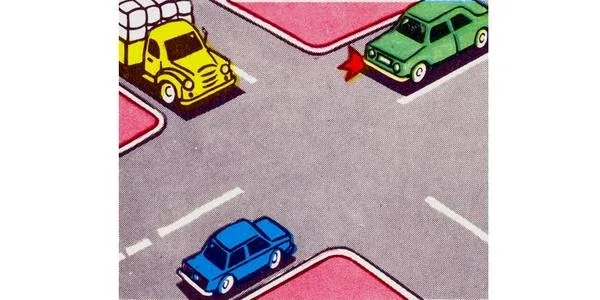
Blue and green face each other and go straight, so they go together. Blue is on yellow’s right, so yellow goes last.
What if everyone has someone on the right?
Section titled “What if everyone has someone on the right?”With a vehicle on all four roads, each driver has someone on the right, and the test goes round in a circle. The Rules don’t settle this case, so the drivers pass showing mutual respect.
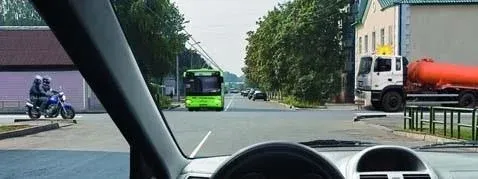
Remember: One free road breaks the circle. If nothing can approach from the right, as on a one-way crossing road, the queue has a start.
Extra: Never assume the other driver will give way
Not from the question bank.
Having priority doesn’t stop the other car. Before you go, check that the driver who should wait is actually slowing down. A moment of doubt costs you a few seconds, and that is cheap.
What if paths cross away from an intersection?
Section titled “What if paths cross away from an intersection?”Point 45 uses the same idea. Where paths cross and the Rules set no order, the driver who has a vehicle approaching from the right gives way.
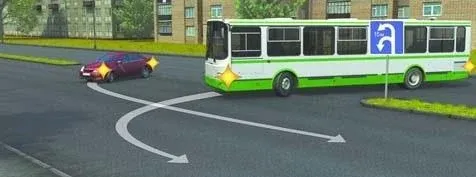
Sign 6.3.1 “Place for turning” allows both to turn round here. The car is on the bus’s right, so the bus gives way.
Try it yourself
Section titled “Try it yourself”You are the red car. There are no signs. A green truck waits on the road to your right and a blue car on the road to your left.
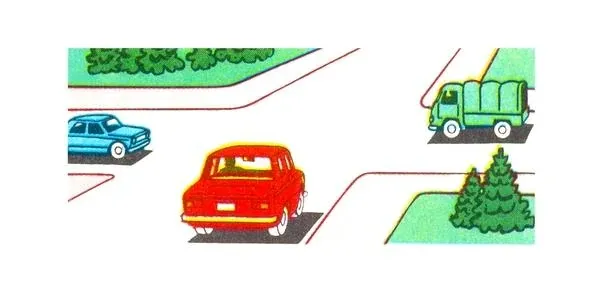
Who crosses last? The blue car. Light: none. Sign: none. Rail: no tram. Right: the truck has nobody on its right, so it goes first. You have the truck on your right, so you go second. The blue car has you on its right, so it goes last.
You are turning left. The arrow on the dashboard shows your turn. A truck comes towards you and a blue car approaches from the right.
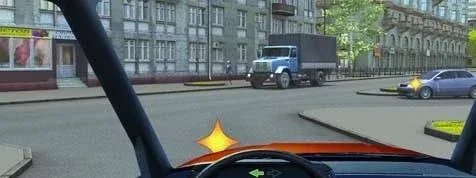
Who do you give way to? Both. Right: the car is on your right. Left: you are turning left across the truck, which is coming straight towards you.
The traffic light flashes yellow. A dark car comes towards you and a horse-drawn cart approaches from the right.
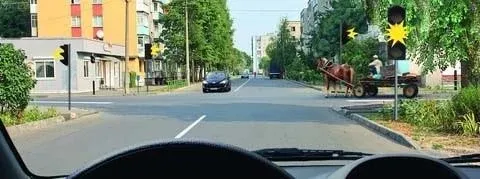
What do you do? Cross, giving way to the cart. Light: flashing yellow doesn’t count, and no green is coming. Sign: none. Right: the cart is a vehicle like any other, and it is on your right.
Key points
Section titled “Key points”- Five steps, in order: Light, Sign, Rail, Right, Left. Then build the queue.
- A light that is off or flashing yellow leaves the intersection unregulated.
- On equal roads, give way to the right. Size, type and direction don’t matter.
- Turning left or making a U-turn, give way to oncoming vehicles going straight or right.
- Two oncoming drivers turning left may turn at once.
- Paths that don’t cross go together.
- Four vehicles in a circle: the Rules don’t settle it, so pass showing mutual respect.
Practice questions
Section titled “Practice questions”Question 304. The first to pass the intersection will be:
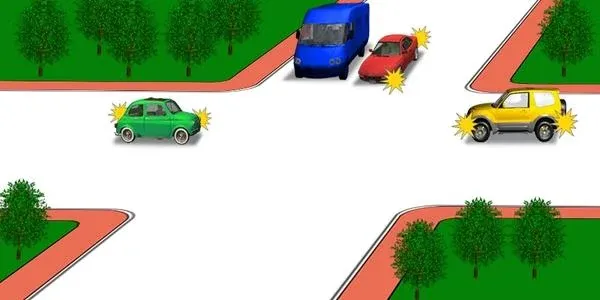
- The red car.
- The blue car.
- The yellow car.
- The green car.
Show answer
Correct: 4. The green car.
This is an uncontrolled intersection of roads of equal importance (there are no signs and no signals), so under point 98 of the Rules the driver of a non-rail vehicle must give way to vehicles approaching from the right, and under point 99 a driver turning left or making a U-turn gives way to oncoming vehicles going straight. The green car has no one on its right and is not required to give way to anyone, while the others have a vehicle on their right (or are turning across the flow) and must give way. The green car therefore passes the intersection first.
Question 305. The last to pass the intersection will be:
- The blue car.
- The green car.
- The red car.
Show answer
Correct: 1. The blue car.
The intersection is unregulated — there are no traffic lights and no priority signs — so the roads are of equal importance and point 98 of the Rules applies: a driver must give way to vehicles approaching from the right. The green lorry has no vehicle approaching on its right, so it crosses the intersection first. The red car has the green lorry on its right, gives way to it and goes second, while the blue car has the red car on its right and gives way to it. The last to pass the intersection is therefore “The blue car.” “The green car.” is wrong because it has nothing approaching on its right and goes first, and “The red car.” is wrong because it gives way only to the green vehicle and passes before the blue one.
Question 307. In which answer is the order of passing the indicated intersection correct?
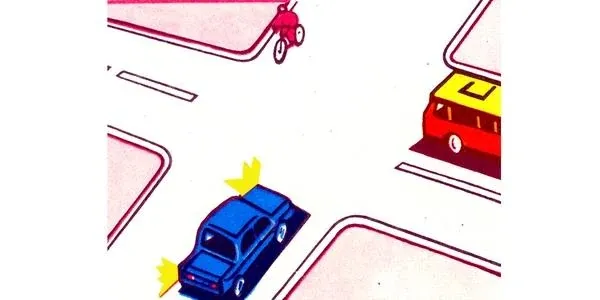
- Bus, light passenger car, bicycle.
- Light passenger car, bus, bicycle.
- Bicycle, bus, light passenger car.
Show answer
Correct: 3. Bicycle, bus, light passenger car.
This is an unregulated intersection of roads of equal importance. Under point 98 of the Rules every driver gives way to those approaching from his right, and under point 99 a driver turning left gives way to oncoming traffic on the equal road that is going straight ahead or turning right. The bicycle has no one on its right and nobody has to yield to anything ahead of it, so it goes first - a bicycle counts in the right-hand rule exactly like any other vehicle. The bus must give way to the bicycle approaching from its right and goes second. The light passenger car is turning left and must give way to the oncoming flow, so it goes last. The order is the bicycle, the bus, the light passenger car.
Question 311. The intersection will be crossed second by:
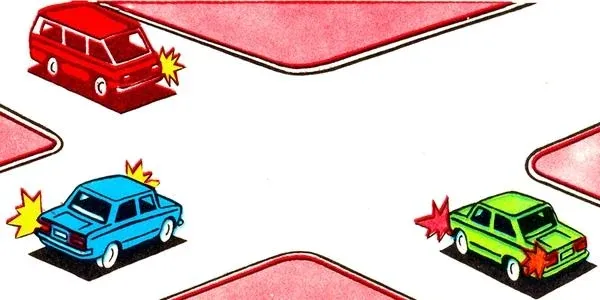
- The blue car.
- The green car.
- The red car.
Show answer
Correct: 1. The blue car.
This is an unregulated intersection of equal-rank roads (there are no priority signs), so the order of passage is set by point 98 — the driver of a non-rail vehicle must give way to vehicles approaching from the right. There is nothing on the green car’s right, so it goes first. The green car is on the blue car’s right, but it has already passed, so the blue car goes second. The other two vehicles are on the red car’s right, so it goes last. The correct answer is therefore “The blue car”. “The green car” is wrong because it goes first, not second; “The red car” is wrong because under the right-hand rule it yields to both and goes last.
Question 314. Which vehicle’s driver must give way?
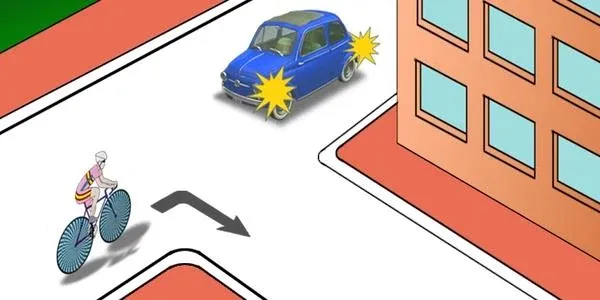
- The cyclist.
- The car driver.
Show answer
Correct: 2. The car driver.
The grey arrow shows the cyclist turning right into the entrance beside the building — the same entrance the car is turning into with its left indicator on, crossing the path of the oncoming cyclist. Under point 99 of the Rules, a driver turning left must give way to those coming from the opposite direction on an equal-rank road and going straight or turning right; and under point 38, a driver entering an adjacent territory from the road must give way to cyclists whose path is crossed. The car driver therefore gives way. “The cyclist” is wrong: an oncoming cyclist turning right has priority over a car turning left.
Question 317. The intersection will be crossed second by:
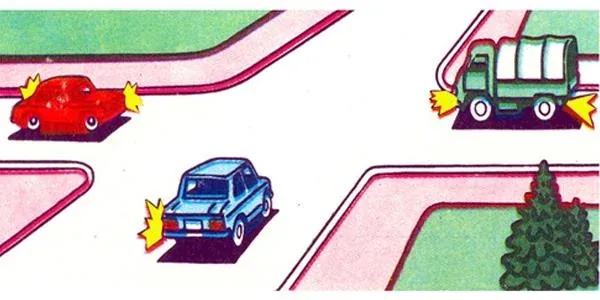
- The red car.
- The blue car.
- The green car.
Show answer
Correct: 2. The blue car.
This is an unregulated intersection of equal-rank roads (there are no signs), so under point 98 of the Rules every driver gives way to those approaching from the right. The green vehicle has no one on its right and goes first; the blue car yields only to the green one (on its right) and goes second; the red car yields to the blue one (on its right) and goes last. The intersection is therefore crossed second by the blue car. “The red car” and “The green car” are wrong, because the green vehicle has priority (no one on its right) and the red car goes last.
Question 318. The intersection will be crossed last by:
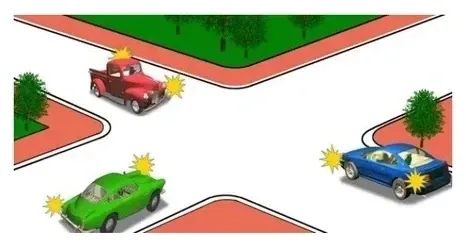
- The green car.
- The blue car.
- The red car.
Show answer
Correct: 3. The red car.
The intersection is unregulated — there are no traffic lights and no priority signs — so the roads are of equal importance and point 98 of the Rules applies: a driver must give way to vehicles approaching from the right. The blue car has no vehicle approaching on its right, so it crosses the intersection first. The green car has the blue car on its right, gives way to it and goes second, while the red car has the green car on its right and gives way to it. The last to pass the intersection is therefore “The red car.” “The blue car.” is wrong because it has nothing approaching on its right and goes first, and “The green car.” is wrong because it goes after the blue car but before the red one.
Question 320. The intersection will be crossed first by:
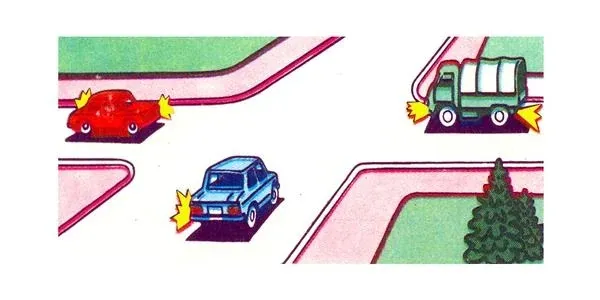
- The green car.
- The red car.
- The blue car.
Show answer
Correct: 1. The green car.
This is an unregulated intersection of equal-rank roads (there are no signs), so under point 98 of the Rules every driver gives way to those approaching from the right. The green vehicle has no one on its right and therefore goes first; the blue car yields to the green one (on its right), and the red car yields to the blue one (on its right). The intersection is therefore crossed first by the green car. “The red car” and “The blue car” are wrong, because each of them has a vehicle on its right that it must give way to.
Question 321. Which vehicle’s driver must give way?
- The bus driver.
- The motorcycle driver.
Show answer
Correct: 1. The bus driver.
This is an unregulated intersection of roads of equal importance, so under point 98 of the Rules each driver must give way to vehicles approaching from his right. The motorcycle is approaching from the bus’s right-hand side, so the bus driver must give way to the motorcycle. “The motorcycle driver.” is wrong because, being on the bus’s right, the motorcycle has priority under the give-way-to-the-right rule - the size of the vehicle counts for nothing here.
Question 323. The intersection will be crossed second by:
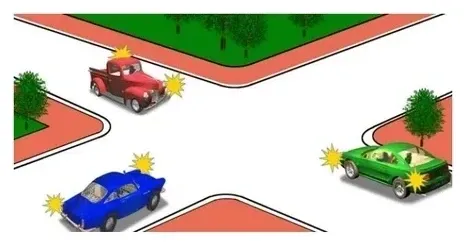
- The blue car.
- The green car.
- The red car.
Show answer
Correct: 1. The blue car.
This is an uncontrolled intersection of equal roads (there are no signs), so under point 98 of the Rules every driver gives way to those approaching from the right. The green vehicle has no one on its right and passes first; the blue car gives way only to the green one (on its right) and passes second; the red car gives way to the blue one (on its right) and passes last. The intersection is therefore crossed second by the blue car. “The green car” is wrong (it passes first), “The red car” is wrong (it passes last).
Question 326. The cars will cross the intersection in the following order:
- The yellow, the green, the blue.
- The blue simultaneously with the green, the yellow.
Show answer
Correct: 2. The blue simultaneously with the green, the yellow.
This is an unregulated intersection of roads of equal importance - there are no priority signs - so the order is settled by point 98 of the Rules: the driver of a non-rail vehicle must give way to vehicles approaching from his right. The blue and green cars’ paths do not cross each other, so they pass the intersection at the same time. The blue car is on the yellow car’s right, so under point 98 the yellow car must give way to it and goes only after the blue and green have cleared the intersection. The order is therefore the blue simultaneously with the green, then the yellow. “The yellow, the green, the blue.” is wrong because the yellow car cannot go first - the right-hand rule makes it yield to the blue car approaching on its right.
Question 328. The intersection will be crossed first by:
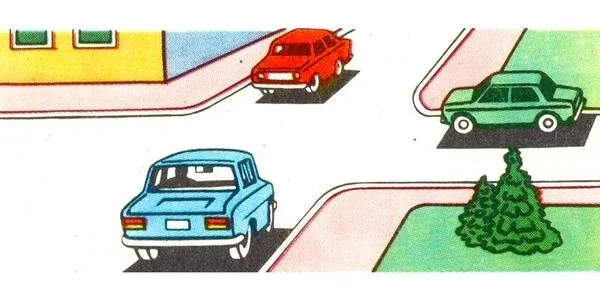
- The green car.
- The blue car.
- The red car.
Show answer
Correct: 3. The red car.
This is an uncontrolled intersection of equal roads (there are no signs), so under point 98 of the Rules every driver gives way to vehicles approaching from the right. The red car has no one on its right and is not obliged to give way to anyone, so it passes first; the green car gives way to the red one (on its right), and the blue car to the green one (on its right). The intersection is therefore crossed first by the red car. “The green car” and “The blue car” are wrong, because each of them has a vehicle on its right to which it must give way.
Question 331. Which of the drivers has the right of priority travel?
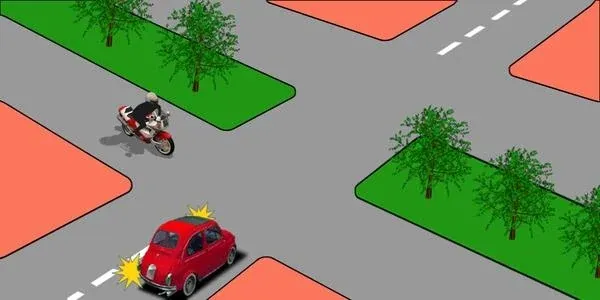
- The motorcycle driver.
- The car driver.
Show answer
Correct: 2. The car driver.
This is an unregulated intersection of roads of equal importance, since there are no signs, so under point 98 of the Rules a driver must give way to vehicles approaching from his right. The car is approaching on the motorcycle’s right-hand side, so the motorcycle gives way and the right of priority travel belongs to the car driver. “The motorcycle driver.” is wrong because under the give-way-to-the-right rule it is the car, being on the motorcycle’s right, that has the advantage.
Question 332. The intersection will be crossed second by:
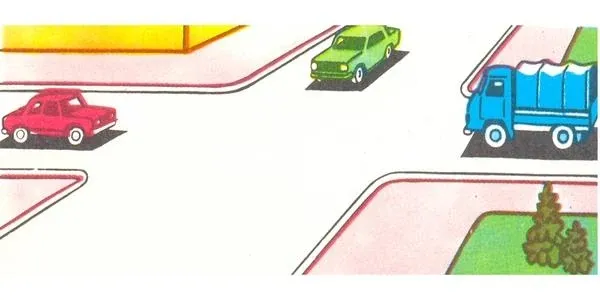
- The red car.
- The blue car.
- The green car.
Show answer
Correct: 3. The green car.
This is an uncontrolled intersection of equal roads (there are no signs), so under point 98 of the Rules every driver gives way to those approaching from the right. The red car has no one on its right and passes first; the green car gives way only to the red one (on its right) and passes second; the blue lorry gives way to the green car (on its right) and passes last. The intersection is therefore crossed second by the green car. “The red car” is wrong (it passes first), “The blue car” is wrong (it passes last).
Question 338. Which vehicle’s driver must give way?
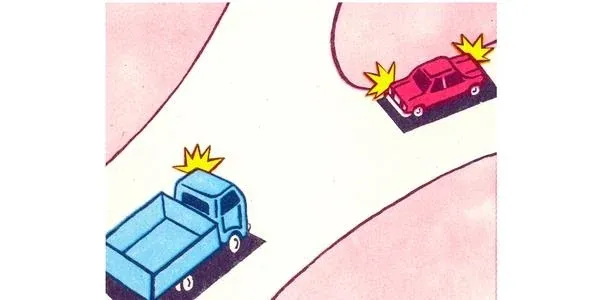
- The blue car’s driver.
- The red car’s driver.
Show answer
Correct: 1. The blue car’s driver.
This is an unregulated intersection of roads of equal importance, since there are no signs, so under point 98 of the Rules a driver must give way to vehicles approaching from his right. The red car is approaching on the blue truck’s right-hand side, so the blue truck’s driver must give way to it. “The red car’s driver.” is wrong because the red car, being on the truck’s right, has the advantage under the give-way-to-the-right rule.
Question 343. The green car’s driver:
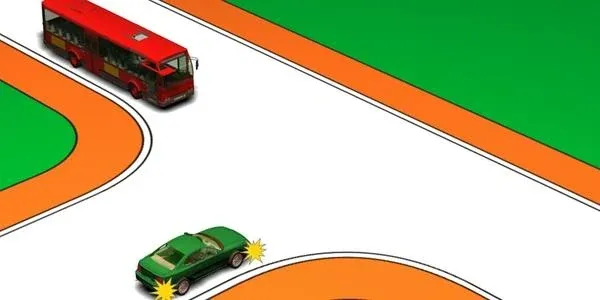
- Has the right of way.
- Must give way.
Show answer
Correct: 1. Has the right of way.
This is an unregulated intersection of roads of equal importance, since there are no signs, so under point 98 of the Rules a driver must give way to vehicles approaching from his right. The green car is approaching on the bus’s right-hand side, so the bus must give way and the green car’s driver has the right of way. “Must give way.” is wrong because under the give-way-to-the-right rule the green car, being on the bus’s right, has the advantage - the bus being much the larger vehicle counts for nothing.
Question 345. The second to pass the intersection will be:
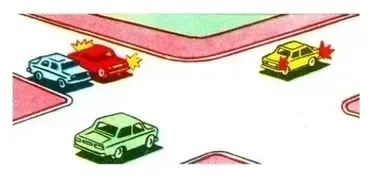
- The green car.
- The red car, simultaneously with the blue one.
- The yellow car.
Show answer
Correct: 2. The red car, simultaneously with the blue one.
At this four-way intersection there are neither priority signs nor a traffic light, so the order of passage is settled by point 98 of the Traffic Rules: at an intersection of roads of equal importance the driver of a non-rail vehicle must give way to the drivers of vehicles approaching from his right. Applying the right-hand rule, the green car has no vehicle on its right and goes first. After it, the red and blue cars have no conflict between themselves - their paths do not cross - so they go together, as the second step. The yellow car does have a vehicle on its right and must give way to it, so it goes last. The answer to who passes second is therefore the red car simultaneously with the blue one; “The green car.” goes first rather than second, and “The yellow car.” goes last.
Question 348. The red car will pass the intersection:
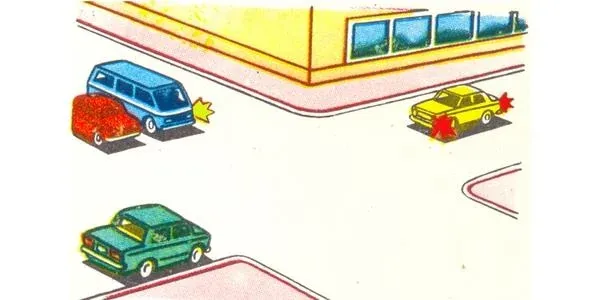
- Second, simultaneously with the blue one.
- Second, after the yellow one.
- Third, after the green one and the yellow one.
Show answer
Correct: 1. Second, simultaneously with the blue one.
This is an unregulated intersection of roads of equal importance - there are no signs - so under point 98 of the Rules each driver gives way to those approaching from his right. The green car has no vehicle on its right and goes first. The red car and the blue minibus are travelling on the same road in adjacent lanes side by side, so their paths do not cross each other, and both give way to the green car on their right; after it they therefore go together, as the second step. “Second, after the yellow one.” and “Third, after the green one and the yellow one.” are wrong because the yellow car gives way to the red and the blue approaching on ITS right, and so crosses last.
Question 350. In which answer is the order of passing correctly indicated?
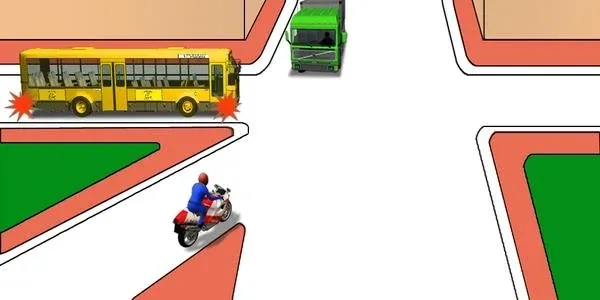
- The motorcycle, the bus, the truck.
- The bus, the motorcycle, the truck.
- The bus, the truck, the motorcycle.
Show answer
Correct: 1. The motorcycle, the bus, the truck.
This is an uncontrolled intersection of roads of equal importance (there are no signs), so under point 98 of the Rules every driver gives way to those approaching from the right. The motorcycle has no one on its right and goes first; the bus gives way to the motorcycle (on its right) and goes second; the truck gives way to the bus (on its right) and goes last. The order is therefore: motorcycle, bus, truck. The other answers are wrong, because the motorcycle, having no one on its right, does not go after the bus or the truck.
Question 352. Which vehicle’s driver must give way?
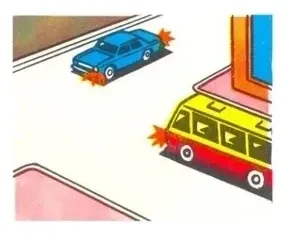
- The passenger car’s driver.
- The bus driver.
Show answer
Correct: 2. The bus driver.
This is an unregulated intersection of roads of equal importance, since there are no signs, so under point 98 of the Rules a driver must give way to vehicles approaching from his right. The light passenger car is approaching on the bus’s right-hand side, so the bus driver must give way to it. “The passenger car’s driver.” is wrong because the car, being on the bus’s right, has the advantage under the give-way-to-the-right rule.
Question 356. In what order will the vehicles pass the intersection if the traffic lights are not working?
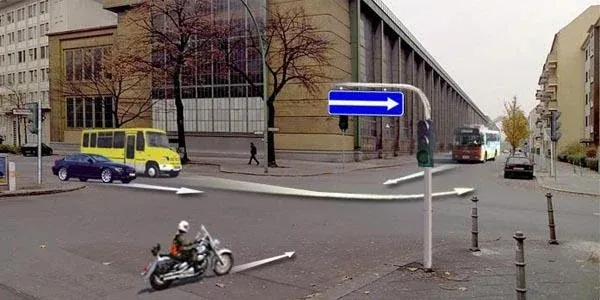
- The trolleybus and the motorcycle, the bus and the passenger car.
- The motorcycle, the bus and the passenger car, the trolleybus.
- The bus and the passenger car, the trolleybus and the motorcycle.
Show answer
Correct: 2. The motorcycle, the bus and the passenger car, the trolleybus.
With the traffic lights not working the intersection counts as unregulated (point 95), and there are no priority signs, so the right-hand rule of point 98 governs. Sign 5.7.1 shows that the crossing road carries one-way traffic, so nothing can approach the motorcycle from its right and it passes first. The bus and the light passenger car travel along that one-way road in the same direction in adjacent lanes, so their paths do not cross; giving way only to the motorcycle on their right, they pass second, together. The trolleybus gives way to the bus and the car approaching on its right (point 98) and, as it turns left, to the oncoming motorcycle going straight (point 99), so it goes last - which is why the other two options are wrong.
Question 364. Can they make the left turn simultaneously at this intersection?
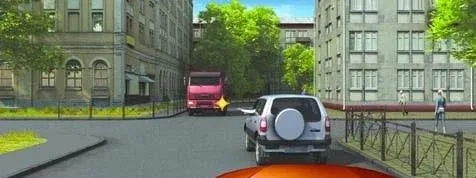
- Yes
- No. The driver of the light passenger car must give way
- No. The driver of the lorry must give way
Show answer
Correct: 1. Yes
Both vehicles are oncoming to each other and both are turning left. Under point 99 of the Rules a driver turning left must give way only to vehicles coming from the opposite direction that are travelling STRAIGHT AHEAD or turning RIGHT. Here the oncoming vehicle is turning left as well - neither straight nor right - so neither driver is obliged to give way to the other, and they may complete their left turns at the same time, passing left side to left side. “No. The driver of the light passenger car must give way” and “No. The driver of the lorry must give way” are wrong because point 99’s duty does not arise between two oncoming vehicles that are both turning left.
Question 366. In this situation, when making a left turn
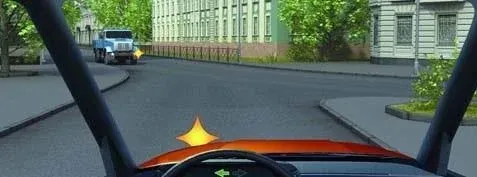
- You will pass the intersection first
- We will give way to the driver of the lorry
Show answer
Correct: 1. You will pass the intersection first
This is an uncontrolled intersection of roads of equal importance (there are no signs), so under point 98 of the Rules a driver gives way only to vehicles approaching from the right. The truck approaches from the left, not from the right, so there is no obligation to give way to it, and the intersection is passed first when turning left. The answer “We will give way to the driver of the lorry” is wrong, because the truck is on the left and the “give way to the right” rule does not require giving way to it.
Question 367. In this situation, when making a right turn
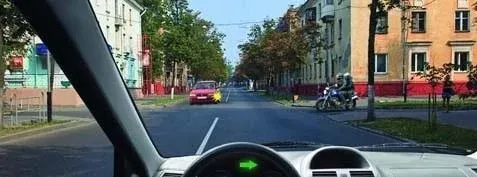
- You will pass the intersection first
- We will give way to the driver of the light passenger car
Show answer
Correct: 1. You will pass the intersection first
You are turning right, while the oncoming red car, with its left indicator on, is turning left into the same road. Under point 99 of the Rules a driver turning left must give way to vehicles coming from the opposite direction that are travelling straight ahead or turning RIGHT, so the duty to yield lies with the red car’s driver, and you pass the intersection first. “We will give way to the driver of the light passenger car” is wrong because point 99 puts the obligation on the one turning left, not on the one turning right.
Question 368. If you continue travelling straight
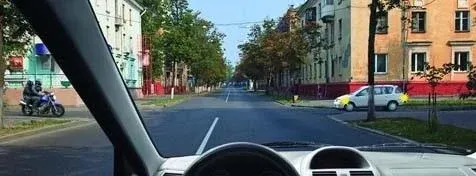
- You will pass the intersection first
- You will pass after the light passenger car has passed
Show answer
Correct: 2. You will pass after the light passenger car has passed
There are no priority signs at this intersection, so it is an unregulated one between roads of equal importance. Under point 98 of the Traffic Rules a driver at such an intersection must give way to vehicles approaching from his right. The light passenger car is approaching from your right, so continuing straight ahead you pass after it. “You will pass the intersection first” is wrong because the vehicle on the right has the advantage - while the motorcycle approaching from your left is, by the same rule, the one that gives way to you.
Question 376. In this situation, when crossing the intersection, to give way you
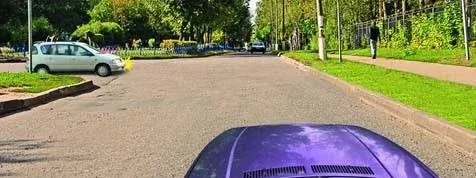
- Are obliged
- Are not obliged
Show answer
Correct: 2. Are not obliged
This is an unregulated intersection of roads of equal importance, so under point 98 of the Rules a driver must give way ONLY to vehicles approaching from his right. The other car is on your left, not your right, so it has no advantage over you, and crossing the intersection you are not obliged to give way. “Are obliged” is wrong because the give-way-to-the-right rule works in one direction only: it says nothing in favour of a vehicle coming from your left.
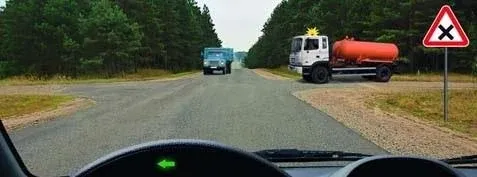
Question 389. In this situation we are obliged to give way to
- Both drivers
- Only the truck approaching from the oncoming direction
Show answer
Correct: 1. Both drivers
Warning sign 1.6 “Intersection of roads of equal importance” shows that this is an unregulated intersection between equal roads, and the green arrow on the dashboard shows that you are turning left. Under point 98 of the Traffic Rules you must give way to vehicles approaching from your right, and under point 99, turning left, also to vehicles coming from the opposite direction and travelling straight ahead. The tanker truck is approaching from the right and the other truck is coming head-on going straight, so you are obliged to give way to both drivers. “Only the truck approaching from the oncoming direction” is wrong because the tanker on your right must be let through as well.
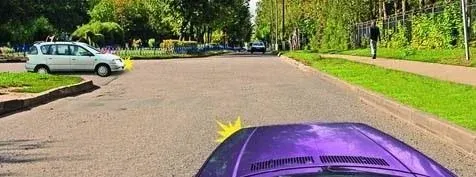
Question 390. When making a left turn
- You will cross the intersection first
- You will give way
Show answer
Correct: 1. You will cross the intersection first
This is an unregulated intersection of roads of equal importance, since there are no signs, so under point 98 of the Rules a driver gives way only to vehicles approaching from his right. The other car is on your left rather than your right, and it is not oncoming either, so making the left turn you are not obliged to give way and you cross the intersection first. “You will give way” is wrong because the give-way-to-the-right rule imposes nothing in favour of a vehicle on your left.
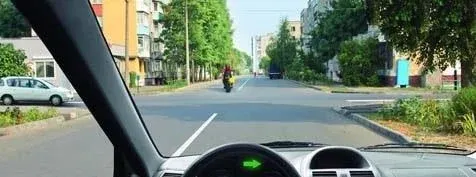
Question 391. In this situation we make the right turn
- By crossing the intersection first
- We give way to the passenger car driver
- We give way to both drivers
Show answer
Correct: 1. By crossing the intersection first
This is an unregulated intersection of roads of equal importance and you are turning right. Under point 99 of the Rules the duty to give way to oncoming traffic attaches to a LEFT turn and a U-turn, not to a right turn, and a right turn does not cross the path of the oncoming motorcycle going straight. The other car is on your left, so under point 98 - which requires yielding only to the right - you need not give way to it either. You therefore cross the intersection first. “We give way to the passenger car driver” and “We give way to both drivers” are wrong because nobody is on your right and a right turn conflicts with no oncoming vehicle.
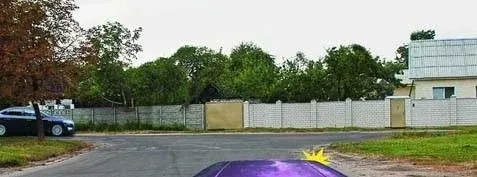
Question 392. When making a right turn
- You must give way
- You may go first
Show answer
Correct: 2. You may go first
This is an unregulated intersection of roads of equal importance, since there are no signs. You are turning right, and the other car is on your left rather than your right. Under point 98 of the Rules you give way only to traffic approaching from your right, so you are not obliged to yield to the car on the left and you may go first. “You must give way” is wrong because the give-way-to-the-right rule does not apply to a vehicle on your left, and your right turn does not conflict with its path.
Question 394. When making a left turn
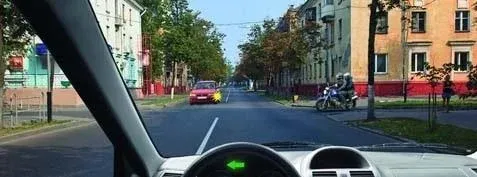
- You will go first, simultaneously with the passenger car
- You will go after the motorcycle
Show answer
Correct: 2. You will go after the motorcycle
The intersection is unregulated and there are no priority signs, so the roads are of equal importance, and the green arrow on the dashboard shows that you are turning left. Under point 98 of the Traffic Rules a driver at such an intersection must give way to vehicles approaching from his right. The motorcycle is approaching from your right, so it goes first and you pass after it. “You will go first, simultaneously with the passenger car” is wrong because turning left gives you no advantage and you are obliged to yield to the motorcycle on your right.
Question 403. In this situation we are obliged to give way to
- All drivers
- Only the truck driver
- Only the passenger car driver
Show answer
Correct: 1. All drivers
This is an unregulated intersection of roads of equal importance - there are no priority signs - and you are turning left. Under point 98 you must give way to those approaching from your right, which is the passenger car, and under point 99 a driver turning left must give way to oncoming traffic going straight ahead, which is the truck. You are therefore obliged to give way to all the drivers. “Only the truck driver” and “Only the passenger car driver” each name one of the two: both the car on your right and the oncoming truck have priority over your left turn.
Question 405. When making a U-turn at this intersection
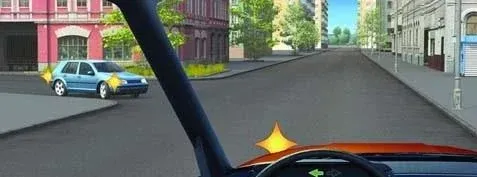
- I will perform the manoeuvre first
- One must give way to the other driver
Show answer
Correct: 2. One must give way to the other driver
You are making a U-turn at the intersection while the blue car, indicating, is entering the same road from the road on the left, so your paths cross. Under point 45 of the Rules, where the paths of vehicles cross and the order of passage is not fixed by the Rules, the driver to whom a vehicle is approaching from the RIGHT must give way - and as you come out of the U-turn the other car is on your right. You must therefore give way to it. “I will perform the manoeuvre first” is wrong because a driver making a U-turn has no priority in this situation and may complete it only without obstructing the other driver.
Question 407. In case of straight driving
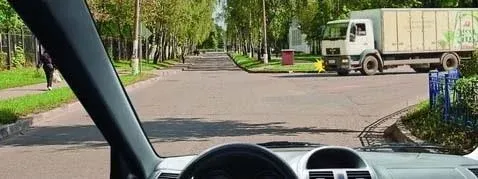
- You can drive through the intersection first
- You must give way
Show answer
Correct: 2. You must give way
This is an unregulated intersection of roads of equal importance, with no priority signs. Under point 98 of the Rules the driver of a non-rail vehicle must give way to those approaching from his right, and the truck is approaching from your right, so you must give way to it. “You can drive through the intersection first” is wrong because at an intersection of equal roads the advantage belongs to whoever comes from the right, whatever direction either of you is taking.
Question 411. In the case of a flashing yellow traffic-light signal
- We must wait for the green signal to come on
- We will cross the intersection giving way to the horse-cart driver
- You will cross the intersection simultaneously with the passenger car
Show answer
Correct: 2. We will cross the intersection giving way to the horse-cart driver
A flashing yellow signal means the intersection counts as unregulated (point 95 of the Rules), so the order is settled by the rule for roads of equal importance. Under point 98 you must give way to those approaching from your right, and the horse-drawn cart is approaching from the right - it is a vehicle for these purposes like any other - so you cross the intersection giving way to its driver. “We must wait for the green signal to come on” is wrong because flashing yellow permits movement and no green will follow here, and crossing at the same time as the passenger car is wrong because the order is fixed by the right-hand rule, which obliges you to yield to the cart.
Question 416. In this situation, when making a left turn
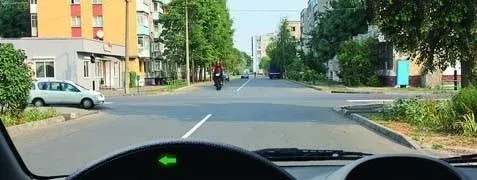
- You will cross the intersection first
- Entering the intersection you will give way to the motorcycle driver and then complete the maneuver
Show answer
Correct: 2. Entering the intersection you will give way to the motorcycle driver and then complete the maneuver
The green arrow on the dashboard shows that you are turning left, and the motorcycle is coming from the opposite direction going straight ahead. Under point 99 of the Traffic Rules a driver of a non-rail vehicle turning left must give way to vehicles coming from the opposite direction on a road of equal importance that are travelling straight ahead or turning right. You therefore enter the intersection, give way to the motorcyclist there, and only then complete the manoeuvre. “You will cross the intersection first” is wrong because the oncoming motorcycle going straight has priority over your turn.
Question 418. In this situation
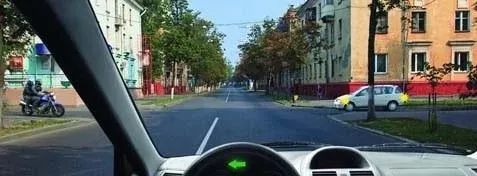
- You will cross the intersection first
- You will give way to the passenger car driver
- You will give way to both drivers
Show answer
Correct: 2. You will give way to the passenger car driver
The intersection is unregulated and there are no priority signs, so the roads are of equal importance, and the green arrow on the dashboard shows a left turn. Under point 98 of the Traffic Rules the driver of a non-rail vehicle must give way to vehicles approaching from his right: the light passenger car is on your right, so you give way to it. The motorcycle is on your left and at an intersection of equal roads it is the one that yields to you, so “You will give way to both drivers” is wrong, and “You will cross the intersection first” is wrong because the car approaching from the right has the advantage.
Question 420. Here, the intersection
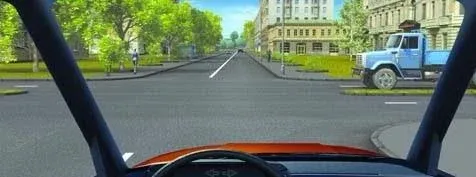
- You will cross first
- You will give way to the truck
Show answer
Correct: 2. You will give way to the truck
This is an unregulated intersection of roads of equal importance, with no priority signs. Under point 98 of the Rules, the driver of a non-rail vehicle must give way to those approaching from the right; the truck is approaching from the right, so the way is given to the truck. “You will cross first” is wrong, because at an intersection of equal roads priority belongs to the vehicle coming from the right.
Question 713. Indicate the order of passing the intersection
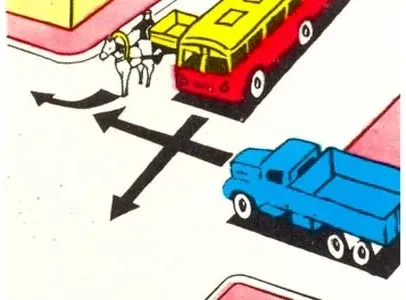
- The bus, the truck, the horse-drawn cart.
- The bus and the horse-drawn cart, the truck.
Show answer
Correct: 2. The bus and the horse-drawn cart, the truck.
This is an unregulated intersection of roads of equal importance, so under point 98 of the Traffic Rules the driver of a non-rail vehicle must give way to vehicles approaching from his right. The bus and the horse-drawn cart both approach the truck from its right, so the truck must give way to both - a horse-drawn cart is a vehicle for these purposes like any other. The bus and the cart travel on the same road and do not cross each other’s paths, so they pass at the same time, and the truck goes last.
Question 722. Is the driver of the bus continuing straight obliged to give way to the truck?
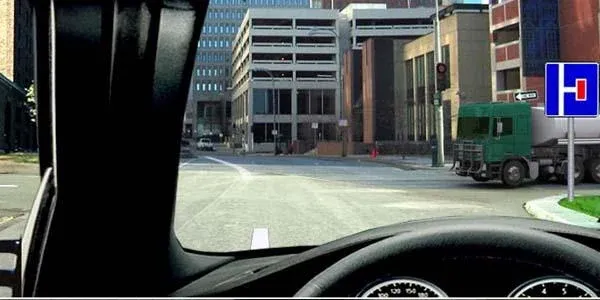
- He is obliged.
- He is not obliged.
Show answer
Correct: 1. He is obliged.
There are no priority signs at this intersection: the blue sign on the right is 6.8.1-6.8.3 “Dead end”, an information sign that only tells you the road has no through passage and establishes no priority at all. The roads are therefore of equal importance, and under the Rules the driver of a non-rail vehicle must give way to those approaching from his right. The truck is approaching from the right, so the driver of the bus continuing straight is obliged to give way to it. “He is not obliged.” reads the dead-end sign as though it made the truck’s road a lesser one, which it does not.
Question 728. You are continuing straight ahead; are you obliged to give way to the passenger car?
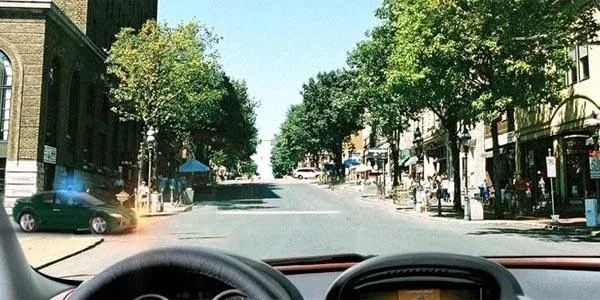
- You are obliged.
- You are not obliged.
Show answer
Correct: 2. You are not obliged.
At an intersection of roads of equal importance, point 98 of the Traffic Rules obliges a driver to give way only to vehicles approaching from his RIGHT. In the picture the light passenger car is on your left as it enters the intersection, so travelling straight ahead you have the advantage and are not obliged to give way - and by the same rule the car’s driver must yield to you.
Question 757. In cases where the paths of vehicles cross and the order of passing is not established by the rules, the driver who must give way is the one
- To whom a vehicle is approaching from the right
- To whom a vehicle is approaching from the left.
Show answer
Correct: 1. To whom a vehicle is approaching from the right
Point 45 of the Road Traffic Rules lays down the “right-hand” rule: where the paths of vehicles cross and the order of passing is not established by the Rules, way is given to the vehicle approaching from the right. The driver who must give way is therefore the one “To whom a vehicle is approaching from the right”, while the driver being approached from the left keeps priority. “To whom a vehicle is approaching from the left” states the rule the wrong way round.
Question 807. Which vehicle’s driver must give way?
- The bus driver
- The passenger car driver
Show answer
Correct: 1. The bus driver
The blue sign 6.3.1 “Place for turning” marks a place set aside for exactly that manoeuvre, so both the bus and the passenger car are entitled to turn round here; the only question is which of them goes first. Their paths cross, and no sign or signal fixes the order between them. Under point 45 of the Rules, where the paths of vehicles cross and the order of passage is not laid down by the Rules, the driver gives way to the vehicle approaching him from the right. The passenger car is on the bus’s right, so it is the bus driver who must give way, and “The passenger car driver” is wrong.
Question 1075. Who will cross the intersection first
- The truck driver
- The trolleybus driver
- The rules do not regulate this case. The drivers will pass showing mutual respect.
Show answer
Correct: 3. The rules do not regulate this case. The drivers will pass showing mutual respect.
There is no traffic light, no controller and no priority sign at this intersection, so under point 95 of the Rules it is an unregulated intersection of roads of equal importance, where point 98 obliges the driver of a non-rail vehicle to give way to those approaching from his right. Vehicles are approaching from every side - the truck from your right, the trolleybus head-on, the motorcycle from your left - and each of them likewise has another vehicle on its own right, so the order of passage closes into a circle that point 98 cannot resolve. The Rules therefore do not settle the order of passage in this case, and the drivers will pass showing mutual respect. “The truck driver” and “The trolleybus driver” are wrong because neither of them has an unconditional priority.