Bus Equipment
A bus carries dozens of people who rely on the driver and on its safety equipment. So a bus has its own extra items on the check, and a passenger’s way out in an emergency is one of them.
What must a bus carry?
Section titled “What must a bus carry?”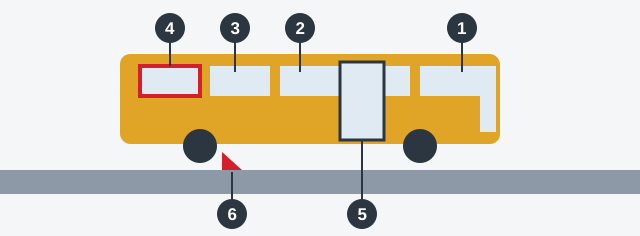
1: driver’s cab. 2: saloon. 3: stop-request signal. 4: emergency exit. 5: door and its control drive. 6: anti-roll chock.
| Item | How many |
|---|---|
| Fire extinguisher | At least 2: one in the driver’s cab, one in the saloon |
| Medical first-aid kit | Must be on board |
| “Emergency stop” sign | Must be on board |
| Anti-roll chocks, on a bus over 5 t | At least 2 |
Remember: Think in pairs. A bus with one fire extinguisher falls short, and one chock is also fewer than the two the Rules set. Two or more chocks is what they ask for, so that’s no fault.
What must work?
Section titled “What must work?”Walk through the saloon from the front door to the back. All of these must work:
- Emergency exits, and the devices that put them into operation.
- Emergency door openers.
- The door control drive.
- The stop-request signal.
- The interior lighting devices of the saloon.
If passengers can’t get out, an accident becomes much more dangerous. That’s why these appear on a list that ignores a hard-starting engine.
Common trap: An interior light that doesn’t work prohibits operating a bus, but not a passenger car.
Extra: A bus driver's minute before the doors open
Not from the question bank.
Check that nothing blocks the aisle or the exits, and that extinguishers still have their seals and pressure. Know how each emergency exit opens. In a real evacuation, passengers will look to you first, so a calm, clear voice helps as much as any equipment.
Try it yourself
Section titled “Try it yourself”A bus has tyres at 2.2 mm and no first-aid kit. Does this prohibit operation? Yes, because of the kit. The bus limit is 2.0 mm, so the tyres are fine.
A bus has white number plate lights, and the “Emergency stop” sign is missing. What’s the problem? Only the sign. White is the proper color for number plate lights.
Key points
Section titled “Key points”- Bus: at least two fire extinguishers, one in the cab and one in the saloon.
- First-aid kit and “Emergency stop” sign must be on board.
- Bus over 5 t: at least two anti-roll chocks.
- Emergency exits, door openers, door drive, stop-request signal and interior lights must all work.
- Minimum tread for a bus: 2.0 mm.
- Reversing lamps must be white, and front turn indicators must not be red.
Practice questions
Section titled “Practice questions”Question 966. Operation of vehicles is prohibited if:
- The engine is started with difficulty.
- The medical first-aid kit is missing in the bus.
- In both cases.
Show answer
Correct: 2. The medical first-aid kit is missing in the bus.
The correct answer is “The medical first-aid kit is missing in the bus.” The section of Annex N 2 to the Road Traffic Rules covering other faults and conditions requires a bus to carry a medical first-aid kit, a fire extinguisher and an emergency-stop sign, so a missing kit bars the bus on its own. “The engine is started with difficulty” is not a prohibiting condition: the engine section lists only a faulty exhaust-gas system, a loss of sealing in the crankcase ventilation or fuel system, and external noise above the permitted level. Hard starting is none of these, so the missing first-aid kit is the only ground here.
Question 968. Operation of vehicles is prohibited if:
- The “Emergency stop” sign is missing in the bus.
- Registration plate lighting lamps with white-coloured lights are installed at the rear.
- In both cases.
Show answer
Correct: 1. The “Emergency stop” sign is missing in the bus.
The correct answer is “The "Emergency stop" sign is missing in the bus.” The “Other” section of Annex N 2 to the Road Traffic Rules (the list of faults and conditions prohibiting operation) requires a bus to carry a medical first-aid kit, a fire extinguisher and an emergency-stop sign, so the absence of any of them bars the bus. “Registration plate lighting lamps with white-coloured lights are installed at the rear” is not a fault: registration-plate lighting is required to be white. The missing sign is therefore the only prohibiting condition.
Question 979. Operation of buses is prohibited if:
- The medical first-aid kit is missing.
- The residual height of the tyre tread pattern is 2.2 mm.
- In both cases.
Show answer
Correct: 1. The medical first-aid kit is missing.
The “Other” section of Appendix No. 2 to the Traffic Rules requires a bus to carry a medical first-aid kit, a fire extinguisher and an emergency stopping sign, so “The medical first-aid kit is missing.” prohibits the operation of the bus. A residual tread height of 2.2 mm is not a fault: the minimum for a bus is 2.0 mm, and 2.2 mm is above it. Only one of the two situations prohibits operation, so “In both cases.” is wrong.
Question 985. Operation of buses is prohibited if:
- The emergency door openers do not work.
- Turn indicators with red-coloured lights are installed at the front.
- In both cases.
Show answer
Correct: 3. In both cases.
Both situations prohibit operation. point 6 of Appendix No. 2 to the Traffic Rules names the emergency door openers of a bus among the devices that must work, so their failure prohibits operation - the passengers could not get out. Turn indicators showing red light at the front are prohibited by sub-point “a” of point 3, under which only white, yellow or orange lights are permitted at the front. Each condition prohibits operation in itself, so “In both cases.” is the correct answer.
Question 986. Operation of buses is prohibited if:
- The stop-request signal does not work.
- Turn indicators with red-coloured lights are installed at the rear.
- In both cases.
Show answer
Correct: 1. The stop-request signal does not work.
point 6 of Appendix N 2 requires a bus’s stop-request signal to work, so a fault in it prohibits operation — the answer given. Red turn indicators at the rear are permitted: point 3, sub-point “b” prohibits other light devices at the rear in any colour other than red, yellow or orange, and red is itself among the permitted ones. “In both cases” is therefore wrong — red at the rear is not a violation.
Question 988. Operation of buses is prohibited if:
- The residual height of the tyre tread pattern is 2.5 mm.
- The interior lighting devices of the cabin do not work.
- In both cases.
Show answer
Correct: 2. The interior lighting devices of the cabin do not work.
point 6 of Appendix No. 2 to the Traffic Rules counts the interior lighting devices of a bus cabin among the compulsory equipment that must work, so “The interior lighting devices of the cabin do not work.” prohibits the operation of the bus. A residual tread height of 2.5 mm is not a fault: point 4 sets the minimum for a bus at 2.0 mm, and 2.5 mm is above it. Only one of the two situations prohibits operation, so “In both cases.” is wrong.
Question 989. Operation of buses is prohibited if:
- The emergency exits and the devices that put them into operation do not work.
- The stop-request signal does not work.
- In both cases.
Show answer
Correct: 3. In both cases.
point 6 of Appendix No. 2 to the Traffic Rules names both the emergency exits and the stop-request signal among the equipment of a bus that must work. Emergency exits, or the devices that put them into operation, that do not work are a ground for prohibiting operation on their own - passengers could not get out in an accident. A stop-request signal that does not work is an independent ground under the same item. Each situation prohibits operation by itself, so “In both cases.” is the correct answer.
Question 990. Operation of buses is prohibited if:
- The door control drive does not work.
- The first-aid kit is missing.
- In both cases.
Show answer
Correct: 3. In both cases.
point 6 of Appendix No. 2 to the Traffic Rules counts the door control drive among the equipment of a bus that must work, so a drive that does not work prohibits operation. The compulsory-equipment requirement in the same item makes a medical first-aid kit obligatory in a bus, so its absence is an independent ground. Each situation breaches point 6 on its own, so “In both cases.” is the correct answer.
Question 991. Operation of buses with a permissible maximum mass of more than 5 tonnes is prohibited if:
- The anti-roll chocks are missing.
- Red reversing lamps are fitted at the rear.
- In both cases.
Show answer
Correct: 3. In both cases.
point 6 of Appendix No. 2 to the Traffic Rules, “Compulsory equipment”, requires not fewer than two anti-roll chocks on a bus with a permissible maximum mass over 5 t, so their absence prohibits the operation of such a bus. Red reversing lamps at the rear are prohibited by sub-point “b” of point 3: reversing lamps are permitted in white only, because their whole purpose is to show that the vehicle is coming backwards rather than braking. Each situation prohibits operation by itself, so “In both cases.” is the correct answer.
Question 992. Operation of buses is prohibited if:
- There is one fire extinguisher.
- The “Emergency stop” sign is missing.
- In both cases.
Show answer
Correct: 3. In both cases.
point 6 of Appendix No. 2 to the Traffic Rules requires a bus to carry at least two fire extinguishers - one in the driver’s cab and one in the saloon - so having only one falls short of that requirement and prohibits operation. The compulsory-equipment list in the same item also makes the “Emergency stop” sign obligatory in a bus, so its absence is an independent ground. Each situation breaches point 6 on its own, so “In both cases.” is the correct answer.
Question 993. Operation of buses is prohibited if:
- There is one anti-roll chock.
- There is one fire extinguisher.
- In both cases.
Show answer
Correct: 3. In both cases.
point 6 of Appendix No. 2 to the Traffic Rules, “Compulsory equipment”, requires not fewer than two anti-roll chocks on a bus with a permissible maximum mass over 5 t, so carrying only one falls short and prohibits operation. The same item requires at least two fire extinguishers in a bus - one in the driver’s cab, one in the saloon - so carrying only one is likewise short of the requirement. Each situation breaches point 6 on its own, so “In both cases.” is the correct answer.