Turning
A good turn starts well before the corner, in the right lane and at the right edge. This lesson covers where to position your car, what path to take, who to let through and which signs really stop you.
Which lane do I turn from?
Section titled “Which lane do I turn from?”Point 40 says: move into the edge lane for your direction in advance. Turning right, use the right edge lane. Turning left or making a U-turn, use the left edge lane.
Waiting until the last moment means cutting across other lanes. So even a green arrow doesn’t save you if you are in the wrong lane.
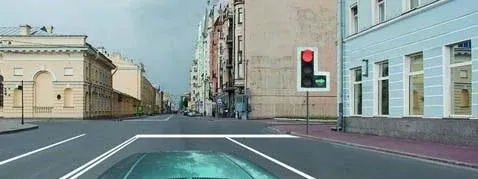
The right lane is free, and you are in the left one. You may not turn right from here, despite the green arrow.
The same rule applies on a one-way section, where the left lane also belongs to your direction. Move across first, then turn left.
Exception: a sign or marking can allow the turn from other lanes too. Where sign 5.15.2 “Directions of travel by lane” or the arrows on the road permit a right turn from your lane, you may stay there. You may also move to the right lane. Both are correct.
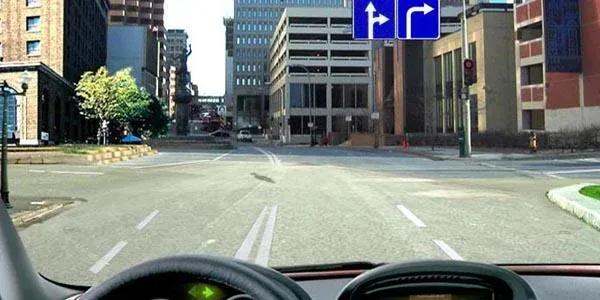
Both lanes may turn right here, so you may turn from either.
Three special lanes also affect turns:
- Deceleration lane: if there is one, move into it first, then slow down, and turn from it (point 47). This way you don’t hold up traffic in the main lane.
- Lane for route vehicles with a broken line: if it runs along the right edge and is marked with a broken line, you must move into it to turn right (point 124).
- Tram tracks on your left, at road level: normally you turn left from the tracks without obstructing a tram (point 40). If sign 5.15.1 or 5.15.2 stands before the intersection, you turn from a lane instead.
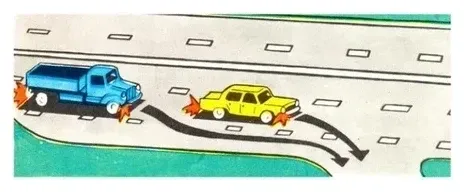
The blue truck does it correctly. The yellow car breaks the rule by turning from the main lane.
What path do I take?
Section titled “What path do I take?”Point 41 sets one rule for all turns: when you leave the intersection of carriageways, you must not end up on the side of oncoming traffic. Right turns have a second rule: stay as close as possible to the right edge.
Turning right: hug the kerb. A wide swing is prohibited.
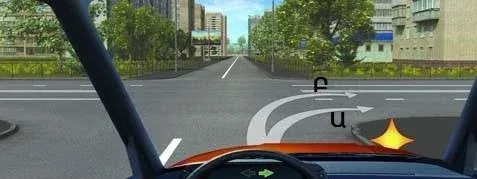
Ա (A) follows the right edge and is permitted. Բ (B) swings wide and isn’t.
Turning left: the Rules don’t set a path inside the intersection. Only the finish matters. Any path that brings you out on your own side of the crossing road is allowed, into any of its lanes.
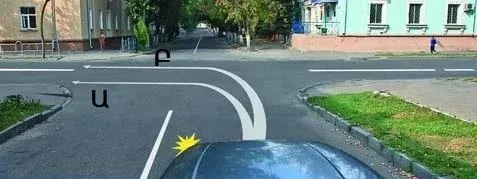
Ա (A) cuts the corner and ends in the oncoming half. Բ (B) ends in your own half, so only Բ (B) is permitted.
Remember: Right turn: the path matters, so stay close to the edge. Left turn: the exit matters, so don’t finish on the oncoming side.
Turning into a one-way road: there is no oncoming side, so any left-turn path that ends correctly is fine.
Crossing a road with a dividing strip: it has two carriageways. A right turn goes into the nearer carriageway. A path that crosses the strip brings you out on the carriageway for oncoming traffic, which is prohibited.
Who do I let through?
Section titled “Who do I let through?”When you turn at an intersection, you can meet three groups.
| Who | When | Point |
|---|---|---|
| Pedestrians crossing the road you are entering, and cyclists on a cycle path | Every turn, right or left | 87 |
| Oncoming vehicles going straight or turning right | Turning left on green | 90 |
| Trams, whatever direction they are going | When the signal lets trams and other vehicles move together | 92 |
Going straight on, you meet none of these turning duties.
On green, don’t wait at the stop line. Enter the intersection, give way there, then finish your turn.
Common trap: Oncoming right-turners count too. An option limiting the duty to oncoming traffic going straight is wrong.
Where a traffic light is working, the priority signs at the intersection don’t decide the order. The manoeuvre does, so a bus turning left waits for oncoming traffic.
Outside an intersection, a left turn or U-turn means you give way to oncoming vehicles and to trams travelling in the same direction (point 44).
Extra: Keep your wheels straight while you wait
Not from the question bank.
While you wait to turn left, keep the front wheels pointing straight ahead until you can go. If a car hits you from behind, straight wheels push you forward along your own side. Wheels already turned could push you into oncoming traffic.
Which signs stop a left turn?
Section titled “Which signs stop a left turn?”Only some do. Warning signs warn, and information signs inform.
| Sign | Left turn? |
|---|---|
| 1.11.1 “Dangerous turn” and similar warning signs | Allowed: they only warn |
| 6.8.1 “Dead end” | Allowed: the road just has no through passage |
| 3.19 “No U-turn” | Allowed: it bans only the U-turn |
| 6.3.1 “Place for turning” | Prohibited |
| 5.7.1 “Exit to a road with one-way traffic”, arrow pointing right | Prohibited: you would drive against the flow |
Sign 5.13.1 “Exit to a road with a lane for public-use transport vehicles” needs a closer look. The plain arrow shows the general traffic, and the arrow with the bus shows the bus lane.
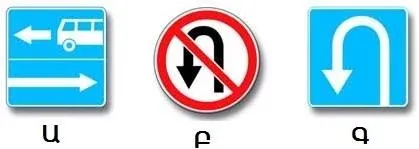
In the first sign the plain arrow points right, so general traffic flows right and a left turn into this road is prohibited. Place for turning (right) also prohibits a left turn. No U-turn (middle) doesn’t.
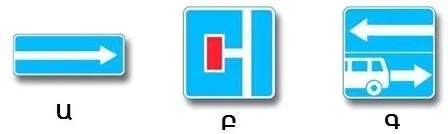
Here the third sign’s plain arrow points left, so a left turn is allowed. Dead end (middle) allows it too. The first sign, with its arrow to the right, doesn’t.
Try it yourself
Section titled “Try it yourself”You are turning left on green. A car is coming towards you, and pedestrians are crossing the road on your left.
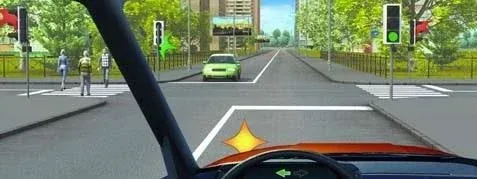
Who do you give way to? Both. Point 90 covers the car, and point 87 covers the pedestrians.
You face this sign, and four paths are drawn.
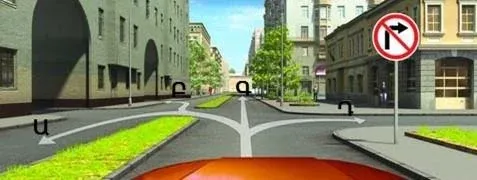
Which are allowed? Ա (A) or Գ (C). The sign rules out Դ (D), and Բ (B) ends on the oncoming carriageway of the divided road.
Sign 4.1.2 “Movement to the right” stands here, and the crossing road has a dividing strip.
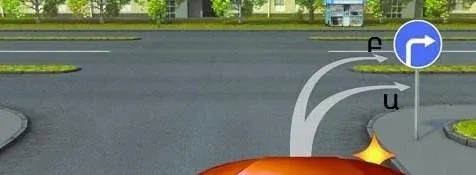
Which path? Only Ա (A). It enters the nearer carriageway close to the right edge. Բ (B) crosses to the far carriageway, which is for oncoming traffic.
Key points
Section titled “Key points”- Move to the correct edge lane in advance, unless a sign or marking allows other lanes.
- Enter a deceleration lane first, then slow down.
- Right turn: stay close to the right edge. Left turn: don’t finish on the oncoming side.
- Turning left on green: enter, then give way to oncoming vehicles going straight or right, and to trams.
- Every turn: give way to pedestrians crossing and cyclists on a cycle path.
- Warning and information signs don’t ban turns. Sign 6.3.1 and a one-way arrow pointing right do stop a left turn.
Practice questions
Section titled “Practice questions”Question 73. How must the driver act if he intends to make a right turn at the intersection?
- He may change lanes into the right lane and then make the right turn.
- He may approach the intersection and then make the right turn.
- Both answers are correct.
Show answer
Correct: 3. Both answers are correct.
The panels above the lanes are signs 5.15.2 “Directions of travel by lane”: from the right lane only a right turn is permitted, and from the left lane both straight ahead and a right turn. Under point 40 of the Traffic Rules a driver must take the appropriate edge lane in advance of a turn, so he may change into the right lane and then turn right. But the same item allows a turn from other lanes where a road sign permits it, and here sign 5.15.2 permits the right turn from the left lane too, so he may equally approach the intersection without changing lanes and turn right from where he is. Both answers are therefore correct.
Question 95. Is the driver permitted to make a left turn
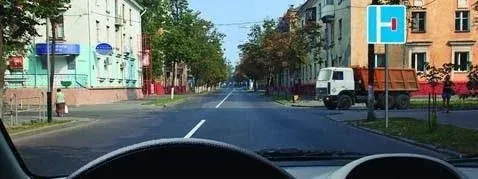
- Yes
- No
Show answer
Correct: 1. Yes
The blue square sign is the “Dead end” information sign, signs 6.8.1 to 6.8.3 of the road-signs annex, which does no more than tell the driver that the road on the right, where the lorry is standing, has no through passage. Information signs report where objects are and how traffic is arranged; they prohibit no manoeuvre. There is no prohibitory or mandatory sign here and the centre line is broken, so the left turn is permitted. “No” is wrong because the “Dead end” sign forbids no turns at all.
Question 98. Is a right turn onto the dirt-surfaced road permitted?
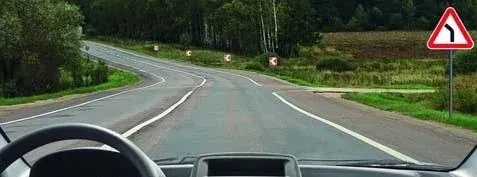
- Yes
- No
Show answer
Correct: 1. Yes
The signs present are warning signs of the bend group - 1.11.1 and 1.11.2 “Dangerous turn” and the chevrons showing the direction of the bend - which under the Rules only warn of a curve of small radius or limited visibility and impose no ban on any manoeuvre. There is no prohibitory sign such as 3.18.1 “No right turn”, and no solid line 1.1 that would prevent turning off onto the adjoining dirt road, so the right turn is permitted. “No” is wrong because warning signs do not prohibit a right turn - they only warn about the geometry of the road.
Question 243. The red car will pass the intersection:
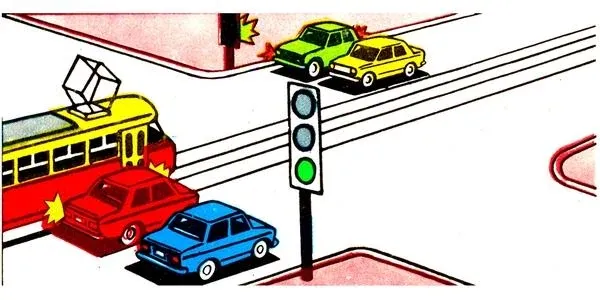
- First.
- Second.
- Third.
- Last.
Show answer
Correct: 4. Last.
The traffic light is showing green, so movement is permitted, and the red car’s lit indicator shows a left turn. Under the Rules a non-rail driver turning left must give way to vehicles coming from the opposite direction travelling straight ahead or turning right, and where the traffic light’s signal permits a tram and non-rail vehicles to move at the same time the tram has the advantage as well. The red car must therefore go after the tram and after the other cars - that is, last. “First.”, “Second.” and “Third.” are wrong because in this situation the left turn is the very last turn in the order.
Question 252. Which vehicle must give way?
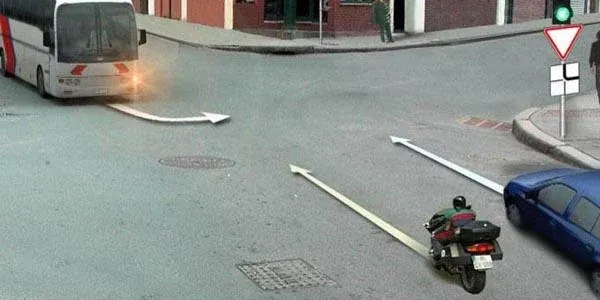
- The bus.
- The motorcycle and the passenger car.
Show answer
Correct: 1. The bus.
The intersection is a regulated one - the traffic light is showing green - so the priority signs visible in the picture, sign 2.4 “Give way” with plate 8.13, do not operate here, and the order is decided by the manoeuvre. The bus’s lit indicator shows a left turn, while the motorcycle and the passenger car are coming from the opposite direction travelling straight ahead. Under the Rules a driver turning left must give way to vehicles coming from the opposite direction going straight or turning right, so it is the bus that must give way. “The motorcycle and the passenger car.” is wrong because neither of them is making a manoeuvre that costs it its priority.
Question 261. How should you act in this situation?
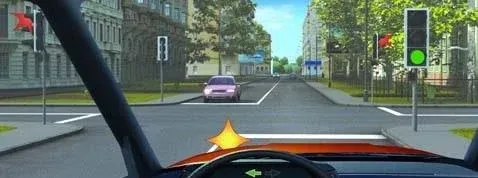
- Enter the intersection and, giving way to the passenger car driver, pass the intersection.
- Wait before the “Stop line” until the passenger car driver passes the intersection
- Pass first
Show answer
Correct: 1. Enter the intersection and, giving way to the passenger car driver, pass the intersection.
You are turning left on the green signal. Under point 90 of the Rules, a driver of a non-rail vehicle turning left on green must give way to vehicles coming from the opposite direction that are travelling straight ahead or turning right. You therefore enter the intersection and complete the turn after giving way to the oncoming passenger car. “Wait before the ‘Stop line’ until the passenger car driver passes the intersection” is wrong because on green you enter the intersection rather than waiting at the stop line - you yield from inside it - and “Pass first” is wrong because the oncoming car must be let through.
Question 272. When making a left turn you must give way to
- Only the passenger car’s driver
- Only the pedestrians
- The passenger car’s driver and the pedestrians
Show answer
Correct: 3. The passenger car’s driver and the pedestrians
Turning left on the green signal, point 90 of the Rules requires you to give way to vehicles coming from the opposite direction that are travelling straight ahead or turning right - that is the oncoming passenger car. On top of that, point 87 requires a driver leaving an intersection on a turn to give way to the pedestrians crossing the carriageway. You must therefore give way to both the passenger car’s driver and the pedestrians. “Only the passenger car’s driver” and “Only the pedestrians” are wrong because points 90 and 87 both bite here, one after the other.
Question 278. You intend to make a left turn. To whom are you obliged to give way
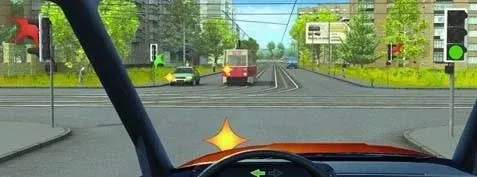
- Only to the tram driver
- To no one
- To the car’s and the tram’s drivers
Show answer
Correct: 3. To the car’s and the tram’s drivers
Turning left on the green signal, point 90 of the Rules requires you to give way to vehicles coming from the opposite direction and travelling straight ahead or turning right - in the picture that is the oncoming light passenger car. In addition, under point 92, where a tram and non-rail vehicles are permitted to move at the same time the tram has priority whatever direction it is going in. You must therefore give way both to the car’s driver and to the tram’s. “Only to the tram driver” is wrong because the oncoming car has priority too under point 90, and “To no one” is wrong because you are obliged to yield to both.
Question 280. Are we obliged in this situation to give way to the truck driver
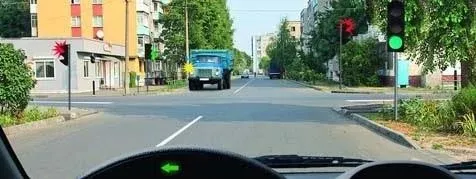
- Yes
- No
Show answer
Correct: 1. Yes
You are turning left on the green signal. Under point 90 of the Rules a non-rail vehicle turning left on green must give way to vehicles coming from the opposite direction that are travelling straight ahead OR turning right. The oncoming truck has its right indicator on and is turning right, which is expressly one of the cases point 90 covers, so you are obliged to give way. “No” is wrong: point 90 is not limited to oncoming traffic going straight, and a right-turning truck is covered by it just the same.
Question 282. In which case may you cross the intersection without giving way to another road user
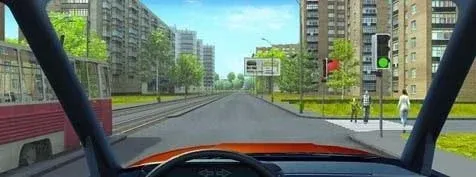
- When going straight
- When making a right turn
- When making a left turn
Show answer
Correct: 1. When going straight
When turning right or left, point 87 of the Rules requires the driver to give way to the pedestrians crossing the carriageway and to cyclists on the cycle path, and when turning left point 90 adds the oncoming vehicles going straight ahead or turning right. Going straight ahead involves no turning manoeuvre, so none of those duties arises and you cross without giving way to those road users. “When making a right turn” and “When making a left turn” are wrong because a turn always brings point 87 - and, to the left, point 90 - into play.
Question 680. In the given case, from which lane must the right turn be made?
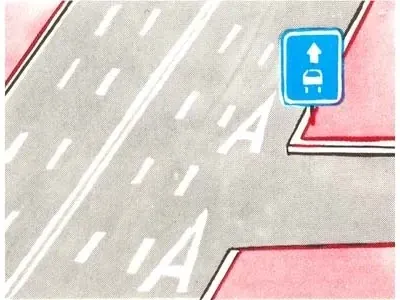
- Only from the second lane.
- Only from the right edge lane marked with marking “A”.
Show answer
Correct: 2. Only from the right edge lane marked with marking “A”.
The right edge lane is marked with the letter A and separated from the lane beside it by a broken line: it is a lane for route transport vehicles, marked by sign 5.14 and the corresponding marking. Under point 40 of the Traffic Rules a driver must take the appropriate edge lane in advance of a turn, and under point 124, where the route-vehicle lane is separated from the rest of the carriageway by a BROKEN marking, drivers making a turn are obliged to move across into that lane. The right turn is therefore made only from the right edge lane marked with marking “A”, and not from the second lane.
Question 696. Which vehicle’s driver is breaking the rules when turning on a road having a deceleration lane?
- Both drivers.
- The yellow car’s driver.
- Both drivers are performing the turn correctly.
Show answer
Correct: 2. The yellow car’s driver.
Under point 47 of the Traffic Rules a driver intending to enter a deceleration lane must move across into it IN ADVANCE and only then reduce speed - so that he does not slow the traffic behind him. In the picture the blue truck does exactly that: it has moved into the deceleration lane and is turning from there. The yellow car’s driver begins his right turn straight from the main traffic lane, bypassing the deceleration lane. Taking point 40 into account as well, which requires the appropriate edge lane to be occupied in advance of a turn, it is the yellow car’s driver who is breaking the rules.
Question 751. When making a right turn into the road adjoining on the right it is necessary to
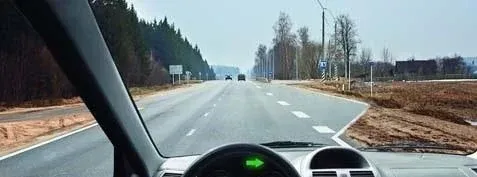
- Continue driving in this lane and make the turn only from that lane
- Change lanes into the deceleration lane and make the turn only from that lane
- Both options are correct.
Show answer
Correct: 2. Change lanes into the deceleration lane and make the turn only from that lane
Under point 47 of the Traffic Rules a driver intending to enter a deceleration lane must move across into it IN ADVANCE and only then reduce speed. In the picture a separate deceleration lane is clearly visible on the right, divided from the main carriageway by a broken line, so the right turn must be made from that lane - without slowing down in the main lane, where braking would hold up the traffic behind. The correct answer is therefore to change lanes into the deceleration lane and make the turn only from it.
Question 761. Is the driver obliged to change lanes into the right lane and only then make the right turn in this situation
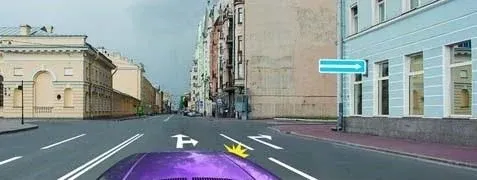
- Yes
- No
Show answer
Correct: 2. No
Under point 40 of the Traffic Rules a driver must take the appropriate edge lane in advance of a turn, EXCEPT where a road sign or marking permits the manoeuvre from other lanes as well. In the picture the arrow marking on the lanes permits a right turn both from the right lane and from the left lane the driver occupies, and sign 5.7.1 “Exit to a road with one-way traffic” shows that the crossing road is one-way. The driver is therefore not obliged to change into the right lane in advance and may make the right turn from his own lane.
Question 769. Is the driver permitted to make a right turn in this situation
- Yes
- No
Show answer
Correct: 2. No
Under point 40 of the Traffic Rules a driver must take, in advance, the appropriate edge lane of the carriageway intended for travel in that direction, and under point 41, when turning right the vehicle must move as close as possible to the right-hand edge of the carriageway. In the picture the car is standing in the left lane while there is a free right lane beside it, so a right turn from this position is prohibited. “Yes” is wrong because a green arrow lit in an additional section does not remove the point 40 requirement to have taken the right edge lane beforehand.
Question 787. How must you act when making a left turn or a U-turn outside an intersection
- You must give way to oncoming vehicles
- You must give way to oncoming vehicles and to trams travelling in the same direction
Show answer
Correct: 2. You must give way to oncoming vehicles and to trams travelling in the same direction
Making a left turn or a U-turn outside an intersection takes the vehicle across the oncoming lane, and it may also take it across the track of a tram running in the same direction. Point 44 of the Road Traffic Rules therefore requires the driver of a non-rail vehicle to give way both to the oncoming vehicles and to the tram travelling in the same direction. The answer is “You must give way to oncoming vehicles and to trams travelling in the same direction”; “You must give way to oncoming vehicles” is only half the requirement and leaves the tram out.
Question 799. The right turn along the indicated trajectory
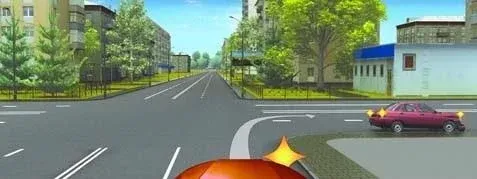
- Is permitted
- Is prohibited
Show answer
Correct: 1. Is permitted
The manoeuvre is permitted. Under point 41 of the Traffic Rules a vehicle making a right turn must travel as close as possible to the right-hand edge of the carriageway, and point 40 requires the appropriate edge lane to be taken in advance of the turn. The trajectory shown in the picture takes the car tight to the kerb at the corner and into the side road by its right-hand half, which is precisely what those requirements demand, so “Is prohibited” is wrong.
Question 1017. Along which trajectory is the right turn permitted
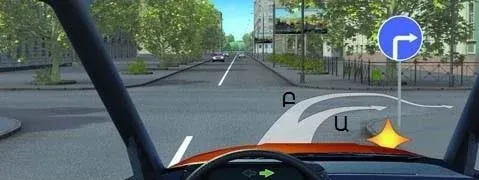
- Only Ա (A)
- Only Բ (B)
- Along both trajectories
Show answer
Correct: 1. Only Ա (A)
Before this intersection of carriageways stands sign 4.1.2 “Movement to the right”, and under point 41 of the Traffic Rules a turn must be made so that, on leaving the intersection of carriageways, the vehicle does not end up on the side of oncoming traffic - and when turning right it must travel as close as possible to the right-hand edge of the carriageway. Trajectory Ա (A) runs right against that edge and satisfies the requirement. Trajectory Բ (B) swings out in a wide arc away from the right edge, into the depth of the intersection, which contradicts point 41 - and for the same reason “Along both trajectories” is wrong.
Question 1019. Along which trajectory is the left turn permitted
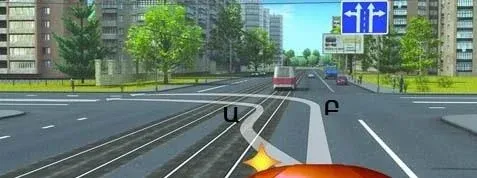
- Only Ա (A)
- Only Բ (B)
- Any
Show answer
Correct: 2. Only Բ (B)
On the left, at the same level, tram tracks of the same direction run alongside, but sign 5.15.1 “Directions of movement by lanes” is installed before the intersection, which reserves the left turn for the left edge lane of the carriageway. point 40 of the Traffic Rules makes turning from the tram tracks compulsory only where signs 5.15.1, 5.15.2 or marking 1.18 provide no other arrangement, and point 59 directly prohibits driving along the tram tracks in an intersection where sign 5.15.1 or 5.15.2 is installed before it. Only trajectory Բ (B) is therefore permitted — from a lane of the carriageway — while trajectory Ա (A) is made from the tram tracks, so the “any” option is wrong as well.
Question 1020. Along which trajectory is the right turn permitted
- Only Ա (A)
- Only Բ (B)
- Any
Show answer
Correct: 1. Only Ա (A)
Under point 41 of the Traffic Rules, a vehicle turning right must move as close as possible to the right edge of the carriageway. In the picture only trajectory Ա (A) meets that requirement, running in the right lane alongside the kerb; trajectory Բ (B) swings out in a wide arc into the far lane and is therefore not permitted, and for the same reason the “any” option is wrong too.
Question 1022. A left turn is permitted
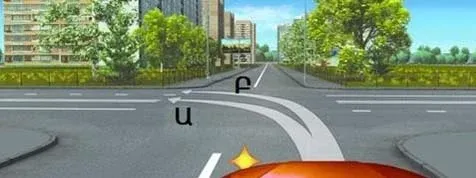
- Only along trajectory Ա (A)
- Only along trajectory Բ (B)
- Along any trajectory
Show answer
Correct: 3. Along any trajectory
Under point 41 of the Traffic Rules a left turn is made so that, on leaving the intersection of carriageways, the vehicle does not end up on the side of oncoming traffic - but no particular trajectory INSIDE the intersection is prescribed, unlike a right turn, which must keep close to the right-hand edge. In the picture both trajectory Ա (A) and trajectory Բ (B) bring the car out into a lane of its own direction, so the left turn is permitted along any trajectory.
Question 1023. Along which trajectory does the driver have the right to make a left turn in this situation
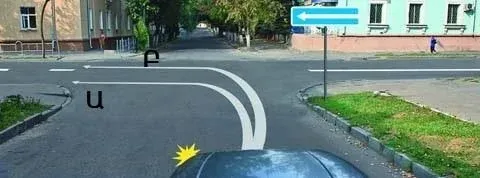
- Only Ա (A)
- Only Բ (B)
- Any
Show answer
Correct: 3. Any
Under point 41 of the Traffic Rules a turn must be made so that, on leaving the intersection of carriageways, the vehicle does not end up on the side of oncoming traffic; signs and markings fix only the position on entering and leaving an intersection, while the path taken inside it is not regulated. In the picture the road to the left carries one-way traffic - the blue sign with the single arrow - so there is no oncoming flow to end up in front of, and both trajectory Ա (A) and trajectory Բ (B) bring the car out in a correct position. The driver therefore has the right to make the left turn along any trajectory.
Question 1024. Along which trajectories is travel permitted
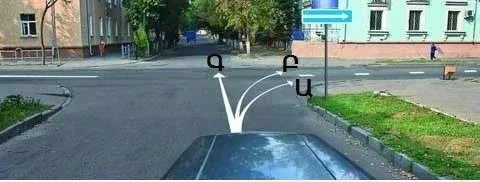
- All
- Only Ա (A)
- Only Ա (A) or Գ (C)
Show answer
Correct: 3. Only Ա (A) or Գ (C)
Under point 41 of the Traffic Rules, when turning right a vehicle must travel as close as possible to the right-hand edge of the carriageway. Trajectory Ա (A) does exactly that, running in the lane against the kerb, and Գ (C) is simply travelling straight ahead, which nothing here restricts - the blue sign with the right arrow only shows that the crossing road is one-way to the right. Trajectory Բ (B) swings out in a wide arc and finishes in the far lane rather than close to the right edge, so it is not permitted. “All” is therefore wrong, and “Only Ա (A)” is incomplete, because travelling straight ahead is permitted too.
Question 1025. A left turn is permitted
- Only along trajectory Ա (A)
- Only along trajectory Բ (B)
- Along both trajectories
Show answer
Correct: 2. Only along trajectory Բ (B)
Under point 41 of the Traffic Rules a turn must be carried out so that, on leaving the intersection of carriageways, the vehicle does not end up on the side of oncoming traffic. Trajectory Բ (B) takes the car through the intersection and brings it out beyond the broken centre line of the crossing street, into the half intended for its new direction. Trajectory Ա (A) cuts the corner and leaves the car in the nearer half - that is, on the side of oncoming traffic - so neither trajectory Ա (A) nor “Along both trajectories” is correct.
Question 1028. Along which trajectory is a left turn permitted
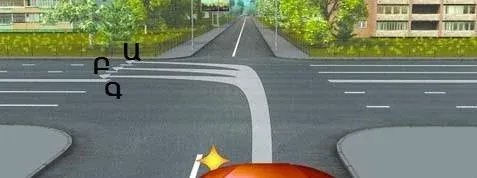
- Only Ա (A)
- Only Գ (C)
- Any
Show answer
Correct: 3. Any
Per point 41 of the Traffic Rules a turn must be performed so that, when leaving the intersection of carriageways, the vehicle does not end up on the side of oncoming traffic; the Rules do not prescribe any particular path inside the intersection. All three trajectories Ա (A), Բ (B) and Գ (C) bring the car out above the solid centre line of the cross road, into the lanes intended for the new direction of travel, and no sign or marking at this intersection dictates a specific lane. That is why the turn may be made along any of them, and the options naming only Ա (A) or only Գ (C) are incomplete.
Question 1043. Which of the signs prohibits making a left turn
- Only Ա (A)
- Only Ա (A) and Բ (B)
- Only Ա (A) and Գ (C)
- All
Show answer
Correct: 3. Only Ա (A) and Գ (C)
Sign Ա (A) is 5.13.1 “Exit to a road with a lane for public-use transport vehicles”: the general traffic there is one-way, in the direction of the lower arrow - to the right - so turning left into that road would mean driving against the one-way flow, and the left turn is prohibited. Sign Բ (B) is 3.19 “No U-turn”, which prohibits only the U-turn and not the left turn, so it does not bar a left turn at all. Sign Գ (C) is 6.3.1 “Place for turning”, of which the Rules say expressly that the left turn is prohibited. The left turn is therefore prohibited by Ա (A) and Գ (C) only. “Only Ա (A)” leaves out Գ (C), “Only Ա (A) and Բ (B)” wrongly includes Բ (B), and “All” is wrong for the same reason.
Question 1057. Along which path may you continue driving?
- Only Ա (A)
- Only Բ (B)
- Along both indicated paths
Show answer
Correct: 1. Only Ա (A)
The sign is the mandatory 4.1.2 “Movement to the right”, which permits travel only in the direction its arrow shows, and both trajectories in the picture are right turns. But the crossing road has a dividing strip and therefore two carriageways, and under point 41 of the Rules a turn must be made so that, on leaving the intersection of carriageways, the vehicle does not end up on the side of oncoming traffic - and when turning right it must travel as close as possible to the right-hand edge. Trajectory Ա (A) enters the nearer carriageway close to its right edge, so only Ա (A) is correct. “Only Բ (B)” and “Along both indicated paths” are wrong because trajectory Բ (B) crosses beyond the dividing strip and comes out on the carriageway intended for oncoming traffic.
Question 1066. Which of the indicated directions is permitted?
- Only Գ (C)
- Ա (A) or Գ (C)
- All except Դ (D)
Show answer
Correct: 2. Ա (A) or Գ (C)
The sign on the right is 3.18.1 “Right turn prohibited”, which rules out trajectory Դ (D). The road ahead is divided by a dividing strip, and trajectory Բ (B) ends on the oncoming (left-hand) carriageway of that divided road: under point 41 of the Rules a turn must be made so that on leaving the intersection of carriageways the vehicle does not end up on the side of oncoming traffic, so Բ (B) is prohibited too. Trajectory Ա (A), a left turn into the crossing street, and trajectory Գ (C), straight on along the right-hand carriageway of the divided road, both end on the correct side and are forbidden by no sign - so the answer is “Ա (A) or Գ (C)”. “Only Գ (C)” is wrong because Ա (A) is a permitted left turn, and “All except Դ (D)” is wrong because it would include Բ (B), which point 41 also forbids.
Question 1070. With which of the signs may you make a left turn?
- Only Բ (B)
- Ա (A) and Բ (B)
- Բ (B) and Գ (C)
Show answer
Correct: 3. Բ (B) and Գ (C)
Sign Ա (A) is 5.7.1 “Exit to a road with one-way traffic” with its arrow pointing to the right: the one-way flow runs to the right, so turning left into that road would mean driving against the one-way traffic - a left turn is not permitted there. Sign Բ (B) is 6.8.1-6.8.3 “Dead end”, a purely informational sign: the road has no through passage, but entry to it is not prohibited, so a left turn into it is permitted. Sign Գ (C) is 5.13.1 “Exit to a road with a lane for public-use transport vehicles”, likewise an informational exit sign that does not forbid turning left into that road. A left turn may therefore be made with Բ (B) and Գ (C); “Only Բ (B)” leaves out Գ (C), and “Ա (A) and Բ (B)” wrongly includes Ա (A), where the left turn would run against the one-way flow, while still leaving out Գ (C).
Question 1101. In the given situation, the right to travel along the indicated trajectories is held by:
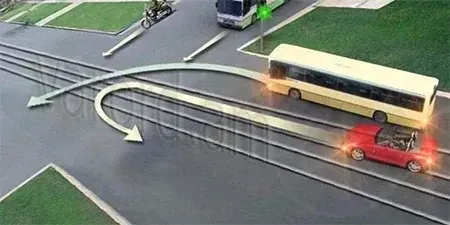
- The drivers of the yellow bus and the passenger car.
- The driver of the passenger car.
- The driver of the yellow bus.
Show answer
Correct: 2. The driver of the passenger car.
Point 40 of the Traffic Rules requires a driver to move in advance into the edge lane before a turn or a U-turn. The passenger car is in the left-hand lane, so its U-turn is correct. The yellow bus is in the right-hand lane, so it may not turn left from there. Only the driver of the passenger car has the right to follow the indicated trajectory.
Question 1103. Along which trajectory is the left turn permitted
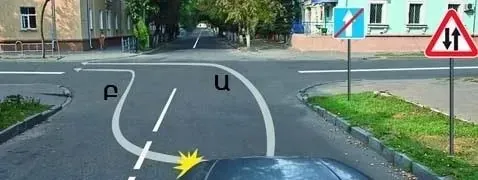
- Any
- Only Բ (B)
- Only Ա (A)
Show answer
Correct: 2. Only Բ (B)
On the right stand signs 5.6 “End of one-way road” and 1.21 “Two-way traffic”: they show that the section you are driving on is still a one-way road and that oncoming traffic begins further ahead. The broken marking on the carriageway therefore divides lanes, and the left-hand lane belongs to your direction as well. Under point 40 of the Rules, before turning the driver must take in advance the appropriate outermost lane of the carriageway intended for travel in that direction — for a left turn, the left-hand outermost lane — and it is trajectory Բ (B) that moves into the left lane and only then turns. So “Only Բ (B)” is correct. “Only Ա (A)” is wrong, because trajectory Ա (A) makes the left turn from the right-hand lane without first taking the left-hand outermost lane, and “Any” is wrong for that same reason.