Pedestrians and Crossings
A person on foot has no protection if you misjudge a crossing, so the Rules make you wait. The exam tests three moments: you are turning, the light has just changed, or another vehicle has stopped at a crossing.
Who do I give way to when I turn?
Section titled “Who do I give way to when I turn?”When you turn right or left and leave an intersection, point 87 makes you give way to pedestrians crossing the carriageway and to cyclists on the cycle path. It applies to every turning driver, in both directions.
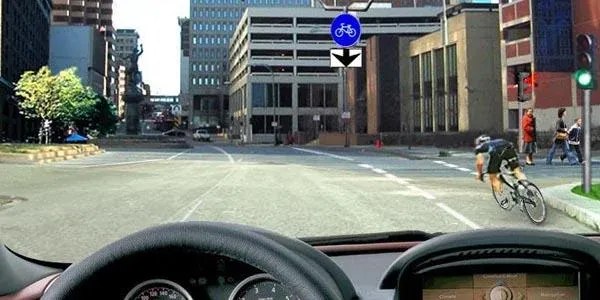
Turning right here, you give way to the pedestrians and the cyclist, not to just one of them.
Common trap: “Stop before the stop line to keep clear of pedestrians” is wrong on a green. The green lets you enter, so go in and stop there if you need to, so you don’t obstruct them.
The light has turned green. Can I go at once?
Section titled “The light has turned green. Can I go at once?”Not until you have checked. Point 94 makes you give way to pedestrians who have not finished crossing.
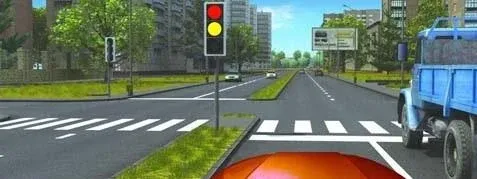
The truck hides part of the crossing. When the green comes on, make sure nobody is still crossing there.
What if another vehicle stops before a crossing?
Section titled “What if another vehicle stops before a crossing?”At an unregulated pedestrian crossing, marked by signs 5.19.1 and 5.19.2 and zebra markings, you must give way to pedestrians crossing (point 103). If a vehicle in an adjacent lane slows down or stops before the crossing, it hides the crossing from you. Slow down, stop if necessary, and continue only after making sure there are no pedestrians in front of it (point 104).
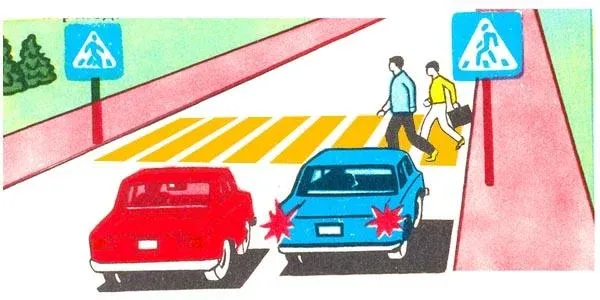
The blue car has stopped and pedestrians are crossing, so the red car must not continue.
Common trap: You don’t wait for the bus to move off. The condition is that no pedestrians are on the crossing, not what the bus does next.
What about children getting on or off a vehicle?
Section titled “What about children getting on or off a vehicle?”Reduce speed when you approach a vehicle with a “Transport of children” sign while children are boarding or alighting (point 156).
Try it yourself
Section titled “Try it yourself”You are driving the yellow car. The bus has stopped and two pedestrians are on the crossing.
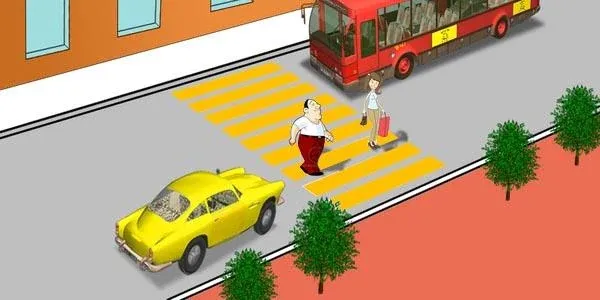
Who must stop? You. The bus has already stopped, so the duty now falls on the approaching car.
Key points
Section titled “Key points”- Turning right or left: give way to pedestrians and to cyclists on the cycle path.
- A new green doesn’t end your duty to pedestrians still crossing, including ones you can’t see.
- If a vehicle has stopped before an unregulated crossing, go on only once the crossing is clear.
Practice questions
Section titled “Practice questions”Question 257. When turning right, the driver is obliged to give way:
- Only to the cyclist.
- Only to the pedestrians.
- To the pedestrians and the cyclist.
- He may continue movement without stopping.
Show answer
Correct: 3. To the pedestrians and the cyclist.
Under point 87 of the Rules, when turning right (or left) and leaving the intersection the driver must give way to the pedestrians crossing the carriageway AND to cyclists travelling along the cycle path. Turning right here, he must therefore give way to both the pedestrians and the cyclist. “Only to the cyclist.” and “Only to the pedestrians.” are wrong because point 87 covers the two together, and “He may continue movement without stopping.” is wrong because giving way to them is compulsory.
Question 269. When making the turn the driver is obliged to give way to
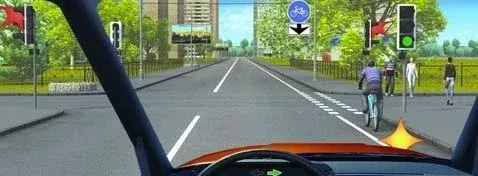
- Only the pedestrians
- The cyclist
- The cyclist and the pedestrians
Show answer
Correct: 3. The cyclist and the pedestrians
Under point 87 of the Rules, when leaving an intersection while making a turn the driver must give way to the pedestrians crossing the carriageway AND to the cyclists travelling along the cycle path. Making the turn here, he must give way to both the cyclist and the pedestrians. “Only the pedestrians” and “The cyclist” are wrong because point 87 covers the two together - the cyclist on the path and the pedestrians on the carriageway.
Question 283. When making a right turn one must
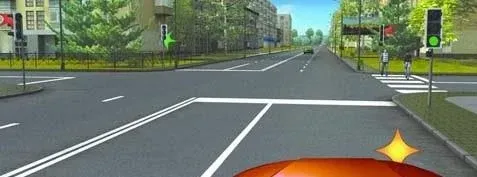
- Stop before the “Stop line” in order not to obstruct pedestrians,
- Entering the intersection, stop in order not to obstruct pedestrians
- Cross the intersection without stopping
Show answer
Correct: 2. Entering the intersection, stop in order not to obstruct pedestrians
The green signal permits you to enter the intersection, so there is no need to stop before the “Stop line” - that is required only on a prohibiting signal. When turning right, point 87 of the Rules requires you to give way to the pedestrians crossing the carriageway, so having entered the intersection you stop, if need be, in order not to obstruct them. “Stop before the ‘Stop line’ in order not to obstruct pedestrians” is wrong because the green permits entry, and “Cross the intersection without stopping” is wrong because point 87 obliges you to yield to the pedestrians.
Question 286. After the green signal comes on we are obliged to
- Make sure that in the non-visible part of the pedestrian crossing there are no pedestrians who have not finished crossing
- Start moving immediately in accordance with the traffic light signal
Show answer
Correct: 1. Make sure that in the non-visible part of the pedestrian crossing there are no pedestrians who have not finished crossing
Under point 94 of the Rules the driver must give way to pedestrians who have not yet finished crossing the carriageway, even though the permitting signal has already come on. Once the green shows you are therefore obliged to make sure that there are no pedestrians still crossing in the part of the pedestrian crossing you cannot see - here the part screened by the truck standing to the right. “Start moving immediately in accordance with the traffic light signal” is wrong because point 94 requires you to let those still crossing finish, and you cannot know they have unless you look.
Question 370. In this situation, when passing the intersection, not to create an obstacle for pedestrians
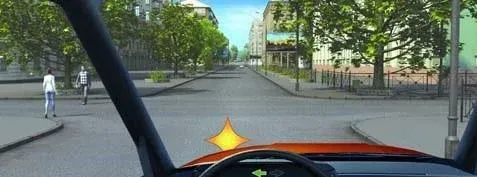
- We are obliged
- We are not obliged
Show answer
Correct: 1. We are obliged
You are turning at the intersection, and there are pedestrians crossing the very carriageway you are turning into. Under point 87 of the Rules, when turning right or left and leaving the intersection the driver must give way to the pedestrians crossing the carriageway and to cyclists travelling along the cycle path. You are therefore obliged not to obstruct the pedestrians. “We are not obliged” is wrong because point 87 makes yielding to pedestrians crossing your path compulsory whenever you turn.
Question 380. Which driver is obliged not to obstruct pedestrians
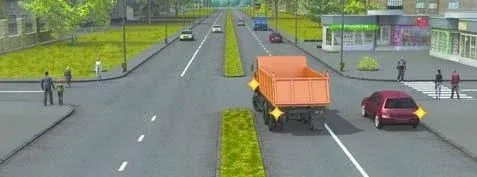
- The passenger car driver
- The truck driver
- Both drivers
Show answer
Correct: 3. Both drivers
Both the truck and the passenger car are turning at the intersection, and pedestrians are crossing the carriageways they are turning into. Under point 87 of the Rules, when turning right or left a driver leaving the intersection must give way to pedestrians crossing the carriageway. Both drivers are therefore obliged not to obstruct pedestrians. “The passenger car driver” and “The truck driver” taken separately are wrong, because both turning drivers must give way to the pedestrians crossing.
Question 399. The driver is obliged not to obstruct pedestrians
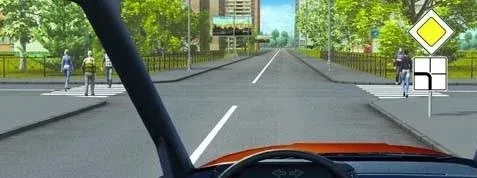
- Only when making a left turn
- Only when making a right turn
- In both cases alike
Show answer
Correct: 3. In both cases alike
Under point 87 of the Traffic Rules, when exiting an intersection while turning right or left the driver must give way to pedestrians crossing the carriageway and to cyclists on the bicycle path. The obligation applies equally to a left turn and to a right turn, so the pedestrians must not be obstructed in either case. “Only when making a left turn” and “Only when making a right turn” are wrong, because point 87 covers both turning directions.
Question 400. During a right turn you are obliged to give way to
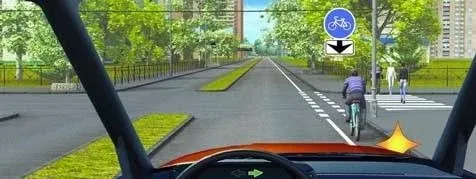
- Pedestrians and cyclists
- Only pedestrians
Show answer
Correct: 1. Pedestrians and cyclists
Under point 87 of the Rules, when turning right and leaving the intersection the driver must give way to the pedestrians crossing the carriageway AND to the cyclists travelling along the cycle path. You must therefore give way to the pedestrians and the cyclists alike. “Only pedestrians” is wrong because point 87 names the cyclists on the cycle path expressly - a cycle path crossing your turn has the same standing as a pedestrian crossing.
Question 439. Which of the drivers is obliged to stop?
- The driver of the passenger car.
- The driver of the bus.
- Both drivers.
Show answer
Correct: 1. The driver of the passenger car.
The pedestrians are crossing at an unregulated pedestrian crossing. Under point 103 of the Rules a driver must give way to pedestrians crossing the carriageway at such a crossing, and under point 104, where a vehicle has stopped before it, drivers in the adjacent lanes may continue only after making sure that there are no pedestrians in front of it. The bus has already stopped and the pedestrians are on the crossing, so the one who must stop is the driver of the light passenger car. “The driver of the bus.” is wrong because the bus has stopped already, and “Both drivers.” is wrong because the obligation to stop now falls on the approaching passenger car.
Question 483. How must the driver of the passenger car act if the bus driver has begun to brake?
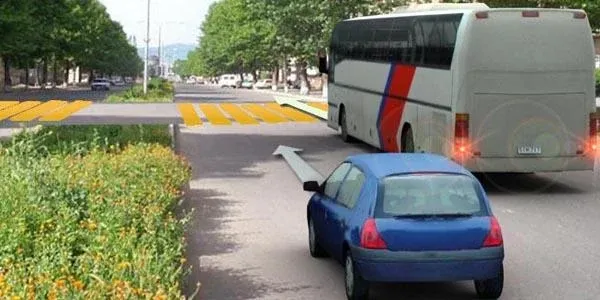
- Continue moving.
- Slow down, if necessary stop, and continue moving after making sure that there are no pedestrians on the crossing.
- Stop and continue moving only when the bus resumes movement.
Show answer
Correct: 2. Slow down, if necessary stop, and continue moving after making sure that there are no pedestrians on the crossing.
The bus has braked before the pedestrian crossing. Under point 104 of the Rules, where a vehicle has slowed down or stopped before an unregulated pedestrian crossing, the drivers of other vehicles in the adjacent lanes may continue only after making sure that there are no pedestrians in front of it - the stopped bus hides the crossing from you. The passenger car’s driver must therefore slow down, stop if necessary, and go on only once he has satisfied himself that there is nobody on the crossing. “Continue moving.” ignores that duty, and “Stop and continue moving only when the bus resumes movement.” is wrong because the condition is the absence of pedestrians, not what the bus does next.
Question 487. The bus has stopped to give way to a pedestrian. In the given situation, does the driver of the passenger car violate the requirements of the road traffic rules?
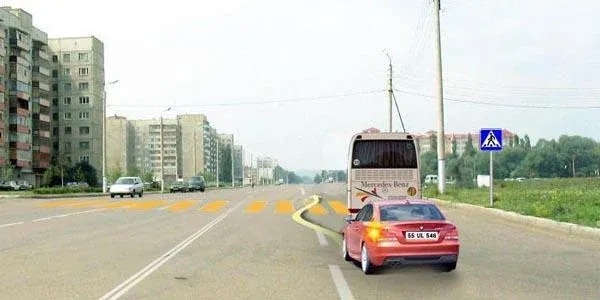
- He does violate.
- He does not violate.
Show answer
Correct: 1. He does violate.
The bus has stopped before the pedestrian crossing to give way to a pedestrian. Under point 104 of the Rules, where a vehicle has stopped before an unregulated pedestrian crossing, the drivers of other vehicles in the adjacent lanes may continue only after making sure that there are no pedestrians in front of it. The passenger car is passing the stopped bus and carrying on towards the crossing without that assurance, so its driver does violate the Rules - and with him the duty to give way to the pedestrian. “He does not violate.” is wrong: a stopped bus at a crossing is a warning, not an obstacle to be gone round.
Question 697. Is the red car’s driver permitted to continue driving in the given situation?
- It is permitted.
- It is prohibited.
Show answer
Correct: 2. It is prohibited.
The pedestrians are already crossing the carriageway at an unregulated pedestrian crossing - signs 5.19.1 and 5.19.2 with the zebra markings 1.14.1 and 1.14.2 - so under point 103 of the Traffic Rules the driver is obliged to give way to them. On top of that the blue car in the adjacent lane has stopped before the crossing, and under point 104 the drivers of other vehicles in adjacent lanes may continue only after making sure that there are no pedestrians in front of that vehicle, which is not the case here. The red car’s driver is therefore prohibited from continuing.