Fractures and Burns
Well-meant help can make these injuries worse, from moving a broken bone to bursting a blister. This lesson shows what to do and what to leave alone.
Remember: This lesson does not replace a first-aid course.
How do I help with a fracture?
Section titled “How do I help with a fracture?”For an open fracture, where the wound reaches the bone:
- Cover the wound with a sterile napkin, against infection.
- Immobilize the limb, so the fragments can’t damage vessels and nerves.
Don’t raise the limb or apply direct pressure, which move the fragments, and don’t put cold compresses on the wound.
With no splint, tie the bent arm, resting on a headscarf, to the trunk. Tie the legs together with a soft cloth between them, so the bony points don’t press together.
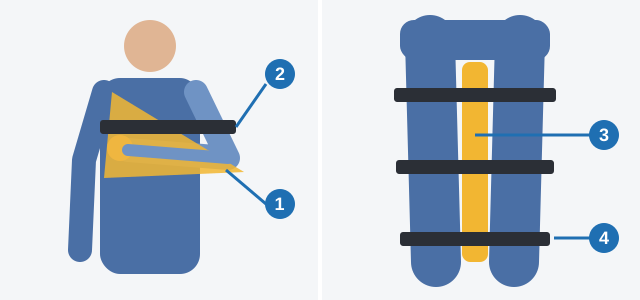
The headscarf (1), the band to the trunk (2), the soft cloth (3) and the ties (4).
If the spine may be injured, movement can cause permanent paralysis. Lay a conscious casualty on their back on a hard, flat surface, and don’t move them unless necessary. No side position, no roll under the neck, no raised legs.
Extra: Bleeding and neck care in first-aid courses
Not from the question bank.
If an open fracture bleeds heavily, press around the wound with a clean dressing, not on the bone, and call an ambulance. If someone awake may have a spinal injury, ask them to stay still and support the head as you found it.
How do I treat a burn?
Section titled “How do I treat a burn?”Superficial thermal burn: redness, swelling, blisters with clear fluid and severe pain.
- Cool it with water for 20 minutes. This stops the tissue burning and eases the pain.
- Leave the blisters closed and any stuck clothing in place. Blisters are a barrier against infection.
- Cover with a sterile napkin or clean cloth, without bandaging.
- If possible apply cold, and give water to drink.
Common trap: Oil holds the heat in. Leaving the burn open invites infection.
Extra: Cool water, not ice
Not from the question bank.
Use cool running water, not ice, which can damage the skin. Give drinks only to someone fully awake.
How do I treat frostbite and hypothermia?
Section titled “How do I treat frostbite and hypothermia?”Warm the affected parts and immobilize them, cover the casualty with warm clothes or a blanket, give a warm drink, and move them to a warm area. Don’t rub with snow or wool, give alcohol, or use ointment, warming compresses or heat pads.
What about fallen power wires?
Section titled “What about fallen power wires?”On the car: ask the people inside to stay there until the current is switched off. Stepping out means touching the car and the ground together, and the current passes through the body.
On a casualty: they are live, so don’t touch them. First remove the wire with an insulating object, such as dry wood. The primary survey comes afterwards.
If you can’t make the scene safe, don’t approach. Call for help and keep bystanders away.
Extra: Fallen lines can be high voltage
Not from the question bank.
You can’t see the voltage. High voltage can pass through dry wood and make nearby ground live, so first-aid courses teach you to stay well back, keep others back and call the emergency services until the power is confirmed off. If fire forces people out of a car, they should jump clear with feet together, never touching the car and ground at once, then shuffle away.
Try it yourself
Section titled “Try it yourself”A car has hit a pole, and a wire lies on an unconscious casualty beside it. What comes first, if the scene can be made safe? Remove the wire with an insulating object. Moving the casualty means touching a live person.
Key points
Section titled “Key points”- Open fracture: sterile napkin, then immobilize.
- Spine: on the back on a hard, flat surface. Don’t move them unless necessary.
- Burn: water for 20 minutes, blisters closed, cover without bandaging.
- Frostbite: warm and immobilize. No rubbing, no alcohol.
- Wire on the car: stay inside. Wire on a casualty: insulating object first.
Practice questions
Section titled “Practice questions”Question 555. What must be done when giving assistance in case of a burn?
- Leave the burn open.
- Open the fluid-filled blisters, then bandage tightly.
- Apply oil onto the burn.
- Cool the burn with water, then cover with sterile dressing material or clean cloth.
Show answer
Correct: 4. Cool the burn with water, then cover with sterile dressing material or clean cloth.
The first step with a burn is to cool it with water, which stops the tissue from burning further and eases the pain, and then to cover it with sterile dressing material or clean cloth. “Leave the burn open.” invites infection; “Apply oil onto the burn.” holds the heat in the tissue and hinders healing; and “Open the fluid-filled blisters, then bandage tightly.” destroys the one natural barrier protecting the burn from infection, while tight bandaging damages the burnt tissue further.
Question 561. When the casualty has an open fracture of a limb, then when giving assistance it is necessary to:
- Immediately raise the casualty’s limb.
- Cover the wound with a sterile napkin and immobilize the injured limb.
- Stop the bleeding by direct pressure.
- Place cold compresses on the wound.
Show answer
Correct: 2. Cover the wound with a sterile napkin and immobilize the injured limb.
With an open fracture the wound is in contact with the broken bone, so the first task is to cover the wound with a sterile napkin against infection and to immobilize the injured limb so that the bone fragments cannot move and damage vessels and nerves. “Immediately raise the casualty’s limb.” and “Stop the bleeding by direct pressure.” both move the fragments of broken bone and make the injury worse, and “Place cold compresses on the wound.” is a route for infection into an open wound and does not stop bleeding.
Question 577. A car has hit a pole and an electrical wire has fallen onto the casualty lying unconscious beside the car. When giving assistance, first of all you must:
- Move the casualty away from the electrical source.
- Perform the primary survey.
- Remove the wire from the casualty with some insulating object.
- Look for the entry and exit points of the current on the body (the burns).
Show answer
Correct: 3. Remove the wire from the casualty with some insulating object.
While the wire is lying on the casualty he is live, and anyone who touches him joins the electrical circuit. The first step is therefore to remove the wire from the casualty with some insulating object - a dry piece of wood or the like - and not to pull at the casualty. “Move the casualty away from the electrical source.” is precisely what must not be done first, because it means touching a person who is still live. “Perform the primary survey.” and “Look for the entry and exit points of the current on the body (the burns).” both come after the electrical danger has been removed.
Question 584. If a wire has fallen onto the car, then you must:
- Help the persons in the car to get out of the car urgently.
- Ask the persons in the car to stay inside the car until the electric current is switched off.
Show answer
Correct: 2. Ask the persons in the car to stay inside the car until the electric current is switched off.
If a wire has fallen onto the car, the people inside are safe: they are not in contact with the ground, and the current passes through the body of the car. At the moment of getting out a person touches the car and the ground at the same time and becomes the path for the current, which is lethal. They must therefore be asked to stay inside the car until the electric current is switched off, and “Help the persons in the car to get out of the car urgently.” is precisely what would kill both them and the rescuer.
Question 588. What optimal position should be given to a conscious casualty when a spinal injury is suspected?
- Lay the casualty on their side.
- Lay the casualty on their back on a hard, flat surface; do not move them unless necessary, do not change the position.
- Lay the casualty on their back, place a roll made of clothing under the neck and raise the legs.
Show answer
Correct: 2. Lay the casualty on their back on a hard, flat surface; do not move them unless necessary, do not change the position.
Where a spinal injury is suspected, any movement can damage the spinal cord and cause permanent paralysis. A conscious casualty is therefore laid on their back on a hard, flat surface and not moved unless necessary, with the position left unchanged. “Lay the casualty on their side.” means twisting the spine, which is the one thing to avoid, and “Lay the casualty on their back, place a roll made of clothing under the neck and raise the legs.” bends the neck and moves the lower spine - both harmful with this injury.
Question 589. How is first aid carried out in case of frostbite and hypothermia?
- Rub the affected parts of the body with snow or a woollen cloth, then warm them, give an alcoholic drink, move to a warm area.
- Warm the affected parts of the body and immobilize them, cover the casualty with warm clothes or a blanket, give a warm drink, move to a warm area.
- Coat the affected parts of the body with ointment, apply a warming compress and a heat pad, move to a warm area, give a warm drink.
Show answer
Correct: 2. Warm the affected parts of the body and immobilize them, cover the casualty with warm clothes or a blanket, give a warm drink, move to a warm area.
With frostbite and hypothermia the affected parts of the body are warmed gently and immobilized, the casualty is covered with warm clothes or a blanket, given a warm drink and moved to a warm area. “Rub the affected parts of the body with snow or a woollen cloth, then warm them, give an alcoholic drink, move to a warm area.” is wrong twice over: rubbing damages already frozen skin, and alcohol widens the vessels in the skin so that heat pours out of the body and the hypothermia deepens. “Coat the affected parts of the body with ointment, apply a warming compress and a heat pad, move to a warm area, give a warm drink.” warms damaged tissue abruptly and unevenly, which does further harm.
Question 598. How is first aid carried out in case of fractures of the limbs if there are no splints and no means at hand for making one?
- The upper limb, extended along the trunk, is tied to the trunk. The lower limbs are tied to each other, placing a soft cloth between them.
- The upper limb, bent at the elbow joint and resting on a headscarf, is tied to the trunk. The lower limbs are tied to each other, placing a soft cloth between them.
- The upper limb, bent at the elbow joint and resting on a headscarf, is tied to the trunk. The lower limbs are tied to each other
Show answer
Correct: 2. The upper limb, bent at the elbow joint and resting on a headscarf, is tied to the trunk. The lower limbs are tied to each other, placing a soft cloth between them.
Where there are no splints and nothing to make one from, the injured limb is immobilized against the body. The upper limb, bent at the elbow joint and resting on a headscarf, is tied to the trunk - the bent position is the natural one and eases the pain, whereas “The upper limb, extended along the trunk, is tied to the trunk.” stretches the injured part. The lower limbs are tied to each other, the sound leg acting as the splint, and a soft cloth must be placed between them so that the bony points do not press together and damage the skin - which is exactly what the answer that ties the legs to each other with nothing between them leaves out.
Question 600. What is the first aid in case of a superficial thermal burn (redness of the skin, swelling, formation of blisters filled with clear fluid at the burn site, severe pain)?
- Pour cold water on the burned surface, cover it with a sterile napkin and bandage it tightly.
- Open the blisters, clean the burn surface of the remains of clothing, cover with a sterile napkin (do not bandage), if possible apply cold, and give the casualty water to drink
- Cool the burn surface with water for 20 minutes. Without opening the blisters and without removing the remains of clothing, cover the burn surface with a sterile napkin (do not bandage), if possible apply cold and give the casualty water to drink.
Show answer
Correct: 3. Cool the burn surface with water for 20 minutes. Without opening the blisters and without removing the remains of clothing, cover the burn surface with a sterile napkin (do not bandage), if possible apply cold and give the casualty water to drink.
With a superficial thermal burn the burn surface is cooled with water for 20 minutes, which stops the tissue burning further and eases the pain. The blisters are not opened - they are the natural barrier against infection - and the remains of clothing are not removed, because they are stuck to the burnt skin and pulling them off deepens the injury; the surface is then covered with a sterile napkin without bandaging, cold is applied if possible, and the casualty is given water to drink to replace the lost fluid. The first answer bandages the burn tightly and damages the tissue further, and the second opens the blisters and cleans off the remains of clothing - both of which are forbidden.