Entering an Intersection
Before you work out who goes first, you must check whether you should enter at all. Even with a green light, you need a clear way out on the far side.
How fast should I approach?
Section titled “How fast should I approach?”Slowly enough to stop. Point 86.1 asks you to be particularly attentive, and to drive at a speed that lets you stop and let through vehicles with priority. Staying under the limit isn’t enough.
What does the traffic light ask of me?
Section titled “What does the traffic light ask of me?”An intersection is regulated when a traffic light or an officer sets the order (point 89).
- Prohibiting signal: stop before marking 1.12 “Stop line” (point 18). Only without a stop line do you look to the crossing carriageway or the traffic light.
- Green signal: carry on without stopping, even if you can see a stop line. The line works only with a prohibiting signal.
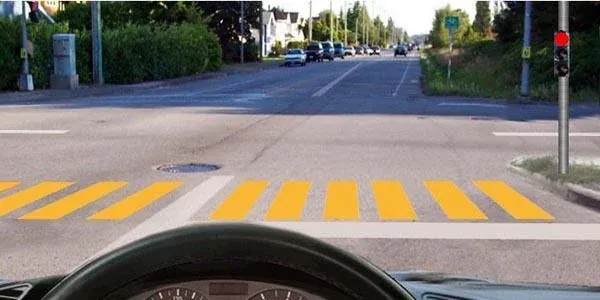
Green doesn’t clear the intersection for you. When it comes on, you give way to pedestrians and vehicles still finishing their crossing (point 94).
May I enter a blocked intersection?
Section titled “May I enter a blocked intersection?”No. Point 88 prohibits entering if a jam will force you to stop there and obstruct crossing traffic. That applies:
- Even on green: a permitting signal doesn’t override a blocked intersection.
- To everyone: a bus on an established route gets no exception.
- Whatever is blocking the way: a queue beyond the intersection, or a vehicle stranded in it.
If only the road straight ahead is blocked, you may still enter to turn or make a U-turn, because you leave onto a clear road and block nobody.
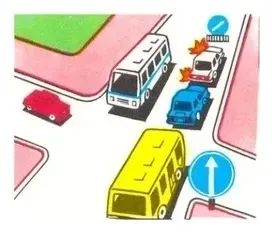
The queue would leave the yellow bus standing in the intersection, so it must wait.
Remember: Before you enter, ask where your vehicle will stop. If the answer is “inside the intersection”, wait.
Try it yourself
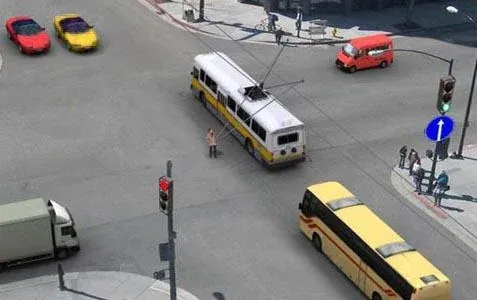
Section titled “Try it yourself”You are driving the bus, and your light is green. A trolleybus stands in the intersection with its poles off the wires, and a workman is putting them back.
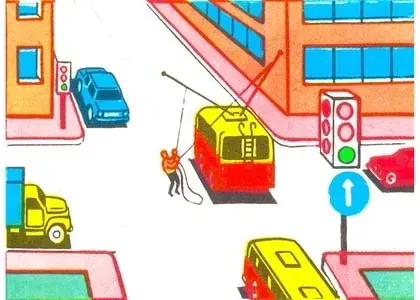
May you enter? No. You couldn’t clear the intersection, and the green light and your route change nothing.
The light is about to turn green, and a light truck is still crossing.
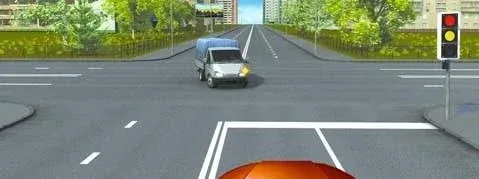
Who goes first when the green comes on? The truck. You give way to vehicles finishing their crossing.
Key points
Section titled “Key points”- Approach at a speed that lets you stop for vehicles with priority.
- Stop at the stop line on a prohibiting signal. On green, carry on.
- On green, still give way to those finishing their crossing.
- Never enter if a jam would stop you inside the intersection.
- That covers everyone, including buses on established routes.
- With the way straight ahead blocked, you may still enter to turn or make a U-turn.
Practice questions
Section titled “Practice questions”Question 255. In the given situation, does the bus driver have the right to drive straight?
- Yes.
- No.
- Yes, if he is moving along an established route.
Show answer
Correct: 2. No.
The traffic light for the bus’s direction is green, but a trolleybus is standing in the intersection — its poles have come off the wires and a workman is putting them back. Under point 88 of the Traffic Rules it is prohibited to enter an intersection where congestion has formed that would force the driver to stop and so obstruct vehicles travelling across his path. The stranded trolleybus has closed the way straight ahead, so even on a permitting signal the bus may not enter the intersection until the obstruction has been moved. That prohibition applies to route vehicles as well, so “Yes.” and “Yes, if he is moving along an established route.” are wrong.
Question 266. When the green signal comes on, the driver
- Must give way to the truck driver
- Has the right of way
Show answer
Correct: 1. Must give way to the truck driver
Under point 94 of the Rules, when the green signal comes on the driver must give way to pedestrians and vehicles that have not yet finished crossing the intersection, even though his own signal is now permitting. The truck has not completed its passage through the intersection, so the driver must give way to the truck driver. “Has the right of way” is wrong because point 94 obliges him to let the truck finish crossing despite the green: a permitting signal releases you into an intersection, it does not clear one that is still occupied.
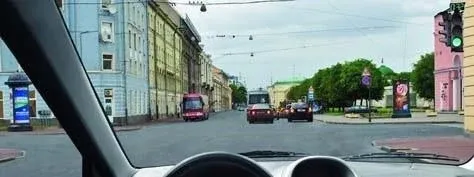
Question 285. After the traffic light’s permitting signal comes on, we may enter the intersection
- Only when making a U-turn or a turn
- In all cases
Show answer
Correct: 1. Only when making a U-turn or a turn
Under point 88 of the Rules it is prohibited to enter an intersection where congestion has formed that would force the driver to stop and so obstruct the movement of other vehicles. With the straight-ahead path blocked, entering in order to carry straight on would leave you standing in the intersection, so even after the permitting signal has come on you may enter only to make a U-turn or a turn - a manoeuvre that takes you off the blocked path. “In all cases” is wrong, because entering into the congestion to go straight would breach point 88: a green light does not override a blocked junction.
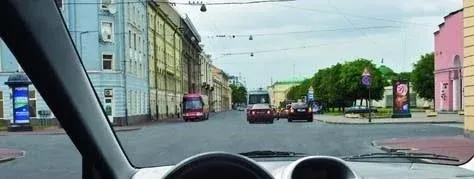
Question 371. Under conditions of a traffic jam formed immediately after the intersection, entering the intersection is permitted only
- If we are going to continue straight
- If we are going to make a turn or a U-turn
- In all the listed cases.
Show answer
Correct: 2. If we are going to make a turn or a U-turn
Under point 88 of the Rules it is prohibited to enter an intersection where congestion has formed - there or immediately beyond it - that would force the driver to stop and so obstruct the movement of other vehicles. If you carried straight on you would be brought to a stand in the queue while still on the intersection; by turning or making a U-turn you leave the intersection onto a clear road and block nothing. Entry is therefore permitted only if you are going to make a turn or a U-turn. “If we are going to continue straight” and “In all the listed cases.” are wrong because driving straight into the queue would leave you standing on the intersection, which point 88 forbids.
Question 456. How must the driver act when approaching an intersection under the conditions of a “Stop line” marking and a green traffic light signal?
- Stop at the “Stop line”, after which resume travel.
- Continue travel through the intersection without stopping.
Show answer
Correct: 2. Continue travel through the intersection without stopping.
Under point 7 of the Rules the green signal permits movement, and under point 18 stopping before the “Stop line” marking is required only at a prohibiting signal of the traffic light or of the traffic controller. Since the signal is green, there is no requirement to stop, and the driver must “Continue travel through the intersection without stopping.” The option “Stop at the “Stop line”, after which resume travel.” is wrong, because the stop line takes effect at a prohibiting signal, not at a green one.
Question 486. Where must the driver stop in the given situation?
- Stopping is not obligatory.
- Before the traffic light.
- Before the “Stop line” marking.
- Before the intersection of the traffic lanes.
Show answer
Correct: 3. Before the “Stop line” marking.
The traffic light is showing a prohibiting signal and there is a stop-line marking 1.12 before the intersection. Under point 18 of the Rules, on a prohibiting signal the driver must stop before marking 1.12 “Stop line” (or sign 6.16); only where there is neither does he stop before the crossing carriageway or before the traffic light. He must therefore stop before the “Stop line” marking. “Stopping is not obligatory.” is wrong because the signal is a prohibiting one, and the traffic-light and lane-intersection answers are wrong because the stop line takes precedence over both.
Question 667. When approaching an intersection, the driver must drive the vehicle at such a speed that
- It does not exceed the maximum permitted in that section.
- He has the possibility of stopping and letting through the vehicles having the right of priority of passage
Show answer
Correct: 2. He has the possibility of stopping and letting through the vehicles having the right of priority of passage
Point 86.1 of the Traffic Rules requires a driver approaching an intersection to be particularly attentive and to drive at a speed such that “He has the possibility of stopping and letting through the vehicles having the right of priority of passage”. Merely making sure the speed “does not exceed the maximum permitted in that section” is not enough — the point demands a speed that actually leaves room to stop, which is why that option is wrong.
Question 679. Is the bus driver permitted to enter the intersection in this situation?
- It is permitted.
- It is prohibited.
- It is permitted if the bus is travelling on an established route.
Show answer
Correct: 2. It is prohibited.
The traffic light shows green for the bus, but a trolleybus is standing in the middle of the intersection — its poles have come off the wires and a workman is putting them back. Under point 88 of the Traffic Rules it is prohibited to enter an intersection if a jam has formed there that will force the driver to stop, obstructing the movement of vehicles in the crossing direction. Even on a permitting signal the bus will not be able to clear the intersection in its intended direction, so entering it is prohibited.
Question 687. Is the driver of the yellow bus permitted to enter the intersection?
- It is permitted.
- It is prohibited.
- It is permitted, if the bus is travelling along an established route.
Show answer
Correct: 2. It is prohibited.
Under point 88 of the Traffic Rules it is prohibited to enter an intersection where congestion has formed that would force the driver to stop on the intersection and so obstruct the movement of other vehicles. In the picture the stretch beyond the intersection is taken up by a queue of standing cars, so the yellow bus would inevitably come to a stand within the intersection. This requirement applies to every driver without exception, buses on established routes included, so the driver is obliged to wait until the way through the intersection is clear.
Question 868. An intersection is considered regulated if the order of movement is determined by:
- Only traffic light signals.
- Only the signals of the traffic controller.
- In both cases.
Show answer
Correct: 3. In both cases.
Point 89 of the Traffic Rules defines a regulated intersection as one where the order of movement is determined by the signals of the traffic controller or by traffic light signals. The rule names both sources equally, so “In both cases.” is correct. “Only traffic light signals.” and “Only the signals of the traffic controller.” each take half of that definition: a controller directing traffic makes the intersection regulated just as a light does, and by point 20 his signals take precedence over the light.