Priority Signs
Priority signs answer one question: who goes first? They work where nothing else decides, so learn exactly what each one asks of you, because the exam separates “give way” from “stop and give way”.
What do the priority signs look like?
Section titled “What do the priority signs look like?”This family has no single shape, so learn each sign on its own.
| Sign | No. | Name | Meaning |
|---|---|---|---|
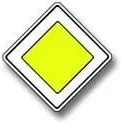 |
2.1 | Main road | You have priority through uncontrolled intersections |
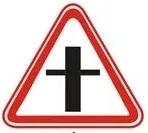 |
2.3.1 | Junction with a minor road | Your road is the main one. A minor road crosses it |
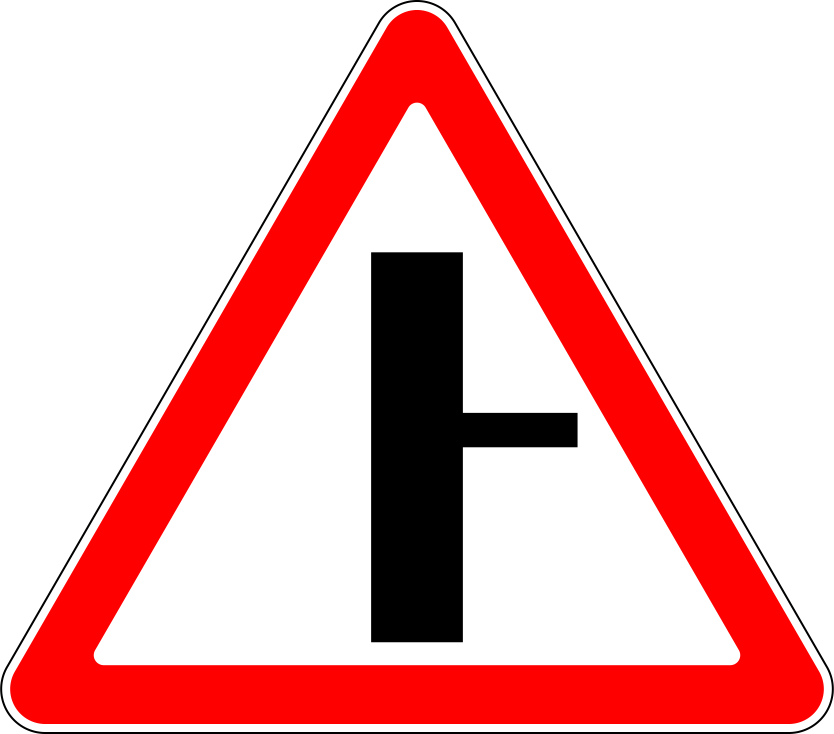 |
2.3.2 | Adjoining of a minor road | Your road is the main one. A minor road joins from the right |
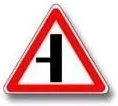 |
2.3.3 | Adjoining of a minor road | Your road is the main one. A minor road joins from the left |
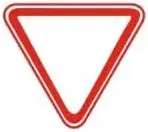 |
2.4 | Give way | Give way to vehicles on the crossing road |
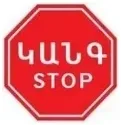 |
2.5 | Movement without stopping prohibited | Stop, then give way to vehicles on the crossing road |
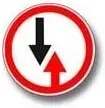 |
2.6 | Priority of oncoming traffic | Give way to oncoming vehicles at a narrow section |
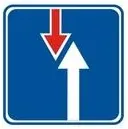 |
2.7 | Priority over oncoming traffic | You go first at a narrow section |
Sign 2.2 “End of main road” is the yellow diamond with black stripes across it, number 5 here:
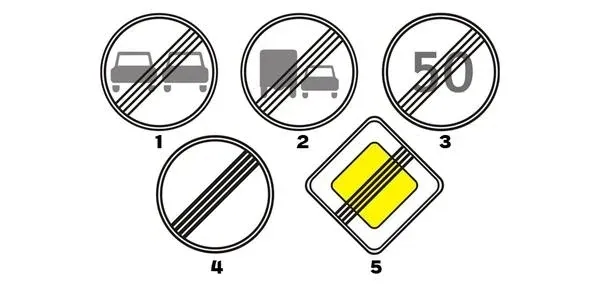
Common trap: In signs 2.3.1 to 2.3.3, the triangle isn’t a warning of something you must yield to. The thick line is your road, so the priority is yours. Compare sign 1.6, whose plain cross has arms of equal weight: there, neither road is the main one.
Priority signs fix the order only at unregulated intersections. If the traffic light is working, follow the light.
How do “Give way” and “Stop” differ?
Section titled “How do “Give way” and “Stop” differ?”Both make you yield. Only one makes you stop.
- Sign 2.4 “Give way”: yield to vehicles on the crossing road. If nobody is coming, you carry on.
- Sign 2.5 “Movement without stopping prohibited”: stop in every case, whether or not anything is coming. Then give way, and drive on by your own judgement.
Under sign 2.4, you give way to every vehicle, not only mechanical ones. Bicycles, mopeds and horse-drawn carts count too.
If sign 2.4 stands with plate 8.13 “Direction of the main road”, you must give way to whoever is on the main road, from any direction, including vehicles coming from your left.
Remember: Stop under sign 2.5 at the stop line. If there is no line, stop at the edge of the crossing carriageway, where you can actually see the traffic. The sign itself is not the stopping place at an intersection. Only before a railway crossing with no line does the driver stop at the sign.
So you may drive past the sign, up to the line.
Who goes first at a narrow section?
Section titled “Who goes first at a narrow section?”Signs 2.6 and 2.7 work as a pair: 2.7 faces one driver and 2.6 faces the driver coming the other way.
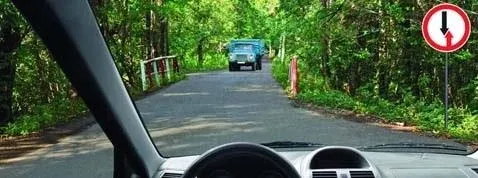
Sign 2.6: don’t enter the narrow section if that would obstruct oncoming traffic, and give way to vehicles on it or approaching it.
Use this hook: the red arrow is the driver who gives way. On 2.6 the red arrow points up, in your direction, so you yield. On 2.7 it points down, at the oncoming driver, so you go first.
Common trap: Sign 2.6 looks like a prohibitory sign, but it forbids no passage: it only settles who goes first. Sign 2.7 looks like an information sign, but it gives you priority. That priority covers oncoming traffic on the narrow section only, not traffic on a crossing road.
Try it yourself
Section titled “Try it yourself”A give-way sign stands on the right, with a plate reading STOP and 250 m.
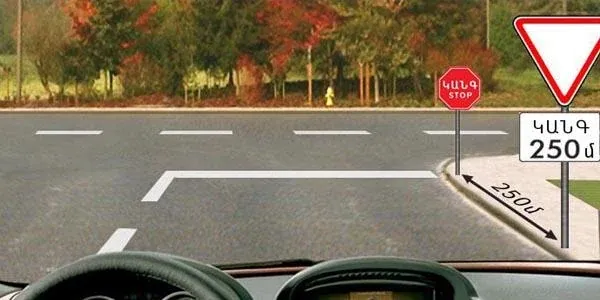
Where must you stop? Before the stop line. The first sign and its plate only warn you that sign 2.5 is 250 m further on. Don’t stop at either sign.
The STOP sign is on the right, and no stop line is painted.
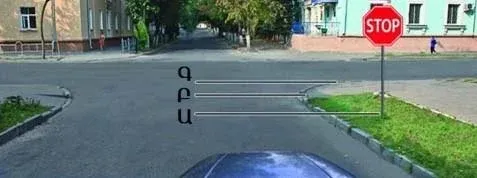
Where do you stop? At the edge of the crossing carriageway, position Գ (C). With no line, that is the place the sign requires.
You must give way to drivers coming from the left. Which sign says so?
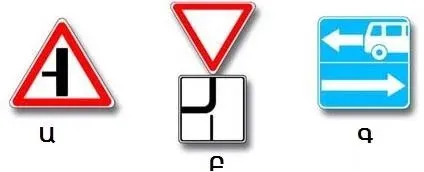
Only Բ (B). Sign 2.4 with plate 8.13 puts you on the secondary road. Under Ա (A) you are the one on the main road.
Key points
Section titled “Key points”- 2.1 and the 2.3 group put you on the main road. The thick line is yours.
- 2.4: give way to every vehicle on the crossing road. No stop needed if the way is clear.
- 2.5: always stop, at the stop line or else at the edge of the crossing carriageway. Then give way.
- With plate 8.13, give way to the main road from any direction.
- 2.6: you yield at a narrow section. 2.7: you go first. The red arrow yields.
- Priority signs decide only at unregulated intersections.
Practice questions
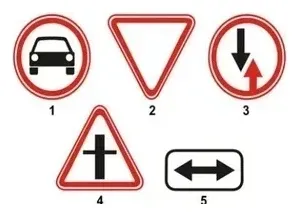
Section titled “Practice questions”Question 6. Which of the following signs obliges to give way to vehicles entering or approaching a narrow section of the road in the opposite direction?
- 1
- 2
- 3
- 4
- 5
Show answer
Correct: 3. 3
Giving way to oncoming vehicles that are entering or approaching a narrow section of the road is required by sign 2.6, “Priority of oncoming traffic” — number 3: entering the narrow section is prohibited if it could obstruct oncoming traffic, and the driver must give way to vehicles approaching the narrow section from the opposite side. Number 1 is prohibitory sign 3.3, number 2 is 2.4, “Give way”, which concerns the intersecting road, number 4 is 2.3.1, “Junction with a minor road”, and number 5 is a plate and imposes no duty to give way. Sign 3 is therefore correct.
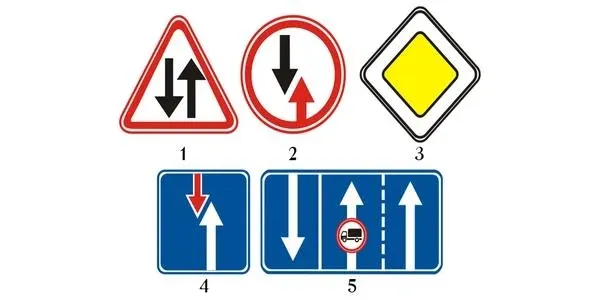
Question 10. Which of the signs gives the driver priority over oncoming vehicles?
- 1
- 2
- 3
- 4
- 5
Show answer
Correct: 4. 4
The sign that gives the driver priority over oncoming vehicles is priority sign 2.7 “Priority over oncoming traffic” - a narrow section of road on which the driver going in the arrow’s direction has the right of way over oncoming vehicles. That is number 4, the blue square with the large white arrow. None of the others gives such a priority. Number 2 in particular is 2.6 “Priority of oncoming traffic”, which means the exact reverse: there the driver must give way. Sign 4 is therefore the correct answer.
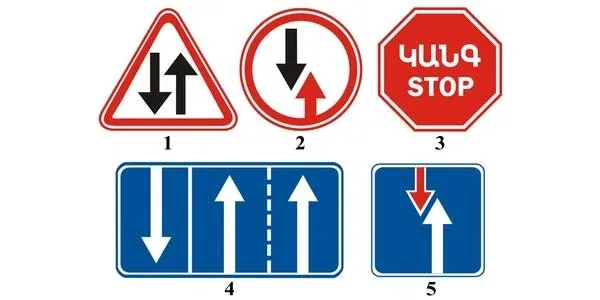
Question 15. Which of the following signs requires giving way to oncoming vehicles?
- 1
- 2
- 3
- 4
- 5
Show answer
Correct: 2. 2
The sign that requires giving way to oncoming vehicles is priority sign 2.6, “Priority of oncoming traffic”: entering the narrow section is prohibited if it could obstruct oncoming traffic, and the driver must give way to oncoming vehicles that are on that section or approaching it — that is sign number 2. The other signs impose no such duty; in particular, 2.7, “Priority over oncoming traffic”, means the opposite. Sign 2 is therefore correct.
Question 17. Which of the signs requires giving way to vehicles travelling on the intersecting road?
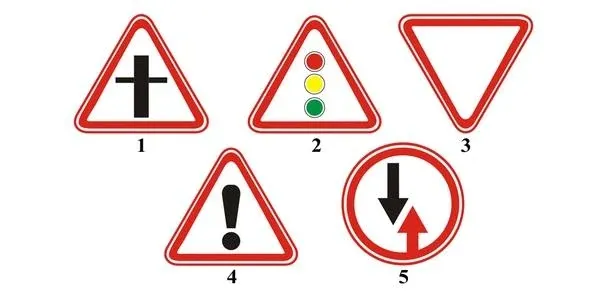
- 1
- 2
- 3
- 4
- 5
Show answer
Correct: 3. 3
Giving way to vehicles travelling on the intersecting road is required by sign 2.4 “Give way” (an inverted triangle) — number 3: the driver must yield to crossing traffic, and where plate 8.13 is present, to traffic on the main road. The other signs impose no such duty. Number 1 is 2.3.1 “Junction with a minor road”, where priority belongs to the driver passing it; number 2 is 1.8 “Traffic light regulation” and number 4 is 1.33 “Other dangers”, both warning signs; number 5 is 2.6, which concerns a narrow section of road, not an intersection. Sign 3 is therefore correct.
Question 32. In which case has the driver correctly fulfilled the requirements of this sign?
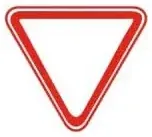
- Gave way to the mechanical vehicles travelling on the crossing road.
- Gave way to the vehicles travelling on the crossing road.
Show answer
Correct: 2. Gave way to the vehicles travelling on the crossing road.
This is priority sign 2.4 “Give way”, under which the driver must give way to the VEHICLES travelling on the crossing road. “Gave way to the vehicles travelling on the crossing road.” states exactly that duty. “Gave way to the mechanical vehicles travelling on the crossing road.” is wrong because sign 2.4 requires giving way to every vehicle on the crossing road, not only to mechanical ones - bicycles, mopeds and horse-drawn carts are included, and limiting the duty to mechanical vehicles would wrongly strip those of their priority.
Question 34. Which sign obliges to give way to the vehicles travelling on the crossing (intersecting) road?
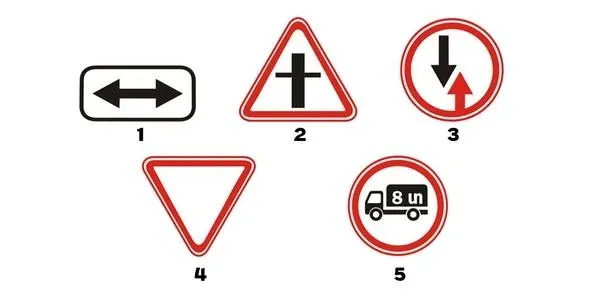
- 1
- 2
- 3
- 4
- 5
Show answer
Correct: 4. 4
Giving way to vehicles travelling on the crossing road is required by sign 2.4 “Give way”, the inverted triangle - number 4: the driver must give way to those crossing, and where plate 8.13 is present, to those on the main road. Number 2 is 2.3.1 “Junction with a minor road”, where the priority is yours rather than theirs. Number 3 is 2.6, which concerns passing a narrow section. Number 5 is prohibitory sign 3.4, banning lorries with a permissible maximum mass over 8 t. Number 1 is a plate and imposes no duty to give way by itself. Sign 4 is therefore correct.
Question 46. Which of the signs obliges to give way to the vehicles travelling on the crossing (intersecting) road?
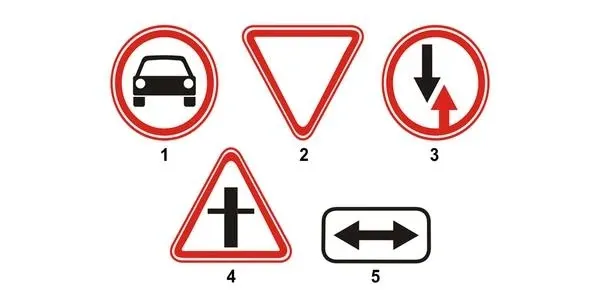
- 1
- 2
- 3
- 4
- 5
Show answer
Correct: 2. 2
Giving way to vehicles travelling on the crossing road is required by priority sign 2.4 “Give way”, the inverted triangle, which is number 2; where plate 8.13 “Direction of the main road” is present, the duty is to give way to those on the main road. Number 1 is the prohibitory sign 3.3 “Movement of mechanical vehicles prohibited”, number 3 is 2.6 “Priority of oncoming traffic”, which concerns only a narrow section of road, number 4 is 2.3.1 “Junction with a minor road”, where the priority is yours, and number 5 is a plate. Sign 2 is therefore the correct choice.
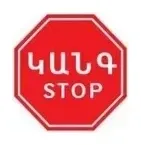
Question 61. How must the driver act when the following road sign is placed before the intersection?
- Pass the intersection, observing safety.
- Give way to vehicles travelling on the intersecting road.
- Stop before the sign and give way to vehicles travelling on the intersecting road.
Show answer
Correct: 3. Stop before the sign and give way to vehicles travelling on the intersecting road.
This is priority sign 2.5 “Movement without stopping prohibited”. Under the Rules the driver may not proceed without first stopping before the stop line - or, where there is none, before the edge of the crossing carriageway - and must give way to the vehicles travelling on the intersecting road: both things, not one of them. “Pass the intersection, observing safety.” is wrong because 2.5 makes the stop compulsory. “Give way to vehicles travelling on the intersecting road.” is the duty imposed by sign 2.4 “Give way”, which does not require a stop; 2.5 adds the compulsory stop on top of it.
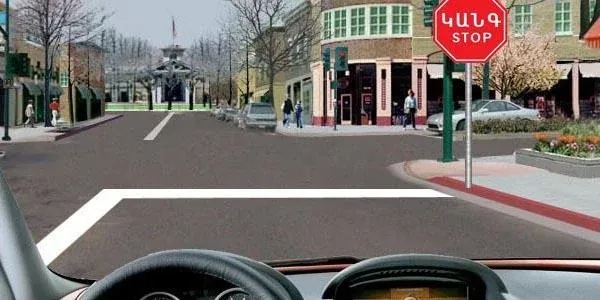
Question 79. How must the driver act in this situation?
- If necessary, give way to the vehicle travelling on the crossing road.
- Stop and give way to the vehicle travelling on the crossing road.
Show answer
Correct: 2. Stop and give way to the vehicle travelling on the crossing road.
Sign 2.5 “Movement without stopping prohibited” stands at the intersection and a stop line is painted on the road. Under that sign it is forbidden to proceed without first stopping before the stop line - or, where there is none, before the edge of the crossing carriageway - and the driver must give way to the vehicles travelling on the intersecting road. He must therefore stop and then give way. “If necessary, give way to the vehicle travelling on the crossing road.” is wrong because sign 2.5 makes the stop unconditional and compulsory: the driver stops in every case, whether or not anything is coming.
- Warns of approaching a narrow section
- Prohibits crossing the bridge
- Requires giving way to the oncoming driver in narrow sections
Show answer
Correct: 3. Requires giving way to the oncoming driver in narrow sections
This is sign 2.6 “Priority of oncoming traffic”, which under the Rules prohibits entering a narrow section of road if that would obstruct oncoming traffic, and obliges the driver to give way to oncoming vehicles in the narrow section. It therefore requires giving way to the oncoming driver in narrow sections. “Warns of approaching a narrow section” is wrong because 2.6 is a PRIORITY sign, not a warning sign - the warning about a narrowing is a red-bordered triangle. “Prohibits crossing the bridge” is wrong because the sign forbids no passage at all; it only settles who goes first.
Question 491. In the given situation, where must you stop?
- Near the first road sign.
- Before the “Stop line” marking.
- Near the second road sign.
- Stopping is not obligatory.
Show answer
Correct: 2. Before the “Stop line” marking.
Sign 2.5 “Movement without stopping prohibited” forbids proceeding without first stopping before marking 1.12 “Stop line”, so the driver must stop before the stop line painted at the intersection. The first sign - 2.4 “Give way” with plate 8.1.2 “Distance to the object” reading STOP 250 m - only warns that sign 2.5 stands 250 m further on, immediately before the intersection, so stopping at the first or the second sign is wrong. “Stopping is not obligatory.” is wrong too, because sign 2.5 makes the stop compulsory.
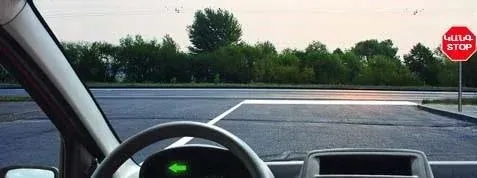
Question 537. Can you continue travelling past the sign
- Yes
- Yes, up to the Stop line
- No
Show answer
Correct: 2. Yes, up to the Stop line
Sign 2.5 “Movement without stopping prohibited” stands on the right, and it forbids proceeding without first stopping before the “Stop” line - or, where there is none, before the edge of the crossing carriageway. Here that stop line, marking 1.12, is painted on the carriageway and is visible ahead. You may therefore continue past the sign, but only as far as the Stop line, where you must stop and give way to the vehicles travelling on the crossing road. “Yes” is wrong because sign 2.5 makes the stop compulsory, and “No” is wrong because travelling up to the Stop line is permitted - the stop is made there, not at the sign.
Question 1039. Where is it necessary to stop when complying with the requirement of the sign
- Before the sign — Ա (A)
- Before the intersection — Բ (B)
- Before the intersection of the carriageways — Գ (C)
Show answer
Correct: 3. Before the intersection of the carriageways — Գ (C)
The sign shown is 2.5 “Movement without stopping prohibited”. Under that sign it is forbidden to proceed without stopping before the “Stop” line, and where there is none, before the edge of the crossing carriageway. There is no stop line here, so it is necessary to stop before the intersection of the carriageways - position Գ (C). Stopping before the sign - Ա (A) - or before the intersection - Բ (B) - is wrong, because the sign requires the stop at the edge of the crossing carriageway itself, where the driver can actually see the traffic he must give way to.
Question 1059. At an uncontrolled intersection, which signs give the driver priority over those driving on the crossing road?
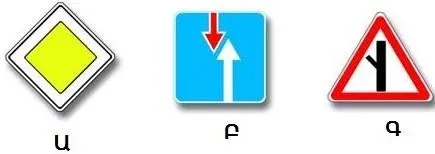
- Only Ա (A)
- Ա (A) and Գ (C)
- All
Show answer
Correct: 2. Ա (A) and Գ (C)
Sign Ա (A) is 2.1 ‘Main road’, which under the Rules gives those travelling along it priority through uncontrolled intersections, and Գ (C) is a priority sign of group 2.3, ‘Crossing with / junction of a secondary road’, which likewise places the driver on the main road relative to the secondary road crossing it. Both give priority over traffic on the crossing road. Sign Բ (B) is 2.7 ‘Priority over oncoming traffic’, which gives priority only over oncoming traffic on a narrow section, not over crossing traffic, so the correct answer is Ա (A) and Գ (C), while ‘Only Ա (A)’ and ‘All’ are wrong.
Question 1076. With which sign must you give way at the intersection to drivers approaching from the left?
- Only Ա (A)
- Only Բ (B)
- Ա (A) and Բ (B)
- All
Show answer
Correct: 2. Only Բ (B)
Sign Բ (B) is 2.4 “Give way” with plate 8.13 “Direction of the main road”, so you are on the secondary road and under point 96 of the Rules you must give way to the vehicles travelling on the main road whatever direction they take - including those approaching from the left along the main road the plate shows. Sign Ա (A) is 2.3.3 “Adjoining of a secondary road”, which means you are the one ON the main road and are not obliged to give way to those coming from the secondary road joining on the left. Sign Գ (C) is 5.13.1 “Exit to a road with a lane for public-use transport vehicles” and establishes no advantage in favour of those approaching from the left. You must therefore give way to drivers approaching from the left only in the case of sign Բ (B).