Moving Off and Changing Lanes
Most lane questions come down to one thing: who is already there. Learn which part of the road is yours, then remember that the driver who moves gives way to the driver who doesn’t.
Which side of the road is mine?
Section titled “Which side of the road is mine?”Traffic in Armenia keeps to the right. Article 7 of the RA law “On ensuring road traffic safety” sets right-hand traffic on all roads of the Republic.
On a two-way road with no markings, the left half of the carriageway is the side for oncoming traffic (point 52). So you may not drive down the centre, even when nothing is coming. The left half is the oncoming side by definition.
Where no lines divide the road into lanes, the number of lanes depends on the width of the carriageway, the size of the vehicles and the gaps they need. A road with only a centre line can still have four lanes.
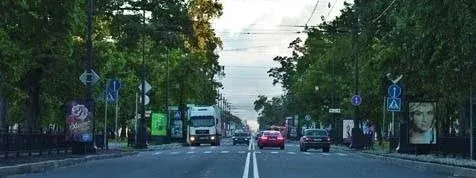
No lane lines, but two vehicles fit abreast on each side, so this road has four lanes.
Who goes first when I move off?
Section titled “Who goes first when I move off?”Everyone already moving. Moving off is a manoeuvre: you signal, and the signal gives you no advantage. You may start only if you don’t obstruct anyone on the road. Traffic you join never has to make room for you.
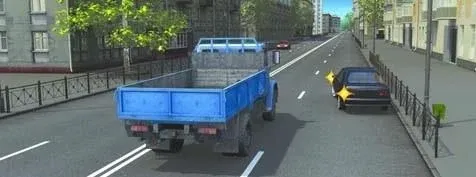
- A truck is coming up behind you in the lane: you may start only if that doesn’t obstruct it.
- A driver is already making a U-turn on the road: you wait for him to finish, even though he is the one turning.
- A driver on the road is about to stop at the kerb where you are pulling out: you give way to him.
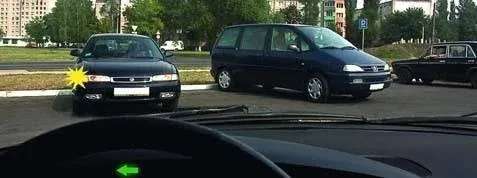
- Two cars start from a parking place at the same moment: the one behind gives way to the one ahead.
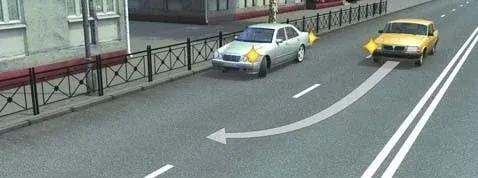
The silver car is starting to move, so it gives way to the yellow car already on the road.
Who gives way when I change lanes?
Section titled “Who gives way when I change lanes?”Point 39 has two rules.
Only you are changing lanes: give way to vehicles travelling in that lane in the same direction without changing direction. This holds wherever the change comes from:
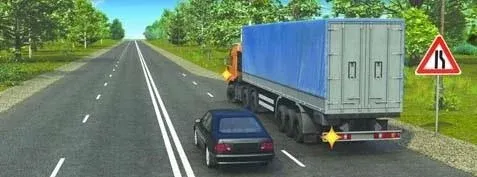
- Your lane is ending, under sign 5.15.5 “End of lane”, or the road narrows under sign 1.20.2. A lane ending gives you no right to push in.
- You are returning to your lane after overtaking. Finishing an overtake gives you no priority.
- You are driving a truck crane with orange beacons. Those beacons warn others and give no priority.
Two vehicles change lanes at the same time: the one on the left gives way. Where each is heading doesn’t matter.
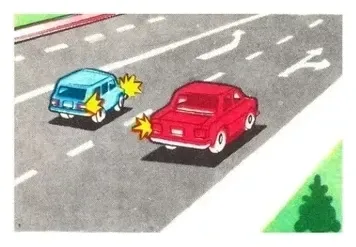
Both cars are moving into the middle lane at the same time. The red car is on the right, so the blue car gives way.
Remember: One car changing lanes: it gives way. Two at once: the left one gives way.
The same idea applies on joining a road. In an acceleration lane, you give way to vehicles on the road you are joining (point 47). The lane is there so you can match their speed, not so that they make room for you.
Extra: Check the blind spot
Not from the question bank.
Mirrors don’t show everything beside you. Before you move off or change lanes, look in the mirrors, then glance over your shoulder at the area they miss. A motorcycle can sit there unseen.
Which lane should I drive in?
Section titled “Which lane should I drive in?”It depends on where you are.
| Where | Rule |
|---|---|
| Outside built-up areas | Keep as far right as you can. You may not occupy the left lanes while the right ones are free (point 55). |
| In built-up areas | You may use whichever lane suits you (point 56). |
So after overtaking outside a built-up area, go back to the right lane if it is free. If trucks fill that lane, you may stay in the left one, because the right lane isn’t free. In a built-up area you don’t have to return at all.
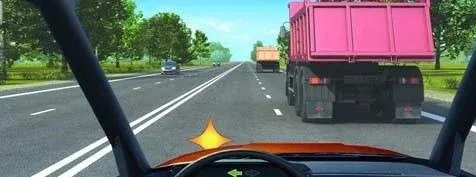
The right lane is taken, so staying in the left lane is permitted.
Common trap: After overtaking, a bare “No, I needn’t return” is wrong. The correct option states the condition: only where built-up area rules apply.
Public-use vehicles on regular passenger routes: where there are 3 or more lanes in the same direction, on any road, they may take the left edge lane only to turn left or make a U-turn. Overtaking doesn’t open it to them (point 57).
How do three-lane roads work?
Section titled “How do three-lane roads work?”On a marked two-way road with three lanes, where the middle lane serves both directions, each lane has one job.
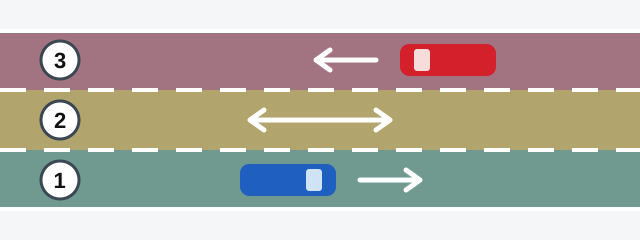
Lane 1 is your lane. Lane 2 is shared: enter it only to overtake, bypass an obstacle, turn left or make a U-turn. Lane 3 is for oncoming traffic only: you may never enter it.
This comes from point 54. You may never just drive along the middle lane. If you are turning left, the middle lane is the one you turn from, because it is the leftmost lane open to you. That holds whether the right lane is busy or free.
Common trap: Each option naming one of the four reasons is true but incomplete. Choose the option that covers them all.
May I drive on the tram tracks?
Section titled “May I drive on the tram tracks?”Only on tracks running in your direction, on your left, at the level of the road. Point 59 allows it in two kinds of case, provided you don’t obstruct a tram:
- All the lanes in your direction are occupied.
- You are overtaking, bypassing an obstacle, turning left or making a U-turn.
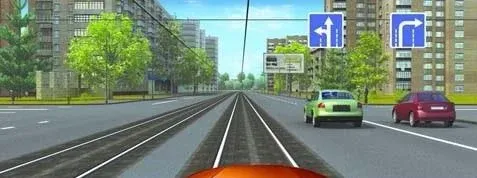
If sign 5.15.1 or 5.15.2 “Directions of travel by lanes” stands before an intersection, you may not drive on the tracks within that intersection. Then even a left turn or U-turn can’t be made from them.
Try it yourself
Section titled “Try it yourself”The blue truck fills the right lane in your direction, and you are the red car.
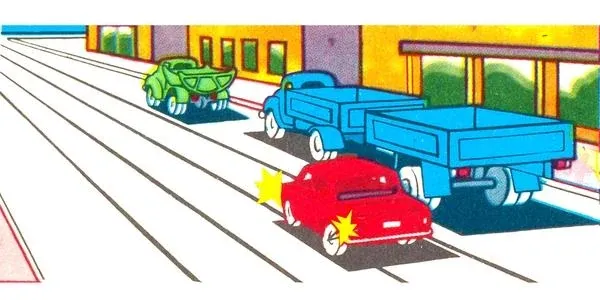
May you drive on the tram tracks? Yes. All the lanes in your direction are occupied, so point 59 allows it, as long as you don’t obstruct a tram.
You have passed the truck on this road outside a built-up area, and the right lane ahead is free.
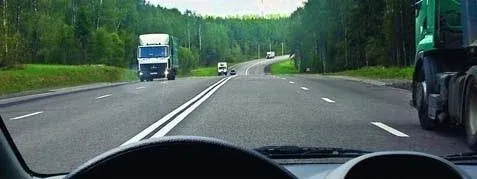
Where do you continue? Only in the right lane. Point 55 prohibits occupying the left lanes while the right ones are free.
A pedestrian waits at the left-hand kerb of this street with tram tracks. You want to pick him up.
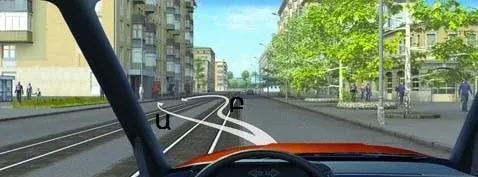
Which path? Only Բ (B). Path Ա (A) cuts diagonally across into the oncoming side. Path Բ (B) continues on your side, then turns left over the tracks as a proper manoeuvre.
Key points
Section titled “Key points”- Right-hand traffic. On an unmarked two-way road, the left half belongs to oncoming traffic.
- Moving off: give way to everyone already on the road.
- Changing lanes: give way to traffic in that lane. Two changing at once: the left one gives way.
- Outside built-up areas, keep right. In built-up areas, use any lane.
- Three lanes: the middle one only to overtake, bypass, turn left or make a U-turn. Never enter the far lane.
- Tram tracks in your direction: only if the lanes are full or you are manoeuvring, and not at an intersection with sign 5.15.1 or 5.15.2.
Practice questions
Section titled “Practice questions”Question 157. According to the RA law “On ensuring road traffic safety”, on the roads of the Republic of Armenia the following is established:
- Right-hand traffic.
- Left-hand traffic.
Show answer
Correct: 1. Right-hand traffic.
Under Article 7 of the RA law “On ensuring road traffic safety”, right-hand traffic is established for vehicles on the roads of the Republic of Armenia. That is why “Right-hand traffic.” is correct, and it is the reason vehicles here travel on the right-hand side of the carriageway. “Left-hand traffic.” is wrong — it is not established on Armenian roads.
Question 191. Is it permitted to drive along the centre of the carriageway under the indicated width conditions?
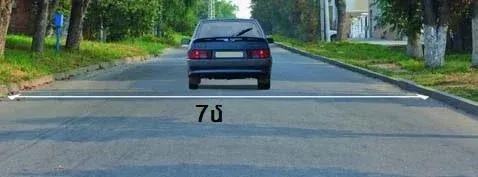
- Yes
- Yes, when there is no oncoming traffic
- No
Show answer
Correct: 3. No
Under point 52 of the Traffic Rules, on two-way roads without markings the left half of the width of the carriageway counts as the side for oncoming traffic. The carriageway in the picture is unmarked, 7 m wide and carries traffic both ways, so the driver must keep to the right half; travelling down the centre would put the car into the oncoming half. Driving along the centre is therefore not permitted - and not even when there is no oncoming traffic, because the left half is the oncoming side by definition and not only while something is coming.
Question 485. In which of the listed cases may the bus driver move into the middle lane of a three-lane two-way road, which is used for movement in both directions?
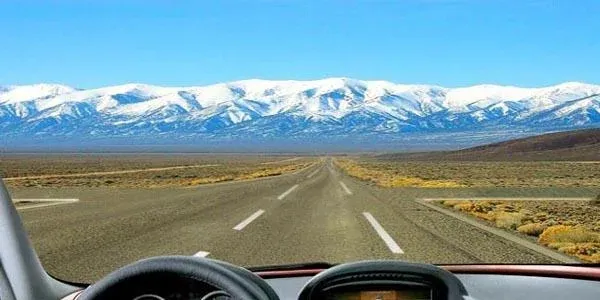
- For the purpose of overtaking or bypassing.
- For the purpose of making a left turn or a U-turn.
- In both of the above cases.
- None of the answers is correct.
Show answer
Correct: 3. In both of the above cases.
Under point 54 of the Rules, on marked three-lane two-way roads whose middle lane is used for travel in both directions, moving out into that middle lane is permitted ONLY for overtaking, for bypassing, for a left turn or for a U-turn. Both of the cases listed - overtaking or bypassing, and a left turn or U-turn - are among them, so the bus driver may move into the middle lane in either. Choosing only one of the two is wrong because point 54 permits all of those manoeuvres, and “None of the answers is correct.” is wrong for the same reason. What the middle lane may never be used for is simply driving along.
Question 523. Is it permitted, after passing ahead of the truck, to continue driving in this lane?
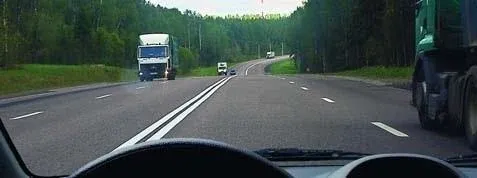
- Yes
- No
Show answer
Correct: 2. No
The road is outside a built-up area and has two lanes in each direction, the opposing flows are separated by a double solid line, the truck travels in the right lane, and the passing is carried out in the left lane of the same direction. Under point 55 of the Road Traffic Rules, outside built-up areas drivers must keep the vehicle as close as possible to the right edge of the carriageway, and in such cases occupying the left lanes while the right lanes are free is prohibited. After the passing is completed the right lane must therefore be resumed, and the answer “Yes” contradicts point 55.
Question 524. Is it permitted in this situation to continue driving in the occupied lane?
- Yes
- No
Show answer
Correct: 1. Yes
There are two traffic lanes in this direction: the lane you occupy is separated from the oncoming flow by the double solid line 1.3 on the left, and from the right-hand lane by a broken line, and that right-hand lane is taken up by the lorries. The prohibition in point 55 of the Rules on occupying the left-hand lanes applies only where the right-hand lanes are FREE, and here the right-hand lane is not free, so continuing in the lane you occupy is permitted. “No” is wrong: neither the marking nor any sign forbids travel in this lane while the lane to its right is occupied.
Question 549. How many traffic lanes does this road have
- Two
- Four
Show answer
Correct: 2. Four
There is no marking dividing this road into lanes - only the line separating the opposing streams is painted. Under the Rules, where there is no such marking the number of traffic lanes is determined by the width of the carriageway, the dimensions of the vehicles and the necessary intervals between them. On each side of the dividing line the carriageway is wide enough to take two vehicles abreast, which the vehicles in the picture themselves show, so the road has four lanes - two in each direction. “Two” counts the two directions rather than the lanes.
Question 683. Moving to the leftmost lane on two-way roads with three lanes marked with markings, of which the middle lane is used for traffic in both directions (except for roads with reversing traffic control)
- Allowed
- Prohibited
- Allowed, only to overtake, bypass, turn left or U-turn.
Show answer
Correct: 2. Prohibited
Under point 54 of the Armenian Traffic Rules, on marked two-way roads with three lanes where the middle lane is used for traffic in both directions, the leftmost lane is reserved exclusively for oncoming traffic. Drivers may enter the middle lane only to overtake, bypass, turn left or make a U-turn, but entering the leftmost lane is prohibited in all cases.
Question 690. You are driving on a road with two-way traffic having three lanes. In which case is it permitted to enter the middle lane?
- Only in case of overtaking.
- Only in case of bypassing an obstacle.
- Only in case of a left turn or a U-turn.
- In all the listed cases.
Show answer
Correct: 4. In all the listed cases.
On a two-way road with three lanes the left-hand edge lane is reserved for oncoming traffic, while point 54 of the Traffic Rules opens the middle lane to both directions - but only for particular manoeuvres: overtaking, bypassing an obstacle, a left turn and a U-turn. The question lists exactly those manoeuvres, so “Only in case of overtaking.”, “Only in case of bypassing an obstacle.” and “Only in case of a left turn or a U-turn.” are each true but each only part of the rule. The full answer is “In all the listed cases.”
Question 698. On a road with two-way traffic having three lanes you need to make a left turn. From which lane will you perform this manoeuvre?
- From the right lane.
- From the middle lane.
- From the right or the middle lane.
- From the middle lane, if the right lane is occupied.
Show answer
Correct: 2. From the middle lane.
Point 40 of the Traffic Rules requires the driver to move in advance into the edge lane of the carriageway that serves the intended direction. On a two-way road with three lanes, point 54 keeps the left-hand edge lane for oncoming traffic only, so the leftmost lane available to you is the middle one and the turn is made “From the middle lane.” “From the right lane.” and “From the right or the middle lane.” break the requirement to take the correct lane in advance, while “From the middle lane, if the right lane is occupied.” wrongly makes the use of the middle lane depend on the right lane being busy.
Question 699. Is the red car’s driver permitted to drive on the tram tracks?
- It is permitted.
- It is prohibited.
Show answer
Correct: 1. It is permitted.
In the picture the right-hand lane in this direction is occupied by the blue truck, so there is no free lane in the same direction for the red car. Under point 59 of the Traffic Rules, travelling on the tram tracks of the same direction lying to the LEFT is permitted where all the lanes in that direction are occupied, and also when overtaking, bypassing an obstacle, turning left or making a U-turn - provided no obstruction is created for a tram. The red car’s driver is therefore permitted to travel on the tram tracks running in the same direction.
Question 703. In case of simultaneous lane changing by vehicles travelling in the same direction, the way must be given by
- The driver of the vehicle travelling on the left.
- The driver of the vehicle travelling on the right.
Show answer
Correct: 1. The driver of the vehicle travelling on the left.
Point 39 of the Traffic Rules gives priority to the vehicle travelling on the right when two vehicles going in the same direction change lanes at the same moment. So the one who must give way is “The driver of the vehicle travelling on the left.”, by the same principle that yields to a vehicle coming from the right when manoeuvring between adjacent lanes. “The driver of the vehicle travelling on the right.” states the opposite and would have both drivers move into the same lane together.
Question 708. The advantage in traffic is held by
- The blue car, since the red one is changing its direction of travel to the left.
- The red car, since in case of simultaneous lane changing it is on the right side.
- The blue car, since in case of simultaneous lane changing it is on the left side.
Show answer
Correct: 2. The red car, since in case of simultaneous lane changing it is on the right side.
Under point 39 of the Traffic Rules, where vehicles travelling in the same direction change lanes SIMULTANEOUSLY, the driver of the vehicle on the left must give way. In the picture both cars are moving into the middle lane at the same time - the red one from the right, the blue one from the left - so the advantage belongs to the red car. The reason given in the first option is beside the point: what settles it is which of them is on the right during a simultaneous change, not where either is heading.
Question 710. Which vehicle’s driver must give way?
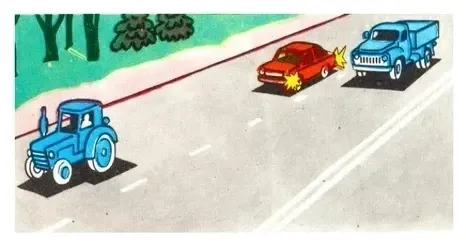
- The passenger car’s driver.
- The truck’s driver.
Show answer
Correct: 1. The passenger car’s driver.
The light passenger car has its left indicators flashing and is preparing to move into the adjacent lane on the left, because a slow tractor is ahead in its own lane. The truck at that moment is travelling in the adjacent left lane in the same direction, without changing direction and without any manoeuvre. Under point 39 of the Traffic Rules a driver changing lanes must give way to vehicles travelling in the same direction in the adjacent lanes WITHOUT changing direction, so the light passenger car’s driver must give way. “The truck’s driver.” is wrong: the truck is making no manoeuvre and keeps its advantage. Note also that under point 36 giving a signal confers no advantage over other road users - a flashing indicator asks, it does not entitle.
Question 715. In built-up areas, where there are 3 or more lanes in the same direction, is it permitted for public-use vehicles to occupy the left edge lane?
- It is permitted when overtaking.
- It is permitted when making a left turn or a U-turn.
- It is permitted in all cases.
Show answer
Correct: 2. It is permitted when making a left turn or a U-turn.
Under point 57 of the Road Traffic Rules, where there are 3 or more lanes in the same direction, public-use vehicles carrying out regular passenger transport may occupy the left edge lane only in order to make a left turn or a U-turn. In built-up areas too, then, the answer is “It is permitted when making a left turn or a U-turn” — the manoeuvre itself is what opens the lane, and only for as long as it takes. “It is permitted when overtaking” belongs to the general permission given to ordinary vehicles, not to public-use ones, and “It is permitted in all cases” ignores the restriction altogether.
Question 716. On all roads, where there are 3 or more lanes in the same direction, is it permitted for public-use vehicles to occupy the left edge lane?
- It is permitted when overtaking.
- It is permitted when making a left turn or a U-turn.
- It is permitted in all cases.
Show answer
Correct: 2. It is permitted when making a left turn or a U-turn.
Point 57 of the Road Traffic Rules applies on all roads alike, inside built-up areas and outside them: where there are 3 or more lanes in the same direction, public-use vehicles carrying out regular passenger transport may occupy the left edge lane only in order to make a left turn or a U-turn. The answer is therefore “It is permitted when making a left turn or a U-turn” — the lane is opened by the manoeuvre and only for its duration. “It is permitted when overtaking” is forbidden to them, and “It is permitted in all cases” removes the restriction entirely.
Question 725. In this situation, is the motorcycle driver obliged to give way?
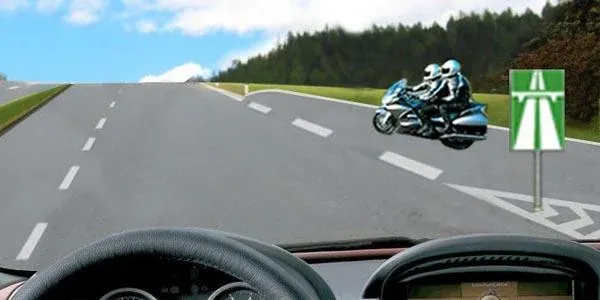
- He is not obliged.
- He is obliged.
Show answer
Correct: 2. He is obliged.
Under point 47 of the Traffic Rules, where there is an acceleration lane at the place of entry onto a road, the driver joining must give way to the vehicles travelling along that road. The picture shows sign 5.1 “Motorway”, and the motorcycle is joining it from the acceleration lane while you are already travelling in the main lane. It is therefore the motorcycle’s driver who is obliged to give way - the acceleration lane exists so that he can match your speed before merging, not so that you must make room.
Question 729. You are starting to move off from the roadside; are you obliged to give way to the passenger car that is making a U-turn?
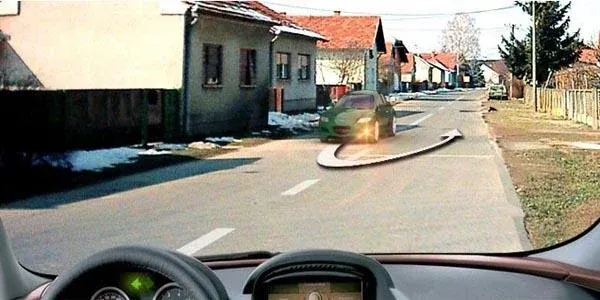
- You are obliged.
- You are not obliged.
Show answer
Correct: 1. You are obliged.
Under point 36 of the Traffic Rules, before moving off a driver must give a signal and carry out the manoeuvre so as not to create an obstruction for the other road users - which means that vehicles already moving along the carriageway have the advantage. In the picture the oncoming car is already making its U-turn on the road, so in starting off from the roadside you are obliged to give way to it. A vehicle joining the traffic always yields to the traffic it is joining.
Question 746. In this situation the one obliged to give way is
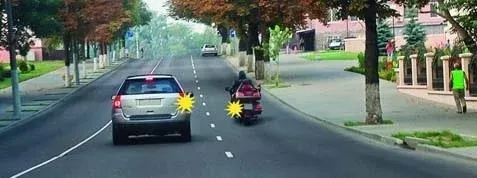
- The driver of the passenger car
- The driver of the motorcycle
Show answer
Correct: 1. The driver of the passenger car
In the picture the light passenger car is travelling in the left lane and the motorcycle in the right, and both have their indicators on: they are changing lanes towards each other at the same time. Under point 39 of the Traffic Rules, where vehicles travelling in the same direction change lanes SIMULTANEOUSLY, the driver of the vehicle on the left must give way. Since the left lane is occupied by the light passenger car, the duty to give way is its driver’s, and the motorcyclist on the right has the advantage in this mutual manoeuvre.
Question 747. In the situation shown in which picture does the driver of the blue car have the right of priority over the other driver
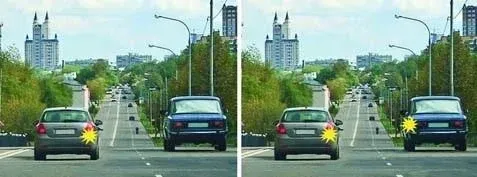
- Left
- Right
- Both
Show answer
Correct: 3. Both
In the left picture the grey car, with its right indicator on, is changing lanes into the blue car’s lane while the blue car travels in its own lane without changing direction; under point 39 of the Traffic Rules the driver changing lanes must give way. In the right picture both drivers have their indicators on and are changing lanes at the same time, and under the same point 39 a simultaneous change is settled by the one on the LEFT giving way - which is the grey car’s driver. In both pictures, therefore, the right of priority travel belongs to the driver of the blue car.
Question 749. The driver of which vehicle must give way
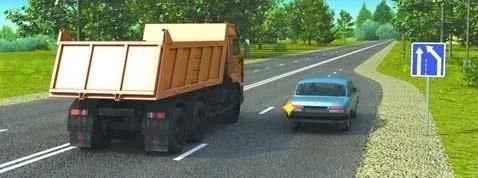
- Of the truck
- Of the passenger car
Show answer
Correct: 2. Of the passenger car
Sign 5.15.5 “End of lane” on the right announces that the right-hand lane is coming to an end, so it is the light passenger car’s driver who must move across into the left lane. Under point 39 of the Traffic Rules a driver changing lanes must give way to vehicles travelling in the same direction in the adjacent lane WITHOUT changing direction. The light passenger car’s driver therefore gives way, while the truck, travelling in its own lane without changing direction, has the advantage - a lane ending gives its users no right to push in.
Question 754. Is the driver of the passenger car obliged to give way to the driver of the truck crane changing lanes into his lane
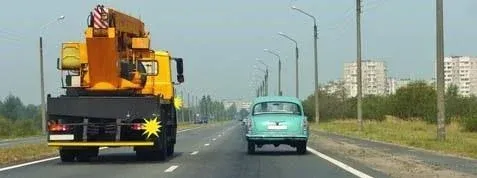
- Yes, if the truck crane is equipped with orange beacons
- Yes
- No
Show answer
Correct: 3. No
Under point 39 of the Traffic Rules a driver changing lanes must give way to vehicles travelling in the same direction in the adjacent lane without changing direction. In the picture it is the truck crane that is moving into the light passenger car’s lane, so the crane is the one obliged to give way, not the car. Nor do beacons change that: under points 32 and 33 orange (yellow) flashing beacons confer NO priority in traffic and serve only to warn, so “Yes, if the truck crane is equipped with orange beacons” is wrong as well.
Question 756. Is the driver of the passenger car obliged to change lanes into the right edge lane after finishing the overtaking
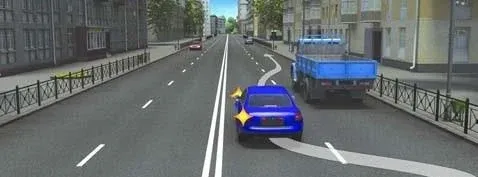
- No, if the rules for driving in a built-up area apply
- Yes
- No
Show answer
Correct: 1. No, if the rules for driving in a built-up area apply
In the picture the light passenger car is finishing overtaking the truck on a multi-lane road inside a built-up area. Under point 56 of the Traffic Rules, in built-up areas drivers may travel in whichever traffic lane suits them. So if the rules for movement in a built-up area apply, the driver is not obliged to return to the right edge lane after finishing the overtake and may remain in the left lane. Outside a built-up area the answer would be different, which is why the correct option states the condition rather than answering with a bare “No”.
Question 758. Which driver must give way
- The driver starting to move
- The driver preparing to stop
Show answer
Correct: 1. The driver starting to move
In the picture the silver car, with its left indicator on, is moving off from the kerb, while the yellow car, with its right indicator on, is travelling in the lane and preparing to stop at the kerb. Under point 36 of the Traffic Rules giving a signal confers no advantage over the other road users and the manoeuvre must create no obstruction, and under point 39 a driver changing lanes gives way to those already travelling in that lane. The driver starting to move must therefore give way to the driver already on the road who is preparing to stop.
Question 765. The driver travelling without changing lanes, giving way to the driver changing lanes from the right
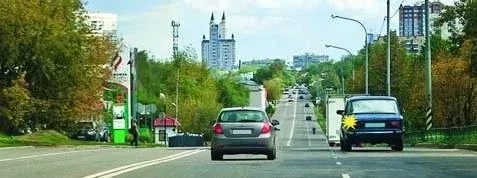
- Is not obliged
- Is obliged
Show answer
Correct: 1. Is not obliged
Under point 39 of the Traffic Rules a driver changing lanes must give way to the drivers of vehicles travelling in the same direction in the adjacent lanes WITHOUT changing direction. In the picture the car on the right, with its left indicator on, is changing lanes, while the car on the left is travelling without changing lanes. The driver going straight on is therefore not obliged to give way to the one changing lanes from the right; on the contrary, the duty to give way rests on the driver making the manoeuvre.
Question 767. When starting to move from a parking place at the same time, are you obliged to give way to the driver located ahead
- Yes
- No
Show answer
Correct: 1. Yes
Starting off is a manoeuvre, and under the Rules a driver making a manoeuvre must give way and must not obstruct other vehicles. When two drivers start off from a parking place at the same moment neither has the advantage that belongs to traffic already moving, and it is the driver in front who reaches the stream first. Being behind him, you are therefore obliged to give way to the driver located ahead and not to cut across his path.
Question 773. Is the driver of the passenger car permitted to start moving
- Yes
- Yes, if it does not obstruct the truck driver
- No
Show answer
Correct: 2. Yes, if it does not obstruct the truck driver
In the picture the light passenger car, with its indicator on, is preparing to move off from the edge of the carriageway, while a truck is coming up from behind in the same lane. Under point 36 of the Traffic Rules a driver must signal with the indicator before moving off, but giving a signal confers no advantage, and the manoeuvre must create no obstruction for the other road users. The passenger car’s driver may therefore start only if he does not obstruct the truck already travelling in the lane. “Yes” is wrong because a driver moving off has no priority, and “No” is wrong because moving off without obstructing anyone is permitted.
Question 775. In the given situation, is the driver permitted to travel along the tram tracks
- Yes
- It is permitted only when making a U-turn or a left turn
- No
Show answer
Correct: 3. No
Under point 59 of the Traffic Rules, travelling on the same-direction tram tracks lying to the left at the same level is permitted only when all the lanes in that direction are occupied, and also when overtaking, bypassing an obstacle, turning left or making a U-turn - BUT where signs 5.15.1 or 5.15.2 are placed before an intersection, travelling on the tram tracks within the intersection is prohibited. In the picture signs 5.15.2 stand before the intersection - straight or left from the left lane, right from the right lane - and the same-direction lanes are not occupied, so travelling on the tram tracks is prohibited. “It is permitted only when making a U-turn or a left turn” is wrong, because with 5.15.1 or 5.15.2 in place even a left turn or a U-turn may not be made from the tram tracks at the intersection.
Question 781. The one who must give way is
- The driver of the passenger car
- The driver of the truck
Show answer
Correct: 2. The driver of the truck
Sign 1.20.2 “Narrowing of the road” stands on the right - the narrowing is from the right - so the truck’s right-hand lane is ending and, with its left indicator on, it is preparing to move into the left lane, along which the light passenger car is travelling without changing direction. Under point 39 of the Traffic Rules a driver changing lanes must give way to vehicles travelling in the same direction in the adjacent lane without changing direction. The one who must give way is therefore the truck’s driver, while the light passenger car, holding its own lane, has the advantage.
Question 785. Changing lanes into the adjacent lane in this situation
- You are obliged to give way to the drivers travelling in that lane
- You have priority of travel
Show answer
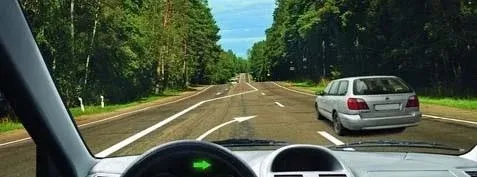
Correct: 1. You are obliged to give way to the drivers travelling in that lane
Under point 39 of the Traffic Rules a driver changing lanes must give way to the vehicles travelling in the same direction in the adjacent lane without changing direction. In the picture you have switched on your right indicator and are preparing to move into the right lane, along which a light passenger car is already travelling without changing direction. Under point 36 giving a signal confers no advantage, so you are obliged to give way to the drivers travelling in that lane, and “You have priority of travel” is wrong.
Question 789. When starting to move, are you obliged to give way to the driver making a U-turn
- Yes
- No
Show answer
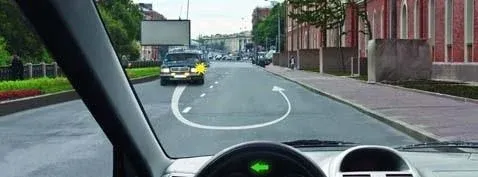
Correct: 1. Yes
Moving off from a stopping place is itself a manoeuvre under sub-point 6 of point 3 of the Traffic Rules, and under the definition of “giving way” in Article 2 of the law “On ensuring road traffic safety” a driver must not start or resume movement if that would force drivers who have the advantage to change their direction or speed unexpectedly. In the picture you are only now starting off from the stopping place with your left indicator on, while the car already travelling on the road is making a U-turn and has the advantage. Under point 36 giving a signal confers no advantage, so you are obliged to give way, and the answer is yes.
Question 800. After passing ahead of the truck, in which lane may you continue driving?
- Only the right one
- It is permitted in both lanes going the same direction
Show answer
Correct: 1. Only the right one
The picture shows a multi-lane road outside a built-up area: you are passing the truck in the left lane of your direction, and the right lane ahead is free. Under point 55 of the Traffic Rules, outside built-up areas drivers must keep as close as possible to the right-hand edge of the carriageway, and occupying the left lanes is prohibited while the right lanes are free - so after passing ahead of the truck you may continue only in the right lane. point 73 requires nothing different: it only obliges a driver, before starting to overtake, to make sure that he will be able to return to the lane he was in without obstructing anyone.
Question 803. When changing lanes simultaneously, which vehicle’s driver has the right of way?
- The truck’s
- The passenger car’s
Show answer
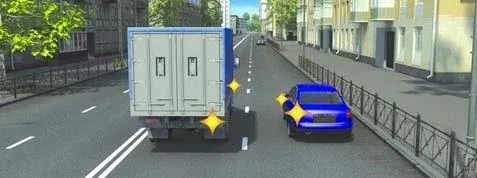
Correct: 2. The passenger car’s
In the picture both vehicles are changing lanes simultaneously: the truck is in the left lane and the light passenger car in the right. Under point 39 of the Traffic Rules, where vehicles travelling in the same direction change lanes at the same time, the driver of the vehicle on the LEFT must give way. The truck is therefore obliged to yield, and the right of priority travel belongs to the driver of the light passenger car.
Question 927. Does the driver of the car completing an overtake have priority, when changing into the lane going in the same direction, over the driver travelling in that lane?
- No
- Yes
Show answer
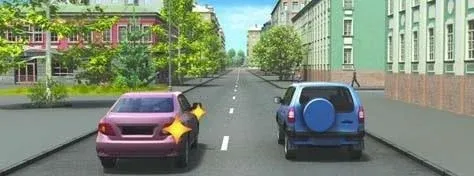
Correct: 1. No
Returning to the right-hand lane at the end of an overtake is a change of lane, and under point 39 of the Traffic Rules a driver changing lanes must give way to vehicles travelling in the same direction in the adjacent lane without changing direction - here to the blue car already in that lane. The right indicator lit on the pink car in the picture changes nothing: point 36 states plainly that giving a signal confers no advantage over the other road users. “Yes” is therefore wrong - finishing an overtake creates no priority in the lane you are returning to.
Question 1015. Along which trajectory is it permitted to approach the pedestrian waiting at the kerb
- Only Ա (A)
- Only Բ (B)
- It is permitted along both trajectories
Show answer
Correct: 2. Only Բ (B)
The pedestrian is waiting at the left-hand kerb, and driving out onto the tram tracks running the same way is not in itself prohibited. The road, however, carries traffic in both directions, and a driver may not simply cross to the opposite side and travel along it. Trajectory Ա (A) does exactly that - it cuts straight across on the diagonal to the left-hand kerb, out into the oncoming carriageway - so the pedestrian may not be approached that way. Trajectory Բ (B) goes forward on its own side, then turns left over the tram tracks and only then pulls up at the kerb: the change of direction is made as a proper manoeuvre rather than by driving along the oncoming side. Approaching is therefore permitted along Բ (B) only, and “Only Ա (A)” and “It is permitted along both trajectories” are wrong.