After a Crash
The first minutes after a crash can decide who survives, and a rescuer who rushes in can become the next casualty. This lesson gives you the order of action.
Remember: This lesson does not replace a first-aid course.
What must a driver involved in a crash do?
Section titled “What must a driver involved in a crash do?”Article 24 of the RA law “On ensuring road traffic safety” requires all three:
- Stop the vehicle immediately.
- Switch on the hazard warning light signal.
- Leave the vehicle and the objects connected with the accident where they are.
What do I do first?
Section titled “What do I do first?”- Ensure safety. Switch off the engine, put on the hazard lights, set out the emergency stop sign, and judge the risk of fire, spilt fuel or electricity.
- Check consciousness and breathing. A blocked airway kills within minutes. A broken bone does not.
- Check for severe bleeding, call the ambulance and treat the injuries.
- Make the casualty comfortable.
Common trap: Even with a bone sticking out, check consciousness and breathing before you call or immobilize the leg.
Extra: If someone else is with you
Not from the question bank.
Point at one person and ask them to call the ambulance straight away while you check the casualty.
What if I can’t make the scene safe?
Section titled “What if I can’t make the scene safe?”The rescuer must not become a casualty, and sending someone else in only exposes them.
- Do not approach.
- Call for help immediately.
- Keep bystanders away.
Who do I help first?
Section titled “Who do I help first?”The one whose condition can kill soonest. An unconscious person can’t keep their own airway open, so they come before a fractured forearm, scratches or a frightened pregnant woman.
When do I take a casualty out of the car?
Section titled “When do I take a casualty out of the car?”Moving can worsen spinal or internal injuries, so do it only when staying is more dangerous:
- The car will probably overturn, catch fire or explode.
- The casualty has hypothermia, or loss of consciousness and breathing.
- First aid can’t be given in the cabin.
Serious injuries, heavy bleeding or a craniocerebral injury (skull and brain) are not reasons on their own.
Common trap: With a power wire on the car, people must stay inside until the current is switched off. See the lesson on fractures and burns.
Extra: If you must move someone
Not from the question bank.
Move them as little as you can, and keep the head, neck and back in line without twisting.
What do I tell the ambulance operator?
Section titled “What do I tell the ambulance operator?”- Place: the street, the house number and the nearest landmarks.
- Casualties: how many, their sex and approximate age.
- State: consciousness, breathing, blood circulation, heavy bleeding, fractures and other injuries.
Then wait until the operator states that the call has been accepted.
May I give medicines?
Section titled “May I give medicines?”No, not even in extreme necessity. You don’t know the casualty’s illnesses, allergies or what they have taken. A casualty who is unconscious or has an internal injury gets nothing by mouth at all.
Where is a hit pedestrian hurt?
Section titled “Where is a hit pedestrian hurt?”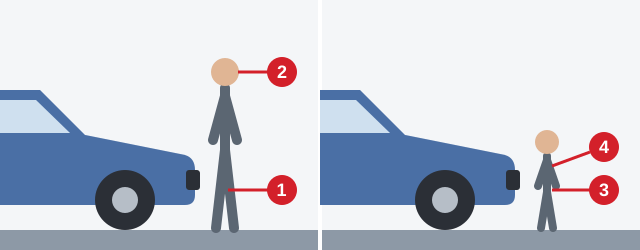
A low car hitting an adult of 1 m 55 cm or more injures the lower limb (1) and the head (2). The head hits the bonnet or windscreen, then the road. With a child of 3-5 years, the bumper meets the pelvis (3) and chest (4).
Try it yourself
Section titled “Try it yourself”You hear an engine in your neighbor’s garage, open the door and see your neighbor on the ground.
What comes first? Open the doors wide, switch off the engine and, if possible, move your neighbor away. The engine produces carbon monoxide, an odorless and lethal gas that would poison you too.
Key points
Section titled “Key points”- Involved in a crash: stop, hazard lights on, move nothing.
- Make the scene safe first. If you can’t, stay out, call for help and keep others away.
- Check consciousness and breathing first. An unconscious casualty comes before all others.
- Move a casualty only if staying is more dangerous. Never give medicines.
Practice questions
Section titled “Practice questions”Question 164. According to the RA law “On ensuring road traffic safety”, in case of being involved in a road traffic accident the driver of a vehicle is obliged to:
- Immediately stop the vehicle.
- Switch on the hazard warning light signal.
- Not move the objects connected with the accident.
- Perform all the listed actions.
Show answer
Correct: 4. Perform all the listed actions.
Under Article 24 of the RA law “On ensuring road traffic safety”, a driver involved in a road traffic accident must immediately stop the vehicle, switch on the hazard warning light signal in the established manner, and leave both the vehicle and the objects connected with the accident where they are. All three duties apply at once, so “Immediately stop the vehicle.”, “Switch on the hazard warning light signal.” and “Not move the objects connected with the accident.” are each only part of what is required, and the answer is “Perform all the listed actions.”
Question 551. In a road accident, which of the following casualties will you assist first?
- A frightened pregnant woman.
- A child with scratches.
- A man with a fractured forearm.
- An unconscious man.
Show answer
Correct: 4. An unconscious man.
When there are several casualties, help goes first to the one whose condition can kill soonest. An unconscious person cannot keep his own airway open — the tongue can fall back, vomit can be inhaled, breathing can stop — so “An unconscious man.” is the correct answer. “A frightened pregnant woman.” is in emotional shock but in no immediate danger to life, “A child with scratches.” has only surface injuries, and “A man with a fractured forearm.” has a painful limb fracture that is not immediately life-threatening. All three are attended to after the unconscious casualty’s breathing has been secured.
Question 559. What must be done if it is not possible to ensure the safety of the scene?
- Assist everyone, but be careful.
- Assist the casualty who is closer to you.
- Do not approach, immediately call for help and do not let bystanders approach the scene.
- Do not approach, ask someone else to give assistance.
Show answer
Correct: 3. Do not approach, immediately call for help and do not let bystanders approach the scene.
The first rule of first aid is that the rescuer must not become a casualty. If the safety of the scene cannot be ensured, you do not approach: you call for help immediately and keep bystanders away from the scene. “Assist everyone, but be careful.” and “Assist the casualty who is closer to you.” both mean entering the dangerous area, which only adds to the number of casualties, and “Do not approach, ask someone else to give assistance.” exposes someone else to the very same danger.
Question 560. You see a fallen person and notice a bone protruding from his lower leg and blood. If the scene is safe, what must be done first?
- Call the ambulance.
- Check consciousness and breathing.
- Immobilize the leg.
Show answer
Correct: 2. Check consciousness and breathing.
The bone protruding from the lower leg is the most striking injury, but not the most dangerous one. The first thing to do is to check consciousness and breathing, because an absent airway kills within minutes while the fracture itself does not. What follows depends on that check - what you tell the emergency service, and whether resuscitation is needed. “Call the ambulance.” and “Immobilize the leg.” are both right things to do, but they come after consciousness and breathing have been checked.
Question 566. In case of a road accident, first of all you must:
- Bring the casualty into a comfortable position.
- Survey the scene and ensure safety.
- Check the casualty for the presence of severe bleeding.
- Move the casualty out of the car.
Show answer
Correct: 2. Survey the scene and ensure safety.
At the scene of a road accident the first step is to survey the scene and ensure safety - switch off the engine, put on the hazard lights, set out the emergency stop sign, and judge the risk of fire, spilt fuel or electricity. Without that the rescuer becomes a casualty too, and the number of casualties grows. “Check the casualty for the presence of severe bleeding.” matters, but comes after the scene is safe; “Bring the casualty into a comfortable position.” comes later still; and “Move the casualty out of the car.” is done only where staying is more dangerous than being moved.
Question 570. In case of an accident the casualty must be moved out of the car if:
- The casualty has serious injuries.
- The scene is dangerous, for example there is a danger of explosion.
- A power line wire has fallen onto the car.
Show answer
Correct: 2. The scene is dangerous, for example there is a danger of explosion.
Moving a casualty out of a car is itself dangerous - it can worsen spinal or internal injuries - so it is done only when the scene is dangerous, for example there is a danger of explosion, and staying is the greater risk. “The casualty has serious injuries.” is the opposite reasoning: the more serious the injury, the more dangerous the move. And “A power line wire has fallen onto the car.” is the one case where getting out is lethal - the people inside the car are protected, and they must stay there until the current is switched off.
Question 572. You hear the sound of a car engine from your neighbor’s garage and, opening the door, you see your neighbor lying on the ground. What must be done first?
- Open the doors wide and switch off the engine, and if possible move the casualty away from the scene.
- Thoroughly examine the casualty’s body to detect injuries.
- Bring the casualty into the lateral recovery position.
- Help the casualty take a semi-sitting position.
Show answer
Correct: 1. Open the doors wide and switch off the engine, and if possible move the casualty away from the scene.
An engine running in a closed garage produces carbon monoxide, an odourless and lethal gas, and that is why the neighbour is on the ground. The first step is to remove the source of danger: open the doors wide and switch off the engine, and if possible move the casualty away from the scene. “Thoroughly examine the casualty’s body to detect injuries.”, “Bring the casualty into the lateral recovery position.” and “Help the casualty take a semi-sitting position.” all mean staying in a gas-filled space, which poisons the rescuer as well.
Question 582. In case of a collision of a low-bodied car with an adult pedestrian whose height is 1 m 55 cm or more, the most probable injuries are:
- Injury of the lower limb and the head.
- Injury of the pelvis and the chest.
Show answer
Correct: 1. Injury of the lower limb and the head.
The bumper of a low-bodied car strikes an adult of 1 m 55 cm or more at the level of the lower limbs, which is the first injury. The body is then thrown onto the bonnet, the head strikes the bonnet or the windscreen, and the person falls to the road - a second blow to the head. So the most probable injuries are injury of the lower limb and the head. “Injury of the pelvis and the chest.” is not typical for an adult of that height struck by a low-bodied car, because the bumper does not reach that level.
Question 583. In case of a collision of a low-bodied car with a 3-5 year old child, the most probable injuries are:
- Injury of the lower limb and the head.
- Injury of the pelvis and the chest.
Show answer
Correct: 2. Injury of the pelvis and the chest.
A child of 3-5 years is short enough that the bumper of a low-bodied car meets him not at the legs but at the level of the pelvis and the chest, and that is where the main injuries occur. “Injury of the lower limb and the head.” is what happens to an adult, whose legs the bumper reaches and whose head then strikes the bonnet; with a child the blow lands at a different level, so that answer is wrong.
Question 587. In case of an accident, what information must be given to the operator when calling the ambulance?
- State the landmark nearest to the accident site. Report the number of casualties, state their sex and age.
- State the street and house number nearest to the accident site. Report who was injured as a result of the accident (pedestrian, driver of the car, or passenger) and describe the injuries received.
- State the place of the accident (the street, the house number and the landmarks nearest to the scene). Report the number of casualties, their sex, approximate age, the state of consciousness, breathing, blood circulation, as well as the presence of heavy bleeding, fractures and other injuries. Wait until the operator states that the call has been accepted.
Show answer
Correct: 3. State the place of the accident (the street, the house number and the landmarks nearest to the scene). Report the number of casualties, their sex, approximate age, the state of consciousness, breathing, blood circulation, as well as the presence of heavy bleeding, fractures and other injuries. Wait until the operator states that the call has been accepted.
When calling the ambulance the operator needs the whole picture, so that the right crew reaches the right place: the place of the accident (the street, the house number and the landmarks nearest to the scene), the number of casualties, their sex, approximate age, the state of consciousness, breathing and blood circulation, and whether there is heavy bleeding, fractures or other injuries - and you wait until the operator states that the call has been accepted. The other two answers are incomplete: one gives only a landmark and no address, the other an address but nothing about the casualties’ condition, and neither waits for the call to be confirmed.
Question 595. Is it permitted to give the casualty medicines while giving first aid?
- It is permitted
- It is permitted in case of extreme necessity
- It is prohibited
Show answer
Correct: 3. It is prohibited
Someone giving first aid is not a doctor: they do not know the casualty’s illnesses, allergies or what medicines have already been taken, and cannot judge the real extent of the injury. A medicine can mask symptoms, get in the way of later treatment, or simply do harm - especially to a casualty who is unconscious or has an internal injury, who must be given nothing by mouth at all. Giving the casualty medicines while giving first aid is therefore prohibited, and “It is permitted in case of extreme necessity” is wrong because no such exception exists.
Question 599. In which cases must the casualty be taken out of the car’s cabin?
- In case of a high probability of the car overturning, catching fire, exploding, or of the casualty’s loss of consciousness.
- In case of a high probability of the car overturning, catching fire, exploding, or of the casualty’s hypothermia, loss of consciousness and breathing, as well as in case it is impossible to give first aid directly in the cabin.
- In case of a high probability of the car overturning, catching fire, exploding, or in case the casualty has heavy bleeding or a craniocerebral injury
Show answer
Correct: 2. In case of a high probability of the car overturning, catching fire, exploding, or of the casualty’s hypothermia, loss of consciousness and breathing, as well as in case it is impossible to give first aid directly in the cabin.
Taking a casualty out of the car’s cabin is itself dangerous, so it is done only where staying is more dangerous still: a high probability of the car overturning, catching fire or exploding, the casualty’s hypothermia, loss of consciousness and breathing, and also where it is impossible to give first aid directly in the cabin. The other two answers are incomplete - one leaves out loss of breathing, which is precisely the case where resuscitation cannot be done in a seat, and the other replaces it with heavy bleeding and a craniocerebral injury, neither of which is by itself a reason to move the casualty.