Safe Driving
Knowing the rules gets you a licence, but your habits get you home. This lesson covers what the exam asks about belts, children and helmets, and the extras below hold the habits that keep you out of trouble.
Who must wear a seat belt?
Section titled “Who must wear a seat belt?”A learner at the wheel counts as a driver, so a learner must wear a belt during training. Article 24 of the RA law releases only one person: the driving instructor, and only while the learner is driving.
Common trap: “Not if it makes driving difficult” and “not if the instructor permits it” are wrong. The law has no such conditions.
Where may children sit?
Section titled “Where may children sit?”A child can sit in the front seat of a passenger car without a child restraint device only from 12 years of age (point 159).
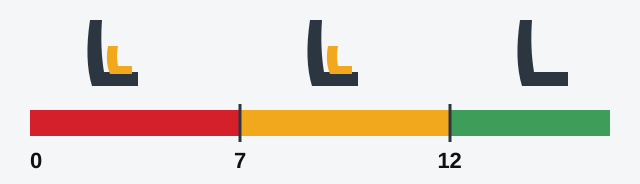
Under 7 (red): a child restraint is compulsory. From 7 up to 12 (yellow): the front seat is allowed only with a restraint that fits the child’s weight and height. From 12 (green): the front seat is allowed without one.
Who needs a helmet?
Section titled “Who needs a helmet?”Anyone travelling on the carriageway by motorcycle, moped or bicycle must wear a fastened helmet (Article 24 of the RA law). Protective goggles aren’t required.
Try it yourself
Section titled “Try it yourself”A 10-year-old wants to sit in the front of your car, and you have no child restraint device. May they? No. Until they are 12, the front seat requires a restraint.
Good habits
Section titled “Good habits”These extras aren’t exam material, but they matter on every drive.
Extra: Leave room in front of you
Not from the question bank.
The gap ahead is your thinking and braking time. Pick a fixed point such as a pole. When the car ahead passes it, count how long you take to reach it, and leave at least a few seconds. Leave more at night, in rain, on snow or behind a large vehicle. If someone is too close behind you, ease off gently to make extra room in front.
Extra: Tiredness
Not from the question bank.
Tired drivers react late and can fall asleep for a moment without knowing it. Yawning, heavy eyes, drifting in the lane or missing a turning are all warnings. Opening a window or turning up the radio doesn’t fix them. Stop somewhere safe and rest, and take regular breaks on long journeys.
Extra: Alcohol and drugs
Not from the question bank.
Alcohol slows your reactions, narrows your attention and makes you feel more capable than you are. The same goes for many drugs, including some medicines, so read the leaflet or ask a pharmacist. Coffee, cold air or a shower won’t sober you up: only time does that. If you plan to drink, don’t plan to drive.
Extra: Phones and distraction
Not from the question bank.
A glance at a screen can cover a long stretch of road with nobody watching it. Even a hands-free conversation takes attention away from driving. Put the phone out of reach, set the navigation before you leave, and stop if a call or message really can’t wait.
Extra: Night and bad weather
Not from the question bank.
At night you can see only as far as your lights reach, so slow down enough to stop within that distance. In rain, tyres grip less, and the first minutes after a dry spell are the most slippery. On snow and ice, do everything gently: steer, brake and accelerate one at a time. In fog, slow down and keep the edge of the road in view.
Extra: Road manners
Not from the question bank.
Signal early, let people merge, and thank those who help you. If another driver makes a mistake or gets angry, don’t compete or reply. Give them space and let them go. Always watch for people who may not have seen you, such as children, older pedestrians and cyclists.
Extra: Saving fuel and cutting pollution
Not from the question bank.
Smooth driving uses less fuel. Look far ahead, ease off early and avoid hard acceleration. Keep your tyres at the right pressure, remove roof racks and unneeded weight, and switch off the engine during long waits. Regular servicing keeps exhaust fumes down. A cold engine pollutes most, so combine short trips into one.
Key points
Section titled “Key points”- A learner driver must wear a belt. Only the instructor is released, while the learner drives.
- Children reach the front seat without a restraint at 12.
- Under 7, a child restraint is compulsory.
- Riders on motorcycles, mopeds and bicycles need a fastened helmet on the carriageway. Goggles aren’t required.
Practice questions
Section titled “Practice questions”Question 143. Is a learner driver obliged to be fastened with seat belts during training driving?
- Obliged.
- Not obliged.
- Not obliged, if it makes driving the car difficult.
- Not obliged, if the driving instructor permits it.
Show answer
Correct: 1. Obliged.
A learner at the wheel is a driver for this purpose and must be wearing a seat belt during training driving. Under Article 24 of the RA law ‘On ensuring road traffic safety’, the only person released from the belt requirement during training driving is the driving instructor, and only while the learner is driving the vehicle. That exemption does not extend to the learner, so ‘Obliged.’ is correct, and the law contains no condition such as ‘Not obliged, if it makes driving the car difficult.’ or ‘Not obliged, if the driving instructor permits it.’
Question 631. On the front seat of a light passenger car, if it is not equipped with a child restraint device, it is permitted to transport children if they have reached:
- 10 years of age.
- 11 years of age
- 12 years of age.
Show answer
Correct: 3. 12 years of age.
Under point 159.1 of the Traffic Rules, children from 7 up to 12 years of age may be carried on the front seat of a light passenger car only with a child restraint system (device) matching the child’s weight and height, and point 159 makes a restraint compulsory for children under 7 as well. So without a child restraint device the front seat is open only to a child who has reached “12 years of age”. At “10 years of age” and at “11 years of age” the restraint is still compulsory in the front seat, so those answers are wrong.
Question 1029. According to the RA law “On ensuring road traffic safety”, cyclists are prohibited from riding on the carriageway:
- Without protective goggles.
- Without a helmet.
- In both cases.
Show answer
Correct: 2. Without a helmet.
Under Article 24 of the RA law “On ensuring road traffic safety”, a person travelling on the carriageway by motorcycle, and likewise by moped or bicycle, is obliged to wear a fastened helmet. A cyclist is therefore prohibited from riding on the carriageway “Without a helmet.” Protective goggles are not required by the law at all, so riding without them is not prohibited and “In both cases.” is wrong.