Road Markings
Markings give orders just as signs do, and they sit right under your wheels. The practice questions often show one marking on its own, so this lesson goes through them by number.
Horizontal markings (numbers starting with 1) are painted on the road. Vertical markings (numbers starting with 2) are painted on structures beside and above it.
Remember: Permanent markings are white, and temporary ones are orange. If they disagree, follow the orange marking (points 170 and 174). It shows the road as it is today, for example during repairs.
Which lines may I cross?
Section titled “Which lines may I cross?”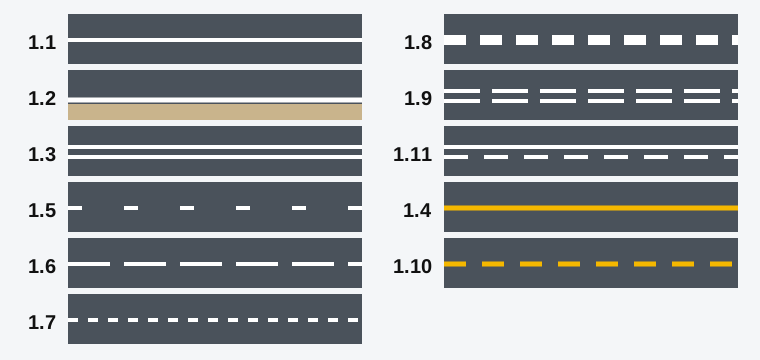
The lines by number, simplified. Yellow lines 1.4 and 1.10 are covered further on.
| No. | Looks like | Meaning and crossing |
|---|---|---|
| 1.1 | Solid line | Separates traffic flows and borders parking places and islands. Don’t cross, except to enter or leave a parking place |
| 1.2 | Solid edge line | Shows the edge of the carriageway. Cross only to stop on the shoulder, where stopping is permitted |
| 1.3 | Double solid line | Separates opposing flows on roads with four or more lanes. Don’t cross |
| 1.5 | Broken line | Separates opposing flows on roads with two or three lanes. May be crossed from either side |
| 1.6 | Dashes about three times longer than the gaps | Warns that solid line 1.1 or 1.11 is coming. Finish overtaking now |
| 1.7 | Short dashes with equal gaps | Shows the lanes inside an intersection, so you leave it in the right lane. It doesn’t show permitted directions |
| 1.8 | Broad broken line | Separates a main lane from an acceleration or deceleration lane |
| 1.9 | Double broken line | Bounds reversible lanes |
| 1.11 | Solid line beside a broken line | Cross from the broken side. Cross from the solid side only to complete an overtaking or a bypass |
1.1 bordering parking places. You may cross it to park or to drive out.
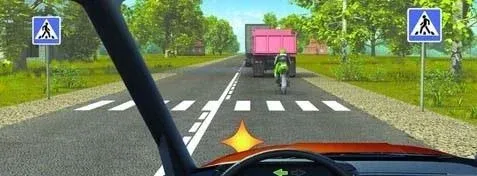
1.1 before pedestrian crossing 1.14.1, then a broken line after it. You may cross the line only after the crossing.
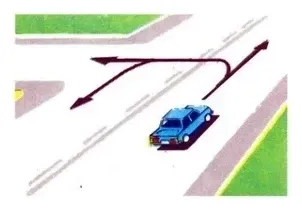
1.3 on your left. A left turn and a U-turn both cross it, so you may only go straight.
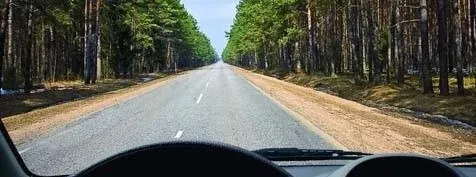
A broken centre line. You may cross it to overtake, bypass an obstacle or make a U-turn, but the far side isn’t your side. Don’t drive to the left of the line or along it, and return when the manoeuvre is done.
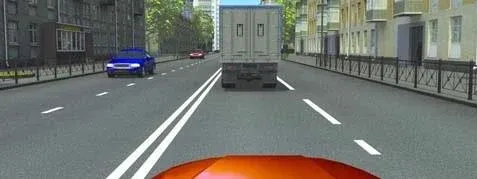
1.6 on the right. The dashes grow longer, so the line will soon turn solid.
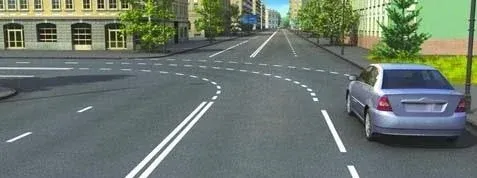
1.7 guiding you through the intersection.
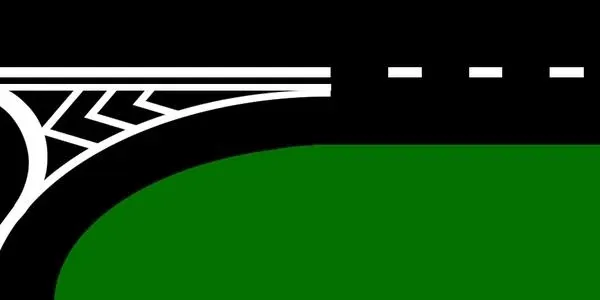
1.8 where a slip road joins: the boundary of an acceleration lane.
A broken line along the side of a two-lane road just shows the edge of the carriageway. It gives you no right to stop on the shoulder or to drive along it.
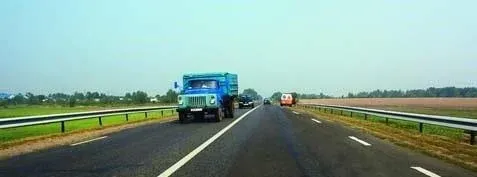
Marking 1.9 and reversible lanes
Section titled “Marking 1.9 and reversible lanes”
1.9: the boundaries of lanes with reversible traffic.
Reversible lights control these lanes. When the lights are off or absent, 1.9 separates opposing flows, and you may cross it only when it lies on your right. So with the lights off, you can’t cross it to your left, even to overtake.
What do the yellow lines at the edge mean?
Section titled “What do the yellow lines at the edge mean?”- 1.4, solid yellow: no stopping and no parking. It is drawn near the edge of the carriageway or on top of the kerbstone, alone or with sign 3.27 “No stopping”.
- 1.10, broken yellow: no parking. It is used alone or with sign 3.28 “No parking”.
Remember: Solid yellow means no stopping. Broken yellow means no parking.
What does the zigzag mean?
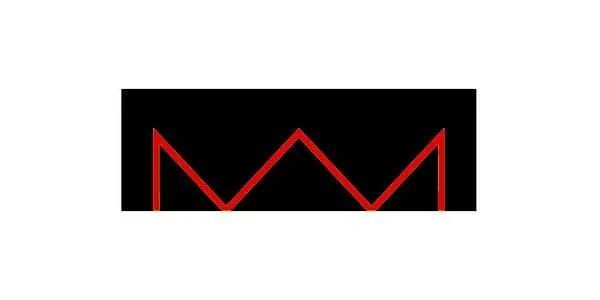
Section titled “What does the zigzag mean?”1.17 marks a stopping point for public-use vehicles. Where sign 5.18 “Parking place for light passenger taxis” stands, it also marks taxi parking.
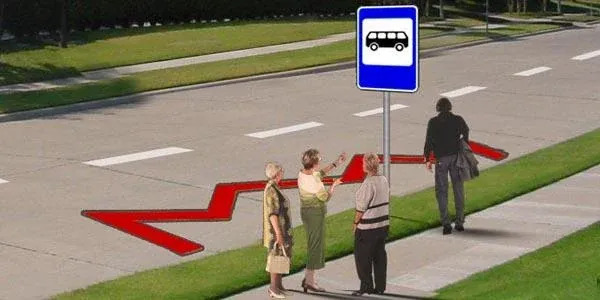
1.17 with a bus stop sign and no sign 5.18, so here it is a stopping point only.
Which markings tell me to stop or give way?
Section titled “Which markings tell me to stop or give way?”- 1.12 “Stop line”: where you stop at a prohibiting light, or at sign 2.5 “Movement without stopping prohibited”.
- 1.13, a row of triangles: where you stop, if necessary, to give way to vehicles on the crossing road.
- 1.20, a large triangle: warns that 1.13 is coming.
- 1.21, the word STOP: warns that 1.12 is coming, where that line is used with sign 2.5. You won’t see it at a traffic light.
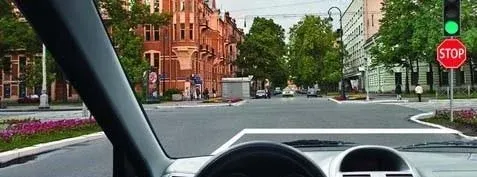
1.12 “Stop line”.
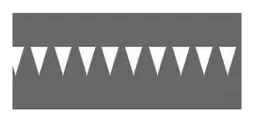
1.13. You stop at the marking: not on it, not 5 m back from it, and not at the sign.
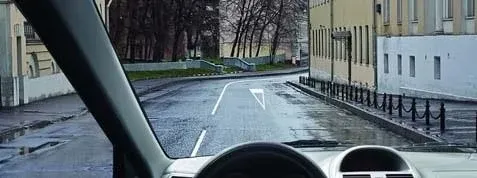
1.20 ahead of a place to give way.
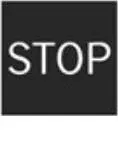
1.21.
What are the squares and grids?
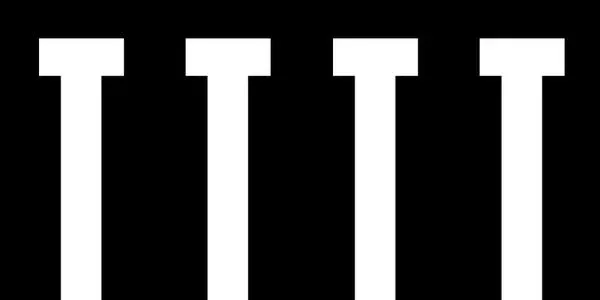
Section titled “What are the squares and grids?”- 1.14.1, broad bars: a pedestrian crossing.
- 1.15, rows of squares: where a cycle path crosses the carriageway.
- 1.25, a chequered band: an artificial bump, used with sign 5.20 “Artificial bump”. It warns you to slow down and prohibits nothing.
- 1.26, a yellow grid: the part of an intersection you must not enter if a jam ahead would force you to stop there. This doesn’t apply if you are turning right or left. It is used alone or with sign 1.35 “Intersection area”.
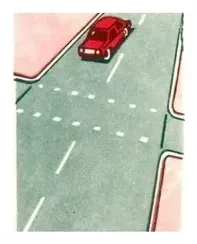
1.15.
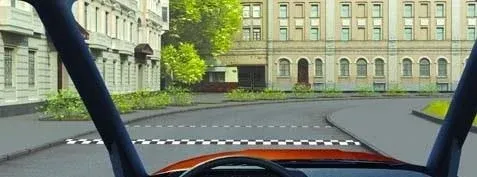
1.25.
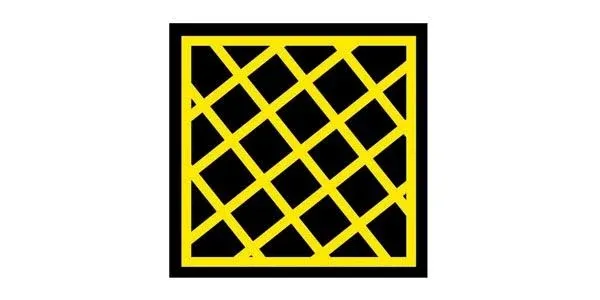
1.26. If you would get stuck on the grid, you would block the traffic crossing your path, so wait before it.
What do arrows, letters and numbers on the road mean?
Section titled “What do arrows, letters and numbers on the road mean?”1.18, lane arrows, show the directions permitted from each lane. A left arrow in the left edge lane also permits a U-turn.
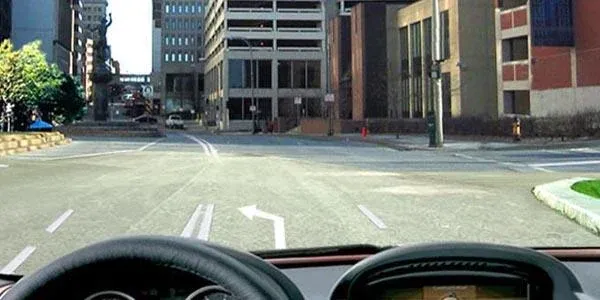
1.18: left and U-turn are permitted, but not straight.
If your arrow doesn’t show your direction, change lanes in good time. Going straight isn’t banned on this road, only from this lane.
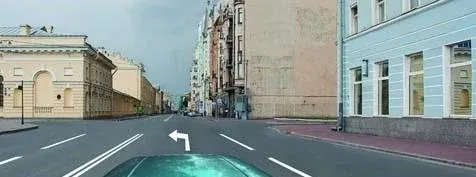
To go straight, first move into the right lane.
1.19, curved arrows, warn that your lane is ending, because the number of lanes in your direction is about to drop. They may be used with signs 1.20.1 to 1.20.3 “Narrowing of the road”. They don’t warn of a bend.
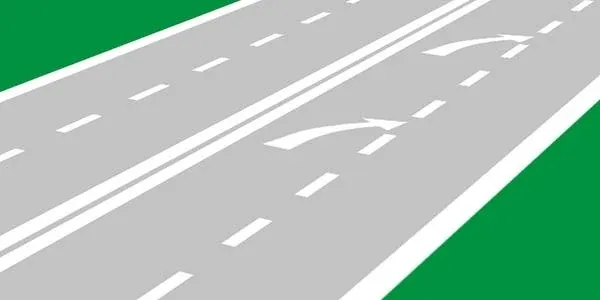
1.19.
1.22 shows the number of the road or route. It shows no distance.
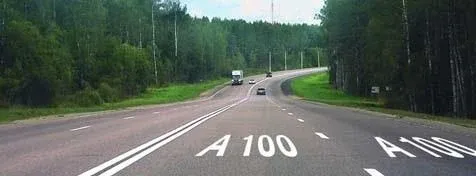
1.22.
1.23, the letter A, marks the special lane for public-use vehicles. It has nothing to do with licence category A, and it isn’t a lane for taxis.
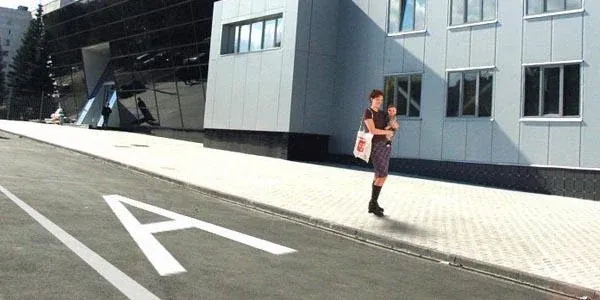
1.23.
1.24.2, a number in a circle, repeats sign 3.24 “Maximum speed limit”. It is a limit, not a recommendation.
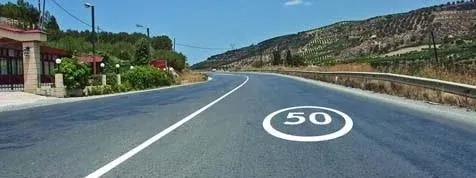
1.24.2.
May I drive over a guide island?
Section titled “May I drive over a guide island?”No. 1.16 is a hatched area bordered by wide white lines. The solid border can’t be crossed, so you may not enter at all, not even to stop or while reversing. Version 1.16.1 is drawn where opposing flows divide, and 1.16.3 where flows merge.
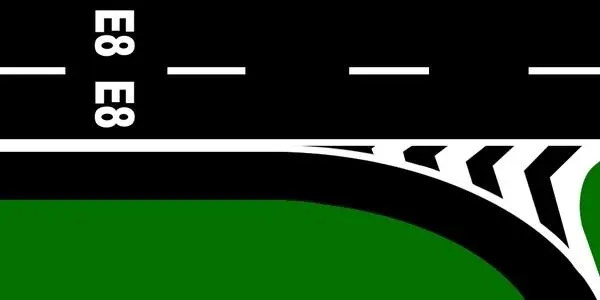
1.16.3.
What are vertical markings for?
Section titled “What are vertical markings for?”- 2.1.1 to 2.1.3, diagonal black and white stripes: on parts of road structures that present a danger to traffic, not on everything beside the road.
- 2.2: the lower edge of a tunnel, bridge or overpass span, the part a high vehicle would hit.
- 2.5, stripes along a barrier: you are driving through a dangerous section, such as a tight curve or a steep descent.
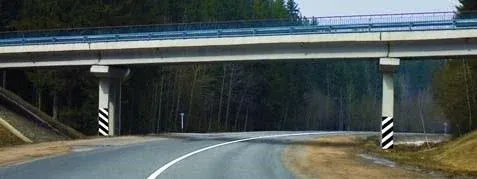
2.1 on the overpass supports.
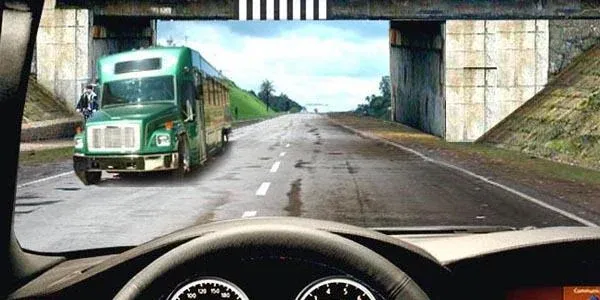
2.2.
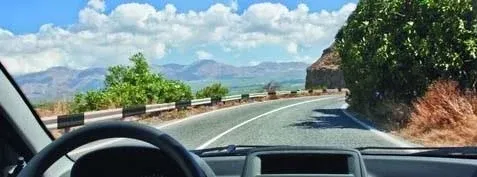
2.5.
Extra: When markings are hard to see
Not from the question bank.
Snow, rain and worn paint can hide markings. When you can’t see them, slow down, look at the signs and watch how the traffic ahead is moving. Don’t assume there is no line just because you can’t see one.
Try it yourself
Section titled “Try it yourself”Which path keeps to the marking? The line is 1.11, with its broken side towards the purple car. Path Ա (A) comes out of a side territory, and path Բ (B) belongs to the purple car.
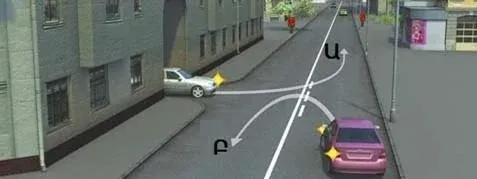
Only Բ (B). It crosses from the broken side. Path Ա (A) crosses from the solid side and isn’t completing an overtaking.
Which driver may cross a solid line to stop? An oncoming car pulls over onto the shoulder, and your path crosses a hatched island on the right.
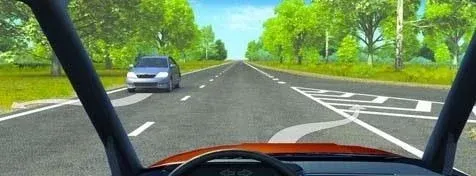
Only the oncoming driver. He crosses edge line 1.2 to stop on the shoulder, which is allowed. You would cross the solid border of island 1.16.2, which isn’t.
Which edge line may you cross to stop? You are outside a built-up area. Path Ա (A) leads left and path Բ (B) leads right.
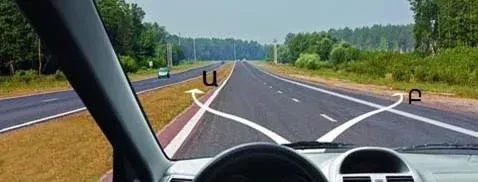
Only Բ (B). Line 1.2 may be crossed only to stop where stopping is permitted, and outside built-up areas that is the right-hand side of the road (points 78 and 79).
Key points
Section titled “Key points”- Solid means don’t cross. The exceptions are 1.1 at a parking place and 1.2 to stop on the shoulder.
- 1.3 belongs to roads with four or more lanes, and 1.5 to roads with two or three.
- Longer dashes (1.6) warn that a solid line is coming.
- 1.11: read the side nearest you.
- Solid yellow 1.4 means no stopping, and broken yellow 1.10 means no parking.
- 1.20 announces 1.13, and 1.21 announces 1.12.
- Orange beats white.
Practice questions
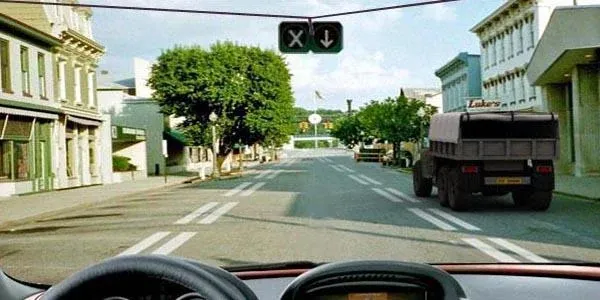
Section titled “Practice questions”Question 77. What does the marking made on the carriageway indicate?
- The boundaries of lanes separated for vehicles travelling in the same direction.
- The boundaries of a reversible traffic lane.
Show answer
Correct: 2. The boundaries of a reversible traffic lane.
The reversible traffic lights above the road - a red X over one lane and a green downward arrow over another - together with the double broken longitudinal line make this marking 1.9. Under the Rules, marking 1.9 shows the boundaries of the lanes on which reversible control is applied, and when the reversible lights are switched off it separates the traffic flows of opposing directions. It therefore indicates the boundaries of a reversible traffic lane. “The boundaries of lanes separated for vehicles travelling in the same direction.” is wrong because ordinary lanes in one direction are divided by a different marking - a single broken line - and not by 1.9, which exists for reversible traffic.
Question 83. What does the following road marking indicate?
- A parking place for vehicles.
- A pedestrian crossing place.
- A safety island.
- A section of the intersection which it is prohibited to enter if congestion (a traffic jam) has formed ahead in the direction of travel that would force the driver to stop.
Show answer
Correct: 4. A section of the intersection which it is prohibited to enter if congestion (a traffic jam) has formed ahead in the direction of travel that would force the driver to stop.
The yellow grid painted on the carriageway is road marking 1.26, which the Rules define as the section of an intersection that may not be entered when congestion has formed ahead in the direction of travel that would force the driver to stop and so obstruct traffic crossing his path - except when he is turning right or left. It is used on its own or together with sign 1.35. The correct answer is therefore the one about not entering the intersection when congestion would force the driver to stop. It is not a parking place, a pedestrian crossing place or a safety island: each of those is an entirely different marking, and none of them is a yellow grid painted across an intersection.
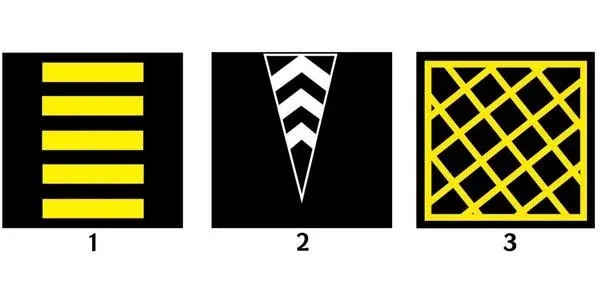
Question 84. Which of the road markings presented below indicates the section of the intersection which it is prohibited to enter if congestion (a traffic jam) has formed ahead in the direction of travel that would force the driver to stop?
- 1
- 2
- 3
Show answer
Correct: 3. 3
The question asks which marking indicates the section of an intersection that may not be entered if congestion ahead would force the driver to stop. That is the yellow grid, option 3 — road marking 1.26, which the Rules define as the section of an intersection that may not be entered when congestion has formed ahead that would force the driver to stop, obstructing crossing traffic, except when turning right or left. Option 1 is the pedestrian crossing marking (parallel bars), option 2 the approach (arrow-shaped) marking; neither designates the section of an intersection, so only option 3 is correct.
Question 295. Driving is permitted
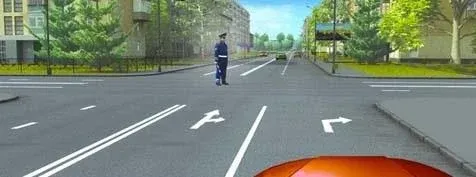
- Straight and right
- Only straight
- Only right
Show answer
Correct: 3. Only right
Marking 1.18 shows the directions permitted from each lane at the intersection: the arrow in the right-hand lane, the one occupied here, permits only a right turn, so going straight from this lane is prohibited. The controller stands side-on with his arms lowered, which under point 16 of the Traffic Rules is equivalent to the position “arms extended sideways”, and from his sides both straight ahead and right are permitted — but straight ahead could be taken only from the left lane, where the marking arrow allows it. Only a right turn is therefore permitted from this position; “Straight and right” and “Only straight” are wrong because of the arrow in this lane.
Question 440. This road marking permits travel:
- Only to the left.
- To the left and in the opposite direction.
- Only in the opposite direction.
- Straight, left and in the opposite direction.
Show answer
Correct: 2. To the left and in the opposite direction.
The road marking is 1.18, which shows the permitted directions of travel at an intersection lane by lane, and a marking that permits a left turn from the LEFT EDGE lane permits a U-turn from it as well. Here the marking shows a left turn from the left edge lane, so travel is permitted to the left and in the opposite direction. “Only to the left.” is wrong because the U-turn comes with it; “Only in the opposite direction.” and “Straight, left and in the opposite direction.” are wrong because there is no straight-ahead arrow, and the left turn and U-turn go together.
Question 442. What does this road marking mean?
- A place for picking up and setting down passengers.
- A stopping point for public transport vehicles.
- A stopping place for public transport vehicles and a parking place for taxis.
Show answer
Correct: 2. A stopping point for public transport vehicles.
The zigzag line drawn beside the bus stop sign is marking 1.17, which under the Rules is yellow and shows the stopping points of public-use transport vehicles - and, where sign 5.18 “Parking place for light passenger taxis” is present, the parking places of taxis as well. Here it is accompanied by a bus stop sign and not by sign 5.18, so it marks a stopping point for public-use transport vehicles. “A place for picking up and setting down passengers.” is wrong because that is what a stopping point IS, and the answer adding taxi parking is wrong because that meaning applies only where sign 5.18 is in place, which it is not.
Question 443. What does the yellow solid line of horizontal marking indicate?

- The place where stopping and parking of vehicles is prohibited.
- The place where it is permitted to stop in order to set down passengers or to unload the vehicle.
- The place where parking of vehicles is prohibited.
Show answer
Correct: 1. The place where stopping and parking of vehicles is prohibited.
The yellow solid line of horizontal marking is marking 1.4, which under the Rules indicates the places where stopping and parking of vehicles are prohibited (used on its own or together with sign 3.27 “Stopping prohibited”). It therefore indicates a place where both stopping and parking are prohibited. “The place where stopping is permitted in order to set down passengers or to unload” is wrong — stopping itself is prohibited. “The place where only parking is prohibited” is wrong, because marking 1.4 prohibits stopping as well.
Question 444. Is the driver permitted to cross the solid line of the marking indicating the boundaries of vehicle parking places?
- It is prohibited.
- It is permitted.
Show answer
Correct: 2. It is permitted.
The markings section of the Rules provides that although the solid lines 1.1, 1.2 and 1.3 may not be crossed, line 1.1 MAY be crossed where it marks the boundaries of vehicle parking places, when manoeuvring to enter or leave a parking place. Since this question is about exactly that line - the solid line marking parking bays - crossing it to park or to drive out is permitted. “It is prohibited.” states only the general rule and overlooks the express exception that applies here; without it a marked bay could never be entered at all.
Question 445. In which directions indicated by the arrows is travel permitted?
- Only straight.
- To the left and in the opposite direction.
- Straight, to the left and in the opposite direction.
Show answer
Correct: 1. Only straight.
To the left of the car is marking 1.3 - a double solid line - which separates the opposing streams of traffic and may not be crossed. Both the left turn and travel in the opposite direction, that is the U-turn, require crossing that line, so both are prohibited and travel is permitted only straight ahead. “To the left and in the opposite direction.” and “Straight, to the left and in the opposite direction.” are wrong for exactly that reason.
Question 446. What does this marking mean?

- A crosswalk where traffic is regulated by a traffic light.
- The place where a bicycle lane crosses a roadway.
- The place where a pedestrian walkway crosses a roadway.
Show answer
Correct: 2. The place where a bicycle lane crosses a roadway.
The marking shown is 1.15 - two rows of squares - which marks the place where a bicycle lane crosses a roadway. A pedestrian crossing is marked quite differently, by the broad bars of marking 1.14.1, so “A crosswalk where traffic is regulated by a traffic light.” and “The place where a pedestrian walkway crosses a roadway.” are wrong: both are about people on foot, whereas a row of squares is for bicycles.
Question 447. How many lanes does a road have where the traffic flows of opposing directions are separated by double solid lines?
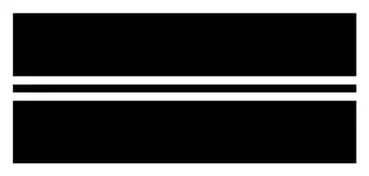
- Two lanes.
- Two or three lanes.
- Three lanes.
- Four and more lanes.
Show answer
Correct: 4. Four and more lanes.
A double solid line separating the flows of opposing directions is marking 1.3, which under the Rules is used on roads having four or more traffic lanes. Such a road therefore has four and more lanes. “Two lanes.”, “Two or three lanes.” and “Three lanes.” are wrong because on roads of two or three lanes the opposing flows are separated by marking 1.5 or 1.1 - a single line - and not by the double solid 1.3.
Question 448. What do the arrows marked on the carriageway warn of?
- They warn the driver of the approach to a dangerous section of the road.
- They warn of the approach to the end of the traffic lane.
- They indicate the direction of a dangerous turn of the road.
Show answer
Correct: 2. They warn of the approach to the end of the traffic lane.
These arrows on the carriageway are marking 1.19, which under the Rules warns of the approach to a narrowing of the carriageway - the section where the number of lanes in that direction is reduced. The arrows therefore warn the driver that the traffic lane he is in is coming to an end and that he must move across in good time. “They warn the driver of the approach to a dangerous section of the road.” and “They indicate the direction of a dangerous turn of the road.” are wrong, because 1.19 is specifically about the number of lanes being reduced.
Question 449. Which of these marking lines is used to mark lanes with reversible traffic?
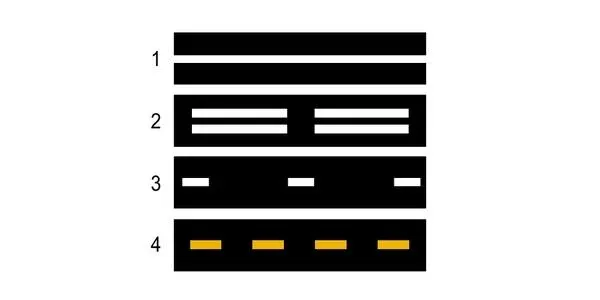
- Line 1.
- Line 2.
- Line 3.
- Lines 2 and 3.
- Lines 3 and 4.
Show answer
Correct: 2. Line 2.
Line 2 is a double BROKEN line - marking 1.9 - which under the Rules shows the boundaries of the lanes where reversible regulation is carried out, and which separates the opposing flows when the reversible traffic lights are switched off. Line 2 is therefore the one used for reversible lanes. Line 1 is the double SOLID 1.3 and line 3 is a single broken line, so neither of them, nor any combination including them, is correct: only the double broken 1.9 marks reversible lanes.
Question 450. Where is the yellow solid line marking the places where stopping and parking are prohibited drawn?
- On the carriageway.
- Near the edge of the carriageway.
- Near the edge of the carriageway or on the top surface of the kerbstone.
- Only on the top surface of the kerbstone.
Show answer
Correct: 3. Near the edge of the carriageway or on the top surface of the kerbstone.
The yellow solid line marking the places where stopping and parking are prohibited is marking 1.4. Under the Rules, marking 1.4 is drawn near the edge of the carriageway or on the top surface of the kerbstone (used on its own or together with sign 3.27 “Stopping prohibited”). It is therefore drawn near the edge of the carriageway or on the top surface of the kerbstone. “On the carriageway”, “near the edge” alone and “only on the top surface of the kerbstone” are wrong, because marking 1.4 is drawn in either of those two places.
Question 451. With which of the road signs may the yellow broken marking be used?
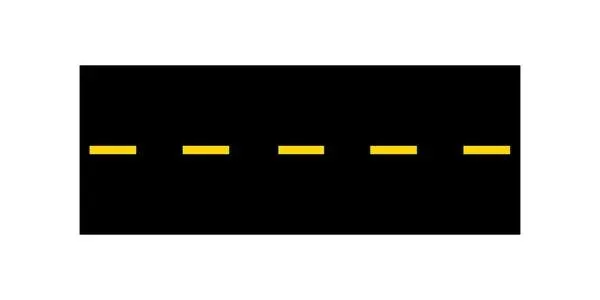
- “Stopping is prohibited”.
- “Parking is prohibited”.
- “Parking is prohibited on odd days of the month”.
Show answer
Correct: 2. “Parking is prohibited”.
The broken yellow line is marking 1.10, which under the Rules indicates the places where parking is prohibited and is used on its own or together with sign 3.28 “No parking”. The yellow broken marking may therefore be used with the sign “Parking is prohibited”. “Stopping is prohibited” is wrong because sign 3.27 is paired with the SOLID yellow line 1.4, and “Parking is prohibited on odd days of the month” is wrong because marking 1.10 goes with 3.28 itself. The rule of thumb is that a broken yellow line means no parking and a solid yellow line means no stopping.
Question 453. This road marking has the following meaning.
- It indicates the parking places alongside the sidewalk, where the ways of positioning mechanical vehicles are shown.
- It indicates the places where stopping of mechanical vehicles is prohibited.
- It indicates the stopping points of public transport vehicles and the parking places of taxis.
Show answer
Correct: 3. It indicates the stopping points of public transport vehicles and the parking places of taxis.
This zigzag line is marking 1.17, which under the Rules is yellow and indicates the stopping points of public-use transport vehicles, and - where sign 5.18 “Parking place for light passenger taxis” is present - the parking places of taxis as well. The correct answer is therefore that it indicates the stopping points of public-use transport vehicles and the parking places of taxis. Marking kerbside parking bays with the manner of standing is a different marking altogether, and places where stopping is prohibited are shown by a solid yellow line, not by a zigzag.
Question 454. This horizontal road marking indicates:
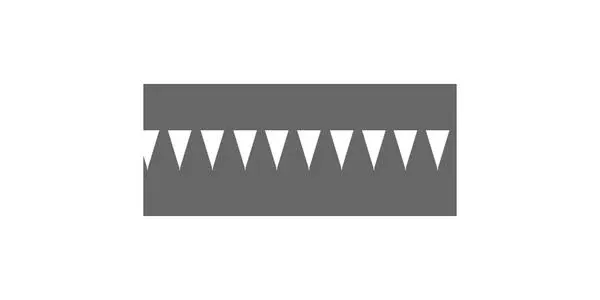
- A narrowing of the carriageway, where the number of traffic lanes in the given direction decreases.
- The place where the driver must, if necessary, stop in order to give way to vehicles travelling on the intersecting road.
- The approach to a place where stopping is prohibited.
Show answer
Correct: 2. The place where the driver must, if necessary, stop in order to give way to vehicles travelling on the intersecting road.
These triangles (“teeth”) are marking 1.13, which under the Rules indicates the place where the driver must, if necessary, stop and give way to vehicles travelling on the intersecting road. It therefore indicates the place where the driver must stop if necessary in order to give way to traffic on the intersecting road. “A narrowing of the carriageway” and “the approach to a place where stopping is prohibited” are wrong, because those are the meanings of markings 1.19 and 1.4/1.10, not of 1.13.
Question 455. Is it permitted to enter a guide island marked with wide white lines?
- It is permitted only in order to stop.
- It is permitted while reversing.
- It is prohibited.
Show answer
Correct: 3. It is prohibited.
The hatched triangular area bounded by wide white lines is a guide island. In the picture it lies where a road running in the same direction merges with the main road - the one carrying the E8 route number on its surface - so it is marking 1.16.3, the island used at merging points; 1.16.1 is the one drawn where the flows of opposing directions divide. The island is bounded by the solid line 1.1, which may not be crossed, so entering a guide island is prohibited. “It is permitted only in order to stop.” and “It is permitted while reversing.” are wrong, because entry is barred in every case.
Question 457. What does this marking indicate?
- A pedestrian crossing.
- The place where a cycle path crosses the carriageway of the road.
- A place intended for driving livestock across.
Show answer
Correct: 2. The place where a cycle path crosses the carriageway of the road.
This marking is marking 1.15, which under the Rules indicates the place where a cycle path crosses the carriageway of the road. It therefore indicates the place where a cycle path crosses the carriageway. “A pedestrian crossing” is wrong — that is marking 1.14. “A place for driving livestock across” is wrong — driving livestock is warning sign 1.26, not a marking. The band of squares crossing the carriageway is marking 1.15 for a cycle crossing.
Question 458. Where must the driver stop the vehicle in the presence of this marking?
- At the marking.
- On the marking.
- Not less than 5 m from the marking.
Show answer
Correct: 1. At the marking.
These triangles are marking 1.13, which under the Rules indicates the place where the driver must, if necessary, stop and give way to vehicles travelling on the intersecting road. The stop is made at that marking. “On the marking” is wrong — a vehicle stops before it, not on it. “Not less than 5 m from the marking” is wrong, because the stopping place set by marking 1.13 is at the marking itself.
Question 459. What does this marking mean?
- A traffic lane intended for public transport vehicles.
- A traffic lane intended for special-purpose vehicles.
- It indicates the boundaries of those traffic lanes where reversible regulation is carried out.
Show answer
Correct: 3. It indicates the boundaries of those traffic lanes where reversible regulation is carried out.
This double broken line is marking 1.9, which under the Rules shows the boundaries of the traffic lanes where reversible regulation is carried out, and which separates the flows of opposing directions when the reversible traffic lights are switched off. “A traffic lane intended for public transport vehicles.” and “A traffic lane intended for special-purpose vehicles.” are wrong because those are different markings - a public-transport lane is marked with the letter A - while the double broken 1.9 marks the boundaries of reversible lanes.
Question 462. What does a marking in the form of a broad broken line indicate?
- The boundary between the carriageway and the shoulder.
- The boundary between the main lane of the carriageway and the acceleration lane.
- The boundary between the main lane of the carriageway and the deceleration lane.
Show answer
Correct: 2. The boundary between the main lane of the carriageway and the acceleration lane.
The broad broken line is marking 1.8, which under the markings section of the Rules shows the boundary between a main lane of the carriageway and an acceleration or deceleration lane. In the picture the marking is drawn where a slip road JOINS the road, so it is the boundary of an acceleration lane - the lane on which a driver builds up speed before merging. “The boundary between the carriageway and the shoulder.” is wrong because the edge of the carriageway is shown by the solid edge line 1.2, and the deceleration answer is wrong because the lane drawn here leads onto the road rather than off it.
Question 479. What does the letter “A” marked in a lane of the carriageway mean?
- The number of the road (route).
- A special lane intended for the movement of public transport vehicles.
- A special lane intended for the movement of category “A” vehicles.
Show answer
Correct: 2. A special lane intended for the movement of public transport vehicles.
The letter A painted in a lane is marking 1.23, which under the Rules indicates the special lane intended for the movement of public-use transport vehicles. “The number of the road (route).” is wrong because route numbers are not painted on the carriageway as a bare letter, and “A special lane intended for the movement of category ‘A’ vehicles.” is wrong because the letter has nothing to do with the driving-licence category - marking 1.23 marks the public-transport lane.
Question 482. Vertical marking of this kind indicates:
- The lower edges of a bridge or tunnel.
- The entrance to unlit tunnels.
- Any element of road structures that creates a danger to traffic.
Show answer
Correct: 1. The lower edges of a bridge or tunnel.
This vertical marking is 2.2, which under the Rules marks the lower edge of the span structures of tunnels, bridges and overpasses - the part a high vehicle would strike. It therefore indicates the lower edges of a bridge or tunnel. “The entrance to unlit tunnels.” and “Any element of road structures that creates a danger to traffic.” are wrong: the second describes vertical marking in general, while 2.2 specifically marks the lower edge of a bridge or tunnel span.
Question 490. In order to continue movement to the left, where must the bus driver stop in order to give way to the passenger car?
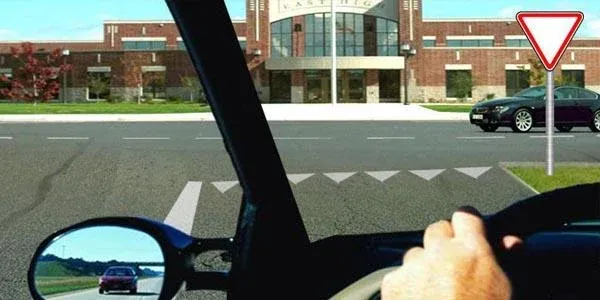
- Before the road sign.
- Near the marking.
- At the driver’s discretion, in a safe place.
Show answer
Correct: 2. Near the marking.
Sign 2.4 “Give way” is in place and marking 1.13 is painted on the road. Under the Rules marking 1.13 shows the place where the driver must, if necessary, stop and give way to the vehicles travelling on the crossing road. The bus driver must therefore stop near that marking in order to give way to the passenger car. “Before the road sign.” is wrong because the stopping place is fixed by the 1.13 marking rather than by the sign, and “At the driver’s discretion, in a safe place.” is wrong because the Rules fix the place and leave nothing to discretion.
Question 494. For which vehicles is the lane marked with the letter “A” separated?
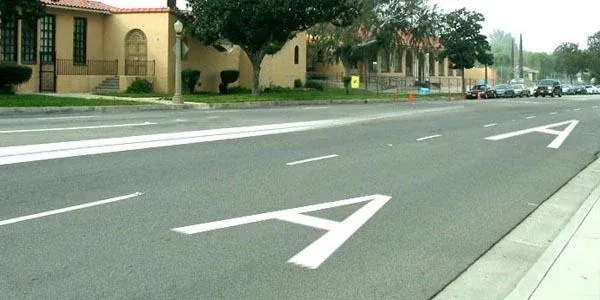
- Only for buses that move along an established route.
- For trolleybuses and taxis.
- For public-use vehicles.
Show answer
Correct: 3. For public-use vehicles.
The lane marked with the letter A is marking 1.23, which under the Rules indicates the special lane intended for public-use transport vehicles. The lane is therefore set aside for public-use vehicles as a class. “Only for buses that move along an established route.” is too narrow, since trolleybuses and other route vehicles use it as well, and “For trolleybuses and taxis.” is wrong because marking 1.23 sets the lane aside for public-use transport and not for taxis.
Question 506. When is it permitted to cross the marking?
- Before the pedestrian crossing
- After the pedestrian crossing
Show answer
Correct: 2. After the pedestrian crossing
Before the pedestrian crossing the centre line separating the opposing flows is solid - marking 1.1 - and after the crossing it is broken. Under the marking rules a solid line 1.1 may not be crossed, while a broken line may be, so the marking may be crossed only after the pedestrian crossing. “Before the pedestrian crossing” is wrong because the line is solid there, and crossing it is prohibited - the solid stretch is placed at the crossing precisely to stop drivers manoeuvring across it where pedestrians are.
Question 526. This marking indicates
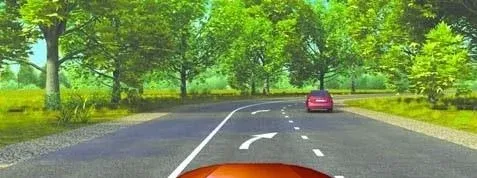
- The priority when changing lanes
- The approach to a curved section of the road
- The approach to the end of the lane
Show answer
Correct: 3. The approach to the end of the lane
The guiding arrows painted on the carriageway are marking 1.19, which under the markings section of the Rules warns of the approach to the end of a traffic lane - the section where the number of lanes in that direction is reduced; it may be used together with the signs 1.20.1 to 1.20.3 “Narrowing of the road”. The marking therefore indicates the approach to the end of the lane. “The priority when changing lanes” is not the meaning of any marking, and “The approach to a curved section of the road” belongs to the dangerous-turn warning sign, not to this marking.
Question 527. What does this marking indicate?
- The approach to the “stop line” at a regulated intersection
- The approach to the “stop line” marking when it is applied together with the “Driving without stopping is prohibited” sign
- The approach to the barrier
Show answer
Correct: 2. The approach to the “stop line” marking when it is applied together with the “Driving without stopping is prohibited” sign
The word STOP painted on the carriageway is marking 1.21. Under the markings section it warns of the approach to marking 1.12 “Stop line” WHERE THAT LINE IS USED together with sign 2.5 “Movement without stopping prohibited”. “The approach to the ‘stop line’ at a regulated intersection” is therefore wrong - the painted STOP is not used at an intersection controlled by traffic lights, where the light itself tells you when to stop - and “The approach to the barrier” does not correspond to the meaning of marking 1.21 at all.
Question 528. The vertical marking of barriers informs about
- The approach to a railway crossing
- The approach to a dangerous intersection
- Driving through a dangerous section of the road
Show answer
Correct: 3. Driving through a dangerous section of the road
The side surfaces of the barriers are painted in alternating black and white stripes - a vertical marking. Under point 171 of the Rules such a combination of stripes on road structures serves as a means of visual orientation, and marking 2.5 in the markings section marks the side surfaces of barriers on curves of small radius, steep descents and other dangerous sections. The vertical marking of barriers therefore informs the driver that he is driving through a dangerous section of road. Approaching a railway crossing or a dangerous intersection is announced by the corresponding warning ROAD SIGNS, not by the marking on a barrier.
Question 529. This triangular marking informs about
- The approach to a dangerous turn
- The approach to the place of giving way
- The approach to the place of stopping the car
Show answer
Correct: 2. The approach to the place of giving way
The large triangle painted on the carriageway is marking 1.20, which under the markings section warns of the approach to marking 1.13 - and marking 1.13 shows the place where the driver must, if necessary, stop and give way to the vehicles travelling on the crossing road. This triangular marking therefore informs the driver of the approach to the place of giving way. “The approach to a dangerous turn” is the meaning of warning sign 1.11 and not of this marking, and “The approach to the place of stopping the car” would refer to the stop line 1.12 rather than to the give-way triangle.
Question 530. These broken markings within the intersection area indicate
- The permitted directions of travel
- The traffic lanes within the boundaries of the intersection
Show answer
Correct: 2. The traffic lanes within the boundaries of the intersection
The broken lines within the intersection - short dashes with equal gaps between them - are marking 1.7. Under the markings section 1.7 is the broken line that shows the traffic lanes WITHIN the boundaries of an intersection, guiding a driver across it so that he leaves in the correct lane. “The permitted directions of travel” is wrong because that is the meaning of marking 1.18, the arrows painted before an intersection; 1.7 tells you where your lane runs, not which way you may go.
Question 532. With this vertical marking
- All vertical elements adjacent to the carriageway are marked
- Only those elements of road structures that present a danger to drivers
Show answer
Correct: 2. Only those elements of road structures that present a danger to drivers
The supports of the overpass adjoining the carriageway are painted with black and white diagonal stripes - the vertical marking 2.1.1 to 2.1.3. Under the markings section that marking is applied to elements of road structures - the supports of bridges and overpasses, the front faces of parapets and the like - WHEN THEY PRESENT A DANGER to the vehicles travelling past. It therefore marks only those elements of road structures that present a danger to drivers. “All vertical elements adjacent to the carriageway are marked” is wrong because the marking is applied selectively, to the dangerous ones alone.
Question 533. What does the broken marking indicate
- The right to stop on the shoulder
- The edges of the carriageway on a two-lane road
- The right to travel along the shoulder
Show answer
Correct: 2. The edges of the carriageway on a two-lane road
The broken line running along the right-hand edge of the road is the edge line, which under the Rules’ list of markings shows the edge of the carriageway. On this two-lane road it therefore marks the edges of the carriageway, separating it from the shoulder. “The right to stop on the shoulder” is wrong: the edge line by itself confers no right to stop, and it may be crossed to stop on the shoulder only where stopping is otherwise permitted. “The right to travel along the shoulder” is wrong because the marking only delimits the edge of the carriageway and gives no permission to drive on the shoulder.
Question 534. Travelling along this trajectory in such a situation
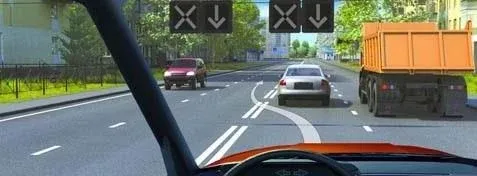
- Is permitted only when overtaking
- Is permitted
- Is prohibited
Show answer
Correct: 3. Is prohibited
Reversible traffic lights hang above the carriageway, but none of their signals is lit - neither the red X nor the green downward arrow, which under point 13 of the Rules is the only signal that permits travel in the lane the light hangs over. The trajectory shown crosses the double broken line of marking 1.9, which lies to the driver’s LEFT, and where the reversible lights are absent or switched off that marking may be crossed only when it is on the driver’s RIGHT. Travelling along this trajectory is therefore prohibited. “Is permitted” and “Is permitted only when overtaking” are wrong: overtaking gives no right to enter a reversible lane whose lights are off.
Question 538. When the orange and white markings contradict each other, drivers
- May follow the requirements of whichever marking suits them
- Must follow the requirements of the white marking
- Must follow the requirements of the orange marking.
Show answer
Correct: 3. Must follow the requirements of the orange marking.
Under point 170 of the Rules, permanent horizontal marking is white and temporary marking is orange. Point 174 states that where the two conflict, drivers follow the temporary marking — the orange one — because that is what reflects the current state of the road, such as repair works or a temporary change of traffic. So “Must follow the requirements of the orange marking.” is correct. “Must follow the requirements of the white marking” is wrong because the permanent marking yields to the temporary one, and “May follow the requirements of whichever marking suits them” is wrong because the Rules leave the driver no choice.
Question 539. Which driver is permitted to cross the solid marking when stopping
- Both drivers
- The driver travelling from the oncoming direction
- It is prohibited for both drivers
Show answer
Correct: 2. The driver travelling from the oncoming direction
The driver coming from the oncoming direction crosses the edge line 1.2 in pulling onto the shoulder, and the marking rules expressly permit line 1.2 to be crossed in order to stop on the shoulder at places where stopping is allowed. Your own trajectory, shown by the arrow, runs across a guide island - marking 1.16.2 - and over the solid line 1.1 that borders it, which may not be crossed. “Both drivers” is therefore wrong, because you cannot cross the island’s solid line, and “It is prohibited for both drivers” is wrong, because the exception for the edge line 1.2 makes the oncoming driver’s stop lawful.
- Indicates the boundaries of a residential zone
- Indicates an artificial bump
- Prohibits further travel
Show answer
Correct: 2. Indicates an artificial bump
The chequered marking of squares drawn across the carriageway is marking 1.25, which under the markings section of the Rules indicates artificial bumps in the carriageway and is used together with sign 5.20 “Artificial bump”. It therefore indicates an artificial bump. “Indicates the boundaries of a residential zone” is wrong because a residential zone is established by signs 5.21 and 5.22, and “Prohibits further travel” is not the meaning of this marking at all - 1.25 warns of a bump so that the driver slows for it, and prohibits nothing.
Question 542. What does this marking prohibit
- Overtaking
- Bypassing
- U-turning
- Travel to the left of it or over it
Show answer
Correct: 4. Travel to the left of it or over it
The broken line separates traffic travelling in opposite directions, and it may be crossed - for overtaking, for bypassing an obstacle and for a U-turn. That is exactly why “Overtaking”, “Bypassing” and “U-turning” are wrong: the marking does not prohibit those manoeuvres. What it does prohibit is the rest of it. On a two-way road a driver may not travel to the left of the line, or along the line itself, as though the opposite side were his own carriageway. The opposite side is used only for the length of one of those manoeuvres, after which the driver must return to his own side. “Travel to the left of it or over it” is therefore the right answer.
Question 543. This marking means
- The number of the route or the road
- The recommended speed
- The maximum permitted speed on the indicated road section
Show answer
Correct: 3. The maximum permitted speed on the indicated road section
The figure 50 enclosed in a circle and painted on the carriageway is marking 1.24.2, which under the horizontal-markings section of the Rules DUPLICATES road sign 3.24 “Maximum speed limit” and is used together with it. It therefore shows the maximum permitted speed on that section of road. “The number of the route or the road” is wrong because a road number is shown by marking 1.22, and “The recommended speed” is wrong because 1.24.2 repeats the prohibitory sign 3.24, which forbids travelling faster than the figure shown - a recommendation would be a blue square, not a circle.
Question 544. The inscription on the carriageway indicates
- The distance to the nearest intersection
- The distance to the nearest populated area
- The number of the road or the route
Show answer
Correct: 3. The number of the road or the route
The inscription A 100 written on the carriageway is marking 1.22, which under the markings section of the Rules shows the number of the road (route). The correct answer is therefore the number of the road or the route. “The distance to the nearest intersection” and “The distance to the nearest populated area” are wrong: marking 1.22 shows no distance at all - it repeats the road’s designation on the carriageway so a driver can confirm which road he is on.
Question 547. The lengthening of the dashes of a broken marking announces
- The approach to the end of the lane
- The approach to a dangerous section
- That this marking will soon become solid
Show answer
Correct: 3. That this marking will soon become solid
The dashes of the broken line on the right are about three times as long as the gaps between them, which makes it marking 1.6, the approach line. Under the horizontal-markings section of the Rules it warns of the approach to marking 1.1 or 1.11, the lines that separate oncoming or same-direction traffic flows. Longer dashes therefore announce that the marking will soon become solid, and that any overtaking must be finished before then. “The approach to the end of the lane” is wrong because that is warned of by marking 1.19, and “The approach to a dangerous section” is wrong because 1.6 warns specifically of the solid line ahead.
Question 548. In the indicated situation, travelling straight
- Is prohibited
- Is permitted
- Is permitted, by changing lanes into the right lane
Show answer
Correct: 3. Is permitted, by changing lanes into the right lane
The arrow marking 1.18 painted in your lane shows the directions permitted from that lane at the intersection, and it shows the left turn only. Travelling straight from this lane is therefore not allowed - but travelling straight is not prohibited as such: you simply have to change lanes into the right lane beforehand, from which straight ahead is permitted. “Is prohibited” is too strong, and “Is permitted” ignores the arrow in the lane.
Question 1092. A driver travelling along which trajectory does not violate the requirements of the marking
- Only Ա (A)
- Only Բ (B)
- Both violate
- Neither violates
Show answer
Correct: 2. Only Բ (B)
The longitudinal marking on the road is 1.11 - a solid line paired with a broken one - and here the broken line is drawn on the right-hand side, the side the magenta car is on. Under the marking section of the road-signs appendix, line 1.11 may be crossed from the side of the BROKEN line, and also from the side of the solid line when completing an overtaking or a bypass. Trajectory Բ (B) crosses the marking from the broken side, so it is permitted. Trajectory Ա (A) comes out of an adjacent territory and crosses from the SOLID side, and it is not completing an overtaking, so it breaches the requirements of the marking. “Only Ա (A)”, “Both violate” and “Neither violates” are therefore wrong.
Question 1093. In which case is it permitted to cross the solid marking
- Only Բ (B), when stopping
- In no case
- When stopping, in both cases
Show answer
Correct: 1. Only Բ (B), when stopping
Both solid lines bounding the carriageway are edge lines 1.2, and under the marking section of the road-signs appendix line 1.2 may be crossed in order to stop on the shoulder at places where stopping is permitted. The road in the picture is outside a built-up area, and under point 78 of the Rules stopping and parking are permitted on the right-hand side of the road, on the shoulder, while point 79 allows the left-hand side only in built-up areas. Trajectory Բ (B), crossing the right-hand line to stop on the right shoulder, is therefore permitted, while trajectory Ա (A) leads to the left, where stopping is not permitted. “In no case” and “When stopping, in both cases” are wrong for that reason.